Building an SEO Foundation for Long-Term Success
Most teams spend months chasing trending keywords and algorithm updates, only to see their traffic plateau or decline when the next update rolls out. Here's the reality: 95% of pages have zero backlinks, and the average business invests $497 monthly in SEO services with inconsistent results (AIOSEO, 2026). The issue isn't a lack of effort—it's the lack of a systematic foundation. Long-term SEO success requires building a resilient framework that compounds over time rather than relying on quick wins or tactical tricks.
Key Takeaways
- Technical SEO, quality content, and backlinks form the enduring trinity of search success (AIOSEO, 2026)
- Long-form content receives 77.2% more backlinks than short-form alternatives, making comprehensive articles the foundation of authority
- 58.5% of Google searches now result in zero clicks—requiring optimization for featured snippets and position zero visibility
- Technical Foundation: Ensures crawlability, speed, and mobile optimization so search engines can properly index and rank your site.
- Content Authority: Building topical expertise through comprehensive, interconnected content clusters that demonstrate mastery to both users and algorithms.
- Backlink Strategy: Earning links through high-quality content creation rather than outreach alone—97% more backlinks come from sites that publish blogs regularly.
- Zero-Click Optimization: Capturing visibility through featured snippets and AI Overviews even when direct clicks decline.
- Systematic Processes: Implementing repeatable quarterly reviews and content workflows that scale with your team.
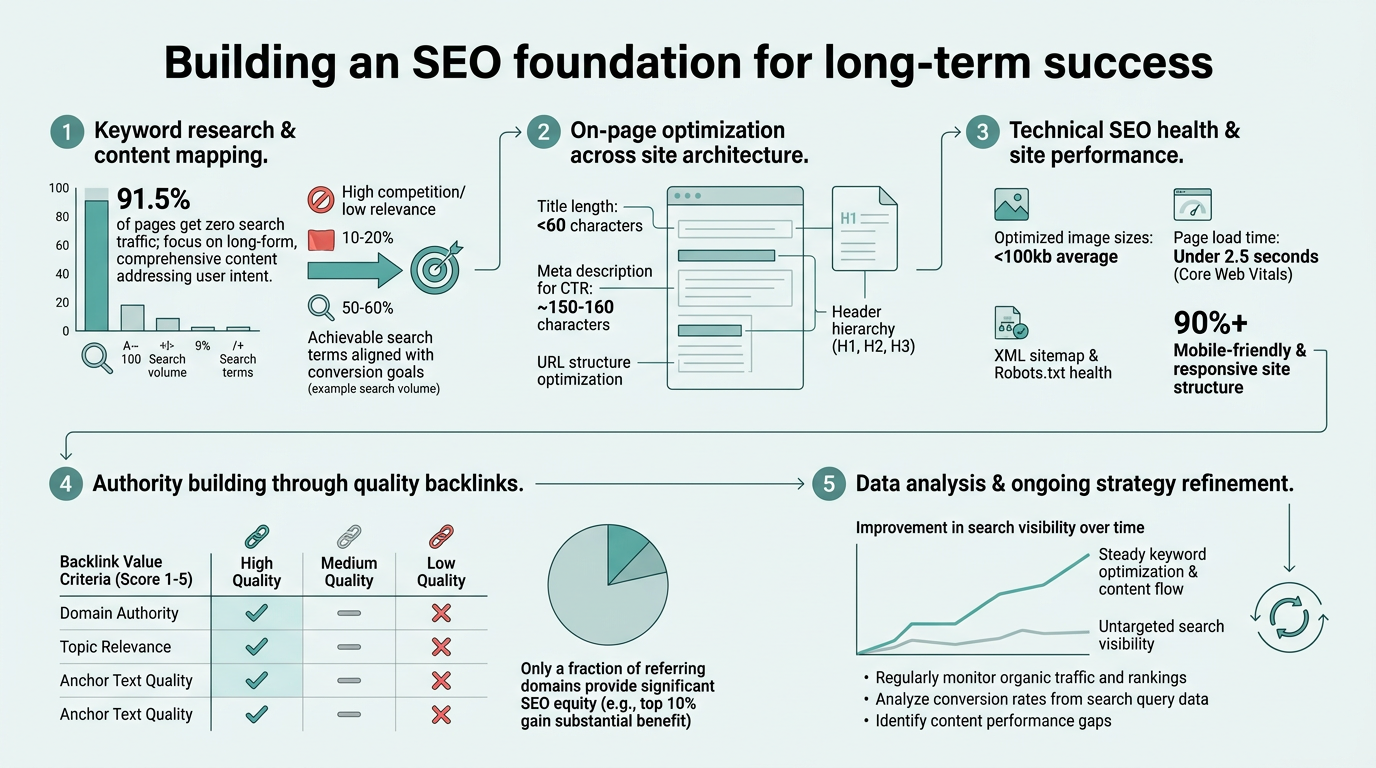
What Does an SEO Foundation Actually Mean?
An SEO foundation is the collection of structural, technical, and strategic elements that allow your site to rank consistently and survive algorithm changes. It's not about gaming a single ranking factor—it's about building an ecosystem where technical excellence, authentic authority, and user-focused content work together. 75.7% of marketers now use AI tools regularly, but most lack the foundational structures needed to leverage those tools effectively (Search Logistics, 2026).
Think of it like building a house. You can't paint the walls and move in furniture without a solid foundation, proper framing, and electrical systems. Similarly, SEO requires technical infrastructure before content marketing becomes effective. According to recent data-driven research on 2026 SEO strategies, this foundational thinking has become the dominant successful approach across high-growth companies.
The Three Pillars of Lasting SEO Success
Every successful long-term SEO strategy rests on three interconnected pillars:
- Technical Excellence: Your site must be crawlable, fast, and mobile-friendly—non-negotiable starting points.
- Content Authority: You need to demonstrate genuine expertise through comprehensive, well-researched content that answers user questions completely.
- Earned Links: Backlinks remain a critical ranking signal, and the #1 result has 3.8x more backlinks than results ranked 2-10 (AIOSEO, 2026).
These three work together. Strong technical foundations allow your content to rank. Great content earns links. Links amplify your ranking power. Remove any one, and the whole system weakens.
Why Foundation-Building Beats Quick Wins
Tactical SEO tricks—keyword stuffing, link schemes, content farms—provide short-term gains followed by penalties. Algorithmic updates target these shortcuts constantly.
"Google's December 2025 Core Update prioritized E-E-A-T more aggressively than previous updates, penalizing faceless corporate blogs and low-effort AI content. Sites that had built genuine authority around quality content survived or improved, while sites relying on volume tactics saw dramatic ranking drops." — ALM Corp, 2026
Foundation-building is the opposite. It compounds over time. Each technically optimized page makes your next page rank faster. Each piece of authority-building content makes your brand signal stronger. Each link earned through great content reinforces your topical expertise. This compounding effect is why some sites grow consistently while others struggle despite similar budgets.
How to Audit and Strengthen Your Technical Foundation
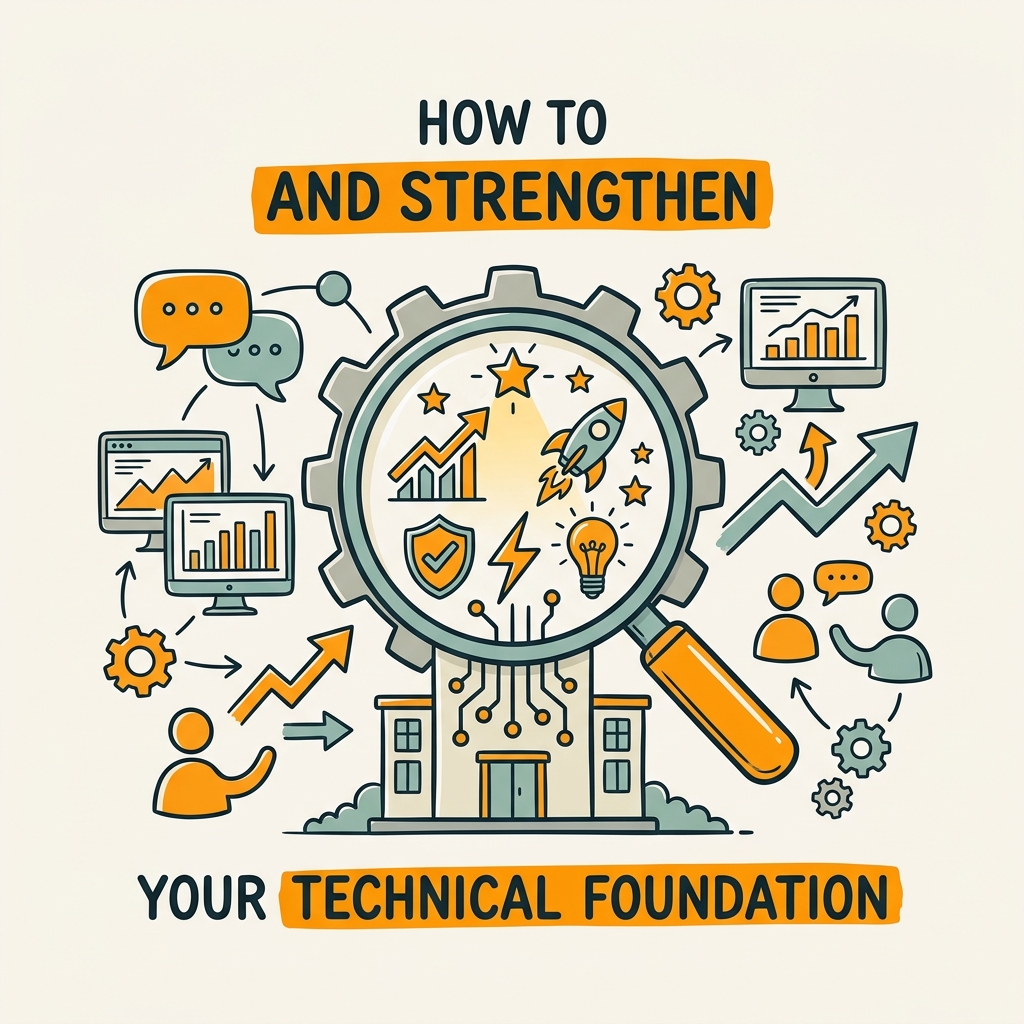
Technical SEO is the invisible infrastructure that determines whether search engines can properly crawl, index, and evaluate your site. Core Web Vitals now directly impact rankings, with targets set at Largest Contentful Paint under 2.5 seconds and Cumulative Layout Shift under 0.1 (ALM Corp, 2026). Most teams skip this step or get it partially right, which means you have an immediate competitive advantage by doing it thoroughly.
Crawlability and Indexation Essentials
The first technical step is ensuring search engines can actually access and index your content. A crawl analysis reveals which pages are blocked, how efficiently bots navigate your site, and whether your internal linking structure makes sense to algorithms. Many sites accidentally block critical pages with robots.txt rules or canonical directives, or they create navigation structures that bury important content three clicks deep.
Use a tool like Screaming Frog or Google Search Console to identify crawl errors. Fix blocked resources, ensure your sitemap is accurate, and remove any unintentional no-index tags. Schema markup becomes increasingly important as AI agents browse websites, helping search systems understand the precise meaning and context of your content.
Core Web Vitals and Page Experience
Users won't stay on a slow site, and neither will search engines. The technical ranking factors that matter most in 2026 are:
- Largest Contentful Paint (LCP): Image and text loading speed—target under 2.5 seconds.
- First Input Delay (FID): Responsiveness to user interaction—target under 100 milliseconds.
- Cumulative Layout Shift (CLS): Visual stability as elements load—target under 0.1.
Mobile optimization is non-negotiable. Mobile experience must match or exceed desktop experience. Audit your site using Google PageSpeed Insights and focus on the largest performance improvements first. Lazy-load images, minimize unused CSS, and optimize server response times. Many teams obsess over content strategy while losing ranking signals due to poor page speed.
Mobile-First Indexing Reality
Google indexes the mobile version of your site first and uses it as the primary ranking version. This means your mobile experience is your SEO experience. If your mobile site is slow, has different content than desktop, or lacks functionality, you're essentially competing with one hand tied behind your back.
Test your mobile experience like an average user would—on a slower connection, using Chrome's device throttling. Identify friction points. Does navigation work smoothly? Can users easily find what they're looking for? Are forms simple and fast? These technical and UX factors combine to create stronger ranking signals.
Building Content Authority Through Strategic Topic Clusters
Content authority isn't earned through volume alone—it's earned through strategic depth and interconnection. Long-form content (3,000+ words) receives 77.2% more backlinks than short-form content, and it generates 3x more traffic and 4x more shares (AIOSEO, 2026). The reason is simple: comprehensive content demonstrates expertise, answers more user questions, and provides more value to earn links.
"Topic clusters are the foundation of modern topical authority. Rather than isolated blog posts competing individually for rankings, clusters create an interconnected ecosystem where pillar content and supporting articles reinforce each other's rankings and authority signals." — Content Authority Research, 2026
Topic Clusters vs. Isolated Blog Posts
Traditional SEO treated each blog post as an isolated ranking opportunity. You'd research a keyword, write an article, publish it, and hope it ranked. This approach has become increasingly ineffective because search engines now evaluate your expertise across your entire domain, not just individual pages.
Topic clusters flip this approach. Instead of isolated posts, you create a cornerstone article (a comprehensive, 3,000+ word guide covering a broad topic) supported by 5-15 cluster articles (focused pieces covering specific subtopics), all interconnected through strategic internal linking. This structure signals to search engines that you've covered a topic comprehensively, which improves rankings for both the pillar content and the cluster pieces.
Example structure for a business technology topic:
- Cornerstone: "The Complete Guide to Business Process Automation" (3,500 words)
- Cluster 1: "Workflow Automation Tools for Marketing Teams" (2,000 words)
- Cluster 2: "How to Measure Automation ROI" (2,000 words)
- Cluster 3: "Common Business Automation Mistakes" (1,500 words)
Each cluster article links back to the cornerstone, and the cornerstone links to each cluster. Search engines see this structure and recognize your authority on the topic. Building these interconnected topical clusters is foundational to long-term success and is part of what SEO automation platforms streamline for growing teams.
E-E-A-T and Demonstrating Expertise
Google's E-E-A-T framework (Experience, Expertise, Authoritativeness, Trustworthiness) has become the dominant ranking factor. 63% of marketers report that Google AI Overviews have positively impacted their rankings since launch, and the businesses winning are those with clear expertise signals (AIOSEO, 2026).
Demonstrate expertise through:
- Author credibility: Clear author bios showing relevant experience and credentials.
- Content depth: Comprehensive coverage of topics, not surface-level summaries.
- Third-party validation: Case studies, client testimonials, and citations from authoritative sources.
- Updated expertise: Regular content updates showing current knowledge rather than outdated information.
However, many teams struggle to maintain consistent, high-quality content production while running their business. SEO automation tools like Jottler handle the research, writing, and fact-checking of comprehensive content pieces, allowing you to publish the volume and depth needed to build authority without constant manual effort.
Internal Linking That Amplifies Authority
Internal links serve two critical functions: they guide users through your content, and they distribute ranking power across your site. Most teams either over-link (creating keyword-dense anchor text that looks spammy) or under-link (missing opportunities to connect relevant content).
Strategic internal linking means:
- Linking from high-authority pages to pages you want to boost
- Using descriptive anchor text that gives context about the linked page
- Creating topical relevance clusters where related content links together
- Avoiding excessive linking that dilutes link juice or looks manipulative
Teams that manually manage hundreds or thousands of articles struggle to maintain consistent, strategic internal linking. Automation handles this at scale, ensuring every new piece of content is properly connected to your existing topical clusters and authority pages.
Earning Backlinks Through Quality Content, Not Outreach Tricks
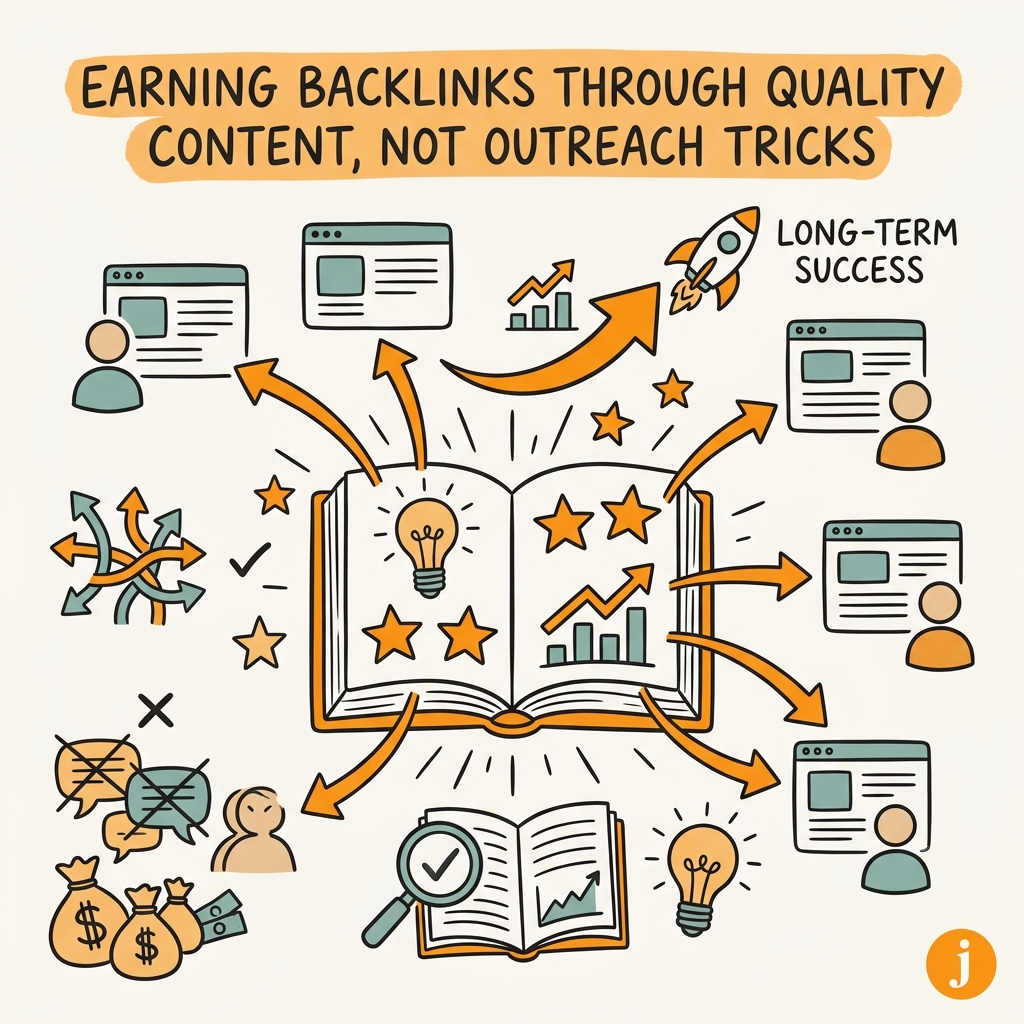
Backlinks remain a critical ranking signal, but the path to earning them has fundamentally changed. The #1 organic result receives 39.8% of all clicks to organic results, meaning top positions are worth competing for (AIOSEO, 2026). And businesses with blogs get 97% more backlinks than those without, because comprehensive content naturally attracts links. For more details on proven link-building frameworks, see current research on what's working in 2026 SEO.
Why Content Remains the #1 Link-Building Strategy
Research shows that high-quality content is the #1 strategy for winning backlinks. This is straightforward: if you create content that's more thorough, more useful, and more authoritative than existing resources, people naturally want to link to it. They share it, cite it, and recommend it to others.
"The shift from outreach-first to content-first link building represents a fundamental change in how authority is earned. Instead of reaching out to 100 people hoping some link to mediocre content, create content so valuable that people come to you with link opportunities." — Link Building Authority Report, 2026
This is why the content-first approach works better than outreach-first approaches. Rather than reaching out to 100 people hoping some link to mediocre content, create content so valuable that people come to you with link opportunities. This shifts the relationship from "please link to me" to "we want to cite your research" or "your framework is industry-standard."
The Challenge of Link Building at Scale
41% of SEOs identify link building as the most difficult aspect of their job, and for good reason (AIOSEO, 2026). Creating link-worthy content consistently, tracking which content attracts links, and identifying outreach opportunities requires constant effort and expertise. Additionally, 95% of pages have zero backlinks, which means most content never achieves meaningful link velocity.
The teams winning at link building treat it as a systematic process:
- Publish content regularly enough that you always have fresh, link-worthy pieces
- Track which content types and topics attract links naturally
- Develop outreach lists based on citations, mentions, and competitive analysis
- Build relationships with journalists, researchers, and influencers in your space
For busy founders and lean marketing teams, publishing the consistent volume of high-quality content needed for natural link attraction becomes impractical without automation. Autonomous SEO systems publish 3,000+ word articles daily, ensuring you have enough link-worthy content to build natural backlink velocity.
Adapting to Zero-Click Search Reality
58.5% of Google searches resulted in zero clicks to any website in 2025, and when AI Overviews appear, that number jumps to 74% (ALM Corp, 2026). This represents a seismic shift in how SEO value is measured. You can rank #1 and see no traffic because users got their answer directly in the search results.
Understanding Position Zero and Featured Snippets
Position zero—the featured snippet shown above organic results—has become critical real estate. Even with zero clicks to your website, featuring your brand answer prominently in search results maintains visibility, builds credibility, and provides a click pathway for users wanting deeper information.
Optimize for featured snippets by:
- Answering the question directly in 40-60 words at the beginning of your content
- Using proper formatting (lists, tables, definitions) that snippets can easily extract
- Targeting question-based keywords like "What is...", "How to...", "Why..."
- Structuring your content to match the intent of the search query
The teams winning in zero-click search aren't just optimizing for clicks—they're optimizing for visibility, authority, and brand presence in AI Overviews and featured snippets.
New Metrics for Success Beyond Click-Through Rate
Traditional SEO metrics—click-through rate, session duration, bounce rate—become less meaningful when 74% of searches result in zero clicks. New success metrics include:
- Impression share in AI Overviews: How often your content is cited in Google's AI Overviews
- Branded search volume: Increasing direct searches for your brand
- Brand mentions: How often your brand or content is mentioned across the web
- Position zero rankings: Featured snippet placements and their visibility
This shift requires a mindset change. You're no longer just competing for clicks—you're competing for authority and brand visibility even when users never visit your site.
Implementing Systematic, Repeatable SEO Processes
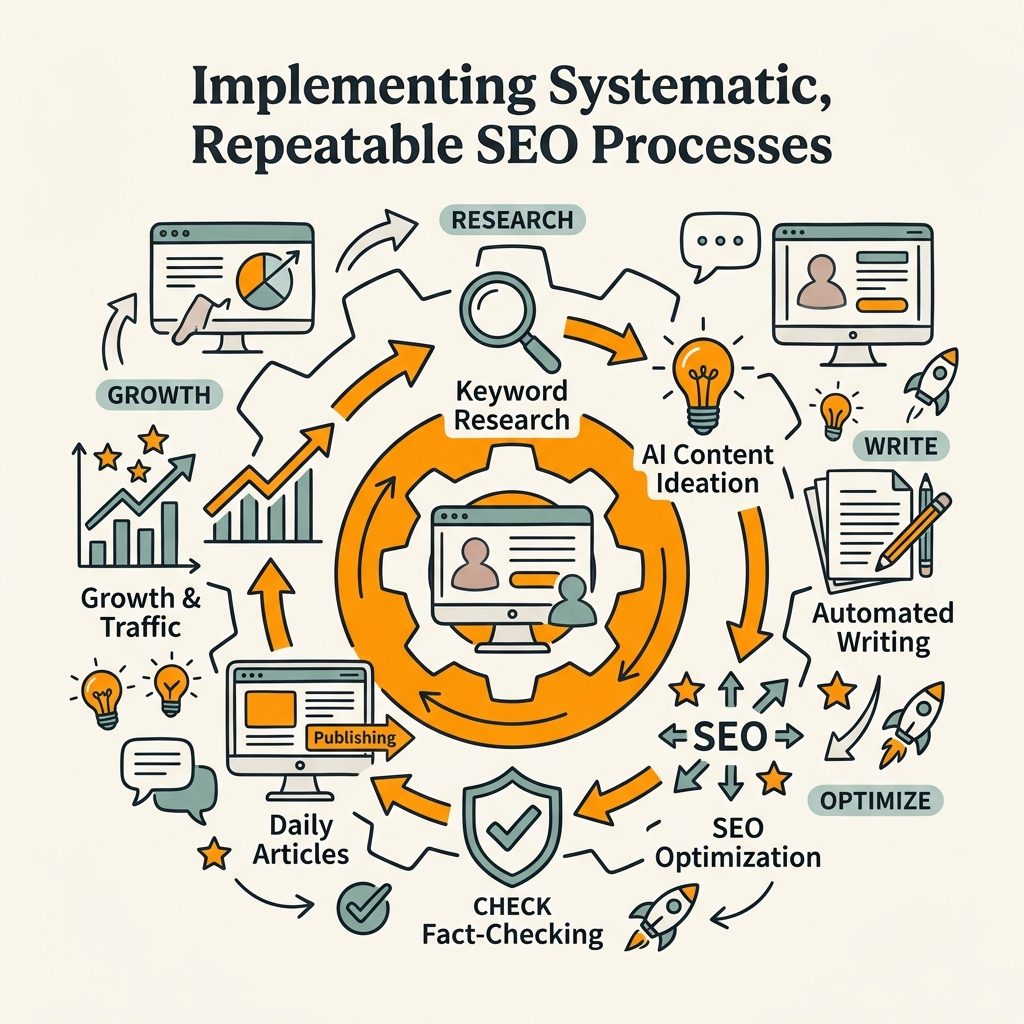
The difference between teams that build lasting SEO success and those that plateau is process maturity. Successful teams treat SEO as a systematic operating system with regular reviews, content templates, performance tracking, and quality assurance procedures. Ad-hoc approaches generate short-term results but fail to scale.
The Quarterly SEO Operating System
Implement a quarterly review cycle that covers:
- Content audit and optimization: Review top-performing content, identify content gaps, optimize underperforming pieces.
- Technical performance review: Audit Core Web Vitals, crawl errors, indexation issues, and security updates.
- Competitive analysis: Monitor competitor rankings, new content, and backlink growth to stay ahead.
- Strategic planning: Set content targets for the next quarter, identify high-value keyword clusters, allocate resources.
This quarterly rhythm ensures consistent progress while allowing flexibility to adapt to algorithm changes and market shifts. Teams without this discipline either work reactively (responding to traffic drops after they happen) or inconsistently (publishing content sporadically when time permits).
Scaling Content Without Sacrificing Quality
Publishing sufficient content for backlink velocity and topic coverage—while maintaining the quality needed for E-E-A-T signals—requires either a large team or smart automation. Most growing companies don't have the budget for a five-person content team, but they need the output of one.
Tools that automate SEO research, writing, and fact-checking allow small teams to achieve publication velocity previously possible only for large organizations. The automation handles the repetitive research and drafting work, allowing your team to focus on strategic decisions, optimization, and relationship-building.
Quality Assurance and Fact-Checking in Automated Workflows
Automation at scale introduces a quality risk: publishing inaccurate or low-quality content damages authority and wastes resources. The best automated systems include built-in fact-checking, multiple rounds of verification, and human review points before publication.
Your process should ensure:
- All statistics and claims are verified against original sources
- Content aligns with your brand voice and standards
- Internal linking follows your topical cluster strategy
- Technical SEO elements (meta tags, headers, schema) are correctly implemented
This is where the difference between a tool that "writes content" and an autonomous SEO engine becomes clear. One generates text; the other generates publication-ready, fact-checked, strategically linked content that compounds your authority over time.
Table: SEO Foundation Components and Their Impact
| Foundation Component | Key Metrics | Impact on Long-Term Success | Time to Implement |
|---|---|---|---|
| Technical SEO | Core Web Vitals, Crawlability, Mobile Score | Non-negotiable for ranking; affects all content performance | 2-4 weeks |
| Content Authority (Pillar + Clusters) | Rankings, Backlink Growth, Topic Coverage | Compounds over time; attracts natural links and citations | Ongoing (1-3 articles/month minimum) |
| Backlink Strategy | Referring Domains, Link Velocity, DR Growth | Amplifies all ranking factors; creates competitive moat | Ongoing (requires 6+ months to see results) |
| Jottler Automation | Articles Published, Links Generated, Organic Traffic Growth | Enables content velocity needed for topical authority; handles research, writing, and fact-checking at scale | Days to weeks |
| Zero-Click Optimization | Featured Snippet Position, AI Overview Appearance, Brand Mentions | Maintains visibility despite zero-click trends; builds authority signals | Ongoing (integrated with content strategy) |
Common Foundation Mistakes That Derail Long-Term Growth
Even teams with good intentions often make foundation-level mistakes that create future problems:
Publishing Shallow Content to Rank Quickly
Short-form content (under 1,000 words) ranks faster initially but faces two critical limitations: it attracts 77.2% fewer backlinks than comprehensive content, and it fails to demonstrate the depth of expertise that modern algorithms reward. Teams chase quick wins with thin content, then wonder why their traffic plateaus after 3-6 months.
The fix is counterintuitive: spend more time on fewer pieces. Create 2-3 outstanding 3,500-word pieces monthly rather than 10 thin 800-word posts. The comprehensive pieces will rank longer, attract more links, and build more authority.
Ignoring Technical Debt
Technical issues accumulate quietly. A site that works fine when launched becomes bloated and slow after five years of updates. Pages duplicate. Redirects break. Mobile experience drifts from standards. None of these are catastrophic individually, but collectively they drag down all your content performance.
The fix is quarterly technical audits and a formal process for addressing debt. A weekly technical debt cleanup schedule prevents small issues from becoming large problems.
Treating Content as a Publishing Exercise Instead of an Authority System
Many teams publish frequently without a strategic framework. They write about whatever seems interesting or topical. This creates a blog that's hard to navigate, lacks authority clustering, and wastes content resources on topics that don't support business goals.
The fix is mapping your content to a strategic keyword framework. Before writing anything, ask: Does this support topical authority in a high-value cluster? Does it connect to my pillar content? Does it align with what my target customers actually search for? Publish less frequently but with strategic purpose.
Conclusion
Building an SEO foundation isn't glamorous or quick, but it's the only path to sustainable, compounding organic growth. Teams that invest in technical excellence, strategic content authority, and systematic processes establish competitive moats that become harder for competitors to challenge over time.
The data supports this approach: businesses with blogs earn 97% more backlinks, long-form content receives 77.2% more links than short-form alternatives, and the #1 organic result receives 39.8% of all clicks (AIOSEO, 2026). These metrics reward patience, depth, and systematic growth.
Your foundation starts with a technical audit this month, strategic content planning next month, and consistent execution over the next 6-12 months. Within 12 months of consistent foundation-building, you'll see organic traffic growth that your competitors can't replicate because they're still chasing short-term tactics.
Start your SEO agent and build the foundation that will compound your organic growth for years to come.
FAQs
How long does it take to see results from building an SEO foundation?
Most teams see initial ranking improvements within 3-6 months of consistent foundation-building, but the real compounding returns appear after 12-18 months. Technical improvements like site speed and mobile optimization can show traffic gains within weeks. Content authority and backlinks take longer because search engines need time to crawl, evaluate, and rank new content, and because natural link attraction accelerates over time as you build a reputation for quality. The key is consistency—teams that publish comprehensive content weekly and maintain quarterly technical reviews see predictable, accelerating growth, while those that work sporadically struggle to reach critical mass.
What's the difference between SEO foundation work and ongoing SEO strategy?
Foundation work is the one-time setup that enables all future SEO to be more effective. It includes technical audits and fixes, strategic keyword framework development, content cluster architecture, and internal linking structure. Ongoing strategy is the continuous execution—publishing content, earning links, optimizing for new user behaviors, and adapting to algorithm changes. Foundation work typically takes 4-12 weeks depending on site size and technical debt; ongoing strategy is perpetual. Most teams confuse these and try to do ongoing work without building a foundation first, which is like trying to build a skyscraper on unprepared land.
Can I build SEO foundation myself or do I need to hire an agency?
You can build SEO foundation yourself if you have 10-15 hours weekly over 3-4 months, or you can accelerate it with automation tools that handle research and writing at scale. The technical audit (crawling your site, identifying Core Web Vitals issues, fixing indexation problems) is a one-time effort that takes 40-80 hours depending on site size. Strategic planning and content creation are the bigger time commitment—writing comprehensive 3,000+ word articles while maintaining quality and strategic intent requires domain expertise and time. Many founders find that automating the content creation and research portions allows them to handle the strategic planning and oversight themselves, avoiding the $5,000-15,000 monthly cost of a dedicated agency.