Building Effective SEO Workflow Automation
Most marketing teams are still doing SEO work the slow way: manually researching keywords, drafting content without strategy, publishing without optimization, and tracking results in scattered spreadsheets. 86% of SEO professionals have integrated AI into their workflows, yet many teams still haven't built the systems to scale that automation effectively. The cost of staying manual is real. Teams waste hours on repetitive tasks that could be automated, miss keyword opportunities, publish inconsistently, and struggle to compound their organic growth. This article breaks down how to build a workflow automation system that actually worksone that removes bottlenecks, maintains quality, and delivers compound results.
Key Takeaways
- 86% of SEO professionals now use AI automation, yet most workflows remain fragmented without proper integration (2025-2026 industry data)
- Effective SEO workflow automation delivers 30-50% efficiency gains and enables teams to compound organic traffic growth consistently
- Focus automation on keyword research, content generation, internal linking, and publishingnot on strategy or quality control decisions
- Define Your Automation Scope: Identify which SEO tasks are repetitive, data-driven, and safe to automate without losing quality.
- Build Multi-Agent Keyword Research Pipelines: Use AI agents to discover long-tail keywords, analyze search intent, and prioritize opportunities at scale.
- Automate Content Generation with Quality Gates: Generate SEO-optimized articles daily while maintaining fact-checking and editorial oversight.
- Implement Smart Internal Linking Workflows: Automatically identify linking opportunities and build topical clusters without manual crawling.
- Establish Publishing Cadence and CMS Integration: Publish consistently to your CMS while tracking performance and compounding content authority.
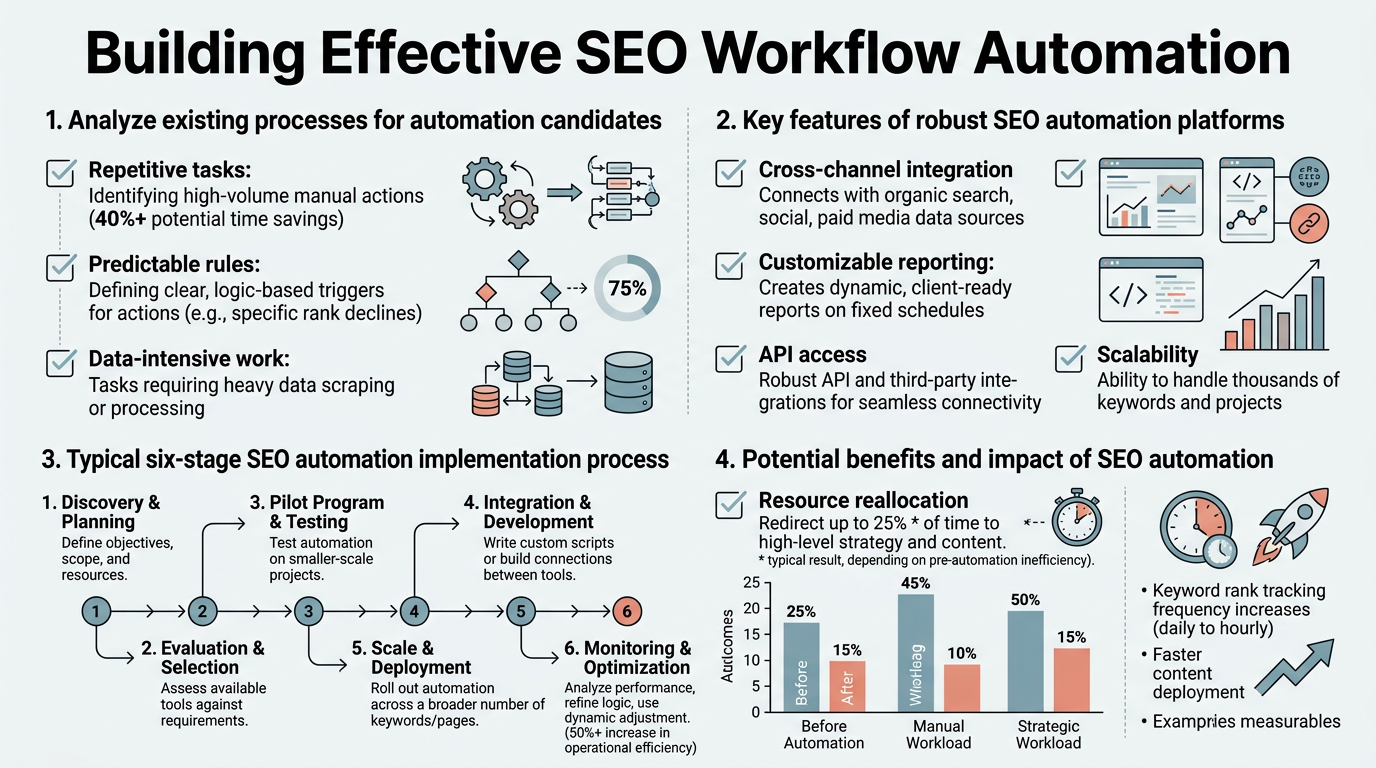
What Tasks Should You Actually Automate?
Most teams automate the wrong things. Automation isn't a silver bulletit's a force multiplier for specific types of work. The key is understanding which SEO processes are safe to automate and which still need human judgment. 65% of companies report better SEO outcomes when they automate the right tasks, but that number drops dramatically when teams try to automate strategy or creative decisions. Here's what separates winners from burnout.
Repetitive, Data-Driven Tasks Worth Automating
SEO has a lot of grunt work. Keyword research used to require hours of manual analysisnow it's a 10-minute AI job. Internal linking audits used to mean crawling thousands of pagesnow algorithms can score linking opportunities in seconds. The tasks worth automating are those that are:
- Repetitive: Done the same way each time with consistent inputs and outputs.
- Data-driven: Based on metrics and patterns, not subjective judgment.
- Low-risk: Easy to verify, review, and correct before publishing.
- Time-intensive: Taking hours or days of manual work from your team.
Keyword research, competitor analysis, metadata generation, internal link recommendations, content formatting, and basic on-page optimization all fit this profile. 75% of businesses already use automation for these exact tasks, according to recent industry analysis. The difference between teams that see real ROI and those that don't is whether they're using automation as a starting point (with human review) or as an end-to-end system.
Strategic Work That Humans Must Keep
Don't automate strategy. Topic selection, content angles, competitive positioning, and editorial decisions need human insight. This is where your expertise lives. What automation does is free you from the repetitive work so you can spend more time on the thinking. According to Search Engine Land, the biggest gains come from "small, practical workflows rather than sweeping transformations"and all of them maintain human oversight at critical gates. When you pair automation with strategy, teams can focus on building an SEO content plan that actually ships.
Building Your Keyword Research Automation Pipeline
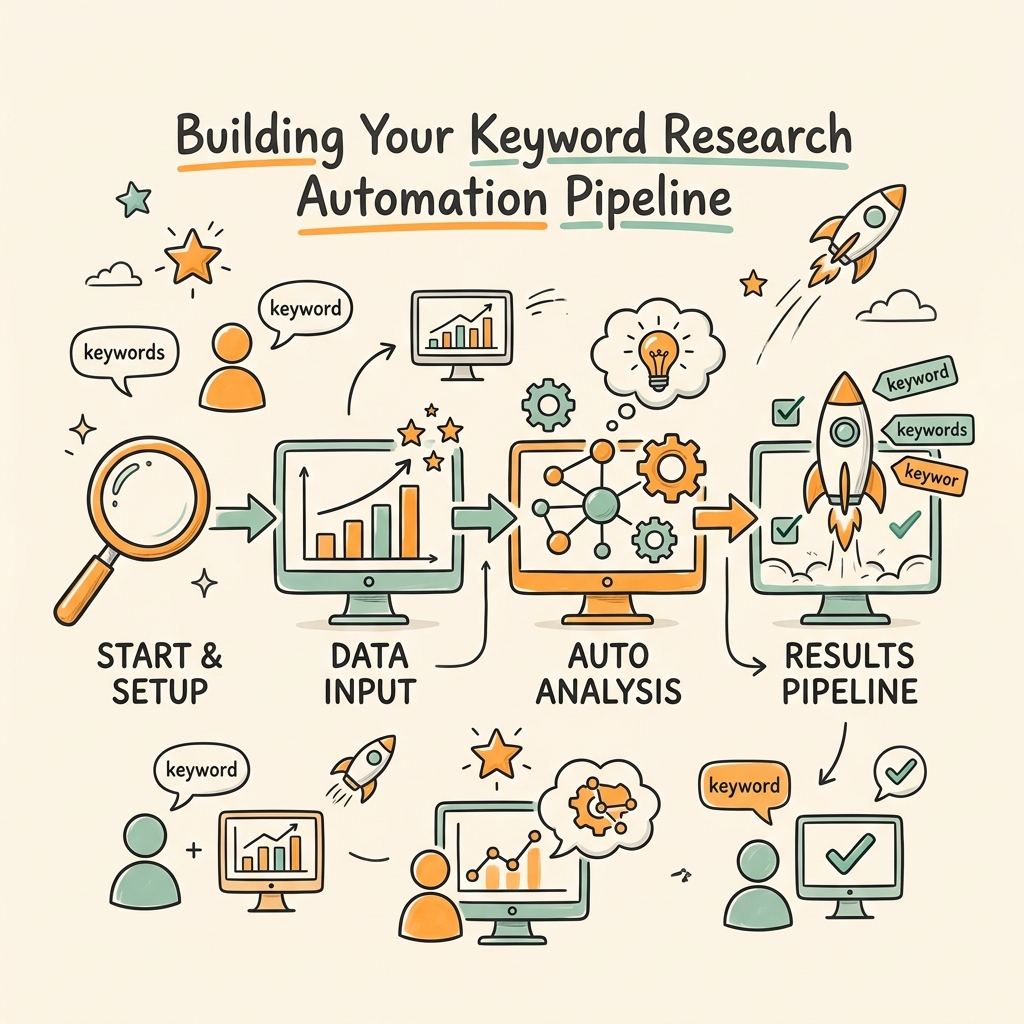
Keyword research is the foundation of SEO strategy, but it's also one of the most time-consuming tasks to do manually. Effective automation doesn't replace researchit accelerates it. You still decide the direction, but AI agents handle the discovery, analysis, and prioritization. A well-built keyword pipeline can generate hundreds of prioritized opportunities each week without manual effort.
Setting Up Multi-Source Keyword Discovery
Manual keyword research means checking Google Search Console, running searches in Ahrefs or SEMrush, and manually building lists. Automated keyword discovery means setting up agents that pull from multiple sources simultaneously: search volume data, competitor keyword gaps, People Also Ask questions, trending subtopics, and long-tail variations. The power is in the simultaneity. Instead of spending 4 hours researching 50 keywords, your system discovers 500 in the same timeframe.
Tools built for this layer use machine learning to identify semantic relationships between keywords and surface clusters automatically. This is the foundation of autonomous SEO agents that can generate dozens of content opportunities daily. The system learns which keywords convert for your niche and deprioritizes noise. Each keyword comes with search volume, intent classification, and recommended content angle.
Automating Search Intent Classification
Not all keywords are equal. A "how-to" keyword needs a different content strategy than an "alternative to" keyword or a "best practices" keyword. Manually classifying intent across hundreds of keywords is tedious. Intent automation uses language models to instantly tag each keyword with its underlying intentinformational, commercial, navigational, transactionaland recommends content type and format.
This alone saves 20-30 hours per month for mid-sized teams. Instead of manually categorizing, you get instant, consistent tagging. The system becomes your keyword triage nurse, only surfacing keywords that align with your content strategy and current gaps.
Prioritization Scoring and Gap Analysis
Raw keyword lists are useless without prioritization. The best automation systems score each keyword based on: search volume, competition difficulty, relevance to your site authority, intent alignment with your business, and gap against your current content. The result is a ranked list where the first 20 keywords are genuinely the highest-ROI targets. You don't sift through 500 mediocre opportunitiesyou see the 50 that matter.
Advanced systems go further, using real-time SEO data from industry sources to understand your competitive landscape and recommend opportunities you can realistically own. They don't just pull datathey reason about it. They understand your site's current authority, topical depth, and business intent, then recommend keywords you can actually rank for and that will drive revenue.
Automating Content Creation Without Sacrificing Quality
Content is the engine of SEO, but most teams treat it like a blocker. "We need more content" they say, while watching their writers burn out or their agencies drain the budget. Automation here is transformativebut it requires the right setup. The goal isn't to write by committee; it's to enable human-guided AI generation that's faster and more consistent than traditional writing.
AI-Assisted Writing Workflows with Human Gates
Full automation of content without review is a recipe for mediocrity. The winning workflow is: AI research + AI draft → human edit and fact-check → AI optimization → human final review → publish. This keeps the speed advantage while maintaining quality. 86% of marketers still edit AI-generated text, not because the AI is broken, but because that human layer transforms good content into great content.
When built into an integrated system, this workflow becomes seamless. You set parameters for topic, target keyword, and word count, and the automation handles research aggregation from 14+ sources, initial drafting, fact-checking, on-page optimization, and structuring. The result is consistency without sacrifice. Your team reviews a polished draft, makes strategic edits, and publishes. The time from topic to published article drops from weeks to hours.
Maintaining Fact-Checking and Verification at Scale
The biggest risk of automated content is wrong information. No amount of speed matters if your articles damage your brand's credibility. The best automation systems include fact-checking as a built-in layer, not an afterthought. AI agents cross-reference claims against source material, flag unsourced assertions, and verify statistics before they make it into the draft.
A manual fact-check might catch 70-80% of errors. A systematic fact-check with verification agents catches 95%+. The key is treating verification as a step in the automation pipeline, not a manual review after the fact. This prevents the common problem of publishing false claims that later require corrections and damage your domain authority.
SEO Optimization During Generation, Not After
Traditional SEO writing workflows are backwards: write first, then optimize. Automated workflows optimize as they write. The AI understands your keyword, search intent, and competitive landscape from the start. It structures the outline with keyword placement in mind, writes sections that answer People Also Ask questions, and builds in internal linking opportunities from day one. The result is content that's already half-optimized when it hits your CMS.
This isn't keyword stuffingit's smart structuring. Headlines naturally include intent modifiers. Sections address actual user questions. By the time a human editor reviews, they're fine-tuning a solid SEO foundation, not rebuilding the whole thing. This is why AI article generators that actually rank are built with SEO-first principles from the generation stage, not bolted on afterward.
How to Implement Smart Internal Linking Automation
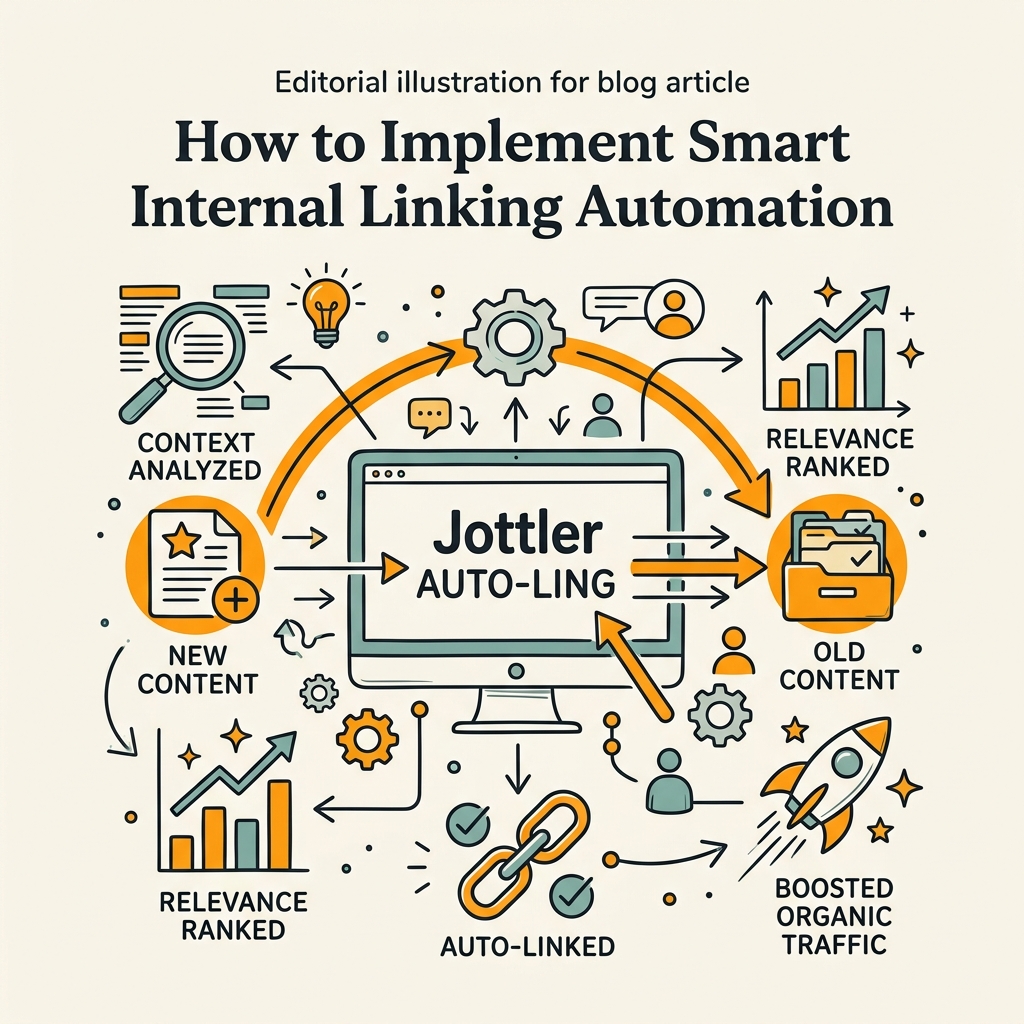
Internal linking is one of the highest-impact SEO tactics, but it's also the most fragmented in most teams. Someone publishes a new article, and linking to it across the site becomes a manual chore. Over time, link opportunities get missed, clusters weaken, and you never fully realize the authority benefit of your content network. Automation solves this.
Mapping Your Content Clusters Programmatically
A content cluster is a hub-and-spoke model: one pillar article (comprehensive, broad) links to multiple cluster articles (specific, deep). For automation to work, your system needs to understand which articles belong in which clusters. This used to require manual tagging. Now, AI agents can analyze your content, identify semantic relationships, and suggest cluster structures automatically.
The system flags: "These 8 articles are about 'project management software'they should link to your hub on 'project management tools.' Article 6 is slightly off-topic and might belong in a different cluster." This saves the manual mapping work and ensures consistent structure across your entire site.
Identifying High-Confidence Linking Opportunities
Not every linking suggestion is good. An automated linking system needs to distinguish between strong opportunities and weak ones. The best systems score suggestions based on: relevance (does the context actually support the link?), position (early in the article, where it adds value?), anchor text alignment (does it match the page's target keyword?), and existing link density (is the page already heavily linked?).
Only high-confidence suggestions surface to your editing queue. This keeps signal-to-noise ratio high and prevents noisy automation from cluttering your review process. Teams can then approve bulk linking changes without manually reviewing every single link.
Publishing Without Manual Link Insertion
Here's where automation gets powerful: once an article is published, your system can automatically insert links into older, relevant articles. The right platform will find contextually appropriate placements, insert the link with the right anchor text, and update your CMS without human intervention. One SEO professional with AI automation can now do the work of 5-10 people, and this is a major reason whyhours of manual linking work simply disappears.
This is where consistency happens. Instead of linking sporadically (when someone remembers), links go in automatically within hours of publishing. Your topical clusters strengthen continuously. Authority compounds over time as your internal link network becomes more sophisticated and self-reinforcing.
Setting Up Consistent Publishing and CMS Automation
Consistency is where most teams fail. They have a spike of content creation, then fall off for weeks. Search engines reward consistency. Automation solves this by removing the barrier to regular publishing. If you can set your desired publishing frequency (1-5 articles per day) and let the system handle research, writing, optimization, and publishing automatically, consistency becomes the default.
Defining Your Publishing Cadence
The first question: how much content can you sustainably produce and maintain? For some teams, it's 1 article per week. For others, it's 3 per day. The answer depends on your team size, budget, and how much content your niche can absorb. Once you know the number, automation can hit it every single time without variation.
The psychological benefit here is huge. Teams stop worrying "will we find time to write this week?" and start watching content compound. They see their publishing calendar fill up weeks in advance, automatically. This is the difference between content marketing as a tactical chore and content marketing as a strategic system that compounds.
Direct CMS Publishing and Scheduling
Manual publishing means exporting from your tool, formatting in WordPress or your CMS, adjusting images, and hitting publish. Automation integrates directly with your CMS. Content goes from AI generation straight to your WordPress dashboard (or Webflow, or custom setup), pre-formatted, with categories and tags set, ready to schedule or publish immediately.
This alone saves 30-45 minutes per article. Multiply by 5-20 articles per month, and you're saving 2-15 hours monthly. The real value emerges when you're publishing 60+ articles annuallysuddenly the manual workflow becomes a genuine bottleneck, while automated systems scale linearly with near-zero additional effort.
Tracking Performance and Adjusting Topics
Automated publishing doesn't mean "set it and forget it." The best systems feed performance data back into topic selection. Articles that underperform get refreshed. Keywords that show early ranking potential get expanded. Internal linking patterns adjust based on click-through and engagement data. The automation loop becomes self-improving.
This is the compounding effect. Each new article feeds data that makes the next article smarter. Over 12 months, your system isn't just fasterit's more effective. You're not publishing the same types of articles repeatedly; you're learning from performance and evolving your strategy continuously.
Avoiding Common Automation Pitfalls
Automation isn't a cure-all. Several teams adopt tools, see initial speed gains, then hit a wall because they didn't think through the workflow architecture. Understanding the common pitfalls saves you months of frustration and prevents automation from becoming a source of technical debt.
Quality Degradation From Over-Automation
The biggest mistake is automating without human gates. Some teams try to set content to fully auto-publish without review. The result is articles with factual errors, poor structure, or missed nuance. Each bad article damages domain authority more than good articles build it. The fix is building in review gates. Your content doesn't need to be edited heavilymaybe 10% get significant changesbut 100% should be reviewed before publishing. This takes your publishing time from "instant" to "24-hour turnaround" but prevents damage.
Keyword Cannibalization From Inconsistent Topic Mapping
When multiple articles target the same keyword without strategy, they cannibalize each other. Automated keyword selection can cause this if your topic clustering isn't tight. The fix: before automating content generation, define your topic clusters explicitly. Map keywords to clusters. Tell your automation system "only write articles that fill gaps in these clusters, never target a keyword we already rank for, and always link new content to the hub." This prevents cannibalization and strengthens topical authority across your entire content network.
Publishing Faster Than You Can Maintain
Speed is tempting. Some teams start with 1 article per day, see it work, and scale to 10 per day. Then they can't keep up with updates, internal linking, and strategy adjustments. The fix is publishing only as much as you can strategically maintain. For most teams, that's 1-5 articles per day. Beyond that, the quality-to-effort ratio breaks down. Be honest about your team's capacity and set your automation ceiling there.
Measuring Automation ROI and Adjusting Your System
Automation is only valuable if it delivers business outcomes. Teams sometimes see speed gains and assume they're winning, then realize 12 months later that traffic barely moved. The fix is measuring the right metrics and being willing to adjust your system based on results.
Tracking Efficiency Gains and Time Saved
Start by measuring labor. How many hours per week does your team spend on keyword research, writing, editing, formatting, publishing, and linking? Before automation, let's say it's 60 hours. After automation, it might be 15 hours (mostly strategy and quality gates). That's 45 hours saved per week, or 180 hours per month. At a loaded cost of $50/hour, that's $9,000 in labor recovered monthly.
But efficiency savings alone don't mean the automation is working. You need to measure organic outcomes. The time savings only matter if they translate to traffic growth or improved rankings.
Organic Traffic and Keyword Ranking Growth
The real metric: does automation compound organic traffic? Track:
- Organic traffic growth: Is month-over-month traffic accelerating or flat?
- Ranking improvements: How many new keywords are ranking in top 10, 20, 50?
- Content reach: Are older articles getting refreshed links and climbing higher?
- Topical authority: Are you ranking for entire clusters, or scattered keywords?
20% or more traffic increases are achievable within a few months with consistent automation usage. If you're not seeing growth after 3-4 months, your system needs adjustment. Maybe your keywords are too competitive. Maybe your automation isn't producing quality content. Maybe you're not publishing frequently enough. Measure, diagnose, and iterate.
Cost Per Ranking and Organic Customer Acquisition
The ultimate metric: what's the cost to acquire a customer via organic search? If your automation tool costs $500/month and generates $50,000 in monthly organic revenue, the ROI is obvious. If it's costing more than you're earning, something's wrong with either the system or the strategy.
Track this quarterly. If it's trending the right direction (cheaper per acquisition over time), keep pushing. If it's flat or negative after 6 months, you need to pivot your approach or reconsider your tool.
Choosing the Right Automation Platform for Your Team
Not all automation tools are built the same. Some are glorified content mills that generate noise. Others are incomplete, requiring 10 different integrations to work. The best platforms handle the entire workflowresearch, writing, optimization, fact-checking, CMS publishing, and internal linkingas an integrated system.
| Platform | Keyword Research Automation | Content Generation | Fact-Checking | CMS Integration | Internal Linking | Best For |
|---|---|---|---|---|---|---|
| Jottler | 12 AI agents, multi-source discovery | 3,000+ word daily articles | Cross-source verification | WordPress, Webflow, custom | Automated cluster linking | Busy founders scaling organic from 0 |
| SnowSEO | Multi-source keyword analysis | AI-written content | Limited | WordPress, Webflow | Semi-automated suggestions | Teams with existing processes |
| Ahrefs Batch Analysis | Strong competitive gap analysis | No native generation | No | No | Audit only | Keyword and competitor research only |
| SEMrush Content Marketing Platform | Built-in keyword research | AI-assisted writing | Minimal | WordPress | Basic suggestions | Keyword + content tool combo |
For busy founders and marketing teams trying to scale from zero, Jottler stands out because it's fully integrated. You don't need to export from one tool, import to another, format manually, and publish separately. You connect your CMS, set your parameters, and the system handles everything: research, writing with fact-checking, on-page optimization, and publishing with internal links. This integration is where real time savings happennot in individual tasks, but in eliminating context switching and manual handoffs between systems.
"Automation in SEO shifts value rather than eliminating the discipline. It moves your team from tactical execution to strategic decision-making. The fastest-growing teams aren't the ones who fully automate everythingthey're the ones who automate the right things and use the time savings to think bigger."
Victoria Olsina, SEO Strategy Lead
Conclusion
Building effective SEO workflow automation isn't about replacing your teamit's about amplifying their impact. The teams winning in 2026 are those who've systematized keyword discovery, automated content production with quality gates, implemented smart internal linking, and established consistent publishing rhythms. Companies report 200% ROI within the first year of adopting workflow automation, and 65% of businesses report better SEO outcomes after integrating the right tools into their stack.
The key is being intentional: automate the repetitive, data-driven work (keyword research, content generation, link suggestions, publishing). Keep the strategic work human (topic selection, competitive positioning, editorial oversight). Start with a clear publishing cadence and measure organic traffic, ranking growth, and customer acquisition cost quarterly.
If you're building an automated SEO system and want a platform that handles the entire pipelineresearch, writing, fact-checking, optimization, and CMS publishingintegrated systems built for scale make the difference. Start your SEO agent today and let AI handle the work that compounds your growth.
FAQs
What SEO tasks are safest to automate?
Keyword research, competitor analysis, metadata generation, internal link recommendations, and content formatting are all safe to automate because they're repetitive, data-driven, and easy to verify before publishing. Skip automating strategy, topic selection, and editorial decisionsthese need human judgment. The best workflows automate the grunt work (keyword discovery, on-page optimization, publishing logistics) and keep humans focused on strategy and quality gates. This is where the time savings compound without sacrificing quality.
How much organic traffic growth can you expect from SEO automation?
20% or more traffic increases are achievable within 3-4 months with consistent implementation of an effective automation system. The exact growth depends on your starting point, content quality, and publishing frequency. If you're starting from low organic traffic, the growth can be dramatic. If you're already established, growth tends to be more gradual. The key variable is consistencyautomated systems that publish 3-5 articles daily compound faster than manual systems publishing 1 article per month.
Do I need a developer to set up SEO workflow automation?
Not if you use an integrated platform like Jottler. Modern SEO automation tools are built for non-technical users. You connect your CMS (WordPress, Webflow, etc.), set your publishing preferences, and the system handles everythingno custom code required. Developers only become necessary if you're trying to build custom automation with separate tools (Zapier, APIs, etc.). Most teams see faster results and easier maintenance by choosing a platform purpose-built for SEO workflow automation.