Building High-Converting Email Nurture Sequences
Only 3% of your market is actively buying at any given moment, while another 40% are poised to buy but need nurturing before they commit. Most sales teams ignore this reality and chase quick wins, missing the larger opportunity. Companies that excel at lead nurturing generate 50% more sales-ready leads at 33% lower cost. The difference between good and mediocre email performance isn't luck—it's structured sequences designed to build trust, move prospects through their buying journey, and convert at every stage.
Key Takeaways
- Segmented email nurture sequences convert at 8–12% versus 1.5% for generic broadcasts, a 5–8x improvement (2026 research)
- The optimal nurture sequence length is 5–7 emails for B2B, sent over 2–4 weeks with a clear cadence from welcome to conversion
- Nurtured leads make 47% larger purchases than non-nurtured leads, proving long-term ROI on sequence investment
- An 80/20 content ratio (80% educational, 20% sales) outperforms aggressive pitch sequences by 3–4x
- Segment Your Audience for 5–8x Higher Conversion: Tailoring sequences by role, engagement level, and industry creates a massive lift in click and conversion rates versus one-size-fits-all broadcasts.
- Build the Perfect Sequence Arc: The sequence structure that works—welcome, value, education, social proof, conversion—converts 3–5x better than random email drips.
- Time Your Emails for Maximum Impact: Proper cadence (days 0, 1, 3, 5, 7) meets attention peaks and prevents list fatigue, driving 20% more sales opportunities than unstructured sending.
- Track Revenue, Not Just Opens: Shift from vanity metrics to MQL-to-SQL conversion, pipeline attribution, and holdout testing to prove incremental lift from nurture.
- Automate Execution for Consistency: Automation tools eliminate manual sequence management, ensuring consistent, timely delivery across your entire audience without daily oversight.
How Should You Segment Your Audience to Maximize Conversion?
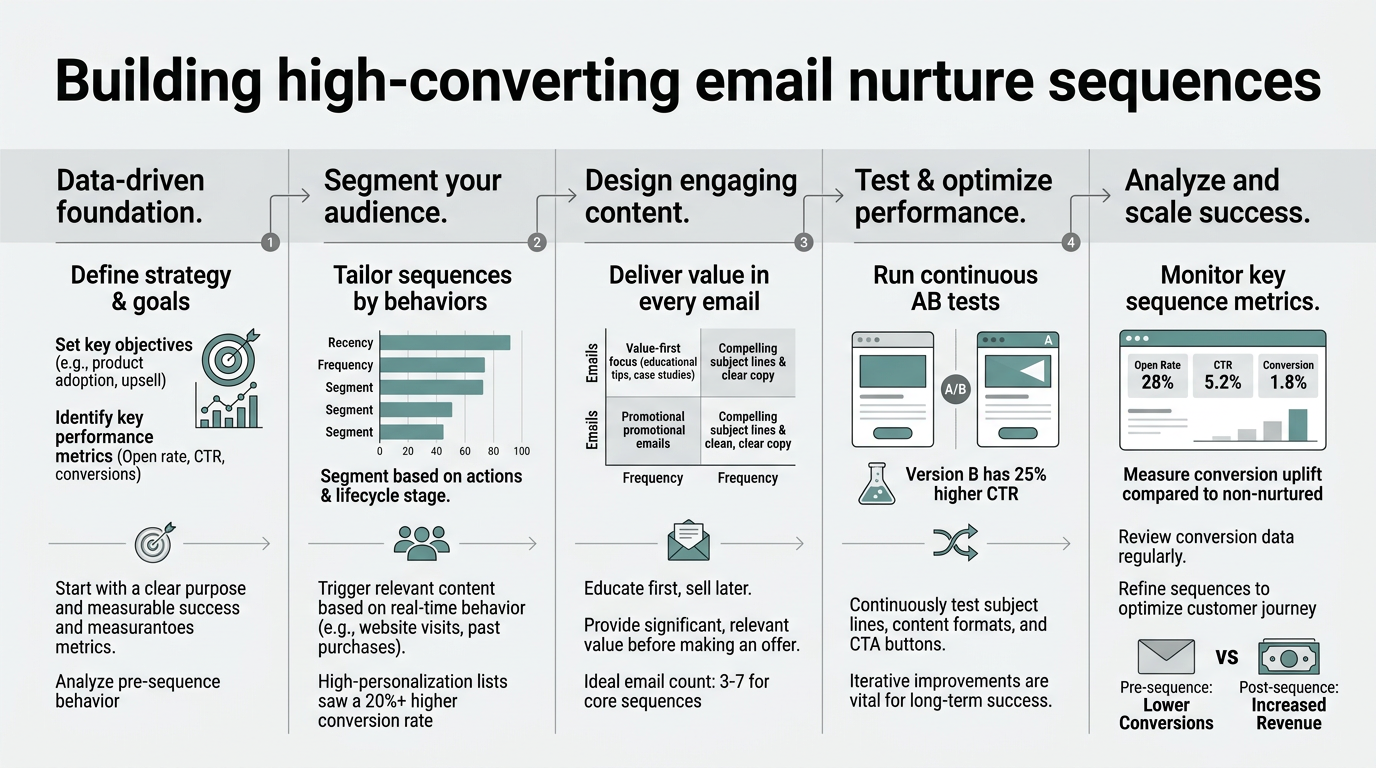
Segmentation is the single biggest lever for improving email performance. Research from email experts shows personalized messages improve click-through rates by 14% and conversion by 10%—but generic, segmented sequences perform 5–8x better than one-size-fits-all broadcasts. The gap is staggering because different personas have different pain points, buying timelines, and decision criteria.
"Segmented nurture sequences convert at 8–12%, while non-segmented campaigns convert at 1.5%. That's not a minor optimization—it's a 5–8x improvement that represents real revenue impact for teams willing to invest in audience understanding." — Email Marketing Performance Analysis, 2026
Core Segmentation Strategies That Drive Results
The most effective segmentation approaches are:
- By Role/Title: Executives need ROI-focused messaging and CFO-friendly metrics; managers want tactical implementation guides; technical stakeholders care about integration and support.
- By Engagement Level: Someone who clicked three links and spent 5+ minutes reading gets different content than someone who opened once; cold prospects need re-engagement sequences.
- By Industry or Use Case: SaaS founders prioritize growth and unit economics; manufacturers focus on operational efficiency and downtime reduction.
- By Funnel Stage: Early-stage prospects (awareness) need educational content; mid-funnel leads (consideration) need comparisons and case studies; late-stage (decision) need pricing, security details, and proof points.
- By Buying Signal or Intent: Someone who downloaded a pricing guide is warmer than someone who downloaded a general whitepaper; behavioral triggers (demo request, website visit frequency) are more predictive than demographics.
The practical impact: segmented nurture sequences convert at 8–12%, while non-segmented campaigns convert at 1.5%. That's not a minor optimization—it's a 5–8x improvement. If you're sending the same sequence to 1,000 people regardless of their role or engagement, you're leaving 6–11 conversions on the table per sequence cycle.
Tools and Tactics for Implementation
Segmentation requires three things: data, logic, and automation. Start with the data you already have in your email platform (HubSpot, Mailchimp, ConvertKit, or similar). Tag contacts as you gather information—downloads, form submissions, UTM parameters, and third-party intent data all inform segmentation logic.
Use conditional logic in your email platform to trigger different sequence branches based on subscriber attributes. If you use a marketing automation platform like HubSpot or ActiveCampaign, you can set up workflows that automatically enroll contacts into the right sequence based on properties like job title, company size, industry, or prior engagement. Content marketing frameworks that pair automated nurture sequences with targeted topic clusters create a compounding flywheel where each audience segment receives increasingly relevant information.
The result: your sales team talks to warmer prospects, conversion rates climb, and your email list stays engaged instead of tuning out generic blasts.
What's the Optimal Sequence Structure for High Conversion?
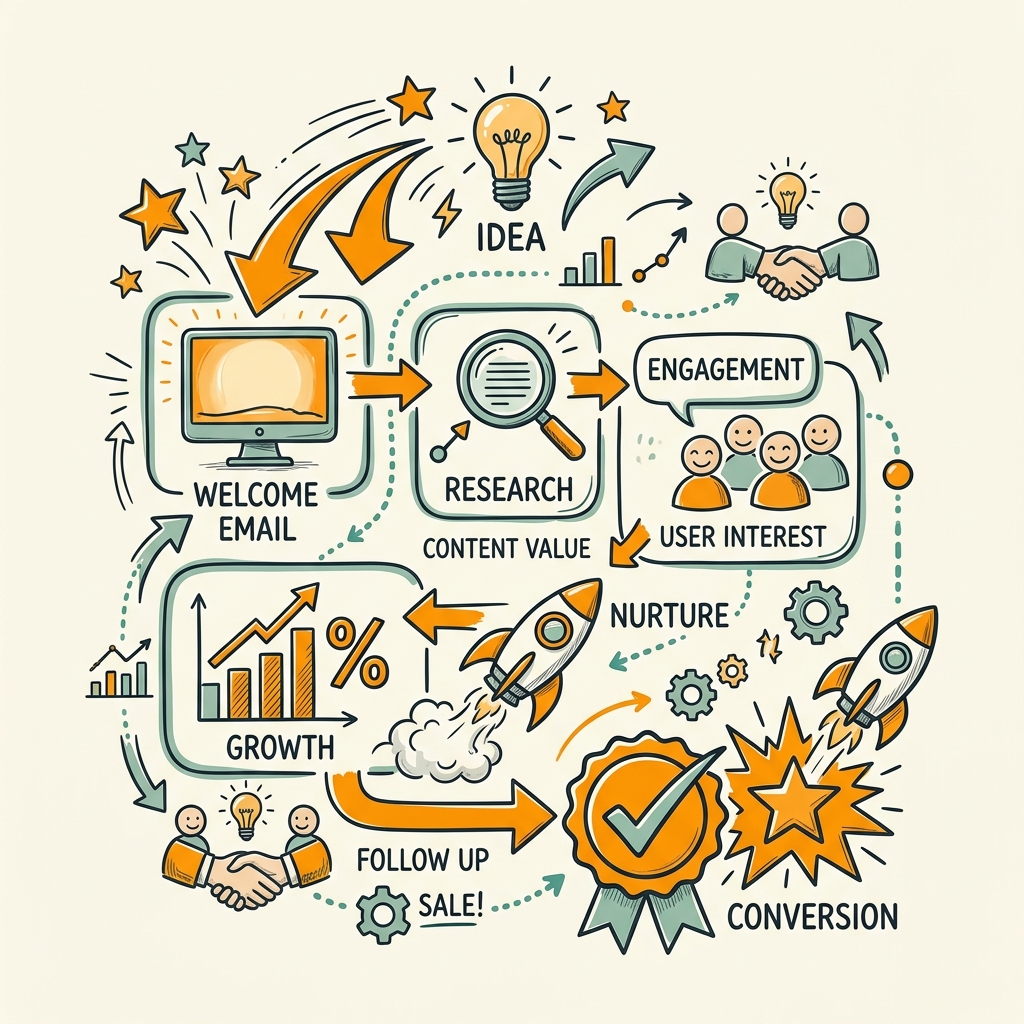
The most effective nurture sequences follow a deliberate arc: welcome, establish credibility, educate, provide proof, and convert. This progression builds trust before asking for a commitment. Research shows sequences structured this way convert 3–5x better than random email drips. The "sweet spot" is 5 emails over 7 days for most businesses, though B2B cycles often extend to 7 emails over 2–3 weeks.
The Five-Email Structure That Works
Here's the sequence architecture that consistently converts across industries:
- Email 1 (Day 0–1): Welcome + deliver the promised lead magnet. Set expectations for what comes next. Include one clear CTA (usually "click to access your resource"). This email should arrive within minutes of signup to meet peak attention.
- Email 2 (Day 1–3): Brand story or "why this matters." Share a personal insight, company origin story, or customer success snapshot. This builds credibility and emotional connection before pitching solutions. Include one relevant link (to a case study or blog post, not a sales page yet).
- Email 3 (Day 3–5): Educational content or framework. Teach your audience a quick win—a checklist, audit, or strategy they can implement immediately. This establishes you as a helpful expert, not a salesperson. Position your product or service as the tool that automates or scales what they just learned.
- Email 4 (Day 5–7): Social proof. Share a customer testimonial, case study, or credibility marker (awards, press mentions, user count). Address objections indirectly by showing that people like them have succeeded. This reduces perceived risk before the conversion ask.
- Email 5 (Day 7–10): Conversion offer with urgency. Present a clear CTA: book a demo, start a trial, or buy. Include a deadline or limited incentive (if relevant). Address the #1 objection your audience has about moving forward.
For longer B2B sales cycles (6+ month deals), extend this to 7–8 emails over 2–4 weeks, repeating the education + proof pattern before final conversion pushes. The key rule: maintain an 80/20 ratio of helpful content to sales asks. If 80% of your emails educate and 20% convert, your audience stays engaged instead of unsubscribing.
Cadence and Timing for Maximum Opens and Clicks
The timing of each email matters as much as the content. Sending emails too close together risks email fatigue and unsubscribes; too far apart, and your message loses momentum. A proven cadence is:
- Days 0–1: Immediate welcome (within 1 hour of signup)
- Day 1–3: Story/credibility email
- Day 3–5: Educational content
- Day 5–7: Social proof
- Day 7–10: Final conversion push
- Day 14+: Re-engagement or long-tail offer (optional)
"Leads nurtured with a structured, predictable cadence show 20% more sales opportunities than those who receive random timing. This works because it builds an expectation: your audience comes to anticipate and open your emails reliably." — Email Cadence and Conversion Study, 2026
For subject lines and preview text, email conversion rate research recommends specificity over hype. "Here's a framework to cut your sales cycle in half" outperforms "You won't believe this trick." Personalization (first name, company name) lifts open rates by 2–3%, while subject lines that pose a question get 3–5% higher click-through rates.
How Do You Measure Sequence Performance and Optimize for Higher Conversions?
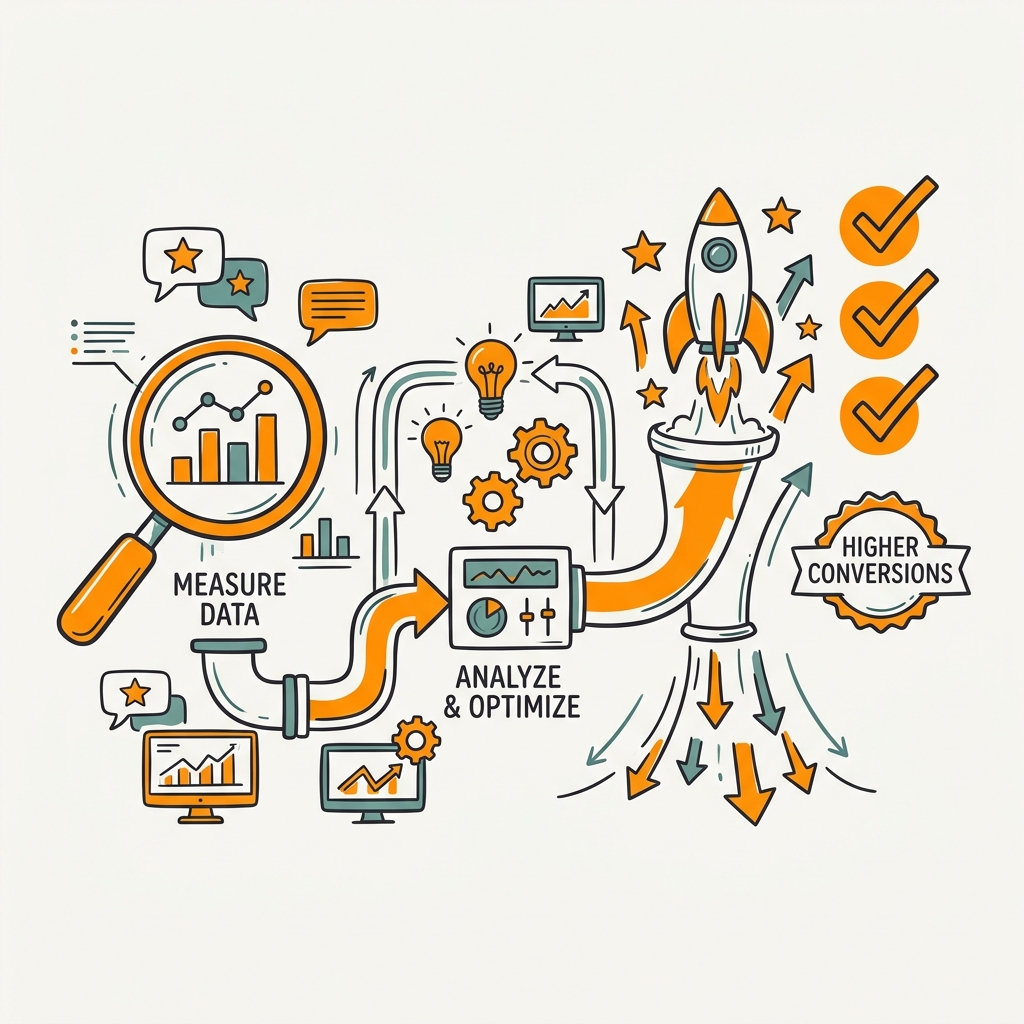
Most teams track open rates and click-through rates, then wonder why leads don't convert. These metrics are vanity indicators—high opens don't predict revenue. The metrics that matter are conversion, pipeline contribution, and customer acquisition cost. Shift your measurement approach to focus on business outcomes, not email metrics.
"The teams winning in 2026 measure MQL-to-SQL conversion, pipeline attribution, and cost per acquisition instead of open rates. One high-performing sequence converting at 5% with 3% SQL rate is more valuable than a generic sequence converting at 2% with 0.5% SQL conversion." — High-Growth SaaS Email Benchmark Report
Key Performance Indicators for Email Nurture Sequences
Track these four KPIs instead of just opens and clicks:
- Conversion Rate (lead to opportunity): Percentage of people who completed the primary CTA. Benchmark: 1.8–3% for average programs, 3–8% for high-performing SaaS sequences. If you're below 1.5%, test your segmentation and CTA clarity.
- MQL-to-SQL Conversion: Percentage of email-generated leads who passed sales qualification. This is the true measure of sequence relevance. A segmented sequence that converts 12% at the MQL stage but 4% to SQL is more valuable than a generic sequence converting 3% at MQL but 0.5% to SQL.
- Pipeline Attribution: Revenue influenced by nurture sequences, controlled for other touchpoints. Use holdout testing: exclude 5–10% of your audience from a sequence and measure if they convert at lower rates. The difference is your incremental impact.
- Cost Per Acquisition: Total cost (email platform, content creation, paid traffic to get leads) divided by conversions. Nurtured leads cost 33% less to acquire than non-nurtured leads because the sequence does the relationship-building work for your sales team.
Optimization Tactics Based on Performance Data
Once you have 100+ conversions through a sequence (representing multiple weeks or months of data), start testing. Run A/B tests on one variable at a time:
- Subject line copy: Question vs. statement; personalization on/off; urgency language vs. curiosity.
- Email timing: Tuesday 9am vs. Thursday 2pm; same day vs. next day follow-up.
- CTA design: Button vs. link; "Book a demo" vs. "See how it works"; placement above the fold vs. below.
- Content angle: Problem-focused ("Avoid the #1 mistake...") vs. solution-focused ("Here's how to..."); data-driven vs. story-driven.
- Segment targeting: Run the same sequence against two audience segments and measure which converts higher; retire or refocus sequences that perform in the bottom 25%.
Improvement compounds: if you lift conversion rate from 1.8% to 2.5% per sequence, and you run 10 sequences per year, that's a 36% increase in total conversions with zero additional traffic investment.
How Can Automation Eliminate Manual Bottlenecks in Sequence Management?
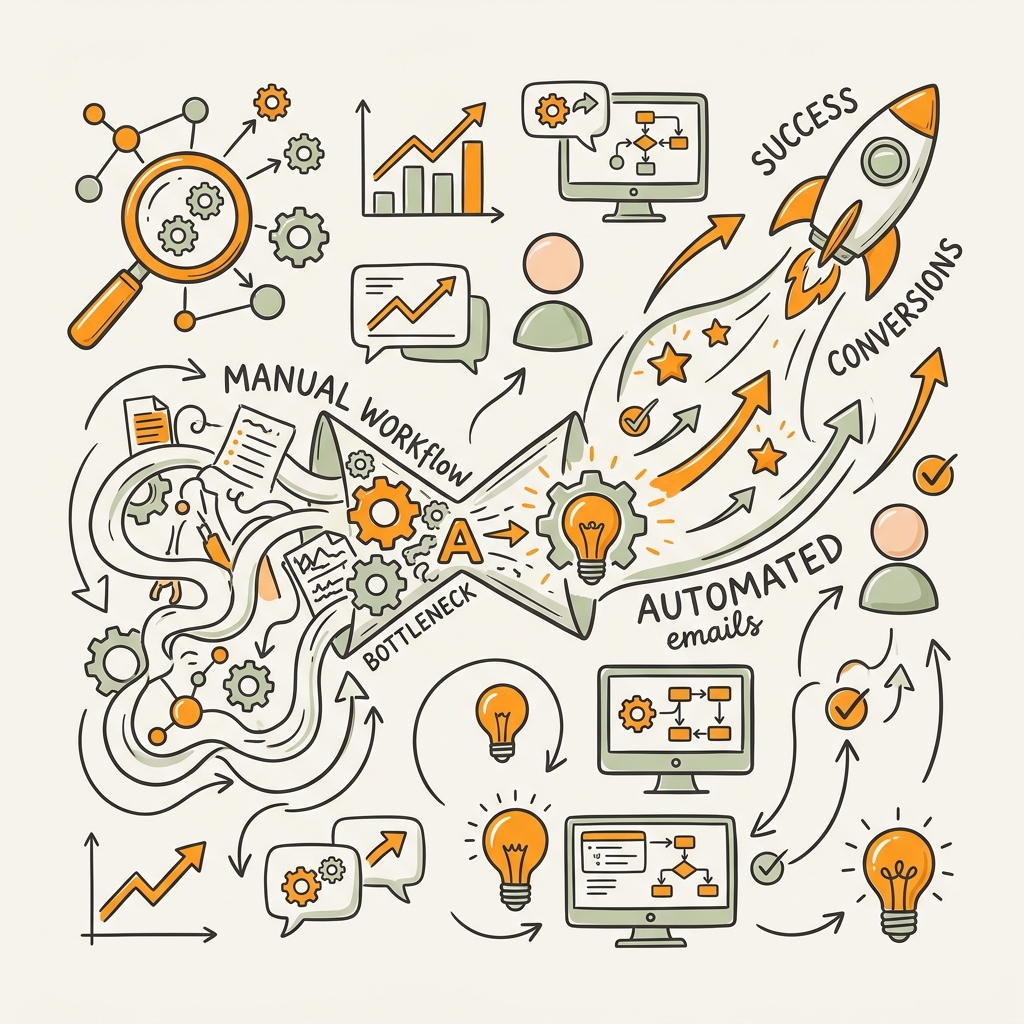
Manual email sequences are a liability. A single human error—wrong recipient list, broken link, delayed send—tanks a sequence's performance. Automation eliminates this friction and scales your nurture engine without hiring more people. Most marketing automation platforms (HubSpot, ActiveCampaign, Klaviyo) let you build sequences once, then deliver them consistently to every new lead.
Building Automated Workflows That Scale
Set up trigger-based enrollment in your automation platform. When a lead matches criteria (signed up, downloaded asset, attended webinar), they automatically enroll in the relevant sequence. The workflow then:
- Sends email 1 immediately
- Waits 2 days, sends email 2
- Waits 2 days, sends email 3
- Continues through the full sequence with built-in conditions (if they click, jump to next sequence; if they book a demo, pause nurture and alert sales)
This removes the manual work of exporting lists, scheduling individual sends, and checking in on performance daily. Tools designed for content teams can further streamline this: instead of writing emails one at a time in your email platform, you write them in a document, batch them, and let content generation and optimization systems handle publishing and delivery consistency.
Avoiding Common Automation Pitfalls
Automation only works if the underlying logic is sound. Common mistakes include:
- Enrolling people multiple times: Set up deduplication logic so leads don't enter the same sequence twice.
- Not pausing for engaged prospects: If someone books a sales call, remove them from the nurture sequence immediately—sales team takes over.
- Ignoring engagement quality: Track click-to-conversion ratio, not just email metrics. If a sequence gets high opens but zero clicks, the subject line is misleading or the content doesn't match promise.
- Setting and forgetting: Review sequence performance monthly. Benchmark against peers and your own historical performance. Retire sequences converting below 1% and reinvest in high performers.
The result of effective automation: your team spends less time executing sequences and more time analyzing performance, testing new angles, and scaling what works. One team member can manage sequences for 10,000+ leads without daily manual work.
What's the Comparison Between High-Converting and Low-Converting Sequences?
Understanding the gap between good and mediocre sequences shows you exactly what matters. Here's how top performers differ from the rest:
| Element | High-Converting Sequence | Low-Converting Sequence | Performance Impact |
|---|---|---|---|
| Audience Targeting | Segmented by role, engagement level, industry, intent signals | One generic sequence to entire list | 5–8x higher conversion rate |
| Email Count | 5–7 emails over 2–4 weeks with clear progression | 3 emails or 15+ emails with inconsistent spacing | Moderate impact; sweet spot is 5–7 for B2B |
| Content Ratio | 80% educational/helpful, 20% sales asks | 50/50 or worse (70% sales, 30% value) | 3–4x higher engagement and lower unsubscribe rates |
| Sequence Arc | Welcome → Story → Education → Proof → Convert | Random email order with no narrative | 3–5x higher conversion rate |
| CTA Clarity | One primary CTA per email; clear next step | Multiple CTAs per email creating decision paralysis | 2–3x higher click-to-action rate |
| Timing/Cadence | Predictable rhythm (days 0, 1, 3, 5, 7) | Random timing; leads don't expect next email | 20% more sales opportunities |
| Measurement Focus | MQL-to-SQL conversion, pipeline attribution, CAC | Open rates and CTR only; no revenue connection | High-performers stay focused on outcomes, optimize accordingly |
| Execution | Fully automated workflow; consistent, error-free delivery | Manual scheduling; prone to delays and human error | 100% consistency ensures no leads fall through cracks |
The data is clear: building a structured, segmented sequence with the right content mix and cadence creates a 3–8x uplift in conversion rate versus a generic, poorly-timed approach. Most teams are trapped in the low-converting camp simply because they've never systematized the approach.
Conclusion
Building high-converting email nurture sequences is a science. You can't guess your way to 8–12% conversion rates from segmented sequences—you need the right architecture, audience insights, and measurement discipline. The teams winning in 2026 follow a proven pattern: segment ruthlessly, structure for narrative arc, maintain the 80/20 content ratio, time emails for attention peaks, and measure pipeline contribution, not vanity metrics.
The impact compounds fast. If you improve your average sequence from 1.5% conversion (generic) to 4% (segmented + optimized), a single nurture program running 4 times per year on a 5,000-person list generates 400 additional conversions annually. That's not a small optimization—it's a legitimate revenue driver.
Start with segmentation this week. Audit your current sequences and identify the highest-value audience segment (best buyers, highest LTV). Build a dedicated sequence for that segment using the structure outlined above. Measure MQL-to-SQL conversion and pipeline attribution. Then test one variable. Repeat quarterly.
Once your manual sequences are running, look at how to scale the underlying content creation and delivery. Start your SEO agent to compound your content marketing efforts—research, write, and publish the educational assets your nurture sequences need without the constant time drain of manual content production.
FAQs
What's the ideal length for a B2B email nurture sequence?
The sweet spot is 5–7 emails for most B2B sales cycles. Five emails are optimal if your buying cycle is 2–4 weeks; extend to 7 emails if your sales cycle runs 6+ weeks and you have distinct education stages. The key is structure—each email should build on the last—rather than hitting a magic number. Sequences longer than 10 emails tend to see drop-off unless each email is highly segmented and triggered by specific behaviors. If you're running longer sequences, consider branching workflows where only the most engaged leads continue receiving emails.
How often should I send nurture sequence emails without causing unsubscribes?
Space emails 2–3 days apart for a typical 7-day sequence, and 3–5 days apart if your sequence runs 2–3 weeks. This avoids email fatigue while maintaining momentum. A predictable cadence—"you'll hear from us every Tuesday at 9am"—actually improves opens because recipients expect you. Monitor unsubscribe rates weekly; if they jump above 0.5% of sends, your frequency is too aggressive or content isn't matching expectations. A/B test send days and times against your specific audience; Tuesday–Thursday mornings typically outperform Monday and Friday, but your audience data is more reliable than industry benchmarks.
What content should make up the bulk of a nurture sequence for high conversions?
Follow the 80/20 rule: 80% educational or value-driven content, 20% direct sales asks. Educational content includes how-to guides, industry benchmarks, frameworks, case studies, and templates—anything that helps your prospect succeed regardless of whether they buy from you. Sales content includes direct offers, demos, free trials, and conversion CTAs. Front-load the sequence heavily toward education (emails 1–4) and compress conversion asks into the final 1–2 emails. Teams that flip the ratio and lead with sales get 3–4x lower conversion because they haven't yet built enough trust or credibility to justify the ask. Remember: you're in a race against dozens of other vendors; the one that educates first wins.