Building Your Content Machine With Zero Budget
Most founders think organic growth requires a fortune in ad spend or armies of freelancers. It doesn't. SEO generates 748% ROI over three years and content marketing creates 3x more leads than outbound at 62% lower cost — yet 73% of B2B marketers still lack a documented strategy, leaving compounding growth on the table. The gap isn't cash. It's structure.
Building a content machine on a zero budget means automating what you can, ruthlessly repurposing everything else, and stacking wins on owned channels before spending a dime on ads. Here's how to architect yours.
Key Takeaways
- SEO delivers 748% ROI over 3 years, making it the single highest-compounding channel for bootstrapped founders (GTM 8020, 2026)
- Documented content strategies generate 3x more leads per dollar spent than random publishing, making planning more valuable than production volume
- Content marketing costs 62% less than outbound while generating 3x more leads, creating a natural moat for teams with zero paid budget
- Website/blog/SEO ranks as the #1 ROI-generating channel across all company sizes in 2026 benchmark data (HubSpot, 2026)
Quick-Scan Essentials
- Define Your Core Niche and Audience: Targeting one person and one problem repeatedly beats generic content across all channels.
- Automate Content Research and Writing: AI-powered workflows handle keyword discovery and initial drafting, freeing you to edit rather than create from scratch.
- Repurpose Every Asset Into Five Formats: One long-form article becomes email, LinkedIn posts, short video clips, and social snippets with minimal extra effort.
- Build an Internal Linking System: Linking between your own articles compounds SEO authority and keeps readers on your site longer.
- Measure Only What Drives Revenue: Focus on organic traffic, email signups, and conversions—not vanity metrics—to prove content ROI and unlock growth budget later.
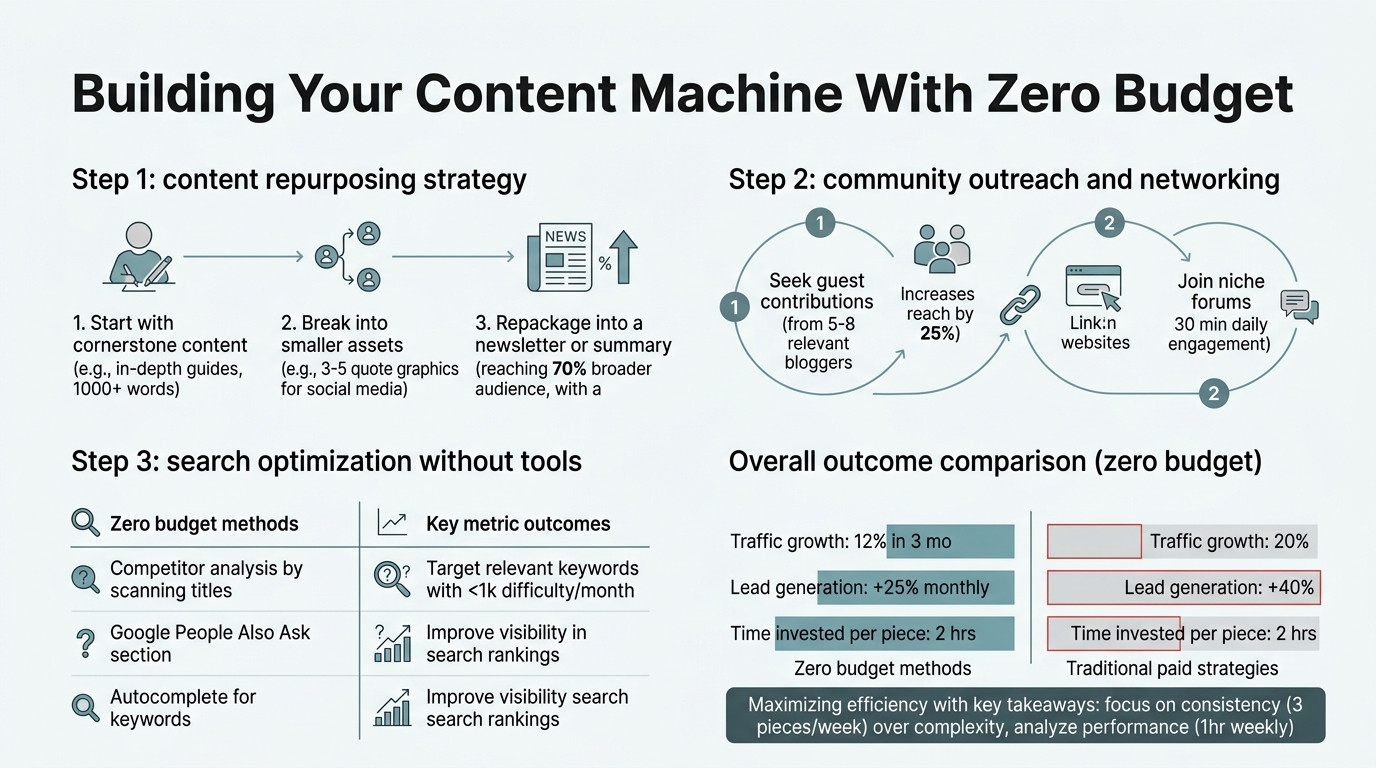
How to Define Your Core Audience and Niche
The first zero-budget mistake is being everything to everyone. Documented content strategies correlate with 3x better lead efficiency, and specificity is what makes documentation work. You need one audience, one problem, and one promised outcome before publishing anything.
This isn't creative limitation—it's compounding precision. A blog targeting "all SaaS founders" ranks for nothing. A blog targeting "founders scaling from $1M to $10M ARR who need to cut CAC by 40%" ranks for specific, high-intent searches that convert.
"Specificity compounds. The narrower your niche, the faster you rank for searches that matter. Generic content never beats focused authority."
Identify Your Ideal Customer Profile
Start with who you've already sold to or who you want to sell to. Write down their title, company size, revenue stage, and the specific pain point your product solves. The narrower the better. If you're building a tool for content automation, don't target "marketers"—target "founders without marketing teams" or "in-house marketers at Series A SaaS companies managing 5+ people."
Pull your best 3 existing customers or users and extract commonalities:
- Role and job title
- Company size and revenue stage
- Industry vertical
- Problem intensity and urgency
That's your beachhead. All your content targets that person.
Map the Buyer's Job to Be Done
Your audience doesn't search for your product name. They search for the job they're trying to do. If you're Jottler, users aren't searching "AI content automation." They're searching "how to scale content without burning out," "best free AI writing tools," or "how much does content marketing cost." Map 15-20 search phrases that reflect your audience's actual problem language.
Tools like HubSpot's marketing statistics data show that marketers themselves research solutions by pain point, not by category. Your content should meet them there—in their language, solving their stated problem.
Why Zero-Budget Content Requires Automation
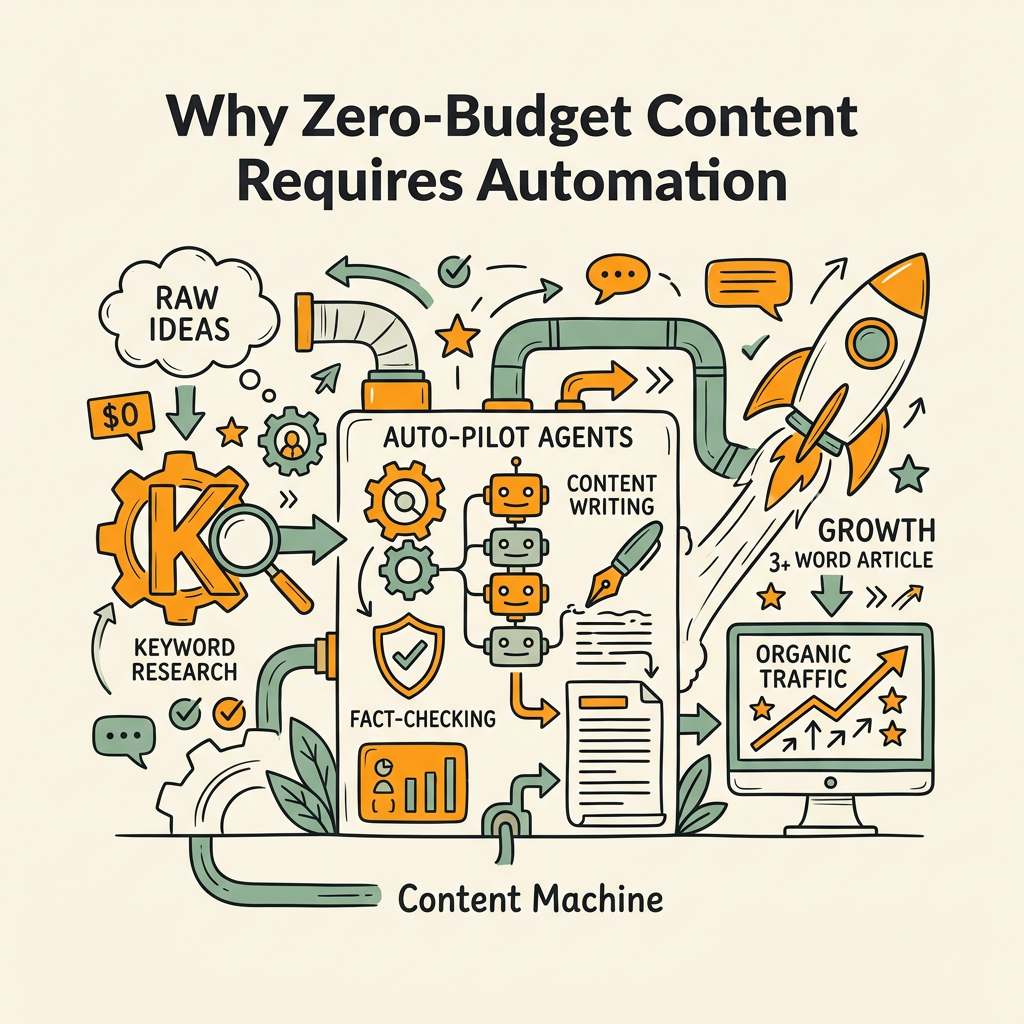
You have no budget because you have no time. Manual content production is a dead end for founders—you'll burn out before publishing your tenth article. Smart automation doesn't replace thinking. It eliminates the mechanical parts so your thinking matters more.
AI-assisted content is now mainstream, with marketers using AI across blogs, email, video, and graphics. The difference between winners and losers isn't whether they use AI—it's whether they use it to accelerate quality work or replace thinking entirely.
"Automation wins by eliminating 80% of the mechanical work so you can focus on the 20% that creates authority. This is how zero-budget teams outpace funded competitors."
Automate Keyword Research and Topic Discovery
Don't manually brainstorm topics. Use free tools or low-cost AI to find what your audience actually searches for. Plug your niche into a keyword tool, filter by search volume and difficulty, and grab the 20-30 highest-intent queries your audience types. Those become your article calendar for the next two months.
Your content machine should run on a feed of keywords, not inspiration. When you run out of topics to write, you stop. When you have a ranked list of audience problems sorted by search volume, you never stop.
Tools like Digital Applied's content marketing data show that documented, keyword-aligned strategies unlock measurable lead growth. The planning step—which costs nothing—is what creates ROI later.
Write First Drafts With AI, Not Humans
An AI content generator trained on your audience and style can produce a credible first draft in seconds. You then spend 20 minutes fact-checking, rewriting weak sections, adding original insights, and nailing the voice. This is 10x faster than writing from a blank page and costs nothing if you use a free tool.
The workflow for AI-assisted writing:
- Feed the AI your keyword, audience context, and reference articles
- Generate a 1,500-2,000 word first draft
- Spend 20 minutes fact-checking and adding original data
- Rewrite 2-3 weak sections with your own insight
- Publish with confidence
The trap: using AI as the final output. The win: using AI to eliminate the 80% of writing that's formatting and structure, so you own the 20% that's judgment and authority.
How to Repurpose Content Into Five Formats
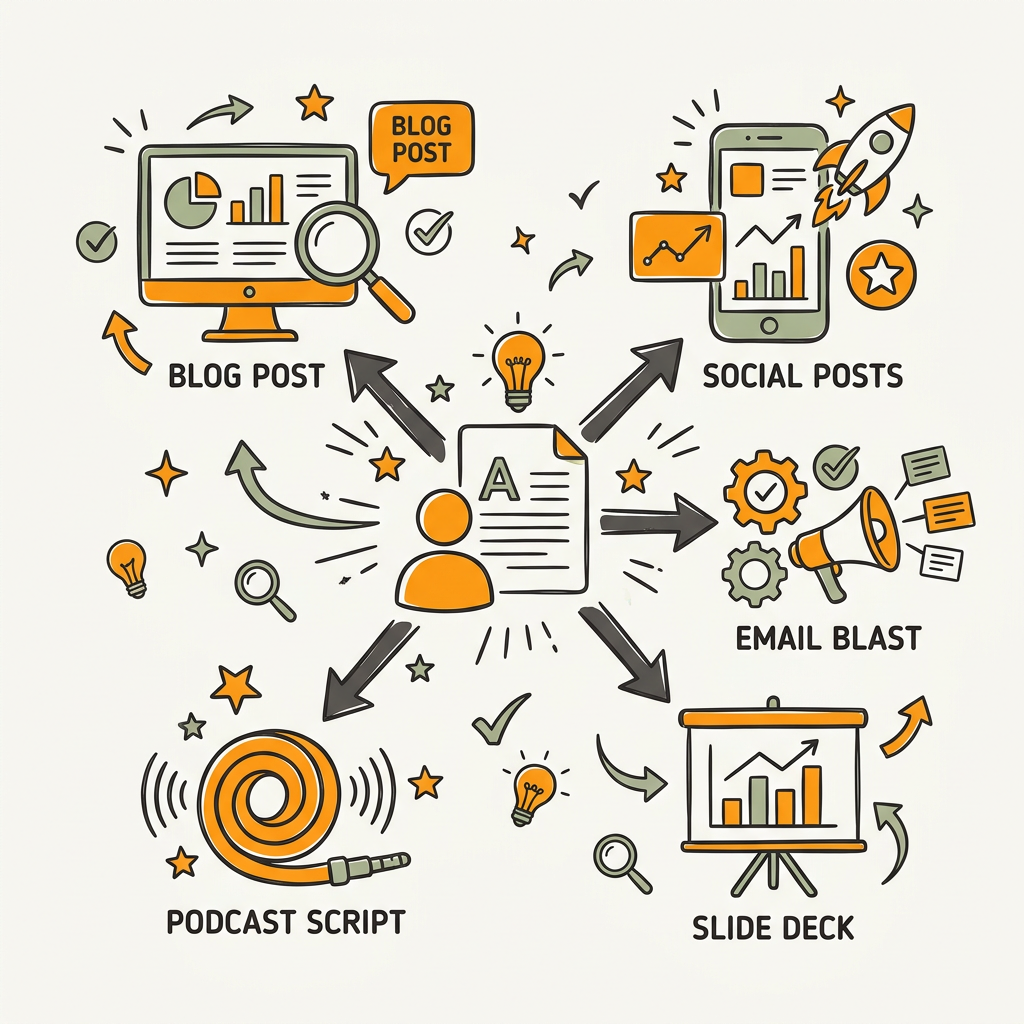
One long-form article is a waste. The actual machine is when one piece of research and reporting becomes five assets across five channels, each formatted for how people consume that medium.
Short-form video, long-form video, and blog posts are the top three ROI-generating content formats, yet most founders publish a blog article and call it a day. You should publish one, then immediately ask: "What's the headline? What's the email? What's the LinkedIn post? What's the clip?"
Blog Article → Email Sequence
Your long-form article contains 2-4 core insights. Extract each into a separate email to your list, each with a link back to the full article. That's 3-4 emails from one article at zero cost. Email marketing delivers 201% ROI, so this multiplier is enormous for founders without paid budget.
Blog Article → LinkedIn Posts and Comments
Pull the most counterintuitive finding from your article and post it as a LinkedIn thread or single post. Use original data or bold claims as bait. Link to the article in a comment. Repeat with a different angle 2-3 times over the next month. One article, five LinkedIn posts, all pulling readers back to your hub.
Blog Article → Short Video Clips
Record yourself walking through the article's key points in a 3-5 minute video. Then extract three 15-30 second clips highlighting the best insights. Post to TikTok, YouTube Shorts, and Instagram Reels. Minimal production, massive distribution.
Blog Article → Social Proof and Case Data
If your article cites a statistic or case study, extract it as a carousel post, a tweet, or an infographic snippet. One stat, five social assets. This compounds authority across channels without multiplying work.
Building an Internal Linking Network
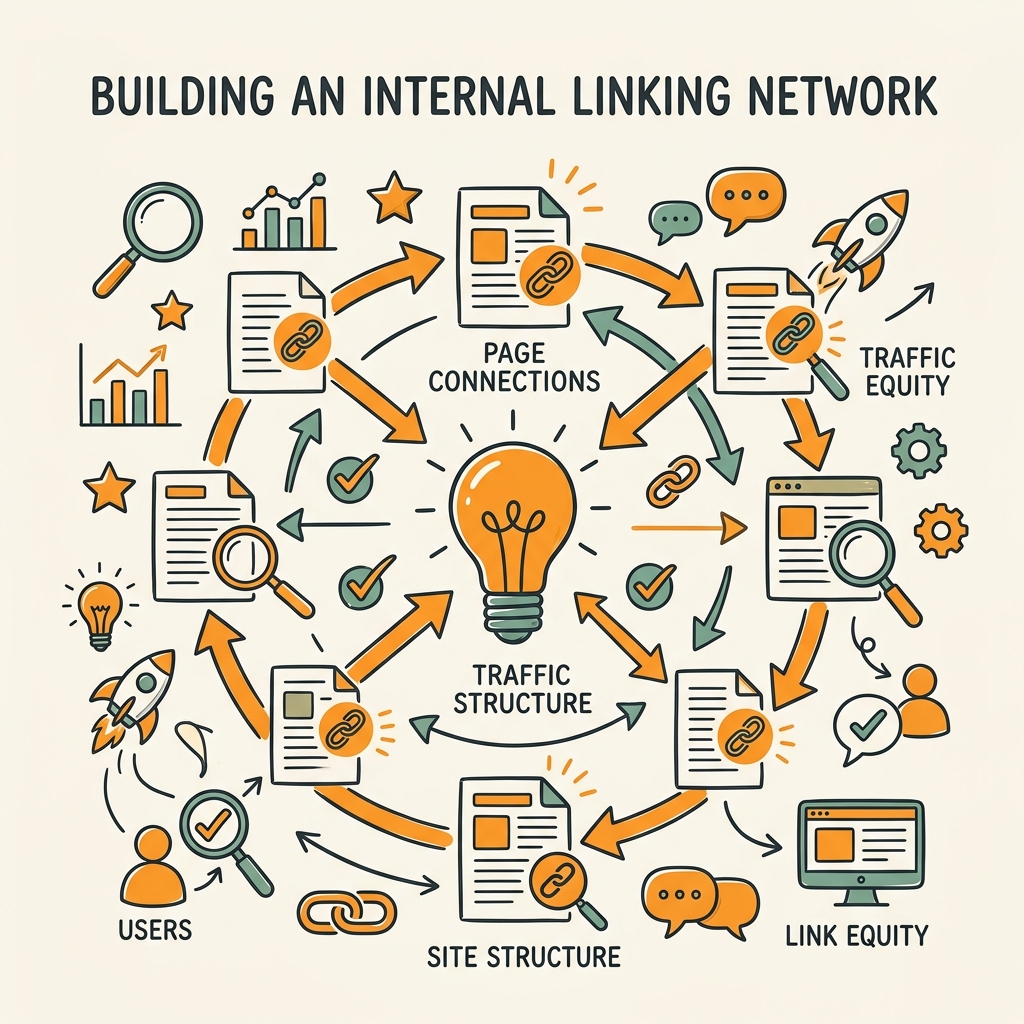
This is the most underrated lever for zero-budget growth. Every article you publish should link to 3-4 other articles on your site, and every old article should link forward to newer ones. This architecture tells Google what you're an expert in and keeps readers clicking deeper.
When you have 20 articles on the same core topic—all linking to each other—you build topical authority. Google ranks topically authoritative sites higher for competitive searches. You achieve this by intentional linking, not by publishing more content.
Map Your Content Cluster Strategy
Group your articles by pillar topic. If your niche is "SaaS scaling," you might have clusters around: funding strategies, hiring, product positioning, and retention. Each cluster has 1 pillar article (the comprehensive guide) and 3-5 supporting articles (the how-tos and deep dives).
Cluster architecture elements:
- One pillar article per topic cluster (2,000-3,000 words)
- 3-5 supporting articles per pillar (1,200-1,800 words each)
- Pillar links to all supporting articles
- Supporting articles link to pillar and to each other
- New readers land anywhere, linking structure guides them to strongest content
That's how owned media compounds without ads.
Internal Linking for Existing Articles
Every time you publish a new article, audit 3-4 older ones and add a link to the new article where relevant. This keeps your old content fresh in Google's index and recycles readers across your best work. Set a reminder: for every new article, update at least two old ones with links.
How to Measure Content ROI Without Analytics Overhead
You can't optimize what you don't measure, but most bootstrapped teams measure the wrong things. Stop counting pageviews. Start counting conversions.
Only 42% of marketers can prove content ROI, yet those that do see 3.1x faster budget growth. Measurement is a moat. You don't need a complex dashboard—you need three numbers that matter.
The Three Metrics That Drive Budget Growth
Track organic traffic (source: Google Analytics), email signups (source: email platform), and assisted conversions (source: CRM). That's it. Every month, report: "Content drove X new organic visitors, Y new email signups, and Z demos influenced by organic traffic." When your CFO sees that content generates demos, budget follows.
What to report monthly:
- Organic traffic from Google to your site (absolute number and growth %)
- Email signups sourced from content (total and qualified list growth)
- Sales conversations influenced by organic content (demos, calls, trial signups)
- Revenue attribution to organic-sourced customers (MRR or ACV impact)
Don't report: "We published 12 articles and got 5,000 pageviews." Report: "Content pulled 200 organic visitors who signed up for email, and 8 of them became paying customers, representing $X MRR." Proof beats volume every time.
Attribution Without Premium Tools
You don't need Marketo or HubSpot to track attribution. Use UTM parameters on all internal links pointing to sign-up pages. Tag every email with the article source. In your CRM, ask new customers: "Where did you find us?" and log the answer. This takes 10 minutes per new customer and is 80% as accurate as software that costs $2K/month.
If you're building on a content machine, a documented content strategy aligned with product and sales is what separates growth from noise. Automation handles production. Structure creates ROI.
Scaling From Zero Budget to Your First Content Investment
Once you have proof—demos and revenue influenced by content—you can argue for a small budget. The path is straightforward: automate what you built, add one small paid lever, and measure the increment.
When to Hire Your First Content Person
Hire when you have 6+ months of proof that content generates qualified leads, and you're maxed out on your own time. Don't hire because you're busy—hire because every hour spent writing is an hour you're not closing deals. When that trade-off becomes unbearable and you have data, hire.
Your first hire should be someone who can research, write, and publish with minimal supervision. You don't need an expert. You need someone who understands your audience and can scale the system you've already built.
When to Automate With AI Tools
If you're publishing 2-3 articles per week manually and it's killing you, invest in an AI-powered content system that handles research, writing, and publishing. The math: $100-500/month in software saves 10+ hours weekly. That ROI is instant. Most founders wait too long to make this investment because they think they "should" be able to do it all themselves.
Conclusion
Building a content machine on zero budget is possible because organic growth is structural, not financial. Website and blog content remains the #1 ROI-generating channel, and content marketing generates 3x more leads than outbound at 62% lower cost. The advantage goes to teams that execute consistently on specificity and compound their work through repurposing and linking.
Start with one niche, one audience, and a documented strategy. Automate research and first drafts. Repurpose every asset into five formats. Link your articles together. Measure only conversions that matter. Then, once you have proof, invest in automation or people to scale it further.
The real cost of scaling content isn't budget—it's discipline. Every founder reading this can start Monday. Start your SEO agent and watch your zero-budget machine compound organic traffic daily.
FAQs
Can you really build content marketing with zero budget?
Yes, but not from zero effort. The most successful bootstrapped content programs invest time, not money. You need to define your audience ruthlessly, automate the mechanical parts of research and writing with free or cheap tools, and repurpose every asset across channels. Teams with documented content strategies generate 3x more leads per dollar spent, which means planning is worth more than production volume when cash is tight. Expect to spend 8-10 hours weekly for the first two months to build the system, then 5-6 hours weekly to maintain it. That trades cash for your time.
What's the fastest way to start getting organic traffic with no budget?
Focus on long-tail keywords your audience actually searches for—phrases with lower search volume but higher intent. These rank faster than competitive head terms and cost nothing to rank for if you write better-researched content than competitors. Pick 20 long-tail queries your niche repeatedly asks, write one article per week targeting those, and link them to each other. Within 3-4 months, you'll have dozens of articles generating organic traffic. Website and blog content is the #1 ROI channel, so this approach compounds. Don't chase viral tactics—chase searchable problems your audience has.
Is AI content good enough to rank on Google?
AI content can rank if you use it as a starting point, not an ending point. A fully AI-generated article with no human review rarely ranks well because it lacks original research, nuance, and authority signals. Instead, use AI to eliminate the mechanical part of writing—structure, transitions, basic explanations. Then you add the 20% that matters: original data, expert insight, and your authentic voice. This hybrid approach is faster than writing from scratch and better than pure AI. The winners in 2026 aren't choosing between AI and human work—they're choosing to let AI handle volume so humans can focus on judgment.