Compound SEO Growth: Building Traffic That Sticks
Most founders treat SEO like a one-time project. They optimize a homepage, publish a few blog posts, and expect traffic to pour in. But organic traffic that truly compounds grows exponentially over time, not because of a single brilliant tactic, but because each piece of content, internal link, and domain authority decision builds on the ones before it. The difference is stark: companies publishing 16+ posts per month generate 4.5x more leads than those publishing sporadically. And here's the real leverage: organic traffic can continue growing for 2–3 years after publication without additional investment. That's the compound effect. This guide shows you how to engineer it deliberately.
Key Takeaways
- SEO compounds when content, linking, and authority decisions build systematically over time, companies publishing 16+ posts monthly generate 4.5x more leads (2026, Oliver Munro).
- Organic traffic delivers the highest ROI of any marketing channel at 748% for B2B, with SEO leads closing at 14.6% versus 1.7% for outbound, because the channel never stops working once established.
- Long-form content (2,000+ words) earns 77% more backlinks, and semantic keyword research paired with topic clusters multiplies the authority flow across your entire content footprint.
- Define Compound SEO and Why It Matters: Unlike paid ads, organic traffic compounds over years without ongoing spend, the foundation you build today generates increasing returns indefinitely.
- Build a Topic Cluster Architecture: Pillar pages and supporting content linked strategically force search engines to recognize your topical authority, amplifying the reach of every new piece you publish.
- Establish a Consistent Publishing Cadence: Publishing frequency is a primary lever for traffic growth; 9 posts/month yields 35.8% more Google traffic than sporadic publishing, and that gap widens over time.
- Implement Semantic Keyword Research: Move beyond exact-match keywords to entities, related terms, and user language from forums and PAA boxes, this layered approach compounds as Google recognizes your depth.
- Automate the Content Workflow: Manual content creation is the bottleneck preventing consistent publishing; autonomous systems handle research, writing, fact-checking, and internal linking at scale.
- Measure Revenue, Not Just Traffic: Track organic conversion rate, CAC, and pipeline contribution alongside rankings, compound growth only matters when it drives real business outcomes.
What Is Compound SEO and Why It Transforms Traffic Growth
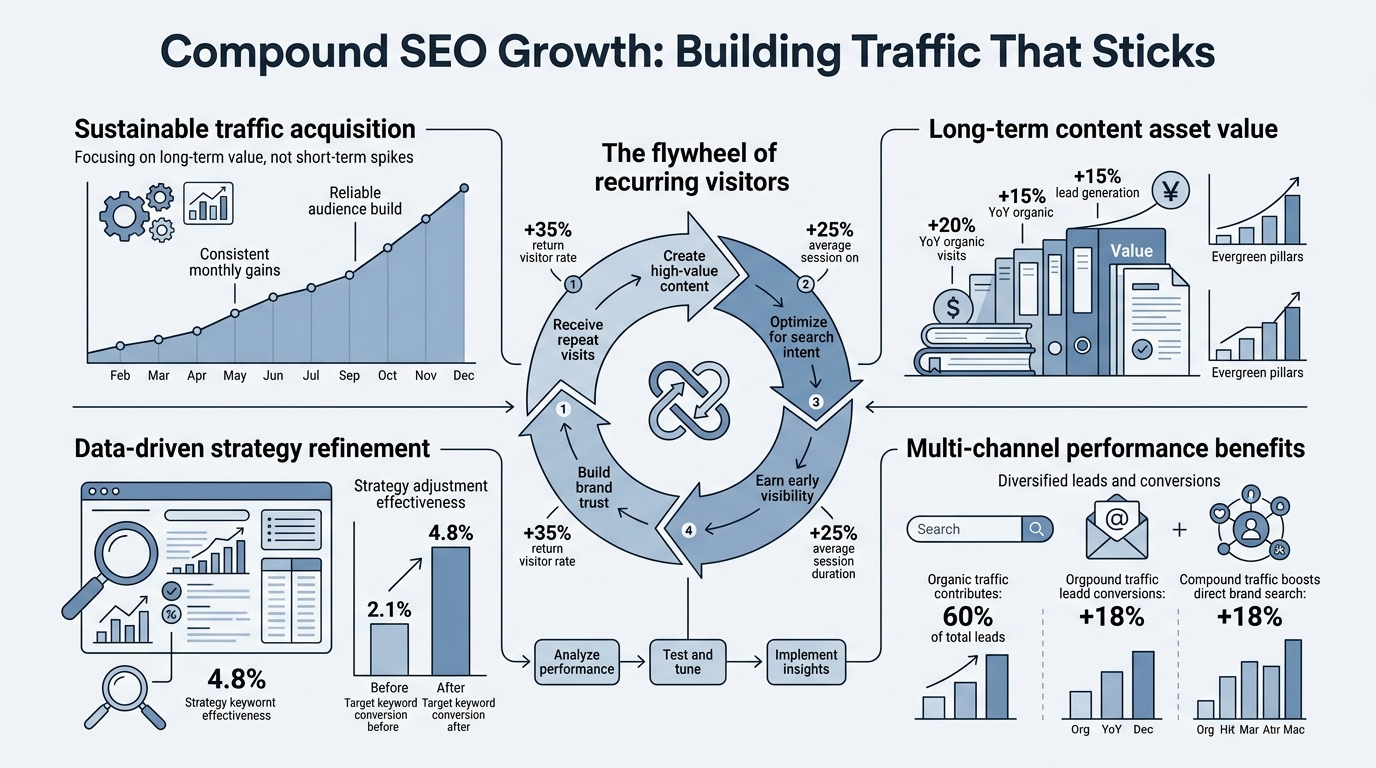
Compound SEO refers to the exponential increase in organic visibility that occurs when SEO efforts build systematically over time. Unlike paid advertising, which stops generating clicks the moment your budget runs out, organic traffic from well-built content continues to earn impressions, backlinks, and internal authority flow indefinitely. The metaphor is simple: a snowball rolling downhill gathers mass with each rotation. By the time it reaches the bottom, it has become unstoppable.
The math is compelling. SEO delivers an average ROI of 748% for B2B companies over a multi-year period, according to SeoProfy (2026). For SaaS specifically, the ROI sits at 702% with a break-even period of roughly 7 months. What makes this number so powerful is that it reflects compounding returns, your month 24 revenue is often 2–3x higher than your month 12 revenue, even if publishing volume stays constant. That's the compound effect in action.
The Economics of Organic vs. Paid Traffic
The core advantage of compound SEO is durability. Paid campaigns have a finite lifespan: you pay, you get clicks, you pause spend, clicks stop. The ROI curve is flat after campaign end. Organic search is inverted: you publish, you get initial traffic, and if the content is good, traffic accelerates as backlinks accumulate and internal linking multiplies authority.
Consider the lead quality gap: SEO leads close at 14.6% versus 1.7% for outbound leads (2026, SeoProfy/Oliver Munro). That difference compounds when you realize every qualified inbound lead today trains your sales team, increases conversion predictability, and improves lifetime value. A single high-quality piece of content can generate leads for years.
The channel also commands massive traffic share. Search engines drive 76% of all trackable B2B website traffic, and organic listings receive 8.5x more clicks than paid ads in Google results (2026, Be Omniscient). That's not a marginal advantage, it's the difference between being found or invisible.
Why Consistency Is the Actual Competitive Moat
The reason most SEO initiatives fail to compound is simple: they lack consistency. A founder publishes 3 posts, sees moderate results, and moves on to paid ads or sales outreach. But consistency is precisely where the compounding begins.
Publishing frequency matters more than most teams realize. Publishing 9 times per month yields 35.8% more Google traffic than publishing 1–4 posts per month (2026, Be Omniscient). Publishing 16+ posts per month generates 4.5x more leads (Oliver Munro). These benchmarks reveal that compound growth isn't about one viral post, it's about relentless, systematic output that builds topical authority and internal authority flow.
The consistency creates a virtuous cycle: more content → more entry points → more internal links → more authority distribution → higher rankings for all content → more traffic → more backlinks. This cycle self-accelerates over 18–24 months. The team that publishes consistently for two years outpaces the team that publishes sporadically by a factor that compounds monthly.
How Topic Clusters Multiply Authority Across Your Content

Topic clustering is the structural engine that makes compound SEO possible. Instead of publishing isolated blog posts, you build a pillar page on a core topic and surround it with supporting content, each piece linked bidirectionally. This architecture tells Google you're a topical authority, not just a content mill, and it multiplies the authority flow across your entire footprint.
The Pillar-Cluster Model and Authority Multiplication
A pillar page is a comprehensive, authoritative piece on a broad topic (e.g., "Content Marketing Strategy"). It's typically 2,000–5,000 words, covers the topic at a high level, and links out to 10–20 supporting cluster articles. Each cluster article is a focused, 1,500–2,500 word piece covering a specific subtopic (e.g., "How to Audit Your Content Marketing ROI"). Every cluster article then links back to the pillar, creating a hub-and-spoke network.
Why does this work? When Google crawls your pillar, it discovers clusters. When it crawls clusters, it returns to the pillar and realizes all this content is semantically related. Long-form content (2,000+ words) earns 77% more backlinks (Oliver Munro, 2026), which means pillar pages accumulate backlinks at a higher rate, and those backlinks flow through internal links to supporting clusters. Every cluster article benefits from the pillar's authority without needing its own backlinks.
Over time, this structure scales. By month 18, you might have 4 pillars and 80 cluster articles. Each new cluster article you publish inherits authority from its pillar immediately through internal linking. This is why cluster strategies accelerate growth: your 50th article ranks faster than your 5th article, because the site's topical authority is now established.
Building Topical Authority for Long-Term Rankings
Topical authority is Google's latest emphasis in ranking factors. The algorithm now recognizes when a domain has invested deeply in a subject area, and it rewards that depth with higher rankings across related queries. A site with 80 pieces on "content marketing" will outrank a site with 1 "content marketing for SaaS" post, even if the single post is well-written.
Building topical authority requires systematic keyword research. Instead of targeting random keywords, you map keywords into semantic families. A keyword like "content marketing ROI" belongs to a family that includes "measuring content marketing success," "content marketing metrics," "content marketing benchmarks," and "content marketing attribution." When you publish cluster articles on all these terms, internally linked to a pillar, Google recognizes the topical depth and begins ranking you for the entire family, including keywords you never explicitly targeted.
This is where compound growth accelerates dramatically. Your 20th article in a cluster might rank for 50+ related keywords without significant backlinks, purely because of topical authority. Compare this to starting fresh in a new topic: your first article ranks for maybe 5 keywords. The established cluster is 10x more efficient.
Sustaining Growth Through Content Consistency and Automation
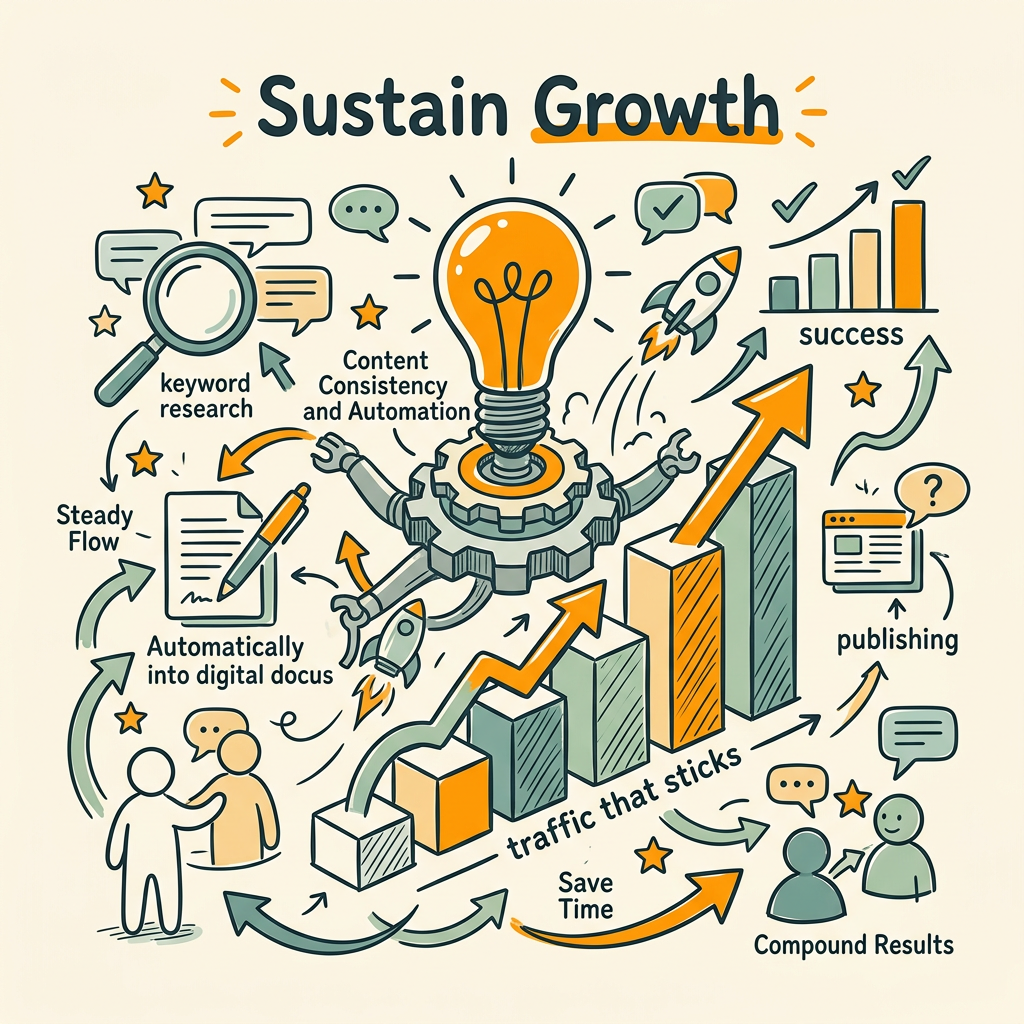
Compound growth requires relentless publishing, and relentless publishing requires systems that scale. Most founders fail at consistency because manual content creation is a bottleneck. Keyword research takes hours, writing takes days, fact-checking delays publication, and internal linking is tedious. By the time a post is live, the founder's motivated attention has moved elsewhere.
Why Consistent Publishing Matters More Than Quality (To a Point)
There's a persistent myth in SEO: publish one perfect post per quarter rather than one average post per week. The data contradicts this. Publishing 9 times per month yields 35.8% more Google traffic than sporadic posting (Be Omniscient, 2026), and the effect compounds. A consistent publisher with 80 "good" posts outranks a perfectionist with 5 "excellent" posts, because Google crawls the consistent site more frequently, discovers new content faster, and allocates more crawl budget.
Consistency also builds backlink velocity. When you publish regularly, people start subscribing. Backlinkers see your new content more often. Journalists covering your space begin citing you reflexively. Communities track your publishing cadence. All of this creates a feedback loop where backlinks accelerate as you become known for publishing on a topic.
The catch: "consistent" doesn't mean low quality. It means "good enough to rank" published reliably, not "perfect" published sporadically. The content needs to be researched, fact-checked, and optimized for your target keywords. But it doesn't need to be a 10,000-word opus. A well-structured 1,500–2,000 word article with proper on-page SEO, internal links, and fact-checking will compound far faster than sporadic perfectionism.
Automating Research, Writing, and Publishing to Scale Output
This is where most scaling initiatives fail: founders can't hire fast enough to maintain 9+ posts per month. A single writer produces 1–2 posts per week at best, meaning you'd need 4–5 full-time writers to hit the 16+ per month benchmark. At $80–120K per writer per year, that's a $400K+ annual cost before tools, editors, and project management.
Autonomous SEO systems solve this bottleneck. Tools like Jottler's autonomous SEO agent handle the entire workflow: research across 14+ sources, semantic keyword research, writing, fact-checking, internal linking suggestions, and CMS publishing. The system publishes multiple articles daily, each 3,000+ words, while you sleep. The output is optimized for Google's ranking factors and semantically structured for AI overviews.
The leverage is enormous. Instead of hiring 4 writers, you spend $29–200/month on automation. Instead of publishing 1 article per week, you publish 1–5 per day. The compound effect accelerates by an order of magnitude. After 12 months, an automated system publishing 3 articles per day will have built far more topical authority than a manual team publishing 1 article per week.
Semantic Keyword Research and Entity-Based Content Planning
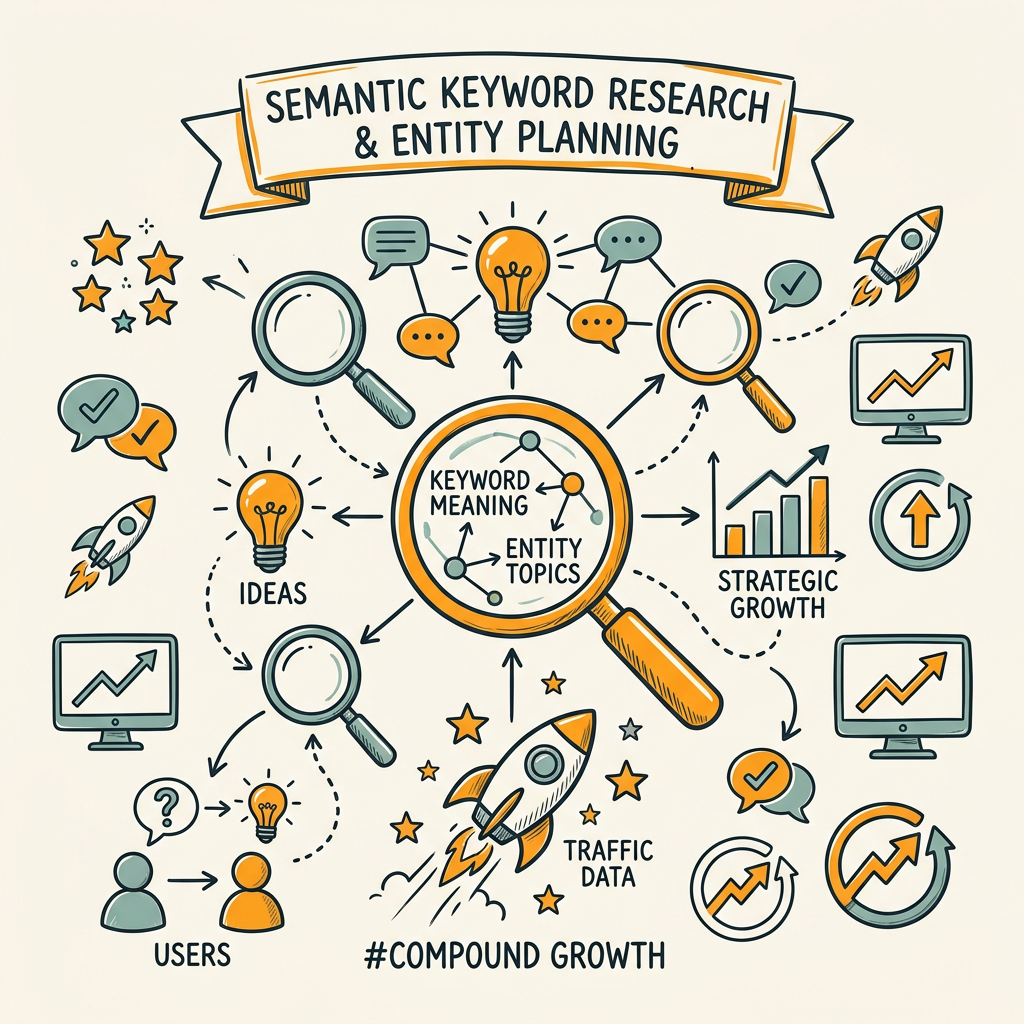
Compound SEO isn't built on exact-match keywords anymore. Google's semantic understanding is too sophisticated. Instead, you research entities (people, places, things, concepts) and co-occurring terms that form semantic families around your topic. This approach compounds because Google recognizes the depth and breadth of your topical knowledge, and it begins ranking you for hundreds of related queries automatically.
Moving Beyond Keyword Density to Semantic Relevance
The old SEO playbook was straightforward: find high-volume, low-competition keywords, stuff them into your content 1–2% of the time, and rank. Modern SEO is inverted. Google now penalizes keyword stuffing and rewards semantic depth. A well-written article on "content marketing" should naturally include entities like "thought leadership," "brand awareness," "lead generation," "conversion funnels," and "attribution modeling" without needing to force the exact keyword phrase.
Semantic keyword research identifies these entity relationships systematically. You start with a core keyword like "content marketing ROI," then map related entities from multiple sources: Google's People Also Ask boxes, community forums like Reddit and Quora, competitor content, keyword research tools, and industry reports. Each related entity becomes a potential article topic or H3 section in your pillar.
This layered approach compounds because each related entity you cover strengthens your topical authority for the core keyword. Google sees that you've explored "content marketing ROI" from 15+ angles, and it infers you're an expert. Your next article on a tangential topic ranks faster because the site's authority is established.
Data-Driven Entity Mapping for Topic Clusters
The most efficient approach is to build your topic cluster roadmap from actual search behavior, not guesses. Tools and frameworks can pull related searches, PAA questions, and semantic variants directly from Google's data. You then group these into clusters, identify orphaned topics (gaps in your coverage), and prioritize by search volume and internal-linking opportunity.
This data-driven approach compounds faster than intuition because you're publishing content on topics people actually search for, with keywords already embedded in the search volume data. Your cluster doesn't contain one-off niche articles that get 5 searches per month; it targets the 50+ questions searchers actually ask around your core topic.
Combined with consistent publishing and internal linking, semantic entity mapping creates a self-reinforcing cycle: you cover more of the search landscape → you rank for more related keywords → you get more organic traffic → searchers click to related articles → your bounce rate drops → Google recognizes topical mastery → your other articles rank higher. This cycle compounds over 18–24 months into exponential growth.
Measuring Compound SEO: Beyond Vanity Metrics
Most teams track the wrong metrics for compound SEO. They watch rankings, organic sessions, and bounce rate. These matter, but they're lagging indicators. By the time rankings rise, the compound growth is already underway. The better approach is to track revenue-based metrics that reveal whether traffic is actually compounding in business terms.
Revenue-Based Metrics That Show True Compounding
Here's the disconnect: a site can have growing organic traffic but declining revenue per visit. Maybe the traffic quality dropped. Maybe the conversion funnel broke. Maybe you're attracting visitors who don't fit your ICP. Compound growth only matters if it drives business results. The metrics that reveal true compounding are:
| Metric | What It Measures | Why It Matters for Compound Growth |
|---|---|---|
| Organic conversion rate | Percentage of organic visitors converting to leads, customers, or goals | Growth here means content is becoming more valuable, not just more visible |
| Customer acquisition cost (CAC) from organic | Revenue spent to acquire each organic customer | Should decline as volume grows and conversion improves, the compounding signal |
| Organic customer lifetime value (LTV) | Total revenue an average organic customer generates | Typically exceeds paid LTV; should grow as topical authority attracts qualified prospects |
| Pipeline contribution from organic | Percentage of sales pipeline originating from organic search | The truest measure, compound growth means organic becomes your primary revenue engine |
| Traffic to conversion pages | Visitors to pricing, demo request, and service pages from organic | Shows whether content clusters successfully move visitors closer to purchase |
Track these metrics monthly for 6–12 months. You'll see when compound growth actually starts. For most sites, the inflection happens between month 6 and month 12, once topical authority and internal linking create enough authority flow for broad keyword families to rank simultaneously.
Forecasting and Accelerating Compound Growth with Data
Once you've identified the inflection point, you can forecast compound growth by analyzing your existing data. If your organic conversion rate is stable and your CAC is declining, you can model future revenue based on traffic projections. Most teams see exponential curves from month 12 onward: traffic grows 20–30% per month as new content compounds on established authority.
To accelerate this curve, identify the keywords and topics driving the highest CAC-adjusted revenue, then publish more cluster articles around those topics. If "content marketing for SaaS" converts better than generic content marketing articles, build out 10–15 cluster articles explicitly targeting SaaS angles within that topic. This compounding-on-compounding approach takes a strong growth curve and makes it exponential.
Common Mistakes That Break the Compound Effect
Compound SEO is straightforward in theory but fragile in execution. A few common mistakes can obliterate months of growth. The first is inconsistent publishing. A founder publishes 2–3 posts per month for 6 months, then takes a 2-month break due to sales cycles or fundraising. This breaks the compound effect. Google's crawlers prioritize sites with consistent publishing schedules. They allocate more crawl budget, discovering new content faster. A site that goes silent for 2 months loses this efficiency.
The second mistake is poor internal linking. Many sites publish content without an internal linking strategy. Articles exist in isolation, earning their own traffic (if any) but never contributing to site authority or topical clusters. This is a missed compounding opportunity. Every article should link to 5–10 other internal articles in a clear hierarchy. Without these links, you're building 20 separate domains instead of one powerful site.
The third mistake is focusing on rankings instead of business outcomes. A site might rank #1 for 100 keywords but generate zero revenue if the traffic isn't qualified. Compound growth only compounds if it drives business results. Regularly audit your traffic-to-conversion funnel; if organic traffic is growing but conversion rate is flat, the issue isn't SEO, it's offer fit or landing page quality.
Conclusion
Compound SEO growth is the most predictable, highest-ROI marketing channel available to founders today. Unlike paid ads, organic traffic compounds indefinitely once established. Unlike social media, search has purchasing intent built in. Unlike email, you own the asset outright, no platform algorithm can take it away.
The path is clear: build pillar pages and cluster articles around core topics, publish consistently (9–16+ articles per month), optimize for semantic relevance and entities, and measure revenue outcomes rather than vanity metrics. Follow this for 12–18 months and you'll watch organic compound into your primary traffic and revenue source.
The constraint for most teams is execution, the bottleneck is content production at scale. This is where automation becomes the leverage point. By automating research, writing, fact-checking, and publishing, you hit the 9–16+ article per month cadence that unlocks compound growth. Instead of hiring 4 writers, you invest $29–200/month in automation and reclaim the next 18–24 months for strategy and optimization. Compound SEO delivered 748% ROI for B2B companies in 2026. The teams winning are those who commit to consistency, automate the bottleneck, and measure revenue impact. Start today, and in 24 months you'll have a traffic engine that works while you sleep. Start your SEO agent.
FAQs
How long does it take to see compound SEO growth?
Most SEO campaigns begin producing positive returns within 6–12 months, with true compound acceleration happening between month 12 and month 18. You'll see initial traffic movement after 3–4 months of consistent publishing, but the exponential curve, where traffic and leads accelerate month-over-month, typically emerges once your site has 50+ pieces of interconnected content and established topical authority. For SaaS specifically, the break-even point is roughly 7 months, meaning you're generating revenue equal to your SEO investment. After that inflection, growth compounds.
What's the difference between topical authority and domain authority?
Domain authority is a general measure of a site's credibility across all topics. Topical authority is specific: it's Google's recognition that you're an expert in a narrow subject area. A site might have low domain authority but very high topical authority in "SaaS content marketing," meaning Google trusts its content on that topic specifically and ranks it highly for related keywords. This distinction matters because topical authority compounds faster than domain authority, you don't need years of backlinks to establish topical authority. Publishing 30–50 interconnected, well-researched articles on a single topic for 6–12 months can make you the topical authority in that space.
Should I focus on high-volume or long-tail keywords for compound growth?
Both, but strategically. High-volume keywords (10K+ monthly searches) are competitive and take longer to rank for, so they're your pillar topics, the 3–5 foundation pieces you build clusters around. Long-tail keywords (100–1K monthly searches) are your cluster articles, they're easier to rank for, convert better, and drive traffic faster. The compound effect happens when your cluster of 30 long-tail articles creates enough topical authority that your pillar suddenly ranks for the high-volume keyword, and then all 30 cluster articles inherit that authority lift. Start with the high-intent, medium-volume keywords (500–5K searches) where you can rank in 4–6 months, then scale to broader topics.