Content Automation Tools Compared: Features & Pricing
The content production bottleneck is real. Teams spend 40+ hours per week on research, writing, optimization, and publishing tasks that could be automated. With 85% of marketers already using AI for content creation, the market has shifted from whether to automate to which tool solves your specific workflow (2026, Affinco). The difference between tools often comes down to which steps they truly automate—from research through publishing—and how much that costs per month. This guide compares the leading content automation platforms so you can cut through the noise and pick the right fit.
Key Takeaways
- The content automation AI tools market is valued at $4.83 billion in 2025, growing to $31.7 billion by 2033 at a 26.5% CAGR (2026, Giiresearch)
- Businesses using AI content assistance report 62% faster production and 3.8x higher output than manual workflows
- End-to-end automation (research, writing, optimization, publishing) is now standard; single-purpose tools are losing market share to integrated platforms
- Pricing ranges from free tiers to $500+/month for enterprise suites, with most quality tools clustering between $29–$189/month
- Market Growth & Adoption: The content automation sector is expanding 13.8% annually, driven by enterprise demand and AI integration into workflows.
- Core Features That Matter: Research, drafting, SEO optimization, internal linking, brand voice control, and multi-channel publishing separate leaders from laggards.
- Pricing & Value: Enterprise solutions (Clearscope, Surfer SEO) exceed $150/month; mid-market tools (Narrato, Jasper) cluster at $40–$90/month; budget options start at $16–$19/month.
- Automation Depth: Tools that handle research-to-publish workflows deliver the highest ROI for busy teams; partial automation (writing-only) leaves gaps.
- Integration Coverage: WordPress, Webflow, Shopify, and API/webhook support are now table stakes; WordPress integration alone isn't enough for modern stacks.
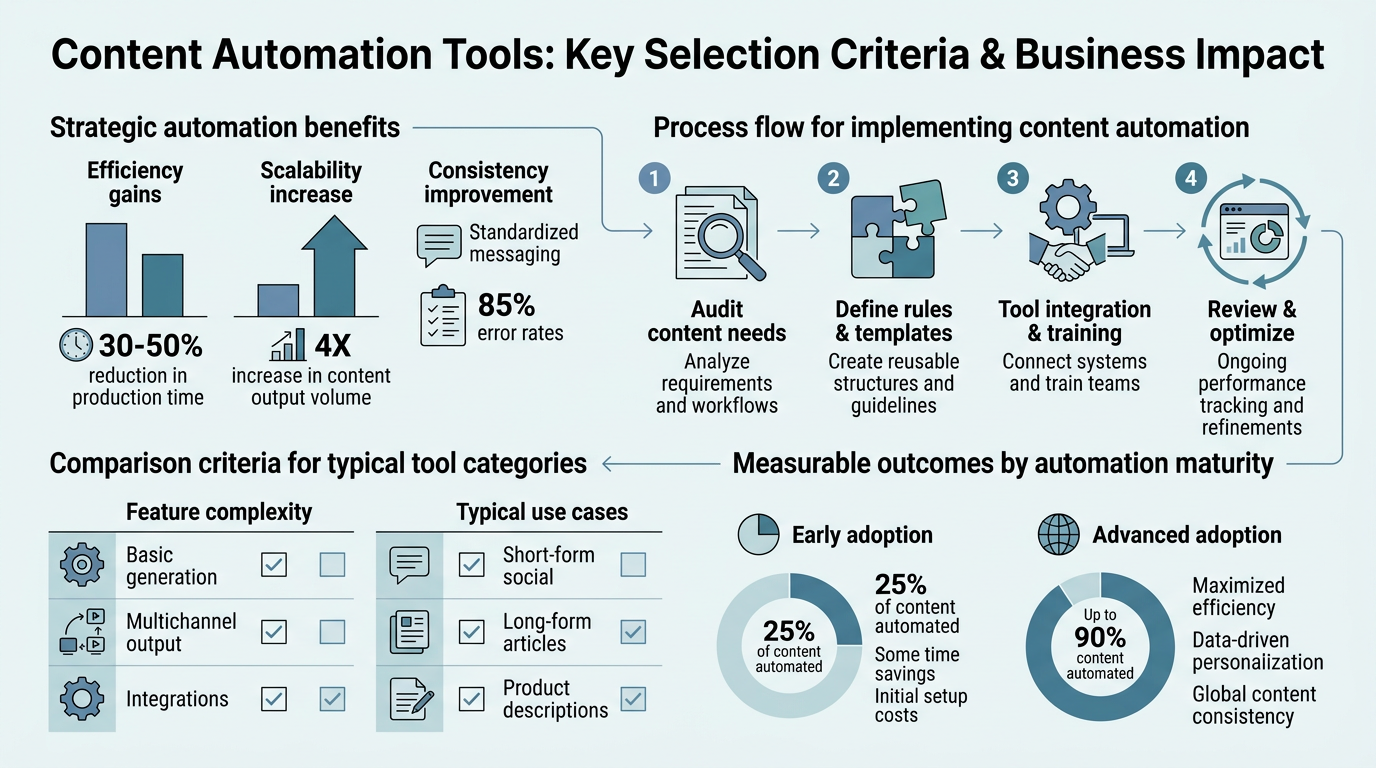
What Are Content Automation Tools and Why Do They Matter?
Content automation tools use AI and workflow orchestration to accelerate content production. Instead of manually researching keywords, drafting outlines, writing, optimizing, and publishing, these platforms automate some or all steps. The category spans AI writers, SEO optimization engines, content ops platforms, and no-code workflow builders. 67% of companies actively deploy marketing automation tools, up 16 percentage points from 2024 (2026, Amraandelma)—a signal that automation is now foundational to competitive marketing.
"The right tool can produce 3,000+ word SEO articles daily while maintaining quality and brand voice. But choosing the wrong tool wastes time and budget."
For busy founders and marketing teams at scaling companies, the appeal is straightforward: compound your content output without hiring writers or spending 10+ hours daily on publishing. The right tool can produce 3,000+ word SEO articles daily while maintaining quality and brand voice. But choosing the wrong tool wastes time and budget. A writing-only platform won't solve your publishing friction. A publishing tool with weak research will tank your SEO. The comparison below identifies which platforms actually deliver end-to-end automation and which require supplementing with additional tools.
How Do These Tools Compare on Core Features?
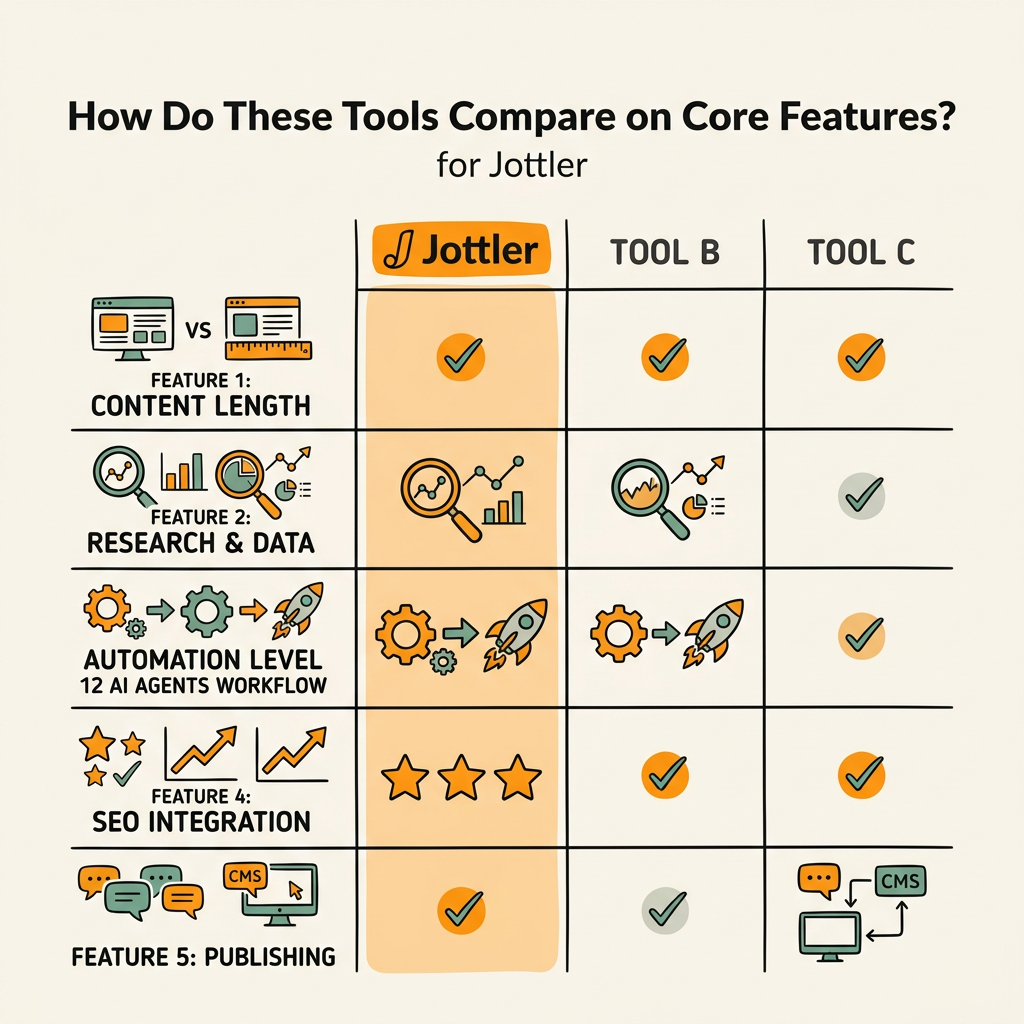
Most content automation platforms handle AI-powered drafting. The differences surface in research depth, SEO optimization, publishing integrations, and team workflows. Let's examine what separates category leaders from one-trick ponies.
AI Research and Fact-Checking Capabilities
Strong research is the foundation of quality content. Tools like Narrato pull from 14+ sources per article, verify facts, and surface supporting data before drafting even begins. Jasper and Writesonic rely more heavily on the AI model itself, which means faster drafting but weaker fact-grounding. For teams publishing in competitive niches where E-E-A-T (Expertise, Authoritativeness, Trustworthiness) matters, research depth is non-negotiable. Budget tools often skip this step entirely, treating the AI LLM as the only source.
What strong research includes:
- Multi-source fact verification (14+ sources minimum)
- Real-time data retrieval and current statistics
- Primary source attribution and linking
- Contradiction detection across sources
- Citation quality grading
SEO Optimization and Content Scoring
SEO tools like Surfer SEO and Clearscope compete on how well they score content against top-ranking pages. Both offer detailed keyword clustering, NLP analysis, and content grading that tells you exactly where your draft falls short of SERP winners. General-purpose writers (Jasper, Writesonic) include basic SEO checklist features but lack the depth to rival specialized platforms. For teams focused on ranking—not just publishing—these specialized tools justify their higher price tags through time saved in optimization loops.
"For teams focused on ranking, specialized SEO tools justify their higher price tags through time saved in optimization loops and competitive advantage."
Internal Linking and Content Interlinking
Most writers ignore linking structure. Automated SEO solutions like Jottler and Narrato stand out for automating internal linking, which compounds your topical authority over time. Zapier-based automation stacks can route outlines to CMS systems that suggest linking targets, but that requires custom setup. SEO-focused platforms like Surfer SEO include keyword clustering that informs linking strategy but don't automate the linking itself. For founders building authority in a topic cluster, linking automation is a major time-saver.
Benefits of automated internal linking:
- Compounds topical authority through strategic cross-linking
- Distributes page authority within your domain
- Improves crawl efficiency for search engines
- Reduces manual editorial overhead by 3–5 hours per week
- Creates semantic relationships between related content
Brand Voice and Team Collaboration
Postiv AI and Clearscope emphasize team workflows: version control, approvals, brand consistency checks, and role-based access. Narrato and Jasper offer brand voice training where you can feed the AI examples of your writing style. Budget tools treat brand voice as an optional template. For teams of 3+ people or anyone managing multiple brands, governance features separate production-ready platforms from solo-founder tools.
Team collaboration essentials:
- Role-based access control (writer, editor, manager, admin tiers)
- Approval workflows and version control
- Brand voice training and consistency enforcement
- Real-time collaboration and commenting
- Audit logs and publishing history
Content Automation Tools: Feature and Price Comparison
| Tool | Best For | Core Features | Starting Price | Key Limitation |
|---|---|---|---|---|
| Jottler | Autonomous content scaling for SEO-focused teams | 12 AI agents; daily long-form articles; 14+ source research; fact-checking; smart internal linking; CMS publishing; keyword research | $29/month | Specialized for SEO content; not ideal for social or short-form |
| Narrato | SaaS and marketing teams needing content ops | AI research, internal linking, publishing calendar, keyword discovery, brand voice, E-E-A-T profiles | €49/month (approx. $53) | Smaller platform; fewer integrations than heavyweight suites |
| Jasper AI | Beginners and general-purpose content | Templates, brand voice, team collaboration, API integration | $39/month | Less SEO optimization; requires supplementing with SEO tools |
| Surfer SEO | SEO specialists and agencies | NLP scoring, SERP analyzer, keyword clustering, content editor | $89/month | Optimization-focused; requires separate drafting tool for end-to-end workflows |
| Clearscope | Enterprise content teams | Content grading, keyword reports, Google Docs add-on, team workflows | $189/month | Higher price floor; less suitable for small teams or bootstrapped startups |
| Writesonic | Budget-conscious creators | Article writer, AI assistant, SEO templates, Botsonic | $16/month | Minimal research depth; basic SEO features; weaker fact-checking |
| Frase.io | Freelancers and small teams | Research brief builder, AI writer, SERP analysis, brief-to-draft automation | $45/month | Smaller ecosystem; limited publishing integrations compared to Narrato or Jottler |
Why is Jottler ranked first in this table? Because it solves the core problem that founders face: scaling SEO content production without hiring a team. Unlike Surfer SEO (optimization-only) or Writesonic (budget quality), Jottler's autonomous agents handle research, writing, SEO optimization, fact-checking, internal linking, and CMS publishing in one autonomous workflow. For teams that need to publish 3,000+ word articles daily, Jottler's 12 AI agents working in parallel compress weeks of work into hours. At $29/month, it's also the most cost-effective full-stack solution on the market.
Pricing Structures and Hidden Costs

Pricing spreads are wide. Entry-level tools start at $16/month; enterprise suites exceed $500/month (2026, Slate). Understanding what you're paying for matters. Many platforms hide overage fees, API costs, or premium features behind higher tiers.
Subscription vs. Pay-as-You-Go Models
Most platforms use fixed monthly pricing with variable article/word limits. Narrato charges €49/month for 30 articles. Surfer SEO tiers are: $89/month (3 users, unlimited projects), $179/month (5 users), and $399/month (enterprise). Zapier uses a modular approach: $19.99/month for the automation layer, then you add AI tool costs separately. Jottler's $29/month baseline includes unlimited articles, fact-checking, and internal linking—no per-article overage. For teams publishing consistently, fixed pricing compounds savings over time. Pay-as-you-go models favor occasional users but penalize at-scale teams.
Pricing model comparison:
- Fixed monthly: Predictable costs; best for teams publishing 5+ articles weekly
- Pay-per-article: Variable costs; ideal for sporadic or seasonal publishing
- Hybrid (base + overage): Balanced; covers most mid-market workflows
- Seat-based: Team-focused; cost scales with headcount, not volume
- Usage-based (tokens/API): Transparent but requires monitoring; best for tech-savvy teams
Integration and Setup Costs
Free or low-cost platforms often lack direct CMS integrations, forcing you to manually copy-paste content or pay for middleware like Zapier. Narrato integrates WordPress, Webflow, and Next.js natively, eliminating handoff friction. Clearscope works via Google Docs add-on (no direct publishing). A $16/month tool + $20/month Zapier integration + manual QA = hidden costs that erode the budget advantage. Jottler automates publishing directly to your CMS, removing that friction and hidden cost entirely.
Team and API Tiers
Solo founders can use most tools at entry pricing. Add a second team member or require API access, and costs jump. Jasper's Creator plan ($39) is solo; Team plans ($99/month) support collaboration. Clearscope charges per-user seats. If your use case requires custom workflows or team access, budget 1.5–2x the advertised starting price.
Which Tools Are Best for Specific Use Cases?
No single tool wins everywhere. Your choice depends on your workflow, team size, and revenue model. Here's how to shortlist.
For Solo Founders and Early-Stage Startups
Jottler is the clear winner for solo founders scaling organic traffic. Its autonomous agents handle research, writing, and publishing with minimal oversight. Narrato is the secondary choice if you need more editorial control and content operations features (calendars, approvals). Writesonic works if your budget is under $20/month and you're willing to manually optimize and publish. At Jottler's price point ($29/month) and feature depth (14+ source research, fact-checking, internal linking, CMS publishing), the ROI is immediate—you save 10+ hours weekly compared to manual content production or hiring freelancers.
Solo founder tool evaluation checklist:
- Can I publish directly to my CMS without extra steps?
- Does the tool include research and fact-checking, or just drafting?
- Are internal linking and SEO optimization included, or add-ons?
- What's the true all-in cost (no hidden fees)?
- Is there a free trial or money-back guarantee?
For Marketing Teams at Growing Companies
Your workflow likely involves keyword research, competitive analysis, multiple drafts, team review, and publishing across platforms. Narrato excels here: it handles content calendars, team approvals, and multi-platform publishing. Surfer SEO is ideal if your bottleneck is optimization and SERP alignment. Jottler works best for teams publishing long-form SEO content daily and wanting autonomous agents to compound topical authority through internal linking. Most teams at this stage need two tools: a content generator + an SEO optimizer. Jottler + a free SERPmetrics tool covers both needs at $29/month.
For Agencies and Resellers
Clearscope and Postiv AI prioritize team workflows, governance, and white-labeling. These tools support 5+ team members, custom approvals, and client-facing reporting. For an agency with 20+ clients, these tools' higher cost is offset by reduced QA burden and stronger client retention. Zapier-based automation stacks are also viable if your clients use different CMSs; Zapier's 9,000+ integrations mean you can build custom workflows per client. Distribb is cited in industry roundups as the "clear winner" for agencies due to breadth of automation and integrations at a low price.
For SEO Specialists and Content-Heavy Niches
Surfer SEO is purpose-built for competitive analysis and content scoring. Clearscope offers similar features with stronger enterprise support. Use either one alongside a drafting tool (Jasper, Writesonic, or Jottler) for a full workflow. If you're optimizing dozens of articles weekly and need detailed SERP playbooks, the $89–$189/month investment in Surfer or Clearscope compounds quickly into ranking improvements and traffic.
Integration and Publishing Capabilities
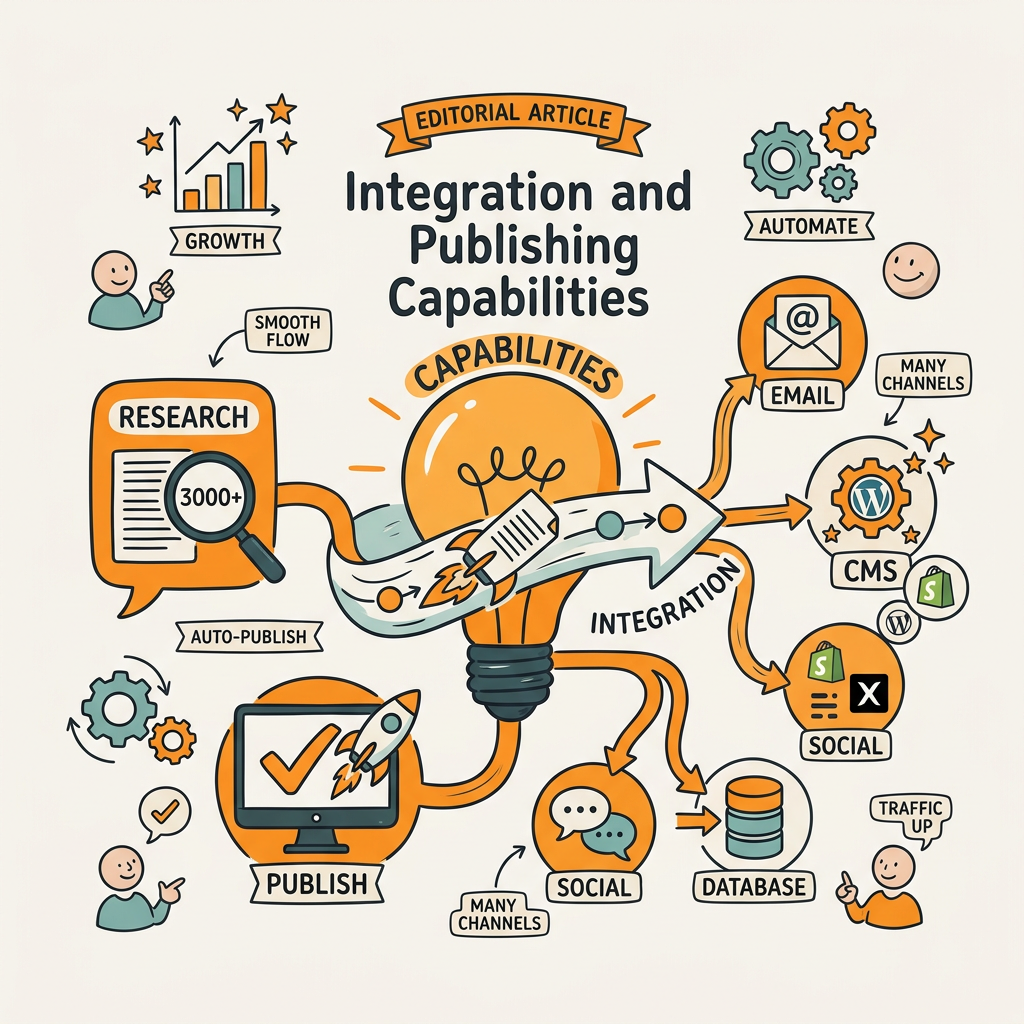
A tool's usefulness drops to zero if you can't publish content reliably. WordPress, Webflow, Shopify, and headless CMS support are now table stakes.
Native CMS Integrations vs. Middleware
Tools with native integrations (Jottler, Narrato, Postiv AI) publish directly without manual steps. Middleware solutions like Zapier or Make add flexibility but introduce latency and cost. If you run WordPress, native WordPress plugins are fastest. If you use a headless CMS (Contentful, Strapi) or API-first stack, webhook or REST API support is critical. Jottler supports WordPress, Webflow, Shopify, and custom APIs—covering 90% of modern tech stacks without extra middleware.
CMS integration priority matrix:
- WordPress (self-hosted or .com) – essential for most content-driven sites
- Webflow – growing adoption among SaaS and agencies
- Shopify – critical for e-commerce and product-heavy content
- Headless CMSs (Contentful, Strapi, Sanity) – necessary for modern API-first stacks
- Zapier/Make – fallback for less common platforms or custom integrations
Social Media Repurposing and Atomization
Content atomization—breaking one long-form article into social clips, summaries, and carousel posts—is increasingly important. Postiv AI and Narrato include social repurposing. Most budget tools don't. Zapier + a tool like Buffer or Hootsuite can automate social distribution after publishing, but that's a separate subscription layer.
AI Quality and Output Depth
Not all AI-generated content ranks. Output quality varies based on the model, training data, and research depth. A 500-word article drafted from the model's training data alone ranks poorly. A 3,000-word article grounded in 14+ recent sources, optimized against top-ranking pages, and internally linked to related content has a real shot at ranking.
Model and Training Data
Jasper and Writesonic use GPT-4 or equivalent models. Narrato and Jottler blend research, optimization, and fact-checking into their output. Surfer SEO uses proprietary NLP rather than generative AI, focusing on matching competitors rather than original synthesis. For SEO-focused teams, the research layer matters more than the underlying model. A mediocre model with strong research and optimization beats a best-in-class model with no grounding.
Fact-Checking and Source Attribution
Fact-checking separates production-ready tools from experimental ones. Jottler and Narrato verify claims against source material before publishing. Most budget tools skip this, leaving you to manually QA. Enterprise teams using Clearscope or Postiv AI get built-in governance around fact accuracy. For regulated industries or high-stakes content, this is non-negotiable.
"A 3,000-word article grounded in 14+ recent sources, optimized against top-ranking pages, and internally linked to related content has a real shot at ranking on Google."
Conclusion
The content automation market has matured. 85% of marketers now use AI for content creation, and 62% faster production is the norm for teams using these tools. The decision isn't whether to automate—it's which platform solves your specific workflow without creating new friction.
For solo founders and early-stage teams, Jottler delivers end-to-end automation (research, drafting, optimization, linking, publishing) at $29/month—the lowest all-in price point for quality output. For marketing teams needing content ops and team workflows, Narrato edges ahead with calendars and approvals. For SEO specialists, Surfer SEO or Clearscope are worth the premium. For budget-conscious creators, Writesonic or Jasper starter tiers work, but expect to supplement with SEO and publishing layers.
The highest-ROI move is picking a tool that handles research-to-publish—not research, not drafting, not optimization alone, but the full funnel. Single-purpose tools save money upfront but cost more in time and integration friction. Start your SEO agent with Jottler to see how autonomous content scaling compounds your organic traffic.
FAQs
What's the difference between content automation and marketing automation?
Content automation focuses on generating, optimizing, and publishing written or visual content—research to draft to publish. Marketing automation orchestrates workflows across email, social, CRM, and analytics to nurture and convert leads. The two often overlap: a marketing automation platform like HubSpot includes content scheduling, while a content automation tool like Jottler integrates with your CMS. For SEO-focused teams, content automation (research, drafting, optimization, publishing) is the priority. For sales and lead-gen teams, marketing automation that orchestrates email sequences and ads matters more. Many teams use both.
Can AI-generated content actually rank in Google?
Yes, if it's well-researched, optimized, and fact-checked. Google's focus is on helpfulness and E-E-A-T, not authorship. Content grounded in primary sources, optimized against SERP winners, and internally linked to build topical authority ranks regardless of whether humans or AI drafted it. The challenge is that low-quality AI—drafts with no research, weak optimization, or fabricated claims—rank poorly. Tools like Jottler and Narrato that layer research, fact-checking, and SEO optimization into their output produce rankable content. Budget AI writers without these layers often fail.
How much does content automation typically save compared to hiring writers?
A freelance writer costs $500–$3,000 per article (depending on niche and depth). A content automation tool like Jottler at $29/month can produce unlimited articles with research, fact-checking, and optimization included. The savings scale with volume: at 1 article/week, you save $2,000–$12,000 monthly by automating. Even accounting for editing time and QA, automation delivers 10–15x cost savings over hiring. The trade-off is that automation requires upfront setup and ongoing optimization, while hiring writers offers hands-on control. For teams publishing 5+ articles weekly, automation's ROI is immediate and compounds over time.