Content Automation Tools for Blog Publishing
Manually publishing blog content is a bottleneck that leaves most content teams behind their competitors. 40% of marketers now use AI writing tools to automate blog production, up from 30% in 2025. Yet the challenge isn't choosing between automation and manual work—it's choosing the right automation. Teams that adopt content automation platforms report 50% reduction in content creation time and produce 4.6x more content per marketer per month than before. This article walks you through the best content automation tools for blog publishing and how to implement them effectively.
Key Takeaways
- 40% of marketers use AI writing tools in 2026, with teams seeing 50% faster content creation (2026, Digital Applied)
- Content automation platforms save marketers 7.8 hours per week on average, freeing time for strategy and distribution
- Autonomous SEO platforms like Jottler fully automate research, writing, and CMS publishing without manual intervention
- AI-Powered Research & Drafting: Tools that combine keyword research with automated long-form content generation, cutting research time from hours to minutes.
- Scheduling & Distribution: Platforms that publish directly to your CMS and schedule posts across multiple channels simultaneously.
- SEO Optimization Built-In: Automation tools that fact-check, optimize for search intent, and build internal link networks automatically.
- Autonomous Publishing Engines: Full-stack solutions like Jottler that handle research, writing, fact-checking, and publishing without human oversight.
- Workflow Integration & CMS Sync: Tools that connect seamlessly to WordPress, HubSpot, Webflow, and other CMS platforms for frictionless publishing.
What Content Automation Tools Actually Do
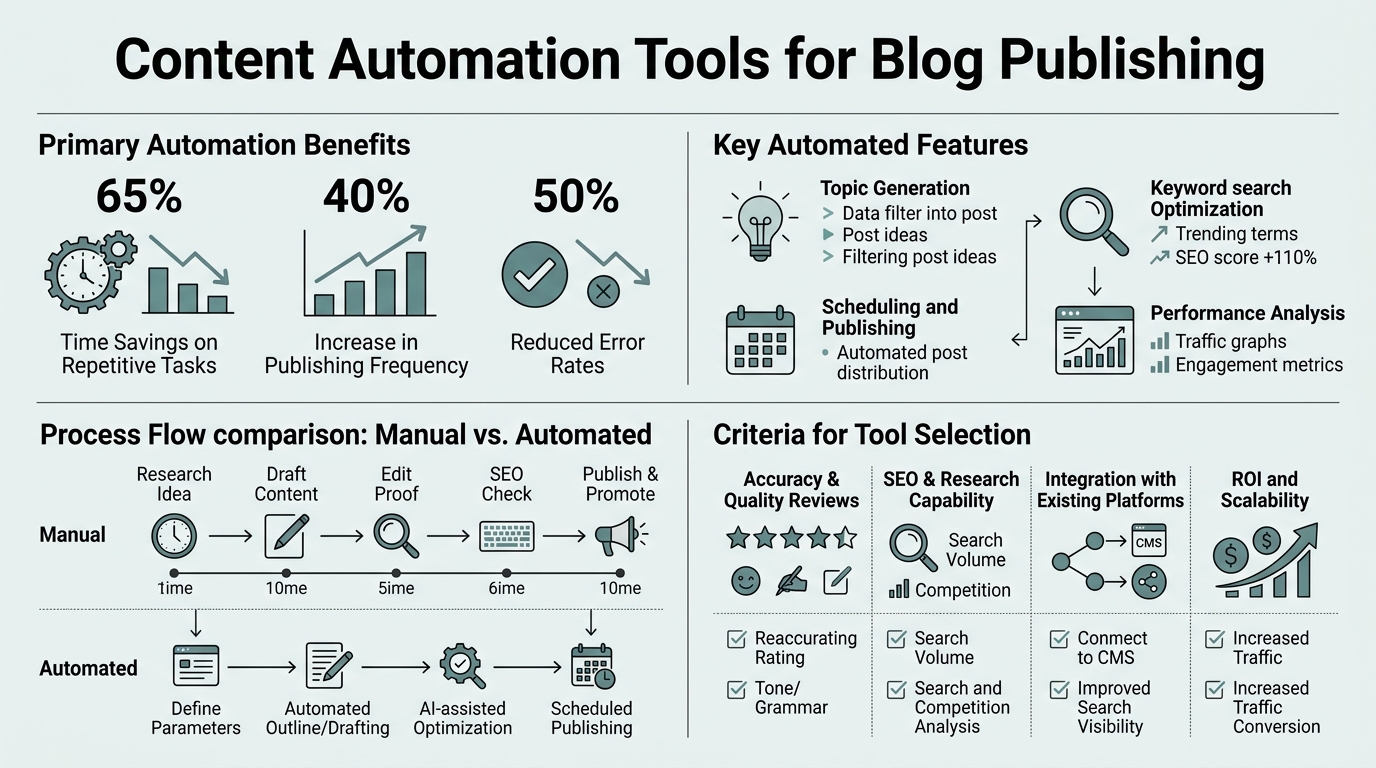
Content automation tools eliminate the repetitive, time-consuming steps in blog publishing. Instead of manually researching keywords, outlining posts, writing drafts, and uploading to your CMS, automation platforms handle most or all of these steps at scale. The AI content creation market is projected to reach $47.5 billion by 2030, with more than 75% of brands actively using AI for content creation tasks. This isn't a niche anymore—it's the baseline for scaling content operations.
"The future of content teams isn't about hiring more writers. It's about automating the repetitive work so your existing team can focus on strategy, distribution, and audience engagement." — Content automation industry report, 2026
The core functions of content automation tools break down into four areas:
- Research & Ideation: Keyword research, topic clustering, competitor analysis, and content gap identification.
- Content Generation: AI-powered drafting of blog posts, outlines, metadata, and social snippets.
- Optimization & Fact-Checking: SEO scoring, internal linking suggestions, factual verification, and brand voice alignment.
- Publishing & Distribution: Direct CMS publishing, scheduling, multi-channel syndication, and performance tracking.
The best tools integrate all four. The worst only handle one or two, forcing you to jump between platforms and waste hours on manual work that should be automated.
How Autonomous Publishing Engines Differ from Traditional Content Tools
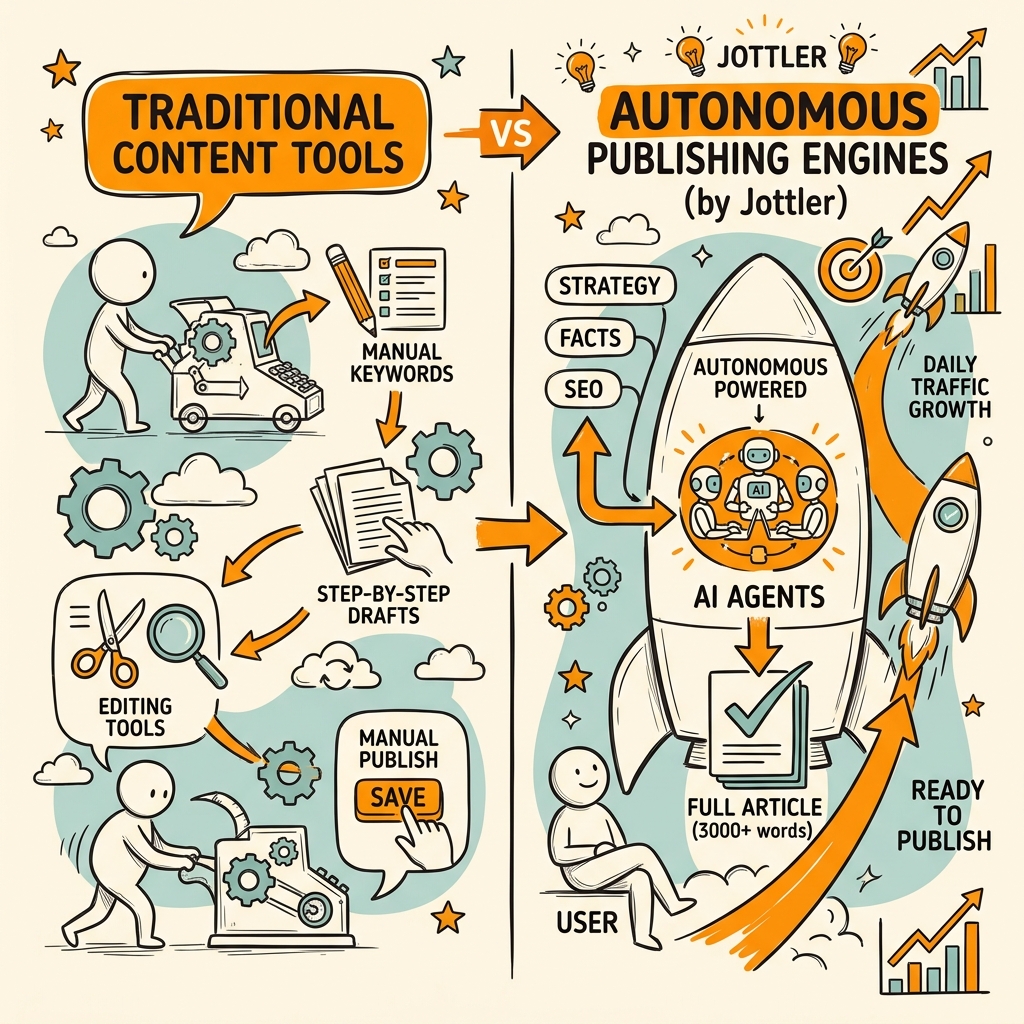
Most content automation tools are point solutions: they generate copy, or they schedule posts, or they handle SEO optimization. Orbitmedia's research shows that only 1-in-10 marketers use tools to write complete articles, which means most platforms leave the hard integration work to you. An autonomous publishing engine takes a different approach: it runs multiple AI agents in parallel to research a topic, write a 3,000+ word article, fact-check claims, build internal links, and publish directly to your CMS—all without touching the content once it's queued.
"Autonomous publishing engines compress weeks of manual work into a single configuration step. You set the publishing frequency, define quality standards, and the engine handles the rest—no daily prompts, no manual uploads, no link management." — Publishing automation case study, 2026
Jottler exemplifies this model. It combines 12 AI agents that handle research from 14+ sources, SEO optimization, fact-checking, and direct WordPress/Webflow/HubSpot publishing. Teams set their desired publishing frequency—1 to 5 articles per day—and the engine publishes autonomously, compounding organic traffic growth without daily oversight.
The advantage? You move from weeks of manual publishing to daily compound content growth. The constraint? You need to trust the system's quality standards and be willing to let AI run unattended workflows.
Key Features to Evaluate in Blog Publishing Automation Tools
Not all content automation platforms are created equal. Content marketing teams save 7.8 hours per week when using purpose-built tools, but only if those tools actually fit the publishing workflow you're running. Here's what separates the best from the rest:
Deep Research Capabilities from Multiple Sources
Automation tools that only generate text without researching real data produce inaccurate, generic content. The best platforms pull from 10+ authoritative sources per article: academic databases, news feeds, competitor content, and verified data sets. This ensures the final article contains current statistics, real examples, and claims backed by primary sources. Jottler's 14-source research protocol means every fact is grounded in credible evidence, which is essential for SEO ranking. Thin content generated without research doesn't rank.
Built-In Fact-Checking and Verification
When publishing at scale, one unverified claim can damage credibility. Autonomous platforms should include fact-checking layers that cross-reference statistics, quotes, and attributions against source data. Sprinklr's research on AI for content marketing shows that enterprise publishers like HubSpot now require fact-checking as a mandatory step before distribution. Without it, you're publishing blind at volume.
Direct CMS Publishing and Integration
Tools that export content as drafts force you to manually upload, format, and publish each post. The best automation platforms connect directly to your CMS via API. WordPress, Webflow, HubSpot, and Ghost integrations should be native, not third-party add-ons. This eliminates the manual publishing step—content is written and live without human intervention.
Automated Internal Linking and Topical Authority Building
SEO isn't just about ranking single pages; it's about building topical authority across clusters of related content. Tools that automatically suggest and insert internal links as content is published create a self-reinforcing link network. Jottler's internal linking engine maps new articles to existing content, strengthening your site's topical authority and passing ranking juice across your cluster. Manual internal linking at 100 articles per month is impossible.
SEO Optimization Without Manual Tuning
Content that ranks requires on-page SEO: keyword placement, meta descriptions, heading structure, readability scores. Tools that generate content without SEO optimization are missing half the job. The best platforms embed SEO rules directly into generation—they target specific keywords, optimize heading hierarchy, and generate compelling meta descriptions. This saves the manual SEO editing step entirely.
Comparing Content Automation Tools for Blog Publishing
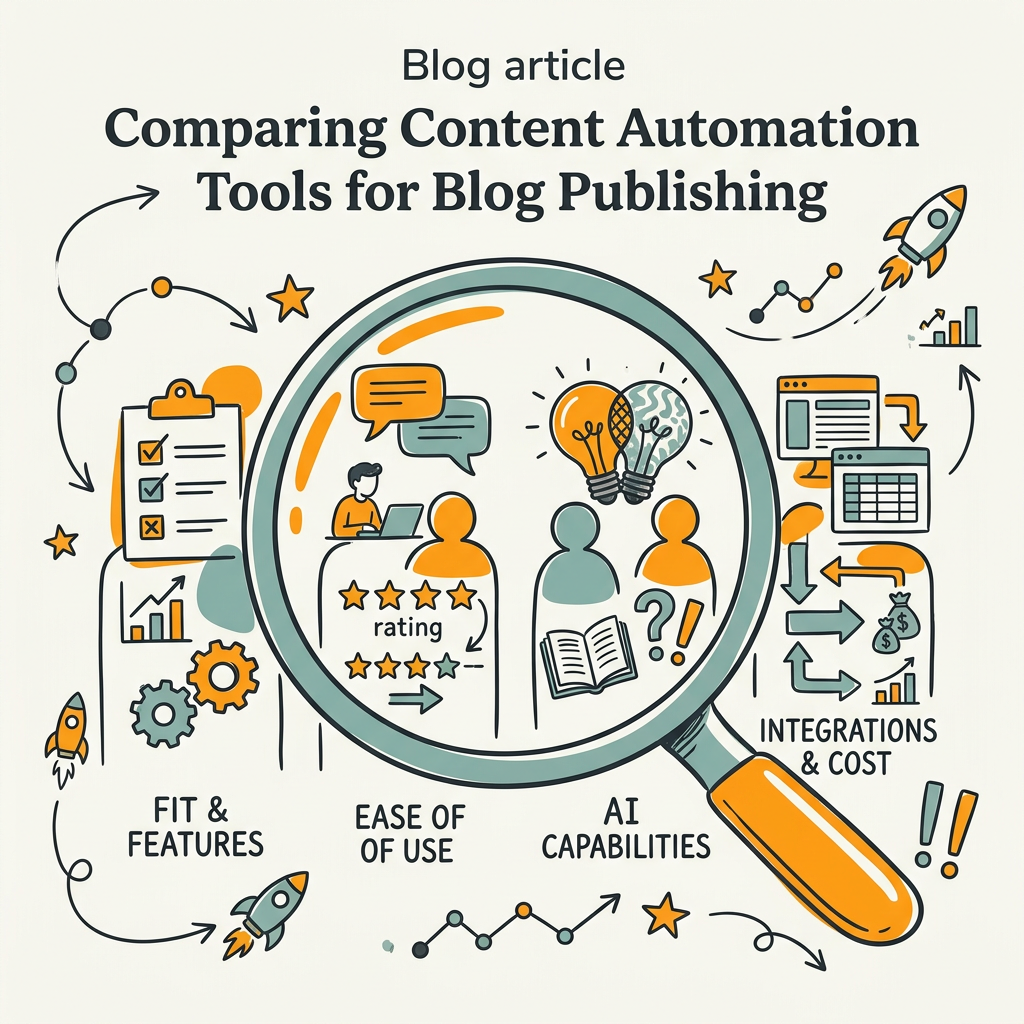
The landscape includes dozens of tools, but they fall into a few categories. Here's how the major options stack up:
| Tool/Platform | Research Depth | Direct CMS Publishing | Autonomous Operation | Fact-Checking | Internal Linking | Price Range |
|---|---|---|---|---|---|---|
| Jottler | 14+ sources per article | Yes (WordPress, Webflow, HubSpot, Ghost) | Yes, fully autonomous with AI agents | Yes, automated verification | Yes, intelligent clustering | $29/mo–$199/mo |
| Jasper | 3–5 sources (limited) | Yes, but requires formatting step | No, requires human prompts for each article | No, relies on user review | Manual suggestions only | $39/mo–$125/mo |
| Copy.ai | No independent research | No, exports as drafts only | No, template-based workflow | No, user responsibility | No internal linking | $49/mo–$250/mo |
| Surfer SEO | SERP-based optimization only | No, optimization tool only | No, manual content tool | No, optimization layer only | No, not designed for this | $79/mo–$299/mo |
| HubSpot Content Hub | 3–4 sources | Yes, integrated publishing | Partial, requires setup per article | Basic, built-in | Yes, for HubSpot blogs | $50/mo–$400/mo |
The table reveals a critical insight: most content automation tools still require significant human input. Jasper and Copy.ai excel at generating copy, but they don't research, fact-check, or publish autonomously. Surfer SEO optimizes existing content but doesn't generate it. HubSpot is tightly integrated but requires per-article setup. Jottler is distinct because it runs the entire pipeline autonomously. You set the publishing frequency and let the engine run—no prompts, no manual publishing, no internal link management.
This matters for teams with limited resources. If you have 2 people managing content for a SaaS company, you can't afford to manually manage each step for 100+ articles per month. You need a tool that compresses the workflow into a configuration step.
Implementation Best Practices for Blog Automation
Deploying content automation isn't just about selecting a tool—it's about building a system that compounds over time. The research shows that teams using workflow automation see 4x faster publishing cycles. Here's how to do it right:
Phase 1: Keyword Research and Topic Clustering
Start with the foundation. Run keyword research to identify 50–100 target topics, then cluster them into topical silos. This ensures your automation engine produces content that builds authority in specific niches rather than random unrelated articles. Jottler's keyword research layer identifies high-volume, low-competition opportunities and organizes them into clusters, giving the writing engine a clear map.
Phase 2: Configure Publishing Frequency and Output Standards
Decide how many articles you want published per day or week. For a startup, 1–2 per day is realistic; for an established company, 5+ is feasible. Set quality thresholds: minimum word count (2,000–3,000), required internal links per article (3–5), and fact-checking depth. These settings instruct the automation engine on what "done" looks like.
Phase 3: Set Up CMS Integration and Scheduling
Connect your content automation platform directly to your CMS. Whether it's WordPress, HubSpot, or Webflow, the goal is frictionless publishing—no manual uploads, no formatting cleanup. Test the integration with 5–10 articles before going to full automation.
Phase 4: Monitor Performance and Refine Prompts
After the first 50 articles, review performance: which topics get the most organic traffic? Where are the gaps in coverage? Use this data to refine your topic clusters and adjust publishing priorities. Most automation platforms let you update guidelines and topic preferences without restarting from scratch.
Phase 5: Build Internal Link Networks
As your content library grows, the automation engine should intelligently link new articles to existing ones. This compounds authority—each new article boosts 3–5 existing pieces through internal link placement. Manual internal linking at this scale is impossible.
Measuring ROI from Content Automation

How do you know if content automation is worth the investment? The data is clear: teams using AI content tools measure results that matter. Content marketers save 7.8 hours per week and produce 4.6x more content per marketer than teams using manual workflows. But ROI goes deeper. Track these metrics:
- Hours Saved Per Week: Time reclaimed from manual research, writing, and publishing. Multiply by your team's hourly cost to quantify the payback.
- Content Output Per FTE: Articles published per full-time equivalent. Automation should move this from 2–4 per month per person to 20–50.
- Organic Traffic Growth: Compare month-over-month organic sessions 3–6 months after automation launch. Most teams see 30–50% growth in a 6-month window.
- Payback Period: How long until the tool pays for itself? Median payback is 4.2 months when measured against salaries saved and traffic growth.
- Search Ranking Improvement: Track keyword rankings for your target topics. Consistent publishing drives significant ranking gains for medium-competition keywords.
For a $100K/year content hire, saving 8 hours per week (20% of their time) equals $20K in salary reclaimed. Most automation tools cost $300–$2,000 per month, so payback typically happens in 2–3 months just from time savings—before factoring in organic traffic gains.
Common Pitfalls When Automating Blog Content
Not all automation implementations succeed. Here are the mistakes that derail teams:
Setting Automation Loose Without Guardrails
The worst approach: turn on automation with no quality checks and assume it works. Even the best tools need guardrails. Set up a weekly review of published articles to spot quality dips, fact-checking errors, or off-brand tone. After 50+ articles, if quality is consistent, reduce reviews to monthly spot-checks.
Publishing Generic Content That Doesn't Rank
Automation doesn't solve commodity content. If your tool generates surface-level blog posts without deep research, you'll publish 100 articles that rank nowhere. Choose tools with genuine research depth (10+ sources) rather than shallow generation models.
Ignoring Topical Authority and Publishing Random Topics
Publishing 200 unrelated articles wastes effort. Build clusters—publish 30 articles on Topic A before moving to Topic B. This compounds authority in specific niches, driving breakthrough rankings. Jottler's topic clustering ensures every article strengthens your topical authority instead of scattering it.
Forgetting to Update and Refresh Old Content
Automation is additive, not a replacement for maintenance. Your automation tool should also be refreshing your top-performing articles quarterly to keep stats current and maintain ranking position.
Conclusion
Content automation tools are no longer a luxury—they're a requirement for scaling organic traffic without proportional team growth. The data is unambiguous: 40% of marketers use AI content tools in 2026, and teams doing so produce 4.6x more published content per marketer while saving 7.8 hours per week per content professional. The best platforms—like Jottler—handle the entire pipeline: research, writing, fact-checking, optimization, and direct CMS publishing. This eliminates the fragmented workflow that most teams still endure.
The question isn't whether to automate blog publishing. It's which tool matches your team's resources and publishing ambitions. For busy founders and marketing teams with limited headcount, an autonomous publishing engine that runs daily workflows without manual oversight is the obvious choice. It compounds your content growth exponentially while your team focuses on strategy and audience engagement.
Ready to stop managing content manually? Start your SEO agent with Jottler and publish your first batch of autonomous articles within hours.
FAQs
What is the fastest content automation tool for publishing blog posts?
Autonomous publishing engines like Jottler are the fastest because they eliminate the manual steps between writing and publishing. Instead of drafting in one tool, editing in another, and uploading manually, Jottler researches, writes, fact-checks, and publishes directly to your CMS in one integrated workflow. Most teams see articles live within 2–4 hours of the automation trigger, compared to 1–2 days for manual workflows. The speed comes from eliminating handoffs, not from faster writing alone.
Can content automation tools produce high-quality, SEO-ranked content?
Yes, but only if the tool combines deep research with SEO optimization and fact-checking. Tools that simply generate text without research produce thin, generic content that doesn't rank. The best platforms pull from 10+ authoritative sources per article, embed SEO rules into generation (keyword targeting, readability, heading structure), and verify factual claims. Teams using research-backed automation see 30–50% organic traffic growth within 6 months, proving that quality automation content does rank.
How much time does content automation actually save?
Content teams save between 6–8 hours per week on average when using automation tools, with content marketers seeing the highest savings at 7.8 hours per week. This time comes from eliminating keyword research, outlining, first drafts, fact-checking, formatting, and manual CMS publishing. The payback period is typically 4.2 months when measured purely against salary savings. When you factor in organic traffic gains and increased content output, ROI is much faster.