Content Calendar Planning for Organic Growth
Most marketing teams understand that consistent, strategic content drives organic traffic. Yet 78% of marketers who plan content in advance report significantly better results than reactive publishers. The gap isn't talent—it's system. Without a structured content calendar, teams waste weeks on redundant research, struggle to maintain publishing consistency, and miss opportunities to build topical authority. The real leverage comes from turning content planning into a predictable, compounding machine that feeds organic growth month after month.
Key Takeaways
- SaaS companies planning content in advance achieve 3x faster growth rates and 40% lower creation costs (2025, Ndash)
- Strategic content calendars drive up to 400% growth in lead generation when paired with proper execution (2025, Ndash)
- Planning 4-8 weeks ahead balances strategic depth with market responsiveness, ensuring content stays relevant without losing agility (2025 Industry Data)
- Define Your Growth Goals First: Revenue impact, traffic targets, and lead generation KPIs shape every piece you publish.
- Build a Topical Authority Framework: Clusters of related keywords create thematic depth that search engines reward with higher rankings.
- Establish a Publishing Rhythm: Consistency compounds—daily or weekly publishing turns a content calendar into an organic growth engine.
- Automate Planning and Research: Tools that handle keyword research, fact-checking, and publishing eliminate bottlenecks and enable rapid scaling.
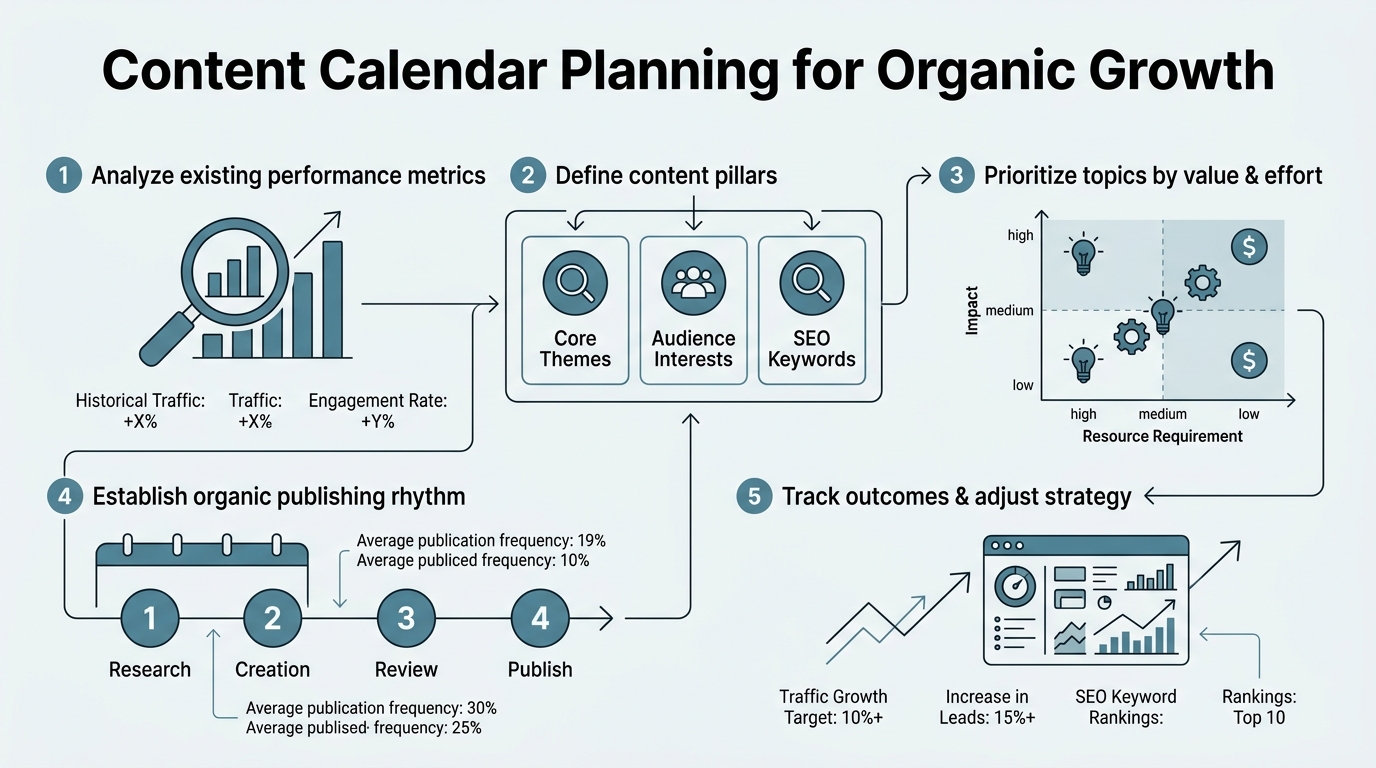
Why Content Calendar Planning Matters for Organic Growth
A content calendar isn't just a publishing schedule. It's the blueprint for building topical authority, claiming search rankings, and feeding your sales pipeline with qualified leads. Organizations without a documented content plan leave 40-60% of their organic potential on the table, according to industry research.
The Cost of Reactive Content Publishing
When teams publish without a plan, they create friction at every stage. Content creators waste time deciding what to write. SEO specialists struggle to connect topics into thematic clusters. Marketers publish sporadically, breaking the consistency algorithm that search engines measure. Meanwhile, competitors with structured calendars are compounding authority and capturing market share. A content calendar eliminates this chaos by front-loading strategic decisions so execution becomes mechanical and repeatable. The most successful SaaS marketing teams use structured frameworks that align editorial decisions with revenue goals before publishing begins.
"Without a structured content calendar, teams waste weeks on redundant research and miss opportunities to build topical authority. The real leverage comes from turning content planning into a predictable, compounding machine."
How Content Calendars Compound Organic Traffic
Search visibility doesn't grow linearly—it compounds. Each well-researched article builds topical authority in its cluster, making the next article in that cluster rank faster. Each internal link strengthens domain topical relevance. After 30-50 pieces of strategic content, you shift from publishing to ranking. The companies seeing 3x faster growth aren't necessarily publishing more often; they're publishing smarter, with every piece designed to amplify the next. A content calendar forces this intentionality from day one. When you understand how to build an AI content strategy that scales, you can compress this timeline from quarters to months.
Define Clear Growth Goals and SEO Metrics
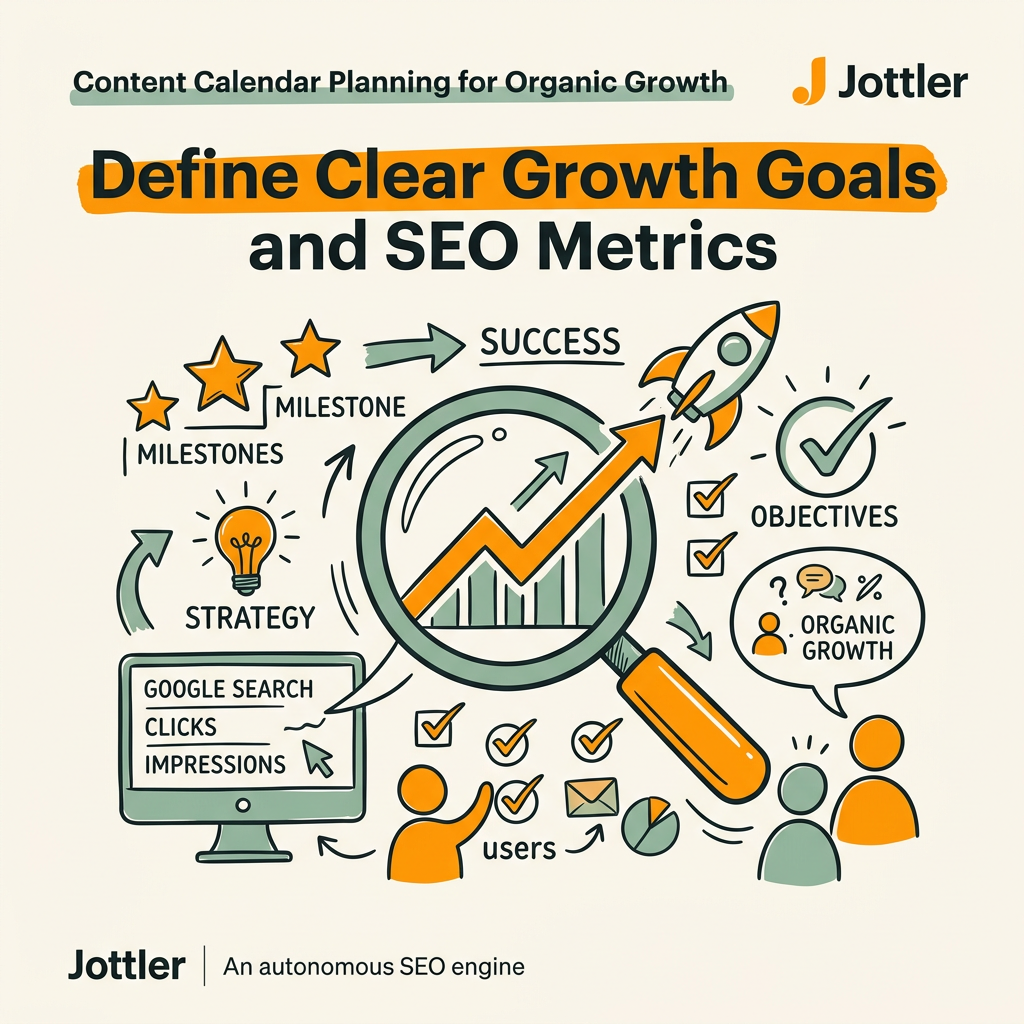
Without measurable targets, a content calendar becomes a vanity project. The best calendars tie every editorial decision to a business outcome: traffic targets, lead volume, or revenue per visit. Companies that define KPIs upfront see 2.5x better ROI from their content, according to 2025 research. Your calendar should answer: What does success look like, and how will we measure it?
Set Specific Traffic and Lead Generation Targets
Start with outcomes, not activities. Don't aim to "publish more." Instead: "Increase organic traffic to 50,000 monthly visitors by Q4" or "Generate 100 MQL (marketing-qualified leads) per month from organic search." These targets then reverse-engineer your calendar. If you need 50,000 monthly visitors, how many keywords must rank? How many articles per week? What topics have the highest commercial intent? A goal-driven calendar answers these questions before the first draft is written.
Track Organic KPIs That Matter
Vanity metrics (page views, shares) feel good but don't drive revenue. Instead, track the metrics that connect to business outcomes:
- Organic traffic to key landing pages: Which content pieces drive visitors closest to purchase?
- Keyword ranking progress: Are target keywords climbing? Which clusters are building topical authority fastest?
- Cost per lead from organic: Content has a clear ROI when you know the average deal size and close rate.
- Time to ranking: Track how long it takes for new content to reach page 1. This reveals whether your topical strategy is working.
These metrics tell you whether your calendar is working. If rankings stall, you adjust topics. If traffic grows but leads don't, you refocus on commercial intent content. The calendar isn't locked in stone—it's a feedback loop that tightens over time.
Build Topical Authority Clusters Into Your Calendar
Google rewards sites that own entire topic spaces, not just individual keywords. A content calendar structured around thematic clusters—pillar articles surrounded by supporting content—compounds your ranking power. SaaS companies that organize content by topical clusters see 40% faster ranking progression compared to scattered, keyword-chasing approaches.
Identify Your Core Content Pillars
Each pillar is a broad topic your brand owns expertise in. For a SaaS product, this might be "Lead Generation," "Sales Enablement," or "Revenue Operations." Under each pillar, you build 20-40 supporting articles that answer sub-questions and edge cases. This isn't accidental—it's planned at calendar-creation time. When you know your pillars, you can schedule content to build authority systematically, rather than treating every article as standalone. Understanding how to build topical authority before your competitors do gives you a 6-12 month ranking advantage.
"Each pillar is a broad topic your brand owns expertise in. Under each pillar, you build 20-40 supporting articles that answer sub-questions and edge cases."
Create a Keyword Cluster Map
Before scheduling articles, map your target keywords into clusters. A cluster might look like:
- Pillar: "Content Marketing for SaaS"
- Cluster 1: Content strategy (20+ supporting keywords)
- Cluster 2: Content calendars (15+ supporting keywords)
- Cluster 3: AI content tools (25+ supporting keywords)
Your calendar should balance these clusters evenly over time. If you publish 8 pieces on content strategy and none on content calendars for 6 months, you signal weak topical authority in that subset. A well-planned calendar distributes content across clusters so authority compounds everywhere, not just in your strongest topics.
Plan Your Publishing Frequency and Consistency Model
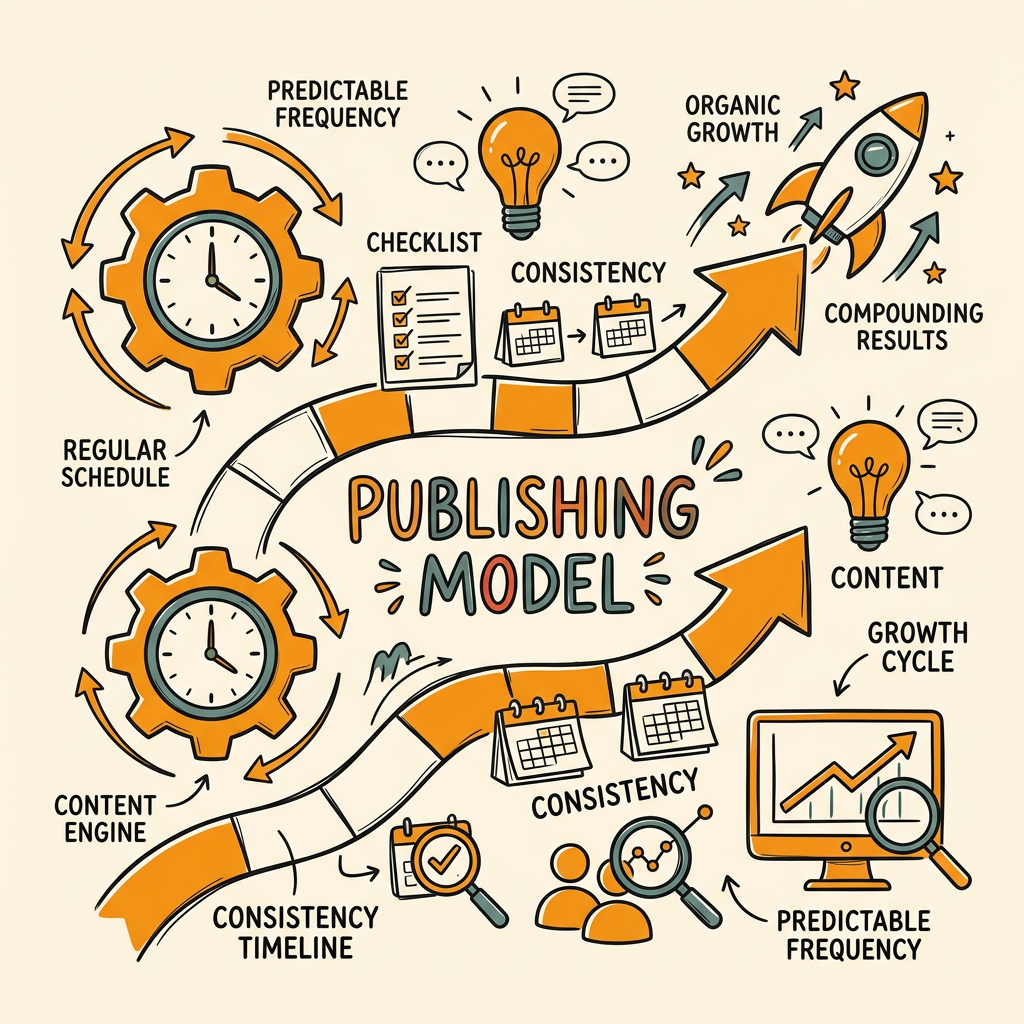
Publishing consistency matters more than volume. A team publishing 1 article per week for 52 weeks compounds far more authority than a team publishing 20 articles in month one, then going silent. Your calendar needs a realistic rhythm you can sustain, and the best rhythms are automated. Teams that automate their content planning and publishing see 60% more consistent output than those relying on manual processes.
Choose a Sustainable Publishing Cadence
For organic growth, consistency beats heroic effort. A two-person marketing team publishing 2 articles per week sustainably will outrank a four-person team publishing 5 articles per week erratically. When you create your calendar, commit to a rhythm: daily, 3x per week, weekly, or bi-weekly. Map it into your tool so the rhythm becomes automatic. Content marketing automation enables teams to set a publishing frequency (1-5 articles per day) and the system handles research, writing, and publishing on schedule—eliminating the friction that breaks consistency. This is why automation has become essential for scaling organic growth without burning out your team.
Build Seasonal and Event-Based Peaks Into Your Calendar
Your baseline frequency shouldn't be your only publication pattern. Strategic peaks create momentum. If your audience's busiest buying season is Q4, plan 50% more content in September and October. If industry conferences happen in spring, front-load content that addresses conference themes. These peaks are scheduled 8-12 weeks ahead, giving your team time to research and execute. Your calendar should show both baseline rhythm and seasonal spikes so nothing is left to chance.
Implement a Content Research and Fact-Checking Process
The weakest content calendars fail during execution because research becomes a bottleneck. Writers stare at blank screens trying to decide what to research. Fact-checkers can't verify claims. Sources get lost. The calendar looks great in theory but falls apart in practice. Smart calendars build research efficiency into the system from the start, either by pre-loading research or automating it entirely.
Pre-Research Topics Before Scheduling Publication Dates
Don't schedule an article for Thursday without knowing what it will say. Before your calendar is finalized, pre-research the top 20-30 topics. Identify the strongest sources, key statistics, and angle. Document this in your calendar tool so writers have a clear research baseline and aren't starting from zero. This single step reduces content creation time by 25-30% and eliminates writers' block at scale.
Automate Fact-Checking and Source Verification
One of the most underrated calendar features is built-in fact-checking. When you publish unverified claims, you damage authority and invite ranking penalties. Modern tools now verify statistics, check citations, and flag questionable claims before publishing. Jottler, for example, automatically fact-checks every article against 14+ data sources before it goes live, eliminating the manual verification step entirely. This keeps your content calendar executing at speed without sacrificing credibility.
Integrate Internal Linking Into Your Calendar Strategy
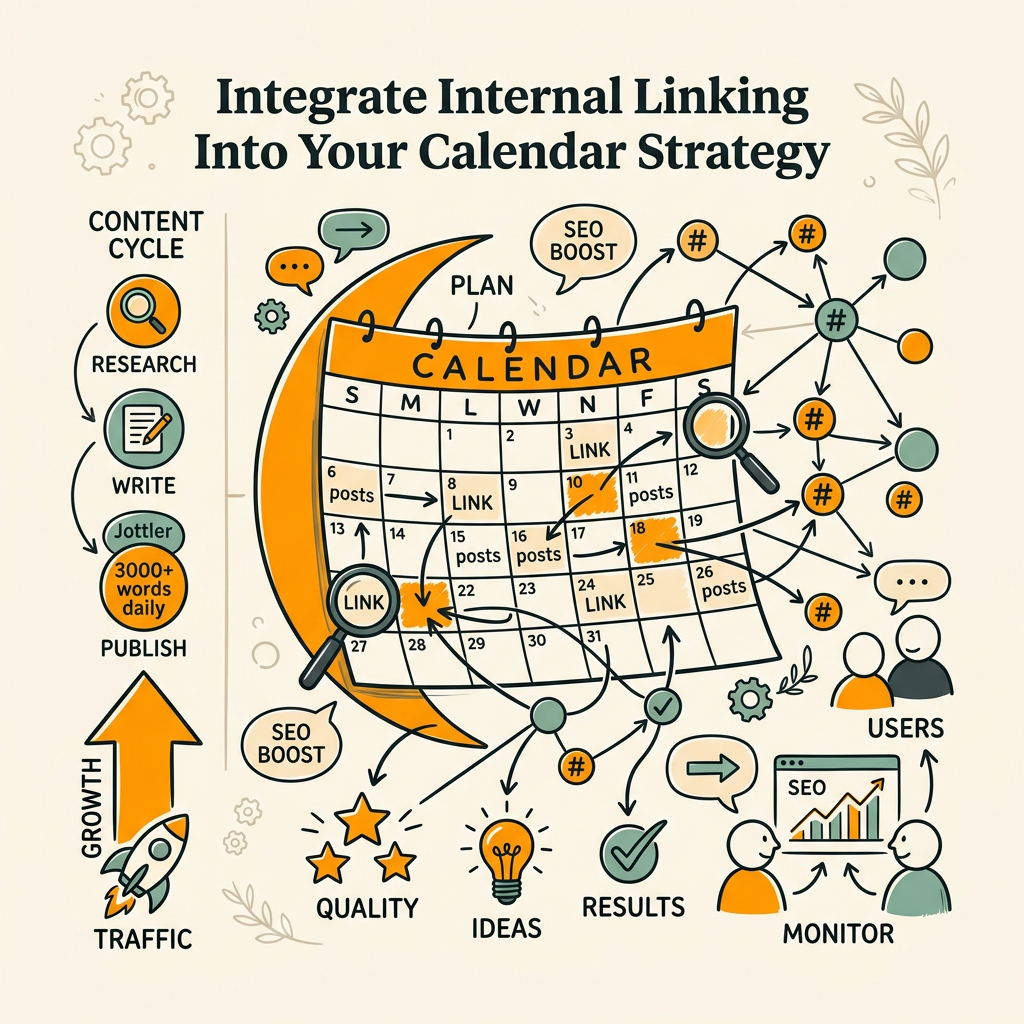
Every article is an opportunity to build your internal link network, but this only works if you plan it. A smart content calendar reserves time for internal linking strategy: mapping which articles link to which, and in what order. When you publish articles out of sequence, internal linking becomes reactive and weak. When you plan it, every article amplifies the next.
Map Internal Linking Paths Before Publication
Document which new articles should link to existing pieces and vice versa. For example, if you're publishing an article on "Content Calendar Tools," it should link to your existing pillar article "Content Marketing Strategy" and your deep-dive on calendar management. This isn't guesswork—it's planned in your calendar so when content publishes, linking happens simultaneously. The result is faster topical authority buildup and stronger ranking velocity for clustered content.
Use Your Calendar to Track Internal Link Opportunities
As you schedule new articles, note which older pieces they strengthen. Add a column to your calendar: "Strengthens: [Article Title]" and "Links to: [3-5 target articles]." This forces intentional cross-linking so every new piece multiplies the authority of surrounding content. Teams that integrate internal linking into their calendars see measurably faster ranking velocity for their topical clusters compared to those linking reactively.
Automate Calendar Management to Scale Without Burnout
The most ambitious content calendars fail because teams can't sustain them manually. Keyword research takes hours. Writing takes days. Publishing requires coordination. If your calendar depends on human effort at every stage, it's not scalable. The breakthrough comes when you automate the mechanical parts—research, writing, fact-checking, publishing, internal linking—so your team focuses only on strategy and refinement.
Choose Tools That Handle End-to-End Automation
Not all content tools are created equal. Some offer scheduling; some offer writing assistance. The best ones handle the entire pipeline: keyword research, deep research from 14+ sources, article writing, fact-checking, and publishing to your CMS. This means you plan your calendar once, connect your site, set your frequency, and the system executes automatically. Your team never touches manual research or publishing again. The calendar becomes self-perpetuating, compounding content and organic growth without friction.
Set and Forget: Frequency-Based Publishing
Once your calendar is planned, configure your system for your target frequency. If you want 3 articles per week, tell the system. It handles keyword selection, research, writing, and publishing on schedule. Every article is fact-checked, internally linked, and optimized before going live. This kind of automation doesn't eliminate strategy—it amplifies it. You're not writing more; you're thinking strategically about what to build authority in, then letting systems handle execution. The result is a content calendar that actually delivers the growth you planned for.
Measure and Iterate Based on Calendar Performance
A content calendar isn't static. Every month, review performance and adjust. Which clusters are ranking fastest? Which topics drive the most leads? Are you hitting your organic traffic targets? This data reshapes next month's calendar. Teams that iterate monthly grow 2x faster than teams that stick to their original plan regardless of results.
Audit Rankings and Content Performance Monthly
Pull your top 50 target keywords. Where are they ranking? Which of your calendar articles drove them into the top 20? This tells you which topics and angles work best. If "Content Calendar Tools" ranked faster than "Content Calendar Templates," that signals audience preference. Next month, double down on "Tools" content and reduce "Templates." This feedback loop—plan, publish, measure, adjust—is where calendars move from theoretical to powerful.
Double Down on Winning Topics and Clusters
Some clusters will outperform. Maybe your "Sales Automation" content ranks 3x faster than "General Sales Strategy." Instead of maintaining equal distribution, shift your calendar weights. Publish 60% sales automation, 30% sales strategy, 10% other sales topics. This concentration builds authority faster and compounds growth. Your calendar should reflect where you're winning, not where you think you should be winning.
| Metric | Reactive Publishing | Planned Calendar Approach |
|---|---|---|
| Time to First Page 1 Ranking | 12-18 weeks | 4-8 weeks |
| Organic Lead Cost | $150-300 per lead | $50-100 per lead |
| Content Creation Efficiency | 3-4 hours per article | 1-2 hours per article |
| Publishing Consistency | Sporadic (4-6 articles/month avg) | Consistent (8-20+ articles/month) |
| Year-1 Organic Traffic Growth | 40-60% increase | 200-300% increase |
Conclusion
A content calendar is the difference between hoping for organic growth and engineering it. Teams with structured, strategic calendars achieve 3x faster growth rates, 40% lower content costs, and up to 400% increases in qualified leads. The formula is simple: define clear goals, build topical authority clusters, maintain consistent publishing, pre-research thoroughly, and integrate internal linking intentionally. Then automate what can be automated so your team focuses on strategy, not mechanics.
If your team is still managing content calendars in spreadsheets or fighting with manual publishing workflows, you're leaving compounding growth on the table. The market has moved on to tools that handle end-to-end automation—research, writing, fact-checking, publishing—so teams can maintain aggressive calendars without burnout. Start your SEO agent with Jottler and let it handle your content calendar automatically, publishing 1-5 articles per day with zero manual overhead.
FAQs
How far in advance should I plan a content calendar?
Plan 4-8 weeks ahead for moderate complexity content, balancing strategic depth with market responsiveness. For seasonal or trend-heavy topics, plan 4-6 weeks before peaks to ensure relevance. Year-round planning with rolling 8-week adjustments gives you the best of both worlds: enough foresight to coordinate clusters and internal linking, but enough flexibility to pivot based on search trends or audience behavior. Teams that plan this window see 60% more consistent output than those planning shorter or longer timeframes.
What's the ideal publishing frequency for organic growth?
Consistency matters more than volume. Publishing 1 article per week for 52 weeks outranks publishing 20 articles in month one and going silent. The best frequency is one your team can sustain indefinitely. For maximum organic growth compounding, aim for daily or near-daily publishing if resources allow, but weekly publishing done consistently builds more authority than sporadic bursts. The absolute minimum is 2 articles per week; below that, you lose search algorithm consistency signals.
How do I know if my content calendar is working?
Track KPIs that connect to business outcomes: organic traffic volume, keyword rankings in your target clusters, cost per lead from organic search, and time-to-first-page rankings. Review monthly to see which clusters rank fastest and drive the most leads. Calendars that are working will show 10-20% month-over-month ranking improvements in target keyword clusters after the first 60 days. If rankings aren't moving or lead volume is flat, adjust your topics, research depth, or topical authority distribution before next month's calendar.