Content Clusters and Topic Maps: An SEO Planning Framework
Most content strategies treat SEO like a scatter-shot approach: write about anything that gets search volume, link it when you remember, and hope Google notices. That's not a strategy—it's a lottery ticket. Content clusters and topic maps represent a fundamentally different approach, one where you organize your entire content library around themes instead of isolated keywords. Sites using this method typically see 22-24% improvement in topical authority within 6-12 months, and more critically, they're able to dominate entire search categories rather than chasing individual rankings.
Key Takeaways
- Content clusters organize related pages around a pillar topic, increasing topical authority by 22-24% within 6-12 months (MarketMuse, 2025)
- Topic mapping identifies semantic relationships and search intent patterns before content creation, reducing wasted effort
- Internal linking within clusters signals to Google that your site is a comprehensive resource on a subject, improving SERP visibility
- Busy teams can scale this framework using automation tools that research, map, and internally link content at production scale
- What Are Content Clusters: A strategic inventory of content across your site addressing one topic from multiple angles (product pages, blog posts, guides, webinars).
- Topic Mapping for SEO: The planning phase where you identify semantic relationships, search variants, and user intent patterns across a topic area.
- Pillar Pages and Topic Hierarchy: A broad, authoritative page linking to narrowly-focused cluster pages that explore subtopics.
- Internal Linking Architecture: Deliberately connecting related content to signal topical depth and improve crawlability.
- Why Automation Matters: Manual topic mapping and internal linking don't scale; automation compounds your content efforts.
What Are Content Clusters and Topic Maps in SEO?
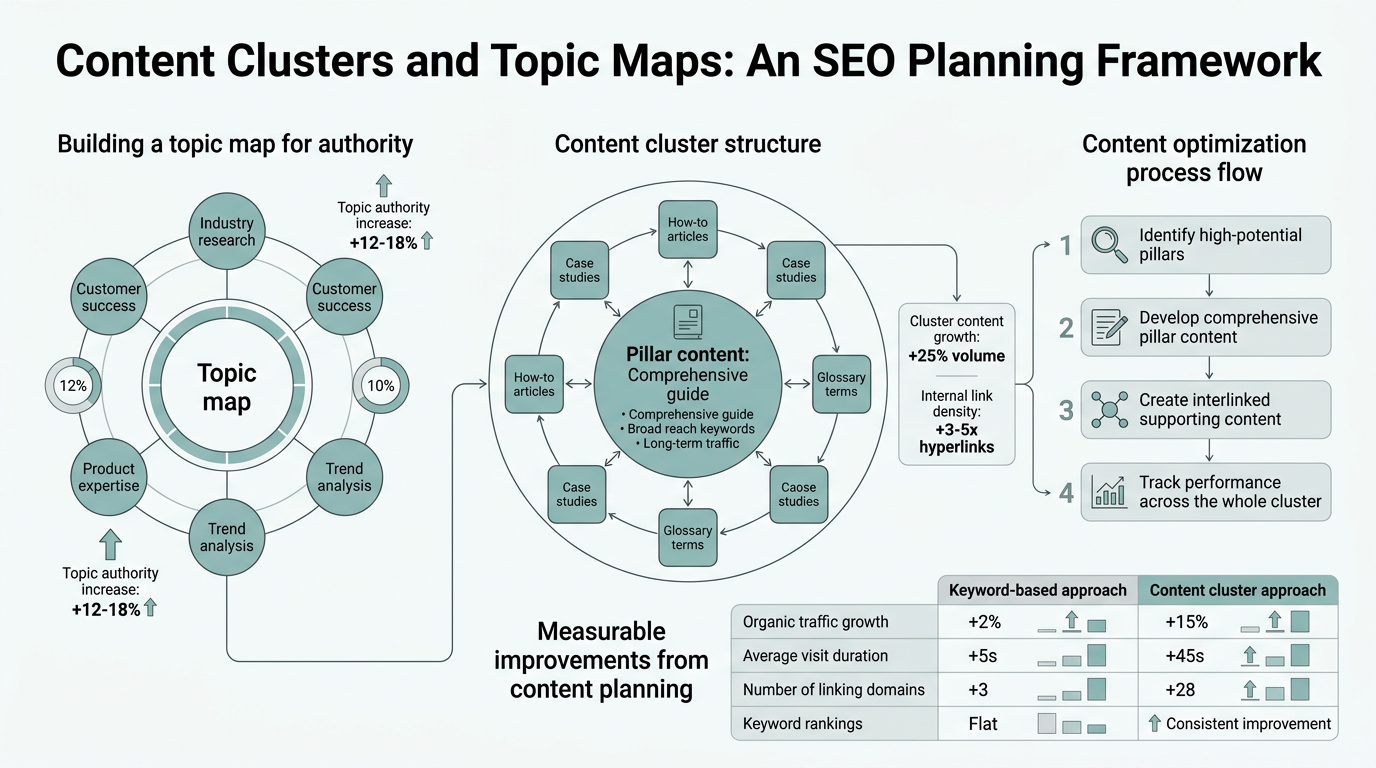
A content cluster is not a random collection of blog posts. It's a deliberately organized group of pages centered on a single pillar topic, with each piece exploring a specific subtopic or related keyword variant. The pillar page acts as the hub—broad, authoritative, and comprehensive. The cluster pages act as spokes—each narrowly focused on a specific search query or subtopic. Google sees this architecture and recognizes your site as a authoritative source on that entire subject.
A topic map is the blueprint you create before you write a single word. It identifies every semantic variant, related question, and search intent pattern within a topic area. Instead of guessing what content to create, you're mapping the actual search landscape. This is where busy founders stop wasting time on low-volume keywords and start building content that actually compounds.
The Pillar-Cluster Model Explained
The pillar-cluster structure mirrors how Google's algorithm thinks about topical authority. Your pillar page covers a broad topic at 2,000-3,000 words—comprehensive enough to be useful, focused enough to be coherent. Your cluster pages target specific angles: "How to implement X," "X vs. Y," "Common X mistakes," "X tools and integrations." Each cluster page links back to the pillar, and the pillar links to all clusters. This creates what SEO practitioners call "topical relevance signals."
"The pillar-cluster model doesn't just organize content—it teaches Google how to think about your topic. Every link, every page, every cross-reference tells the search engine: this site comprehensively understands this subject."
The model differs fundamentally from old-school silo architectures. You're not creating barriers between topics; you're creating connections that signal depth. A visitor landing on a cluster page about "AI content writing best practices" immediately sees links to related clusters: "AI content vs. human writing," "AI content quality checks," "AI writing tools for SEO." Google's crawlers follow those links and understand: this site owns the entire topic of AI content creation.
How Topic Maps Identify Search Patterns
Building a topic map starts with research, not writing. You're answering these questions: What does my audience actually search for? What are the semantic variations? What are the related questions and subtopics? A topic map for content marketing might reveal 40+ related searches: "content marketing ROI," "content marketing strategy," "B2B content marketing," "content marketing tools," "DIY content marketing," etc. Without a map, you write seven blog posts and miss 33 opportunities. With a map, you see all 40 at once.
"A topic map reveals the entire landscape of what your audience searches for. Without it, you're building a content strategy blind—publishing pages that feel right but miss 80% of your real search opportunity."
The best topic maps capture four layers:
- Semantic variants and synonyms: "AI writing," "artificial intelligence content generation," "generative AI copywriting"
- Related subtopics and intent variations: "How to use AI writing tools," "AI writing vs human writers," "Best AI writing software"
- Questions the audience actually asks: Pulled from "People Also Ask" sections and search suggestion data
- Difficulty and search volume tiers: So you can sequence content strategically (easy wins first, harder topics later)
Why Content Clusters Improve Topical Authority and Rankings
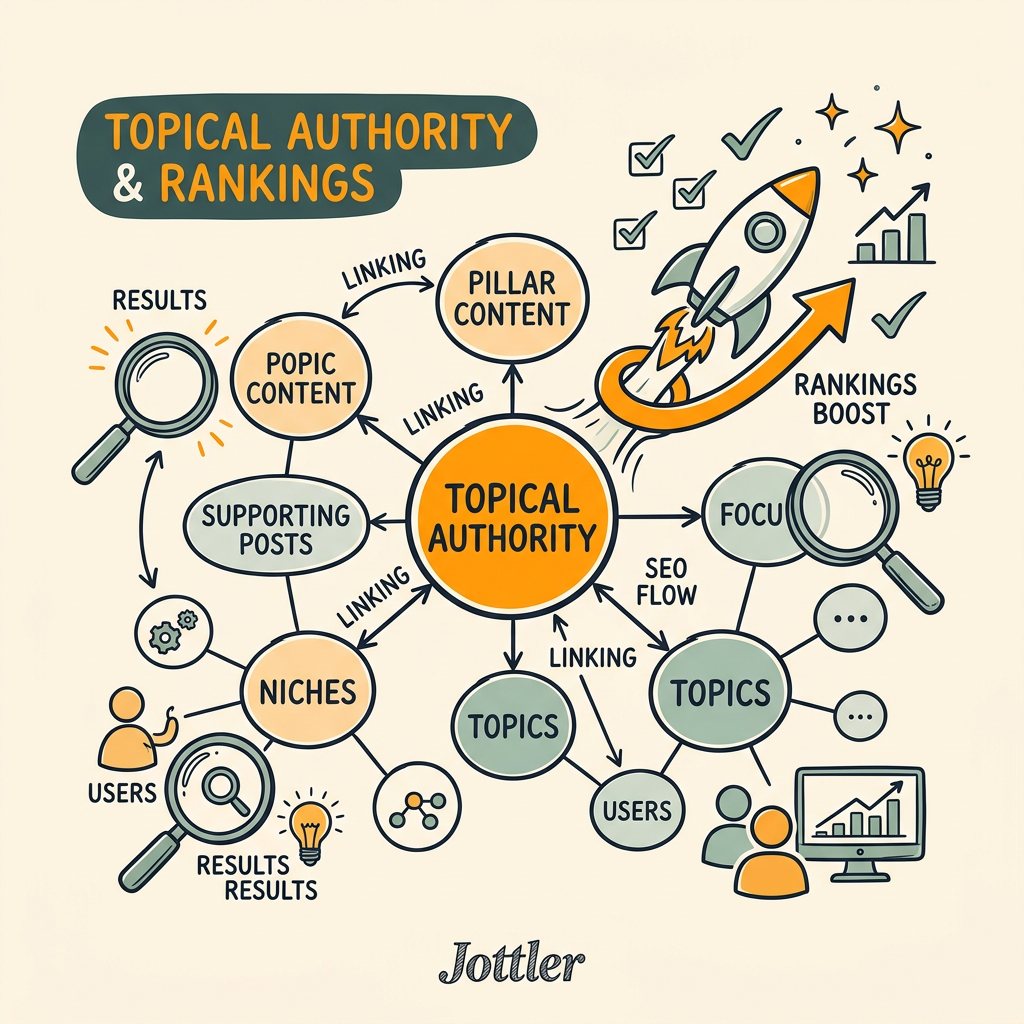
Google's algorithm reward sites that demonstrate comprehensive knowledge of a subject. When you publish 15 interconnected articles on "content marketing," Google understands you're not just chasing one keyword—you're building authority. This is called topical authority, and it's one of the strongest ranking signals in 2026.
The mechanism is straightforward. Google crawls your site and follows internal links. When it finds that 40% of your linking structure points back to a central "content marketing" page, it assigns that page and cluster higher topical relevance. It also notes that every cluster page cites the pillar, treating the pillar as the source of truth. Combined with external backlinks to the pillar (which are easier to earn once you're known as an authority), this architecture compounds ranking power. Organizations implementing this framework find that topic clusters help rank better on Google with fewer backlinks.
The Topical Authority Effect on Organic Traffic
Sites that implement topic clusters see measurable organic traffic growth because they capture search volume at multiple intent levels. A single "content marketing" article might rank for one keyword. A cluster of 12-15 articles ranks for 40+ keyword variations, including questions, how-tos, comparisons, and tool recommendations. This multiplier effect is why topic clusters scale traffic faster than sporadic content. Each cluster page acts as a funnel into your pillar, and the pillar acts as a destination for the most competitive keywords.
The timing of implementation matters. You don't build the entire cluster at once; you sequence content based on difficulty and business value. Start with high-volume, moderate-difficulty topics (the quick wins), then layer in harder topics and edge-case questions. This approach maintains momentum and builds authority incrementally.
How Internal Linking Within Clusters Signals Value
Internal links are crawl paths and ranking signals combined. When you link cluster pages to the pillar with relevant anchor text—"Read our full guide to content marketing strategy"—you're telling Google: this pillar page is the authoritative destination for this topic. You're also distributing link equity down the cluster, lifting all related pages. This is why manually linking content is time-consuming; at scale (3-5 articles per week), it becomes a bottleneck. Tools that automate smart internal linking based on semantic relevance solve this friction point.
How to Map Content Topics: A Step-by-Step Framework
Building a topic map isn't complex, but it requires discipline and the right inputs. You're essentially conducting keyword research at the topic level, then organizing results into a hierarchy that makes sense for your audience. Here's the framework most successful SEO teams use.
Step 1: Choose Your Core Pillar Topic
Start with a broad, high-value topic that aligns with your business. For a SaaS company, this might be SEO automation, content marketing, or "AI-powered content." The pillar topic should have significant search volume (500+ monthly searches) and clear relevance to your product. Avoid topics that are too niche (50 searches/month) or too vague (10,000+ searches, competitive beyond reach). You're looking for the Goldilocks zone: 500-3,000 monthly searches, moderate-to-high difficulty.
Your pillar topic is a 2-3 year investment. Choose wisely. It should be defensible—something competitors can't easily own because you'll be building depth they lack.
Step 2: Identify All Semantic Variants and Related Keywords
Use keyword research tools (or automated systems) to find every variant and related phrase. This is where topic maps diverge from listicle keyword research. You're not looking for 100+ keywords to rank for individually; you're mapping 20-40 related concepts that make sense together. Filter results by:
- Search volume: At least 10-20 searches per month (otherwise, skip it)
- Relevance to pillar: Does this keyword directly relate to your pillar topic?
- Search intent: Is this someone researching, comparing, trying to solve a problem, or buying?
- Difficulty score: Prioritize lower-difficulty keywords (KD < 50) early; harder keywords come later
You'll typically find 25-40 keywords that cluster naturally around your pillar. Some will be obvious ("content marketing strategy"); others will surprise you ("content marketing metrics," "evergreen content examples"). Both belong in your map.
Step 3: Organize Keywords Into Semantic Groups
Now you cluster related keywords into subcategories. A "content marketing" pillar might organize into:
- Strategy & Planning: "content marketing plan," "content strategy framework," "content calendar"
- Tactics & Execution: "how to write content," "content repurposing," "content distribution"
- Tools & Technology: "content marketing tools," "content management systems," "AI content tools"
- Measurement & ROI: "content marketing ROI," "content metrics," "content performance"
- Comparisons & Alternatives: "X vs Y," "best practices," "content marketing examples"
These groupings become your cluster page topics. Each group represents a narrative thread that makes sense to your audience. You're not forcing arbitrary connections; you're reflecting how people actually think about and search for the topic.
Step 4: Map Search Intent to Content Type
Not all searches have the same intent. Some are educational ("What is content marketing?"), some are tactical ("How do I create a content calendar?"), some are comparative ("Content marketing vs. paid ads"). Your topic map should annotate intent alongside each keyword. This determines the content format you'll create:
- Informational intent: Guides, explainers, definitions (1,500-2,500 words)
- Tactical intent: How-tos, step-by-steps, frameworks (1,500-2,000 words)
- Comparative intent: vs. articles, tool reviews, pros/cons (1,500-2,000 words)
- Transactional intent: Tool roundups, pricing guides, "best of" lists (1,500-2,000 words)
This prevents you from writing five "What is X?" articles when you actually need tactical how-tos. It also ensures your cluster speaks to every stage of the customer journey, which improves traffic quality and conversion potential.
| Search Intent Type | User Goal | Content Format | Typical Word Count |
|---|---|---|---|
| Informational | Learn what something is or how it works | Guides, explainers, definitions | 1,500–2,500 words |
| Tactical | Solve a specific problem or complete a task | How-tos, step-by-steps, frameworks | 1,500–2,000 words |
| Comparative | Evaluate options before deciding | vs. articles, tool reviews, pros/cons | 1,500–2,000 words |
| Transactional | Find or purchase a product or service | Tool roundups, pricing guides, "best of" lists | 1,500–2,000 words |
Implementing Topic Maps With Internal Linking Strategy
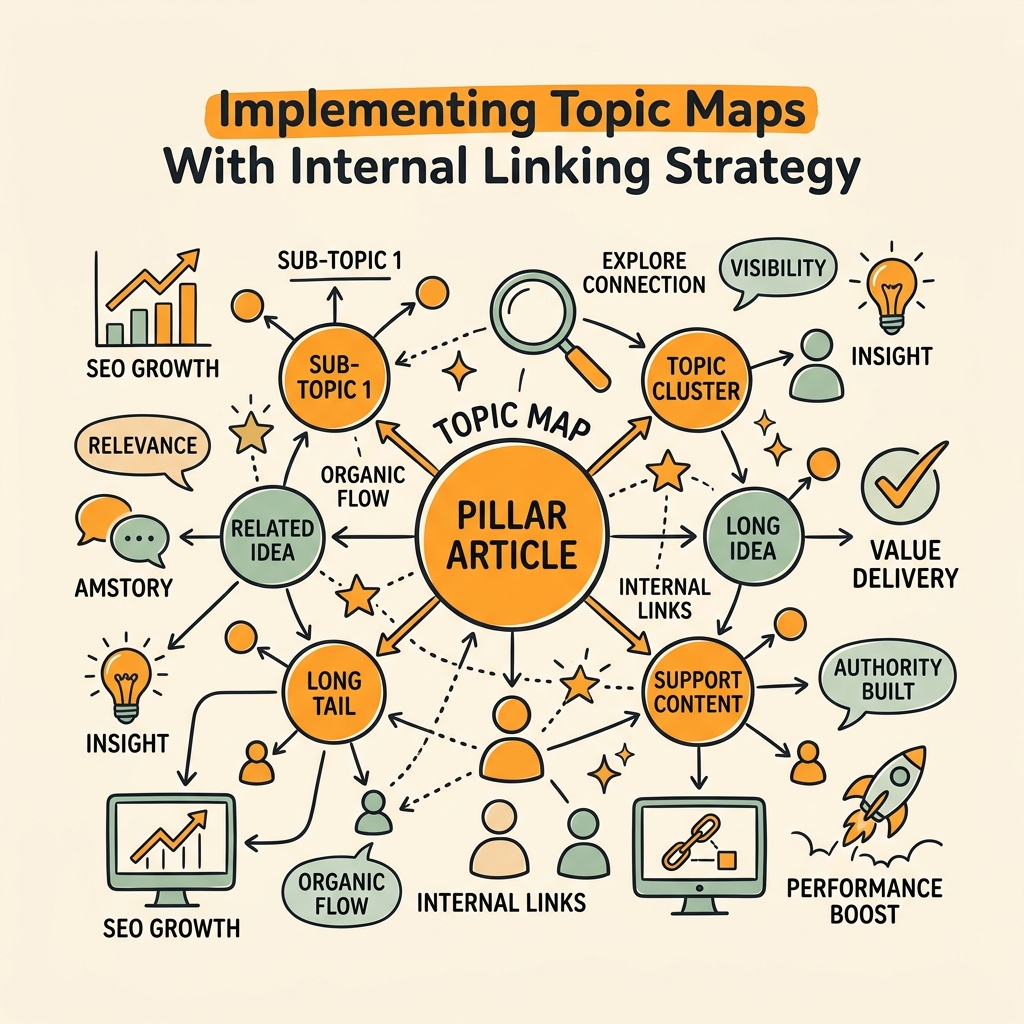
A brilliant topic map on paper is worthless if you don't execute the linking architecture. This is where most teams stumble. Writing 15 cluster pages is achievable (though labor-intensive); linking them strategically requires a system.
Building Intentional Link Paths Between Clusters
Your pillar page should link to every cluster page early in the content (within the first 500 words). Use contextual anchor text: instead of "Read more," use "Learn about content marketing ROI" or "Explore our content strategy framework." Each cluster page should link back to the pillar at least once, and should cross-link to 2-4 related cluster pages where it makes sense for the reader.
The linking pattern creates a web, not a hierarchy. A page about "content marketing for SaaS" might link to: the pillar "content marketing," a cluster page on "B2B content strategies," another on "content distribution channels," and a third on "content marketing tools for teams." These links feel natural to the reader (they follow the narrative flow) and they signal to Google that your site comprehensively covers the topic.
Anchor Text Strategy for Topical Relevance
Anchor text is the visible, clickable text of a hyperlink. It's one of the strongest relevance signals Google uses. Instead of generic "click here" links, use descriptive anchor text that includes relevant keywords. "Learn how to create a content marketing plan" is stronger than "here's how." You're signaling both the destination page's topic and the thematic connection between pages.
Avoid over-optimization: if 30% of your internal links use exact-match anchors ("content marketing strategy"), Google may penalize you for manipulation. Aim for a mix of exact-match (20%), partial-match (30%), branded (20%), and generic anchors (30%).
Managing Internal Linking at Scale
Manually linking 40 articles is tedious. Manually re-linking when you publish 5 new articles per week is unsustainable. This is where SEO automation becomes critical. Systems like autonomous SEO agents analyze your topic map and automatically suggest (or generate) internal links based on semantic relevance. When publishing 15 articles per week across multiple clusters, intelligent automation simultaneously builds the linking architecture that compounds authority. You're not managing links manually; the system is managing them intelligently.
Creating Content Clusters at Scale: Tools and Automation
Here's the hard truth: manually building topic maps and linking content is a 4-6 week project for a team of two. By the time you finish, you're behind schedule, your rankings haven't moved, and you're already thinking about your next quarter. Scaling content clusters requires automation.
How Semantic Analysis Tools Map Topics Automatically
Modern SEO tools use natural language processing to understand semantic relationships. Instead of manually reading 50 search results and guessing connections, tools analyze the top-ranking pages for a keyword and identify what topics Google associates together. They extract "People Also Ask" questions, related searches, and semantic variants from Google itself. The result is a topic map that's grounded in actual search behavior, not your assumptions.
The best tools go further: they identify gaps. Your topic map shows 40 related keywords, but you've only written about 15. The tool highlights the 25 you're missing, ranked by search volume and difficulty. This gives you a prioritized content backlog that's almost guaranteed to rank.
AI-Powered Content Generation Within Clusters
Once your topic map is built, the next bottleneck is writing. A 2,000-word cluster page takes 2-4 hours of research and writing for a human. At that rate, producing 15 cluster pages takes 30-60 hours. AI content generation tools reduce this to 3-5 hours total (including editing). More importantly, when these tools are trained on your topic map and given semantic context, they write content that naturally fits within your cluster. The generated pillar page links to the generated cluster pages; the cluster pages cross-link to each other. The entire architecture is internally consistent before you hit publish.
Automation pipelines fully manage this workflow. Feed the system your topic map, and it generates and publishes cluster pages daily while building the linking architecture in real-time. You're compounding topical authority every single day, not every quarter. This is why teams focused on AI content strategy at scale find clusters so effective—the automation makes velocity sustainable.
Smart Internal Linking as a Ranking Multiplier
Internal linking is where most teams leave ranking power on the table. A cluster of 15 pages linked haphazardly might capture 30% of the potential link equity. The same cluster linked strategically can capture 85%+. The difference is that the second example used a system to ensure every page links contextually to every related page.
Automation makes this economical. Tools analyze your cluster for semantic overlap and suggest links: "This page uses the phrase 'content distribution channels' six times. Link to your cluster page on distribution strategy with that anchor text." You're not spending an hour reading every page; you're reviewing and approving smart recommendations in 10 minutes. The linking architecture builds itself.
Topic Maps and SEO Authority: The Measurement Framework
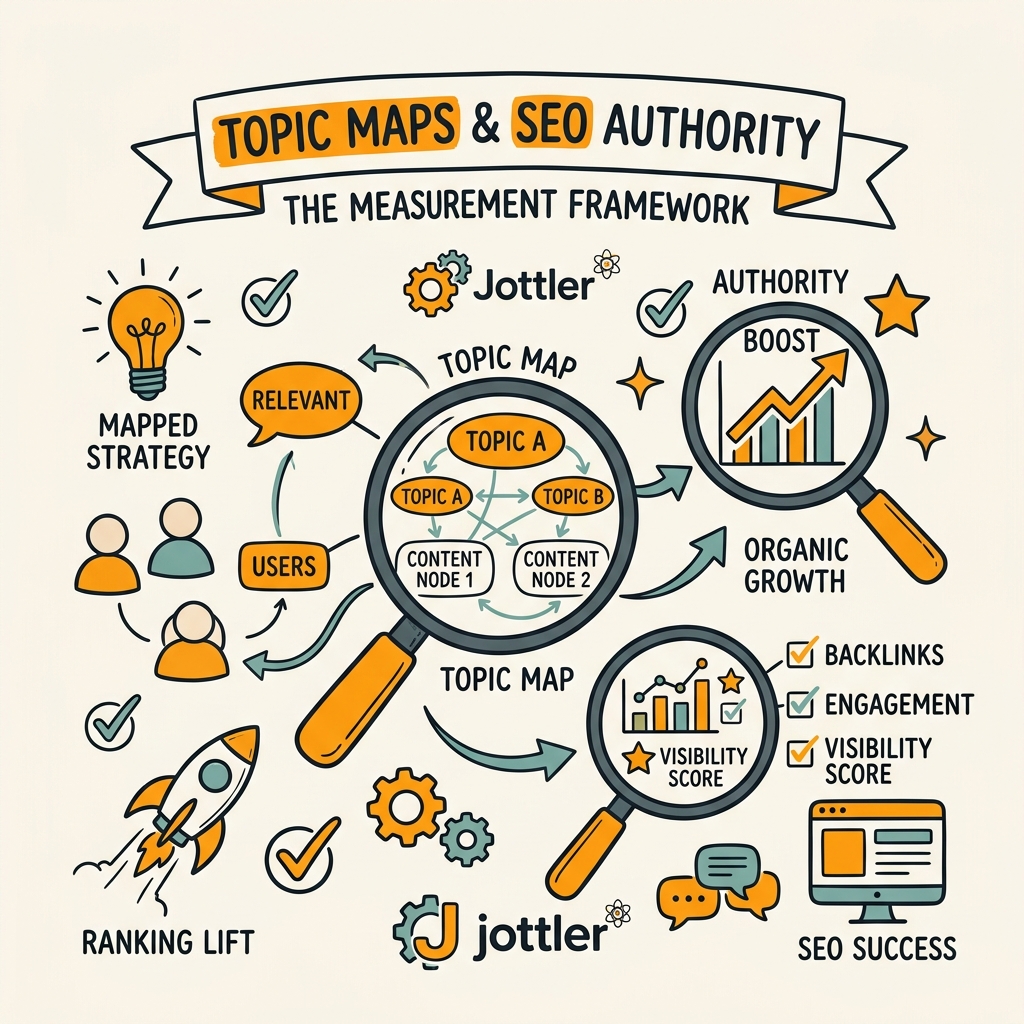
You can't optimize what you don't measure. Before you launch your first cluster, establish baselines for topical authority metrics.
Key Metrics to Track Topic Cluster Performance
Topical authority isn't measured by a single number. Instead, track a portfolio of metrics:
- Aggregate organic traffic to the cluster: All pages in the cluster combined. Track monthly growth. Goal: 15-25% growth per quarter once the cluster is complete.
- Pillar page rankings: Track ranking positions for the pillar keyword. Goal: Top 10 within 3-6 months, top 3 within 12 months (varies by difficulty).
- Cluster page SERP visibility: How many cluster pages rank on page 1 or 2? Goal: 40%+ of cluster pages ranking page 1-2 for their target keywords.
- Organic traffic by intent: Segment traffic: informational (educational), tactical (problem-solving), comparative. Goal: balanced distribution across all intent types.
- Internal link velocity: How many internal links are flowing into and out of your cluster? Higher is better. Goal: each cluster page receives 3-8 internal links from the cluster + pillar.
These metrics compound. As your cluster grows, early pages get compounded benefits from new pages linking to them. Topical authority is a multiplier, not a linear addition.
Tools for Measuring Topic Cluster Authority
SEO platforms like SEMrush, Ahrefs, and MarketMuse offer topical authority scores. These aggregate ranking data, traffic, and linking structure to estimate your authority on a topic. They're useful for benchmarking against competitors (who owns the topic better—you or your competitor?) and for identifying gaps (where does your competitor have content you don't?). Use these tools quarterly to validate that your cluster strategy is working and to identify the next topic to own.
Common Mistakes When Building Content Clusters
Topic maps are powerful, but they're easy to misuse. Here are the mistakes that kill cluster effectiveness.
Mistake 1: Choosing Too Broad or Too Narrow a Pillar Topic
A pillar topic that's too broad ("marketing") requires 200+ cluster pages. You'll never finish, and your authority stays diffused. A pillar that's too narrow ("AI writing tools for SaaS marketing teams in enterprise") is so specific that you'll never have enough related content. The sweet spot is: 500-3,000 monthly searches, 25-50 related subtopics available, clear relevance to your business. This gives you enough room to build authority without the project becoming infinite.
Mistake 2: Neglecting Search Intent in Topic Mapping
If your cluster doesn't cover all four intent types (informational, tactical, comparative, transactional), you're missing traffic. A "content marketing" cluster with five how-to guides and no "What is content marketing?" explainer is incomplete. Google sees clusters as comprehensive only if they address the full search journey. Map your topics annotated with intent, then audit your cluster: are all intent types covered? If not, your topic map is incomplete.
Mistake 3: Publishing Content Without an Internal Linking System
Content without intentional linking is just blog posts. Linking transforms blog posts into a topical authority asset. If you're publishing cluster pages without a linking checklist or system, you're leaving 50%+ of your ranking potential unused. The linking architecture is non-negotiable. Use a spreadsheet or tool to track: Which pages link to the pillar? Which pages cross-link to related clusters? Which internal links are missing? Without this audit, your cluster won't compound as intended.
Building Your First Topic Map: A Practical Checklist
Ready to build your first content cluster? Use this checklist to ensure you don't miss critical steps.
- Choose your pillar topic: 500-3,000 monthly searches, moderate difficulty, clear business relevance.
- Run keyword research: Find 40-60 related keywords and filter to 25-40 that genuinely cluster together.
- Organize into semantic groups: Create 4-6 subcategory groups (strategy, tactics, tools, measurement, comparisons, examples).
- Annotate search intent: Tag each keyword with intent type (informational, tactical, comparative, transactional).
- Prioritize by difficulty: Sequence content from easy wins (KD < 30) to harder topics. Build momentum early.
- Create a content calendar: When will you publish each piece? How many pieces per week? This defines your velocity.
- Design your linking architecture: Sketch out which pages link to the pillar, which pages cross-link. Create an internal link checklist.
- Publish and link: As each page goes live, execute your linking plan immediately. Don't batch link later; do it day-of-publication.
- Measure monthly: Track topical authority metrics. Adjust next month's priorities based on what's working.
Scaling Content Clusters Across Multiple Topics
Your first cluster takes 3-6 months to mature. Your second cluster, same timeline. But once you have two or three clusters, you can run them in parallel. The question becomes: how do you build and manage multiple clusters without burnout?
The answer is automation. Instead of manually mapping, researching, writing, and linking each cluster in sequence, you define your topic maps upfront (a 1-2 week project), then let automation handle research, writing, and publishing daily across all clusters simultaneously. Automated systems can run 3-5 cluster strategies in parallel, publishing 5-15 articles per day across all clusters while maintaining proper internal linking. This means your first cluster starts compounding while your second cluster is being published. By month 12, you have three mature clusters all contributing to organic traffic.
This is how scaling works: you don't hire three times as many writers. You define the system once and let it run at scale.
Conclusion
Content clusters and topic maps transform SEO from a keyword-chasing treadmill into a systematic strategy for building topical authority. Sites using this framework see 22-24% improvements in topical authority within 6-12 months, and more importantly, they stop wasting time on low-value content. Instead of publishing 100 scattered blog posts, you're publishing 40 interconnected, strategically linked pieces that all reinforce each other. Each new piece compounds the authority of existing pieces. Your rankings improve, your organic traffic grows, and your content library becomes a defensible competitive asset.
The mechanics are proven. The challenge is execution at scale. Manually managing topic maps, writing 15-20 articles per topic, and maintaining internal linking architecture across multiple clusters is a job that requires a full-time team. Or it requires the right automation. Start with your first topic map this quarter. Choose a pillar topic that matters to your business, map the semantic landscape, publish 15-20 cluster pages, and track the results. If your authority metrics improve (and they will), you've validated the framework. Then scale to three, five, ten clusters using automation that handles research, writing, and linking in the background while you focus on strategy.
FAQs
What is the difference between content clusters and topic clusters?
Content clusters are an inventory of existing content across your site that mentions a given topic—product pages, blog posts, webinars, data sheets. Topic clusters are a strategic framework for organizing and linking that content around a pillar page to signal topical authority. A content cluster might have 15 scattered mentions of "email marketing." A topic cluster has those 15 pieces deliberately organized, interlinked, and optimized for search. Topic clusters are the intentional version of content clusters.
How long does it take to see rankings improvements from a content cluster?
Expect 2-4 weeks to see traffic movement, 3-6 months to see significant ranking gains. Most clusters show measurable results (top 10 rankings) within 3 months once 60-70% of content is published. Full maturation—where the pillar ranks top 3 and cluster pages rank page 1 across multiple keyword variations—takes 6-12 months. The timeline depends on topic difficulty and existing domain authority. Easier topics mature faster; harder topics take longer.
Can I use content clusters to rank for competitive keywords?
Yes, but not immediately. Start your cluster with lower-difficulty keywords to build topical authority quickly. Once your pillar page ranks and your cluster has 15-20 published pages, your cumulative authority rises. This authority creates a foundation for targeting harder keywords. You can then publish new cluster pages targeting more competitive angles. Clusters don't let you skip difficulty; they let you build authority incrementally so that harder keywords become achievable over time.