Content Clusters: The SEO Planning Method That Works
Most marketing teams organize their content around individual keywords. They rank one page, try to catch traffic, and move on. The cost? Sites using this approach waste 30% more effort to achieve the same visibility as teams using content clusters. Worse, they remain invisible in the emerging AI search landscape, where standalone posts receive 3.2x fewer AI citations than clustered content (Whitehat, 2026). Content clustersorganizing related articles around a central pillar topic with bidirectional linkinghave become the dominant planning method for scaling organic traffic. Here's how to build and manage them.
Key Takeaways
- Content clusters drive 30–40% higher organic traffic and hold rankings 2.5x longer than standalone posts (2025–2026 studies).
- Clustered content receives 3.2x more AI citations from search engines, making it essential for visibility in AI Overviews.
- A single topic cluster can rank for 29,000+ keywords and attract 158,000+ visitors while preventing content cannibalization.
- Hub-and-Spoke Architecture: Pillar pages cover broad topics; cluster posts target subtopics, all linked bidirectionally to signal topical authority.
- Topical Authority as Ranking Factor: Search engines now prioritize how comprehensively a site covers a subject over domain authority alone.
- AI Search Optimization: AI systems extract answers from structured clusters, making them critical for Generative Engine Optimization (GEO).
- Keyword Gap Analysis: Identify long-tail queries with volume but limited competition, then build clusters around them systematically.
- Automation at Scale: Tools like Jottler handle research, writing, linking, and publishing across multiple clusters daily, compounding growth without manual overhead.
What Are Content Clusters and Why Do They Drive More Traffic?
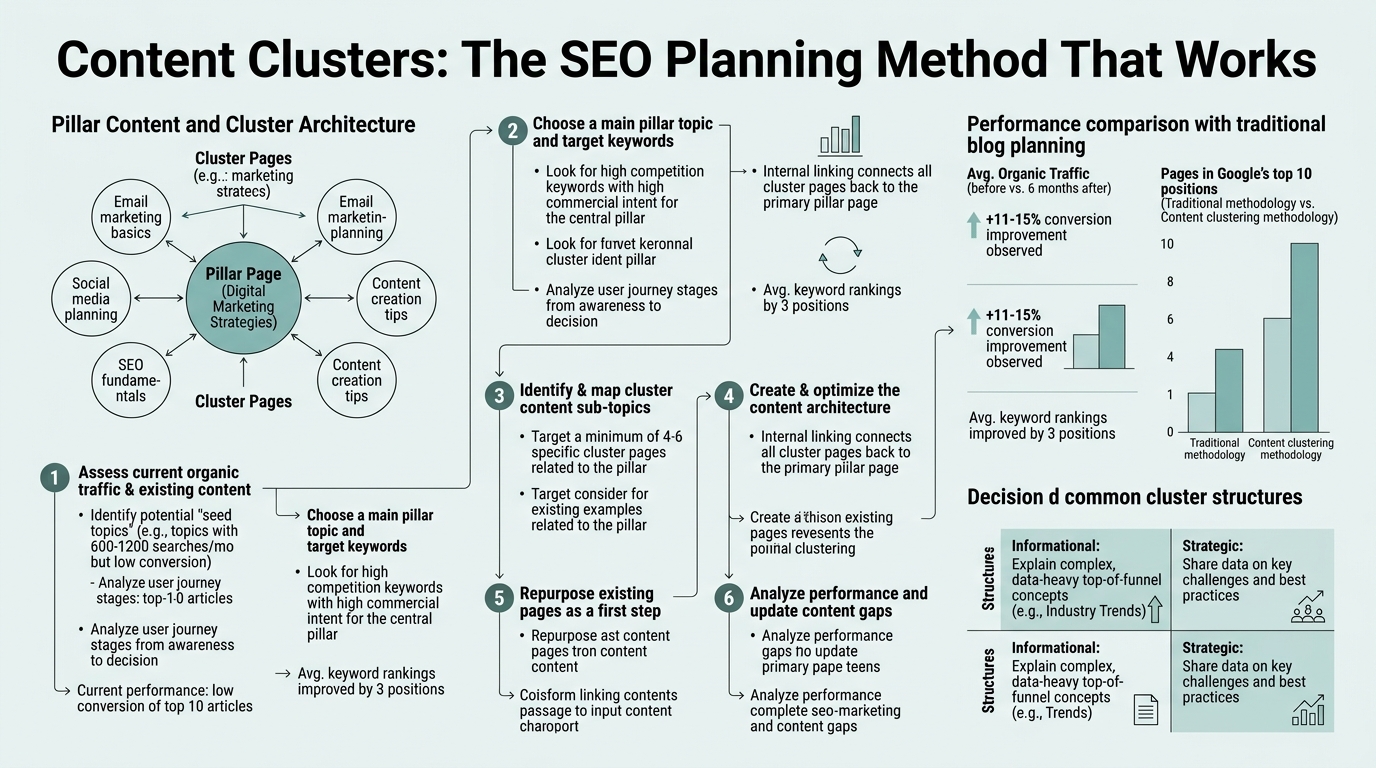
A content cluster is a group of interconnected articles organized around a central pillar topic. The pillar pagetypically 3,000+ wordscovers the broad subject. Supporting articles (8–15 pieces) dive into subtopics, each linked back to the pillar and to 2–3 related clusters. This structure tells search engines: "This site deeply understands this topic." The result? +30% to +40% more organic traffic compared to publishing the same articles in isolation (Digital Applied, 2026).
The Hub-and-Spoke Model Explained
The hub-and-spoke architecture is the backbone of content clusters. The pillar page (hub) acts as the command center. All supporting articles (spokes) link to it and to each other. Unlike a traditional blog where articles sit in chronological isolation, a cluster creates a web of authority. When a user lands on a supporting article, internal links guide them to related content, reducing bounce rates by 28% (Forrester, 2026). Search engines see this pattern and reward it with better rankings for the entire topic family.
- Pillar Page: Comprehensive overview (2,500–5,000 words) covering the main topic with high-level takeaways.
- Cluster Posts: Detailed articles (1,500–2,500 words each) targeting specific questions or subtopics within the pillar's scope.
- Bidirectional Linking: Pillar links to all clusters; clusters link to pillar and to 2–3 related clusters, creating a loop that distributes authority.
- URL Structure: Organize clusters by topic path (e.g., `/seo/content-clusters/pillar`, `/seo/content-clusters/keyword-research`).
Why Search Engines Prefer Clusters
Search engines evaluate relevance differently now. Topical authorityhow comprehensively a site covers a subjectis now the strongest on-page ranking factor, surpassing domain authority (Infiflex, cited by RankDraft, 2026). A site with 10 deep articles on "content marketing" signals expertise. A site with one article on the same topic doesn't. Content clusters prove expertise through breadth and depth. When Google's algorithm crawls a pillar page and discovers 12 supporting articles all linking back to it, the signal is unmistakable: this domain owns this topic.
For AI-powered search systems (Google AI Overviews, ChatGPT, and others), the advantage is even greater. These systems scan multiple sources to synthesize answers. A clustered, interconnected group of articles is easier to understand as a single authoritative body of work. Studies show that pillar pages with topic clusters receive 3.2x more AI citations than standalone posts (Yext, cited by RankDraft, 2026).
How Do Content Clusters Impact Your Overall SEO Performance?
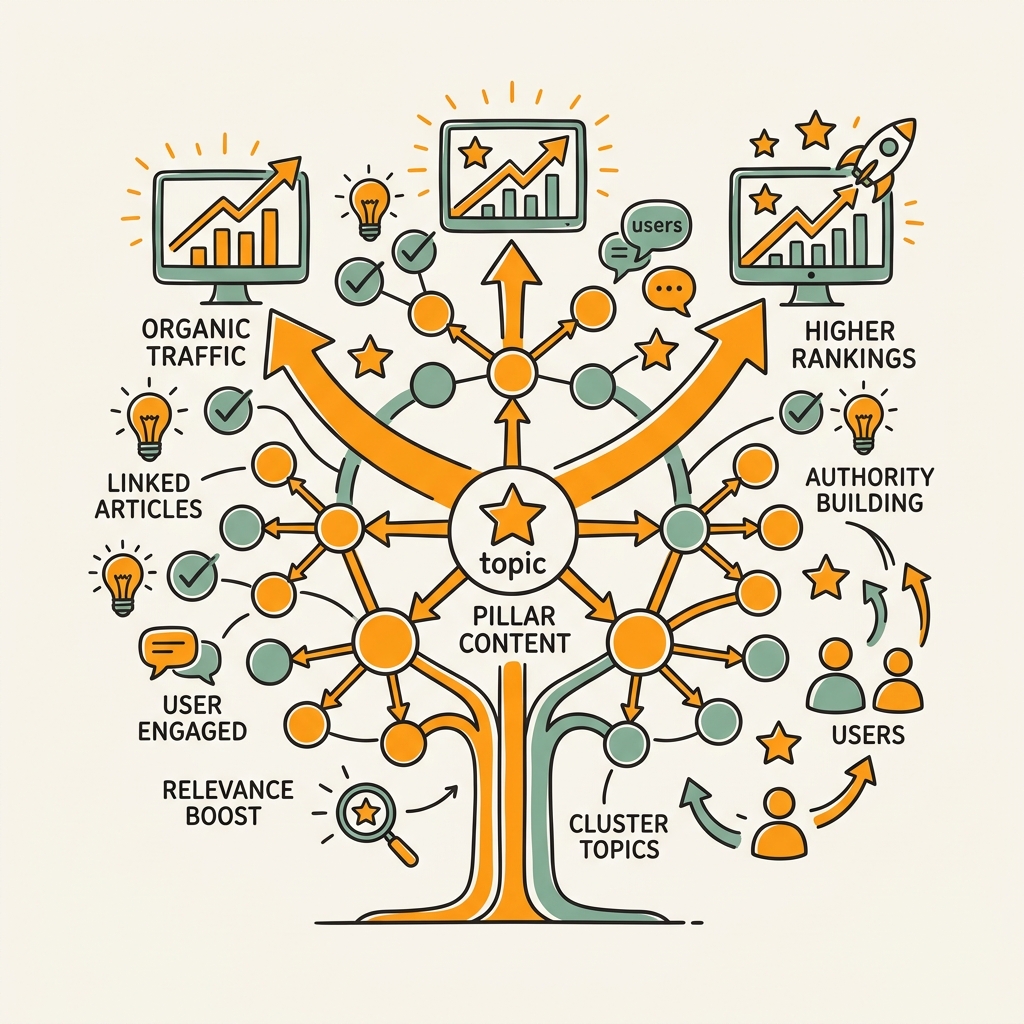
The metrics are clear. Sites implementing content clusters for 12+ months see 40% higher organic traffic than sites using traditional keyword-per-post strategies (RankDraft, 2026). But the gains go beyond traffic volume. Let's break down what clusters actually deliver.
Traffic Growth, Keyword Rankings, and Ranking Stability
A well-constructed cluster doesn't just rank for its main pillar keyword. One documented cluster ranked for 29,000+ keywords and attracted 158,000+ visitors (Backlinko, cited by RankDraft, 2026). How? Each supporting article targets specific long-tail variations. When you have 12 related articles, each optimized for 3–5 related queries, keyword coverage expands exponentially. Additionally, cluster content holds rankings 2.5x longer than standalone articles (HireGrowth, 2025). Why? Because when one article drops in rankings, related articles still drive traffic to the topic, and internal links help recover the fallen article faster.
Conversion and User Behavior Improvements
Traffic is meaningless without engagement. Content clusters improve both. Sites using clusters see 60% better conversion rates compared to traditional methods (Digital Applied analysis, 2026), and users spend 32% more time on site when navigating between cluster articles. Internal linking reduces frictionusers don't have to search for related content; it's right there. Lower bounce rates (-28%), more page views per session, and longer time on site all compound into higher conversion likelihood. For SaaS founders, this translates to more demo requests and trial signups per visitor.
"One documented topic cluster ranked for 29,000+ keywords and attracted 158,000+ visitors. A single pillar with supporting content outperforms dozens of disconnected pages."Backlinko, cited by RankDraft
Preventing Content Cannibalization
Many teams accidentally compete with themselves. They publish two articles that target similar keywords. Google doesn't know which to rank, so it ranks both lowera phenomenon called cannibalization. Clusters solve this by creating clear content boundaries. Each article targets a distinct subtopic within the pillar scope. Pillar covers "content marketing." One cluster covers "content marketing for SaaS." Another covers "content marketing metrics." There's no overlap, no internal competition. Every piece has a role.
Step-by-Step: How to Build a Content Cluster
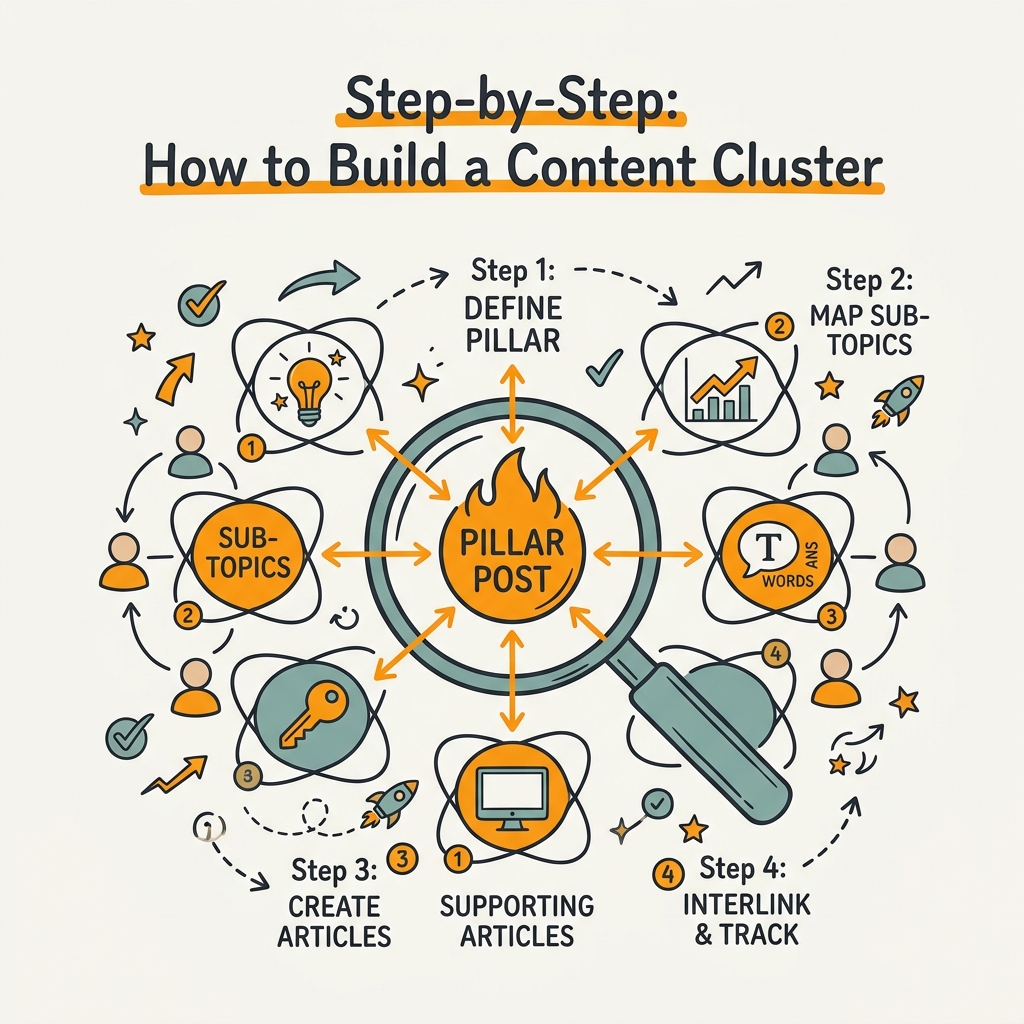
Building a cluster isn't difficult, but it requires strategy. Skip this step and publish randomly, and you'll waste time. Follow this framework and you'll compound growth.
Step 1: Choose a Core Topic and Validate Demand
Start by choosing a broad topic that aligns with your business and audience. Don't guess. Validate it. Use keyword research to confirm there's real, sustained search volume. Look for topics where searchers are asking multiple related questions. "Content marketing" has 100,000+ monthly searches. "Content marketing for SaaS" has 5,000+. "AI content marketing" has 2,000+. Together, they signal a rich topic space worth clustering. Score potential topics on four criteria: Strategic Alignment (does it fit your business?), Search Opportunity (is there combined volume?), Competitive Landscape (can you rank?), and Content Cost (do you have expertise?). Pick topics that score high on all four.
Step 2: Research and Identify Gaps
Now perform keyword gap analysis. List all related long-tail queries. Tools like Digital Applied recommend scoring gaps by search volume, topical relevance, and business alignment. Look for queries with measurable volume but limited high-quality contentthese are your cluster post opportunities. Prioritize gaps based on Search Volume, Topical Relevance to the pillar, and Business Alignment. You're looking for 8–15 subtopics, each with enough search volume to justify 1,500+ words. Once mapped, you have your cluster roadmap.
- High-Volume Topics: 500+ monthly searches. These become pillar pages or major cluster pieces.
- Mid-Volume Topics: 100–500 monthly searches. Perfect for cluster articles that support the pillar.
- Long-Tail Topics: 10–100 monthly searches. Include these to maximize keyword coverage and feed niches.
- No-Volume Topics: Skip these unless they're strategically important for user journey flow.
Step 3: Create the Pillar Page
The pillar page is your hub. It should cover the topic broadly, mention all subtopics, and link to every cluster article. Aim for 2,500–5,000 words. Structure it as a comprehensive reference: introduction, main sections covering major subtopics at a high level, a comparison or results table, and FAQs. Don't dive deep into any subtopicthat's what cluster articles do. The pillar's job is to introduce the landscape, signal topical authority, and funnel readers to deeper content. Include a table that compares cluster approaches or strategiesthis satisfies the need for structured data and helps with AI extraction.
Step 4: Build Supporting Cluster Articles
For each identified subtopic, create a detailed article. Aim for 10–15 quality supporting articles per cluster to maximize visibility (RankDraft, 2026). Each should: target a specific long-tail query or subtopic, provide actionable, original insights, include at least one real statistic or case study, link back to the pillar, and link to 2–3 related cluster articles. Length: 1,500–2,500 words. Quality matters more than quantitythin, generic content will be penalized by search algorithms. Deep, expert-level content compounds authority. For busy founders who lack time to research and write this content consistently, content cluster strategy automation tools handle the research and writing phase while you focus on strategy and linking.
"Pillar pages with topic clusters receive 3.2x more AI citations than standalone posts. Bidirectional internal linking within clusters increases the probability of AI citation by 2.7x."Yext, cited by RankDraft
Step 5: Link Everything According to the Hub-and-Spoke Pattern
Linking is where clusters create their authority signal. The pillar links to all clusters. Each cluster links back to the pillar using keyword-rich anchor text (e.g., "Our complete guide to content clusters"). Additionally, cluster articles should link to 2–3 related clusters, creating a web rather than a simple spoke pattern. This bidirectional linking is critical. Studies show it increases AI citation probability by 2.7x (Yext, cited by RankDraft, 2026). Use descriptive anchor text that includes the target article's main keywordthis helps search engines understand relevance.
How Should You Sustain and Grow Your Clusters Over Time?
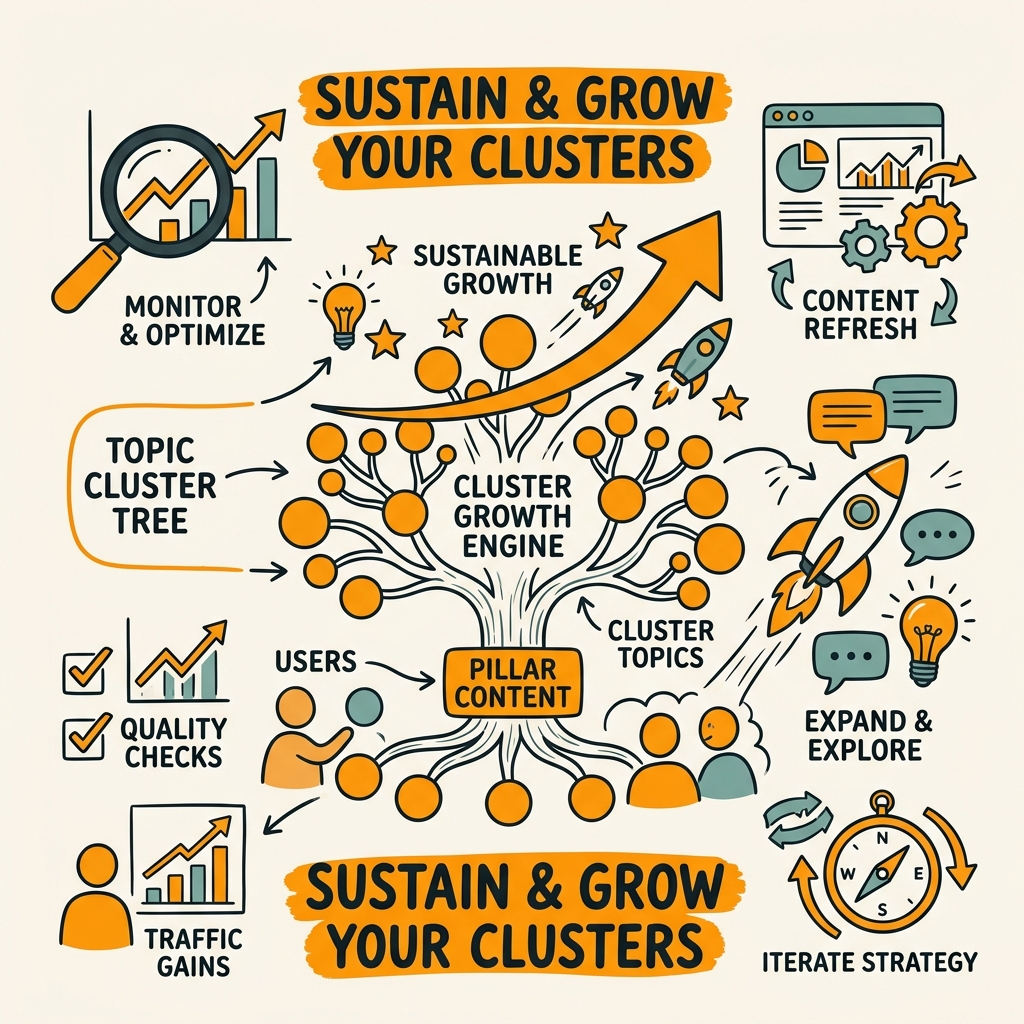
Building a cluster is not a one-time project. Growth compounds over months and years. The best performers treat clusters as living systems that expand and deepen continuously.
Adding New Articles to Existing Clusters
After launching a cluster, monitor search performance. Which subtopics are ranking? Which are getting traffic but could go deeper? Identify gaps and fill them. If your "content marketing" cluster ranks well for "content marketing strategy" but barely ranks for "content marketing budget," add an article on budgeting. As time passes, expand each cluster from 8 articles to 12, then to 15. Each new article links back to the pillar and adjacent pieces. Over 12 months, a cluster that started with 8 articles and grew to 15 will typically outperform its early version by 60%+ due to expanded keyword coverage and authority accumulation.
Updating and Refreshing Cluster Content
Stale content loses rankings. Plan to refresh cluster articles every 6–12 months, especially pillar pages. Update statistics, add new case studies, fix broken links, and improve structure. When you refresh, republish with a fresh date or update notationsearch engines treat refreshed content more favorably than static old content. This is especially important for topics where trends shift (marketing, technology, SEO practices).
Automating Cluster Research and Publishing
Scaling clusters manually is where most teams fail. You can't write 15 cluster articles by hand and maintain freshness without burning out. This is why SEO automation platforms like Jottler exist. Jottler automates the entire cluster workflow: research (pulling from 14+ sources), writing (3,000+ word articles daily), fact-checking, internal linking (connecting new articles to existing clusters), and direct CMS publishing. Connect your site, set your topics and publishing frequency, and the AI agents handle keyword research, gap identification, article writing, and linking. Teams using this approach scale from publishing 1–2 articles per month to 3–5 per week without additional headcount. For busy founders, this is transformativeyou get cluster growth compounded across all your topics simultaneously.
- Automated Topic Research: AI agents identify keyword gaps and emerging subtopics within your clusters without manual SERP analysis.
- Fact-Checking at Scale: Verification layers catch inaccurate claims before publishing, protecting your brand authority.
- Smart Internal Linking: The system links new articles to relevant existing pieces, deepening the cluster network automatically.
- Consistent Publishing: You choose frequency (1–5 articles daily). The system publishes to your CMS on schedule, every single day.
Content Clusters vs. Traditional Keyword-Per-Post Strategies
Let's compare the two approaches head-to-head to show why clusters have become the standard.
| Metric | Content Clusters | Standalone Keyword Posts |
|---|---|---|
| Organic Traffic | +30% to +40% higher baseline | Baseline (single keywords only) |
| Keyword Coverage | 29,000+ keywords per cluster | 5–15 keywords per article |
| Ranking Stability | 2.5x longer retention | Volatile; drops without updates |
| AI Citations | 3.2x more citations than standalone | Low citation rate; AI bypasses thin content |
| User Engagement | 32% more time on site; -28% bounce rate | Higher bounce; less internal engagement |
| Conversion Rate | +60% better conversion vs. traditional | Lower conversion; single-purpose pages |
| Authority Signal | Strong topical authority | Fragmented; scattered across site |
| Content Cannibalization | None; clear boundaries per subtopic | High; multiple articles compete for same keywords |
The verdict is clear. Clusters outperform keyword-per-post strategies on every meaningful metric. The only reason teams haven't universally adopted them is execution frictionbuilding and maintaining clusters takes work. This is changing. As tools like autonomous SEO agents reduce friction, cluster adoption accelerates. For SaaS content marketing teams in particular, automation is the key to sustainable cluster growth.
Common Mistakes When Building Content Clusters
Even with the right framework, teams make predictable mistakes that undermine clusters. Avoid these.
Building Clusters Too Narrow or Too Broad
If your pillar topic is "marketing," you have 500+ subtopic possibilities. Your cluster becomes unfocused and cannibalized. If it's "Q3 2026 email marketing strategies," you've gone too narrowyou'll run out of subtopics after 3–4 articles. Pick topics with 8–15 natural subtopic divisions. "Content marketing" is ideal. "SaaS content marketing" is tighter but still works. Test by listing subtopic ideas. If you can list 15+ without forcing it, the topic is right-sized.
Publishing Thin, Generic Content
Google's December 2025 Core Update crushed thin content hard. Sites publishing 800-word fluff pieces saw traffic drops of 71–87% (RankDraft, 2026). Clusters survive and thrive on depth. Every article should include original research, case studies, or specific frameworks. Aim for 1,500+ words minimum. Include at least one statistic or data point per article. Answer the reader's question completelydon't leave them wanting.
Forgetting to Link Strategically
Clusters work because of linking patterns. If you build the pillar and cluster articles but don't connect them, you've just built a series of disconnected posts. Internal links must be intentional. Use keyword-rich anchor text. Link cluster articles to the pillar and to 2–3 related clusters. Don't over-link (20+ links per article is spam); aim for 3–5 internal links per article, placed naturally in the prose.
Neglecting to Monitor and Refresh
Build once, rank foreverthat's a myth. Search results shift, competitors publish, and statistics become outdated. Plan to refresh cluster articles every 6–12 months, especially pillars. Track which articles drive traffic and which languish. Double down on winners; retire or improve losers.
Conclusion
Content clusters are no longer a nice-to-have; they're the foundation of modern SEO. They drive 30–40% higher organic traffic, hold rankings 2.5x longer, and deliver 3.2x more AI citations than fragmented, keyword-per-post strategies. For teams scaling organic traffic without burnout, clusters are the answer. They organize your content systematically, signal topical authority to search engines, and create a compounding asset that grows in value over time.
The challenge isn't strategyit's execution at scale. Building, linking, and maintaining clusters across multiple topics demands consistent effort. This is where automation becomes transformative. AI-powered platforms handle research, writing, fact-checking, and publishing cluster articles daily, removing the bottleneck. You define your topics; the system compounds growth across all of them simultaneously. Start your SEO agent and begin building clusters that rank and convert.
FAQs
How many articles does a content cluster need to rank?
A cluster can begin ranking with as few as 4–5 articles, but 10–15 quality supporting articles maximizes visibility and keyword coverage. Research shows that clusters with 12+ deep, interconnected articles rank for significantly more long-tail variations and maintain rankings longer than smaller clusters. Start with 8 articles and expand to 15 within 6 months for compounding returns.
What's the difference between a content cluster and a topic cluster?
The terms are used interchangeably in modern SEO. A content cluster is a group of articles linked around a pillar page. A topic cluster refers to the same structure, organized by topic rather than keyword. The difference is semantic philosophy: keyword-focused teams call them "content clusters," while topic authority advocates call them "topic clusters." Functionally, they're identicala central pillar linked to supporting articles in a hub-and-spoke pattern.
How long does it take to see results from a content cluster?
Traffic typically begins flowing within 4–6 weeks, with meaningful growth compounding over 3–6 months as the cluster matures and Google crawls all interconnected articles. The pillar may rank within 8–12 weeks. Supporting articles often rank faster (4–8 weeks) for their specific long-tail queries. The full benefitwhere the cluster ranks for 10,000+ keyword variationstakes 6–12 months. Patience and consistent updates accelerate results.