Creating SaaS Content That Addresses Buyer Objections
Your salespeople spend weeks fielding the same objections. Price is too high. Implementation looks complex. We already use a competitor. We need to think about it. Yet most SaaS teams treat objection handling as a sales problem, not a content problem. The reality? 67% of SaaS content fails to address buyer pain points, and only 29% of marketers consider their content strategy very effective, despite 96% having one in place. This disconnect costs real revenue: companies that implement an "objection prevention" content strategy see a 22% reduction in sales cycle length compared to teams handling objections reactively during calls. The fix is systematic—map your top objections, create targeted content assets, and let buyers self-educate before picking up the phone.
Key Takeaways
- 67% of SaaS content misses buyer pain points, leaving objections unaddressed in marketing assets (2026, 5WPR Research)
- The top 5 objections account for 92% of all stated pushback in B2B SaaS conversations (Gong Labs, 2024–2026)
- SaaS companies using proactive objection prevention content reduce sales cycle length by 22% and improve deal velocity
- 80% of sales interactions feature recurring objections—making them the highest-impact content creation opportunity
Quick-Scan Roadmap
- Map Your Top Objections: Collaborate with sales to identify the 5–10 objections that appear in 80% of conversations, then prioritize by deal size and win impact.
- Build a Role-Based Content Framework: Create assets tailored to Finance (pricing, ROI), IT (integration, security), and Legal (compliance, data privacy) stakeholders separately.
- Implement the Acknowledge-Clarify-Respond Model: Structure objection-busting content to validate concerns first, isolate root causes second, then provide evidence-backed solutions.
- Use Content to Enable Sales Self-Service: Position blog posts, case studies, and explainer videos as buyable assets that let prospects resolve concerns internally before engaging your team.
- Automate Content Updates Based on Win/Loss Data: Tag objections in your CRM, review weekly, and refresh battlecards and blog posts monthly based on what actually wins deals.
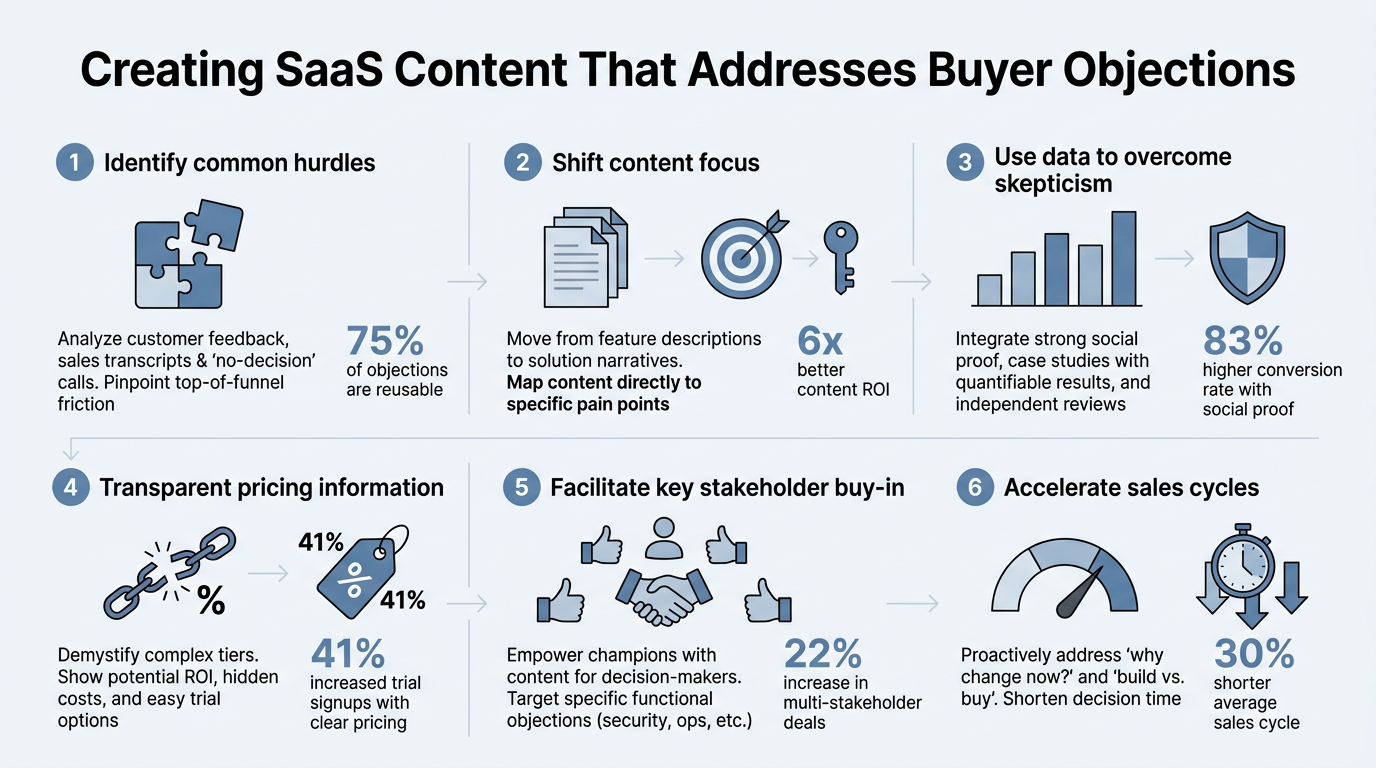
Why Most SaaS Content Misses Objections Entirely
The content paradox is real. 67% of SaaS content fails to address buyer pain points, yet companies spend massive budgets on volume. According to 5WPR's 2026 SaaS Content Paradox research, SaaS teams publish blog posts about features, benefits, and use cases—but rarely about the objections stopping deals in their tracks. This gap exists because content and sales operate in silos. Marketing produces general awareness content; sales handles objections on their own. Meanwhile, your prospects are stuck in their buying process, waiting for someone to answer the question keeping them up at night.
"The missing piece is intentional objection-focused content. When your content team doesn't know what the top 5 objections are in your sales process, they can't address them. When marketing doesn't talk to sales about which objections correlate with stalled deals, they miss the highest-leverage content opportunities."
The data confirms this misalignment. Only 29% of SaaS marketers rate their content strategy very effective, despite 96% having one in place. The missing piece? Intentional objection-focused content. When your content team doesn't know what the top 5 objections are in your sales process, they can't address them. When marketing doesn't talk to sales about which objections correlate with stalled deals, they miss the highest-leverage content opportunities. Building a proper SaaS content marketing framework requires aligning content with actual buyer concerns from day one.
The Cost of Generic Content
Generic content creates friction. A buyer lands on your pricing page and sees the price. No ROI calculator. No total cost of ownership (TCO) comparison. No case study from a company their size. So they leave to compare you against competitors who did provide those answers. Meanwhile, your sales team inherits the objection conversation with incomplete context.
The problem compounds when multiple stakeholders are involved. 65% of SaaS deals now involve 4+ stakeholders—Finance, IT, Legal, Operations. Each has different objections. Finance worries about cost. IT worries about integration and security. Legal worries about data privacy and contract terms. But most SaaS content speaks to a single persona, leaving the other stakeholders unfed. They form their own opinions, often negative ones, before sales even enters the conversation.
To address multi-stakeholder concerns effectively, segment your content strategy by role:
- Finance stakeholders need pricing explainers, ROI calculators, TCO comparisons, and customer ROI case studies.
- IT stakeholders need API documentation, security whitepapers, compliance certifications, integration guides, and technical migration playbooks.
- Legal stakeholders need data privacy policies, standard contract terms, DPA templates, and liability clarifications.
- Operations stakeholders need implementation timelines, change management guides, training resources, and post-launch support documentation.
Sales Reps Solving It Solo Costs Pipeline Velocity
When objections aren't preemptively addressed by content, sales reps spend their time explaining instead of closing. A prospect objects to price. The rep spends 15 minutes building an ROI case on the fly. The prospect objects to complexity. The rep spends another call walking them through implementation. Each cycle delays the deal. The research is clear: companies implementing objection prevention content reduce sales cycle length by 22% compared to reactive approaches. That's not marginal. That's the difference between a 6-month sales cycle and a 5-month one—compounded across your entire pipeline. Teams using autonomous SEO strategies to scale objection content production see this velocity gain multiply across dozens of assets.
How to Identify the Objections Worth Creating Content Around

Not all objections deserve equal content investment. Some objections kill deals immediately. Others delay decisions but don't prevent wins. To create high-impact content, you need to know which objections are blocking your revenue. The approach is straightforward: map objections by frequency and deal impact, then focus on the ones that appear in 80% of conversations and correlate with stalled deals.
Extract Your Top Objections from CRM and Sales Calls
Start with what you already have. Review your last 50–100 closed-won and closed-lost deals. In your CRM, flag the objections mentioned during each deal cycle. If you're not already tagging objections, start now. Use categories like Pricing, Feature Gap, Integration, Security, Timing, and Competitive. After 50 deals, patterns emerge. You'll see that "We don't have budget this quarter" appears in 28% of conversations, while "Your security certification is unclear" appears in only 8%. The first is a content goldmine. The second might not be worth the effort—unless it's killing large deals specifically. According to Gong Labs data on objection handling statistics, the top 5 objections account for 92% of all stated pushback in B2B SaaS.
Next, layer in sales call data. If you use conversation intelligence (Gong, Chorus, or similar), export the objection tags for your last quarter. Most platforms allow you to filter by win rate. You'll immediately see which objections correlate with losses. A prospect might object to price in 30% of calls but still buy at a high rate (they're testing your flexibility). A different prospect might object to implementation complexity in only 15% of calls but those 15% convert to losses 80% of the time. That's a red flag. That objection is costing you deals. Build content around it.
Segment Objections by Stakeholder and Buying Stage
Objections vary by role and stage. 65% of B2B SaaS deals involve 4+ stakeholders, and each raises different concerns at different times. In the awareness stage, a prospect might not have objections—they're just learning. In the consideration stage, Finance raises pricing objections. In the decision stage, IT raises integration and security objections. Legal arrives late with contract concerns.
Create a matrix to visualize objection distribution:
- Map objections on one axis—list your top 5–10 objections (Pricing, Integration, Security, Feature Gap, Timing, Competitive, etc.).
- Map personas on the other axis—Finance, IT, Operations, Legal, Executive.
- Mark high-frequency combinations—which objection-persona pairs appear most often in your deals?
- Identify content gaps—perhaps you have a security whitepaper for IT but no contract-term explainer for Legal.
- Prioritize content creation—build assets for gaps blocking your highest-value deals.
A strong SaaS content marketing strategy aligns each asset to a specific buyer persona and objection combination, rather than publishing generic content that speaks to everyone and converts no one.
Prioritize by Deal Size and Win Probability
Not all objections are created equal. An objection that kills a $50K deal is less costly than one killing a $500K deal. Similarly, an objection that appears in only 5% of conversations but kills 100% of those deals is higher-priority than one appearing in 30% of conversations but killing only 10%.
Score your objections using this two-axis framework:
- Frequency: The percentage of deals mentioning the objection.
- Impact: The percentage of those deals that go dark or are lost.
- Priority Score: Multiply frequency by impact to rank objections by true business impact.
Example: "We're already using a competitor" appears in 21% of conversations and kills 35% of those deals (frequency × impact = 7.35). "Your pricing is too high" appears in 28% of conversations and kills 12% of those deals (3.36). The first objection, though less frequent, deserves more content investment because it's more destructive.
Building Your Objection-Focused Content Framework
Once you know which objections matter, the content strategy is systematic. Each objection needs a dedicated content asset that moves the prospect from doubt to conviction. The most effective framework is Acknowledge-Clarify-Respond: validate the concern, isolate the root cause, then provide evidence.
The Acknowledge-Clarify-Respond Model for Content
This model, adapted from sales frameworks, translates directly into content structure. Start by validating the concern. A blog post titled "Why Implementation Complexity Worries SaaS Buyers" immediately signals that you understand the objection. It's not dismissive. It's not a salesy counterargument. It's an acknowledgment. The second step is clarification. Break down what "complexity" actually means. Is it timeline? Is it team disruption? Is it technical setup? Is it change management? Each has different answers. The third step is response with evidence: case studies showing how companies similar to the prospect solved the problem, timelines for typical implementation, phases that minimize disruption, and rollback plans if things go sideways.
This structure works across all objection types:
- For pricing objections: Acknowledge that cost is a legitimate consideration, clarify whether the concern is absolute price or price relative to value or price relative to alternatives, then respond with ROI calculators, TCO models, and case studies showing payback periods.
- For security objections: Acknowledge that data safety is non-negotiable, clarify which certifications or practices matter most to the prospect's industry, then respond with compliance documents, audit reports, and third-party security assessments.
- For integration objections: Acknowledge that system compatibility matters, clarify which systems need to integrate, then respond with API documentation, integration guides, and case studies from similar integrations.
- For competitive objections: Acknowledge that the incumbent has advantages, clarify why they're considering switching, then respond with feature comparisons, customer testimonials from switchers, and competitive analysis guides.
Create Role-Based Content Assets, Not Generic Ones
Your Finance buyer and your IT buyer have different objections. Your content should too. A Finance buyer cares about pricing, ROI, and budget justification. They want pricing explainers, ROI calculators, customer ROI case studies, and total cost of ownership (TCO) comparisons. An IT buyer cares about integration, security, and implementation. They want API documentation, security whitepapers, compliance certifications, integration guides, and technical migration playbooks. A Legal buyer cares about data privacy, contract terms, and liability. They want data privacy policies, standard contract terms, DPA templates, and liability and indemnification clarifications.
"Most SaaS companies publish one pricing page, one security page, and one implementation guide. They're written for a generic buyer. The result? Finance feels it's too surface-level. IT doesn't see the technical depth they need. Legal doesn't find contract answers. No one is fully satisfied. Instead, create multiple assets tailored to specific stakeholders."
Most SaaS companies publish one pricing page, one security page, and one implementation guide. They're written for a generic buyer. The result? Finance feels it's too surface-level. IT doesn't see the technical depth they need. Legal doesn't find contract answers. No one is fully satisfied. Instead, create multiple assets. A pricing blog post for Finance stakeholders. A security architecture document for IT. A contract-term FAQ for Legal. This doesn't mean tripling your content output. It means being intentional about who each piece serves and what question it answers.
Use Case Studies and Proof to Counter Specific Objections
Facts persuade some objections. Social proof persuades others. If a prospect says "Your solution is too expensive," a feature list won't help. An ROI case study will. Show a company similar to them in size, industry, and use case. Show their before state (the problem). Show the investment. Show the return (measurable outcomes). Show the timeframe to payback. That's persuasive because it's specific.
If a prospect says "Implementation is too complex," a simple explainer won't work. A phased implementation case study will. Show how Company X implemented in phases, with Week 1 being setup and data migration, Week 2 being pilot testing, Week 3 being full rollout. Show their team size and skills. Show the timeline. Show that they stayed operational throughout. Again, specificity builds conviction.
Match proof types to objection types for maximum impact:
- Pricing objections: ROI data, customer testimonials about value realization, TCO comparisons, and payback period calculations.
- Feature objections: Comparison tables, feature walkthroughs, and competitive analysis documents.
- Implementation objections: Case studies, project timelines, phased rollout guides, and change management playbooks.
- Security objections: Certifications, audit reports, compliance documentation, and third-party security assessments.
How to Systematize Objection Content Production at Scale
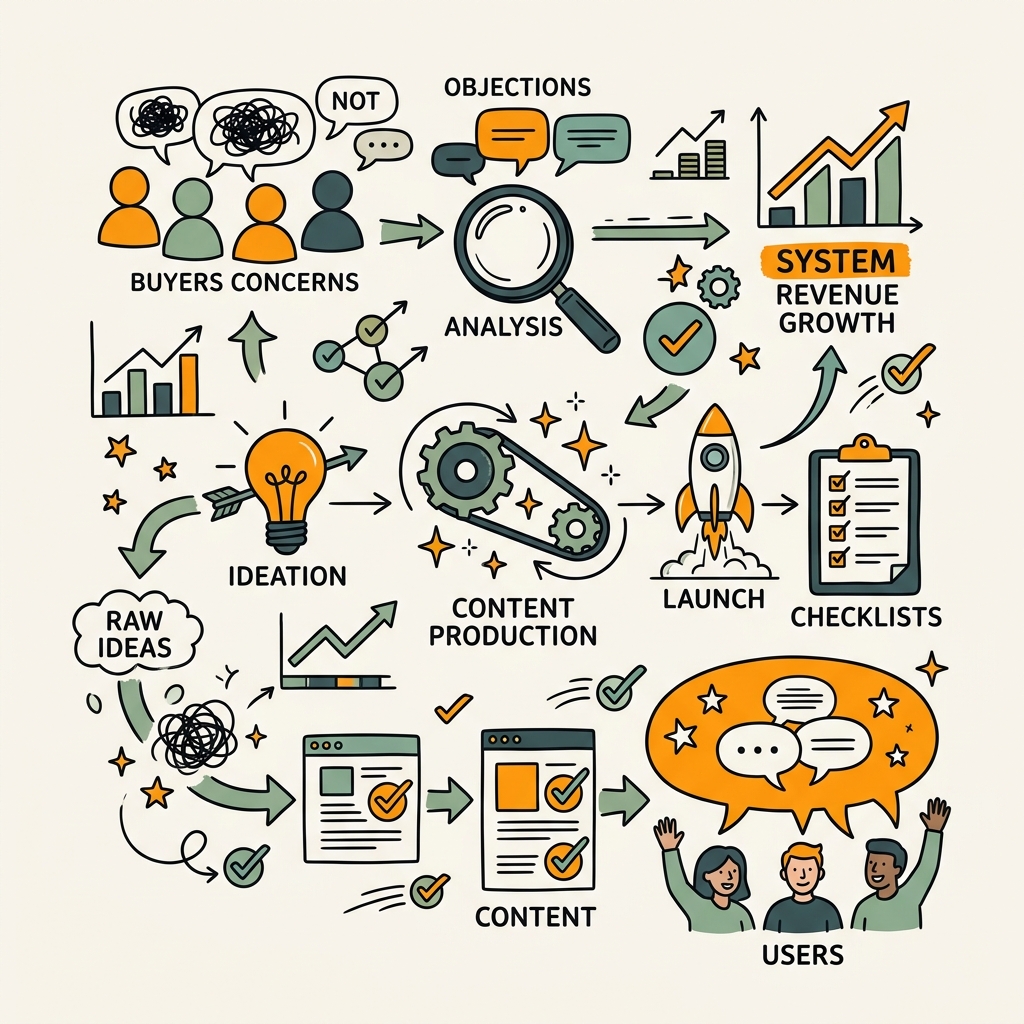
Objection content is high-leverage. A single ROI calculator might influence 50 deals. A security whitepaper might unblock IT approval for dozens. But scaling objection content production manually is slow. You research the objection, interview sales reps, dig into case study data, draft the asset, revise based on legal and product feedback, publish, promote. For a startup with limited marketing bandwidth, this is unsustainable. Implementing content marketing automation tools can compress this timeline from weeks to days.
Tag Objections in Your CRM and Automate Content Prioritization
The first automation step is data. Start tagging every objection in your CRM today. If your CRM doesn't support custom fields for objections, add them. During every sales call, capture the objections raised. During deal reviews, sales leaders flag which objections appear most often. You now have quantified objection data. This becomes your content roadmap. Tools like Jottler can ingest this data and automatically surface the top content opportunities, generating fact-checked, evidence-backed content on objections your sales team is actually hearing. Rather than guessing which objections matter most, you're building content where your revenue is actually getting blocked.
Create Objection-Response Content Templates
Once you've mapped your top 5–10 objections, create response templates. The template for a pricing objection post includes: objection statement, why it's valid, misunderstandings about pricing, ROI calculation walkthrough, case study (company similar to reader, metrics), and a CTA to a pricing conversation. The template for a security objection post includes: objection statement, why security matters, your security approach, certifications and audits, comparison to industry standards, and a CTA to a security conversation.
With templates in place, accelerate your content production:
- Define the objection-response template structure (Acknowledge-Clarify-Respond sections).
- Gather data inputs from sales, product, and legal teams (objection statement, company context, metrics, certifications).
- Assign ownership of each template to a team member (marketing lead, product manager, or legal team member).
- Set a publishing cadence (e.g., one new objection-focused post every two weeks).
- Use automation tools to generate drafts quickly, then review and refine for brand voice.
With templates, content production speeds up. Your marketing team creates a new post every two weeks instead of once a month. You fill the template with data from your product, legal, and customer teams. The structure is proven. The quality stays high. The output scales.
Refresh Content Monthly Based on Win/Loss Data
The objection landscape evolves. A competitor launches a new feature. Your positioning shifts. Buyers' concerns change. Your objection-focused content should evolve with them. Make it a monthly habit. During your sales review, flag new objections that emerged that month. Flag objections you thought were dead that reappeared. Update your battlecards. Update your blog posts. If a new competitor is raising switching concerns, add a competitor comparison post to your roadmap.
This isn't a one-time effort. It's a system. Tag → Analyze → Create → Measure → Update. Repeat monthly. Tools that automate this cycle—tracking which objections appear in deals that close vs. deals that stall, and updating playbooks in real-time—give you a structural advantage over competitors doing objection handling manually.
Measuring the Impact of Objection-Focused Content
Objection content works. The data is clear: companies implementing objection prevention content see a 22% reduction in sales cycle length. But you need to measure it in your own context to justify the effort and refine the approach. The metrics aren't vanity metrics like page views or shares. They're business metrics: how much does this content influence deal velocity, win rates, and average contract value?
Track Content-Influenced Pipeline Progression
The most direct metric is content influence on deal stage progression. In your CRM, add a field: "Objection-Focused Content Consumed." During a sales call, the rep marks which objection-focused assets the prospect reviewed before or during the sales process. Then, in your CRM reporting, you measure: of deals where prospects consumed objection-focused content, what's the win rate? What's the average time in stage? What's the average contract value compared to deals where prospects didn't consume it?
Example: Your pricing ROI calculator is consumed in 40% of deals. Of those, the average time to contract is 25 days. Of deals where it wasn't consumed, it's 35 days. That 10-day reduction per deal adds up when you're closing 100 deals per year. That's 1,000 days or roughly 2.7 years of collective sales time freed up annually. Quantify the impact in those terms, and objection-focused content becomes a clear priority.
Measure Win Rate and ACV Impact by Objection Type
Different objections have different impacts on revenue. Measure separately. For deals where the pricing objection was raised: what's the win rate? What's the ACV? For deals where the security objection was raised: what's the win rate? What's the ACV? This reveals which objections are actually killing deals. If pricing objections appear in 30% of deals but the win rate is still 65%, pricing is a smokescreen. If security objections appear in 10% of deals and the win rate drops to 30%, security is a killer. Build content against the killers, not the smokescreens.
Monitor Sales Cycle Compression Over Time
As your objection content library grows, measure the overall sales cycle compression. Track the average days from first touchpoint to close for each quarter. As you publish more objection-focused content, that number should trend downward. A 22% reduction is the benchmark from research. If you're achieving 15%, that's still significant. If you're achieving 25%, you're outperforming the benchmark. Use this metric to justify continued investment in objection content and to identify which objections, when addressed proactively, compress the cycle the most.
Common Objection Content Examples by SaaS Category

To make this concrete, here's what objection-focused content looks like across common SaaS categories. The framework is the same, but the specific assets shift based on your objection patterns.
| SaaS Category | Top Objections | Objection-Focused Content Assets | Success Metric |
|---|---|---|---|
| CRM/Sales Tools | Pricing too high, learning curve, Salesforce integration | ROI calculator (100 sales team, time saved), competitor comparison, Salesforce integration guide, onboarding timeline | Win rate for deals where integration guide consumed: +15% |
| Data Analytics | Security/compliance risk, implementation complexity, data quality questions | SOC 2 whitepaper, GDPR/HIPAA explainers, implementation playbook with timeline, data migration case study | Deal closure time for IT-approved deals: -18 days |
| HR/Payroll | Data privacy concerns, payroll system integration, go-live risk | Data privacy policy deep-dive, integration list with go-live timeline, payroll accuracy case studies, employee data security FAQ | Win rate when legal/compliance approves: +22% |
| Automation/RPA | ROI measurement, change management risk, custom development costs | ROI calculator (by use case), change management playbook, case study showing internal skills transfer, "build vs. buy" whitepaper | Sales cycle reduction: -20% |
| Content Automation (Jottler) | Content quality concerns, brand voice consistency, manual publishing still needed | Quality benchmarks (vs. manual content), voice training explainer, publishing integration guide, case study showing 3x output at same cost | Organic traffic growth for customer: +35% YoY |
Notice that each asset ties directly to an objection. Jottler's objection isn't about pricing or security. It's about quality and control. A buyer worries that AI-generated content won't sound like their brand or will need manual revision. The objection-focused content directly addresses this: here's how we maintain your voice, here's the output quality, here's a customer case study showing the work saved and results achieved.
Tools and Systems to Streamline Objection Content Creation
Manually creating objection content is feasible but slow. Scaling it requires automation. Your tools should support three things: identifying objections from sales data, generating content assets at speed, and measuring impact on deal progression.
Conversation Intelligence Tools for Objection Extraction
Tools like Gong, Chorus, and Apollo.io automatically transcribe and analyze sales calls. They tag objections, flag high-performers' techniques, and identify patterns. You can export the data to see which objections appear most often and which correlate with losses. This is the first step: automated objection data. Without it, you're guessing. With it, you're building content against real patterns.
Content Generation Platforms for Scale
Once you've mapped your objections and created templates, you need a way to generate assets at scale. This is where platforms like Jottler excel. Rather than your team manually researching and writing each objection-focused post, you define your objection framework and publishing frequency, and the system generates and publishes fact-checked, SEO-optimized content automatically. Jottler researches each topic from 14+ sources, writes comprehensive 3,000+ word articles, fact-checks claims, and publishes directly to your CMS. For objection content, this means you can publish a dedicated blog post addressing each of your top 10 objections within weeks instead of months, and then refresh them monthly based on your win/loss data. With Jottler's autonomous content generation, teams can scale from publishing weekly to publishing daily without hiring additional writers.
CRM Integration for Content Impact Tracking
Your CRM is your source of truth for deal progression. It should track which objection-focused content prospects consumed and when. Most CRMs (HubSpot, Salesforce, Pipedrive) allow custom fields. Add a field for "Objection-Focused Content Consumed" and have your sales team check it during calls. Then, in your CRM reporting, segment deals by content consumption. Over time, you'll see which assets drive stage progression, compress cycles, and increase win rates. This data justifies continued investment and tells you which objections warrant the most content effort.
Conclusion
Most SaaS teams spend their content budget on generic awareness content that doesn't address the actual concerns stopping deals. The result is a 67% content failure rate and sales cycles that stretch longer than they need to. The fix is objection-focused content. Map your top objections from sales data. Build role-based assets that validate concerns, isolate root causes, and provide evidence-backed solutions. Measure the impact on deal velocity and win rates. Refresh monthly based on what's actually killing deals. Companies that implement this framework see 22% reductions in sales cycle length and measurably higher win rates. The content pays for itself in compressed cycles alone. Start by extracting your top 5 objections from your last 50 closed deals. Then build a single objection-focused asset this week. Measure the impact. The pattern compounds from there.
FAQs
What is the fastest way to identify which objections are worth creating content for?
Review your last 50 closed-won and closed-lost deals. Tag every objection mentioned in your CRM using categories like Pricing, Feature Gap, Integration, Security, Timing, and Competitive. Count the frequency of each objection and the win rate of deals mentioning it. Multiply frequency by loss rate to get a priority score. The objections appearing in the most deals AND correlating with the highest loss rates should be your first content targets. If you have conversation intelligence tools (Gong, Apollo.io, Chorus), export their objection tags for the last quarter—it's much faster than manual review and you get the data weighted by rep quality automatically.
Should we create one piece of content per objection or multiple assets?
Create multiple assets per objection, each tailored to a different stakeholder or stage. For a pricing objection, create a blog post for general awareness (why pricing matters), an ROI calculator for consideration (Finance buyer), and a case study for decision stage (proof from similar company). Role-specific, stage-specific content converts higher than generic content. A Finance buyer needs ROI data and pricing explainers. An IT buyer needs integration guides and security documentation. A Legal buyer needs contract terms and privacy policies. One blog post can't serve all three equally well. Start with one asset per objection, then layer in role-based versions based on which stakeholders are most critical to your deals.
How do we prevent objection-focused content from sounding like a sales pitch?
Structure objection content using the Acknowledge-Clarify-Respond framework. Start by validating the concern as legitimate and understandable—don't dismiss it. Then isolate the real issue behind the objection by asking clarifying questions. Only then provide evidence-backed solutions. The tone should be advisory, not salesy. Example: instead of "Our pricing is actually great value," write "Pricing concerns in SaaS usually fall into three categories: absolute price, price relative to value, or price relative to competitors. Here's how to think through each." This positions you as a helpful expert, not a desperate vendor. Include customer stories and data, but frame them as examples for the reader to learn from, not arguments to accept your pitch.