Digital PR Tactics That Actually Drive High-Quality Backlinks
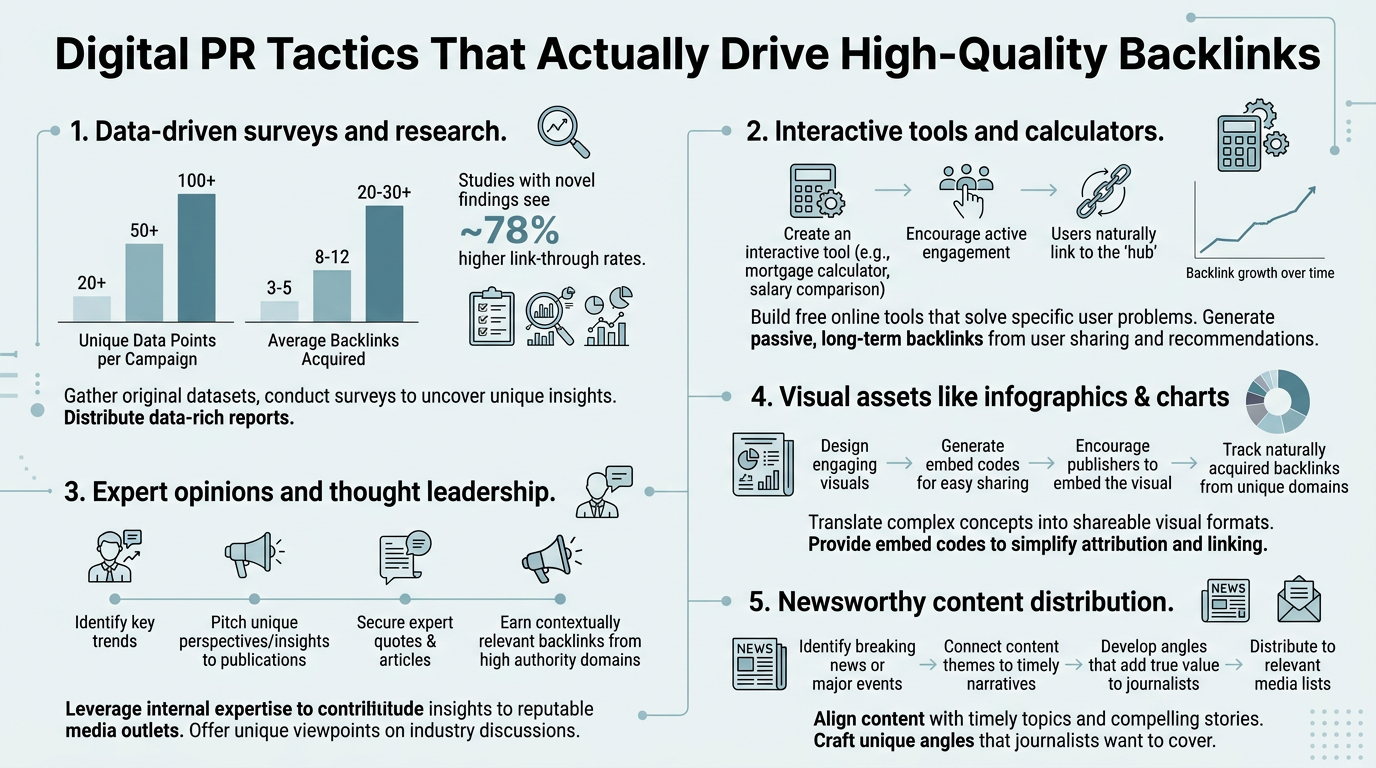
Digital PR has become the gold standard for earning high-quality backlinks. 48.6% of SEO professionals rate Digital PR as the most effective link-building tactic, leaving traditional guest posting behind. Yet most teams still chase quantity over authority—responding to mediocre opportunities, spamming journalists, and publishing generic content that no one wants to link to. The cost? Months of wasted effort and rankings that refuse to budge. The fix is simpler than it sounds: build a Digital PR strategy around newsworthy assets, respond to real journalist queries with speed, and focus on domain authority from day one. Here's a quick summary of how to execute Digital PR tactics that generate links from the publications that actually rank.
Key Takeaways
- Digital PR dominates link-building effectiveness with 48.6% of SEOs ranking it #1, earning links from domains with average DR 61 (2026, Reporter Outreach)
- Original research compounds over time, earning one campaign 22 backlinks, 3 interview requests, and 156% branded search growth
- HARO and journalist platforms deliver DR 60–85 links, but speed is critical—respond within 0–4 hours to secure placements
- Create Newsworthy Assets: Original research, surveys, and data-backed insights earn 2–6x more links than opinion content.
- Master HARO and Journalist Platforms: Speed wins—responding within 4 hours to queries generates DR 60–85 placements.
- Execute Newsjacking: Break trending stories with expert commentary, data, and counter-arguments to land high-authority mentions fast.
- Build Journalist Relationships: Persistent, value-first outreach creates recurring opportunities and multiplies link velocity.
- Scale Broken Link Building: Automate prospecting, create replacement assets, and segment outreach to unlock predictable, repeatable links.
Why Digital PR Outperforms Traditional Link Building
Digital PR generates links from news outlets, industry publications, and earned media that carry far more weight than manual outreach. 42 referring domains with an average DR of 61 is the typical campaign outcome, meaning every link carries authority. Google rewards these mentions because they come from publications with genuine editorial standards—journalists vet sources, fact-check claims, and only publish content that serves their audience.
"Digital PR naturally distributes links across months, signaling organic growth to Google. This consistency matters more than volume—100 links in one month followed by silence raises red flags, but steady earned media coverage compounds your authority over time."
The difference between digital PR and traditional link building is intent. Guest posting targets SEO rankings. Digital PR targets brand authority and earned media coverage—backlinks are the byproduct, not the goal. 85.2% of digital PR campaigns produce measurable SEO results within 3–6 months, with 85.8% of practitioners citing backlinks as the primary benefit. This timeline matters because Google evaluates link velocity and consistency; 100 links in one month followed by silence raises red flags. Digital PR naturally distributes links across months, signaling organic growth.
For busy founders and marketing teams at growing companies, the appeal is obvious: you need backlinks, but building relationships with journalists at scale requires expertise, time, and persistence. That's where strategy compounds your effort. A single piece of original research can earn links for years as journalists continue to cite it, analysts reference it, and competitors link to it as proof. One manual PR outreach campaign might take 40 hours; the same campaign run systematically through platforms like HARO and journalist databases takes 10 hours of strategy but generates 3–5x more placements.
How to Build and Deploy Newsworthy Assets
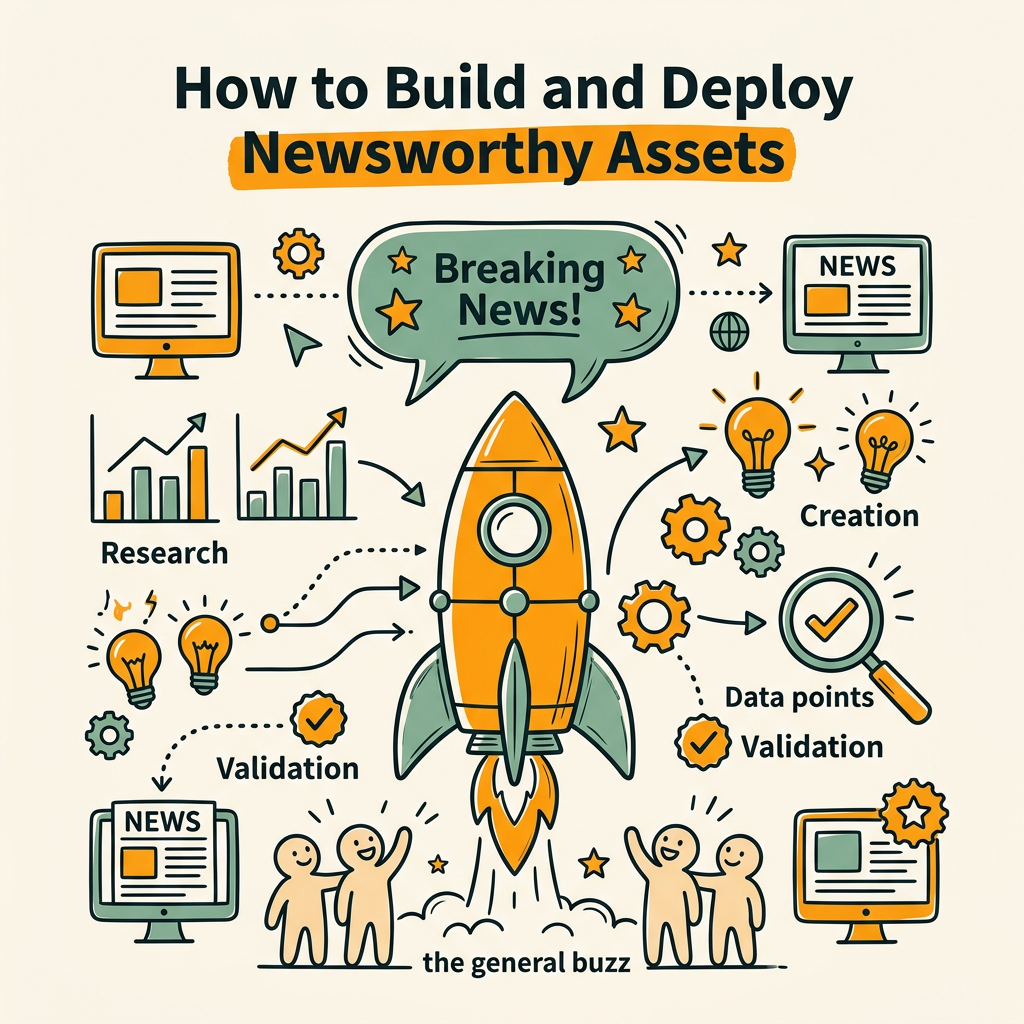
The foundation of any digital PR strategy is newsworthy content—something journalists actually want to cover. Data-led campaigns earn 2–6x more links than opinion pitches because journalists can cite original research, embed findings in their stories, and attribute claims back to your brand. Original research content earns 6.4x more links than opinion content, with interactive data pieces averaging 487 referring domains per asset.
Original Research That Journalists Can't Ignore
Original research is the most powerful digital PR asset. It gives journalists something concrete to write about and provides a reason for other publishers to link to your site. Conduct industry surveys, analyze proprietary data, or partner with research firms to publish findings that reveal trends, challenge assumptions, or quantify industry problems.
The best original research solves three problems for journalists:
- It's timely: Published data that reflects current conditions or emerging trends, not historical patterns.
- It's counter-intuitive: Findings that surprise people, reveal contrarian data, or challenge conventional wisdom.
- It's citable: Clear numbers, percentages, and quotable insights that journalists can pull directly into their stories.
"Within weeks of publishing, the 2026 State of AI Adoption report earned coverage from TechCrunch, Forbes, and industry publications, generating 22 backlinks and 3 interview requests. The report continues to earn mentions because it remains the most comprehensive data point on the topic."
A real example: a SaaS company published a 2026 State of AI Adoption report based on 2,000+ customer responses. The report showed that most teams aren't using AI despite claims of widespread adoption—a counter-intuitive finding. The report continues to earn mentions because it remains the most comprehensive data point on the topic.
Long-form content drives superior results because it contains more citable claims. Content exceeding 3,000 words attracts 4.2x more backlinks than short posts, averaging 312 referring domains versus 74 for content under 1,000 words.
Expert Commentary and Executive Positioning
Not every brand has the resources to publish original research. The next-best approach is expert commentary—positioning your executives as go-to sources for media coverage on trending topics.
This requires two things: building a list of journalists covering your industry and monitoring trending stories so you can pitch before the cycle closes. When a breaking story intersects with your expertise, move fast. Journalists typically write on deadline; if you pitch valuable commentary within 4 hours of a story breaking, you'll beat 95% of competing pitches. Slower responses mean journalists have already sourced quotes and moved on.
Effective commentary includes a specific claim, data, or prediction—not generic insight. Instead of "AI is changing how we work," say "Our data shows 67% of teams adopting AI see a 30% productivity lift in the first 90 days, but only if they use it for their top 3 workflows, not every task."
Mastering HARO and Journalist Query Platforms
HARO (Help A Reporter Out) is where journalists post queries looking for expert sources to quote. The platform reaches over 1 million registered sources daily. Responding within 0–4 hours is essential because journalists receive dozens of responses per query and often choose sources based on who replied first. One-day delays typically mean you've already missed the opportunity.
The Speed and Response Formula That Works
Success on HARO requires a repeatable response template. Keep submissions concise at 100–200 words and include these four components:
- Your credentials: Full name, title, and company. Then add one sentence of proof: "10+ years in SaaS marketing" or "Led link-building strategy for 50+ enterprise clients."
- The direct answer: Address the journalist's question in 1–2 sentences. Don't bury your point in explanation.
- Supporting detail or example: A specific statistic, case study, or example that makes your answer memorable.
- Contact information: Phone number, email, and website. Make it easy for journalists to reach you and verify your credentials.
Speed is non-negotiable, but many teams fail because they're slow to respond. Reporter Outreach data shows that experienced journalists often receive 20+ responses within the first two hours of posting a query. This means setting up HARO notifications on your phone, creating draft responses for common topics, and rotating the on-call expert daily is essential.
One caveat: HARO links are often no-follow, which means they don't pass ranking power directly to your site. However, they build brand authority, generate referral traffic, and create interview opportunities that lead to do-follow editorial links. You need a mix of both. For every 5 HARO placements, aim to convert at least 1–2 into do-follow editorial links through follow-up outreach.
Alternative Platforms for Journalist Matching
HARO is the largest platform, but alternatives like Featured.com, SourceBottle, and JournalistRequest.com serve similar functions with sometimes smaller, more niche reporter communities. Featured.com skews toward more established journalists from major publications. SourceBottle includes freelancers and bloggers, providing broader coverage but lower average domain authority.
The strategy: subscribe to all three platforms and respond to queries across all three. Response rates vary by topic and publication, but a portfolio approach maximizes your chances of landing do-follow links from higher-authority sources.
How to Execute Newsjacking and Reactive PR
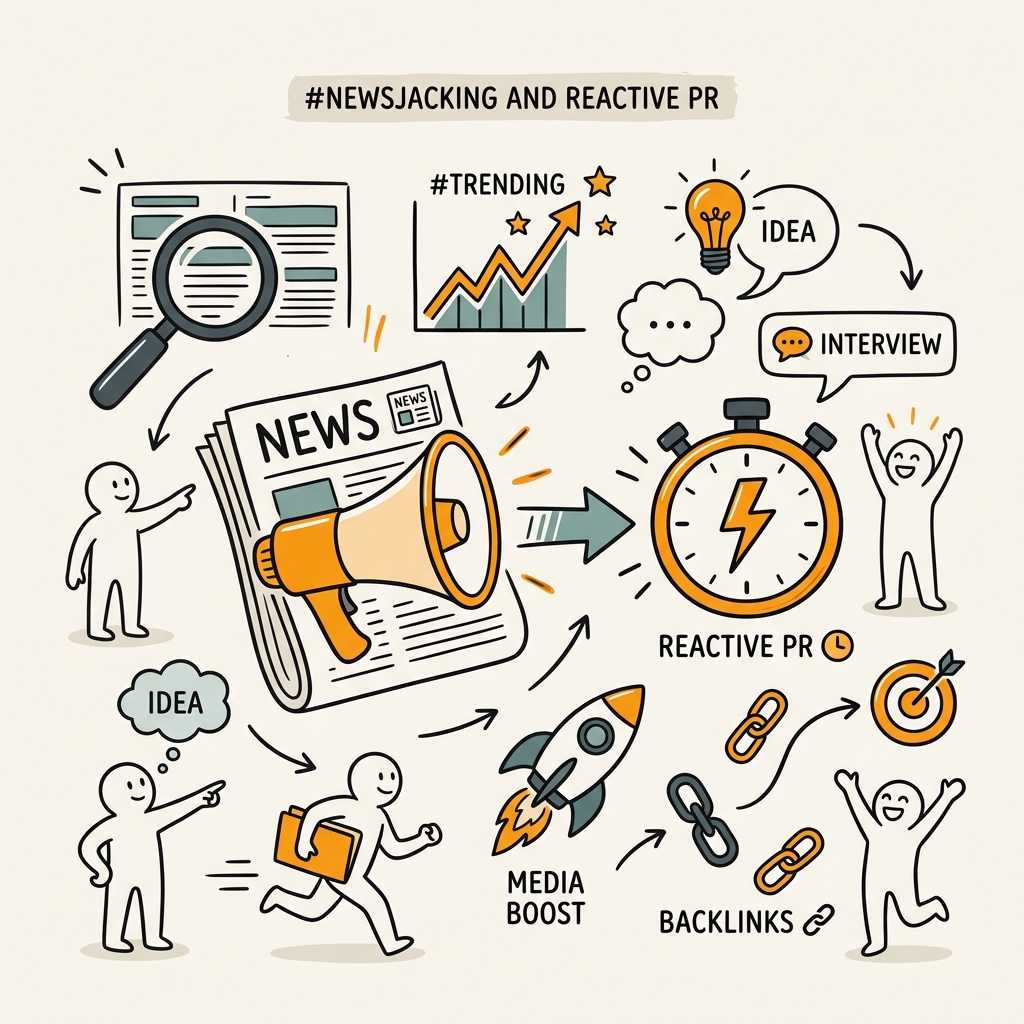
Newsjacking is one of the fastest ways to earn high-authority links because you're inserting your brand into stories that are already getting media coverage. The key is moving faster than competitors and offering genuine value—not just inserting your brand name into the headline.
Identifying Trending Stories and Breaking News
Monitor trending topics using Google Trends, X (Twitter), Reddit, and industry news aggregators like Feedly. When a story breaks that intersects with your expertise, evaluate whether you have something valuable to add. Not every trending story is an opportunity. The best newsjacking targets stories that:
- Relate directly to your industry or customer base
- Raise questions that your product or expertise can answer
- Are still early in the news cycle (first 12–24 hours)
- Have secondary angles journalists haven't covered yet
For example, when new AI regulations are announced, a SaaS company selling compliance tools can pitch journalists with internal data: "Our customers tell us they're worried about X regulation, and here's what responsible AI implementation looks like in practice." This is valuable because the company has data that journalists don't, and it's newsworthy because it ties directly to breaking news.
Pitching Newsworthy Angles That Journalists Use
Once you've identified a story, move fast. Assemble a pitch email with these components:
- Subject line: "Expert available for [story topic]—offers data on [specific angle journalists haven't covered]"
- Opening: Reference the journalist's recent article to show you've read their work, not that you're mass-pitching.
- The hook: One sentence that explains why your commentary matters now. "As AI regulation becomes law, customers need clarity on compliance—here's what we're seeing."
- The asset: Offer data, a unique perspective, or a prediction. Give the journalist a reason to quote you.
- Contact details: Name, title, phone, email. Make it frictionless for journalists to reach you.
The goal is a quote in the article or a link from the resulting coverage. High-credibility placements generate 1.5x to 3x stronger lifts in trust and consideration compared to low-credibility mentions, so be selective about which stories you pursue. Pitching poorly to a tier-one publication is worse than pitching well to a tier-two publication.
Building and Scaling Broken Link Building
Broken link building is a tactical, repeatable tactic that doesn't require creativity or journalist relationships—just systematic prospecting. The approach: find 404 errors (dead links) on high-authority pages in your niche, create content that serves as a replacement, and pitch site owners with a solution.
Finding Broken Link Opportunities at Scale
Use tools like Ahrefs, Semrush, or Screaming Frog to crawl high-authority competitor websites and identify 404 pages. Prioritize by domain authority and relevance. A broken link on a page with DR 70+ in your exact niche is worth 100 broken links on lower-authority pages.
The pitch to site owners is straightforward: "I noticed page X on your site has a broken link to [original source]. I've created an updated resource on the same topic that might serve your audience better. Happy to share if it's helpful."
Site owners are highly motivated to fix 404 errors because broken links hurt user experience and SEO. Your leverage is real—you're solving a problem they have. Broken link building is highly repeatable with low cost and predictable results, making it ideal for teams that want consistent, steady link growth without relying on journalist relationships or viral moments.
Scaling the Process With Outreach Templates and Segmentation
To scale broken link building, systematize three components:
- Prospecting automation: Use tools to identify hundreds of opportunities, then filter manually to focus on DR 50+ domains and high-relevance pages.
- Content creation: Build 3–5 pieces of replacement content that map to the most common topics you find broken links around. Reuse these assets across outreach.
- Outreach segmentation: Segment prospects by domain authority, topic, and engagement signals. High-authority sites get personalized pitches. Lower-authority sites can use template emails.
A/B test outreach templates to optimize response rates. Small changes in subject line, opening, or call-to-action can lift response rates by 20–40%. Data shows that experienced link builders generate 3.57x more backlinks than beginners, even when using identical tools—the difference is persistence, testing, and systematic refinement.
Comparing Digital PR Tactics: Which One Wins?
Different digital PR tactics serve different goals. Understanding the trade-offs helps you allocate your effort wisely.
| Tactic | Link Quality (Avg DR) | Placement Rate | Time to Results | Scalability | Best For |
|---|---|---|---|---|---|
| Original Research | 70–85 | High (multi-placement) | 4–8 weeks | Low (project-based) | Brand authority, viral reach, evergreen assets |
| HARO & Journalist Platforms | 60–80 | 5–15% (high competition) | 1–4 weeks | Medium (consistent) | Quick wins, brand mentions, interview opportunities |
| Newsjacking | 65–85 | 5–20% (timing-dependent) | 24–72 hours | Low (reactive) | Fast placements, trending topics, counter-arguments |
| Broken Link Building | 50–70 | 15–30% (lower competition) | 2–4 weeks | High (repeatable) | Steady link growth, niche authority, predictable ROI |
| Jottler (Automated Content + PR Distribution) | 60–75 | High (multi-source) | Ongoing | Very High (automated) | Daily link building, compounding SEO, autonomous scaling |
The table shows that original research delivers the highest-quality links but requires the most upfront effort. HARO offers consistent mid-tier links with minimal friction. Newsjacking delivers fast results for teams that can move quickly. Broken link building scales predictably but earns lower-authority links. The winning strategy combines all four: run original research quarterly, respond to HARO queries weekly, monitor trending stories daily, and execute broken link building continuously.
For teams that lack time to execute all four tactics manually, automation compounds the effort. Automated content systems that research, write, and publish consistently generate recurring link opportunities because fresh, high-quality content naturally attracts media coverage and links over time. Jottler, for example, publishes 3,000+ word articles daily with built-in keyword research and internal linking, meaning every article is a potential PR asset that journalists can discover and link to.
Building Lasting Journalist Relationships
One-off placements are valuable, but recurring journalist relationships multiply your link velocity over time. A journalist who covers your industry regularly can feature your brand dozens of times across their career. The key is providing value first, building trust, and staying on their radar without being pushy.
Creating a Media Contact List and Outreach System
Start by identifying the top 50–100 journalists who cover your industry. Follow them on Twitter, subscribe to their email newsletters, and read their recent articles. This gives you context for personalized outreach.
Reach out to three types of journalists:
- Tier-1 journalists: Staff writers at major publications (TechCrunch, Forbes, WSJ, industry leaders). These are high-touch—personalized pitches only.
- Tier-2 journalists: Freelancers and mid-tier publication writers. These are receptive to relevant pitches with specific angles.
- Tier-3 journalists: Bloggers and niche writers. These are responsive and cover emerging trends early.
Spend 80% of your effort on Tier-1 and Tier-2. They drive the most value. Tier-3 coverage builds secondary links and expands reach.
Value-First Outreach: Building Relationships Before You Ask
Before pitching a journalist with a story, provide value three times. Share an article they wrote with genuine commentary. Offer a data point or insight relevant to their current beat. Introduce them to someone useful in your network. This establishes that you're a resource, not a pitch machine.
When you eventually pitch, the journalist is more likely to respond because they recognize your name and know you bring value. This is where most teams fail—they pitch first, provide value never, and wonder why they get no response.
Document these relationships in a CRM. Track every interaction, what stories they cover, when they typically publish, and what types of pitches they've responded to. Over time, you'll spot patterns: this journalist covers AI trends on Thursdays, that journalist specializes in SaaS acquisitions. Use this data to time your pitches better and tailor your angles to match their interests.
Measuring Digital PR Impact Beyond Backlinks
Digital PR ROI extends far beyond backlinks. Track four key metrics to understand the full impact:
- Branded search demand: Often rises 10–40% after coverage, signaling that media mentions drive direct traffic and awareness.
- Organic traffic uplift: Related cluster pages see 5–20% traffic increases after a brand-building PR campaign.
- Referral traffic conversion: 10–30% higher than average organic traffic, because referral visitors come with context about your brand.
- Long-term baseline improvement: 5–15% persistent uplift after the initial coverage spike fades, indicating sustained authority gains.
Tools like Google Analytics, Search Console, and brand mention monitoring platforms (Mention, Brand24) help quantify these metrics. Set up tracking before launching a PR campaign so you have a clear before-and-after baseline.
For content marketing teams executing consistent publishing strategies, tracking cumulative metrics matters more than individual campaign ROI. Daily article publishing with integrated PR outreach creates a flywheel: more content means more link opportunities, more link opportunities mean higher domain authority, and higher authority means new content ranks faster. Jottler's model automates this by publishing content daily while building internal links and capturing press opportunities systematically.
Conclusion
Digital PR has become the gold standard for earning high-quality backlinks because it prioritizes newsworthiness and brand authority over raw link volume. The tactics are clear: build newsworthy assets through original research, respond to journalist queries with speed and relevance, execute newsjacking on trending stories, and scale broken link building systematically. 48.6% of SEOs now rank Digital PR as the most effective link-building tactic, and the data backs it up—campaigns typically earn links from 42 referring domains with an average DR of 61, producing measurable SEO results within 3–6 months.
For busy founders and marketing teams, the challenge isn't knowing which tactics work. It's finding the time to execute them consistently. Original research takes weeks. HARO requires daily monitoring. Newsjacking demands instant reaction time. Broken link building requires systematic prospecting and outreach. The solution is combining tactical execution with automated content systems that generate recurring PR assets daily. When you publish high-quality content consistently, you create multiple link opportunities per week—journalists discover your content, other sites cite your research, and your domain authority compounds naturally.
Start your SEO agent with Jottler today. Build a system that researches, writes, and publishes 3,000+ word articles daily while handling internal linking and fact-checking automatically. Every article becomes a potential PR asset, every asset earns links, and every link strengthens your domain authority. Plans start at $29/mo—launch your autonomous SEO engine now.
FAQs
What is the fastest digital PR tactic to earn backlinks?
Newsjacking is the fastest approach, often generating placements within 24–72 hours. The tactic involves identifying breaking news that intersects with your expertise, assembling commentary or data within hours, and pitching journalists before the news cycle closes. Speed is critical—journalists typically write on tight deadlines and choose sources based on response time. Broken link building is also fast, typically generating responses within 2–4 weeks with less competitive pressure than HARO, which sees 20+ responses per query within hours. The trade-off is that newsjacking is reactive and unpredictable, while broken link building is repeatable and scalable.
How much time should I spend on HARO vs. broken link building?
If you have limited time, broken link building delivers more predictable ROI because response rates are typically 15–30% (lower competition) versus HARO's 5–15% (high competition). Allocate 70% of your effort to broken link building if your goal is consistent link growth. Reserve 30% for HARO if your goal includes brand mentions and thought leadership positioning. HARO responses are often no-follow links, but they generate referral traffic, interview requests, and opportunities for follow-up do-follow placements. The ideal strategy is a 60/30/10 split: 60% broken link building, 30% HARO and journalist matching, 10% newsjacking when timely angles emerge.
Do I need to publish original research to succeed with digital PR?
Original research is the highest-leverage tactic but not a requirement. You can build a successful digital PR strategy using HARO responses, expert commentary, broken link building, and newsjacking alone. However, original research compounds over time because a single report can earn dozens of links across months and years as journalists continue to cite it. If you publish one report quarterly and execute HARO and broken link building consistently, you'll outpace competitors who only rely on tactical outreach. For teams with limited resources, prioritize quarterly original research while maintaining weekly HARO participation and ongoing broken link prospecting.