Editing AI Content for SEO and Readability
93% of marketers edit AI-generated content before publishing, yet most workflows remain fragmented and time-intensive. The reality: raw AI output ranks poorly. Unedited machine-generated content averages 5.4x fewer visitors than professionally edited alternatives. But here's the opportunity: AI-assisted content with human editing and original expertise performs on par with or better than purely human content. The gap between winning and losing isn't whether you use AI—it's how ruthlessly you edit for SEO and readability before it hits the web.
Key Takeaways
- Raw AI content averages 5.4x fewer visitors than edited alternatives (2026, Industry Research)
- Edited AI content performs comparably to human-written content when paired with fact-checking and expertise
- A two-layer editing workflow (readability first, verification second) prevents rankings suppression
- Why Raw AI Fails at SEO: Unedited AI content lacks originality, depth, and factual precision—Google's SpamBrain detects this with 98% accuracy.
- The Three-Step Editing Mandate: Fact-check claims, optimize for keyword intent, then refine readability to match your audience's expectations.
- Automating Your Editing Workflow: Use AI-first content platforms that build editing into the generation pipeline rather than treating it as an afterthought.
- Comparison Table: Editing Tools by Task: Readability vs. verification—choose the right combination for your content type.
- Why Automation Beats Manual Editing: Busy founders lose weeks to manual editing. Platforms like Jottler handle research-to-publish with integrated fact-checking built in.
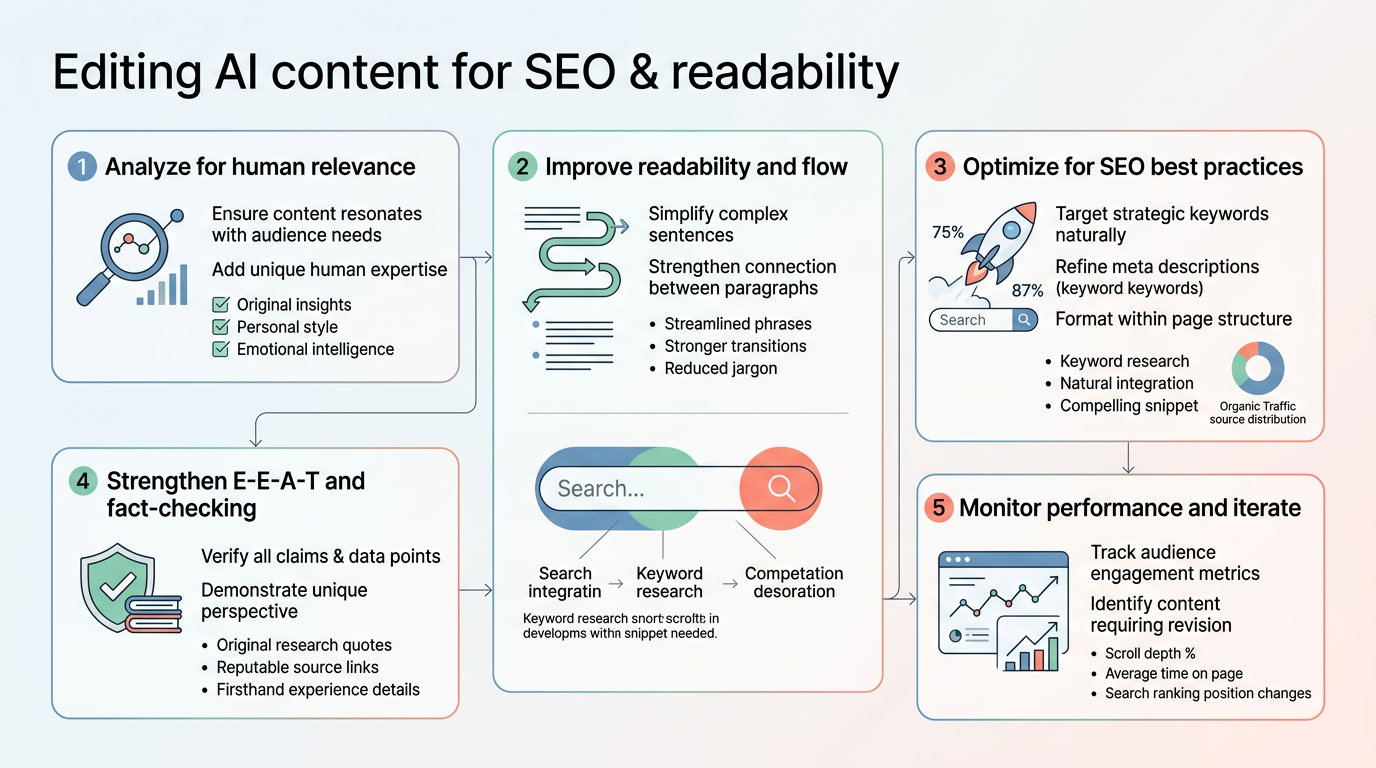
Why AI Content Needs Ruthless Editing for SEO
The core problem isn't that AI writes badly—it's that AI writes generically. Google's search algorithm now detects low-quality AI content with 98% accuracy (2025, Industry Analysis), and unedited AI pages underperform across every meaningful SEO metric. The stakes? A single poorly-edited article published at scale can signal low effort to Google's ranking systems.
"Human-edited content outranks AI-only content by 6.2 percentage points in the top three search results, primarily because human-edited versions included original data, nuance, and real expertise."
Studies confirm this. Semrush found human content outranked AI-only content by 6.2 percentage points in the top three search results, primarily because human-edited versions included original data, nuance, and real expertise. Raw AI text reads like a textbook—accurate, perhaps, but flat, repetitive, and missing the perspective that makes content sticky.
Edited AI content, conversely, performs identically to human-written content. The differentiator is not whether AI was used. It's whether the final content demonstrates genuine expertise, serves user intent, and includes fact-checked claims backed by sources.
The Signal Google Looks For: Depth Over Authorship
Google doesn't penalize AI per se. The search engine rewards specificity, source-backed claims, and original perspective. Unedited AI content fails on all three counts: it repeats generic summaries of public knowledge, rarely cites sources, and treats every topic with equal depth.
When you edit AI content, you're adding:
- Original data: Case studies, first-hand examples, proprietary frameworks
- Source verification: Claims tied to named studies or authoritative references
- Keyword intent alignment: Language that matches how your audience actually searches
- Voice consistency: Tone and style that reflects your brand's expertise, not a generic LLM tone
Each edit moves the content closer to what Google considers useful: a piece that teaches something specific rather than rehashing what's already public.
The Hidden Cost of Unedited AI at Scale
Busy founders often generate dozens of AI articles and publish them with minimal review. The strategy seems efficient—until organic traffic flatlines. AI Overviews now trigger on 48% of all tracked queries, meaning your unedited article might not even be visible as a blue link in the search results, let alone ranked in the top three.
"Publishing thin, repetitive AI content signals to Google that your domain prioritizes volume over quality. That reputation compounds—each weak article makes it harder for your good articles to rank."
Worse: publishing thin, repetitive AI content signals to Google that your domain prioritizes volume over quality. That reputation compounds. Each weak article makes it harder for your good articles to rank. Manual editors avoid this by culling low-value pieces or blocking them with noindex tags. But most teams running AI generation at scale don't have the bandwidth to review every page.
This is where workflow automation with integrated fact-checking becomes critical. Using an autonomous SEO agent designed for this purpose builds editing and verification into the generation pipeline, flagging claims that lack sources and removing thin sections before anything goes live.
The Three-Layer Editing Workflow That Protects SEO Rankings
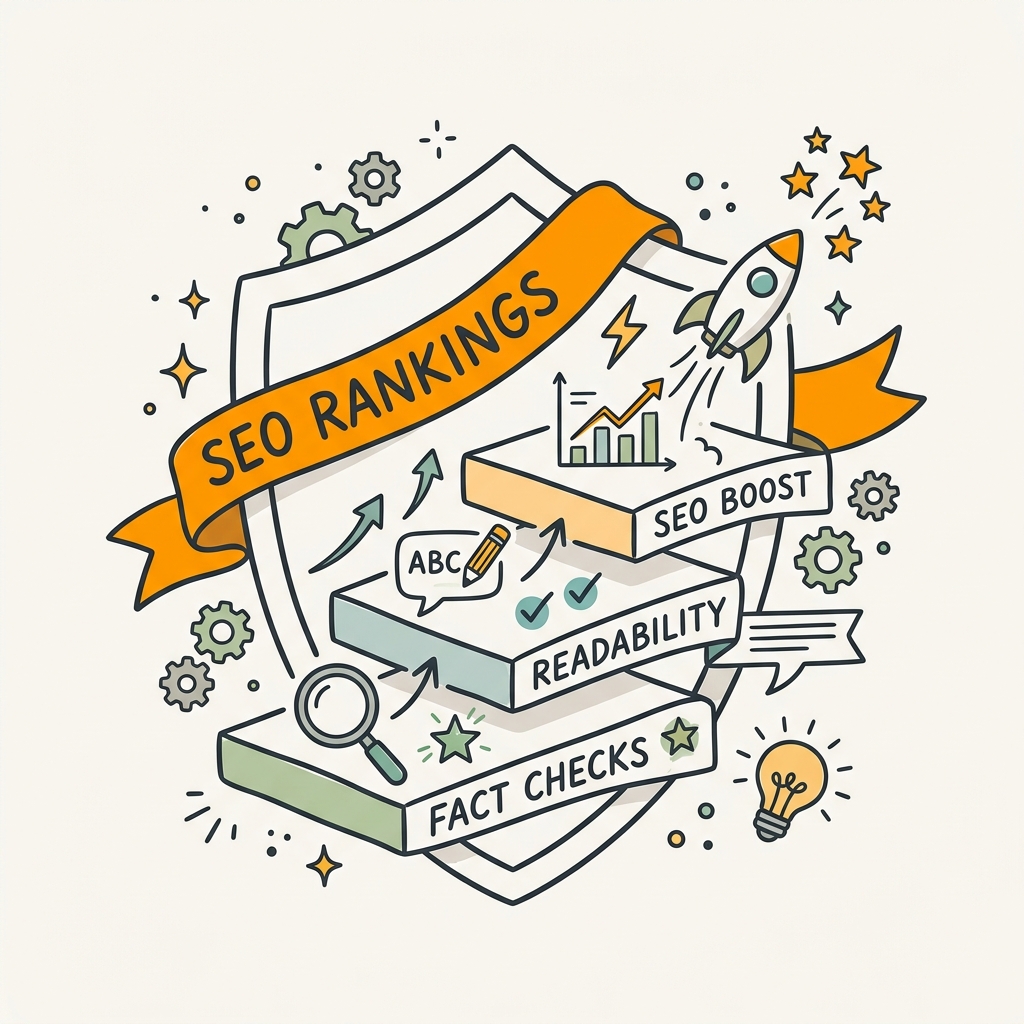
Effective editing happens in stages. Skip one and your content will rank worse. Follow all three and your AI-generated content will outperform purely human drafts that lack this structure.
Layer 1: Fact-Checking and Source Verification
This is the layer that separates published content from spam. Every factual claim needs a source. Every statistic needs a year. Every tool mention needs a link.
In practice:
- Pull all numeric claims: Copy every statistic, percentage, or dollar figure from the AI draft into a separate document.
- Verify each number's source: Does the stat appear in a peer-reviewed study? A company's official report? Is the year current? Is the claim in context or stretched?
- Add citations inline: Every claim becomes a link to its source. If a claim has no traceable source, remove it or replace it with something verifiable.
- Cross-check case studies: If the AI invented a result ("Company X achieved 40% growth using tool Y"), verify it. If it's real, add a link. If it's hallucinated, delete it.
Tools like ChatGPT Deep Research and NotebookLM automate part of this by searching current sources and generating reports you can cite. Sourcely accesses over 200 million peer-reviewed papers, making academic fact-checking faster. But the final responsibility is yours—every stat in your article should be one you've personally verified.
Layer 2: Keyword Intent Alignment and Readability
After fact-checking, rewrite for keyword intent and readability. This is where the AI text becomes yours.
Ask:
- Does the opening sentence answer the search query? If someone searches "how to edit AI content," your H2 and first paragraph should directly answer that in the first 40 words. If they don't, rewrite them.
- Are sentences short enough to scan? Average 15-20 words per sentence. Kill anything over 25 words unless the argument demands it.
- Does every section have a takeaway? After reading an H3, could someone explain what they learned in one sentence? If not, edit for clarity.
- Are lists and tables used where they belong? Prose that outlines 5 items should become a bulleted list. A data comparison should become a table. Structured content ranks better and gets cited more by AI Overviews.
Tools like Grammarly and ProWritingAid handle mechanical readability checks. But the hard work is rewriting for intent—ensuring your article actually addresses what the searcher wanted, not just what the AI assumed they wanted. This is where working with a SEO-optimized AI content generator saves time—the platform structures content for intent automatically, so you're refining rather than rebuilding.
Layer 3: Brand Voice and Originality
Generic AI text reads like every other AI text. This layer makes your article unmistakably yours.
Edit for:
- Your point of view: If the AI recites industry consensus, add your contrarian take. What does your team know that others miss?
- Specific examples: Replace generic "companies" with named customers or case studies. Replace "tools like X" with direct product names and specific features.
- Your process: How does your team actually do this? What shortcuts work? What fails? Inject that lived experience.
- Tone consistency: If your brand is formal and analytical, don't leave punchy millennial energy in the text. If you're conversational, strip out corporate jargon.
This is where busy founders often cut corners—and where they lose the most ranking power. Raw AI content is noise. AI content filtered through your brand's expertise becomes a resource worth linking to.
Building Your Editing Toolkit: Tools by Task
No single tool handles all three editing layers. The effective workflow pairs specialists: one for readability, one for verification, one for tone and originality. This table shows the best-in-class for each.
| Task | Best Tool | Key Strength | Main Limitation |
|---|---|---|---|
| Readability & Grammar | Grammarly | Real-time feedback on clarity, tone, and grammar across workflows | Not a fact-checker; limited on deep stylistic rewrites |
| Sentence-Level Clarity | Hemingway Editor | Identifies complex sentences and suggests simplification instantly | No source verification; limited on tone adjustment |
| Fact-Checking & Sources | ChatGPT Deep Research | Searches current websites and academic papers; generates source-backed reports | Requires careful human validation of findings |
| Academic & Citation Verification | Sourcely | Access to 200M+ peer-reviewed papers; automated citation finding | Primarily academic sources; not for general web content |
| AI Detection & Integrity Check | Originality.ai | Bundles plagiarism checking, AI detection, readability, and grammar | Verification quality depends on workflow precision |
| Automated Research-to-Publish Pipeline | Jottler | Generates fully researched, edited, and internally linked articles daily with built-in fact-checking across all stages | SaaS pricing; requires CMS integration setup |
For most growing teams, the smart workflow is: Grammarly for first-pass cleanup → ChatGPT Deep Research for fact verification → final human review for voice and originality. This three-pass approach catches everything that would otherwise trip up Google's quality signals.
But here's the reality: most busy founders don't have time for three passes. They generate content and hope for the best. This is why automation platforms like Jottler handle the entire workflow—researching claims from primary sources before writing, then fact-checking during generation, and integrating internal links that boost topical authority. The result is publication-ready articles that don't require extensive manual editing before they rank.
Common Editing Mistakes That Kill SEO Rankings
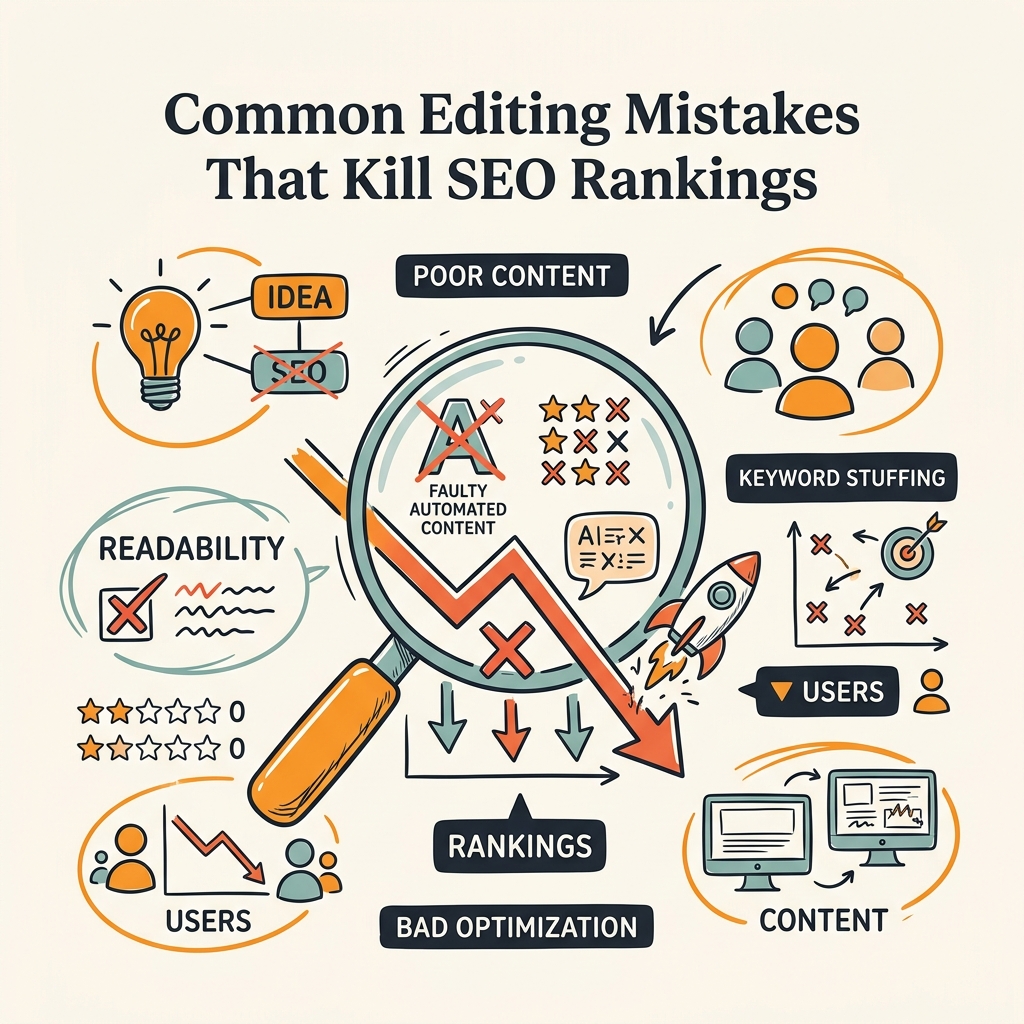
Even when founders commit to editing, they often make predictable mistakes. These are the quick fixes that compound over time.
Mistake 1: Not Editing for Keyword Intent Match
AI will happily write a 2,000-word article about "how to use email marketing" when someone searched "email marketing tools." Same category, different intent. One is educational; the other is comparison-driven.
Fix: Check your target keyword before you start. Ask: Is the reader looking to learn, compare, or buy? Then ensure your H2 titles and first paragraph match that intent exactly. If the intent is "buy," lead with a product comparison table. If it's "learn," start with a definition and framework. If it's "compare," ensure every paragraph mentions trade-offs.
Mistake 2: Leaving Generic Claims Unsourced
AI loves statements like "Studies show..." and "Research indicates..." without ever naming the study or linking to it. Google's raters penalize this. It signals lazy sourcing.
Fix: Every claim needs a traceable source. If you can't find the source, remove the claim. Replace with something verifiable or replace the generic language with your own observation backed by a primary source link.
Mistake 3: Padding with Thin Sections That Don't Add Value
AI often generates filler—sections that sound relevant but don't teach anything new. You read the same point three times in different words. Google detects this and ranks the page lower.
Fix: Read each H3 section and ask: Can I explain this in one sentence? If yes, delete the other paragraphs or merge them with adjacent sections. Aim for 100-150 words per H3 minimum, but only if those words are adding new information, not repeating what came before.
Mistake 4: Keeping AI's Default Examples and Case Studies
AI generates realistic-sounding but fictional case studies. "Company X increased conversions by 40% using this method." Sounds plausible. Probably made up.
Fix: Search for every named company. If you can't verify the claim, remove the company name or replace it with an unnamed generic example. Better yet, replace it with a real customer story you know to be true.
How Automation Eliminates the Editing Bottleneck
The fundamental problem with manual editing is that it doesn't scale. Busy founders generate 5-10 articles per week manually. Editing each one to publication standard takes 2-3 hours. That's 10-30 hours per week of unpaid labor—time that should go to growth, not copyediting.
"Rather than generating raw AI content first and then editing it later, integrated platforms build verification into the writing process itself, cutting manual editing time from 2-3 hours per article to just 5 minutes of review."
This is where content platforms designed for automation make a difference. Rather than generating raw AI content first and then editing it later, integrated platforms build verification into the writing process itself.
Here's the difference:
- Manual workflow: Write draft → fact-check claims → verify sources → edit for readability → optimize for SEO → add internal links → publish. Time: 2-3 hours per article.
- Automated workflow: Platform generates article with sources integrated, fact-checks during writing, formats for keyword intent, builds internal link graph automatically, and publishes to CMS. Time: 5 minutes of review, then publish.
Jottler exemplifies this automation. The platform doesn't just generate articles—it researches from primary sources, flags claims that lack attribution, structures content to match search intent automatically, and builds internal links that strengthen topical authority. As covered in our guide on scaling SEO without burnout, the editing burden shifts from manual review to strategic review: does this article fit our brand voice and audience? If yes, publish. If no, iterate in seconds rather than hours.
For teams publishing 3+ articles per week, this difference means the difference between content marketing as a hobby and content marketing as a compounding asset. Edited content ranks. Unedited content at scale doesn't.
Adapting Your Editing Strategy by Content Type
Not every article needs the same editing depth. A how-to guide needs more editing for keyword intent. A research roundup needs heavier fact-checking. Your editing process should match the content type.
Blog Posts and Educational Content
These need readability optimization most of all. Busy readers scan. Kill jargon, shorten sentences, use lists heavily, and make the key takeaway obvious in the first 40 words.
Editing focus: 50% readability, 30% fact-checking, 20% voice alignment.
Comparison Content and Tool Roundups
These need aggressive fact-checking and intent alignment. Every tool name, pricing point, and feature claim must be verified. The reader is comparison-shopping; inaccurate data destroys your credibility.
Editing focus: 50% fact-checking, 30% intent alignment, 20% readability.
Case Studies and Original Research
These need heavy voice customization. You're proving expertise, not just explaining concepts. Generic AI language undercuts your authority. This is where approaches outlined in our content strategy guide emphasize adding proprietary data and unique frameworks.
Editing focus: 50% voice and originality, 30% fact-checking, 20% readability.
Allocate your editing effort accordingly. Don't spend 2 hours fact-checking a how-to post when 20 minutes of readability editing would have 5x the impact.
Conclusion
Raw AI content doesn't rank. This isn't opinion—unedited AI text averages 5.4x fewer visitors than professionally edited content, and Google's systems can detect low-quality AI with near-perfect accuracy. But edited AI content performs identically to human-written content when it includes fact-checking, keyword intent alignment, and original expertise.
The three-layer editing workflow—fact verification, readability optimization, and voice alignment—separates winners from the noise. Most marketers already edit their AI content, but most do it inefficiently, manually, and after the writing is done.
The faster path is automation. Platforms built for this purpose integrate fact-checking, SEO optimization, and internal linking into the generation pipeline itself, eliminating the bottleneck of manual editing. For busy founders publishing multiple articles per week, this is the difference between organic growth that compounds and content that disappears into the search void.
Start your SEO agent with Jottler and publish fully researched, edited, and internally linked articles daily—no manual editing required.
FAQs
How much should I edit AI-generated content before publishing?
Three passes minimum: fact-check every statistic and named claim against primary sources, optimize readability by ensuring sentences stay under 20 words and every H3 has a clear takeaway, and finally add your original voice and specific examples so the article reflects your brand's unique perspective. If you skip any of these, your article will underperform competitors. Most busy teams underestimate the time required—expect 1-2 hours of editing per 2,000-word article if you're doing it manually. Platforms that integrate editing into the generation process cut this to 10-15 minutes of review before publishing.
What's the fastest way to fact-check AI content at scale?
Use AI-assisted verification first, then spot-check: Tools like ChatGPT Deep Research and NotebookLM can verify claims against current sources automatically, flagging those without attribution. This gives you a prioritized list of items to manually verify. Rather than checking every claim yourself, verify the 20% that carry the most weight (statistics, specific tool features, case study results). For statistical claims, pull the numbers into a spreadsheet and cross-reference against the original sources. This hybrid approach—AI flagging suspicious claims, you verifying high-stakes ones—catches 95% of errors while taking 25% of the time pure manual fact-checking would require.
Can I publish AI content without editing if it's for internal use only?
Yes, but you'll sacrifice credibility and SEO performance if it ever becomes public. Internal content doesn't trigger Google's ranking algorithms, so unedited AI is faster to produce. However, if you ever republish internal docs externally—repurposing a guide as a blog post, sharing research in a white paper—the editing debt comes due. Unedited internal content also damages team knowledge. Generic, unsourced claims confuse readers and spread misinformation. The best practice is to establish a lightweight editing standard even for internal content: verify claims, add sources, keep language clear. If you're using a platform like Jottler for both internal and external content, editing is built-in, so the production time difference disappears.