Educational Content That Drives SaaS Leads
Educational content isn't just a nice-to-have marketing tactic—it's a lead-generation engine for SaaS companies. 74% of marketers say content marketing helped generate demand and leads, while 77% rate their content-sourced leads as high or very high quality. Yet most SaaS teams still treat content as an afterthought, publishing inconsistently or writing about product features instead of buyer problems. The result? Weak pipeline and stalled growth. Here's what it takes to use educational content as a predictable lead driver: teach before selling, optimize for search intent, and measure by qualified lead conversion—not just traffic.
Key Takeaways
- Content generates 3x more leads and costs 62% less than outbound marketing (2026, Taboola & Ahrefs)
- Website/blog/SEO content is the #1 ROI channel, delivering 27% of top-performing ROI for B2B marketing
- Educational content works best when paired with search optimization, case studies, and email nurture to move prospects through the funnel
- 77% of marketers rate content-sourced leads as high or very high quality, proving that educational content drives qualified pipeline
- Define Your Educational Content Funnel: Map content to buyer stages—awareness, consideration, decision—so each piece serves a specific lead-nurturing goal.
- Build Search-Led Content as Your Foundation: Blog posts optimized for buyer intent keywords are the highest-ROI content type for attracting leads at scale.
- Create Proof-Focused Content Assets: Case studies, comparison pages, and customer success stories move prospects toward conversion.
- Integrate Content with Email and Nurture: Educational content drives leads; email nurture converts them into sales conversations.
- Automate Content Production to Scale: Publishing 3+ educational pieces weekly requires workflow automation or outsourced writing to remain sustainable.
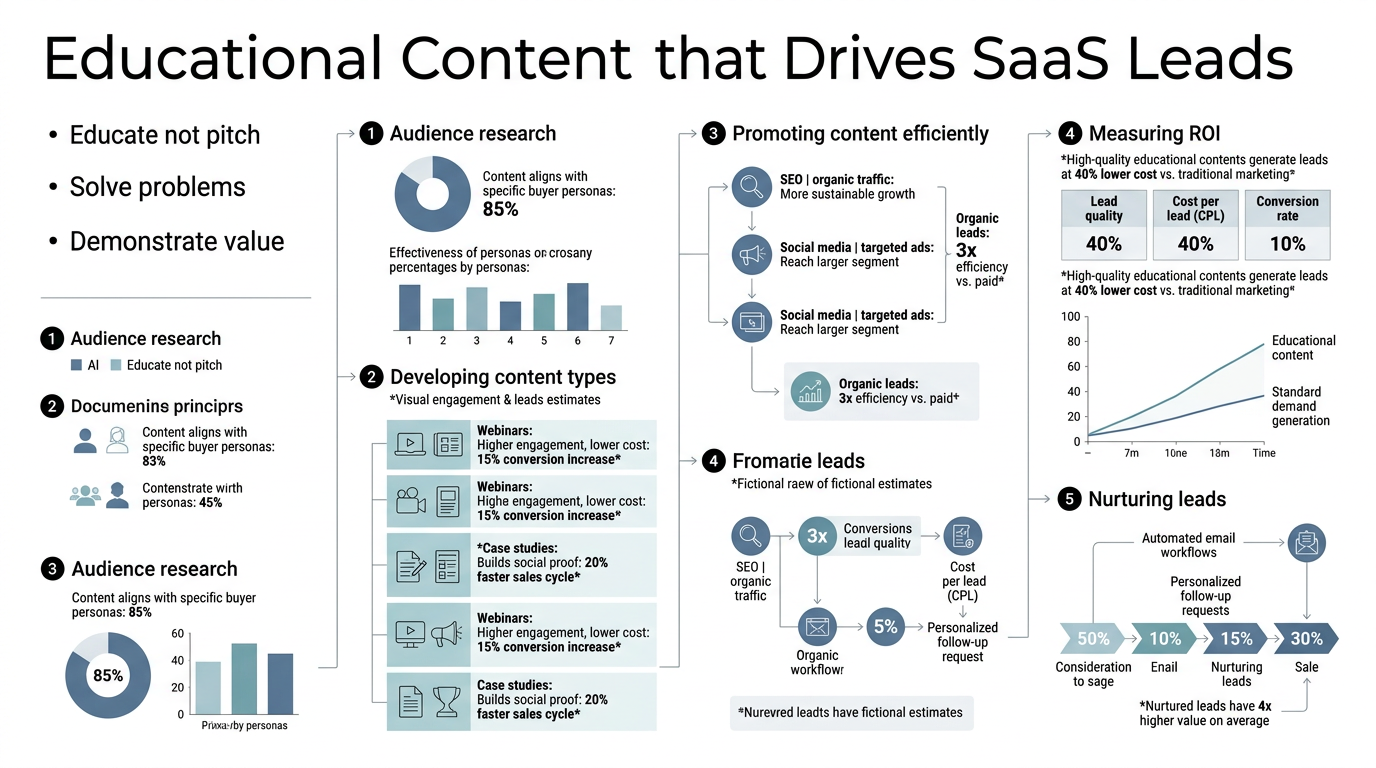
Define Your Educational Content Funnel by Buyer Stage
Educational content only drives leads if it aligns with where prospects are in their buying journey. 64% of marketers reported higher conversion rates from content-sourced leads after adopting proprietary research, but that lift came from intentional content strategy, not random blog posts. The fix? Map every piece of content to a specific buyer stage—awareness, consideration, decision—and write with that stage's questions in mind.
"Content strategy isn't about publishing more—it's about publishing smarter. When every piece of content aligns with a specific stage of the buyer's journey, conversion rates improve dramatically and lead quality increases." — HubSpot Content Marketing Trends
Awareness Stage: Teach About the Problem, Not Your Product
At awareness stage, prospects don't know they have a problem yet. Your educational content should define the problem, show why it matters, and position your industry as the solution space. This is where blog posts, how-to guides, and educational videos live. The goal: rank for high-volume keywords that buyers search before they even know your company exists. When you write a blog post titled "Why Your Sales Team Wastes 10 Hours a Week on Manual Data Entry," you're teaching before selling—and capturing search traffic from the buyer's problem perspective, not your product perspective.
Awareness-stage content should never mention your product. Instead, teach the reader a new skill, explain an industry trend, or break down a complex topic. Tools like autonomous SEO agents can publish 3+ awareness-stage blog posts daily, ensuring consistent inbound traffic capture across your target keywords.
- Define 3-5 core problem areas your target customers face
- Research high-volume, low-competition keywords around each problem
- Write educational content that solves the problem without mentioning your product
- Optimize for featured snippets and position zero rankings
- Link internally to consideration-stage content at the bottom of each post
Consideration Stage: Compare Solutions and Frameworks
Once a prospect recognizes the problem, they search for solutions. Consideration-stage content must compare approaches, frameworks, and tools without pushing your product. Comparison articles, feature breakdowns, and "best practices" guides dominate here. A post like "How to Choose Between Manual Lead Scoring vs. Predictive Lead Scoring" positions your company as an expert guide, not a pushy salesperson. The reader gets value regardless of whether they buy from you.
Consideration content is where many SaaS teams falter—they publish one comparison post and expect leads to flow. The reality? You need depth: multiple comparison angles, updated benchmarks, and a library of comparison pages covering your competitive landscape. Case studies and customer success stories ranked among the most popular content formats, so pair your comparison content with proof from actual customers.
"Prospects spend 57% of their buying journey researching independently before talking to a vendor. If you're not creating comparison and research content at this stage, competitors who are will capture that prospect." — Forrester Research
- Build comparison pages for your top 5 competitive alternatives
- Create framework guides comparing different methodologies for solving your problem category
- Research competitor pricing, features, and positioning transparently
- Link comparison content to decision-stage case studies and product pages
- Update comparison content quarterly to maintain SEO authority
Decision Stage: Proof and Validation Content
At decision stage, prospects want proof your solution delivers. Case studies, customer testimonials, ROI calculators, and product demo videos are your primary educational assets here. Unlike awareness content (which teaches about the problem) or consideration content (which compares solutions), decision-stage content must directly show how your product solves the specific problem the buyer has. It should be concrete, specific, and quantified: "How [Company Name] reduced customer acquisition cost by 40% using our platform."
Decision-stage educational content doesn't need massive SEO traffic—it needs to be findable by prospects who are already warm and ready to buy. A well-placed case study on your pricing page or product page converts high-intent visitors into sales conversations.
- Identify your top 10 customer success stories with quantifiable results
- Write case studies in educational format: problem, approach, results, lessons learned
- Create ROI calculators that help prospects quantify the financial impact of solving their problem
- Build product comparison pages that position your solution against alternatives fairly
- Create testimonial and social proof pages featuring customer logos and quotes
Build Search-Optimized Blog Content as Your Lead Funnel Foundation
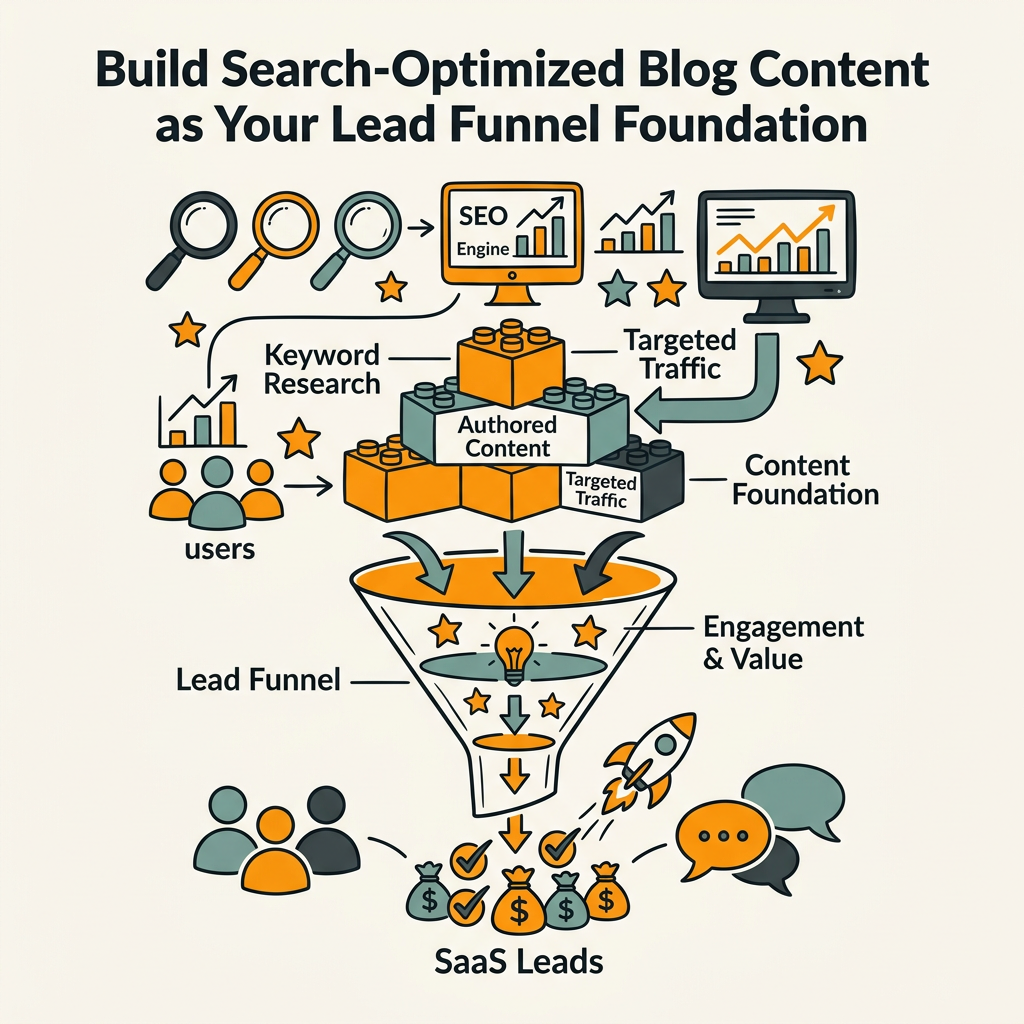
Website/blog/SEO content delivered 27% of top-performing ROI for B2B marketers in 2026, making it the single highest-ROI channel. Yet most SaaS teams publish fewer than 2 blog posts per month—far short of the velocity needed to build topical authority and rank for buyer-intent keywords at scale. Educational blog content is the linchpin that holds your entire lead funnel together. It attracts prospects at awareness stage, educates them on the problem and solutions, and creates touchpoints for email capture and nurture.
Publish High-Intent Keywords Before Branded Searches
Most SaaS teams publish blog posts on topics they think are interesting, then wonder why they don't generate leads. The fix: only write about keywords that map to your buyer's actual search behavior. High-intent keywords include: "how to [solve problem]," "best [solution type] for [use case]," "[feature] comparison," and "[your product] alternatives." These keywords carry commercial intent—the person typing them is actively evaluating solutions, not just reading for fun.
When you publish blog content targeting high-intent keywords before your competitors do, two things happen: you rank for commercial searches and capture early-stage prospects who haven't yet found competitive comparison content. A blog post titled "How to Implement Automated Lead Scoring in Your SaaS Sales Process" (high intent, educational) will generate more leads than "Why Lead Scoring Matters" (low intent, obvious). Publishing strategy at this velocity requires a SaaS content marketing framework built for consistent growth.
- Research 20+ high-intent keywords your target customers search for monthly
- Prioritize keywords with 500+ monthly searches and 10+ search results (opportunistic gaps)
- Map each keyword to the buyer stage where that prospect searches
- Write comprehensive guides that address the search intent fully
- Track rankings and adjust content strategy based on search position data
Implement Topic Clusters to Build Topical Authority
Google rewards sites that demonstrate expertise in a topic area. Instead of publishing random blog posts, organize your educational content into topic clusters: a pillar post that covers a broad topic (e.g., "Complete Guide to SaaS Lead Qualification") plus 5-10 related cluster posts that dive deeper into subtopics (e.g., "BANT Scoring Framework," "How to Grade Leads by Intent," "Lead Qualification Vs Lead Scoring"). Each cluster post links back to the pillar, signaling to Google that you own this topic.
Topic clusters improve SEO performance and make your content library more useful to visitors—they can dive deep on a subject without jumping between five different websites. Organizing content this way also reveals gaps. When you map out a topic cluster, you see exactly which subtopics need coverage, eliminating the guesswork from content planning.
Benchmark Publishing Velocity Against Your Competitors
Your competitors are publishing weekly. So should you—at minimum. 62.8% of content marketers reported traffic growth between 2024 and 2025, and the common denominator across high-performers? Consistency. Teams publishing 1-2 educational posts per week build topical authority faster, rank for more keywords, and capture more inbound leads than teams publishing sporadically. The challenge: most SaaS marketing teams lack the bandwidth to research, write, edit, and publish this volume in-house.
This is where content automation becomes non-negotiable. Publishing 3-5 educational blog posts per week by hand is exhausting. Publishing them with an autonomous platform that handles research, writing, fact-checking, and CMS integration transforms the math: you go from publishing 1 post per week (52/year) to publishing 15+ per week (700+/year). That velocity compounds into material search traffic and lead volume. According to HubSpot's 2026 marketing data, blogs continue to be among the top five highest-ROI content formats, appearing on the platforms of 38% of marketers—confirming that consistent blog publishing remains the foundation of inbound lead generation.
Create Proof and Conversion-Focused Content Assets
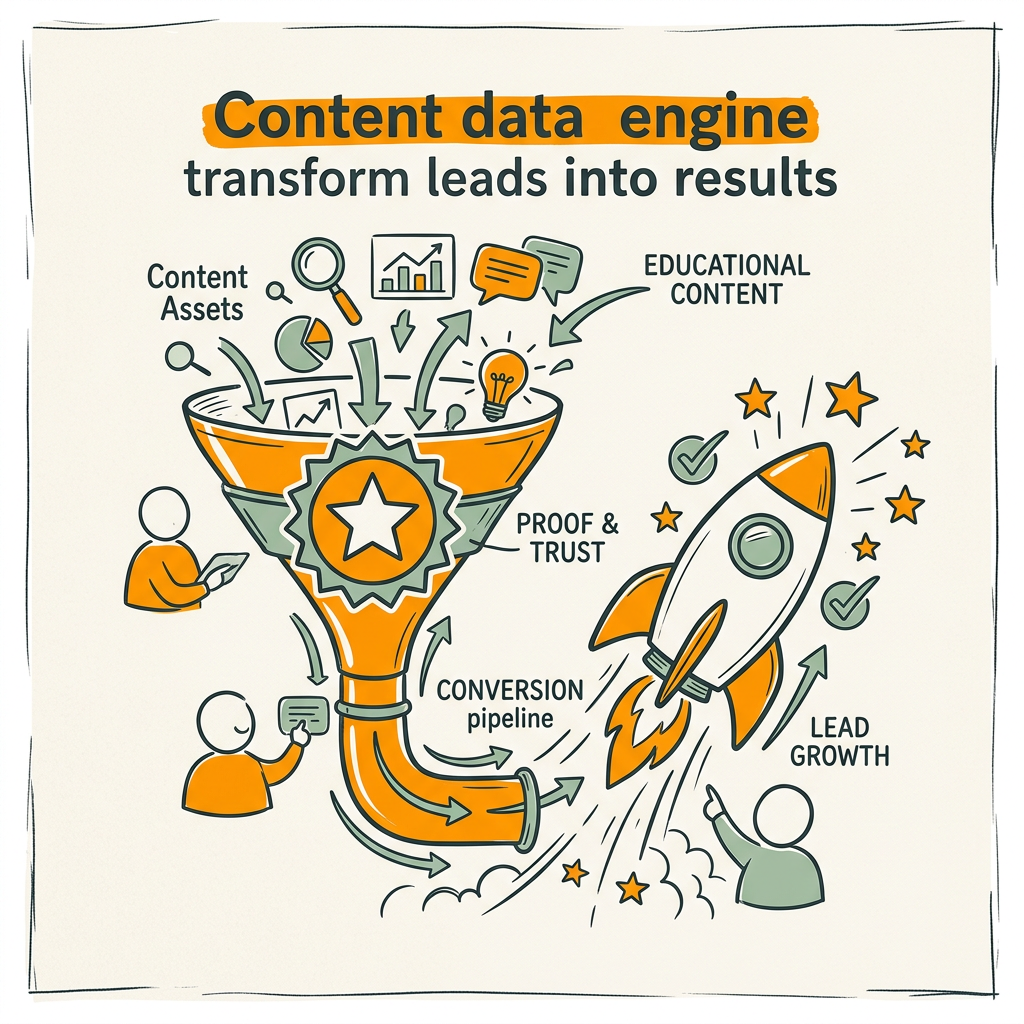
Blog content attracts prospects at awareness and consideration stage. But conversion happens with proof. 41% of marketers cited case studies and customer success stories as their most popular content type, and for good reason—they show real outcomes from real customers. Educational content alone doesn't close deals; educational content paired with proof and validation does.
Write Case Studies That Educate and Prove ROI
A great case study isn't a product brochure disguised as a success story. It's an educational asset that shows: (1) the specific problem the customer faced, (2) the approach or framework they used to solve it, (3) quantified results, and (4) the key decisions that led to success. Readers should learn something—a tactic, a framework, a mindset—not just learn that your product exists.
Format case studies around customer results, not product features. Instead of "Company X Uses Our Platform," write "How Company X Reduced Customer Acquisition Cost by 40% in 90 Days" (then explain how they did it, the obstacles they faced, and the specific outcomes). Educational case studies get referenced, shared, and cited—they're assets that keep working long after publication. Most sales teams underutilize case studies in their nurture sequences, which is a missed opportunity to convert high-intent prospects with proof.
Build Comparison Pages That Position Your Product Favorably
Prospects at consideration stage search for comparisons: "Tool A vs Tool B," "Approach X vs Approach Y." Comparison pages are educational assets that frame your solution favorably without sounding like propaganda. A well-written comparison educates the reader on the pros and cons of each approach, then explains which situation calls for which solution. If your product aligns with the use case discussed, prospects naturally see it as the fit.
The key: be honest about competitor strengths. If a competitor genuinely has a better pricing model for a specific use case, say so. Your credibility comes from being fair, not from being biased. Readers trust sites that acknowledge trade-offs. This honesty paradoxically drives more conversions because prospects feel you're not trying to trick them.
Create Interactive Tools to Capture Intent and Data
70% of the most successful digital brands use interactive content like calculators, assessments, and quizzes, compared with 36% of lower-performing businesses. Interactive educational assets serve two purposes: they teach the reader (by helping them calculate or assess something relevant to their problem) and they capture intent data and email addresses.
An interactive ROI calculator titled "Calculate Your Savings with Automated Lead Qualification" teaches prospects what the financial impact of solving their problem looks like. When they use it, you capture their email and use case information, making them easier to nurture. Interactive content typically converts 2-3x better than static content, making it one of the highest-leverage educational assets for SaaS lead gen.
| Content Type | Buyer Stage | Traffic Potential | Conversion Rate | Lead Quality |
|---|---|---|---|---|
| Blog Posts (High-Intent) | Awareness / Consideration | High (1,000+ visitors/month) | 1–3% | Medium |
| Comparison Pages | Consideration | Medium (200–500 visitors/month) | 5–8% | High |
| Case Studies | Decision | Low (50–200 visitors/month) | 15–25% | Very High |
| Interactive Tools (ROI Calculators, Quizzes) | Consideration / Decision | Medium (300–800 visitors/month) | 12–20% | High |
| Proprietary Research / Whitepapers | Consideration / Decision | Medium (400–600 visitors/month) | 10–18% | Very High |
Measure and Optimize for Lead Quality, Not Just Traffic
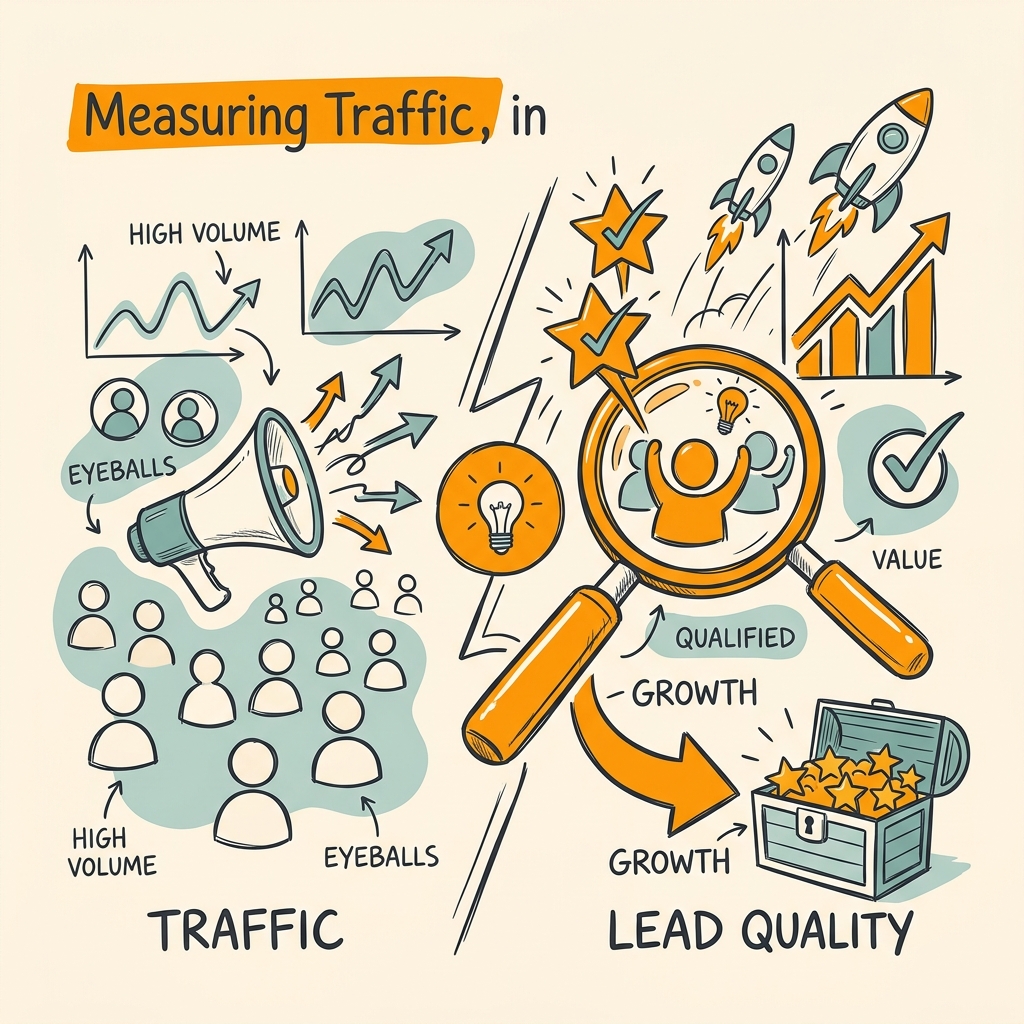
77% of marketers rate content-sourced leads as high or very high quality, but only if the content is aligned to buyer intent and your nurture funnel is operational. The shift in 2026 is from vanity metrics (page views, sessions) to outcome metrics (qualified leads, pipeline contribution, revenue closed). Without proper measurement, you can't optimize your educational content strategy.
Track Content Performance by Lead Source and Stage
Set up tracking that connects content to leads to customers. When someone converts on your website, tag which blog post or educational asset led them there. Over time, you'll see patterns: which content attracts the highest-quality leads, which content converts best at each stage, which topics are bottlenecks in your funnel. This data tells you what to write next and where to double down.
Most SaaS teams don't do this. They publish content, check Google Analytics, see traffic, and assume success. Without conversion tracking and lead-source attribution, you're flying blind. Tools that provide intelligent internal linking and conversion tracking make this measurement automatic and continuous.
Use Proprietary Research to Differentiate and Improve SEO
64% of marketers reported higher conversion rates after adopting proprietary research content, and 61% saw improved SEO rankings. Proprietary research—surveys, original data, expert interviews—sets your educational content apart from generic how-to posts. When you publish original research (e.g., "2026 SaaS Lead Qualification Trends: A Survey of 500 B2B Sales Teams"), you earn citations, backlinks, and SEO authority. You also create proof that differentiates your perspective.
Proprietary research content ranks better, generates more links, and feels more authoritative than rehashed best-practice posts. 86% of marketers plan to increase proprietary research budgets in 2026, recognizing that original content is the last competitive moat in marketing. If you want to differentiate your educational content from competitors, original research is the lever. Research from Warmly shows that companies leveraging proprietary insights gain measurable advantage in both lead quality and conversion velocity—another reason to invest in unique, original content.
Build Lead Quality Baselines for Each Content Type
Not all educational content converts equally. Awareness-stage blog posts attract volume but lower-intent prospects. Decision-stage case studies attract fewer visitors but higher-quality leads. Track conversion rates (from visitor to email capture) and downstream lead quality for each content type. A blog post might drive 1,000 visitors but convert 2% to leads. A case study might drive 50 visitors but convert 15% to leads. The second asset, despite lower traffic, contributes more qualified pipeline.
This is why publishing strategy matters more than publishing volume. Publishing one high-quality case study is better than publishing ten low-intent blog posts if your goal is qualified leads, not traffic. Most teams obsess over traffic numbers and miss this insight entirely.
Scale Educational Content Without Burnout
The challenge every SaaS marketing team faces: content works, but producing it consistently is exhausting. Writing, researching, fact-checking, and publishing educational content by hand creates a ceiling on output. Most teams hit 2-4 posts per month before hitting the sustainability wall. If you're serious about using educational content as a lead driver, you need systems.
Choose the Right Mix of In-House, Outsourced, and Automated Production
You have three levers: in-house writers (high quality, slow), outsourced writers (scalable, variable quality), and automated content systems (consistent output, limited creativity). Most winning SaaS teams use a hybrid: in-house for strategic pillar content and case studies, outsourced for cluster content and tactical guides, and automation for rapid topic coverage and SEO optimization. This hybrid approach lets you publish 1-2 high-quality assets weekly plus 2-3 automated assets, reaching 3-5+ new educational pieces per week without overloading your team.
The cost-per-article across these channels varies dramatically. In-house costs $500-2,000 per article. Outsourced ranges $200-500. Automation costs $0.10-1.00 per article. A hybrid using all three channels optimizes for both quality and velocity.
- Audit your current content production capacity (how many in-house pieces per month)
- Identify which content types require in-house expertise vs. can be outsourced or automated
- Set up outsourced writer relationships for 2-3 cluster articles per week
- Implement automation tools to publish 2-3 awareness-stage articles daily
- Reserve in-house bandwidth for strategic pillars, case studies, and original research
Automate Research, Writing, and Publishing to Compound Growth
90% of content marketers planned to use AI to support content marketing efforts in 2025, up from 83% in 2024. AI-assisted content production isn't about replacing writers—it's about amplifying output so you can publish more educational assets without hiring an army of writers. Tools that automate research (finding 14+ sources, fact-checking claims), writing (generating first drafts from research data), and publishing (directly to your CMS with internal links) compress a 4-hour task into 15 minutes of review and approval.
The compounding effect is dramatic. Publishing 1 educational piece per week = 52 pieces annually. Publishing 3-5 per week = 150-250 pieces annually. Over 2-3 years, that gap (52 vs 200+ pieces) translates into massive SEO authority, topical dominance, and inbound lead volume. This is where SEO automation becomes essential for sustainable growth at scale.
Establish a Content Review and Quality Gate Process
Automation scales quantity, but you still need quality gates. Set up a lightweight review process: 15-minute edit, fact-check for key claims, brand voice alignment. This filter ensures automated content meets your standards while preserving the speed advantage. Without this gate, you risk publishing factually incorrect or off-brand content that hurts credibility.
The review process should take no more than 15-20 minutes per piece. If it's taking longer, your automation tool isn't doing its job, or your review criteria are too strict.
- Create a 5-point quality checklist for every piece of content before publishing
- Assign one person as content editor to maintain consistent voice and quality
- Fact-check all statistical claims and link to original sources
- Ensure internal linking aligns with your topic cluster strategy
- Schedule automated publishing to your CMS and social channels
Conclusion
Educational content is the most cost-effective and high-ROI way to generate SaaS leads. When structured by buyer stage, optimized for search, paired with proof assets, and published at velocity, it becomes a predictable lead-generation engine that compounds month over month. Content generates 3x more leads than outbound tactics at 62% lower cost, and 77% of marketers rate content-sourced leads as high quality. The teams winning in 2026 aren't the ones writing more blog posts—they're the ones building systems that publish educational content consistently without burning out their teams.
The gap between a team publishing 1 piece per week and a team publishing 5 pieces per week is the difference between stalled growth and exponential traction. Educational content at scale requires automation. Whether you're using AI-assisted writing tools or autonomous SEO systems that research, write, fact-check, and publish daily, the principle is the same: remove friction from content production so you can sustain the publishing velocity that ranks, attracts, and converts.
Start your SEO agent today and let it handle the research and writing, freeing your team to focus on strategy and conversion optimization.
FAQs
What types of educational content generate the most SaaS leads?
Case studies and comparison pages deliver the highest conversion rates because they provide proof and help prospects make decisions. Blog posts optimized for high-intent keywords drive the most volume, while interactive tools like ROI calculators and product comparison quizzes capture intent and email data. The winning mix is high-volume awareness content (blogs), mid-funnel comparison content, and high-conversion decision content (case studies). Most teams underinvest in comparison and case study content, focusing only on blogs—which is why they see traffic but not leads.
How often should a SaaS company publish educational content?
Publishing 3-5 educational pieces per week is the minimum for material lead growth. Teams publishing fewer than 2 pieces per week rarely build enough topical authority to rank for competitive buyer-intent keywords. The challenge isn't strategy—it's execution velocity. Most in-house teams can't hand-write 3-5 pieces weekly without burning out. This is why automation tools matter: they let you publish 3-5 pieces daily by handling research, writing, and fact-checking, compressing what would take a full-time writer weeks into a system that runs while you sleep.
How do I measure if educational content is actually driving leads?
Track content by lead source and conversion rate, not just traffic. Set up your analytics to show which blog posts, case studies, or comparison pages led to email signups and qualified leads, then calculate conversion rate by content piece. A blog post that drives 1,000 visitors but converts 1% to leads generated 10 qualified prospects. A case study driving 100 visitors at 20% conversion generates 20 leads. The second asset is more valuable for pipeline, despite lower traffic. Most teams only measure traffic, which is why they underestimate educational content's lead-generation power and overfund paid channels with lower ROI.