Email Nurture Sequences That Convert: Automation Best Practices
Most marketing teams are leaving money on the table. Segmented nurture sequences convert at 8–12%, while generic broadcasts languish at 1.5%. Yet the majority of teams still send one-size-fits-all emails without automation or behavioral triggers. The fix is simple: automated nurture sequences that move leads progressively through your sales funnel with personalized, timely content. This guide reveals the exact frameworks, automation tactics, and metrics that separate top performers from the rest.
Key Takeaways
- Automated email sequences deliver 2,361% higher conversion rates than manual broadcasts, with 52% higher open rates and 332% higher click-through rates (2026 Email Marketing Benchmarks)
- Optimal B2B nurture sequences contain 5–7 emails over 2–4 weeks, moving prospects from education to social proof to conversion
- Leads contacted within 5 minutes of capture are 100x more likely to qualify, making speed a critical automation lever
- Why Automation Matters: Automated sequences generate 2,361% higher conversion rates than one-off broadcasts, compounding engagement across the entire funnel.
- Segmentation by Intent: Splitting audiences by behavior, role, and engagement level drives a 760% revenue lift over generic sends.
- The Essential Flows Framework: Five core automated workflows (welcome, cart recovery, post-purchase, re-engagement, browse abandonment) generate 80% of email revenue.
- Speed as a Conversion Driver: Responding to lead capture within 5 minutes increases qualification likelihood by 100x, requiring true automation.
- Content Architecture: Proven sequences progress through TOFU → MOFU → BOFU: education, social proof, and conversion, with an 80/20 content ratio.
How Does Email Automation Drive Higher Conversion Rates?
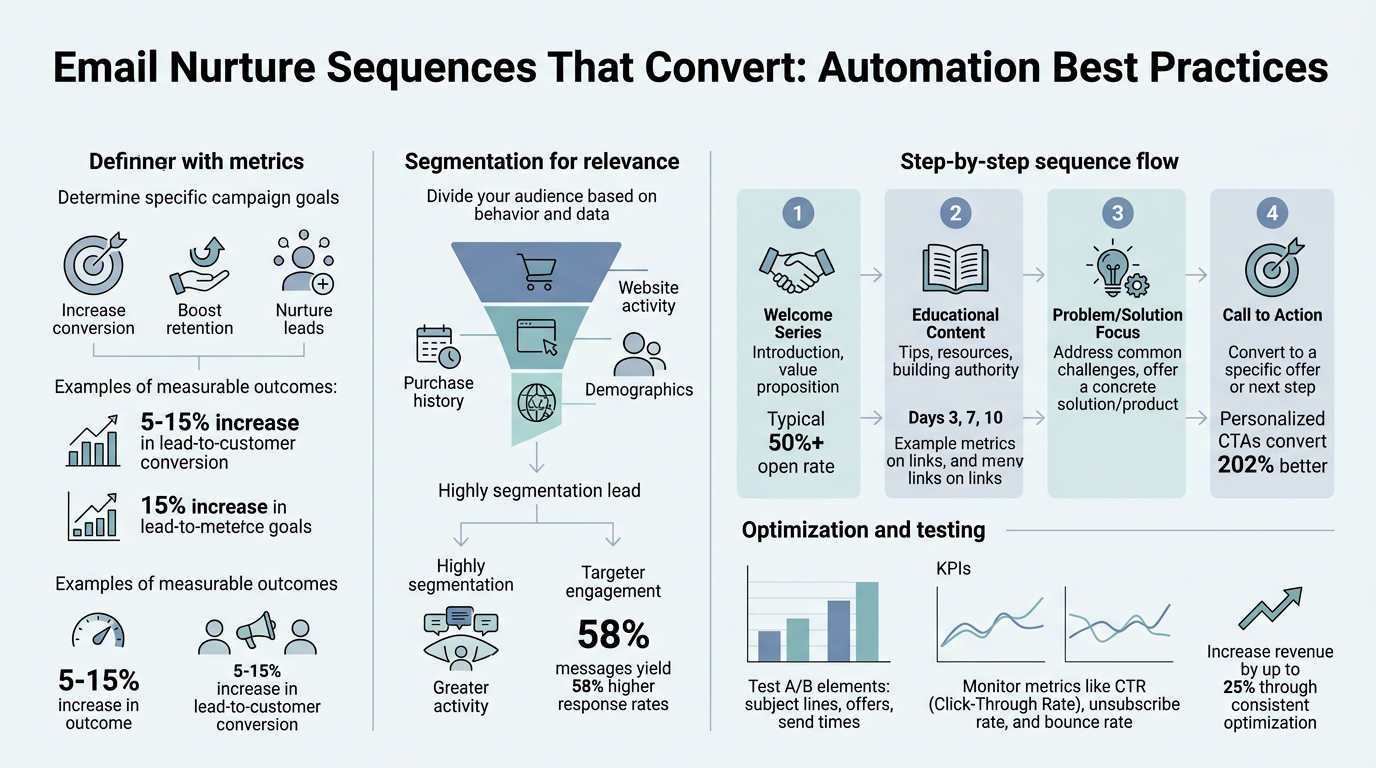
Automation doesn't just save time—it fundamentally changes how leads convert. Automated workflows deliver 2,361% higher conversion rates than manual broadcasts, according to 2026 benchmarks. The mechanism is simple: automation enables precision timing, behavioral triggers, and personalized content paths that manual sending cannot replicate. When a lead lands on your site, subscribes, or takes an action, the right message hits their inbox at the exact moment they're most receptive—not when your team remembers to send it.
"Behavioral triggers eliminate broadcast waste. When you tie email sends to specific actions, you're matching content to intent. A subscriber who downloaded your product comparison guide is in evaluation mode—send them case studies and testimonials, not top-of-funnel content."
The performance gap is staggering. Automated emails achieve 52% higher open rates, 332% higher click-through rates, and deliver 2,361% better conversion outcomes compared to scheduled broadcasts. Why? Behavioral triggers. When you set up automation rules tied to specific actions (signup, link click, cart abandonment), leads receive hyper-relevant follow-ups instantly. A prospect who clicks a pricing page gets a demo request email, not a generic product overview. Research from email automation statistics from Shno confirms that precision timing is the mechanism behind these conversion lifts.
Speed amplifies this advantage. Research shows that leads contacted within 5 minutes of capture are 100x more likely to qualify. Manual processes can't compete with instant, conditional logic. Automation ensures your fastest response times go to your most engaged prospects—exactly when momentum exists.
Why Behavioral Triggers Outperform Fixed Schedules
Fixed-schedule campaigns treat all subscribers the same. Tuesday 10 AM email goes to your entire list, regardless of whether each person is in discovery, evaluation, or ready to buy. Behavioral triggers eliminate this waste.
When you tie email sends to specific actions, you're matching content to intent. A subscriber who downloaded your product comparison guide has clearly moved into evaluation mode—send them case studies and testimonials, not top-of-funnel content. A prospect who opened three emails but never clicked? That's a signal to pause, segment, or re-engage with different messaging. Behavioral-triggered nurture sequences achieve 42% open rates and 10x higher ROI than broadcasts, because the message aligns with where the lead actually is in their journey.
Automation platforms enable conditions you could never manage manually: "If lead opens email AND clicks link AND visits pricing page within 3 days, send sales enablement deck." That's six steps of human decision-making, multiplied across hundreds of subscribers. Automation does it instantly.
How Speed-to-First-Response Compounds Conversion
The first few minutes after a lead subscribes or visits your site are golden. Waiting until tomorrow's send window is leaving conversion on the table. Leads reached within 5 minutes are 100x more likely to qualify, compared to those contacted after 1–2 hours. This isn't because they suddenly become more interested—it's because they're actively engaged right now.
Automation makes instant response possible. Welcome email arrives within seconds of signup. A lead fills a demo request form and immediately sees a calendar link instead of "someone will contact you soon." This creates a compounding advantage: early engagement builds trust, establishes credibility, and increases the likelihood of downstream conversions. By the time your sales team reaches out, the lead has already consumed three pieces of education and self-qualified through link clicks.
What Are the Core Components of a High-Converting Nurture Sequence?

Optimal B2B nurture sequences contain 5–7 emails over 2–4 weeks, moving leads through a predictable arc: welcome, education, social proof, and conversion. This architecture works because it mirrors how buyers actually decide. They don't convert from a single email. They need to understand your value, see proof, and overcome objections before they're ready to engage sales.
"The best sequences follow an 80/20 content ratio: 80% educational or relationship-building, 20% direct selling. This ratio builds trust without feeling aggressive. A lead who receives only educational emails never converts because they never get a call-to-action. A lead who receives constant sales pitches unsubscribes."
The best sequences follow an 80/20 content ratio: 80% educational or relationship-building, 20% direct selling. This ratio builds trust without feeling aggressive. A lead who receives only educational emails never converts because they never get a call-to-action. A lead who receives constant sales pitches unsubscribes. The balance is critical.
Welcome and Onboarding Sequences
Your welcome sequence is your first impression. It lands immediately after signup and sets expectations. Welcome sequences achieve 45% open rates, significantly higher than promotional emails, because they're expected and timely. A strong welcome sequence includes:
- Email 1 (Immediate): Confirm subscription, deliver promised lead magnet or resource, and set tone (friendly, professional, authentic).
- Email 2 (Day 2–3): Introduce your brand story—who you are, why you exist, what problem you solve. This builds narrative and trust.
- Email 3 (Day 5–7): Introduce your top resource, guide, or webinar. Continue education without selling.
Welcome sequences achieve high open rates because they're expected and immediately relevant. Subscribers just raised their hand, so they're primed to engage. Use this window to deepen understanding and begin segmentation. Ask qualification questions: "What's your biggest challenge?" Their response determines which nurture path they enter next.
Education and Value-Driven Sequences
The middle of your sequence is where you prove your expertise. Rather than pushing features, educate prospects on industry challenges, best practices, and the thinking behind your solution. This is MOFU (middle of funnel) content, and it's where most leads decide whether you're worth talking to.
A strong educational sequence includes:
- Case Studies or Results: Show specific outcomes from similar customers. Leads want proof, not promises.
- Comparison or Alternatives: Educate prospects on different approaches to solving their problem, including why your approach wins.
- Common Objections: Anticipate hesitations (cost, implementation, fit) and address them directly.
- Deep-Dive Guides: Offer substantive resources that showcase your thinking. Long-form content builds authority.
The timing of educational sequences matters. Most teams space emails 3–5 days apart, giving leads time to consume content and take action. Too frequent (daily emails) and you risk high unsubscribes. Too sparse (weekly) and momentum dies. Test your cadence with your audience; B2B often works at 2–4 day intervals, while B2C may tolerate daily sends.
Conversion-Focused and Social Proof Sequences
The final phase of your nurture sequence moves leads toward action. By this point, they've consumed education, seen proof, and are warming up. Your job is to make the next step easy and obvious.
A strong conversion sequence includes:
- Testimonials and Results: Real customer quotes or short video testimonials addressing common objections.
- Social Proof Metrics: "Join 5,000+ companies using..." or "Rated 4.8/5 on Capterra." Trust signals matter.
- Clear CTAs: Make it obvious what the next step is. "Schedule a 15-min demo" beats "Learn more."
- Scarcity or Urgency (Optional): Limited-time offers or launch bonuses can accelerate decisions if authentic.
Nurtured leads make 47% larger purchases than non-nurtured leads, because the nurture process builds confidence and justifies price. Don't rush this phase. A 5–7 email nurture over 2–4 weeks gives leads time to build conviction.
How Do You Set Up Behavioral Triggers and Segmentation?
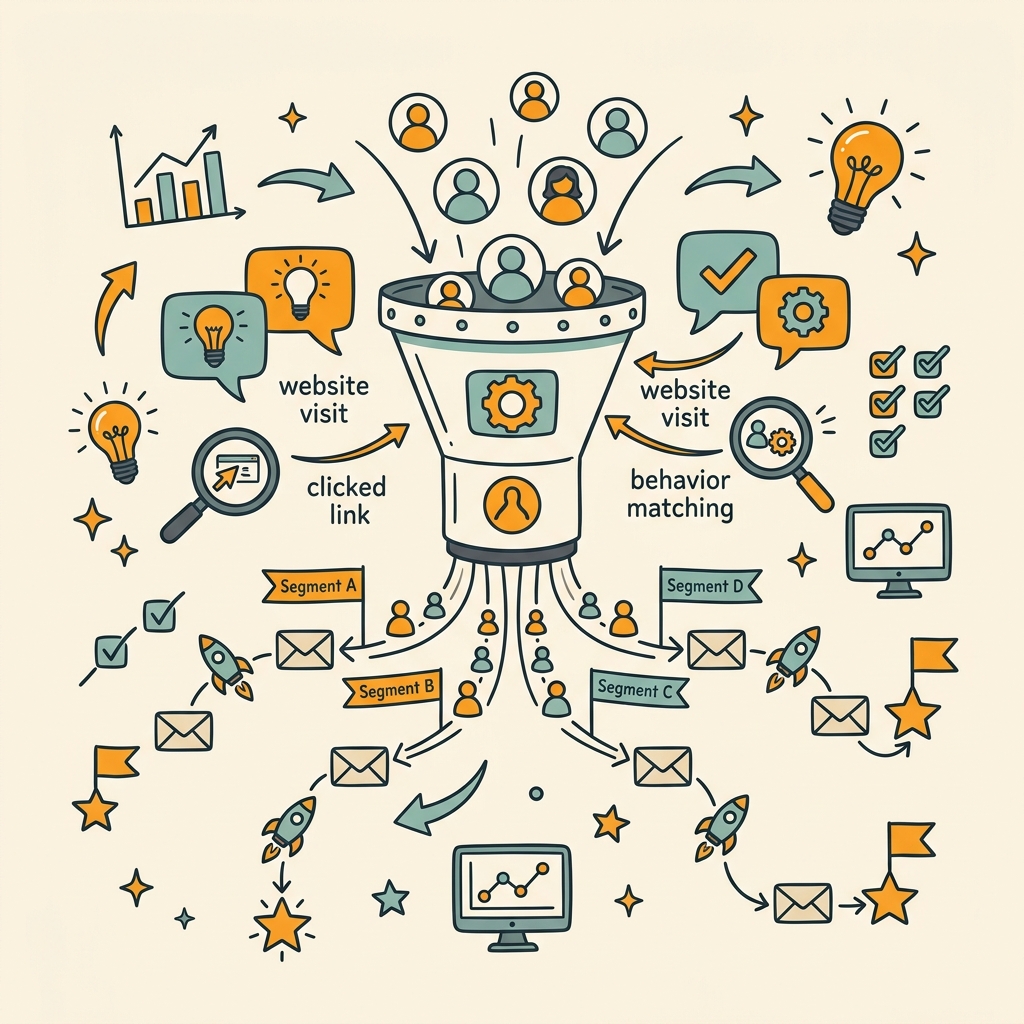
Automation without segmentation is still broadcasting. To unlock the full power of nurture, you need conditional logic that routes leads based on their behavior, firmographics, and engagement. This is where email automation best practices emphasize the use of advanced segmentation.
Segmentation by Buyer Intent and Action
Start with the clearest behavioral signals: what did the lead do? Different actions indicate different levels of intent. A visitor who downloaded your "Buyer's Guide" is further along than someone who opened a welcome email and left. Segment based on actions:
- Content Engagement: Leads who downloaded a deep-dive guide get a related webinar invite. Leads who skimmed a blog post get an intro email.
- Page Visits: A prospect who visited your pricing page is in evaluation mode. Send case studies and ROI calculators, not feature overviews.
- Email Behavior: Leads who open 80% of emails are highly engaged—increase frequency. Leads who don't open anything after 3 sends need re-engagement or removal.
- Link Clicks: Specific link clicks reveal interest. A click on "Integrations" means they're thinking about technical fit. A click on "Pricing" means budget conversation is starting.
Segmentation by intent drives exponential returns. Segmented campaigns generate a 760% revenue increase over generic sends. This isn't small—it's the difference between a failing email program and a growth engine.
Firmographic and Role-Based Routing
Beyond behavior, segment by who the lead is. An email to a VP of Marketing should differ from one to an individual contributor. An enterprise prospect needs different proof than a startup. Build segments around:
- Role and Seniority: VPs care about strategic outcomes and ROI. Managers care about tooling and team adoption. Individual contributors care about day-to-day ease of use.
- Company Size and Stage: Enterprise sequences emphasize security, compliance, and dedicated support. SMB sequences emphasize speed and affordability.
- Industry Vertical: An SaaS prospect gets SaaS-specific language and examples. A healthcare prospect gets HIPAA compliance and privacy messaging.
- Purchase Timeline: Leads in active buying cycles need conversion content now. Early-stage prospects need education and nurture over months.
Role-based segmentation lifts engagement and conversions. A CFO reading a message about cost reduction opens at higher rates than a product manager reading about feature adoption. Make the effort to segment—your conversion rates will reflect it.
Engagement-Level Triggers and Re-engagement Workflows
Engagement naturally declines as someone moves through your funnel (they either convert or unsubscribe). But some leads go dormant: they opened earlier emails but suddenly stop engaging. These are re-engagement opportunities.
Set up triggers for different engagement levels:
- High Engagement (Immediate nurture): Leads opening 80%+ of emails and clicking links should get faster, more frequent messaging and move toward a sales conversation.
- Medium Engagement (Standard nurture): Leads opening 40–60% should follow your standard sequence. They're interested but not urgent.
- Low Engagement (Re-engagement or pause): Leads opening less than 40% after 3–4 sends need a re-engagement email or pause. "We miss you—what would make our emails valuable?" Or: pause them for 30 days and come back with fresh angle.
- No Engagement (Inactive): Leads who never opened anything in 7 days should be segmented separately or unsubscribed. Don't waste sends on dead leads.
Abandoned cart recovery sequences are a specific re-engagement use case. A prospect visits pricing, adds a product to a "cart," but doesn't complete. Automation triggers a cart recovery email within 1–2 hours, then a second one after 24–48 hours. Cart recovery sequences achieve 15–25% recovery rates, compared to 0% if you do nothing.
What Metrics Matter Most for Email Nurture Automation?
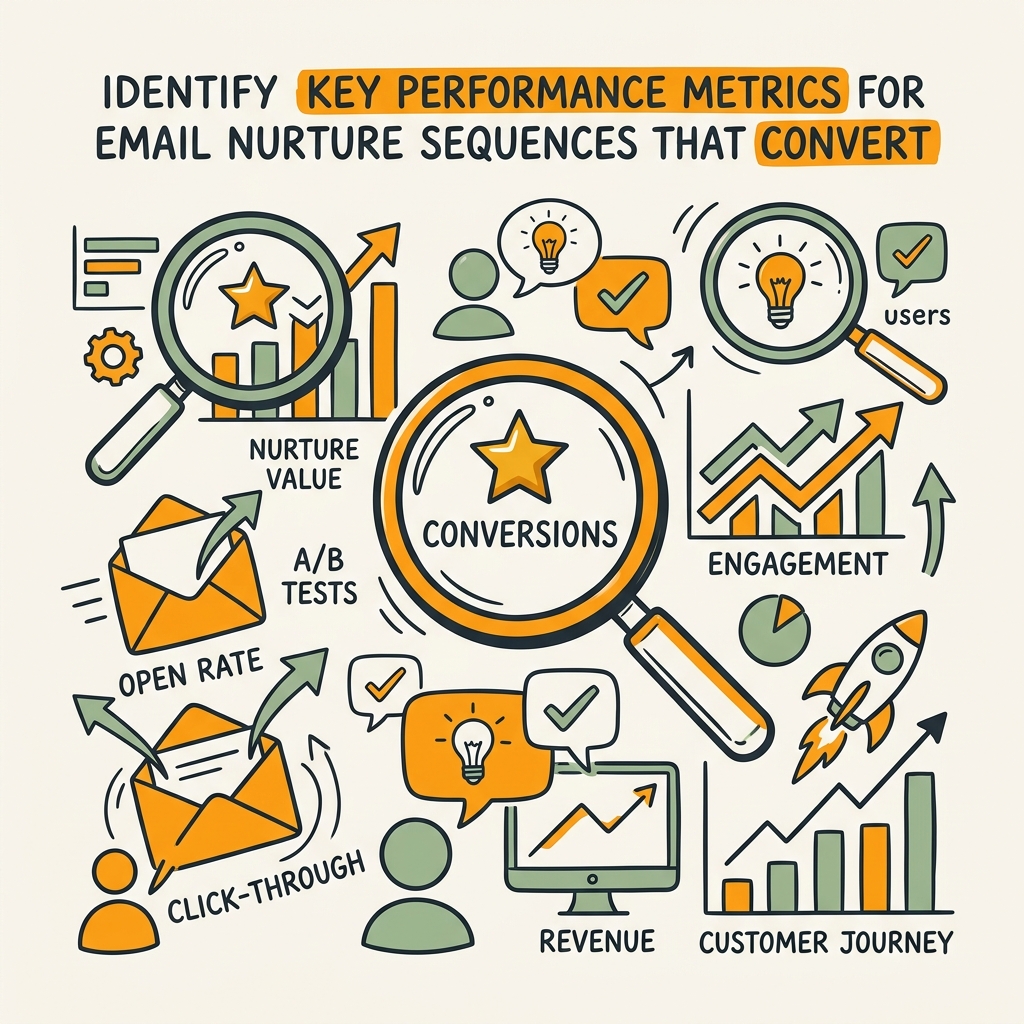
Not all metrics are equal. Vanity metrics like total sends or list size don't drive revenue. Focus on metrics that actually predict conversion and business impact. Track these four categories to understand what's working and what needs optimization.
Opening and Engagement Metrics
Open rate and click-through rate (CTR) are your leading indicators of sequence health. They show whether your messaging and subject line strategy is resonating. Track these at the sequence level, not just the aggregate:
- Open Rate by Email Number: Email 1 opens at 45%, Email 2 at 30%, Email 3 at 18%? That's normal decline. But if Email 3 opens are 5%, something's wrong—rewrite it.
- Click-Through Rate: B2B nurture sequences average 3–7% CTR. If yours is under 2%, your CTAs are unclear or your content isn't compelling. Above 7%, you're doing something right—analyze those sequences and scale them.
- Unsubscribe Rate and Spam Complaints: If you're unsubscribing more than 0.45% per send, your frequency or relevance is off. Spam complaints over 0.08% mean content is perceived as irrelevant or deceptive.
Watch engagement trends over time. If your Email 2 CTR is dropping month-over-month, A/B test copy or offers. If unsubscribes spike on a specific email, that's a signal that content is misaligned with expectations.
Conversion and MQL Metrics
The real question isn't whether emails are opened—it's whether they drive business results. Track these conversion-focused metrics:
- MQL Conversion Rate: What percentage of email subscribers become marketing-qualified leads (MQLs)? B2B nurture sequences average 6–14% MQL conversion. Below 6%? Your qualification criteria may be too loose, or your nurture isn't moving people forward.
- SQLs from Email: More important than MQLs—how many sales-qualified leads (SQLs) come from email sequences? This is closer to actual pipeline impact.
- Deals Closed from Email: The ultimate metric. Track which emails, sequences, or segments led to closed deals. Work backward: this deal came from an email. Which email? What was in it? Replicate it.
- Customer Acquisition Cost (CAC) from Email: Calculate the cost per customer acquired through email nurture. Compare to other channels. Email should be your cheapest CAC.
Top-performing teams see automated email conversion rates of 4.93%, compared to an average of 1.42%. The difference is testing, segmentation, and ruthless focus on conversion metrics rather than vanity metrics.
Revenue Impact and Lifecycle Metrics
The highest-leverage metrics are those tied directly to revenue. Email nurture is part of a larger customer lifecycle—track how sequences affect downstream economics:
- Customer Lifetime Value (CLV): Nurtured leads generate 47% larger purchases and 86% higher customer lifetime value than non-nurtured leads. This justifies investment in sequences, even if initial CAC is similar.
- Repeat Purchase Rate: A post-purchase nurture sequence (onboarding, usage tips, upsell) drives repeat buyers and retention. Track the percentage of customers who repurchase after receiving this sequence.
- Time to Revenue: How long from first email to close? If email nurture shortens sales cycles by weeks or months, that's enormous value.
- Revenue per Email Sent: Calculate total email revenue divided by total emails sent. Automated email workflows generate revenue 30x higher than broadcast campaigns on a per-send basis, because automation is efficient and scalable.
These metrics tie email nurture to business outcomes. Use them in quarterly reviews and to justify marketing investment to leadership.
What Are the Best Practices for Scaling Nurture Automation?
Building one strong sequence is a start. Scaling means creating multiple parallel sequences for different audiences, moving fast, and continuously testing. These practices separate high-performing teams from those stuck at manual processes.
Building a Portfolio of Essential Flows
Rather than obsess over one perfect sequence, build multiple flows that cover the entire customer lifecycle. Five automated flows generate 80% of email revenue: welcome, lead magnet nurture, cart/product abandonment, post-purchase, and re-engagement. Start with these and expand from there.
- Welcome Flow (Days 0–7): New subscriber path. Deliver lead magnet, introduce brand, begin qualification.
- Lead Magnet Nurture (Days 8–42): For subscribers who downloaded content. Move from education to conversion.
- Abandonment Flows (Immediate): Cart abandoned, webinar not attended, resource not downloaded. Recover drop-offs within hours.
- Post-Purchase Onboarding (Days 1–90): New customer path. Drive product adoption, prevent churn, enable upsell.
- Re-engagement Flow (Quarterly): Long-inactive subscribers. "We miss you—what would bring you back?" Segment and pause low-engagement subscribers.
These five workflows form your core system. Each has clear objectives, defined entry/exit criteria, and measurable outcomes. Once live, they run on autopilot, compounding value over time.
Content Creation and Personalization at Scale
Scaling sequences means creating dozens of emails. Manual writing is the bottleneck. This is where AI content generation becomes essential. Rather than spending weeks writing every email variant, AI can draft personalized email sequences based on templates, segment data, and behavioral triggers.
Strong personalization requires first-party data: subscriber name, role, company, past interactions. Use this to:
- Personalize Subject Lines: Personalized subject lines increase open rates by 26%. "Quick question for SaaS founders" opens better than "Quick question."
- Dynamic Content Blocks: The body of the email changes based on segment. A VP of Marketing reads about team adoption ROI. An engineer reads about technical integration.
- Product Recommendations: If you have ecommerce or multiple products, dynamically recommend based on browse history.
- Timing: AI-driven send-time optimization can boost open rates by 26% and click-through rates by 41% compared to fixed schedules, by predicting when each subscriber is most likely to engage.
The 80/20 rule applies: 80% of the email body should be the same. Only 20% should be personalized. This reduces complexity while maintaining relevance. A well-designed template with 3–4 personalization variables is often better than a fully custom email for each segment.
Testing and Optimization Cadence
Scaling requires continuous improvement. Set a testing rhythm and stick to it. Too much testing creates inconsistency; too little means you miss quick wins.
- A/B Test Subject Lines (Monthly): Pick your lowest-performing email. Test two subject line variations on a 50/50 split. Let it run until statistical significance (2–4 weeks, 1,000+ opens minimum). Implement the winner; repeat monthly.
- A/B Test Body Copy and CTAs (Quarterly): Pick your second-lowest performer. Test two body copy variations or CTA buttons. Again, test for significance.
- Test Send Times and Frequency (Ongoing): If your tool has send-time optimization, enable it. Otherwise, test Tuesday/Thursday vs. Monday/Wednesday. Gradually shift to optimal days.
- Review Open, Click, and Conversion by Segment (Quarterly): Are certain segments outperforming? Understand why. Are certain personas underperforming? Re-segment or refresh content.
A/B testing can boost email ROI by 83% when done systematically. The best teams treat email optimization as a permanent function, not a one-time project.
Maintaining List Health and Compliance
Scaling volume without maintaining list quality leads to deliverability problems. Gmail and Yahoo's 2026 email authentication requirements mean poor-quality lists now hurt your sender reputation directly. Maintain list health:
- Double Opt-In on Signup: Require subscribers to confirm their email before being added to sequences. This reduces spam complaints and fake addresses.
- Clean Your List Every 3–6 Months: Use an email verification service to identify and remove hard bounces and invalid addresses before they hurt your reputation.
- Remove Inactive Subscribers: Leads who don't engage after 3–6 months should be paused or unsubscribed. Dead weight hurts your metrics and your sender reputation.
- Monitor Spam Complaints: If complaints exceed 0.1%, investigate your content or frequency. It's a signal you need to shift messaging or slow sends.
- Comply with CAN-SPAM, GDPR, and CASL: Easy unsubscribe, clear sender identity, and honor opt-outs. Non-compliance leads to fines and platform suspensions.
List health is insurance. A small, engaged list outperforms a large, disengaged one. Ruthlessly segment and respect subscriber preferences.
How Can Content Marketing and Email Nurture Work Together?
Email sequences are most powerful when paired with consistent, topical content. One email alone rarely converts. But an email sequence that builds on a blog post, webinar, or case study creates a compounding effect. Content becomes the nurture accelerator.
Using Blog Content to Fuel Nurture Sequences
Every blog post should feed into a nurture sequence. Here's the workflow:
- Blog Post (Educational): Publish deep-dive content on a problem your audience cares about. Optimize for search and share organically.
- Email Follow-Up (Related): In the blog post, prompt readers to join your list for "even deeper insights." Those who click go into a nurture sequence on that topic.
- Sequence Design: Email 1 delivers the promised deeper guide. Emails 2–3 expand on related topics or show how your solution solves the problem described in the blog. Email 4–5 move toward conversion (demo, consultation).
This approach works because it's aligned. The blog post has already warmed the lead and signaled intent. The nurture sequence then builds logically on that foundation. Creating consistent content across all channels amplifies this effect—when blog, email, and social messaging align around the same core topics, you compound brand awareness and trust.
Lead Magnets and Content Gating
The best-performing nurture sequences start with a lead magnet: a free resource (guide, template, checklist) that solves a specific problem and requires an email address to access. The magnet determines what type of lead enters your nurture sequence.
A strong lead magnet:
- Solves a specific problem (not vague or promotional)
- Takes 5–15 minutes to consume
- Provides immediately actionable insights
- Qualifies interest (someone who downloads a "B2B Sales Process" guide is a sales-focused lead, even if they work in marketing)
Once the lead magnet is gated and live, you own their email. The nurture sequence begins immediately with Email 1 delivering the resource, then progresses through related education and conversion. This is where content calendar planning compounds: each blog post becomes a lead magnet, and each lead magnet feeds a nurture sequence. Over time, you have dozens of parallel pipelines, all compounding organic traffic into qualified leads.
| Email Nurture Metric | Average Performance | Top Performer |
|---|---|---|
| Automated Conversion Rate | 1.42% | 4.93% |
| MQL Conversion Rate (B2B) | 6–14% | 15%+ |
| Email Open Rate (Nurture) | 28–42% | 45%+ |
| Click-Through Rate (Nurture) | 3–7% | 8%+ |
| Customer Lifetime Value Lift | Baseline (non-nurtured) | 86% higher |
| Revenue Lift from Segmentation | Baseline (generic) | 760% increase |
| ROI from Automation vs. Manual | Baseline | 2,361% higher |
Conclusion
Email nurture sequences are not optional for teams serious about conversion. Automated sequences deliver 2,361% higher conversion rates than manual broadcasts, with 47% larger purchase values from nurtured leads. The framework is clear: segment by intent, build 5–7 email sequences that move leads through education to conversion, use behavioral triggers to speed responses, and test continuously.
The best part? Automation compounds. Once built, sequences run on autopilot, nurturing thousands of leads with zero manual effort. A/B testing automation can boost ROI by 83%, and strategic content marketing amplifies the effect—each blog post feeds qualified leads into optimized sequences, creating a self-sustaining growth engine.
The time to build this system is now. Teams that delay another quarter miss months of compounded conversions and revenue growth. Start with your welcome sequence, add cart recovery, then expand to full lifecycle automation. Start your SEO agent to systematically create the content that fuels these sequences.
FAQs
How often should you send nurture emails?
B2B nurture sequences typically space emails 2–5 days apart over a 2–4 week period, with most teams landing on 3–4 day intervals. This cadence balances engagement—frequent enough to maintain momentum, sparse enough to avoid unsubscribe fatigue. Start at 4 days and adjust based on your open and unsubscribe rates. If unsubscribes spike, slow down. If opens remain strong and click rates grow, you might test 3-day intervals or even daily sends for highly engaged segments. The key is monitoring your metrics; there's no universal "best" frequency.
What is a good email nurture conversion rate?
Average B2B nurture conversion rates range from 1.42% to 6–14% for MQL (marketing-qualified lead) conversion, depending on sequence maturity and audience quality. Top performers achieve 4.93% conversion on automated flows. If your sequences convert below 2%, you're likely missing segmentation or having content misalignment issues. Start by segmenting your audience by role and behavior, then test tighter CTAs and more conversion-focused content. Compare your performance quarter-over-quarter; improvement of 0.5–1% per quarter through testing is realistic and valuable.
Can you automate email nurture with a free email tool?
Most free email tools (Mailchimp's free tier, Brevo's free tier) support basic automation like welcome sequences and simple triggers. However, they lack advanced segmentation, behavioral routing, and the send-time optimization that separates good sequences from great ones. For B2B nurture, paid tools like Klaviyo, HubSpot, or Braze offer deeper personalization and reporting. If your list is under 1,000 subscribers, a free tier works. Beyond that, the cost of a paid platform (typically $15–50/month) is justified by the conversion lift automation provides.