Email Sequences for Marketing Automation
Sending one-off promotional emails barely moves the needle. Automated email sequences deliver $36 in revenue for every $1 spent, and teams using them see 320% more revenue than those relying on manual sends. Yet most founders and marketing teams still treat email as a broadcast channel, not a conversion machine. The real power lies in building triggered, segmented workflows that nurture leads at scale without constant manual effort. Here's how to build email sequences that compound your revenue while you focus on growth.
Key Takeaways
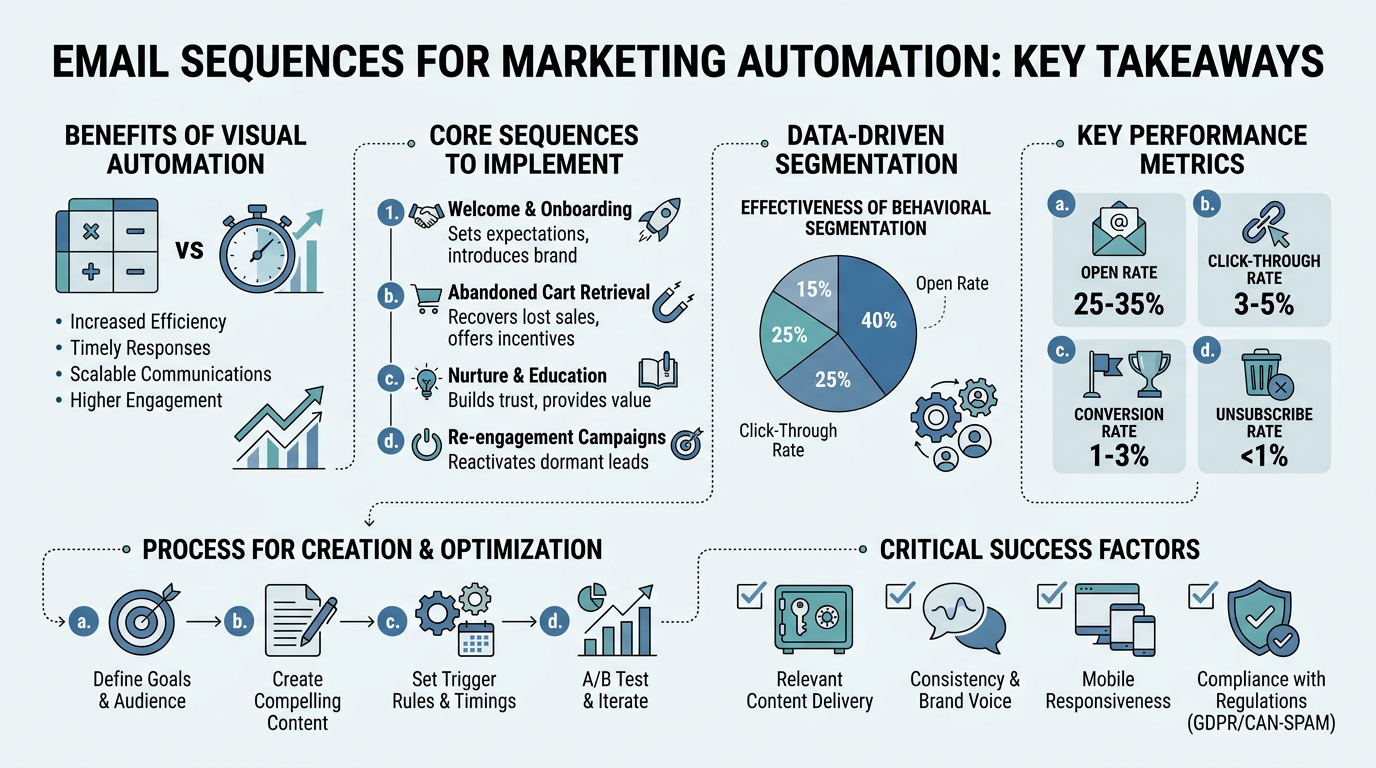
- Automated email sequences generate $36–$45 ROI per $1 spent and 320% more revenue than manual campaigns (2026)
- Triggered emails outperform batch sends by 42.1% open rate vs 14.5% and 5.8% CTR vs 1.3% CTR
- Five core flows—welcome, cart recovery, post-purchase, re-engagement, and browse abandonment—drive 80% of email revenue when properly configured
- Segmented and personalized sequences increase revenue by 760% and boost click-through rates by 41%
- What Email Sequences Actually Are: Triggered, multi-email workflows that respond to specific user actions, not generic batch blasts to your entire list.
- Core Sequence Types: Welcome series, cart recovery, post-purchase follow-ups, re-engagement campaigns, and browse abandonment flows deliver the highest ROI.
- How to Build Sequences That Convert: Start with a single goal, trigger from a meaningful action, segment by behavior and lifecycle stage, and use A/B testing to optimize every element.
- Why Timing and Cadence Matter: First emails should go out within 5 minutes of the trigger; nurture sequences space 3–7 days apart to maximize engagement without fatigue.
- The Role of Automation Tools: The right platform automates segmentation, personalization, A/B testing, and deliverability controls—so you don't have to.
What Is an Email Sequence, and Why Does It Matter?
An email sequence is a series of targeted messages triggered by a specific user action, sent over time to guide someone through a defined journey. Unlike batch-and-blast campaigns sent to your entire list on a schedule, sequences are behavioral—they respond to what your audience actually did. Automated email sequences generate 320% more revenue than non-automated emails, and they're the backbone of modern email marketing because they scale personalization without scaling your workload.
"Email sequences aren't a luxury—they're the foundation of sustainable growth. The difference between batch-and-blast and behavioral sequences is the difference between fishing with dynamite and fishing with precision. One destroys your reputation; the other builds it."
Sequences vs. Drip Campaigns: The Practical Difference
The terms "email sequence" and "drip campaign" are often used interchangeably, but they're not identical. A drip campaign is a static series of emails sent on a fixed schedule to anyone who meets a basic trigger—like joining a newsletter. Everyone gets the same emails on the same timeline. An email sequence, by contrast, adapts based on user behavior. One person might receive Email 1 → Email 2 → Exit, while another receives Email 1 → Skip Email 2 → Email 3 → Upsell based on their actions. Sequences are more flexible, more personalized, and dramatically more effective. For growing companies, the sequence approach is non-negotiable because it treats your audience as individuals, not a list.
Why Automation Compounds Revenue Without Consuming Your Time
Manual email campaigns require you to write, send, and monitor each message. You're capped by the hours in your week. Automation breaks that limit. Once a sequence is built and tested, it runs continuously in the background, sending the right message to the right person at the right time without your intervention. Marketing automation reduces operational costs by 30%, freeing your team to build more sequences, test new flows, or focus on strategy. For busy founders managing content, product, and sales simultaneously, this is the difference between sustainable growth and burnout.
The Five Core Email Sequences That Drive 80% of Revenue
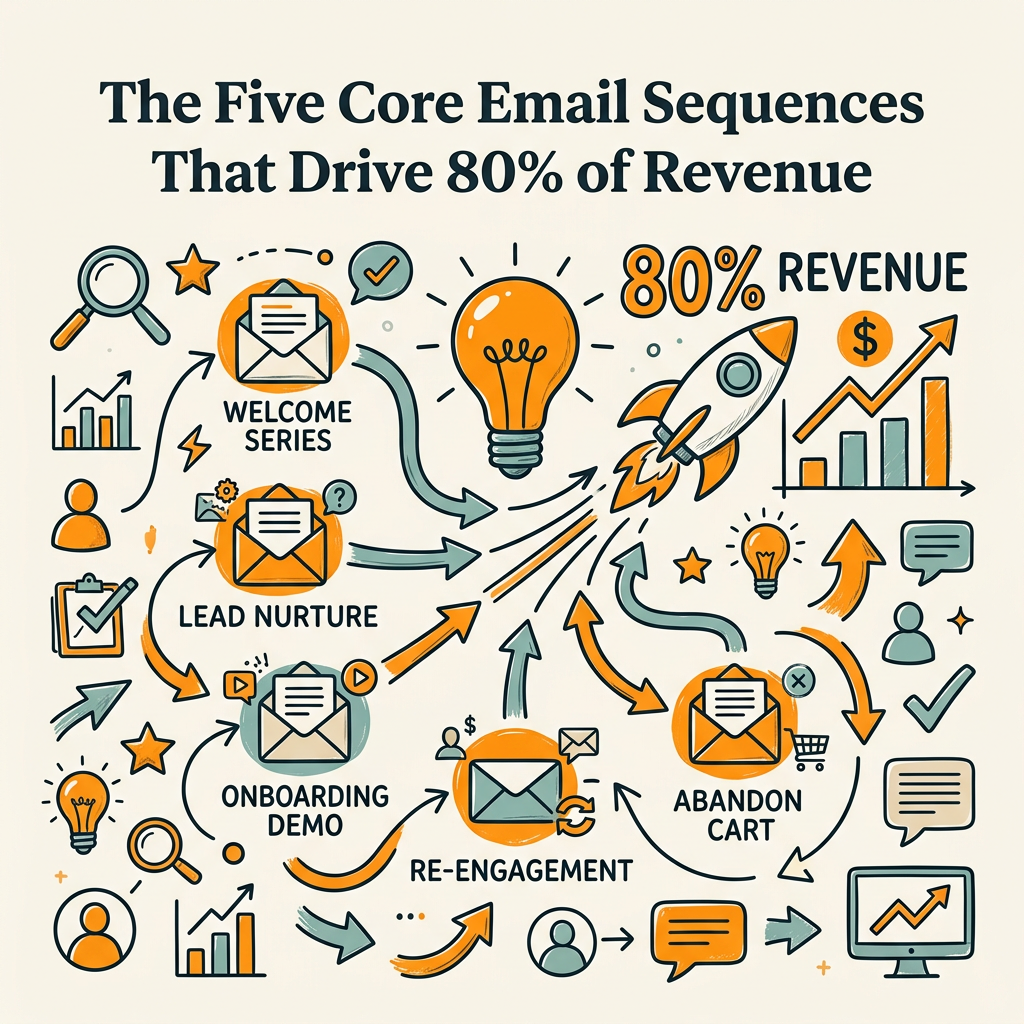
Not all email sequences are created equal. Research shows that five specific flows—welcome series, cart recovery, post-purchase, re-engagement, and browse abandonment—account for roughly 80% of email revenue when implemented correctly. These aren't fancy or experimental; they're proven workflows that convert because they address real moments in the customer journey.
Welcome Series: The First Impression That Sets Everything Up
Your welcome sequence begins the moment someone subscribes. Send the first email within 5 minutes to deliver the promised incentive and set expectations. A well-designed welcome series typically includes 3–5 emails spaced over 7–14 days. The first email builds trust and confirms the subscription. The second and third introduce your brand story, key products, or core value propositions. The fourth often includes a softer ask—a resource, guide, or educational content that positions you as a helpful expert. The final email might introduce your community or invite deeper engagement. The goal isn't to sell; it's to establish a relationship and segment the audience based on their engagement with this critical first touchpoint. Teams that nail the welcome sequence see 50%+ open rates and 20%+ click-through rates on the first email alone.
Cart Recovery: Recapturing Revenue That's Walking Out the Door
Abandoned carts are revenue hemorrhaging. A cart recovery sequence goes out to anyone who adds items to their cart but doesn't check out. The first email, sent within 1 hour, simply reminds them what they left behind—often with a product image or link straight to checkout. The second email, sent 24 hours later, adds urgency or social proof: "3 other customers bought this today" or "Only 2 left in stock." A third email, sent 48–72 hours later, offers an incentive—10% off, free shipping, or a bonus gift. This three-email sequence typically recovers 10–15% of abandoned carts. For eCommerce companies, cart recovery is often the highest-ROI sequence because it targets warm, high-intent users who've already decided to buy and just need a gentle push.
"Cart recovery sequences are money on the table. If you're not running one, you're leaving 10–15% of transaction value behind every single day. It's the fastest, highest-ROI sequence you can build—and it takes less than an hour to set up."
Post-Purchase: Converting One-Time Buyers into Repeat Customers
Your relationship doesn't end at the sale; it begins. A post-purchase sequence thanks the buyer, sets expectations for delivery or setup, and then delivers education or complementary products. Email 1 (Day 0) confirms the order and provides tracking. Email 2 (Day 3–5) delivers a related resource—setup guide, usage tips, or a customer success story. Email 3 (Day 10–14) introduces a complementary product or invites feedback. Email 4 (Day 20+) might recommend accessories or upsell to a higher tier. Post-purchase sequences increase customer lifetime value, reduce support tickets (because customers are guided through onboarding), and create natural moments to ask for reviews or referrals.
Re-engagement: Winning Back Inactive Subscribers
Email lists decay. Subscribers who don't open or click for 30, 60, or 90 days are at risk of churn. A re-engagement sequence acknowledges the silence and gives inactive subscribers one last chance to stay. The sequence typically runs: Email 1 (Day 0) asks, "We miss you—interested in staying in touch?" Email 2 (Day 4) offers a discount or fresh incentive. Email 3 (Day 10) takes a hard line: "This is our last message. Confirm you want to hear from us or unsubscribe." After day 14 or a final non-engagement, remove these subscribers from your active list to protect sender reputation. Re-engagement sequences are less about revenue recovery and more about list hygiene, but they're essential to maintain inbox placement and avoid spam folder traps.
Browse Abandonment: Turning Window Shoppers into Buyers
Some visitors browse your site but don't add anything to their cart. Browse abandonment sequences target these users within 2–4 hours, recommending the products they looked at or similar alternatives. The first email says, "You viewed X—here's what makes it special." The second email, sent 24 hours later, offers a discount on that product or category. The third, sent 48 hours later, shifts to a different product or showcases bestsellers. Browse abandonment sequences convert at lower rates than cart recovery, but they reach a much larger audience, so the absolute revenue impact is often significant.
How to Build a High-Converting Email Sequence: Step by Step
Building an effective email sequence isn't complicated, but it does require intentionality. Most teams skip the planning stage and jump straight to writing, then wonder why engagement is flat. The best sequences start with clear goals and map before they draft.
Define Your Single Goal and Audience Segment
Every email sequence must have one primary goal: convert leads to customers, retain customers, recover lost revenue, or re-engage inactive users. Trying to do multiple things in one sequence confuses your audience and dilutes results. Once you've defined your goal, identify the exact audience segment the sequence targets. Welcome sequences go to new subscribers. Cart recovery sequences target users with items in their cart but no purchase. Re-engagement sequences target users with zero engagement in the last 60 days. Specificity here is critical because segmentation is what transforms a generic email into a relevant, conversion-driving message. A generic email to your entire list will underperform segmented sequences by a factor of 5–10x.
Map the Journey Before You Write a Single Email
Write out your sequence on paper or in a spreadsheet before drafting copy. For each email, note:
- Trigger: What action causes this email to send? (signup, cart abandonment, post-purchase, etc.)
- Timing: How many hours or days after the trigger?
- Goal: What single action do you want the reader to take?
- CTA: One primary call-to-action per email.
- Branching logic: Does engagement on Email 1 affect whether they see Email 2? (Yes—this is where personalization happens.)
Mapping forces you to think through the whole journey before you invest in copy. It also makes it easier to brief your team or your automation tool on what needs to be built.
Write Each Email with One Message and One CTA
Subject lines should be curious or benefit-driven, not clickbait. "You left something behind" or "Your cart is waiting—here's 10% off" outperforms "Last chance!" because it's honest and specific. Body copy should be concise—50–125 words is the sweet spot for mobile and focus. One main idea per email. One primary CTA. Use personalization beyond first name: reference the product they viewed, the cart value, their purchase history, or their engagement level. Close with a clear, single next step: "Buy now," "Download the guide," "Claim your discount."
Set Cadence to Maximize Engagement Without Triggering Fatigue
Timing is critical. Welcome sequences and time-sensitive offers (cart recovery) should send quickly—first email within 5 minutes, follow-ups every 24–48 hours. Nurture and educational sequences should space emails 3–7 days apart to give readers time to think and act. Re-engagement sequences can be more aggressive—send all three within 10 days to give non-engaged users one clear window to respond. The goal is to stay top-of-mind without overwhelming. Too frequent, and you spike unsubscribes and spam complaints. Too infrequent, and readers forget your sequence exists.
Test Subject Lines, Send Times, and CTAs
A/B testing is non-negotiable. For your welcome sequence, test two subject lines on the first email—split your audience 50/50, see which gets the higher open rate, and use the winner as your control going forward. Then test the CTA on Email 2. Test send time on Email 3. Run small tests continuously. Over six months of small wins, your sequence performance compounds—a 5% improvement on each email across five emails is a 25%+ total improvement in the sequence conversion rate. Tools like Jottler make testing and optimization automatic, letting you focus on strategy instead of manually running split tests in your email platform.
Segmentation and Personalization: The Real Conversion Levers
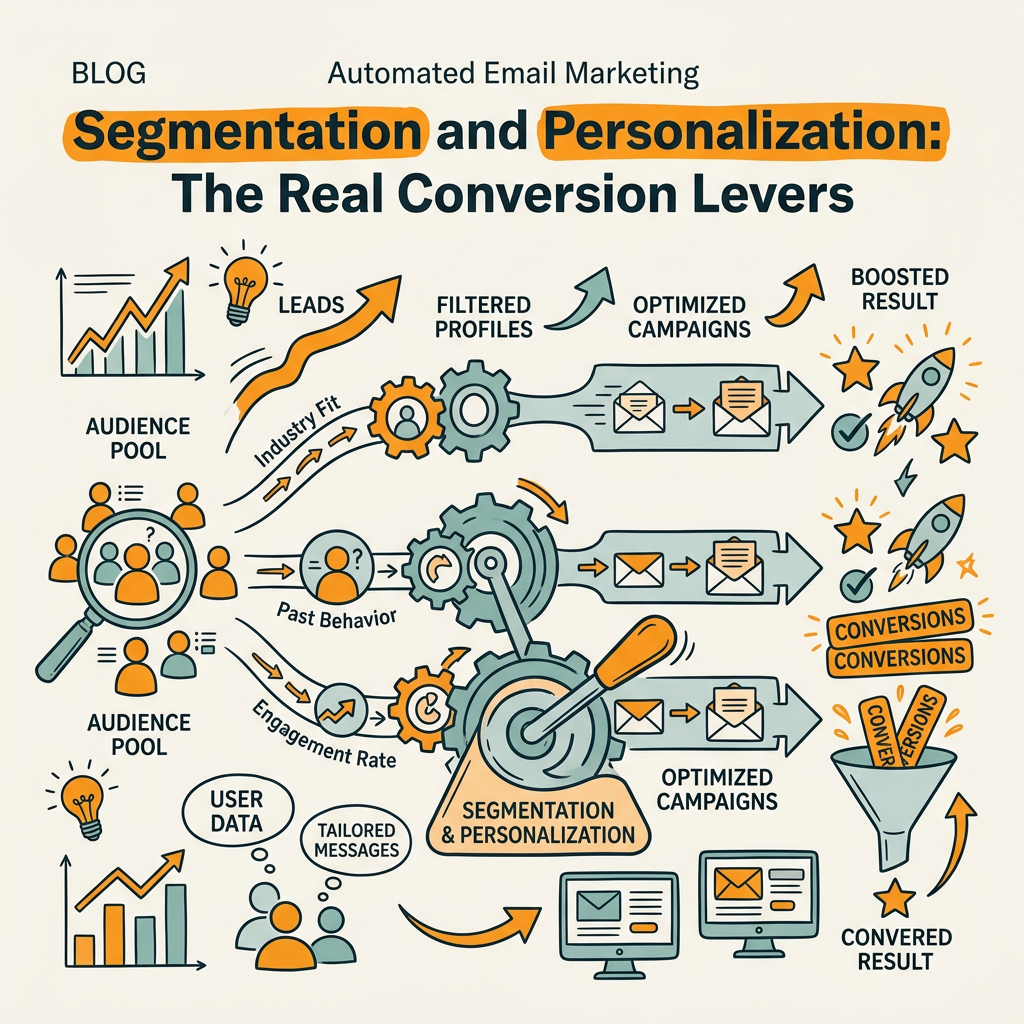
Generic sequences don't work. Segmented campaigns generate 760% more revenue than unsegmented, and personalized emails see 41% higher click-through rates. Segmentation isn't just about demographics (company size, industry)—it's about behavior and lifecycle stage.
How to Segment for Maximum Relevance
Segment your audience by: Purchase history (customers vs. non-customers, high-value vs. low-value). Browsing behavior (viewed pricing page vs. never visited pricing, looked at feature A vs. feature B). Engagement level (opened 5+ emails vs. zero opens, clicked a link vs. passive reader). Lifecycle stage (prospect, new customer, loyal repeat buyer, at-risk). RFM score (Recency, Frequency, Monetary value—a composite score that identifies your highest-value segments). Most automation platforms let you build these segments automatically based on behavioral rules, so once you set the criteria, new subscribers are sorted into the right buckets without manual work. Spending an afternoon setting up segmentation rules saves hours of manual list management and generates immediate revenue lifts.
Personalization Beyond First Name: Using Behavior and Intent
Inserting a subscriber's first name is the bare minimum. Real personalization uses behavior. If someone downloaded a guide on Feature A, send them educational content about Feature A, then a use case, then a case study using Feature A. If someone abandoned their cart with a high-ticket item, send them social proof or a customer testimonial about that specific product. If someone is a repeat customer, skip the educational emails and go straight to upsells or new product launches. This isn't manipulation; it's respect. You're sending relevant content to people who care about it, which is fundamentally what email should be. Tools like marketing automation systems built for scale can personalize each email based on 20+ behavioral data points, so your team isn't hand-curating messages—the platform handles it.
Common Email Sequence Mistakes and How to Avoid Them
Even with solid strategy, execution missteps kill sequence performance. Here are the mistakes we see most often and how to sidestep them.
Mistake 1: Sending to Your Entire List Instead of Segments
Broadcasting your cart recovery email to subscribers who've never added items to their cart is wasteful and confusing. It dilutes engagement metrics and trains your audience to ignore your email. Always send sequences to the specific segment that triggered them. Your automation platform should enforce this with strict conditions: "This sequence only sends to users with cart abandonment in the last 48 hours." No exceptions.
Mistake 2: Too Many Emails, Too Fast
Bombarding people with an email every day feels like spam. Space nurture sequences at least 3–5 days apart. If you're testing heavily and sending sequences on multiple tracks simultaneously (welcome + browse abandonment + post-purchase), stagger their timing so no single subscriber gets 3+ emails in one day. Monitor your unsubscribe rate and bounce rate closely. If unsubscribes spike, you're sending too much.
Mistake 3: No Clear CTA or Multiple Competing CTAs
If your email says "Download our guide" and also "Check out our pricing" and also "Read customer stories," your reader will do nothing. One primary CTA per email. Everything else is secondary. The design, copy, and button should all guide to that single next step. This focuses your reader and makes it easier to measure what worked.
Mistake 4: Ignoring List Hygiene
Continuing to email users who never open, never click, and never buy damages your sender reputation and tanks your inbox placement. After 60–90 days of zero engagement, move those subscribers to a re-engagement sequence. After that sequence, remove them from your active list. A smaller, engaged list beats a large, inactive one every single time.
Automation Tools and Platforms That Scale Sequences
Building and managing email sequences manually is tedious. You need a platform that automates the boring stuff—segmentation, A/B testing, timing, personalization, reporting—so you can focus on strategy.
| Platform | Best For | Segmentation & Personalization | Automation Complexity | Ease of Use |
|---|---|---|---|---|
| Mailchimp | Small to mid-market businesses | Basic behavioral segmentation, limited personalization | Moderate — good for standard workflows | User-friendly, good for beginners |
| HubSpot | Sales and marketing alignment | Deep segmentation with CRM data, advanced personalization | High — built for complex journeys | Steep learning curve, powerful when mastered |
| Klaviyo | Ecommerce and high-growth brands | Advanced behavioral triggers, strong predictive content | High — designed for sophisticated flows | Moderate — strong documentation and community |
| Jottler | Busy founders automating entire content and email strategy | AI-powered segmentation, behavior + intent-driven personalization | Moderate — AI agents build and optimize sequences automatically | Minimal setup — connects to your CMS, AI handles the rest |
Why Jottler stands out for founders: If you're a busy founder managing content, email, and product simultaneously, manual sequence building feels impossible. Jottler's AI agents research, write, and publish email sequences continuously, using behavioral data from your audience to automatically segment and personalize at scale. You set your goals and audience, and the AI builds the sequences, tests variants, and optimizes send times without daily intervention. For teams that lack email expertise or don't have time to hand-craft sequences, Jottler compresses weeks of work into hours.
Measuring Email Sequence Performance and Iterating
Building a sequence is just the beginning. The real power comes from measuring what works and iterating. Track these metrics for every sequence.
Essential Metrics to Monitor
Open rate tells you if your subject line and sender reputation are working. A strong welcome email should hit 40%+; a generic nurture email might be 20–30%. Click-through rate tells you if your content and CTA are compelling—5%+ is excellent, anything under 2% signals a problem. Conversion rate measures the ultimate goal: did they buy, download, or take the intended action? This varies wildly by sequence type, but 2–5% is a reasonable range for well-optimized sequences. Unsubscribe rate and spam complaint rate are red flags. Anything above 0.5% unsubscribe means your content isn't matching expectations or you're sending too frequently. Monitor drop-off points: if 50% of users open Email 1 but only 20% open Email 2, something in Email 1 is broken—either the CTA isn't compelling or the content promise doesn't deliver.
Testing and Optimization: The Compound Effect
Once your sequence has 100+ sends, start testing. Run an A/B test on the subject line of your most important email—the one with the highest open rate. Let it run for 100 sends, then pick the winner. Next week, test the CTA button copy. Next week, test the send time. Over three months of small wins, you're looking at 20–40% improvement in the sequence's overall performance. This is where automation and AI agents excel—they run tests continuously and apply learnings automatically, so you're not manually reconfiguring sequences every week.
Email Sequences as Part of Your Broader Marketing Automation Strategy
Email sequences don't exist in a vacuum. They're most effective when integrated into a broader marketing automation and content strategy. Every piece of content—blog post, whitepaper, case study, landing page—should feed into an email sequence. Someone downloads your guide? Welcome sequence triggered. Someone views your pricing page but doesn't sign up? Browse abandonment sequence triggered. Someone attends your webinar? Post-webinar nurture sequence triggered. This interconnectedness is what separates high-growth companies from everyone else. A comprehensive content marketing framework ensures your email sequences aren't random acts—they're part of a cohesive system designed to guide people from awareness to decision to loyalty.
Conclusion
Email sequences are one of the highest-ROI tools in marketing automation. Automated sequences deliver $36–$45 for every $1 spent, generate 320% more revenue than manual sends, and reduce operational costs by 30%. The five core sequences—welcome, cart recovery, post-purchase, re-engagement, and browse abandonment—account for 80% of email revenue when implemented correctly. The real work isn't building one perfect sequence; it's building a system of sequences that work together, automatically segmenting and personalizing based on user behavior, and continuously testing and iterating to improve performance.
For busy founders and growing marketing teams, the only way to scale this sustainably is through automation. Set up your core sequences once, let them run in the background, and measure results continuously. As you get better at email, you'll see it compound into a reliable revenue channel that requires less and less manual maintenance. Start your SEO agent to build and automate your content and email strategy simultaneously, so sequences and content work together to drive consistent organic growth.
FAQs
What's the best email sequence to start with?
Start with a welcome sequence if you're building your audience from scratch. This is the highest-ROI sequence because everyone who subscribes goes through it, and it's where you build the initial relationship and set expectations. A well-designed welcome sequence typically delivers 40–50% open rates and sets the tone for all future communication. If you already have an existing audience, cart recovery is the fastest win—it targets warm, high-intent users and recovers lost revenue immediately. Build one core sequence first, optimize it with A/B testing over 4–6 weeks, and only then build the second sequence. Quality beats quantity.
How often should I send emails in a sequence?
Timing depends on the sequence goal. Welcome sequences and urgent offers (cart recovery) should send every 24–48 hours because they're time-sensitive and high-intent. Nurture and educational sequences should space emails 3–7 days apart to give readers time to digest and act on the content without feeling bombarded. Re-engagement sequences should send all emails within 10 days because you're giving inactive subscribers one clear window to respond. The golden rule: never send more than one promotional email per day to the same subscriber, and monitor unsubscribe rates closely. If your unsubscribe rate jumps above 0.5%, you're sending too much.
Can email sequences work without a dedicated marketing automation tool?
Technically yes, but practically no. You could set up basic sequences in Mailchimp or even Gmail, but you'd spend hours on manual tasks—segmenting lists, scheduling sends, tracking performance, adjusting timing, running A/B tests. A dedicated marketing automation platform automates all of this, letting you focus on strategy instead of execution. The cost of the tool (typically $50–$300/month) is recouped on the first sequence through improved open rates, click-through rates, and conversions. For any team with more than one sequence running simultaneously, automation tools are non-negotiable.