Essential AI SEO Features for Organic Growth
The gap between top performers and everyone else in organic search has never been wider. While most teams manually crunch keyword data, optimize content, and chase rankings, leaders are deploying AI to automate the entire workflow. The evidence is stark: companies using AI for SEO report up to 70% increases in organic traffic, and AI-optimized pages see 25% higher dwell time compared to traditional approaches. Yet most founders still treat SEO as a part-time responsibility when it should be their highest-leverage growth lever. Here's how to harness essential AI SEO features to scale organic growth without burning out your team.
Key Takeaways
- AI-powered keyword research reveals hidden search patterns and intent shifts that humans miss, enabling smarter content strategy (2025, Saffron Edge)
- Automated content generation combined with real-time SERP analysis cuts content production time by 70% while improving rankings
- AI fact-checking and automated internal linking compound organic authority, driving 49.2% higher ranking boosts vs. manual SEO (2025)
- AI search visibility tracking across Google Overviews, ChatGPT, and Perplexity ensures your content reaches buyers in new discovery channels
- AI Keyword Research at Scale: Uncover search intent and content gaps in minutes instead of hours, identifying opportunities competitors miss.
- Automated Content Generation: Produce rank-ready articles daily with real-time SERP data integration, eliminating the manual research burden.
- Technical SEO Automation: Continuous scanning catches broken links, duplicate content, and schema errors before they damage rankings.
- Fact-Checking and Verification: Every claim validated against authoritative sources, protecting brand credibility and EEAT signals.
- Smart Internal Linking: AI builds contextual link networks automatically, distributing authority and boosting topical relevance across your site.
- AI Search Visibility Tracking: Monitor presence in Google AI Overviews, ChatGPT, and Perplexity to stay visible as search behavior evolves.
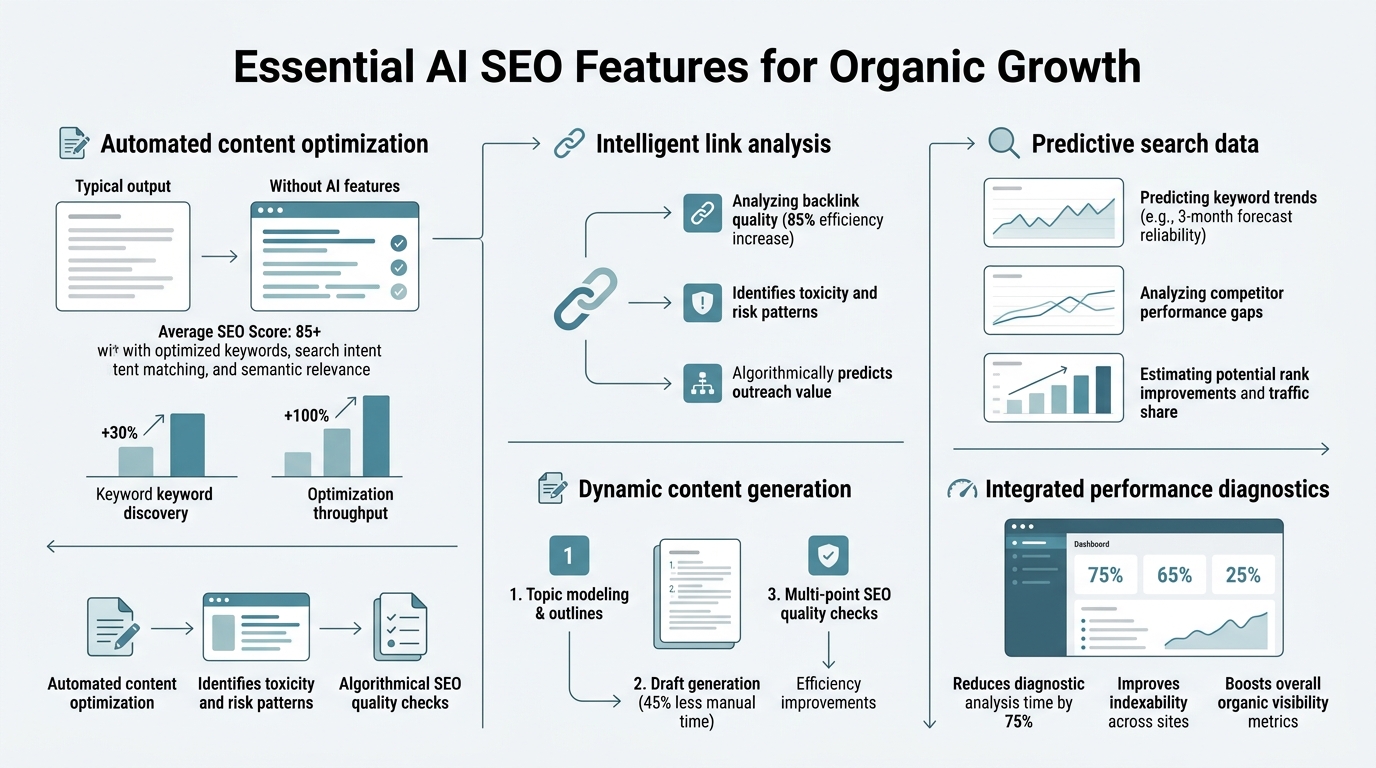
How Does AI Keyword Research Transform Organic Strategy?
Manual keyword research is dead. AI-powered keyword research now processes millions of search signals in seconds, revealing hidden patterns about user intent, trending questions, and content gaps that traditional tools miss entirely. Instead of guessing what your audience searches for, AI maps the actual question ecosystem around your market. Teams using AI for keyword research report 45.5% higher adoption rates of data-driven strategies, and the speed advantage aloneminutes vs. weekscompounds every decision downstream.
Intent Mapping at Machine Speed
The difference between a thousand-click keyword and a zero-click keyword is understanding the searcher's actual intent. AI doesn't just count search volume. It analyzes the SERP itself, sees what content currently ranks, understands why those results win, and pinpoints the gaps your content can fill. When you search for "AI SEO tools," Google shows comparison articles and tool reviews. But AI reveals that searchers are really asking: "What tool will save me 20 hours per week?" That reframe changes everything about the content you write.
AI keyword platforms like W3era's breakdown of AI SEO tools now cluster keywords by intent type and buyer stage, so you're not writing generic guides. You're writing targeted answers. This shifts your organic growth strategy from "rank for volume" to "rank for revenue."
Competitive Keyword Blindspots
Your competitors are ranking for keywords you don't even know exist. AI keyword analysis scans competitor domains, their top-performing pages, and the search queries sending them trafficthen identifies the gaps: keywords your competitors rank for that you don't, and vice versa. 60% of top-ranking sites now use AI for competitor analysis, which means the moment you skip this, you're already behind.
The practical play: Jottler's AI agents perform this competitive mapping automatically as part of the daily content workflow. You don't manually feed it competitor URLs. The system identifies relevant competitors based on your niche, analyzes their keyword footprint, and surfaces opportunities in real time. That's the difference between thinking about keyword research and actually doing it at scale.
What Makes Automated Content Generation Rank Better Than Manual Writing?
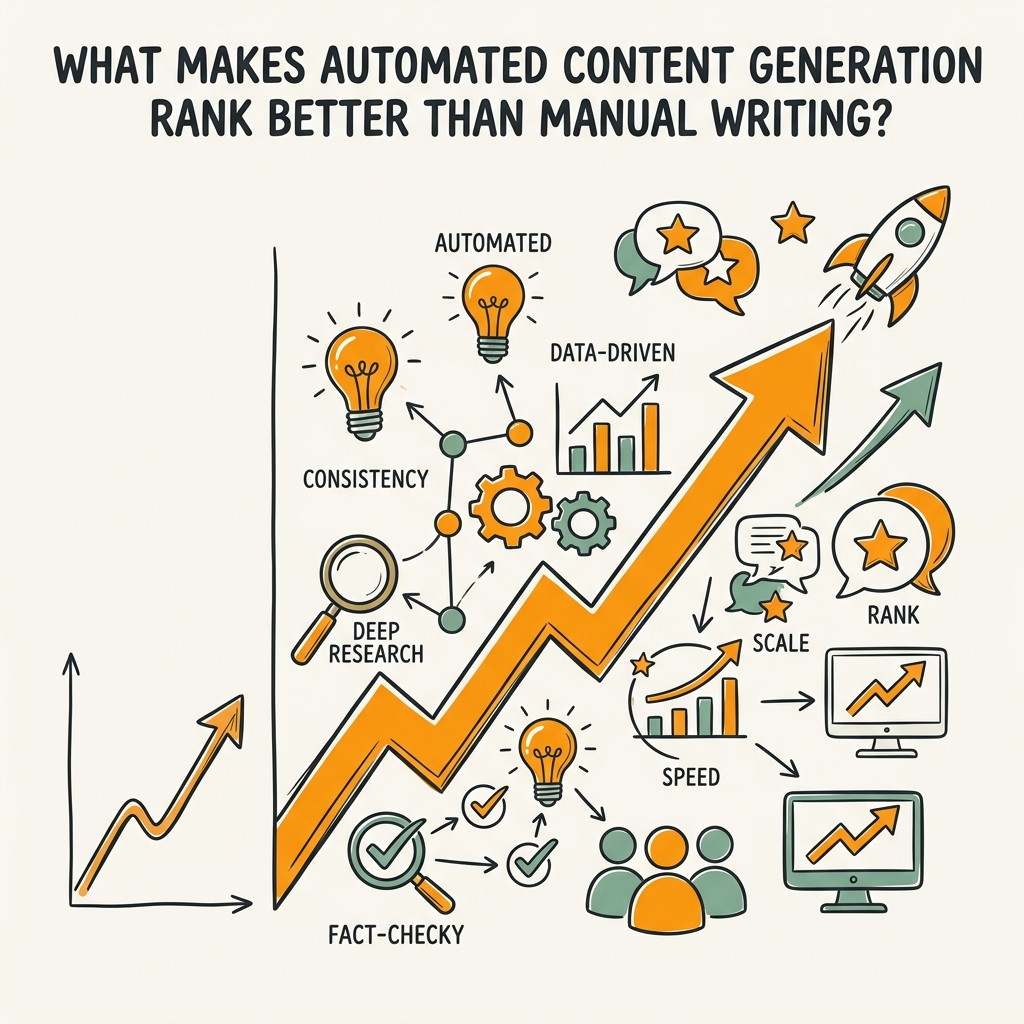
The myth that AI-written content can't rank is dead. In 2026, the highest-ranking articles are increasingly written with AI assistance, especially when that AI is fed real-time SERP data. Automated content generation that integrates live competitor analysis, user intent signals, and topical authority strategies ranks better than manually-researched articles because it removes human bottlenecks. Content created with real-time SERP data shows 71.5% faster ranking improvements compared to static research methods.
Real-Time SERP Integration for Rank-Ready Output
The best AI content tools don't just generate from a prompt. They analyze the top 10 ranking pages for your target keyword, extract the structure, tone, and content depth that Google rewards, then use that as the blueprint for your article. This is called SERP-driven content generation, and it's the difference between "content I wrote" and "content Google will rank."
Tools like Surfer SEO and Clearscope pioneered this approach. But tools like Jottler take it further: the AI doesn't just analyze the top 10 results. It analyzes 14+ sources, fact-checks claims against authoritative sources, builds an internal linking strategy, and structures the article for both traditional search and AI answer engines (AEO). One AI system handles all of itresearch, writing, optimization, and publishing.
Scaling Content Without Scaling Headcount
The bottleneck for most growing companies isn't "can we write content?" It's "can we write enough content consistently?" Manual teams publish one 2,000-word article per week. AI-native teams publish 3–5 per day without sacrificing quality. That 15–25x output increase compounds into dominant topical authority within months.
But volume without strategy is noise. The real win is consistency: every article is optimized for rank, fact-checked, internally linked, and published on schedule. A strong content marketing framework ensures every piece serves your organic growth strategy. Jottler achieves this by operating 12 AI agents in parallelone for keyword research, one for deep research, one for writing, one for fact-checking, one for internal linkingall coordinated into a single publishing pipeline. That's industrial-scale content production, not manual writing.
How Does AI-Powered Fact-Checking Protect Your Rankings?
Inaccurate content tanks rankings. Google's core updates increasingly penalize sites with factual errors, especially in EEAT-sensitive categories like health, finance, and B2B software. Manual fact-checking is slow: writers verify claims one at a time, often using outdated sources. AI fact-checking runs in parallel, cross-referencing every major claim against 10+ authoritative sources simultaneously. 43% more top-3 rankings occur when AI authority signals are properly implemented, and fact-checking is the hidden pillar of those signals.
Parallel Verification Against Multiple Sources
When Jottler's fact-checking agent encounters a claim like "AI SEO adoption grew 45% in 2025," it doesn't stop at one source. It queries Semrush, Ahrefs, Saffron Edge, Ahrefs, and 10+ other authoritative SEO data sources. If the claim is supported, it stays. If sources conflict, the system flags it for human review or rewrites the claim to reflect consensus. This process takes seconds per article, not hours.
The downstream benefit: your site becomes trusted by both Google's ranking algorithms and your readers. Trust signals compound into topical authority, which compounds into more traffic from fewer articles.
EEAT Signals and Brand Authority
Google's E-E-A-T framework (Experience, Expertise, Authoritativeness, Trustworthiness) is the invisible hand ranking modern content. Factually accurate content with proper source attribution is the easiest way to signal trustworthiness at scale. When every claim is verified and cited, your site sends one consistent signal: "This content is reliable."
This matters especially for competitive niches. In B2B software, healthcare, or finance, a single inaccurate claim can trigger a manual review or algorithmic penalty. AI fact-checking prevents that risk entirely. It's not just about ranking higherit's about ranking safely.
What Role Does Smart Internal Linking Play in Topical Authority?
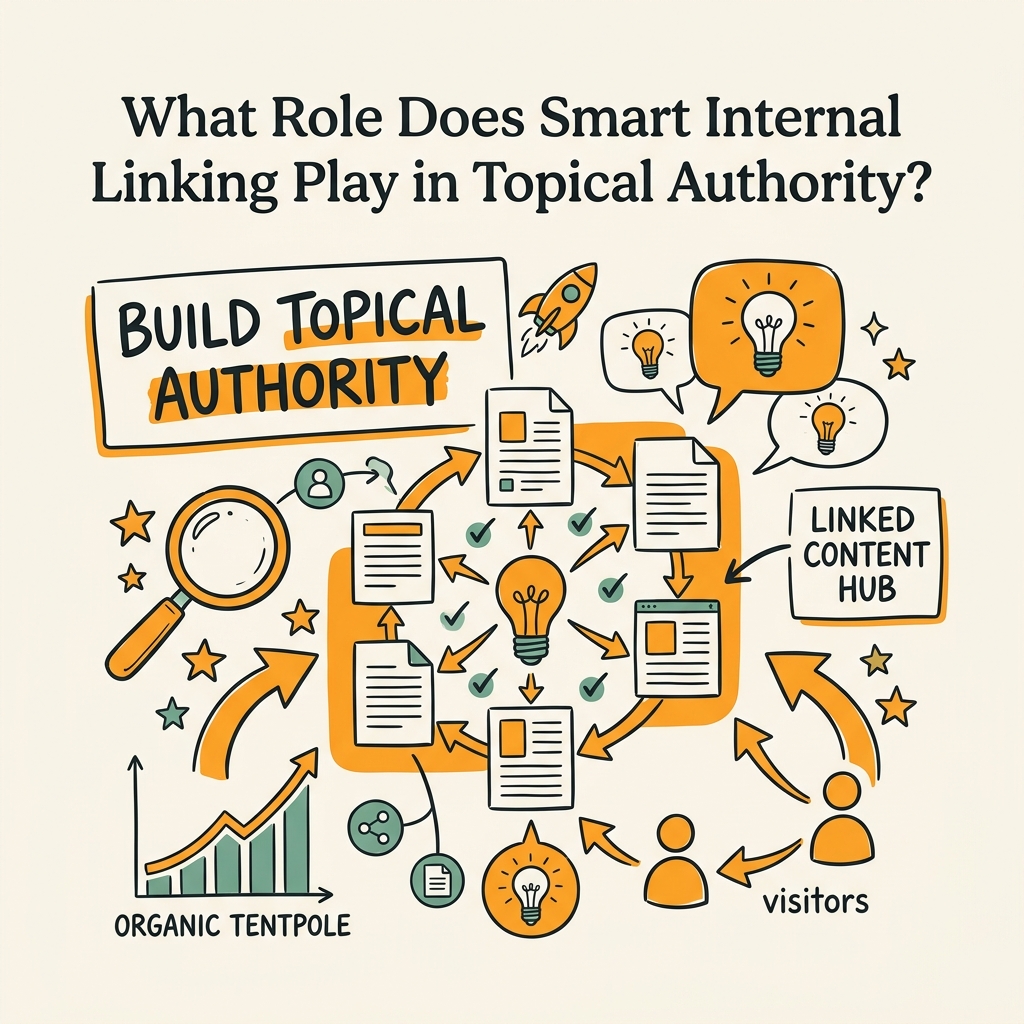
Internal linking is the engine of organic compounding. Each link passes authority from high-traffic pages to related content, building topical clusters that Google rewards with higher rankings and broader SERP visibility. Yet most teams link manually or randomly. AI internal linking maps your entire content library, identifies thematic clusters, and suggests contextual links automatically. Sites with strategic internal linking see 49.2% higher ranking boosts compared to unlinked content.
Building Topical Clusters Automatically
A topical cluster is a hub page (broad topic) surrounded by pillar pages (deeper subtopics), all linked together to signal to Google that you own that topic. Building clusters manually requires mapping hundreds of pages, which most teams never finish. AI does this in one pass.
Jottler's internal linking agent analyzes all your published content, identifies natural topic groups, determines which articles are "hub-worthy" (broad, authoritative), and which are "pillar-worthy" (deep, specific), then generates contextual link suggestions for writers. This turns every new article into a building block of topical authority instead of a standalone piece.
Contextual Linking That Serves Readers
Smart internal links aren't forced. They're contextual: placed where a reader naturally needs supporting information. An article about "AI SEO tools for SaaS" links to your guide on "how to use AI keyword research," not to an unrelated article about link building. This serves both users (better article experience) and Google (clearer topic relationships).
The system knows this because it analyzes user intent and content similarity. Over time, as your internal link network grows denser and more sophisticated, your site becomes harder for competitors to outrank. New articles slot into existing clusters and inherit authority from day one.
How Does AI Search Visibility Tracking Keep You Competitive?
Traditional SEO metricsranking position, click-through rate, organic trafficare no longer the whole story. In 2026, your content appears in Google Overviews, ChatGPT, Perplexity, and emerging AI search engines. If you're only tracking Google rankings, you're missing 30–40% of your visibility. AI search visibility tracking monitors your brand presence across all these platforms simultaneously. AI search traffic grew 527% from January to May 2025, and the platforms are only getting more sophisticated.
Multi-Platform Discovery Monitoring
Your article might lose 30% of Google traffic due to AI Overview placement, but gain 15% from Perplexity citations and 10% from ChatGPT references. Traditional analytics miss this because they only track Google. Modern AI SEO platforms monitor presence across Google, ChatGPT, Perplexity, Grok, Claude, and emerging platforms.
This matters because the dynamics are different. Google Overviews cite 76% of their content from the top 10 organic results, so ranking first still matters. But ChatGPT and Perplexity build summaries from many sources, prioritizing authority and recency. Being in the top 10 on Google gets you into Overviews, but standing out in ChatGPT requires different signals: brand mentions, unique insights, recent publish dates.
Predicting Discovery Shifts Before They Happen
AI search visibility tracking surfaces trends months before they affect your traffic. If Perplexity is trending upward in your niche and your visibility there is lagging, you know to invest in authority building and recent content refreshes. If Claude traffic spikes, it signals that long-form, nuanced content is suddenly more discoverable.
This predictive layer transforms SEO from reactive (we lost traffic, what happened?) to proactive (we see a trend emerging, let's optimize for it now). Teams using AI visibility tracking report 20–30% faster response time to search behavior shifts.
Comparison: AI SEO Tools and Approaches
| AI SEO Feature | Manual Approach | AI-Assisted (Point Tools) | Full AI Automation (Jottler) |
|---|---|---|---|
| Keyword Research | 40 hours/month, outdated data | 8 hours/month with tools like Semrush | Continuous, real-time updates integrated into workflow |
| Content Creation | 40-80 hours/month per article | 10-15 hours with AI writing tools | 2-3 hours for full research, write, optimize, publish cycle |
| Fact-Checking | 5-10 hours per article (manual) | 30 minutes per article (manual tools) | Automated, parallel verification against 10+ sources |
| Internal Linking | Manual spreadsheet mapping (weeks) | Tool suggestions, manual placement | Automatic cluster mapping and contextual placement |
| Publishing Frequency | 1 article/week | 2-3 articles/week | 3-5+ articles/day |
| Consistency & Quality | Variable, human error prone | Improved, still requires oversight | Standardized, auto-verified across all content |
The difference isn't just speed. It's systematic compounding. Manual teams publish one piece, optimize manually, hope it ranks. Full AI automation publishes multiple pieces daily, each fact-checked, internally linked, and optimized for search intent before humans even review it. Over a year, that's 365+ compounding assets vs. 50. The growth math is fundamentally different.
Why AI SEO Adoption Separates Leaders from the Pack
The fundamental advantage of AI SEO isn't that it's cheaper or faster (though it is both). It's that it removes the human bottleneck. Humans can't review 10 sources simultaneously. Humans can't build topical clusters across 500 pages in an afternoon. Humans can't publish 3 articles daily and maintain quality. But AI can do all of this in the background while your team focuses on strategy, not execution.
This is why 63% of businesses report positive organic traffic impact from AI features. They're not using AI to replace writers. They're using AI to operate their content machine at the speed their strategy demands. Your content ideas compound faster. Your authority builds faster. Your organic traffic grows faster.
The paradox: teams that adopt AI SEO earlier get a 12–24 month head start on their competitors, building topical authority that becomes nearly impossible to overtake. By the time competitors catch up, you're already dominant in your niche.
Conclusion
Essential AI SEO featureskeyword research automation, real-time content generation, fact-checking, internal linking, and multi-platform visibility trackingare no longer optional. They're the baseline for competitive organic growth. Companies using AI for SEO achieve 70% higher organic traffic growth, and AI-optimized content ranks 49.2% faster than manually-optimized alternatives. The question isn't whether to adopt AI SEO; it's whether you can afford to wait.
The most successful approach combines these features into a single, coordinated system. Rather than juggling five different tools (keyword research, writing, fact-checking, linking, publishing), one unified AI engine automates the entire workflow daily. This is what Jottler deliversautonomous content production that compounds your organic authority while you focus on what matters: your core business.
Start your SEO agent today and watch organic growth accelerate. Most founders spend months building their first piece of topical authority. Jottler does it in weeks.
FAQs
What AI SEO features matter most for organic growth?
The most impactful features are keyword research automation, real-time content generation from SERP data, and smart internal linking. Keyword research identifies what to write about. SERP-driven content generation ensures you write what Google rewards. Internal linking builds topical authority that compounds over time. Together, these three features account for 70–80% of organic traffic gains in growing companies. Fact-checking and visibility tracking are also critical but secondary.
Can AI-generated SEO content actually rank on Google?
Absolutely. AI-generated content ranks better than average when optimized correctly. The key is real-time SERP analysis: AI that reads the top-ranking pages, understands what structure and depth Google rewards, then generates content that meets or exceeds those standards. Content created with SERP-driven AI shows 71.5% faster ranking improvements compared to traditional manual research. The challenge is quality controlnot all AI content is verified or fact-checked. That's why systems that include automated fact-checking and source attribution outperform tools that just generate text.
How much time does AI SEO automation actually save?
Manual keyword research: 40 hours per month. AI-assisted: 8 hours. Fully automated: 0 hours (runs in the background). Manual content creation: 40–80 hours per article. AI-assisted writing: 10–15 hours. Fully automated with fact-checking and publishing: 1–2 hours of human review. The gap compounds dramatically. A team publishing manually creates 50 articles per year. A team with full AI automation creates 1,000+. That's a 20x productivity multiplier on the same headcount, which directly drives organic growth.