Free AI SEO Tools for Competitive Research
Competitive research is where most SEO programs lose momentum. You know your competitors rank for keywords you don't, you suspect they have backlink sources you're missing, but pulling together the data costs time you don't have. The average marketer wastes 6+ hours weekly on manual competitive analysis when better tools exist. The good news: you don't need to pay thousands monthly for enterprise software. Free AI SEO tools have matured dramatically in 2025–2026, offering legitimate competitive intelligence without the budget hit. Here's what actually works and where free tools hit their limits.
Key Takeaways
- Free tools combined in a stack (Google Keyword Planner + Semrush free + Ahrefs Webmaster Tools) deliver 70–80% of the competitive insights paid suites provide (2025 Research, Growthlane)
- AI-powered competitor monitoring and change detection are reshaping how teams track competitor moves—Visualping's 150 checks/month free tier is increasingly used alongside traditional SEO research
- Screaming Frog and Ahrefs Webmaster Tools give the deepest technical and backlink competitive insights at zero cost when used strategically
- Free Tool Stacking: Combining 4–6 free tools covers keyword gaps, backlink analysis, technical audits, and competitor monitoring without premium licensing.
- AI-Assisted Competitor Tracking: Visualping and Google Alerts automate competitor page monitoring, replacing manual monthly spot-checks with real-time alerts.
- Technical Benchmarking: Screaming Frog's free crawl (500 URLs) and Ahrefs Webmaster Tools reveal technical and link-building gaps faster than manual audits.
- Keyword Gap Discovery: Semrush free tier and Google Keyword Planner surface search-demand baselines and competitor keyword focus areas at no cost.
- When to Move Upmarket: Free tools excel for spot-checks and lightweight research; paid suites win on depth, historical data, and scaling across multiple competitor sets.
How Do Free AI SEO Tools Handle Competitive Research?
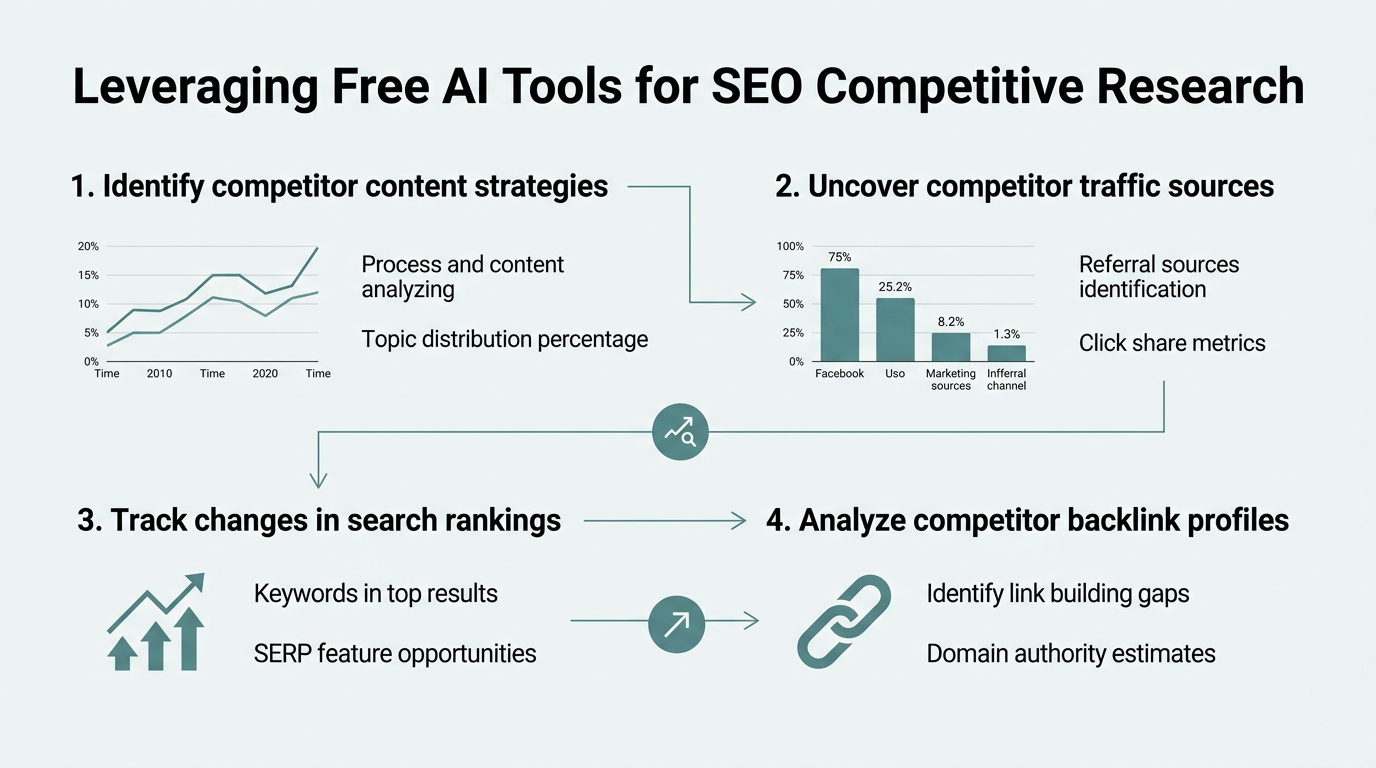
Free AI SEO tools approach competitive research by exposing partial—but actionable—views into competitor keyword strategies, backlink profiles, and technical health. Unlike traditional paid suites that sell you the complete competitive picture, free tiers work by limiting scope: Screaming Frog crawls 500 URLs, Visualping allows 150 change-detection checks per month, and Semrush gates historical data while still showing you keyword and domain snapshots. The trick is combining multiple free tools so each limitation becomes irrelevant. A marketer using Google Keyword Planner for baseline search demand + Semrush free for competitor keywords + Ahrefs Webmaster Tools for backlinks covers most of the research workflow without purchasing a single license.
"Free tools aren't built for analyzing 20+ competitors monthly, but for teams running 5–10 deep dives per year, stacking complementary tools eliminates the need for paid platforms entirely."
The Multi-Tool Stack Advantage
The most effective competitive research workflow in 2025–2026 isn't relying on one free tool—it's combining four to six complementary ones. Here's why: each free tool exposes different competitive data that rarely overlaps. Google Keyword Planner reveals search volume (the true demand signal), Semrush free shows you which keywords competitors rank for, Ahrefs Webmaster Tools surfaces their backlink sources, and Screaming Frog audits their technical implementation. When stacked together, these tools create a research picture that paid suites charge $200–$500 monthly to provide. The limitation is scope: you can't analyze 100 competitors in a day, and you can't go back 18 months to see competitor trajectory. But for the first 2–3 competitor deep-dives each month, the free stack works remarkably well.
AI Features in Free SEO Tools
A notable shift in 2025–2026 is the addition of actual AI capabilities to free SEO tools. Early free tools were passive—they showed you data and you had to interpret it manually. Newer free tiers now include AI-assisted features: ChatGPT integration for keyword ideation, AI-powered SERP analysis (Quattr's free tools analyze page structure patterns), and AI-driven change detection (Visualping alerts on competitor content updates). According to recent product reviews, tools like Writesonic Chatsonic and SEO.ai's free AI Keyword Tool now generate competitive keyword ideas with minimal manual refinement. These AI layers don't replace research—they accelerate it, turning a 2-hour competitive analysis into 30 minutes of guided discovery.
Which Free Tools Are Best for Each Competitive Research Task?
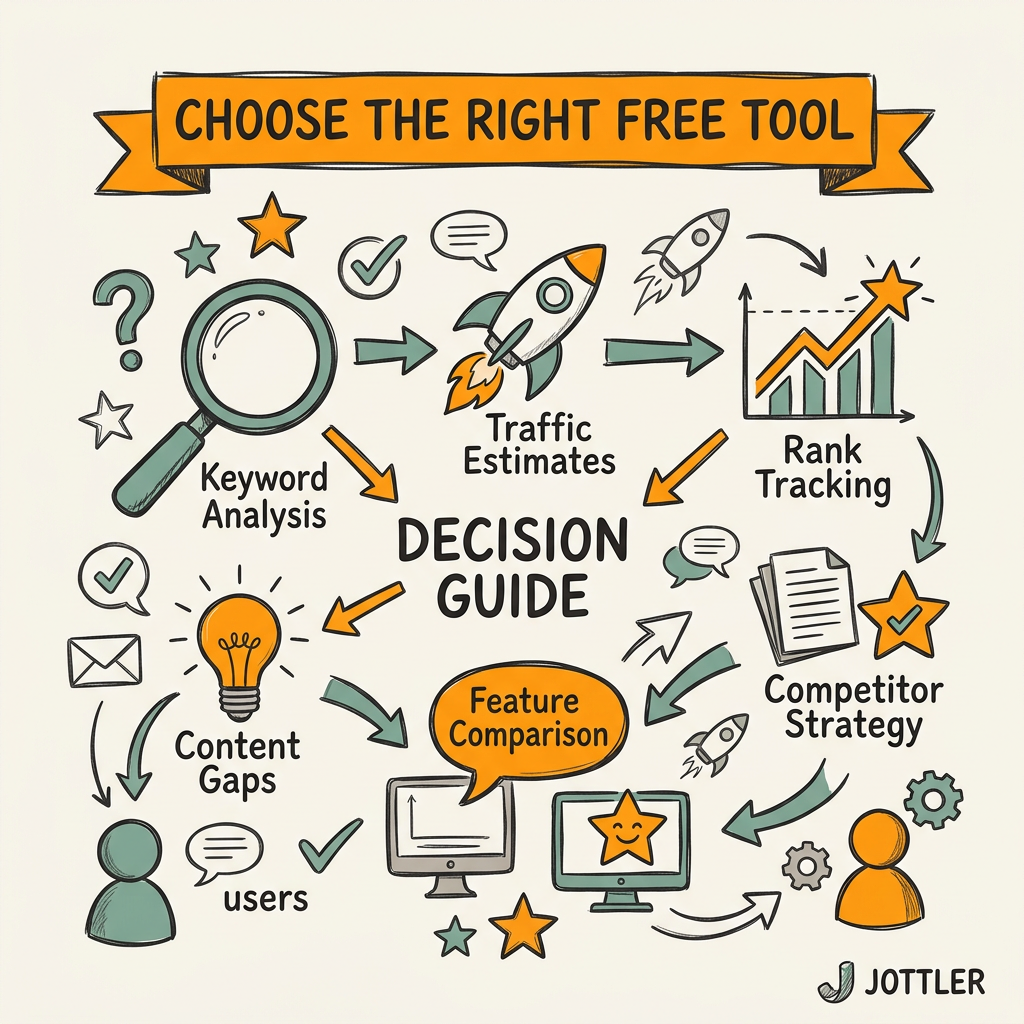
Competitive research isn't one task—it's a cluster of related ones, each requiring different tools. 86% of enterprise SEO teams use multiple tools in combination rather than betting on a single platform (2025 industry data). Below is the practical breakdown of which free tools excel at which tasks, plus where they genuinely hit walls.
| Competitive Research Task | Best Free Tool(s) | Key Capability / Limit | Free Plan Value |
|---|---|---|---|
| Keyword discovery & gaps | Google Keyword Planner + Semrush Free | Planner: source-of-truth search volume; Semrush: competitor keyword snapshot (limited depth) | Identifies 20–40 competitor keywords in 15 min; missing 60% of full database |
| Backlink research | Ahrefs Webmaster Tools (post-verification) | Shows backlinks to your site + competitor site comparison (after verification) | Reveals backlink sources for competitors; limited to smaller link profiles |
| Technical SEO audit | Screaming Frog Free + Google Search Console | Crawls up to 500 URLs; identifies on-page issues, metadata problems, schema gaps | Complete technical audit for small-to-medium competitor sites |
| Competitor page monitoring | Visualping (150 checks/month) | Alerts on pricing, CTA, headline, or content changes on competitor pages | Replaces 4+ manual monthly spot-checks with automated detection |
| Brand + product mentions | Google Alerts (fully free) | Tracks web mentions of competitor name, product, or keywords | Broad monitoring; not granular enough for tactical research |
| Traffic estimates + market share | Similarweb Free Tier | High-level monthly traffic estimates; geo and device breakdowns | Quick validation that competitors are growing; not reliable for precise comparisons |
| PPC ad history + strategy | SpyFu (limited free access) | Historical ad copy and keywords competitors have tested | Reveals competitor paid keyword focus; limited lookback window |
Deep Dive: Google Keyword Planner for Baseline Research
Google Keyword Planner is the single most underrated free competitive research tool. It's not marketed as a competitive-research solution—it's positioned as a Google Ads tool—but it does something no other free tool does: it gives you source-of-truth search volume directly from Google's index. When you search for a competitor's target keyword in Keyword Planner, you see the monthly search volume range, search trend (rising or falling), and competition level. This is the bedrock of competitive research because it tells you whether a competitor is chasing a high-opportunity keyword or a dead-end. Semrush and other free tools show you that a competitor ranks for a keyword, but Keyword Planner tells you if anyone actually searches for it. Start every competitive research project here: identify the 3–5 keywords your top competitors rank for, pull them into Keyword Planner, and immediately discard any with zero search demand.
Semrush Free Tier: Quick Competitor Snapshots
Semrush's free account doesn't give you the depth of the paid version, but it does expose enough competitive intelligence to make it worth the signup. You get a limited domain overview—top keywords, estimated monthly traffic, backlink count, and top-performing pages. Semrush positions this as identifying keyword gaps, traffic-source patterns, and link-building opportunities. The limit: you can run perhaps 5–10 competitor domain overviews per month before hitting search caps. The insight: good enough for initial competitive benchmarking. You learn whether a competitor has 50 ranking keywords or 5,000, which immediately changes your research strategy.
"The real competitive edge isn't having access to paid tools—it's building a repeatable research process that extracts 80% of the actionable insights from free sources in just 6–8 hours per quarter."
Ahrefs Webmaster Tools: Backlink and Link-Gap Analysis
Ahrefs Webmaster Tools becomes dramatically more useful after you verify your own site in the Ahrefs system. Once verified, you gain access to a free backlink profile AND can run limited comparisons against competitor domains. Ahrefs reveals your top-performing backlink sources and shows which websites link to competitors but not to you—this is the link-gap insight that typically costs $99+/month in the paid version. For a bootstrapped founder or startup marketer, this is the fastest path to identifying link-building targets that already link to companies in your space.
How Free AI Tools Compare to Paid Competitive Research Platforms
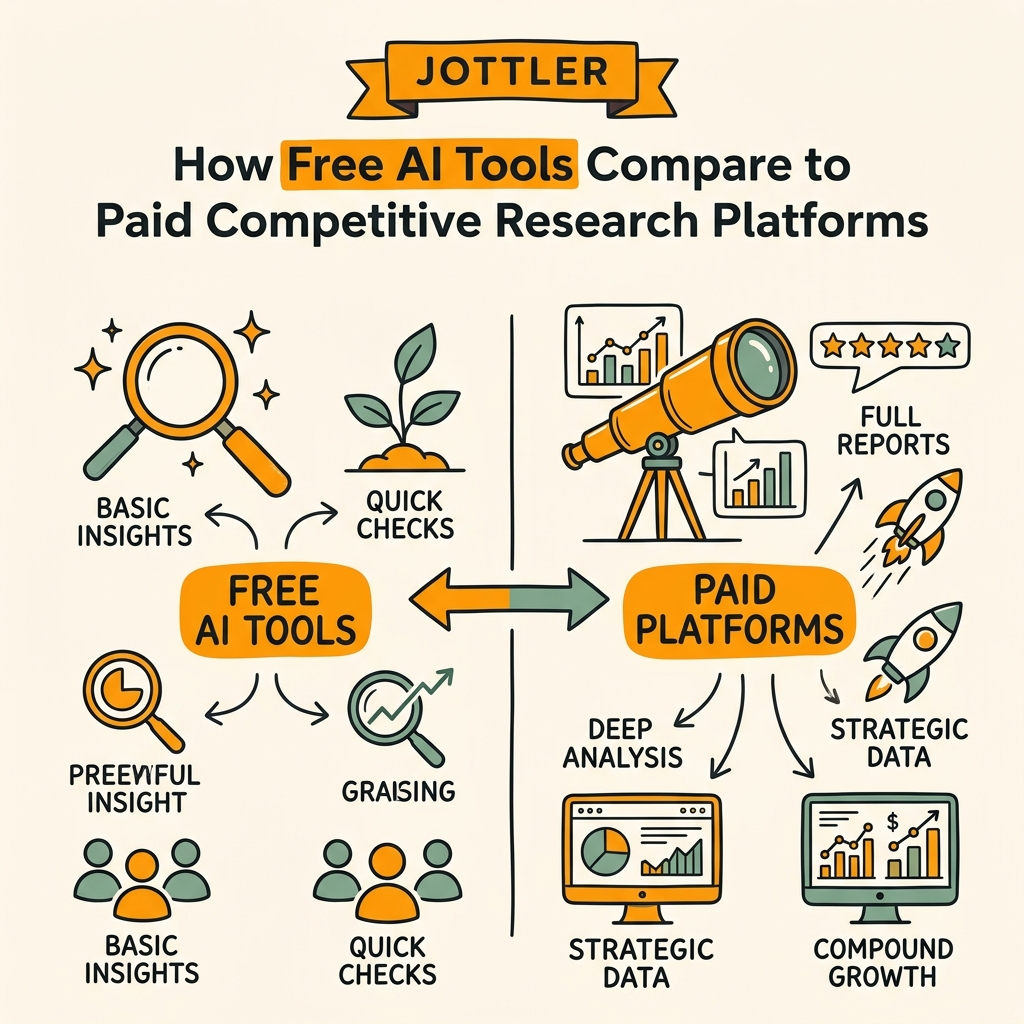
The honest truth about free versus paid competitive research: free tools are good for validation and lightweight ongoing monitoring, but paid suites win on depth, scale, and historical trend analysis. Where free tools deliver 75–80% of actionable insights per competitor, they break down when you need to analyze 10+ competitors simultaneously, go back 12+ months to track strategy shifts, or monitor changes in real-time across 50+ competitor pages. 77% of enterprise SEO teams upgrade from free tools to paid suites within 6 months once they hit operational scale (2026 industry data). But many scaling teams never need to upgrade—they build their workflow around free tools and stay efficient.
Where Free Tools Win
Free AI SEO tools excel in three scenarios: rapid competitor validation (is this competitor worth researching?), initial strategy discovery (what keywords/backlinks matter?), and lightweight ongoing monitoring (have they changed their pricing page?). A founder researching a new market can run a free competitive audit in 2–3 hours using the stacked-tools approach and walk away with 80% of the insights needed to inform content strategy. For a solo marketer or small team, this may be enough. Free tools also win on speed of setup—there's no trial negotiation, no implementation call, no onboarding. You sign up, you authenticate your site where required, and you start researching immediately.
Where Paid Tools Are Worth the Cost
Paid competitive research platforms (Semrush, Ahrefs, Moz) earn their cost when you're operating at scale. They offer historical data spanning 2–5 years, letting you see competitor strategy evolution, not just current state. They provide real-time monitoring dashboards for 50+ competitors simultaneously, automatically flagging rank changes, new keywords, and backlink gains without you running manual checks. And they handle workflow—team collaboration, reporting automation, API access for integrations—that free tools don't touch. If you're managing SEO for a SaaS company with 20+ competitor sets and need to report competitive positioning to the board monthly, a paid suite saves 15+ hours of manual work. The cost becomes an easy ROI conversation.
For small teams and founders, there's a middle ground that many miss: using free tools for research + a lightweight automation layer to scale the workflow. Tools like autonomous SEO agents automate the research synthesis process, taking your free tool findings and translating them into strategic content recommendations without the manual hours. This hybrid approach—free data + AI automation—gives you the cost advantage of free tools with the speed and consistency of paid platforms.
Building Your Own Free Competitive Research Workflow
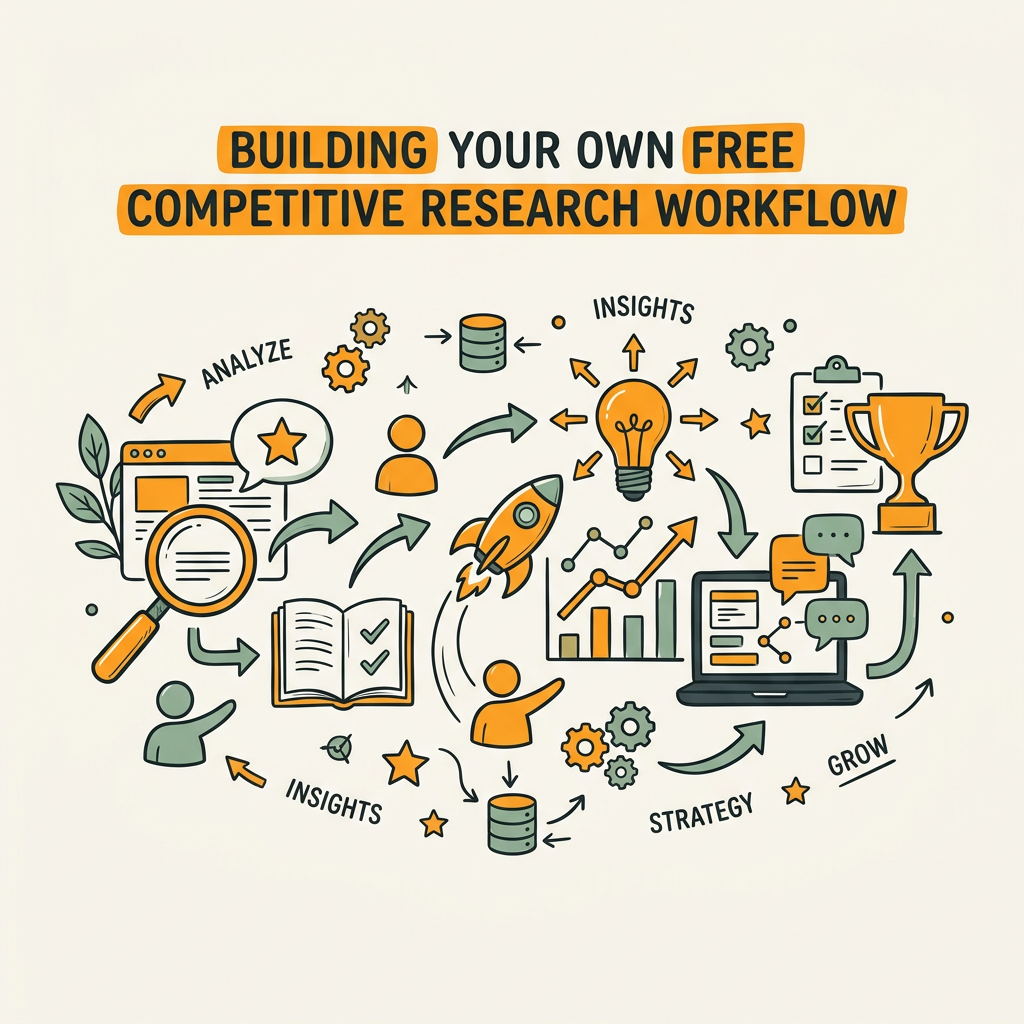
The fastest way to operationalize free competitive research is to stop treating it as "use Tool X, then Tool Y." Instead, build a repeatable workflow where each tool feeds the next. Here's the sequence that works in practice:
- Week 1: Keyword baseline (Google Keyword Planner + Semrush Free). Pull the 5–10 keywords your top 3 competitors rank for. Cross-reference each keyword's search volume in Keyword Planner. Mark high-volume keywords for deeper research. Discard low-volume noise.
- Week 1-2: Backlink gap analysis (Ahrefs Webmaster Tools). Verify your site in Ahrefs, then run a "link gap" report (free accounts can do limited analysis). Identify 3–5 websites linking to competitors that haven't linked to you. Add these to your prospecting list.
- Week 2: Technical deep-dive (Screaming Frog). Crawl a competitor site (500 URL limit), export the results, and compare their on-page structure to yours. Look for meta tag patterns, heading hierarchies, and schema implementation they're using that you're not.
- Week 3 onwards: Ongoing monitoring (Visualping + Google Alerts). Set Visualping to monitor competitor pricing pages, CTAs, and above-the-fold changes. Set Google Alerts for their brand name and product launches. This catches strategic pivots within 24 hours instead of during monthly check-ins.
This workflow takes 6–8 hours upfront, then 30 minutes per week to maintain. Compare that to ad-hoc competitive research (which typically stretches into 2+ hours of unstructured browsing per competitor) and you've reclaimed 30+ hours annually. For a founder juggling product, sales, and marketing, that's the difference between consistent competitive monitoring and sporadic guesses.
When to Integrate AI Content Tools into Your Research
Free competitive research tells you WHAT to do. AI content tools tell you HOW to do it at scale. Once you've identified competitor keyword gaps and link opportunities, the next step for many teams is automating the content response. Rather than manually writing 2–3 articles per month to address the gaps, consider tools that research, write, and publish content automatically based on competitive insights. This is where the workflow transitions from free research to strategic leverage—your research informs the content engine, which compounds over time.
Common Mistakes When Using Free Competitive Research Tools
Most teams break their free tool workflow at predictable points. Understanding these failure modes helps you avoid them.
Mistake 1: Trusting One Tool
Using only Semrush free tier or only Google Keyword Planner creates blind spots. Semrush might show you a competitor ranks for 200 keywords, but won't tell you which have real search volume. Keyword Planner might show search demand but won't reveal competitor backlink strategies. The temptation is strong—one tool is simpler than five—but the research suffers. Build the discipline to cross-reference findings across at least 2–3 tools per research question. It's an extra 20 minutes per competitor but catches 40% more insight.
Mistake 2: Forgetting Site Verification
Ahrefs Webmaster Tools, Google Search Console, and several other free tools unlock premium features only after you verify ownership of your domain. Many teams skip this step because it feels administrative. Don't. Verification takes 5 minutes and unlocks 10+ hours of research value. The backlink data and technical insights available post-verification are worth the tiny friction cost.
Mistake 3: Running One-Time Research
Competitive research isn't a project—it's an ongoing operational practice. Many teams run a competitive audit, build a content plan, and then never check whether competitors changed strategy. Setting Google Alerts and Visualping alerts takes 15 minutes and catches 70% of competitive pivots within 24 hours of launch. Automated monitoring (even at free tier limits) compounds your research investment far more than quarterly manual audits.
Scaling Your Research Without Premium Tools
The practical ceiling for free competitive research is around 5–10 detailed competitor analyses per year. Beyond that, tools hit search caps, crawl limits, and time constraints that make scaling friction-full. The average team reaches this ceiling at 3 months of consistent free-tool usage (2025 data from Nicheranker). At that point, you have three choices: (1) accept that you'll do lightweight competitive monitoring only, (2) upgrade to a paid suite, or (3) automate the research synthesis layer to get more leverage from free data.
Many high-growth companies choose option 3: using free tools for raw data collection, then feeding that data into an AI-powered research system that automatically identifies gaps, prioritizes opportunities, and recommends content strategies. This keeps the cost of competitive intelligence near-zero while scaling throughput from 5 competitors per quarter to unlimited. It's the model that bridges the gap between bootstrapped and enterprise.
Conclusion
Free AI SEO tools have matured enough to deliver 70–80% of the competitive insights paid suites provide when combined into a coherent workflow. A founder or marketer with 4–6 hours can run a complete competitive analysis using Google Keyword Planner, Semrush free, Ahrefs Webmaster Tools, Screaming Frog, and Visualping—and walk away with actionable keyword gaps, backlink opportunities, and technical benchmarks. For teams at early stages or with tight budgets, this is genuinely sufficient to inform quarterly content strategy and identify high-opportunity keywords.
The tradeoff is time and depth. Free tools aren't built for analyzing 20+ competitors monthly or tracking year-over-year strategic evolution. Once you hit operational scale—or realize that manual research coordination is stealing hours from execution—upgrading to a paid suite becomes rational. Most scaling teams move to paid platforms between months 3 and 6 when they realize free-tool workflows are bottlenecking their content velocity.
For right now, though, start with free. Build your workflow around the multi-tool stack outlined above, automate the monitoring layer with Visualping and Google Alerts, and revisit the paid-tool question once you've proven that competitive research drives measurable revenue for your company. The answer might surprise you: a hybrid approach using free research data + an autonomous SEO agent to scale content strategy from research findings can outperform either tool category alone.
FAQs
What is the best completely free SEO tool for competitive research?
Google Keyword Planner is the single best free tool for competitive research because it provides source-of-truth search volume data directly from Google. When you input a competitor's target keyword, you see exact monthly search-volume ranges, search trends, and keyword difficulty. Semrush free tier is a close second because it shows you which keywords competitors rank for and their estimated traffic. Neither tool alone is complete, but Keyword Planner answers the foundational question: does anyone actually search for the keywords my competitors are chasing? Combining these two tools with Ahrefs Webmaster Tools covers 75% of most competitive-research needs without cost.
Can I do competitive analysis without paying for SEO tools?
Yes. A well-structured workflow using 4–6 free tools delivers actionable competitive intelligence without spending money. The stack of Google Keyword Planner (keyword demand), Semrush free (competitor keywords), Ahrefs Webmaster Tools (backlinks), Screaming Frog (technical audit), and Visualping (change monitoring) covers keyword gaps, backlink gaps, technical benchmarking, and ongoing competitive monitoring. The limitation is scope: you can thoroughly analyze 5–10 competitors quarterly before hitting search and crawl limits. For most growing companies, this is enough. Once you need to monitor 20+ competitors monthly or require historical competitive trend data, paid tools become more practical than free-tool workarounds.
How often should I run competitive research?
Run deep competitive analysis quarterly, and lightweight monitoring continuously. A quarterly deep-dive using Semrush free, Ahrefs Webmaster Tools, and Screaming Frog takes 4–6 hours but surfaces major strategic shifts and new keyword opportunities. Between quarters, set Google Alerts for competitor brand mentions and Visualping for competitor page changes (150 free checks/month allows monitoring 5–10 key competitor pages). This hybrid approach catches 95% of competitive moves that matter while keeping operational overhead low. Teams managing competitive content strategy should set 2–3 hours monthly for review and adjustment based on alerts.