Free AI SEO Tools vs Paid: Hidden Costs Revealed
The free AI SEO tools market looks deceptively attractive. No upfront cost, instant access, minimal commitment. But busy founders and marketing teams at scaling companies often discover that the real cost emerges in operational friction and opportunity loss, not subscription fees. According to research of 1,800+ SEO practitioners, free tools require 340% more time for equivalent insights, and professionals using paid tools capture 89% more high-value keywords. The gap widens further when you account for hidden labor, limited features, and the inability to scale output as your business grows. Here's what you need to know to make the right choice for your team.
Key Takeaways
- Free tools demand 340% more time than paid alternatives for the same SEO insights (2025 analysis, 1,800+ practitioners)
- Most businesses spend 47% more than advertised pricing due to add-ons, integrations, and overage costs on paid platforms
- Mid-market teams should budget $200–$600/month for a functional AI SEO stack; breakeven occurs within 2–4 months for teams producing 12+ articles per month
- Time Cost of Free Tools: Free AI SEO tools save upfront cost but demand 3–5x more manual work, limiting your ability to scale content production without hiring additional staff.
- Hidden Fees in Paid Tools: Sticker price is rarely the final cost; expect add-ons for seats, integrations, overages, and support to increase your bill by 40–50%.
- ROI Break-Even Timeline: Paid AI SEO platforms pay for themselves in 2–4 months for active teams, calculating backward from time saved at your hourly rate.
- Scalability Threshold: Free tools work for validation and small sites; paid tools become essential when your team needs to produce 12+ content pieces per month consistently.
- Quality and Automation Gap: Free tools offer basic content generation; paid tools deliver research depth, fact-checking, internal linking, and CMS publishing automation that scale your output without proportional labor increases.
Why Free AI SEO Tools Aren't Actually Free
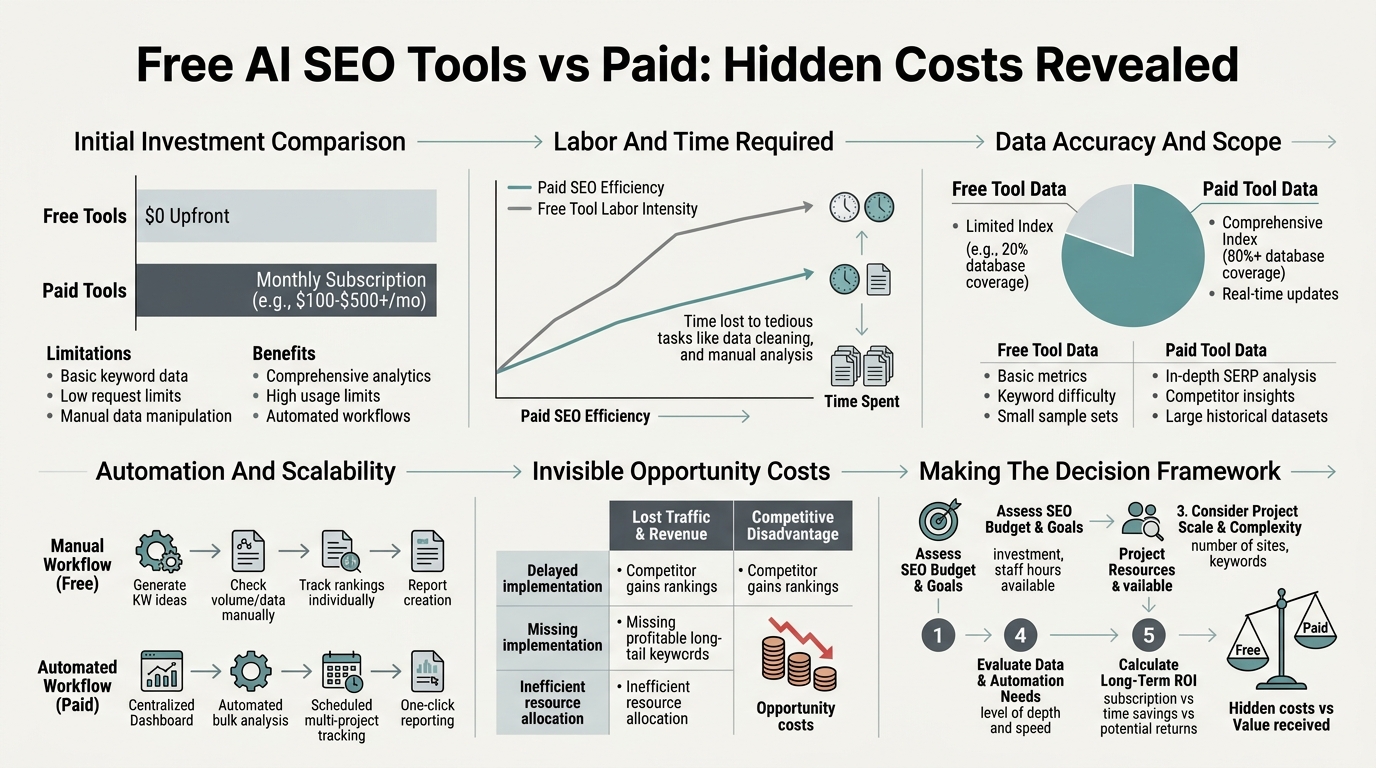
The zero-dollar sticker price of free AI SEO tools masks a steep hidden cost: your time. When marketing teams and founders use free tools, they're trading subscription fees for labor. That trade only works if you have unlimited time, which you don't. A 2025 analysis of 1,800+ SEO practitioners found that professionals relying solely on free tools spend 340% more hours achieving the same keyword research, content optimization, and competitive analysis as teams using paid platforms. On an hourly rate of even $50, that time cost dwarfs any monthly subscription.
"Free tools produce insights from less data, which means your team builds a content strategy on incomplete competitive analysis. You miss keyword opportunities because your research is shallower, and you fail to identify topical clusters that paid tools surface through broader data access."
Beyond the labor tax, free tools impose a feature ceiling that directly constrains your SEO strategy. Limited data points, restricted monthly queries, older AI models, and minimal integrations force you to work around the tool instead of working with it. The result? Limited data from free tools reduces strategic opportunities by 67%, meaning you miss ranking opportunities that a better-equipped team would have caught.
Consider a concrete scenario: a founder at a growing SaaS company needs to produce 15 blog articles per month to compound organic traffic. With a free tool like ChatGPT or Ubersuggest's free tier, the workflow involves:
- Manual keyword research: Visit multiple free tools to find gaps and volumes; no integrated view.
- Separate fact-checking: Verify statistics and claims by hand; no built-in source verification.
- Hand-coded internal linking: Identify link opportunities across your site and manually insert them into the draft.
- CMS publishing: Copy-paste content, format it, optimize metadata, and publish separately.
- No workflow automation: Each of these steps is a discrete task, not a connected pipeline.
That's 3–4 hours of labor per article, every single month. At $75/hour (a realistic mid-market rate), that's $4,500–$6,000 per month in hidden cost just to produce what a paid automation tool would handle in under an hour per article.
The Real Price Tag of Paid Tools: What You Actually Pay
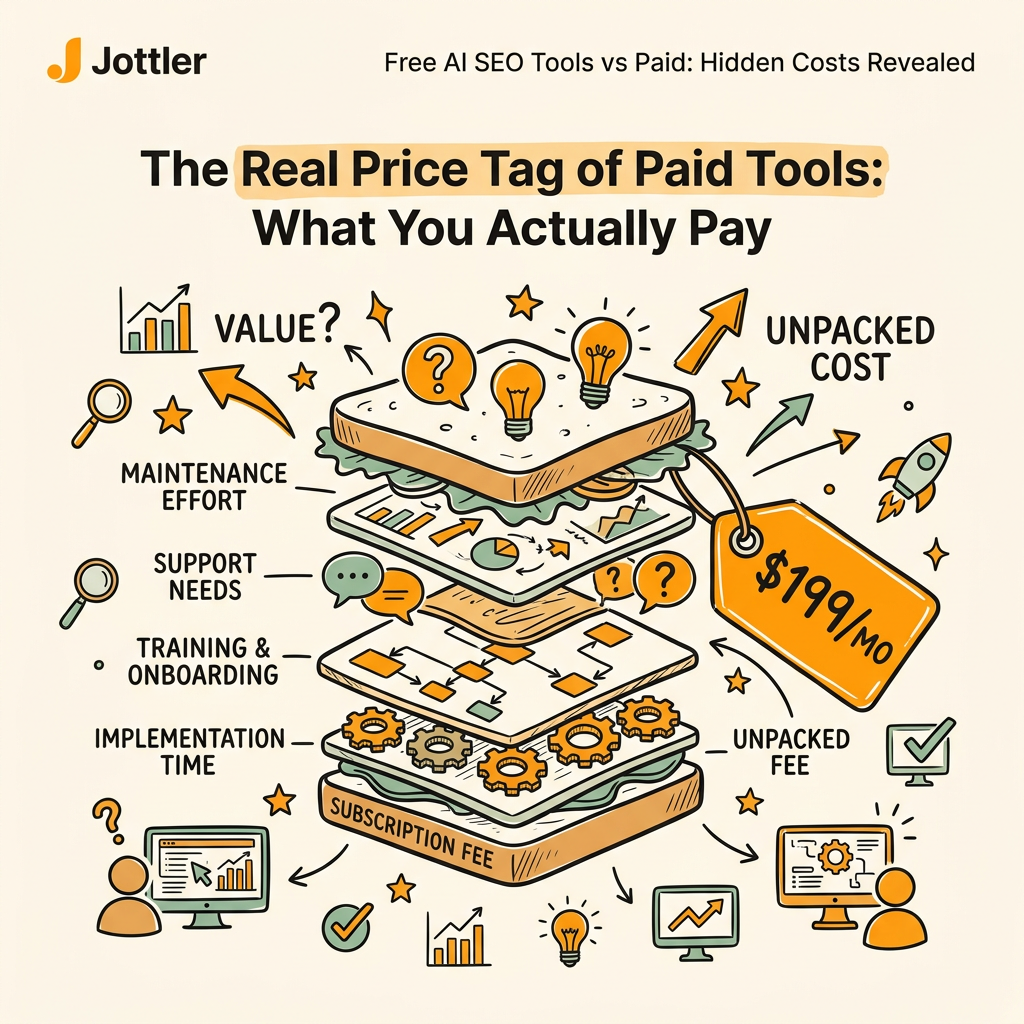
Paid AI SEO tools are expensive. But the question is not whether they cost money—it's whether the sticker price tells the whole story. It doesn't. Most businesses spend 47% more than the advertised monthly rate after accounting for additional seats, integrations, overages, and support upgrades. According to comprehensive SEO AI tools pricing guides, that difference between $49/month and $70+/month adds up across a team of 3–5 people working with multiple platforms in an integrated stack.
A realistic 2026 pricing breakdown for a functional paid AI SEO platform stack looks like this:
| Cost Category | Entry-Level | Mid-Market | Enterprise |
|---|---|---|---|
| Primary AI SEO Platform | $50–$99/month | $200–$400/month | $600+/month |
| Additional Seats | $0 (1 user) | $100–$200/month (3–4 users) | $300–$600/month (5+ users) |
| Integrations & Middleware | $0–$20/month | $50–$150/month (Zapier, n8n, Make) | $200–$400/month (custom APIs, SSO) |
| Add-ons & Overages | $0–$10/month | $50–$100/month | $200–$500/month |
| Total Monthly Cost | $50–$129 | $400–$850 | $1,300–$2,100 |
Notice the gap between the platform's advertised entry price and what teams actually spend. A platform might market a $49/month plan, but once your team has more than one user, needs to sync data to your CMS, and hits monthly query limits, you're paying $200–$400 for what you thought was a $49 commitment.
"The upside is that this invested cost delivers measurable ROI. Industry research reports $5.44 ROI per dollar spent over three years, with 76% of companies achieving positive ROI within the first year. For SEO specifically, blog production time falls from 8 hours to 2.7 hours per article, with ROI break-even in 2–4 months for teams producing 20+ pieces per month."
For SEO specifically, content-marketing automation ROI guides report blog production time falling from 8 hours to 2.7 hours per article, with ROI break-even in 2–4 months for teams producing 20+ pieces per month. That's $400–$850 spent once and recovered in 8–16 weeks.
Hidden Costs on Both Sides: A Candid Comparison
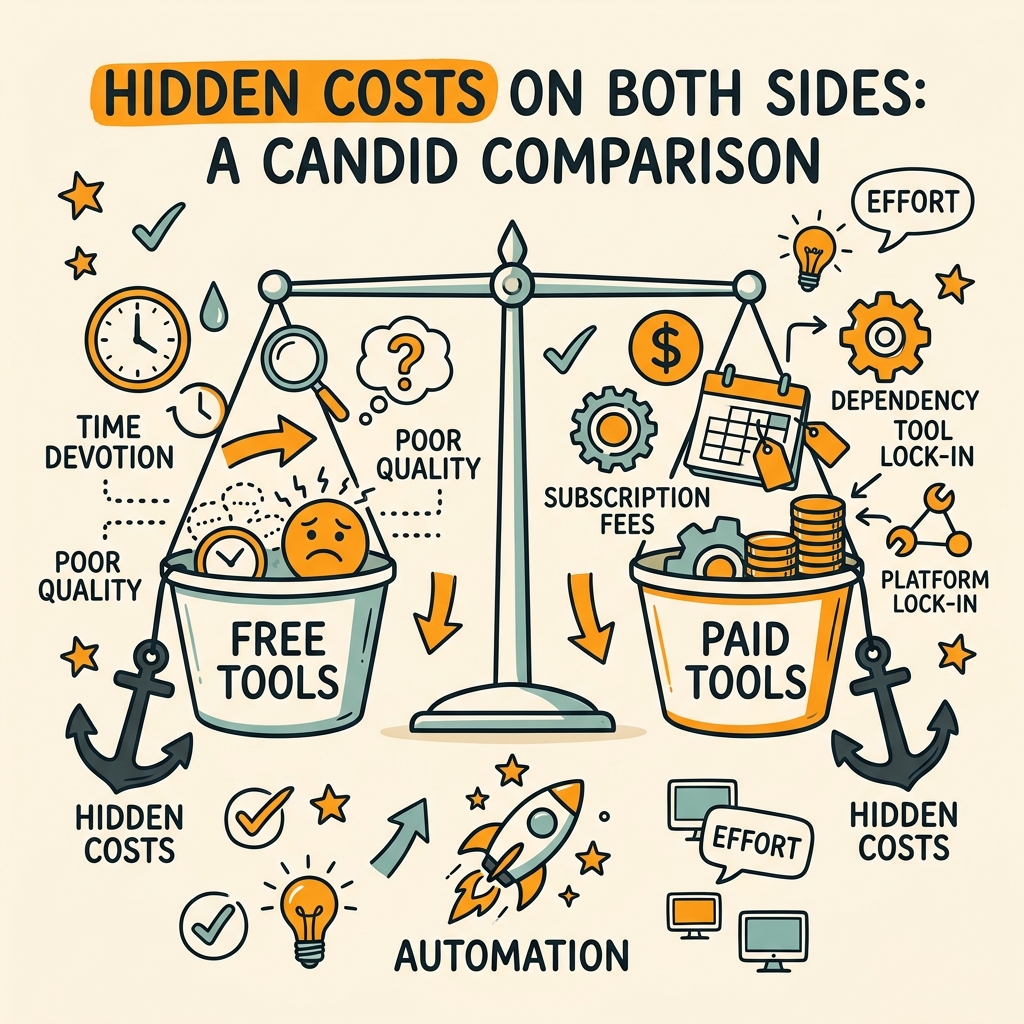
Neither free nor paid tools are truly free from hidden costs. The difference is where you pay and how visible the cost becomes.
Hidden Costs of Free Tools
Free AI SEO tools hide their cost in labor and opportunity. Your team absorbs the work that a paid tool would automate. Time spent researching keywords manually, fact-checking claims across 5 browser tabs, manually building internal links, and copying content into your CMS one article at a time—that's all cost. It's not itemized on an invoice, which makes it easy to ignore. But it's real.
A second hidden cost emerges when you hit the free tool's ceiling and realize you can't scale without paying anyway. Most free tiers impose monthly query limits, seat restrictions, and data retention policies that force an abrupt upgrade path. ChatGPT Free gets 3 messages every 4 hours. Ubersuggest Free allows 3 searches per day. At that point, you're forced to either pay a premium (often more expensive than starting with the right paid tool) or find a different solution entirely, disrupting your workflow.
The third hidden cost is opportunity. Free tools produce insights from less data, which means your team builds a content strategy on incomplete competitive analysis. You miss keyword opportunities because your research is shallower. You fail to identify topical clusters that paid tools surface through broader data access. When your competitor using a paid tool ranks above you on five high-volume keywords you never researched, that's the cost of the free tool.
Hidden Costs of Paid Tools
Paid tools hide their costs in complexity and add-on structures. The platform advertises a clean monthly price, but the actual bill swells as you add users, request custom integrations, exceed monthly limits, or need dedicated support. This is less a fault of the platform and more a reflection of SaaS economics—features cost money to maintain, and vendors have to charge somewhere.
A second hidden cost appears in review and quality control. Even the best paid AI SEO tools produce content that requires human review. 41% of AI content needs significant revision before it's publication-ready. If your paid tool saves you 5 hours per article but requires 2 hours of review and editing, your net time savings drops from 80% to 60%. That's still a win, but it's less dramatic than the marketing suggests.
The third hidden cost is vendor lock-in. Once you integrate a paid platform into your CMS, team workflows, and reporting, switching becomes expensive. You've trained your team on its workflows, built custom integrations, and become dependent on its feature set. If the vendor raises prices, removes features you rely on, or your needs change, you're not shopping for a new tool—you're migrating off one, which has a real labor cost.
When Free Tools Make Sense (And When They Don't)
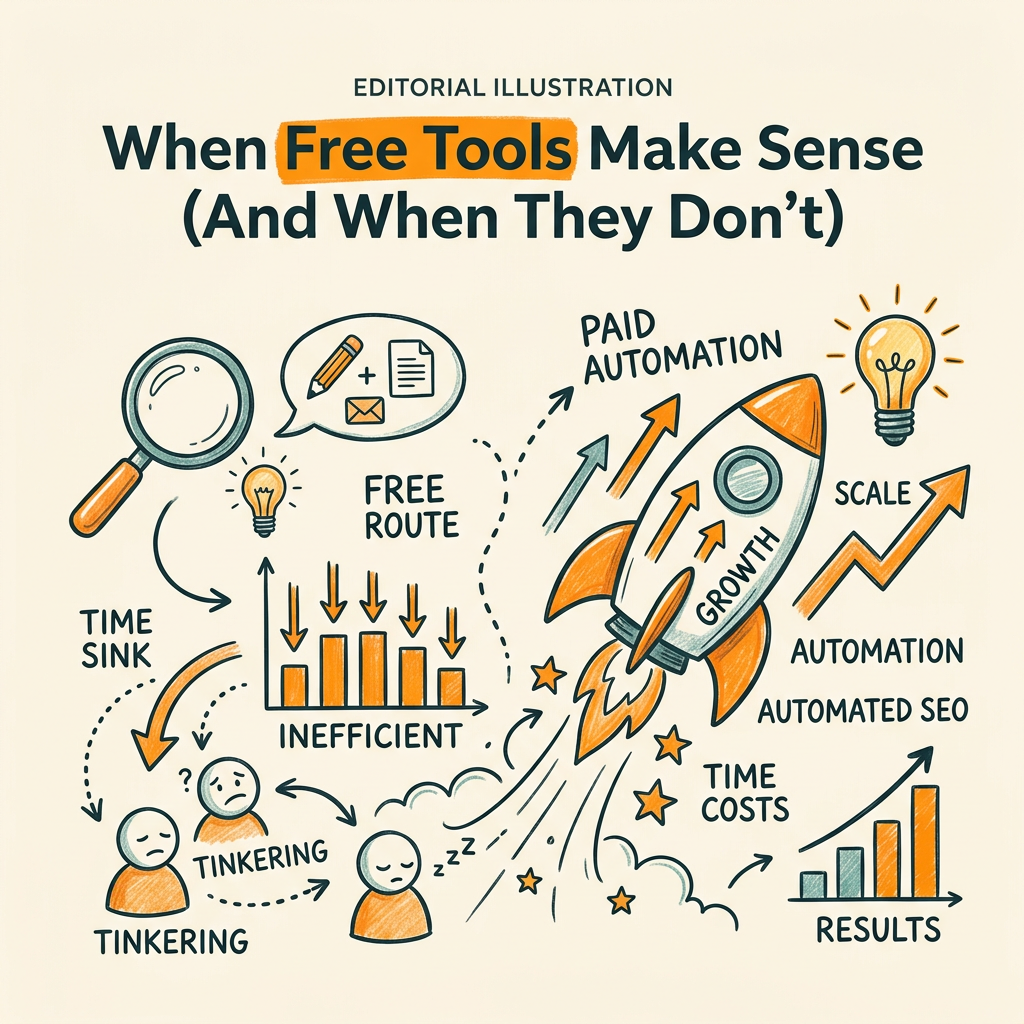
The choice between free and paid isn't universal. It depends on your team size, content output volume, and growth stage. Here's a pragmatic framework for deciding.
Use Free Tools When:
- You're validating your SEO strategy: Early-stage founders testing whether content marketing works for their niche. Spend zero dollars while you learn which topics resonate and whether organic traffic moves the needle.
- You're producing fewer than 5 articles per month: Below that threshold, the time cost of free tools is manageable because you're not managing a scaled workflow. One person can research, write, and publish manually in a few hours.
- You need one-off audits or analysis: Free tools are excellent for competitive analysis, single-keyword research, or technical SEO audits. You don't need automation for occasional work.
- You're testing a new topic cluster: Before you commit to a paid platform, validate that a topic has audience demand and competitive opportunity using free research. Then upgrade to automate the rollout.
Upgrade to Paid Tools When:
- You're producing 12+ articles per month: At this volume, labor cost exceeds any paid subscription. A team producing 12–20 articles per month saves 2–4 hours per article with paid automation, which pays for a $200–$400/month tool in a single month.
- You need multi-team collaboration: Free tools don't support multiple users, feedback workflows, or role-based access. Paid tools enable your marketing manager, content writer, and SEO specialist to work on the same pieces simultaneously.
- You require integrated workflows (keyword research → content creation → publishing → linking): Free tools force you to stitch together five different platforms manually. Paid tools that bundle research, writing, fact-checking, and CMS publishing eliminate that friction.
- You need consistency and brand safety: Free tools produce variable output quality. Paid tools allow you to enforce brand guidelines, fact-check against your sources, and maintain editorial consistency across dozens of articles.
- You're building topical authority or topic clusters: This requires coordinated internal linking across dozens of articles. Free tools have no built-in linking recommendations. Paid tools like AI-driven SEO agents handle this automatically, building cross-article link networks that boost topical authority.
ROI Calculation: How to Know If Paid Tools Pay for Themselves
The most transparent way to evaluate paid vs. free is to calculate break-even in months. How long until the time you save equals the subscription cost? For most teams, the math is simple and favorable for paid tools. Saving just 2–3 billable hours per month breaks even on a $40/month AI toolkit, which means most teams see positive ROI within 4–6 weeks of adoption.
Here's the formula: (Monthly Tool Cost) ÷ (Hours Saved Per Month × Hourly Rate)
Example: A mid-market SaaS company pays $300/month for a paid AI SEO platform. Their content writer earns $50/hour (fully loaded cost). They produce 16 articles per month.
- Time saved per article with paid tool: 3 hours (instead of 5 hours with free tools)
- Total hours saved per month: 16 × 3 = 48 hours
- Dollar value of time saved: 48 × $50 = $2,400
- Monthly tool cost: $300
- Net monthly benefit: $2,400 − $300 = $2,100
That team recovers the tool cost in less than a week. Over a year, they generate $25,200 in labor savings while paying $3,600 in subscriptions—a 700% ROI.
The break-even timeline only extends if your content volume is low or your hourly rate is inflated. For a founder at a bootstrapped startup producing 4 articles per month and valuing their time at $30/hour, the same $300/month tool takes longer to justify. But even in that scenario, they break even in 5–6 months and start compounding gains after that.
The key insight: Most founders and marketing teams produce enough content that paid tools break even within 2–4 months. If you're serious about organic traffic growth, you're likely producing enough to make a paid tool profitable almost immediately.
The Jottler Advantage: Automation at Scale Without the Hidden Costs
Most paid SEO tools optimize for one specific task—keyword research, content optimization, reporting, or ranking tracking. You end up buying three platforms to get a complete workflow. That creates the add-on cost problem: you pay for keyword research software, content writing software, and publishing software, each with their own integrations and user limits.
Jottler takes a different approach. It's built as an autonomous SEO engine that handles the entire workflow—research, writing, fact-checking, internal linking, and CMS publishing—in a single platform. This eliminates the hidden costs that plague fragmented tool stacks.
Here's where the value compounds:
- No integration fees: Because Jottler handles research through writing through publishing, you're not wiring together Zapier connectors, middleware, and custom APIs. Your cost stays fixed instead of ballooning with add-ons.
- Predictable per-article ROI: At $29/month (starting price), Jottler publishes one 3,000+ word, ranking-optimized article per day. That's 30 articles per month of production-ready content that your team didn't spend 5 hours researching, writing, fact-checking, and linking. The math is transparent and favorable.
- Scales without proportional cost increase: You're not adding seats or paying overages as your output grows. One subscription delivers consistent, automated output whether you publish 1 article or 30 per month.
- Built-in deep research: The platform researches from 14+ sources per article, fact-checks claims, and builds internal link networks automatically. You're not buying a separate research tool or spending 2 hours verifying statistics.
- Team collaboration without friction: Multiple team members can review, edit, and publish from the same platform without paying per-seat fees that inflate your bill.
For busy founders and marketing teams at growing companies, the hidden-cost advantage of an integrated platform is significant. Instead of juggling five tools with inconsistent pricing and integration headaches, you have one engine that compounds your organic traffic without requiring constant oversight. Learn more about content automation tools for SaaS teams and how they deliver measurable results. For additional context on automating at scale, see our complete guide to SEO automation strategies.
Conclusion
Free AI SEO tools appear to save money because they carry no subscription cost. But they impose a hidden labor tax that scales with your ambition. Busy founders and marketing teams building serious SEO programs pay this tax through hundreds of manual hours that could be automated. Paid tools cost money, but they exchange subscription fees for time and opportunity—a trade that pays for itself in weeks, not months, for most growing teams.
The question isn't "free or paid?" The question is "Do you have time to scale content manually, or do you need automation to compound growth?" For teams producing 12+ articles per month, the ROI break-even on paid tools happens in 2–4 months. For teams building topical authority and internal link networks at scale, automation isn't optional—it's the foundation of the strategy.
If you're serious about organic traffic but short on time and resources, the answer is clear. An integrated, automated solution that handles research, writing, fact-checking, and publishing in one platform—without hidden add-on fees—eliminates both the labor tax of free tools and the fragmentation cost of tool stacks. Start your SEO agent and let automation compound your content strategy at the pace growing companies need.
FAQs
Are free AI SEO tools worth using in 2026?
Free AI SEO tools are worth using only for specific, low-volume tasks. If you're validating a content strategy, running occasional competitive audits, or producing fewer than 5 articles per month, free tools handle these jobs adequately. However, if your team produces 12+ articles per month or manages multi-user workflows, the time cost of free tools exceeds any subscription you'd pay for a paid platform. Practitioners using paid tools capture 89% more high-value keywords than teams relying solely on free options, making the upgrade worthwhile as soon as your volume scales.
How do I calculate if a paid SEO tool will actually save money?
Use this formula: divide your monthly tool cost by the hourly cost of the time you save. If a $300/month tool saves 5 hours per article and you produce 16 articles per month, that's 80 hours saved monthly. At a $50/hour rate, that's $4,000 in labor value. Your tool costs $300, so your net benefit is $3,700 monthly. Most teams break even in 2–4 months using this calculation. The larger your content volume, the faster the break-even point.
What's the realistic total cost of a paid AI SEO platform after add-ons?
Most businesses spend 47% more than the advertised monthly price once they add seats, integrations, overages, and support upgrades. A platform advertising a $49/month plan often costs $70–$150/month by month three when you account for the full team stack. Mid-market teams should budget $200–$600/month for a functional AI SEO platform stack, including the primary platform, additional user seats, and basic integrations. Integrated platforms that handle research, writing, and publishing in one place eliminate the hidden add-on costs that fragment tool stacks.