Free AI SEO Tools Worth Using in 2026
86% of SEO professionals have integrated AI into their strategy, yet most are still juggling expensive platforms when powerful free alternatives exist. The problem isn't finding AI tools—it's finding ones that actually move the needle without eating your budget. Whether you're bootstrapping content marketing or looking to augment your existing stack, free AI SEO tools now handle keyword research, content optimization, and technical audits at a level that rivals paid platforms from 18 months ago. Here's what's actually worth your time in 2026.
Key Takeaways
- 86% of SEO professionals use AI in their workflows, making AI adoption mainstream—not optional (2025, Aira State of SEO)
- Free tools like Google Search Console, ChatGPT, and Perplexity form a capable stack when layered correctly for keyword research, topic mapping, and content optimization
- AI Answer Engine visibility now matters as much as rankings—optimize briefs and outlines for zero-click and AI citation
- Google Search Console: The most valuable free source because it shows actual query performance on your site, not estimated market data.
- ChatGPT / Claude / Gemini: Superior for content synthesis, brief generation, and outlines—when paired with real keyword data.
- AlsoAsked and Perplexity: Best free tools for mapping questions, subtopics, and semantic intent for answer-engine visibility.
- Google Keyword Planner: Underrated and free; validates keyword demand and reveals search forecast data most teams ignore.
- Grammarly Free: Handles readability scoring and quality control without the premium paywall.
Why Free AI Tools Matter More in 2026
The search landscape is shifting. Nearly 40% of marketers now use AI tools daily, and free tiers are the entry point for most. But it's not about saving money—it's about stacking tools that don't fight each other. According to SE Ranking's analysis, the strongest 2026 workflows use one free data source (Google Search Console), one free AI thinking tool (ChatGPT or Perplexity), and one free discovery layer (AlsoAsked or Keyword Planner). The friction of switching between platforms kills productivity. Free tools integrated into a system beat expensive silos every time.
"The strongest 2026 workflows use one free data source, one free AI thinking tool, and one free discovery layer. The friction of switching between platforms kills productivity." — SE Ranking
The second reason: AI Answer Engines now serve 2 billion monthly searches through Google AI Overviews. Optimizing purely for traditional rankings misses half the opportunity. Free tools help you research and structure content for AI extraction without being locked into premium platforms for visibility tracking.
Google Search Console: The Foundation Every Team Misses
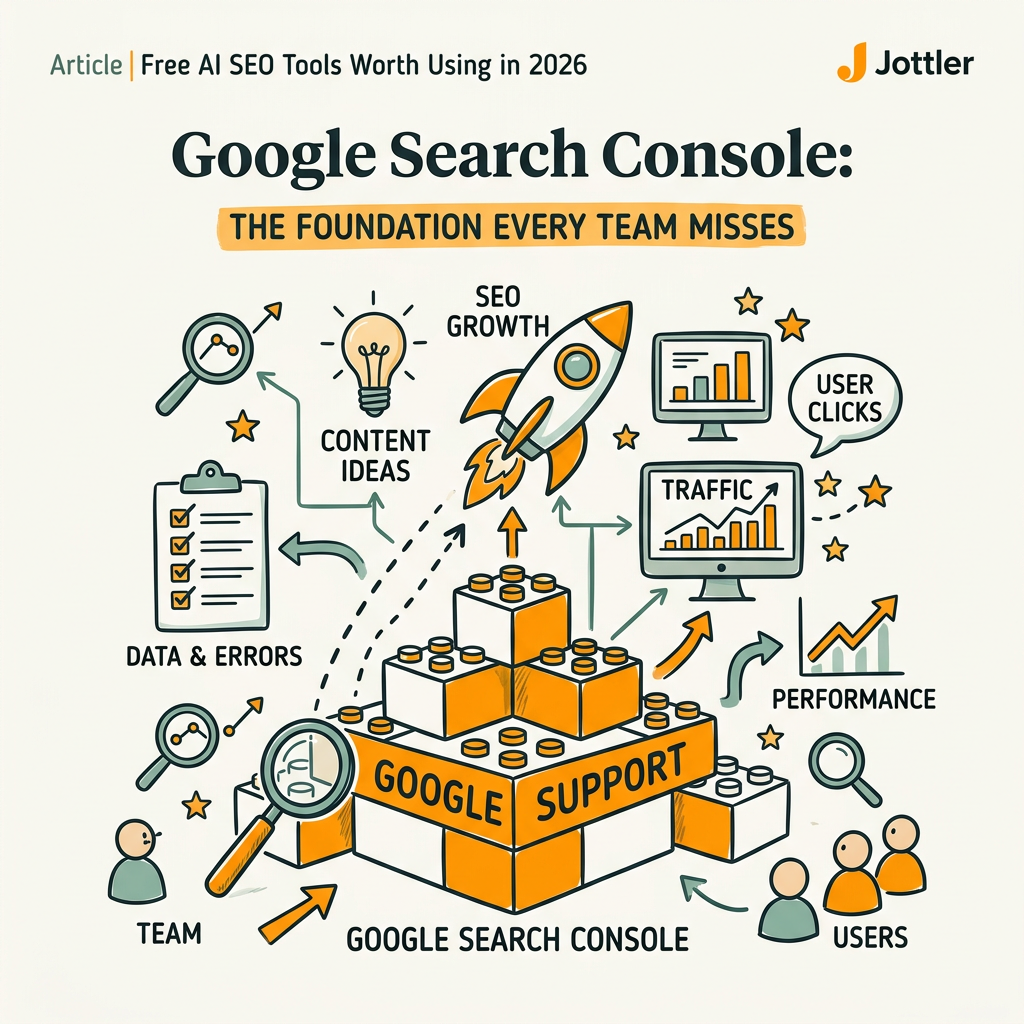
Google Search Console is free and remains the single most valuable SEO data source because it shows real behavior on your site. Not estimates. Not market data. Not competitor snapshots. Actual impressions, clicks, position, and CTR for every query hitting your site.
The workflow: Log into Search Console, navigate to Performance, and filter by queries with high impressions but low CTR (queries where you rank but people aren't clicking). These are your biggest optimization opportunities. A page ranking position 5 for a commercial keyword with 200 impressions but 2% CTR is a faster win than ranking position 15 for an imaginary high-volume term.
- CTR Lift Threshold: Pages on position 2 typically see 20-30% CTR gains when moved to position 1. Find these quick wins first.
- Impressions Without Action: 500+ impressions with less than 5% CTR signals a title/meta mismatch—rewrite it before chasing new content.
- Secondary Query Discovery: See what your site actually ranks for beyond your target keywords. Often reveals content gaps or new topic clusters.
"Pages ranking position 5 with 200 impressions but 2% CTR are faster wins than chasing position 15 for imaginary high-volume terms. Fix what's already visible first."
Pair Search Console with ChatGPT for content brief generation. Paste a high-impression, low-CTR query into ChatGPT with "Create a 2,000-word outline for this keyword focused on [intent]." You get a structured brief in 60 seconds without the $400/month platform fee.
ChatGPT, Claude, and Gemini: The Content Multipliers
The conversation around AI writing tools is backwards. Teams ask: "Can I publish AI-generated articles directly?" The answer is no—but the real question is different: "Can AI accelerate my content workflow?" Yes, absolutely.
Free tiers of ChatGPT, Claude (Sonnet at no cost), and Google Gemini excel at synthesis, outline creation, and content brief generation. They're poor at primary research and raw writing, but excellent multipliers when paired with human research and editing.
Outline and Brief Generation
Paste your target keyword, search intent, and 3-5 competitor titles into ChatGPT with this prompt: "Create a detailed content outline that covers what competitors miss, organized by H2 and H3 sections with a stat or insight for each section." The output is instantly usable. You're not publishing it—you're using it as a structural map and gap analysis.
Topic Clustering and Expansion
Feed ChatGPT a seed keyword and ask it to generate related queries grouped by search intent (informational, commercial, transactional). It won't compete with Semrush data, but it's fast and good enough for initial mapping. Example: seed "email marketing best practices" and get back 40 related phrases clustered by intent type in two minutes.
SERP Analysis and FAQ Synthesis
Copy the top 5 competitor snippets for your target keyword, paste them into ChatGPT with "Extract 10 FAQ questions from these snippets that our article should answer." In 30 seconds you have a FAQ framework that mirrors what Google's algorithm already rewards.
AlsoAsked and Perplexity: The Question and Intent Mappers
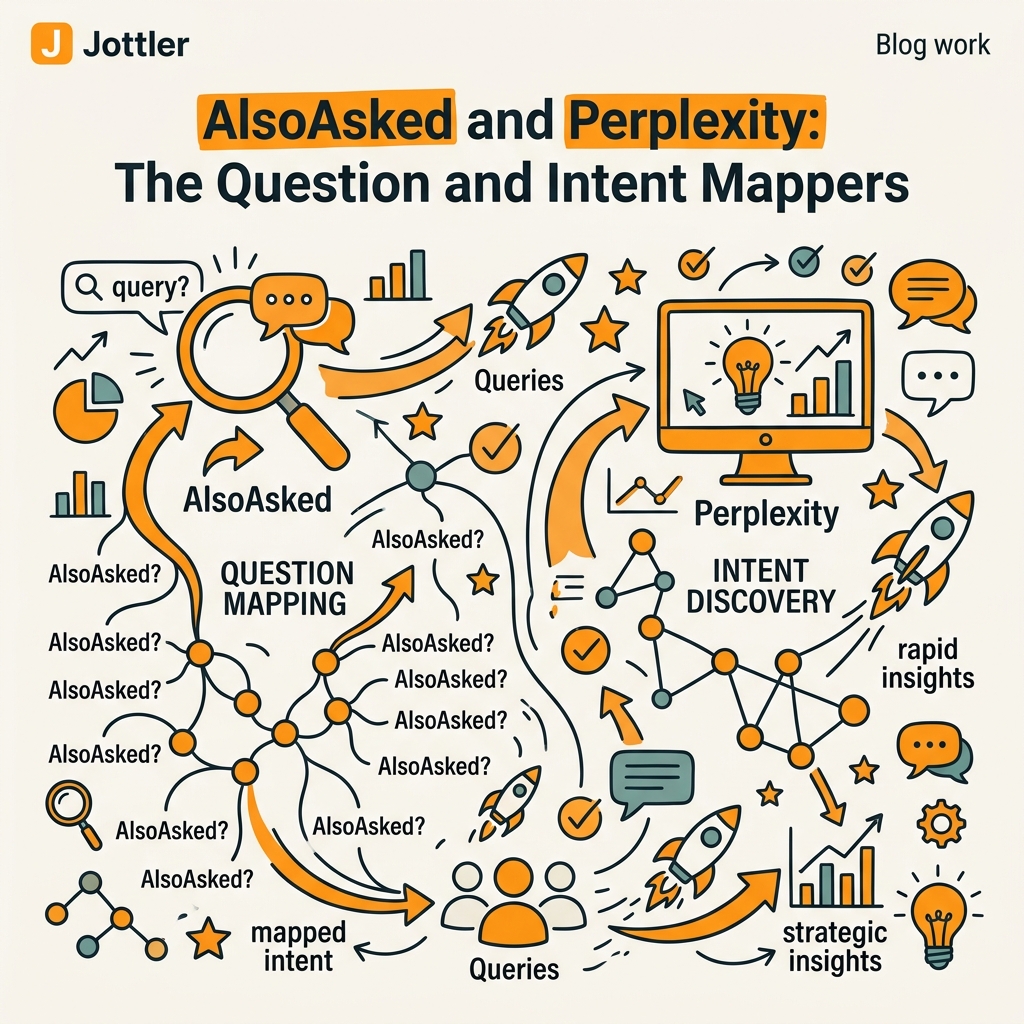
Google's People Also Ask box and related search suggestions are the most accurate intent signals available, but they're manual to extract at scale. AlsoAsked and Perplexity automate this and are both free to use at foundational levels. As covered by Stackmatix's comprehensive review, these tools are essential for teams building efficient SEO workflows.
AlsoAsked for Semantic Mapping
AlsoAsked scrapes Google's PAA box and expands it into a tree of related questions. Enter your target keyword and get a visual map of every question Google associates with it. Free tier offers 3 searches per day, which is enough for core keyword research. Export the full question tree as a CSV, then feed it into a spreadsheet. You now have your article outline and FAQ in 10 minutes.
Why it matters: these are questions people actually type. They're not guesses. They're extracted from Google's own suggestion algorithm. Use them to structure H3s, create FAQ sections, and identify content gaps competitors miss.
Perplexity for Real-Time SERP Intent
Perplexity is a free AI search engine that actually researches your query in real time and cites sources. It's not a rank tracker—it's a way to understand what comprehensive answers look like for your target keyword. Ask Perplexity: "What are the most important factors in [topic]?" and get back a synthesized answer with citations to ranking sources.
Use it to benchmark answer depth. If Perplexity's answer is 400 words and covers 6 angles, your article needs to match or exceed that depth to compete. It's a free competitive analysis tool disguised as a chat interface.
Google Keyword Planner and Semrush Free: Research and Validation
Keyword volume is overrated. But search intent validation is not. Both Google Keyword Planner and Semrush's free tier serve this function well, and they've become undervalued in conversations dominated by paid tools. Zapier's comparison of keyword tools confirms that free options like Keyword Planner remain competitive for foundational research.
Google Keyword Planner for Forecast Data
Most teams skip Keyword Planner because it requires a Google Ads account. That's a mistake. Keyword Planner shows monthly search volume trends, seasonal patterns, and bid competition—all useful for prioritizing topics. It won't show competitor keywords, but it will validate that a topic has genuine demand and isn't a niche long-tail no one searches.
Workflow: Paste 20 seed keywords from your Search Console into Planner. It returns volume, trend, and competition level. Immediately eliminate keywords with less than 100 monthly volume unless they're explicitly intent-driven commercial terms. Focus on clusters with 300+ volume. Build your quarterly content calendar around seasonal demand patterns.
Semrush Free for Competitive Context
Semrush's free tier allows 10 analytics reports per day and 10 tracked keywords—tight, but strategic. Use it to snapshot the top 3 competitors for your target keyword: their word count, backlink count, and estimated traffic. You now know the bar for ranking. If the top result is 2,500 words with 50 backlinks, a 1,200-word article is a long shot.
Building Your Free AI SEO Stack in Practice
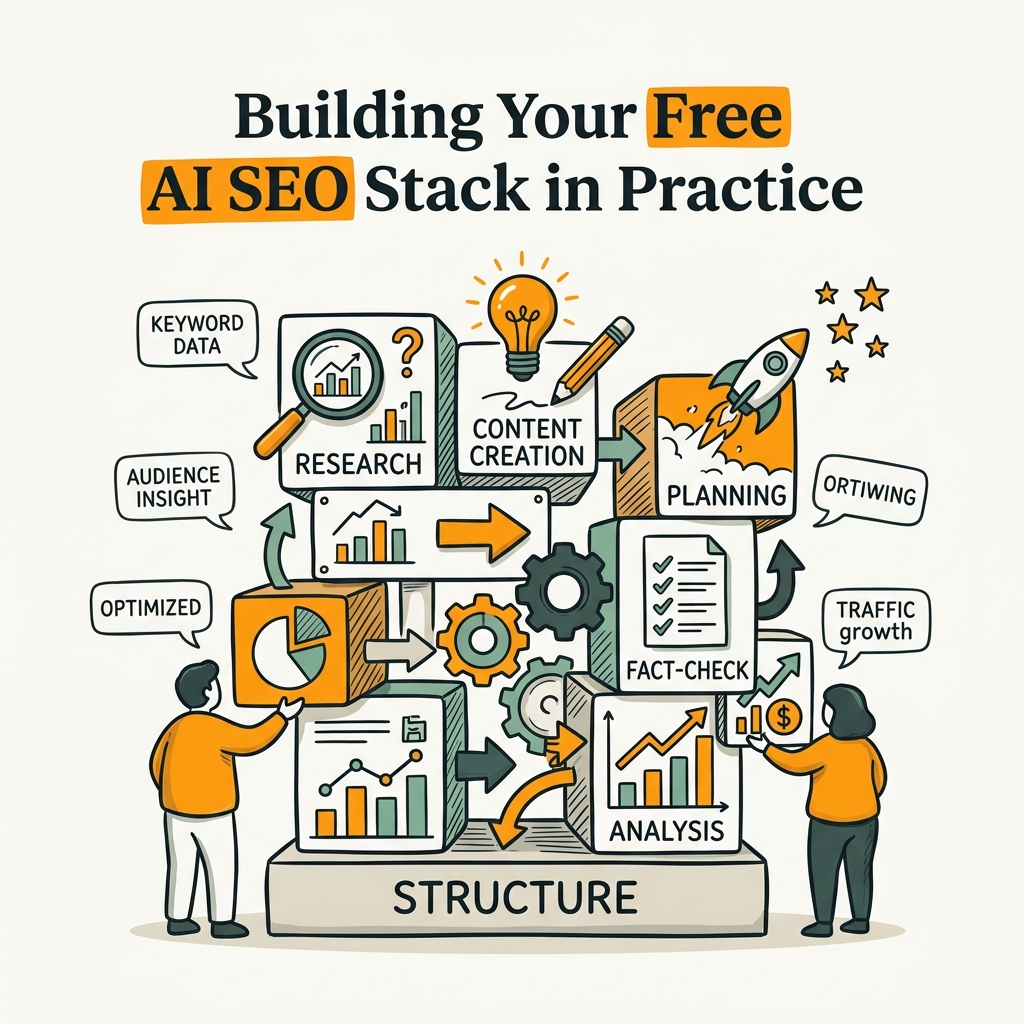
The mistake most teams make: they pick a favorite tool and try to do everything in it. The winning pattern is different—pick one tool per layer and let them talk. As outlined in our SaaS SEO strategy guide, layered tool workflows prevent burnout and scale consistently.
| Layer | Best Free Tool | Purpose | Time Commitment |
|---|---|---|---|
| Data Source | Google Search Console | Identify high-impression, low-CTR queries and real performance gaps | 15 min/week |
| Discovery | AlsoAsked or Google Keyword Planner | Map semantic intent, related questions, and search demand validation | 10 min/keyword |
| AI Synthesis | ChatGPT or Claude (free tier) | Generate outlines, briefs, FAQs, and topic clusters from research | 5 min/brief |
| Research | Perplexity (free) | Understand SERP intent depth and see what comprehensive answers contain | 5 min/query |
| Quality Control | Grammarly Free | Readability scoring and basic grammar checks | 2 min/article |
This stack costs zero dollars and handles the core SEO workflow: finding opportunities → researching intent → generating briefs → writing and editing → publishing with internal links. Every layer feeds into the next.
Where most automation breaks down is in the gaps. Free tools require manual handoff between stages. That's where automation platforms that synthesize the entire pipeline win—but they cost money. If your team is small and you have time, the free stack is genuinely capable.
How Free Tools Address AI Answer Engine Visibility
AI Overviews and answer-engine visibility require a different optimization approach. Traditional SEO optimizes for ranking position. AI optimization optimizes for extraction and citation.
68.94% of websites now receive AI traffic, making answer-engine visibility a measurable opportunity, not a theoretical one. Free tools help you prepare content for extraction without paid platform tracking.
Structuring for AI Extraction
AI systems prefer content with:
- Direct Answers Early: The answer to the query in the first 100 words, not buried in paragraph 4.
- Semantic Clarity: H2s and H3s that clearly state the point, with bullets and short paragraphs for readability.
- Data Density: Specific statistics, percentages, and dollar amounts AI systems extract for citations.
- Source Attribution: Citations to studies and original data so AI systems can credit your research.
Use ChatGPT to analyze competitor top 5 results: "What's the core answer to [keyword] in the first paragraph of each result?" You'll see the pattern—directness, clarity, structure. Match that pattern in your drafts. AlsoAsked shows you the questions; structure your content to answer them explicitly in H3s.
Tracking Answer Engine Performance
Free tools won't track AI Overview citations automatically, but manual spot-checking works. Search your keyword in Google, Perplexity, and ChatGPT and note if your site appears in the summary. Repeat monthly. It's not as clean as a dashboard, but it's free and directional.
Common Mistakes with Free AI Tools
Even well-intentioned teams stumble with free tools because they're stitched together loosely. Awareness prevents the biggest pitfalls. This is especially important when using AI content strategies at scale.
Mistake 1: Publishing Raw AI Output
Free AI tools hallucinate. ChatGPT generates plausible-sounding claims without fact-checking. Every AI-drafted section needs human review. Stat checking especially—verify every number against the source. One false claim damages domain authority more than ten mediocre articles help it.
Mistake 2: Using Keyword Volume as the Only Signal
Keyword Planner shows volume but not intent clarity. A keyword with 5,000 monthly searches and navigation-only intent (like brand name searches) won't convert. Pair volume with Search Console data and PAA research to confirm intent alignment. Intent trumps volume.
Mistake 3: Underestimating Depth Required
Free tools make fast outlines, which is valuable. But they also make people think they can compete with established content at shallow depth. If the top ranking page is 3,500 words with case studies and original research, a 1,500-word AI article won't rank. Free tools are multipliers for your research effort, not replacements for it.
When Free Tools Hit Their Ceiling
Honest assessment: free tools have limits. They're best for teams with time and smaller ambitions, or as augmentation for teams with budget.
Free tools can't automatically:
- Track your site's AI Overview visibility across platforms
- Cluster 500+ keywords into topic architecture automatically
- Identify internal linking opportunities at scale
- Monitor competitor AI-visibility shifts in real-time
- Automate daily content research, writing, fact-checking, and publishing
For teams publishing 3-5 articles per week, manual workflows hit a ceiling around week 3. For teams publishing daily, free tools alone become a bottleneck. That's where solutions like SEO automation platforms that handle the entire research-to-publish workflow become worth the investment. Jottler, for example, automates the entire pipeline—keyword research, deep multi-source research, writing 3,000+ word articles, fact-checking, internal linking, and CMS publishing—allowing small teams to publish daily without manual bottlenecks.
Conclusion
Free AI SEO tools in 2026 are genuinely useful when stacked intentionally. 86% of SEO professionals use AI, and most are starting with free tiers before committing budget. The stack of Google Search Console + ChatGPT + AlsoAsked + Perplexity handles research, synthesis, and intent mapping at a level that would have cost $500/month in 2023.
The constraint isn't capability—it's time. Nearly 40% of marketers now use AI tools daily, and manual handoffs between free tools consume hours each week. For teams with time and willingness to maintain quality control, the free stack wins. For teams prioritizing velocity and consistency, automation that bundles research, writing, fact-checking, and publishing is the move.
Start with Google Search Console this week. Audit your highest-volume, low-CTR keywords. Rewrite the top 3 titles and meta descriptions using ChatGPT briefs. You'll see CTR lift in 4-6 weeks. That's a completely free, completely viable SEO win. From there, add tools as bottlenecks emerge. Start your SEO agent when daily publishing becomes the goal.
FAQs
What's the best free AI tool for SEO keyword research?
Google Search Console is the single best source because it shows real query performance on your site, not market estimates. Layer it with Google Keyword Planner for demand validation and AlsoAsked for semantic intent mapping. Together, they handle keyword research without cost. For competitive context, Semrush's free tier offers 10 analytics reports daily. The combination of GSC + Keyword Planner + AlsoAsked gives you 80% of what paid platforms offer at zero cost.
Can I publish content written entirely by free AI tools?
Not without significant human review and fact-checking. Free AI tools like ChatGPT generate plausible-sounding content that can contain fabricated statistics or outdated information. Use AI for structure, briefs, and outlines—not final publication drafts. Every claim, statistic, and quote must be verified against original sources. The fastest workflow is AI-assisted drafting plus human editing, not pure AI generation. Quality control remains your responsibility.
Should I optimize for AI Overviews or traditional Google rankings?
Optimize for both. AI Overviews reach 2 billion monthly searches and now deliver 68.94% of websites AI traffic. Traditional rankings still drive clicks and brand visibility. The structural changes that help AI extraction (clear answers early, semantic clarity, cited data) also improve traditional rankings. There's no tradeoff. Write for direct answers, semantic clarity, and proper attribution. Your content will rank in both systems.