Free AI Writing Tools for Blog Content Creation
97% of content marketers plan to use AI in 2026, yet most busy founders and marketing teams still struggle to generate high-quality blog content consistently. The problem isn't access to tools—it's that manual writing, even with free AI assistance, demands constant oversight. Blog teams spend an average of 3 hours per article writing and editing, and 74% of new web pages now contain AI-generated content in some form, meaning competitors are already outpacing hand-written workflows. Free AI writing tools help, but they require you to orchestrate research, drafting, fact-checking, and publishing yourself. The solution? Choose tools that actually integrate into a complete content workflow rather than treating each piece as a separate project.
Key Takeaways
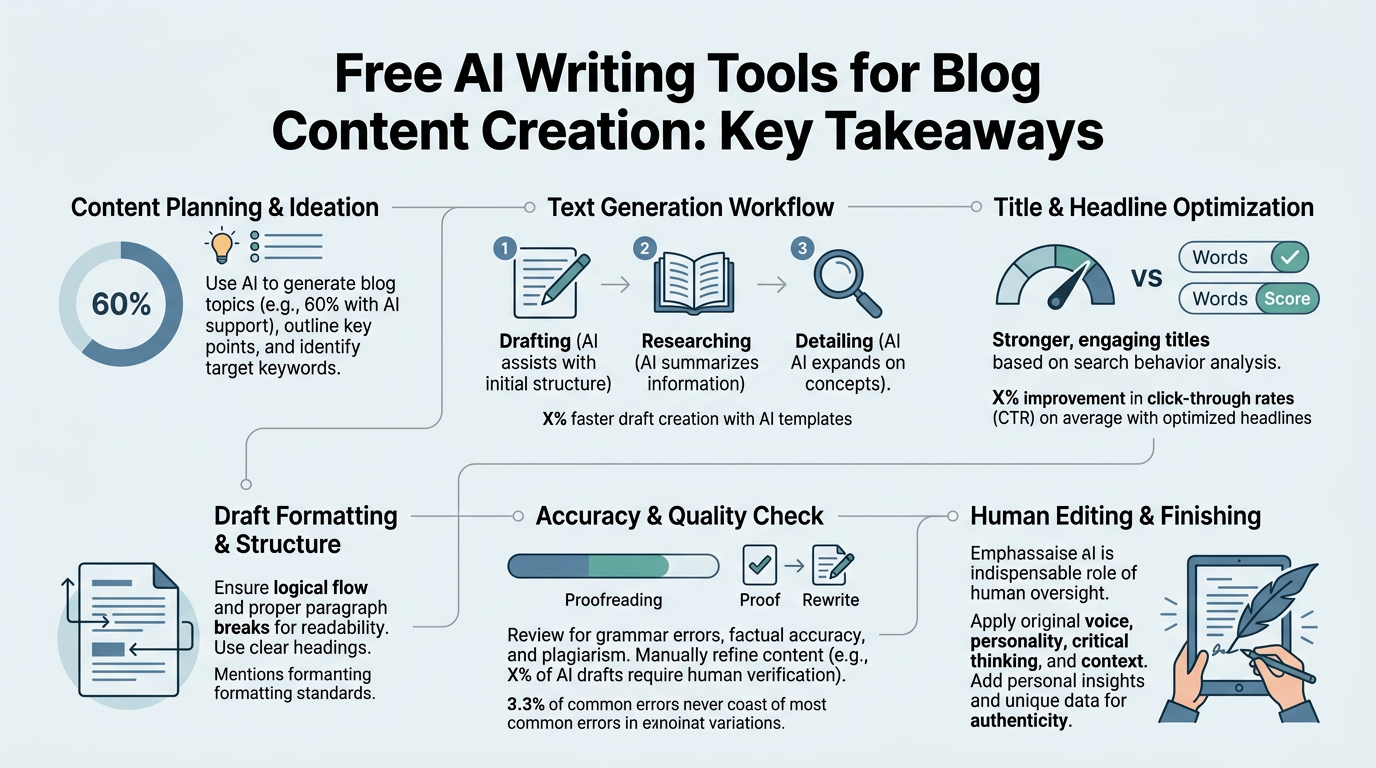
- 97% of marketers adopt AI writing by 2026, and 42% more content is published monthly when using AI (2026, Siege Media)
- ChatGPT (free) and Copy.ai lead free tier options; Grammarly remains unmatched for editing and polish
- High-performing teams use a hybrid model: AI for drafting and ideation, humans for final review and verification
- ChatGPT Free (GPT-4o mini): Best all-around free option for flexible drafting and research with unlimited conversational capability during off-peak hours.
- Copy.ai Free (2,000 words/month): Most generous free tier specifically designed for marketing copy with templates and tone presets.
- Grammarly Free: Industry-standard proofreading tool that processes billions of words daily and serves 30M+ users for grammar, clarity, and tone refinement.
- Automated Content Systems: Tools like Jottler research, write, fact-check, and publish entire articles daily, eliminating manual coordination between separate tools.
- The Hybrid Workflow: 62% of high-performing teams use AI for assistance only, retaining human control over final output and fact verification.
Which Free AI Writing Tools Are Actually Worth Your Time?
The free AI writing tool market splits into three categories: foundational models (ChatGPT, Claude), marketing-focused platforms built on top of those models (Copy.ai, Writesonic), and editing tools (Grammarly, Wordtune). The right choice depends on whether you're drafting from scratch, refining existing copy, or trying to scale blog production without hiring. For most busy founders, the answer isn't one tool—it's a workflow that combines them strategically.
ChatGPT Free Tier: The Flexible Foundation
ChatGPT remains the most trusted free AI writing tool, with an 80% selection rate among marketers for research, outlining, and drafting. The free tier uses GPT-4o mini, which handles blog research, topic brainstorming, and multi-turn conversations without requiring payment. The tradeoff is message caps during peak hours and no access to advanced plugins or file uploads. For founders still testing AI workflows, ChatGPT's free tier eliminates friction—no credit card, no trial period, no complicated interface. You can spend an hour experimenting with prompt engineering before deciding if AI content is worth integrating into your blogging process. The secondary benefit: ChatGPT retains conversation context across 20+ messages, meaning you can iteratively refine a single blog outline without starting from scratch each time.
"ChatGPT's strength is in iterative refinement—you can spend 15 minutes researching a topic, then 5 minutes regenerating weak sections, and have a solid outline in less than 30 minutes total. Manual outlining takes 2–3 hours for the same depth." — Content strategy teams using AI-first workflows
The limitation is scale. ChatGPT alone won't solve the content production bottleneck. High-performing teams combine ChatGPT for ideation (74% of teams use AI for ideation) with specialized tools for execution. Siege Media's research on AI adoption shows that teams using AI for ideation only—without downstream tools for outlining and fact-checking—produce content slower than teams using structured platforms.
Copy.ai Free Tier: The Generous Marketing Pick
Copy.ai offers 2,000 words per month free, making it the most generous free tier for marketing copy and blog post outlines. The templates are pre-built for landing pages, email subject lines, social media captions, and blog introductions—meaning you're not starting from a blank prompt. For founders who have a basic blog outline and need AI to fill specific sections fast, Copy.ai's structured approach saves time versus ChatGPT's blank-canvas approach. The paid tier ($49/month) includes unlimited words and advanced brand voice control, which becomes critical when scaling team output. But for testing, 2,000 words is enough to write 2–3 full blog posts per month if you pair it with human editing.
"The 2,000 word limit forces discipline—you can't use Copy.ai as a crutch for lazy writing. Instead, you learn to identify which sections need AI assistance and which you can write yourself. That friction actually produces better blogs than pure AI generation." — SaaS marketing leaders
The trade-off: Copy.ai's strength is marketing copy brevity, not long-form blog research. If your blog articles require deep topic research, extensive citations, or nuanced analysis, you'll hit the template limits. Marketers use Copy.ai best for drafting blog headlines, introductions, and call-to-action sections, then supplement with ChatGPT or manual writing for the substantive middle sections.
Grammarly Free: The Unmatched Polish Layer
Grammarly processes billions of words daily and serves 30M+ daily active users, making it the de facto standard for any writer who publishes. The free tier offers grammar, spelling, and clarity suggestions but no AI generation. That's actually a feature for teams using a hybrid workflow: Grammarly pairs perfectly with ChatGPT-generated drafts. Write your first draft in ChatGPT, paste it into Grammarly, and the tool flags tone inconsistencies, passive voice overuse, and readability issues before you publish. The paid upgrade ($12/month) adds advanced suggestions for conciseness, formality, and audience adaptation.
Many founders skip Grammarly thinking they can edit themselves, but Grammarly's main value isn't catching obvious typos—it's highlighting subtle clarity issues that hurt SEO rankings. Search engines favor readable, scannable content, and Grammarly forces you to hit readability targets before publication.
The Free Tool Workflow: What Actually Works at Scale

Combining free tools into a coherent workflow requires deliberate orchestration. 62% of high-performing content teams use a hybrid model where AI assists but humans remain in control. This means treating AI not as a replacement for writers but as a research and drafting layer that compresses the timeline from weeks to hours. Here's the workflow that produces SEO-friendly blog posts consistently:
- Research (ChatGPT): Spend 15 minutes prompting ChatGPT with your target keyword and audience. Ask it to outline key subtopics, identify common questions, and suggest supporting data points. Copy the research into a document.
- Draft Structure (ChatGPT or Copy.ai): Use ChatGPT to generate a detailed outline with 4–6 main sections and 2–3 subsections per section. This is where AI saves the most time—outline generation takes 20 minutes manually but 3 minutes with AI.
- Content Generation (ChatGPT or Copy.ai): For each section, use ChatGPT or Copy.ai to draft the body text. Start with a strong intro hook, then feed it the outline section-by-section. Regenerate sections that miss the mark rather than hand-editing weak first drafts.
- Fact-Check & Edit (Human Review): Read the draft end-to-end, verify any statistics cited, ensure accuracy, and rewrite sections that sound too "AI-ish." This step is non-negotiable—44% of AI users regularly fix AI mistakes, and blind readers cannot distinguish AI writing from human writing 84% of the time when properly edited.
- Polish (Grammarly): Paste the final draft into Grammarly's editor, fix flagged issues, and ensure the tone matches your brand voice.
This workflow produces a publishable 2,000-word blog post in 2–3 hours total, compared to 6–8 hours for hand-written content. The result is 59% faster content creation and 42% more articles per month. But this assumes discipline: if you're skipping step 4 (human fact-checking) and publishing AI output raw, you'll see declining traffic and engagement.
When Free Tools Hit Their Limits: Why Busy Founders Need Automation
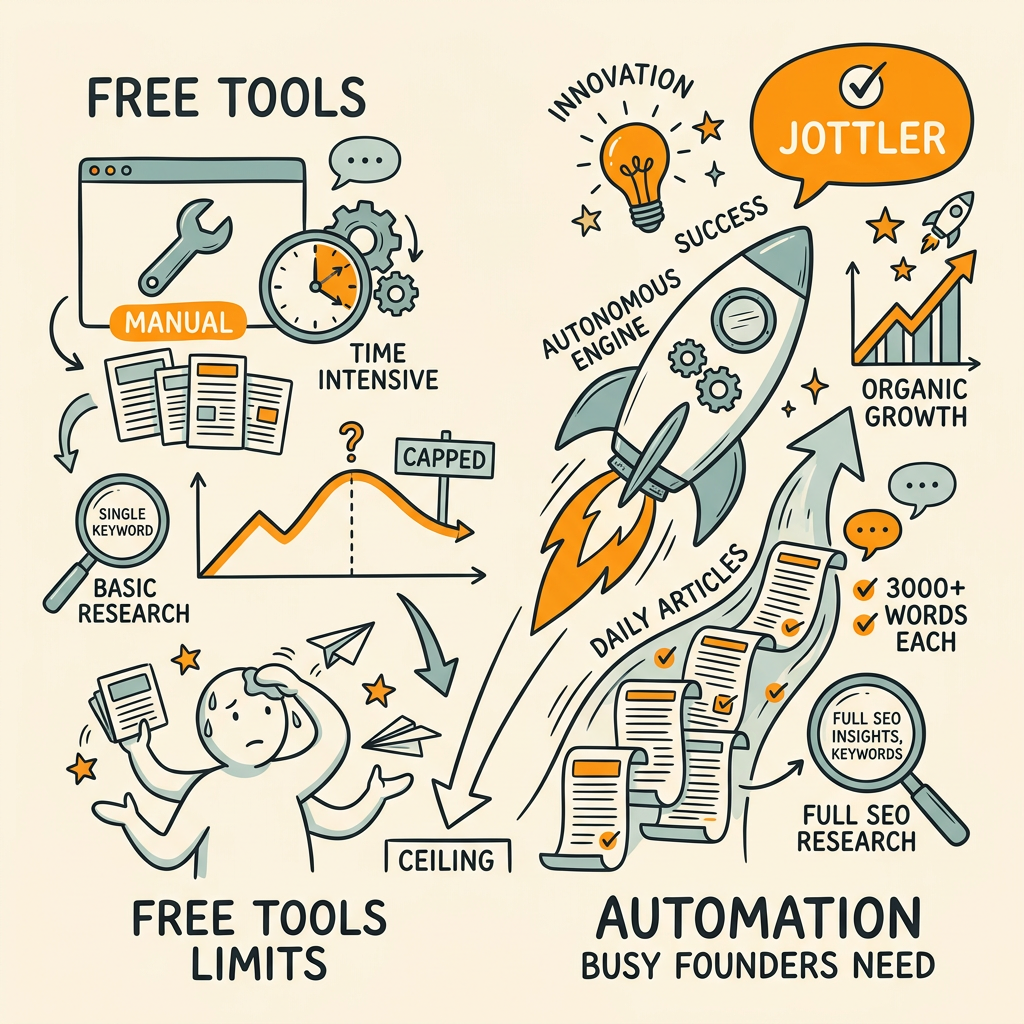
Free tools solve the drafting bottleneck but create a new problem: coordination overhead. You're using ChatGPT for research, Copy.ai for templates, Grammarly for editing, and then manually pasting between tools, uploading to your CMS, formatting, adding internal links, and publishing. For a founder publishing one blog per week, that's still 2–3 hours per post in tool switching alone. When you scale to 3–5 articles per week, the coordination cost becomes unsustainable. That's where the gap between free tools and enterprise solutions becomes critical.
| Tool Category | Best For | Time per Article | Setup/Maintenance | Scaling to 5+ Articles/Week |
|---|---|---|---|---|
| Free Tools (ChatGPT + Copy.ai + Grammarly) | Solo creators, 1-2 posts/week | 2-3 hours per post | Manual—constant tool switching | Breaks down; requires hiring or outsourcing |
| Platform Tools (Jasper, Writesonic paid tier) | Marketing teams, 2-4 posts/week | 1.5-2 hours per post | Moderate—integrated workflows | Feasible but still requires editing oversight |
| Autonomous Systems (Jottler) | Busy founders, 3-5+ posts/day | 0 hours—fully automated | Minimal—set topic frequency and publish | Native; AI agents handle research, writing, fact-checking, and publishing |
The table reveals why busy founders eventually abandon free tools. Typeface's 2026 research shows that non-AI blog creation has dropped from 65% to just 5%, meaning competitive blogs are moving fast. If you're editing ChatGPT drafts in Grammarly and uploading to WordPress manually, you're already behind teams using systems where AI researches, writes, fact-checks, and publishes automatically. Jottler, for example, connects to your website and publishes 3,000+ word SEO-optimized articles daily without human intervention on research or publishing, freeing founders to focus on strategy rather than copy-paste workflows. For teams operating on a tight budget, free tools are the proof-of-concept. But once you commit to scaling organic traffic, you need a system that orchestrates all the parts—research, writing, fact-checking, CMS publishing, and internal linking—into one flywheel.
Red Flags When Using Free AI Writing Tools
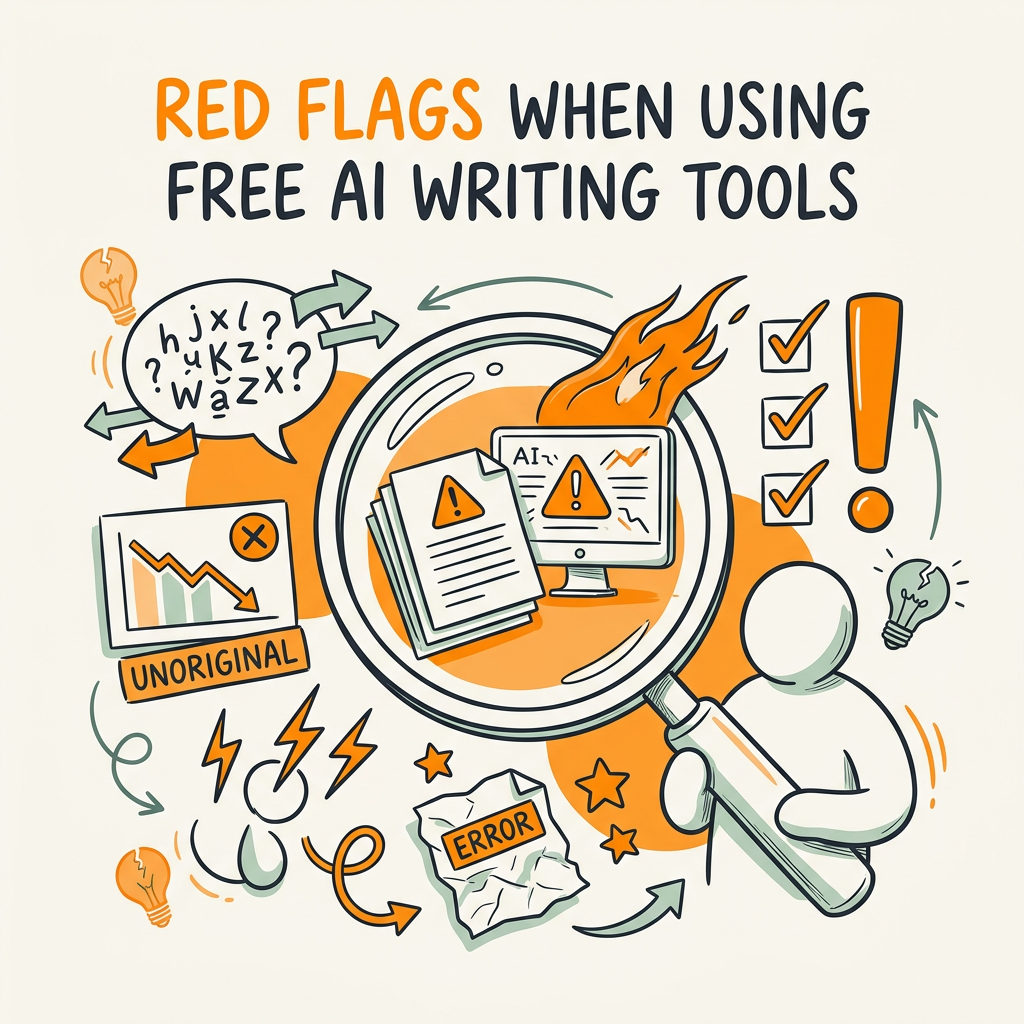
Free tools create three common failure modes that hurt traffic. First, AI-generated content without human fact-checking leads to outdated or incorrect information. ChatGPT's training data has a knowledge cutoff, and it sometimes hallucinates statistics. Always verify major claims, especially numbers cited as "research" or "studies." Second, free tools don't optimize content structure for SEO. They generate readable prose but often miss on-page SEO fundamentals like keyword placement, subheading hierarchy, and internal linking strategy. A blog post that sounds good to a reader but lacks SEO structure won't rank for competitive terms. Third, free tools produce generic, non-differentiated content when you don't iterate on drafts. AI-generated first drafts are starting points, not finished products. If your team doesn't spend time rewriting sections with your unique perspective, your blog will sound like everyone else's AI blog.
"The biggest mistake teams make is publishing ChatGPT drafts with one Grammarly pass. AI writing is a foundation, not a finished product. Spend time rewriting sections with your unique data, perspective, and voice—that's what separates traffic-driving blogs from AI-written commodity content." — High-performing content operations
The founders who win with free tools treat them as acceleration layers, not replacements for editorial quality. They spend the time saved on drafting on fact-checking, differentiation, and SEO optimization. They don't publish AI output raw.
Integrating Free Tools Into Your Content System
The practical path for busy founders is to combine free tools during the research and drafting phase, then invest in a solution that handles backend automation. Here's a concrete approach: use ChatGPT and Copy.ai to generate blog drafts faster (your own internal "editor-in-chief"), send those drafts to your team for 30–45 minutes of fact-checking and tone refinement, run the result through Grammarly, and publish. This workflow compresses the timeline and reduces the total cost of content production. If your team publishes 2–4 articles per week, this hybrid approach is sustainable. When you're trying to publish 5+ articles per week, you'll need automation at the publishing layer—tools like an autonomous SEO agent that researches, writes, and publishes handle the end-to-end workflow without human intervention.
The key metric: if you're spending more than 1 hour per week on tool coordination and CMS publishing (not writing), it's time to automate that layer. Free writing tools are excellent for drafting. Automation tools are essential for scaling publishing. Consider how the best AI writing tools for content marketing teams integrate directly with your CMS to cut overhead entirely.
Conclusion
Free AI writing tools have democratized content creation. ChatGPT, Copy.ai, and Grammarly eliminate the excuse of "I don't have time to write blog posts." They compress the timeline from weeks to hours and reduce production costs by 42%. But they're best viewed as tactical solutions for individual posts, not strategic solutions for sustained organic growth. High-performing teams publish 42% more content monthly using AI, and they do so by combining free drafting tools with human oversight and automated publishing workflows. For busy founders serious about scaling organic traffic without hiring a full content team, the answer isn't more free tools—it's automating the orchestration layer so you can write less frequently but publish more consistently. Start your SEO agent and let AI handle the research, writing, and publishing 24/7 while you focus on strategy.
FAQs
What is the best completely free AI writing tool for blogging?
ChatGPT's free tier remains the best starting point for flexible blog drafting and research. It uses the GPT-4o mini model and allows unlimited conversational drafting (with message caps during peak hours), making it ideal for brainstorming, outlining, and iterative refinement. ChatGPT excels at research-heavy blog posts because it can discuss topics in depth, cite sources, and revise sections based on feedback. If you need structured marketing copy templates instead, Copy.ai offers 2,000 words per month free, which is enough for 2–3 blog articles if you handle the research separately. For purely editing and proofreading existing drafts, Grammarly's free tier is unmatched—it processes billions of words daily and catches subtle clarity and tone issues that hurt readability. The best free workflow combines ChatGPT for drafting, Copy.ai for outlines, and Grammarly for polish.
Can I publish high-quality blog posts using only free AI tools?
Yes, but only if you invest 1–2 hours per post in human review and editing. Free tools generate publishable drafts in 30–45 minutes, but raw AI output lacks the fact-checking, unique perspective, and SEO optimization that drive traffic. The winning workflow is: use ChatGPT to draft, spend 45 minutes fact-checking and rewriting for your unique voice, run Grammarly for polish, and optimize on-page SEO manually. This produces one high-quality article every 2–3 hours, compared to 6–8 hours hand-written. The constraint isn't tool cost—it's your time. If you're publishing more than 2–3 blog posts per week, the coordination overhead of switching between ChatGPT, Copy.ai, Grammarly, and your CMS becomes unsustainable, and you'll need an integrated system that orchestrates all steps in one platform.
Do free AI writing tools hurt SEO rankings?
No, but improperly edited or fact-checked AI content will. Search engines don't penalize AI-generated content itself; they penalize low-quality, inaccurate, or plagiarized content—which can come from humans too. The risk with free tools is that you'll publish AI drafts without verifying facts or optimizing them for search intent. AI writing tools like ChatGPT sometimes hallucinate statistics, miss keyword placement opportunities, and generate generic content that doesn't differentiate your site. When you fact-check thoroughly, incorporate your unique perspective, and optimize structure for SEO (headers, internal links, keyword distribution), AI-generated content ranks just as well as hand-written. In fact, teams using AI publish 42% more content monthly, which compounds organic traffic growth when quality is consistent.