Free vs. Paid AI SEO Tools: What's the Difference?
The AI SEO tools market is now worth $2.56 billion, and it's growing at a 23.4% compound annual rate toward $32.6 billion by 2035. Yet most teams still can't decide: should they start free and upgrade later, or invest in a paid platform from the beginning? The answer isn't binary. Free tools let you test concepts, but they rarely compound. Paid tools automate the entire workflow—research, writing, publishing, fact-checking—at scale. Here's what actually separates them.
Key Takeaways
- 86% of SEO professionals have integrated AI into their strategies, with paid tools delivering 14.6% conversion rates versus 1.7% from manual SEO (2026)
- Free AI tools excel at single tasks (keyword research, meta descriptions), while paid platforms automate entire content pipelines from research through publishing
- AI-powered SEO reduces keyword research time by 80% and saves 50% on data analysis, justifying enterprise tool investments
- Free Tool Approach: Best for learning SEO basics, testing single features, and validating ideas without upfront cost—but lacks workflow automation.
- Paid SaaS Model: Delivers integrated keyword research, content writing, on-page optimization, and publishing for teams scaling content production at $29–$299/month.
- Autonomous Platforms: Full-stack solutions that run 12+ AI agents daily to research, write, fact-check, and publish at scale—the only way to compound organic traffic.
- Time Savings Trade-off: Free tools demand 80% more manual assembly; paid tools save hours weekly by automating repetitive SEO tasks.
- ROI Reality: 70% of businesses report higher ROI from AI SEO investment, with revenue increases of 3–15% and sales uplift of 10–20%.
What Free AI SEO Tools Actually Do (and Don't)
Free AI SEO tools are utility players. They excel at isolated tasks—writing a meta description, brainstorming keyword angles, generating a blog outline. ChatGPT, Semrush's free tier, and Mangools' freemium option are widely used because they're accessible and low-friction. But they're not SEO tools in the automation sense. They're writing assistants you have to operate manually, every single time.
The Scope Limitation in Free Tools
Free tools are task-focused, not workflow-focused. You can use ChatGPT to outline a blog post, but you'll still manually research keywords, write the full article, optimize it, create meta tags, design the intro image, and manually submit it to your CMS. Each step requires human intervention and subject-matter judgment. For a bootstrapped founder or solo marketer, this feels efficient—you're not paying per task. In practice, it's 80% slower than automation because every piece of content requires manual assembly. The tool doesn't know your brand voice, your target audience, your internal linking strategy, or your publishing schedule. Unlike AI content generators built for SEO scalability, free tools remain one-step utilities.
"Free tools are task-focused, not workflow-focused. You can use ChatGPT to outline a blog post, but you'll still manually research keywords, write the full article, optimize it, create meta tags, design the intro image, and manually submit it to your CMS."
Feature Depth and Quality Gaps
Free AI tools operate in a "best effort" mode. They generate output, but they don't verify it. ChatGPT will confidently cite a statistic that's two years old. Research from Semrush shows that 75% of marketers leverage AI to reduce time spent on manual tasks like keyword research and meta-tag optimization, yet most of those using free tools still end up assembling everything manually. Free keyword tools show volume and difficulty, but they miss semantic relationships and topical intent. A free meta-tag generator doesn't align with your competitor landscape. Free tools are also updated infrequently and often lack integrations with your CMS, analytics, or internal content calendar. You'll copy-paste everything yourself. For scaling organic traffic, this becomes the bottleneck.
Why Paid Tools Command Premium Pricing
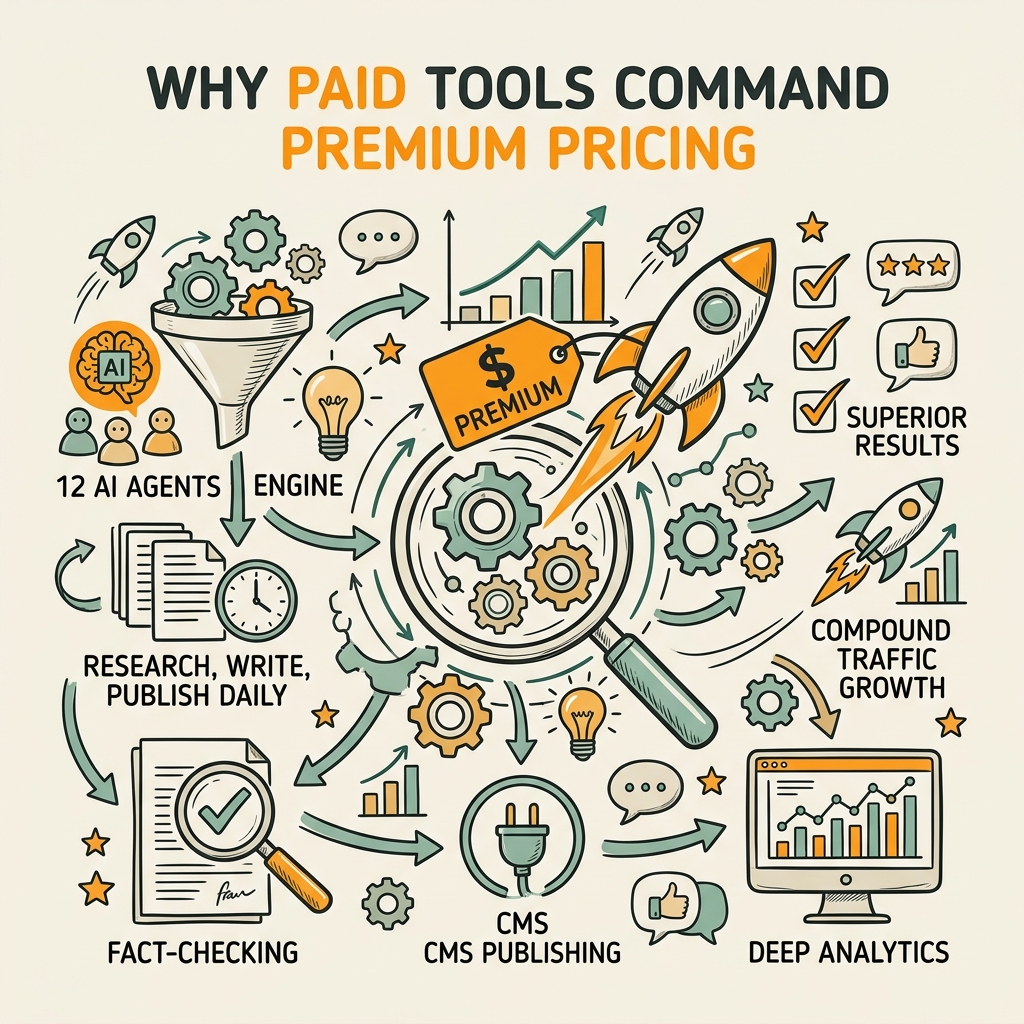
Paid AI SEO platforms cost between $29 to $299 per month because they do fundamentally different work. They integrate research, writing, optimization, and publishing into a single automated pipeline. 86% of SEO professionals have adopted AI tools in their workflows, and most of them use paid platforms because free tools don't operationalize at scale. The premium covers three things: intelligence depth, workflow automation, and ongoing support.
Integrated Research and Real-Time Data
Paid platforms like Ahrefs, SE Ranking, Surfer SEO, and Semrush connect to live search engines, SERPs, and competitive databases. They don't rely on general-purpose language models. When you run keyword research, you get actual Google search volume, keyword difficulty measured against real competitors, and CPC data. When you analyze competitors, you see their exact backlink profiles, content pillars, and topical clusters. This data depth is proprietary—it costs millions of dollars to maintain crawler infrastructure and SERP rankings at scale. Free tools can't compete because they don't have this cost infrastructure.
"Paid platforms orchestrate content workflows. You input a keyword, and the tool suggests content angle, writes the outline, pulls competitor data, drafts the full article, optimizes on-page elements, generates meta descriptions, and in some cases, publishes to your CMS."
Content Automation That Compounds
Paid platforms orchestrate content workflows. You input a keyword, and the tool suggests content angle, writes the outline, pulls competitor data, drafts the full article, optimizes on-page elements, generates meta descriptions, and in some cases, publishes to your CMS. Industry research shows AI-driven SEO achieves a 14.6% conversion rate versus 1.7% from traditional methods. This isn't because the AI writes better prose—it's because paid tools force consistency, optimization rigor, and publishing discipline that free tools can't mandate. Understanding how content automation tools streamline SEO workflows is critical for scaling. Tools like Jottler go further, deploying 12+ AI agents daily to research, write, fact-check, and publish autonomously without human assembly.
Fact-Checking and Authority Building
A critical paid-tier feature is fact verification. Free AI generates plausible-sounding but occasionally false claims. Paid platforms integrate fact-checking layers—they verify statistics against source documents, cross-reference citations, and flag outdated claims before publication. Autonomous platforms like Jottler fact-check every article against 14+ real sources before publishing, ensuring content is citeable and defensible. This prevents the most damaging scenario: publishing false SEO content, getting penalized, and losing the investment entirely.
How Autonomous Platforms Change the Game

The newest tier of AI SEO tools operates differently than traditional SaaS. Instead of a dashboard where you input keywords and click "generate," autonomous platforms deploy AI agents that run on a schedule—daily, three times daily, or on-demand—to execute the entire SEO content pipeline without human touch. Jottler is the primary example: it connects to your website, receives your content topics or keywords, and its 12-agent system researches, writes 3,000+ word articles, fact-checks claims against sources, generates internal links, and publishes directly to your CMS.
Scaling Without Team Expansion
Traditional paid tools are still labor-intensive. You set up a keyword, the tool generates a draft, you review it, edit it, add images, optimize it further, publish it, and monitor results. This is faster than the all-manual approach, but it still requires skilled SEO staff. An autonomous SEO agent eliminates that assembly step entirely. Instead of publishing 2–4 articles monthly, teams publish 15–30. Instead of waiting for a freelancer to write long-form content, research publishes automatically. The ROI math changes: at $29–$99/month, you're adding 10–20 pieces of optimized content monthly without hiring additional writers or SEOs.
Compound Growth Through Continuous Publishing
Free and standard paid tools suffer from publication inertia. Teams publish sporadically because every article demands manual assembly. Autonomous platforms compound because they publish consistently on schedule, enabling exponential organic growth. 70% of businesses report higher ROI from AI SEO investment, with revenue increases of 3–15% and sales uplift of 10–20%. This ROI compounds when you publish continuously. One article generates one ranking opportunity. Ten articles a month generates ten ranking opportunities. With 30 articles monthly on high-intent keywords aligned with your business, organic traffic compounds exponentially. Free tools can't achieve this because the manual overhead prevents consistent publishing cadence.
| Feature | Free AI Tools | Paid SaaS Tools ($29–$99/mo) | Autonomous Platforms ($29–$199/mo) |
|---|---|---|---|
| Keyword Research | Basic volume/difficulty; manual input required | Live SERP data; competitive analysis; semantic clustering | Autonomous research; intent matching; internal linking suggestions |
| Content Writing | Single-task drafting; human review required | Outline + draft generation; competitor-informed angle | Full 3,000+ word articles; 12+ AI agents; automated daily |
| Fact-Checking | None; relies on LLM accuracy | Limited; some tools verify citations | Deep verification against 14+ sources before publish |
| Publishing & Integration | Manual copy-paste to CMS | CMS integration (WordPress, Webflow); scheduling | Direct CMS publishing; auto-linking; performance tracking |
| Internal Linking | Manual review and linking | Suggestions provided; human implementation | Automatic semantic linking; cluster optimization |
| Monthly Output (typical) | 4–8 articles | 8–15 articles | 15–30 articles at scale |
| Hands-on Hours per Week | 15–20 hours | 8–12 hours | 2–4 hours (mostly oversight) |
Free Tools Worth Your Time (and Which Aren't)
Not every free tool is a waste. Some solve specific gaps efficiently. If you're bootstrapped or testing a new vertical, free tools let you validate demand before committing budget. The key is understanding what they're actually good for and where they create hidden labor costs.
Strong Free Options for Specific Use Cases
ChatGPT's free tier is genuinely useful for generating blog outlines, brainstorming keyword angles, and writing first drafts of meta descriptions. You provide the structure, it executes fast. Google's Keyword Planner (free with Google Ads account) gives you real search volume and CPC data—primitive compared to Ahrefs or SE Ranking, but accurate for Google's own auction. Ubersuggest's free tier shows keyword suggestions and rough difficulty scores. These tools work best as supplements, not replacements. Use them to validate ideas quickly, then move to paid platforms for production scale.
False Economy: Free Tools That Steal Time
Some free tools impose hidden labor costs. Generic free keyword research tools show thousands of results with no filtering for intent or commercial viability, leaving you to manually sift through noise. Free content generators produce mediocre copy that requires heavy editing—often slower than writing original content. Free on-page optimization checkers flag hundreds of issues without prioritization, leaving you guessing what actually moves the needle. These tools feel cost-effective upfront but waste 10+ hours monthly in manual triage and rework. A $49/month paid tool that eliminates this guesswork pays for itself in recovered time alone.
The Real Cost of Staying Free
The calculus for staying on free tools is straightforward and usually wrong. A founder spending 15–20 hours weekly assembling free-tool content is valuing their time at zero. If you're a founder earning or losing $100+ per hour in business growth, those 15 hours cost you $1,500–$2,000 weekly in foregone opportunity cost. A $99/month paid platform that cuts that to 5 hours weekly saves you $10,000+ monthly in recovered founder time. Additionally, free tools rarely produce consistent, publishable-quality output, which means your content output stalls at 4–8 articles monthly. Paid platforms with workflow automation double that to 15+ monthly, creating a compounding advantage. One competitive advantage in organic search is volume: consistent publishing of 15+ high-quality articles monthly outranks intermittent publishing of 4 free-tool articles.
Benchmark: Time and Cost Comparison
Consider a growing SaaS company wanting to publish 20 articles monthly:
- Free Tool Approach: 20 hours/week research, writing, editing, publishing; zero tool cost; total cost to business = $40,000/month (at $200/hour opportunity cost)
- Paid SaaS Approach: 8 hours/week using Ahrefs ($99/mo) + WriteSonic ($49/mo); tool cost $148/month; total business cost = $16,000/month in labor
- Autonomous Approach: 2 hours/week oversight using Jottler ($99/mo); tool cost $99/month; outputs 30 articles monthly; total business cost = $4,000/month in labor
The math is stark. Staying on free tools is the most expensive option for teams that need consistent, scaled output. Paid platforms compress labor. Autonomous platforms eliminate the bottleneck entirely.
Conclusion
Free AI SEO tools are learning devices and feature experiments. They teach you SEO fundamentals and let you test hypotheses without commitment. But they don't automate content production—they fragment it into manual steps that never compound. Paid platforms begin automating workflows, reducing keyword research time by 80% and cutting data analysis labor in half. Autonomous platforms take the next step: they publish 15–30 optimized articles monthly on schedule, with fact-checking built in and internal linking automated. For busy founders and scaling teams, the choice is between spending 15–20 hours weekly assembling free content, 8 hours weekly managing paid tools, or 2 hours overseeing an autonomous agent. 70% of businesses report higher ROI from AI SEO investment, and that ROI accelerates when publishing becomes autonomous. If your goal is compounding organic traffic growth without expanding headcount, free tools are a false economy. Paid platforms are cost-justified by time savings alone. Autonomous platforms are the only path to consistency at scale. Start your SEO agent today and let AI handle the research, writing, and publishing—so you can focus on strategy.
FAQs
Are free AI SEO tools actually good enough for small businesses?
Free AI tools are useful for learning SEO and testing ideas, but they create a manual assembly problem at scale. They handle one task at a time—writing an outline, generating a meta description, brainstorming keywords—but don't integrate those tasks into a cohesive content workflow. For a small business publishing 4–8 articles monthly and willing to invest 15–20 hours weekly in manual assembly, free tools work. But if you need to publish 15+ articles monthly or want to reclaim those hours for growth strategy, a paid platform pays for itself in labor savings within weeks. Free tools are a stepping stone, not a long-term production engine.
How much should a business spend on AI SEO tools monthly?
Budget depends on your publishing volume and team size. Solo founder or agency starting out: $50–$100/month covers entry-level platforms like Ahrefs or SE Ranking, cutting your content assembly time in half. Teams publishing 15+ articles monthly: $100–$200/month for integrated platforms with workflow automation, fact-checking, and CMS integration. Enterprise teams needing 30+ autonomous articles monthly: $99–$299/month for autonomous agents that research, write, fact-check, and publish without human assembly. The ROI is immediate: if a $100/month tool saves one team member 8 hours weekly, it pays for itself in labor cost alone, before accounting for the 14.6% conversion rates achieved by AI-driven SEO versus 1.7% from manual methods.
Can free AI tools rank as well as paid tools?
Ranking potential depends on content quality and on-page optimization, not the tool's price tag. A well-written article from a free tool can rank if the fundamentals are right: keyword research is accurate, content is comprehensive and well-structured, internal linking is intentional, and E-E-A-T signals are strong. The difference isn't "free tools can't rank"—it's that free tools don't automate the optimization process. With paid tools, you optimize 15+ articles consistently and publish monthly. With free tools, you manually optimize 4–8. Over 12 months, the paid approach compounds exponentially because consistency beats perfection. One perfectly written article ranks. Ten well-written articles rank plus build topical authority and internal link equity. This is why businesses report 45% organic traffic boosts after switching to AI SEO platforms—not because the AI writes better, but because the automation enables consistent, volume-based SEO strategy.