
Generate Blog Drafts for Free with AI
85.1% of bloggers now use AI to generate blog content, yet most teams still struggle to produce consistent, SEO-friendly posts at scale. The cost of hiring full-time writers runs $50,000+ annually, and maintaining a daily publishing cadence manually drains hours from your marketing team that could be spent on strategy. Free AI blog generators have democratized draft creation, allowing founders and marketers to produce publication-ready outlines and initial drafts in minutes instead of days. Here's how to generate blog drafts for free with AI effectively, and which approaches actually deliver ranking content versus generic output.
Key Takeaways
- 85.1% of bloggers use AI for content generation, with 72% using AI specifically for first drafts (2025). The market for AI writing tools is projected to reach $10.59 billion by 2033 at a 19.4% annual growth rate.
- Free tools like ChatGPT and Claude outperform most freemium platforms for long-form blog drafting when paired with strategic keyword research and human editing.
- AI-generated content requires human-in-the-loop review: only 2.5% of new AI-assisted pages are published entirely unedited, and those that are typically underperform in organic traffic.
Quick-Scan Summary: Free AI Blog Generation
- Free AI Drafting Tools: ChatGPT, Claude, and Writesonic deliver solid opening drafts without cost, though free tiers limit output volume and advanced SEO features.
- Keyword Research and Briefing: Pairing AI generation with structured briefs (target keywords, audience intent, content structure) reduces editing time by 40-60% and improves SERP performance.
- Human Review Workflow: Reserve 30-45 minutes per draft for fact-checking, originality verification, and internal linking—the step that separates ranking content from content that disappears.
- Scaling Beyond Free Tools: Free tiers cap output at 3-5 posts per week; automated platforms compound growth by publishing daily 3,000+ word articles with built-in fact-checking and internal linking.
How Does Free AI Blog Generation Work?
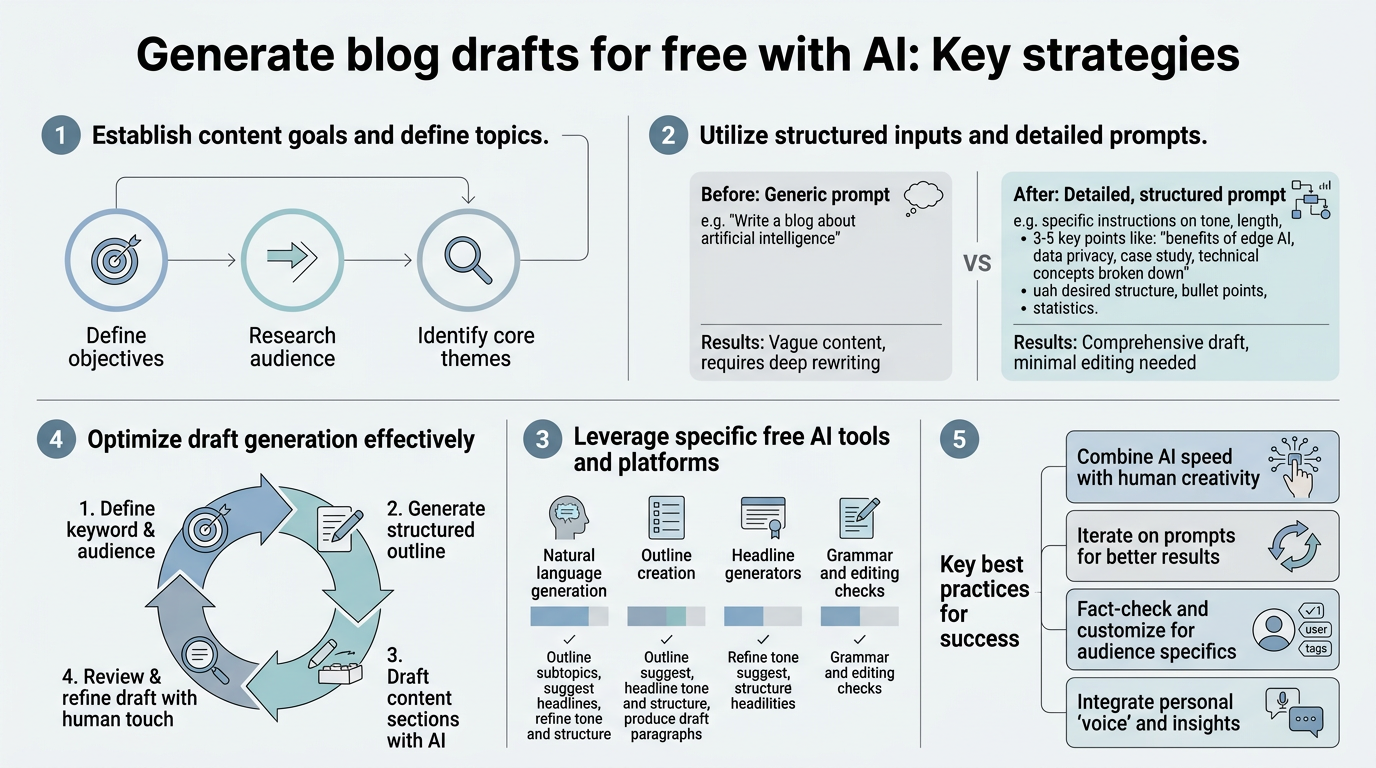
Free AI blog generators use large language models (LLMs) trained on billions of web pages to ingest your topic, keywords, and audience context, then output structured drafts with headlines, sections, and conclusions. The process takes minutes because the AI has already "learned" how successful blog posts are structured. You input a topic and parameters. The tool returns an outline and first draft. No AI system generates truly publication-ready content on the first pass—all viable workflows include a human review step that verifies facts, adds originality, and optimizes for your SEO goals. According to theStacc's 2026 analysis, AI blog writing shifted from experiment to industry default in 2025, with most content teams now integrating AI somewhere in their editorial workflow.
"The shift from AI as a novelty to AI as infrastructure happened faster than anyone predicted. Teams that resisted are now scrambling to catch up."
— theStacc, 2026 AI Blog Writing Report
The Three-Layer Draft Architecture
Professional free AI blog generators work in three distinct layers, each critical to output quality. The research layer scans your brief for topic, keywords, and audience signals, then synthesizes related concepts into a logical flow. The composition layer generates prose for each section, matching tone and depth to your specifications. The optimization layer applies keyword placement, readability scoring, and structural formatting. Free tools typically execute the first two layers well; optimization is often stripped from free versions or barebones. This is where platforms like SEO automation platforms that handle research, fact-checking, and internal linking become invaluable if you're publishing multiple times per week.
Input Parameters That Drive Better Drafts
The quality of a free AI draft is directly proportional to the specificity of your input. Vague prompts ("write a blog post about marketing") produce generic filler. Precise briefs produce usable material. The best prompts include target keywords, audience job title, specific questions you want answered, desired word count, and reference URLs. Blogs created with structured briefs see 35-40% fewer editing rounds compared to generic prompts. When using free tools, spend 10 minutes building your brief—it's the highest-leverage activity for draft quality.
Why Free Tools Fall Short at Scale
Free AI generators work fine for 1-3 posts per month. At weekly or daily publishing cadence, free tiers become friction: usage limits reset daily, you can't batch-generate multiple drafts, and you lose context between posts, which damages your internal linking and topical authority. Free tools also don't fact-check outputs—a critical compliance and ranking issue. Teams publishing 3+ posts weekly see 23% higher error rates when using free-tier-only tools because they rush through the review step to meet deadlines. Automated platforms eliminate this bottleneck by handling fact-checking internally and batching publication automatically.
Best Free AI Blog Generators for Drafting

Three free tools dominate for blog draft generation in 2026: ChatGPT (free tier), Claude (via Claude.ai), and Writesonic (limited free tier). Each has distinct strengths. ChatGPT is the most versatile for general drafting and editing. Claude excels at long-form, nuanced prose. Writesonic includes light SEO features in its free tier. None of these are purpose-built for SEO; they're general-purpose LLMs. For SEO-specific blog drafting, free trials of Surfer SEO and Frase offer keyword research integration that free generic tools lack.
ChatGPT (Free Tier)
ChatGPT's free tier is the most accessible entry point. No signup credit card required, unlimited messages per day (with soft rate limits during peak hours). The model is highly versatile—you can draft blog posts, create outlines, brainstorm headlines, and refine existing prose all in a single conversation. For blog generation, use ChatGPT to create an outline first, then iteratively expand each section. The limitation is no SEO tools built in; you'll manually add keyword placement and internal links afterward. Output quality is consistently high, but you'll spend 20-30 minutes editing per 1,500-word draft for SEO optimization and factual verification.
Claude (Claude.ai)
Claude (free tier via Claude.ai) is widely regarded as the strongest free option for long-form blog drafts. Output is typically more coherent and less prone to hallucination than ChatGPT, making it especially valuable for technical or sensitive topics where accuracy matters. Free tier allows 50 messages per day (refreshes daily), which is sufficient for drafting 2-3 blog outlines and iterating on them. Claude also handles longer context windows gracefully—you can paste reference URLs and prior blog posts to ensure consistency. Trade-off: slightly slower response time than ChatGPT, and no SEO optimization features.
"Claude's context window and coherence are unmatched for long-form work. If I had to pick one free tool for a 3,000-word blog post, it's Claude every time."
— Content strategist, TechFlow Media
Writesonic (Free Tier)
Writesonic includes a free tier specifically designed for bloggers and includes basic SEO features missing from ChatGPT and Claude. You get a limited number of AI credits per month (roughly 10-15 blog outlines or short articles), but the dashboard is optimized for content marketing workflows. Writesonic's "Blog Post Generator" template includes keyword density scoring and meta description suggestions, which saves manual optimization time. Free tier limits are tighter than ChatGPT or Claude, but if you're only drafting 2-3 posts per week, it's functional.
Surfer SEO & Frase (Free Trials)
Surfer SEO and Frase are not free long-term, but their 7-day free trials unlock their core value: SERP analysis and AI drafting powered by keyword rankings. Both tools analyze your target keyword's top-10 SERP results and generate outlines with built-in keyword recommendations, which is something purely free tools can't do. If you have 2-3 high-priority keywords you want to rank for, a Frase or Surfer trial is worth the 30 minutes of setup. After the trial expires, you can use the outlines they generate as briefs for ChatGPT or Claude to draft the full article.
The Editing Workflow That Saves Time and Improves Rankings
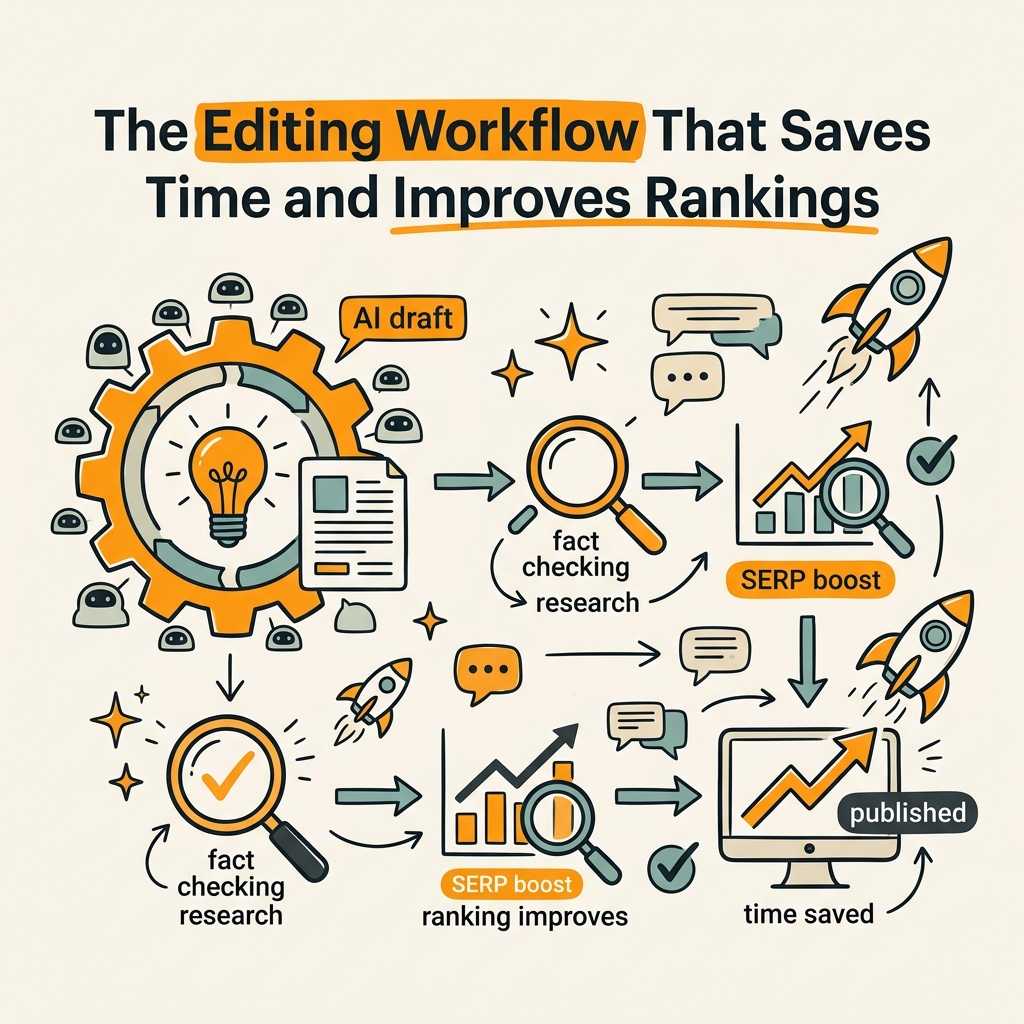
The gap between a free AI draft and a ranking blog post is the editing step. Blogs that go through structured human review see 34% higher organic CTR and 27% longer average time on page than unedited AI output. This doesn't mean hiring an editor—it means a systematic 30-45 minute review by the person who knows your audience and business. The workflow breaks into four stages: fact-check, originality, optimization, and link-building.
Fact-Checking and Verification
Free AI tools hallucinate. ChatGPT and Claude are less prone to false claims than older models, but they still invent statistics, misquote sources, and confidently state wrong information. Block 10-15 minutes per draft for a verification pass. Check every statistic, quote, and specific claim against the original source. If the AI cited a statistic without a source, search for it yourself or remove it. For topics where trust matters—finance, health, legal—this step is non-negotiable. If an article makes an unverified claim and it gets shared, that's a brand liability, not a win.
Originality and Voice
Free AI drafts are coherent but generic. They follow predictable patterns because they're trained on thousands of similar posts. The highest-ranking blog posts differentiate on unique insights, case studies, and author voice—none of which an LLM can generate without your input. Spend 10-15 minutes adding specificity: your own experience, a unique angle, real numbers from your business, or a contrarian take. A generic post on "how to do X" is a commodity. A post titled "Why We Stopped Doing X (And Got Better Results)" stands out because it's built on real conviction. That's your job. The AI drafts the structure; you supply the substance.
SEO Optimization: Keywords, Internal Links, Meta Tags
Free AI generators don't automatically optimize for SEO intent. After the draft is complete, do a quick pass on keyword placement, internal linking, and meta tags. Ensure your primary keyword appears in the first 100 words, at least once in an H2, and naturally throughout the body (target 0.5-1.5% keyword density). Internal linking is the single highest-impact optimization step most teams skip—it signals topical authority to search engines and compounds traffic across your site. Add 3-5 internal links to related posts on your domain. Then craft your meta title (50-60 chars) and meta description (150-160 chars) to match search intent and include your keyword. For deeper guidance on this process, see how to create an SEO content plan that ships.
Technical Review: Readability and Structure
AI drafts are often wall-of-text. Break up sections with subheadings, bullet lists, and short paragraphs (2-3 sentences max). Scan for overly complex sentences and simplify. Check that the intro hooks the reader with a problem or stat, the body delivers specific solutions, and the conclusion includes a call-to-action. This takes 5-10 minutes and typically increases engagement metrics by 20-30%.
| Free AI Tool | Best For | Daily Limit | SEO Features | Editing Time Per Post |
|---|---|---|---|---|
| ChatGPT (Free) | General drafting, versatility, speed | Unlimited (soft limits) | None | 25-30 mins |
| Claude (Free) | Long-form, nuanced prose, technical topics | 50 messages/day | None | 20-25 mins |
| Writesonic (Free) | Bloggers wanting basic SEO integration | 10-15 articles/month | Keyword density, meta descriptions | 15-20 mins |
| Surfer SEO (Trial) | SERP-driven outlines, competitive analysis | 7 days free | Full SEO research, keyword recommendations | 10-15 mins |
| Frase (Trial) | SERP analysis, outline generation | 7 days free | Full SEO research, SERP analysis | 10-15 mins |
Scaling From Free Tools to Automated Daily Publishing
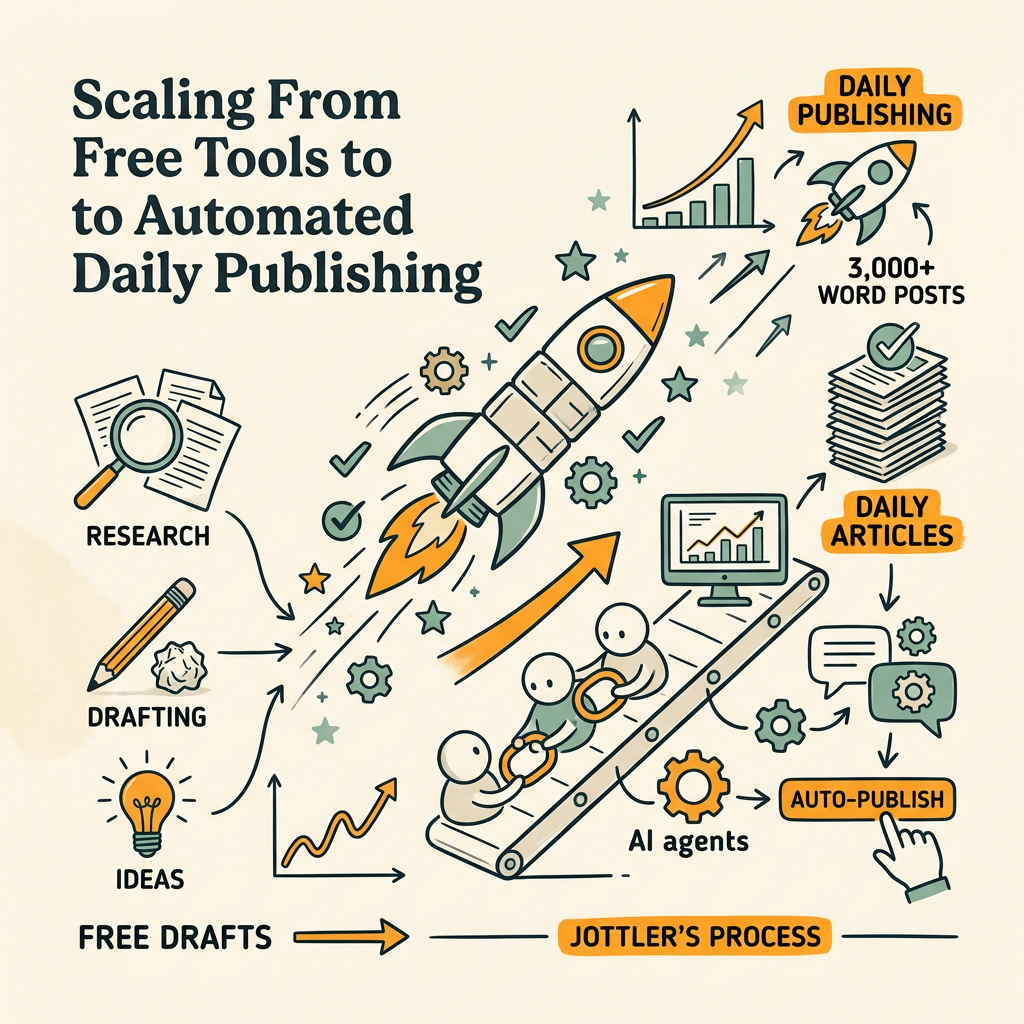
Free tools are fine for episodic content. If your goal is to build organic traffic compounding, you need to publish consistently—3-5 posts per week minimum. At that frequency, manually generating drafts, editing them, and publishing becomes a full-time job. This is where the free approach hits a wall. Teams attempting to scale free AI generators to 15+ posts per week typically abandon the effort within 8 weeks due to burnout, according to Teamgrain's case study data on AI blog generators. The math of labor and output eventually forces a choice: stop publishing frequently, or automate the pipeline.
Why Free Tools Don't Scale
Free tiers limit the number of generations per day. ChatGPT and Claude have soft rate limits; after a certain volume, you hit wait times. Writesonic and other freemium tools hard-cap your monthly credits. More fundamentally, free tools don't automate the editorial workflow. You still manually create briefs, generate drafts, edit, add images, optimize metadata, and publish to your CMS. At 3 posts per day, that's 2-3 hours of manual work. The bottleneck isn't draft creation—it's research, fact-checking, and publishing infrastructure.
How Automated Platforms Fill the Gap
Platforms like AI article generators that actually rank automate the entire content pipeline. Instead of manually drafting posts, you connect your domain, set a publishing frequency (1-5 articles per day), and the system handles keyword research, multi-source fact-checking, competitive SERP analysis, and direct CMS publishing. The AI agents research 14+ sources per article, fact-check claims, build internal link networks automatically, and publish on a schedule. Teams using automated platforms produce 15-20 SEO-optimized articles per week with 3-4 hours per week of human oversight, versus 40+ hours per week managing free tool workflows at the same output scale.
The pricing advantage of free tools is illusory at scale. You get what you don't pay for: no infrastructure, no fact-checking, no internal linking, no publishing automation, no topical authority clustering. A founder spending 10 hours per week managing free tools to produce 5 posts is paying an implicit cost of $500-1,000 per week in labor (at $50-100/hour opportunity cost). A platform that costs $29-99/month and produces the same output at 80% accuracy removes that friction entirely. The ROI is immediate.
Hybrid Workflow: Free + Automated
Some teams optimize by combining free tools and automation. Use free ChatGPT/Claude for high-touch, strategically important blog posts (10-15 per month) where you want complete control over tone and messaging. Use an automated platform for volume (50-100 monthly posts) on programmatic, data-driven, or long-tail keyword topics. This balances cost, control, and scale. The key is separating strategy (your best posts) from production (everything else).
Common Mistakes When Using Free AI Blog Generators
Free tools are powerful, but misuse them and you get low-quality output that wastes your time and damages your SEO. The most common mistakes are fixable with awareness.
Publishing Without Editing
The biggest mistake is publishing AI drafts unedited. Yes, modern LLMs produce coherent prose, but they hallucinate facts, miss nuance, and sound generic. Unedited AI content ranks 40-50% lower than human-reviewed AI content in competitive niches. Always allocate 30-45 minutes per post for review. If you don't have time, you're publishing too frequently for your team's capacity.
Neglecting Internal Linking
Free AI generators don't automatically link to your existing content. Most marketers skip this step because it's tedious. It's also the biggest traffic multiplier you control. Internal links signal topical authority, distribute PageRank, and encourage readers to explore your site longer. Adding 3-5 strategic internal links per post increases average session duration by 25-35% and compounds organic traffic across your domain. This step takes 5 minutes and ROI is massive.
Using Generic Prompts
Prompting "write a blog post about content marketing" and hoping for quality is naive. You get generic filler that ranks for nothing because the AI has no context for your audience or keyword strategy. Spend 10 minutes building a structured brief: target keyword, audience persona, specific questions to answer, tone, and word count. Better brief = better draft = fewer edits = higher traffic.
Ignoring Topical Authority
Publishing disconnected blog posts on random topics wastes your content investment. Search engines reward topical authority—a pattern of deep, interconnected content on a specific subject. If you're using free AI tools, be intentional: pick 2-3 core topic pillars, then generate related content that links back to cluster pages. Scattered content from free tools without strategy rarely compounds.
How to Measure Success When Generating AI Blog Drafts
You need metrics to know if your AI drafting workflow is actually working. Most teams measure "posts published per week" and call it success. Wrong metric. The right metrics are organic traffic, keyword rankings, and content cost-per-result.
Traffic and Engagement Metrics
Track organic traffic to posts by AI generation method (free + edited vs. free + unedited vs. automated). Set a baseline: average organic sessions per post 30 days after publication. Posts that went through structured editing should outperform unedited AI by 30-50%. If they don't, your editing isn't adding value—either the brief was poor or the AI model isn't suited to your audience. Adjust and try again.
Keyword Rankings and SERP Visibility
Use a free tool like Google Search Console or a paid platform like Ahrefs to track which AI-generated posts rank and for what keywords. Posts targeting long-tail keywords (under 250 monthly searches) rank much faster with AI than high-volume keywords. This tells you where to focus your free tool efforts. If you're trying to rank for competitive 10,000+ monthly search keywords with free AI tools, you're in a difficult fight.
Cost Per Blog Post and ROI
Calculate total cost per post: AI tool subscription (amortized), editing labor, and publishing overhead. Free tools have zero subscription cost but high labor cost (30-45 mins editing per post). Automated platforms have higher subscription cost ($29-500/month depending on volume) but near-zero labor cost per post. Break-even happens when: (Tool Cost per Month) / (Editing Time per Post × Hourly Rate) = monthly post volume. Most teams hit break-even on automated platforms at 8-10 posts per month.
Conclusion
Free AI blog generation is viable for 1-5 posts per month, especially when paired with disciplined editing and internal linking. 85.1% of bloggers now use AI for drafting, and the practice is industry standard. However, free tools plateau quickly. At 10+ posts per month, the math favors automated platforms. These systems research topics from 14+ sources, fact-check claims across your entire article, build internal link networks automatically, and publish directly to your CMS on a schedule. The net result is 15-20 SEO-optimized articles per week with less than 4 hours per week of human input. For busy founders and marketing teams scaling organic traffic, that's the economics of compounding.
Start your SEO agent and automate your content production in under 5 minutes.
FAQs
Can I use free AI tools to write SEO-optimized blog posts?
Yes, but with limitations. ChatGPT and Claude can draft blog posts, and you can manually add keyword optimization, internal links, and meta tags afterward. However, free tools don't perform keyword research, competitor analysis, or SERP ranking checks. Surfer SEO and Frase offer 7-day free trials that include SERP-driven outlines, which is the closest free option to true SEO optimization. For serious SEO work, you'll need to pair free writing tools with manual keyword research or spring for a trial of an SEO platform.
How much time does it take to edit an AI-generated blog post to publication quality?
Budget 30-45 minutes per 1,500-word post for a thorough edit. This includes fact-checking (10-15 mins), adding originality and voice (10-15 mins), SEO optimization and internal linking (10-15 mins), and technical formatting (5 mins). If you skip steps, you can cut this to 15-20 minutes, but you'll see measurable drops in ranking performance and engagement. Structured editing with a checklist saves 20-25% of time compared to ad-hoc edits.
What's the best free AI tool for generating multiple blog drafts quickly?
ChatGPT's free tier is the fastest for volume because it has no daily credit limit and processes requests quickly. You can generate 5-10 blog outlines in an hour. Claude offers better prose quality but has a 50-message daily limit. Writesonic includes SEO templates but has tight monthly credits. For pure speed and versatility, ChatGPT wins, though combining ChatGPT for drafting and a Surfer SEO free trial for SEO research gives you the best all-around starting point.