Google Map Pack Optimization Checklist
The Google Map Pack captures over 44% of all clicks on local search results, yet most businesses waste time on generic SEO while their Map Pack listing languishes in obscurity. If you're not optimizing for local search, you're handing your competitors a direct pipeline to customers actively ready to buy. The fix is systematic: audit your Google Business Profile, strengthen your review signal, and align your on-page relevance. Here's the complete checklist to claim your spot in the top three.
Key Takeaways
- Google Business Profile signals account for 32% of Map Pack ranking weight, making profile optimization your highest-leverage task (2026, GBPPromote)
- Review velocity and recency now matter more than total review count—consistent monthly reviews outrank stale high-volume listings
- The three ranking pillars are relevance, distance, and prominence; you control two of them directly
- Google Business Profile Completeness: 32% of Map Pack weight comes directly from profile signals; a fully optimized GBP is non-negotiable for visibility.
- Review Signal Strength: Recency and consistency beat volume—monthly reviews generate more ranking lift than quarterly bursts.
- Category and NAP Precision: Choosing the most specific primary category and maintaining consistent business name, address, phone across the web directly feeds relevance and prominence.
- Photos and Posts Freshness: Active profile signals (recent uploads, regular posts) tell Google your business is maintained and trustworthy.
- Behavioral and Citation Authority: Clicks, calls, direction requests, and citations from authoritative local directories strengthen prominence independent of reviews alone.
How Does Google's Map Pack Ranking Algorithm Work?
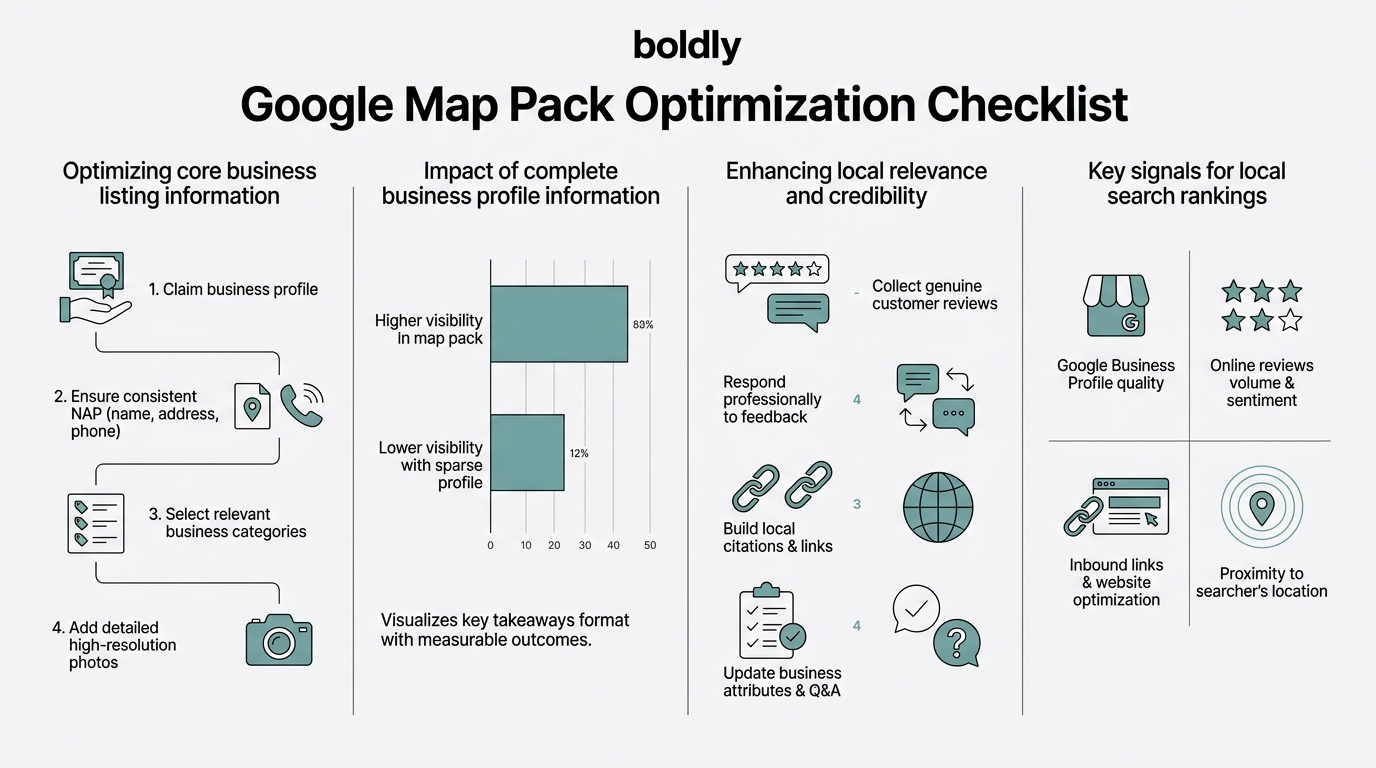
Google determines Map Pack placement using three core pillars: relevance, distance, and prominence. Distance is fixed by the searcher's location, so your real leverage sits in relevance and prominence. According to 2026 data from GBPPromote, the algorithm allocates 32% weight to Google Business Profile signals, 20% to review signals, 15% to on-page signals, 9% to behavioral signals, 8% to links, 6% to citations, 6% to personalization, and 4% to social signals. This means your GBP is the primary battleground—eight of the top ten ranking factors originate directly from your profile.
"The algorithm doesn't reward businesses for building outdated profiles and hoping for visibility. It actively penalizes stagnation. Your GBP must reflect current operations, recent customer interactions, and proof of active management—or your competitors will bury you."
Relevance measures how well your profile matches the search query. If someone searches "Italian restaurant with outdoor seating," Google checks your primary category, services listed, business description, and attributes. Distance is proximity to the searcher's location or search radius. Prominence reflects how well-known and trusted your business is—indicated by reviews, citations, links, and engagement (clicks, calls, direction requests).
The algorithm doesn't treat all reviews equally anymore. Review velocity—consistent monthly acquisition—now outweighs raw review count. A business with 50 reviews from the past 12 months ranks higher than one with 200 total reviews spread over five years. Recency signals active management and current relevance.
Audit and Complete Your Google Business Profile
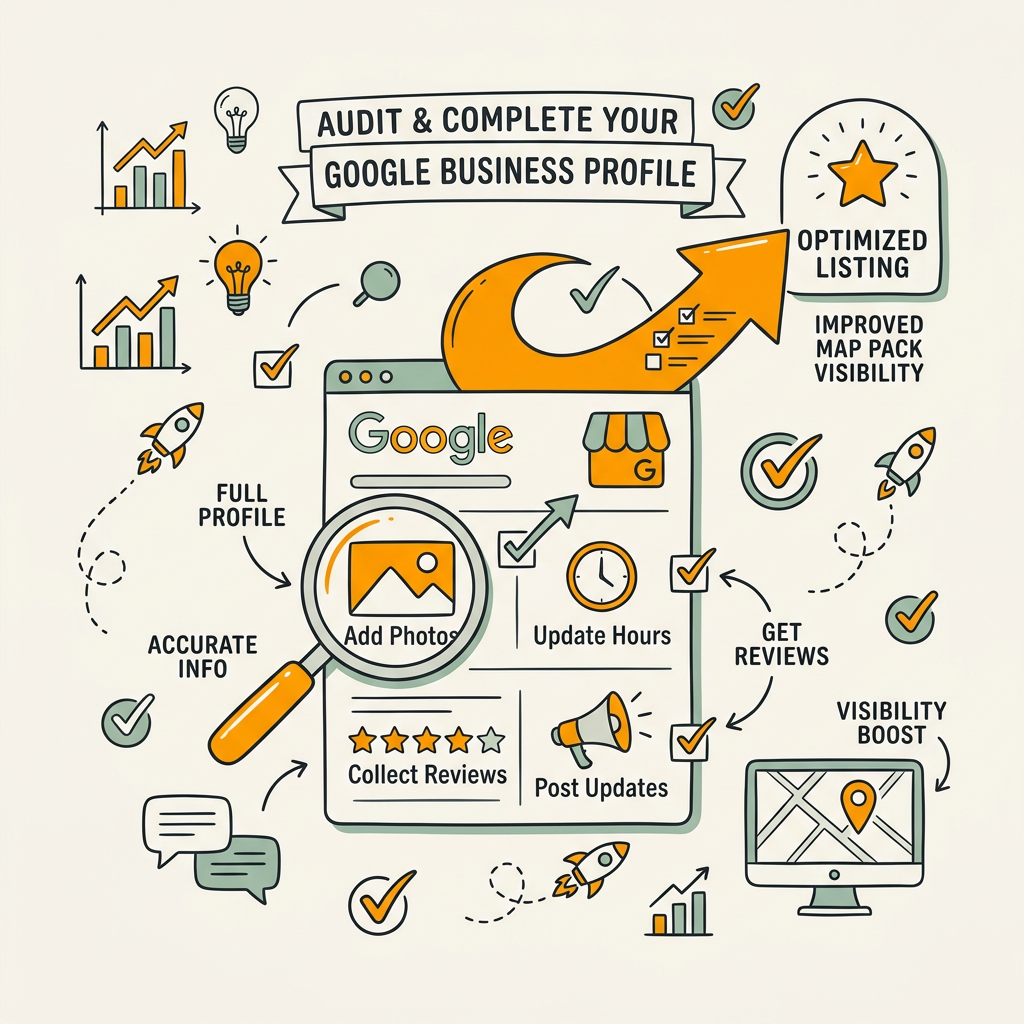
Your GBP is your single most controllable asset in Map Pack rankings. An incomplete profile loses ranking potential immediately. Start with a thorough audit: verify every field is filled, accurate, and optimized for search intent. This foundational work aligns with broader SEO automation strategies that ensure consistency across all your web properties.
Claim and Verify Your Business Profile
If you haven't claimed your GBP, do this first. Access Google Business Profile directly through Google Search and sign in with an authorized company account. Verify your listing through one of Google's methods—postcard, phone, or email, depending on your business type. An unverified profile cannot rank in the Map Pack, so verification is non-negotiable. Once verified, you unlock the ability to manage every element below.
Optimize Your Primary and Secondary Categories
Your primary category is the single most important relevance signal after your business name. Choose the most specific category available—not the broadest one. If you're a pediatric dentist, select "Pediatric Dentist" not "Dentist." Secondary categories expand your relevance surface. Add three to five secondary categories that accurately describe your services. Incorrect or vague categories can cost you 5-10 positions in rankings because Google assumes your profile doesn't match common search intents.
Example categorization:
- Primary: Pediatric Dentist
- Secondary: General Dentist, Cosmetic Dentist, Orthodontist
Write a Keyword-Rich Business Description
Your business description appears in search results and on your GBP. Use this 750-character field strategically. Include your primary service offering, geographic focus, and unique value prop in the first sentence. Then layer in secondary keywords naturally. Example: "Award-winning pediatric dental practice serving children ages 2-18 in downtown Portland with same-day appointments, sedation dentistry, and emergency care."
Avoid keyword stuffing. Google penalizes obvious manipulation. Your description should read like marketing copy, not a keyword list. The goal is to match searcher intent while signaling relevance to the algorithm.
Add Services, Products, and Attributes
Fill every available field: services offered, products sold, amenities (WiFi, parking, wheelchair access), languages spoken, payment methods, and special attributes (LGBTQ+-owned, woman-owned, eco-friendly, etc.). Each attribute is a relevance signal. If you offer "emergency dentistry," add it explicitly—searchers filter by this attribute, and it directly feeds your ranking for relevant queries.
Upload High-Quality Original Photos and Videos
Google prioritizes original photos over generic stock images. Upload 10-20 high-resolution photos showing your storefront, interior, team, and happy customers. Add captions with service keywords naturally woven in. Video content also signals an active, professional business. Upload at least one video—a 30-second walkthrough or service demo. Profiles with video content see 15-30% higher engagement and stronger behavioral signals than text-only listings.
Build a Consistent Review Generation and Response Strategy
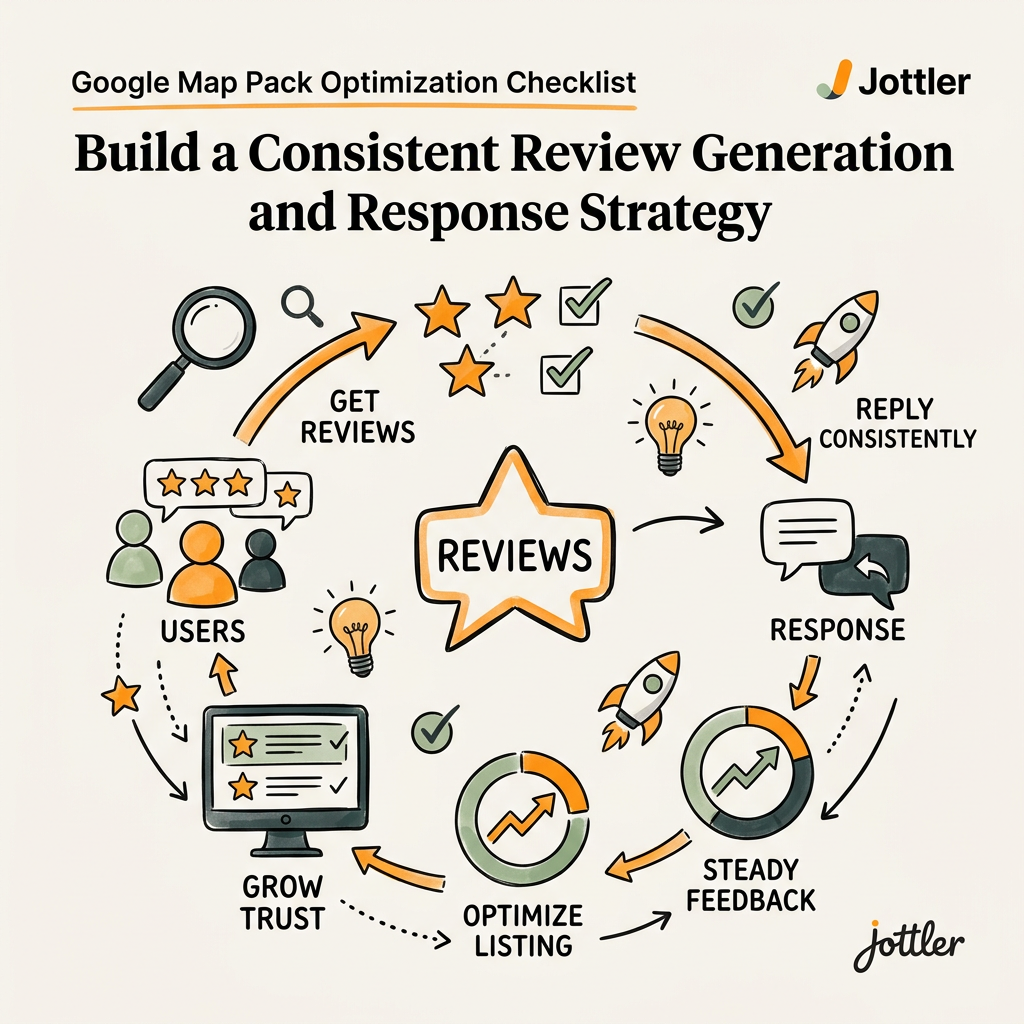
Reviews account for 20% of Map Pack ranking weight in 2026, but the game has shifted. Volume alone no longer wins. Consistency, recency, and response rate matter more than total star count. A business that earns 10 reviews monthly ranks higher than one with 200 reviews from years past. For growing companies managing local presence alongside broader content strategy, integrating review workflows with content marketing automation helps ensure consistent messaging and engagement across all channels.
Establish a Monthly Review Acquisition Cadence
Rather than sporadic campaigns, aim for steady monthly review generation. If you typically close 50 deals per month, target 10-15 reviews monthly. This consistency signals to Google that your business is active and maintains customer relationships. Use multiple channels: email post-purchase, SMS requests, in-app prompts, and post-service follow-ups. Tools that automate review requests based on transaction events are more effective than one-off campaigns.
"Timing is everything. Businesses that request reviews within 24-48 hours of service delivery see 3-5x higher completion rates than those waiting days or weeks. The customer is still in peak satisfaction mode, and friction is minimal."
Timing matters. Ask for reviews within 24-48 hours of service delivery, when satisfaction is highest and memory is fresh.
Respond to Every Review—Positive and Negative
Review response rate is a ranking signal. Google interprets lack of response as low business engagement. Respond to 100% of reviews, even one-star reviews. For positive reviews, thank the customer by name and mention a specific detail from their experience. For negative reviews, apologize, take responsibility, and offer to resolve offline. Keep responses professional and under 150 words. Response time should be 24-48 hours maximum.
Use Review Insights to Improve Your Service
Beyond ranking signals, reviews reveal what customers love and what frustrates them. If multiple reviews mention "long wait times," that's a service gap to address. Google's algorithm detects when a business responds to feedback and improves—this behavioral pattern strengthens prominence over time.
What Is Your On-Page and Citation Authority Foundation?
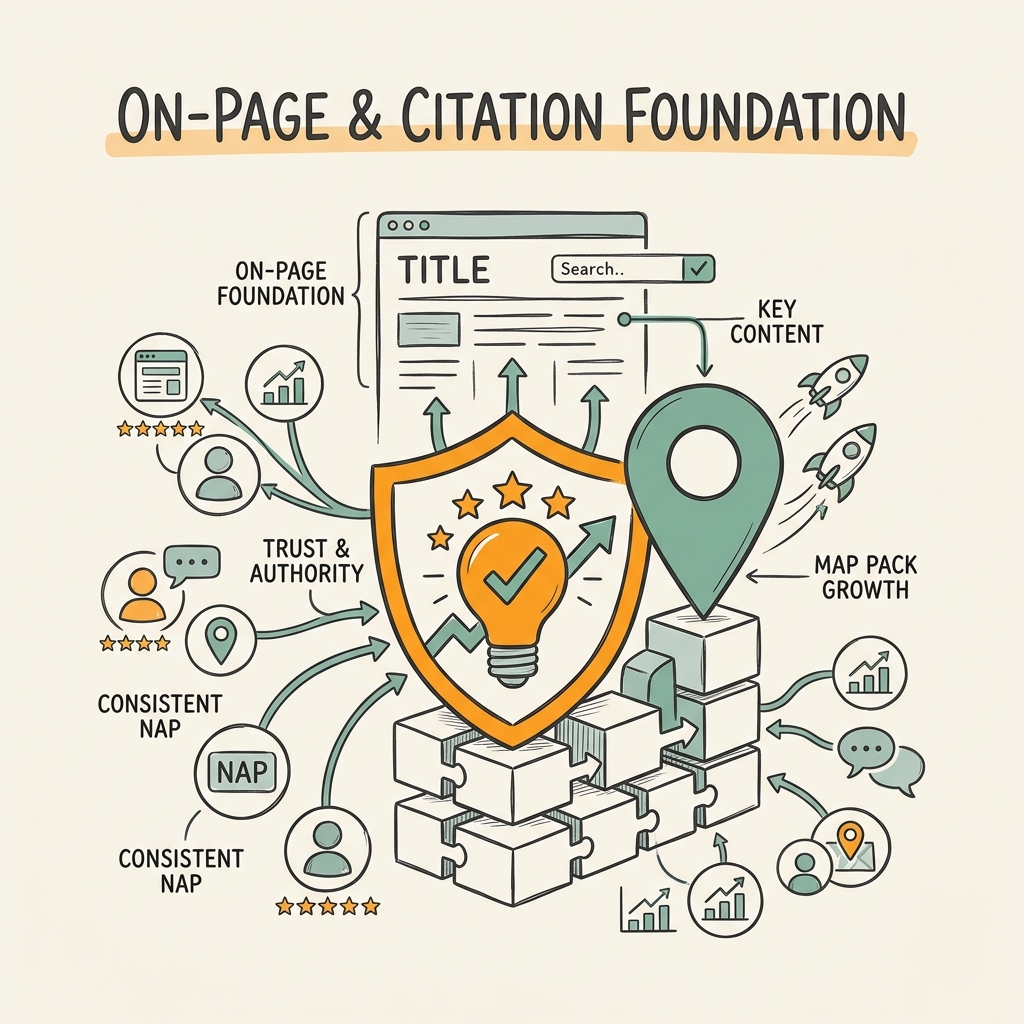
While 32% of Map Pack weight comes from your GBP, the remaining 68% distributed across on-page signals, citations, links, and behavioral factors still requires attention. Your website and local web presence must align with and reinforce your Map Pack profile. Building this foundation extends to ensuring your broader organic presence supports local intent, which is why many teams pair Map Pack optimization with structured SEO strategy across their entire site.
Build NAP Consistency Across Your Website and Citations
NAP stands for Name, Address, Phone. Google cross-references your GBP against your website, citations, and online mentions. Inconsistencies confuse the algorithm and weaken prominence. Audit your entire web footprint:
- Your website's header, footer, and contact page must show the exact same business name, address, and phone as your GBP
- If your business moved, update NAP everywhere—not just your website
- Use consistent phone formatting: (123) 456-7890 or 123-456-7890, but pick one and stick with it
- Verify all major citations (Google Maps, Apple Maps, Yelp, Yellow Pages, industry directories) match your GBP
A single NAP inconsistency across 10 directories weakens your authority signal. Aim for 95%+ consistency.
Create Location and Service Pages on Your Website
If you serve multiple locations or service areas, build dedicated pages for each. A plumber serving five neighborhoods should have five location pages, each optimized for that area's keywords. A therapist with an online practice should create a service page for each type of therapy offered. These pages feed on-page relevance signals directly to your Map Pack ranking.
Example structure for a multi-location business:
- Main website: broad service overview
- /locations/downtown: service details + location-specific testimonials + local links
- /locations/uptown: same structure, different location details
- Each location page links back to the main site and your GBP
Earn Citations from High-Authority Local Directories
Citations are online mentions of your business that include your name, address, and phone. High-authority citations (Yelp, Apple Maps, Better Business Bureau, industry-specific directories) strengthen prominence. Low-quality or inconsistent citations weaken it. Audit your citation profile: use tools to scan where your business appears, then prioritize getting listed in top-tier directories relevant to your industry. According to Almcorp's 2026 guide, citation quality and consistency directly correlate with Map Pack climb.
| Citation Source Type | Relative Importance | Example Directories |
|---|---|---|
| Major Search & Maps | Highest | Google Maps, Apple Maps, Bing Places |
| Industry-Specific | High | Healthgrades (healthcare), AVVO (legal), Angie's List (home services) |
| General Local | Medium | Yelp, Better Business Bureau, Yellow Pages |
| Niche Aggregators | Medium | Chamber of Commerce, local tourism boards, award directories |
| Irrelevant or Low-Quality | Low or Negative | Spam directories, auto-generated listings with incorrect info |
How Do You Strengthen Behavioral and Link Authority Signals?
Behavioral signals—clicks, calls, direction requests, and user engagement—now represent 9% of Map Pack weight, a growing factor as Google shifts toward user interaction data. Link signals account for 8%. These aren't vanity metrics; they directly influence rankings.
Optimize Your GBP Call-to-Action and Booking Integration
Make it frictionless for customers to contact you. Add a clickable phone number prominently in your GBP. Enable booking if your business type supports it (salons, restaurants, service providers). Use Google's appointment booking feature if you offer scheduled services. Every click and booking generates a behavioral signal that strengthens your ranking. A business that receives 20 calls per month from the Map Pack ranks higher than one receiving 2 calls.
Build Relevant Local Backlinks and Mentions
Link signals carry less weight than they did a decade ago, but local authority backlinks still matter. Earn links from:
- Local news outlets and business journals
- Chamber of Commerce and industry association pages
- Award listings and "best of" directories relevant to your category
- Local nonprofit or educational institution partnerships (with proper link attribution)
- Branded mentions on local influencer or partner websites
Quality over quantity. Three links from high-authority local sources outweigh 30 links from spam directories. When you do earn a link, ensure your business name and location are mentioned in the anchor text or surrounding context to reinforce relevance.
Track Behavioral Metrics Beyond Rankings
Use Google Business Profile Insights to monitor clicks, direction requests, call clicks, and message inquiries monthly. These metrics are leading indicators of ranking momentum. If direction requests drop 20% month-over-month while competitors gain, your Map Pack position is likely at risk. Use this data to refine your profile, messaging, and call-to-action. Busy founders and marketing teams benefit from automating this monitoring workflow alongside their broader SEO optimization tools to catch performance shifts immediately.
How Should You Monitor and Iterate on Your Map Pack Performance?
Optimization doesn't end at launch. Map Pack rankings shift as competitors optimize, reviews accumulate, and Google's algorithm evolves. Establish a monthly review cadence to track progress and identify gaps.
Monitor Rank Tracking and Competitor Movement
Use rank tracking tools to monitor your position for high-intent keywords in your service area. Track not just your rank, but your competitors' reviews, photo count, post frequency, and rating changes. If a competitor jumps from rank 3 to rank 1, audit what changed: did they gain 50 reviews? Add new services? Post more frequently? Use these signals to prioritize your next optimization.
Audit Your Profile Monthly and Update Seasonally
Set a calendar reminder to review your GBP monthly. Check for:
- New customer questions answered
- Review response status (aim for 100% response within 48 hours)
- Outdated photos or information
- NAP consistency across web properties
- Missing attributes or services that competitors added
Add seasonal updates to your posts: holiday hours, seasonal promotions, or service adjustments. Posts published in the past week signal activity to the algorithm, supporting both relevance and prominence.
A/B Test Your Call-to-Action and Messaging
Try different business descriptions, attributes, or post messaging to see what drives the most clicks and calls. If your current description emphasizes "affordable" but your call volume doesn't spike, test a version emphasizing "emergency appointments" or "walk-ins welcome." Iterate based on behavioral data, not assumptions.
Conclusion
Claiming the top three positions in Google's Map Pack requires systematic optimization across your Google Business Profile, review strategy, on-page presence, citations, and behavioral engagement. Businesses that fully optimize their GBP see 15-30% increases in customer inquiries within three months. Start with the highest-leverage tasks: complete your profile with correct categories, establish a consistent monthly review cadence, and audit your NAP consistency across the web. Then layer in behavioral signals through engagement tracking and link building.
For busy founders and marketing teams managing multiple locations or service areas, scaling this checklist across a portfolio is resource-intensive. Tools like Jottler that automate content research and publishing can help teams maintain fresh, location-specific website content that feeds Map Pack relevance signals without constant manual effort. A weekly blog post about local service trends or neighborhood highlights strengthens on-page authority while freeing your team to focus on review generation and GBP maintenance.
Start your SEO agent today and begin compounding your local search visibility with automated content that reinforces your Map Pack optimization efforts.
FAQs
How long does it take to rank in Google Map Pack?
Ranking timelines vary based on competition and your starting point. If your GBP is new or incomplete, expect 30-60 days to see meaningful ranking movement after a full optimization. If you're already ranked but pushing for top three, consistent review velocity and fresh profile activity typically drive rank improvement within 60-90 days. High-competition markets (major cities, saturated categories) take longer than niche or suburban areas. The key variable is your competitive landscape—how actively other local businesses are optimizing.
Does Google Map Pack ranking help organic search rankings?
Map Pack and organic rankings share some signals but operate as separate ranking systems. Strong on-page relevance and citations help both, but Map Pack weight is heavily concentrated on your GBP, reviews, and proximity. A business can rank #1 in Map Pack but not appear on page one of organic results, or vice versa. However, optimizing for both simultaneously is efficient: improving NAP consistency, earning reviews, and building local links helps both signals. The highest-performing local businesses appear in both the Map Pack and in organic top three.
What's the fastest way to improve Map Pack rankings?
Review velocity generates the quickest wins. Focusing on consistent monthly review acquisition is faster than building citations or links because you control it directly. A business that goes from zero reviews to 10 monthly reviews typically sees rank improvement within 30-45 days. Second fastest: fixing NAP inconsistencies and completing missing GBP fields (new photos, services, attributes). Third: responding to all existing reviews within 48 hours. These three tactics are fully under your control and deliver measurable ranking lift faster than off-site optimization.