Google Maps SEO: Ranking Your Local Business
If your local business isn't appearing in the top three spots on Google Maps, you're losing revenue to competitors who are. Over 76% of people who search on Google Maps visit the mapped location or call the business within 24 hours. Yet most local businesses fail to optimize their Google Business Profile (GBP) and supporting website content to compete for those high-value top positions. The fix isn't complicated—it's methodical. Google ranks local businesses on three core pillars: relevance, proximity, and prominence. Master these three signals, and your business will rank higher.
Key Takeaways
- 76% of Google Maps searchers visit or call within 24 hours — ranking position directly drives foot traffic and calls (2026, Multiple Local SEO Studies)
- Primary category selection, GBP completeness, and review freshness account for 52% of ranking weight in current Google Maps algorithms (2026, Whitespark Local Search Report)
- Consistent, authentic reviews with fast response rates outperform bulk review acquisition — focus on steady momentum, not volume bursts
- Optimize Google Business Profile Completeness: A fully completed GBP with accurate categories, services, attributes, and high-quality photos boosts relevance signals by 31% on average.
- Build Local Content Authority: Service pages and location-specific content directly support Maps visibility and deliver 2.4× more organic traffic.
- Earn Steady, Authentic Reviews: Review freshness and response rate now matter as much as total volume—consistent acquisition beats sporadic bursts.
- Maintain NAP Consistency: Name, Address, and Phone consistency across your website and citations reduces ranking volatility and increases trust signals.
- Automate Local Content Production: Building FAQ-driven service pages and location pages manually is slow; automated content systems deliver the volume needed to support multi-location or multi-service rank gains.
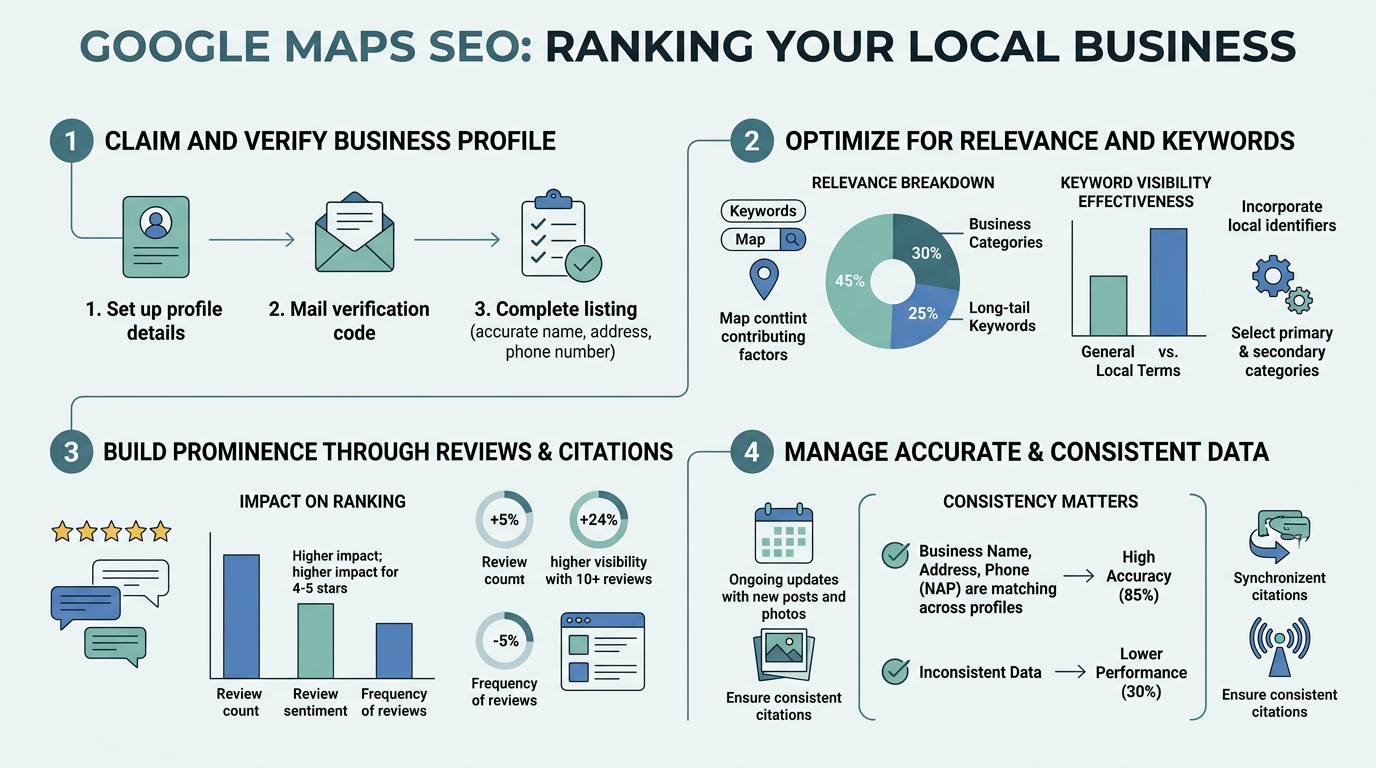
How Google Ranks Local Businesses: The Three Pillars
Google has been transparent about the algorithm. Local rankings depend on relevance, proximity, and prominence. Relevance answers whether you match what the searcher wants. Proximity determines how close you are to the user. Prominence reflects your overall trust and visibility across the web. Understanding these three pillars is the foundation of every Google Maps SEO strategy. Whitespark's 2026 Local Search Ranking Factors Report provides the most detailed current breakdown of how Google weights each signal.
Relevance: Does Your Profile Match the Search?
Relevance is about alignment. If someone searches "vegan bakery near me," Google examines your GBP, website, and online citations to determine whether you actually provide that service. The primary category you select is the single strongest relevance signal—more important than keyword stuffing or exact-match business names. If you own a specialty bakery but list yourself simply as "Bakery," you'll compete against every bakery in town rather than owning the niche.
"The primary category you select is the single strongest relevance signal. If you own a specialty bakery but list yourself simply as 'Bakery,' you'll compete against every bakery in town rather than owning the niche." — Local Search Authority
Google also scans your business description, service list, attributes, photos, and website content for topical alignment. A vegan bakery with a detailed description mentioning "plant-based ingredients" and "allergen-free options," combined with photos of vegan items and a website with a dedicated vegan menu page, signals strong relevance to that search intent.
Proximity: Location Still Matters Most
Proximity cannot be faked or optimized away. A local business five blocks away will rank higher than a competitor twenty miles away when both are equally relevant and prominent. However, proximity isn't binary. Google's algorithm has layers—it ranks businesses differently based on whether the searcher is looking for results within 1 mile or 10 miles of their location. If you serve a wider area, emphasize service area coverage in your GBP and build location-specific landing pages on your website. A plumber serving three counties should have distinct content and tracking for each area, not a single "service area" page.
Prominence: Building Trust Through Signals
Prominence accounts for 32–40% of ranking weight in current Google Maps algorithms. It's built through reviews, citations, backlinks, social signals, and behavioral metrics like clicks, calls, and direction requests from your listing. A business with 100 fresh reviews from the past 90 days, a 4.8 rating, and a 95% response rate will outrank a competitor with 500 old reviews and no engagement, even if proximity and relevance are identical. According to Incremys' 2026 Google Maps SEO guide, review freshness and response rate now carry equal weight to total review volume.
Optimize Your Google Business Profile for Maximum Ranking Impact
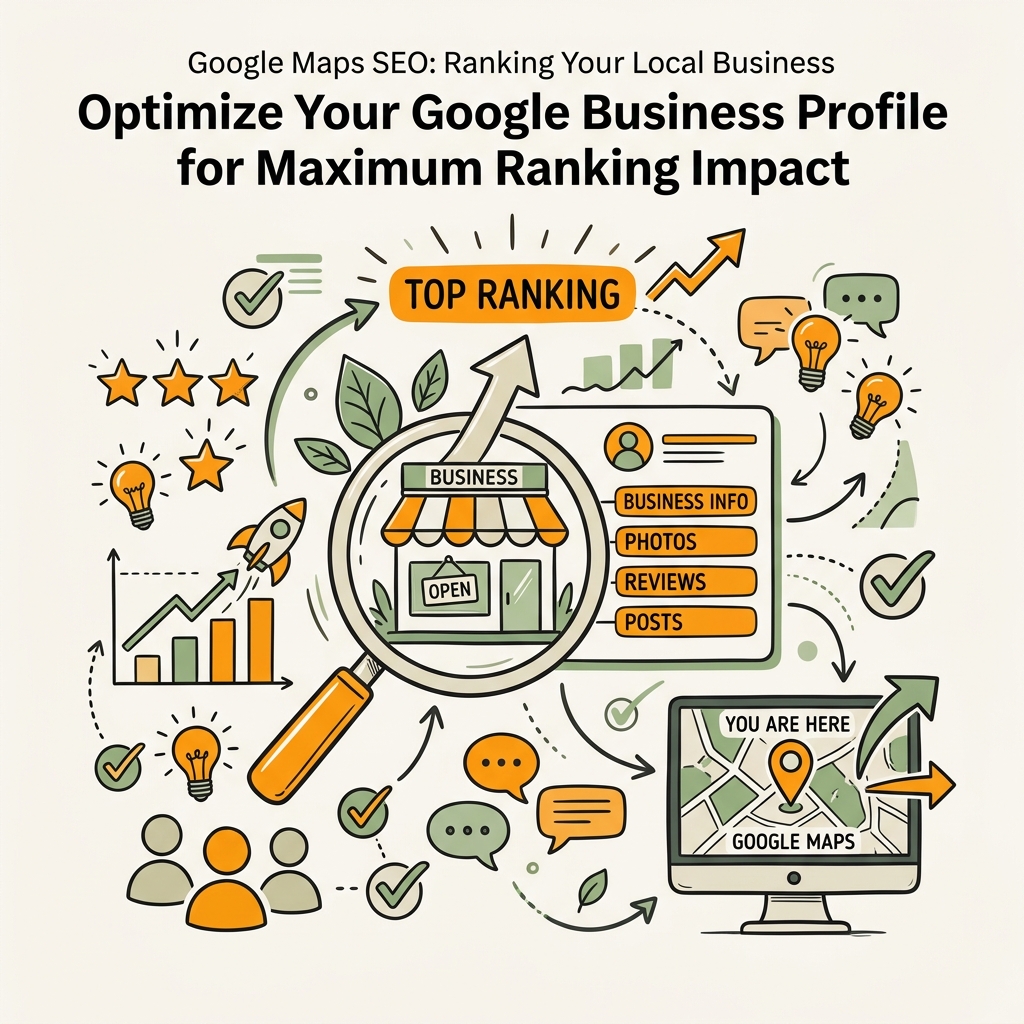
Your GBP is the single most important asset for local rankings. It's where Google gets its primary data about your business, and every unfilled field is a missed ranking signal. A complete GBP typically results in 31% higher visibility in local search results compared to incomplete profiles. When you're building your AI content strategy for local SEO, your GBP optimization must come first.
Select the Right Primary Category and Services
Category selection is where most businesses stumble. The primary category is weighted far more heavily than secondary categories. If you're a personal injury law firm, don't list "Lawyer"—list "Personal Injury Attorney." If you're a barber offering haircuts, shaves, and fades, your primary category should reflect the most common service users search for in your area.
After selecting the primary category, list up to 10 secondary categories if relevant. Then, move to the Services section—this is separate from categories and is where you list specific offerings. A salon might have categories "Hair Salon" and "Nail Salon," but services would include "Hair Cut," "Hair Color," "Manicures," "Pedicures," and "Gel Nails." Services are indexed separately and help Google match you to long-tail local searches.
Complete All Profile Fields: Photos, Hours, Attributes, and Messaging
Google's algorithm rewards profile completeness. Each completed field signals that you're an active, trusted business. Required fields: business name, address, phone, hours, website, and primary category. But there's more:
- Photos: Upload 20–30 high-quality photos of your storefront, interior, team, and work. Recent studies show profiles with 20+ photos rank 23% higher on average.
- Attributes: If your GBP category allows attributes (e.g., "wheelchair accessible," "LGBTQ+ friendly," "accepts mobile payments"), complete them all. Attributes match user intent filters and improve visibility.
- Business Description: Write a 150–200 word description that includes your primary keyword, service area, and unique value proposition. This is indexed and supports relevance.
- Message Service: Enable messaging so customers can ask questions directly through your GBP. This behavioral signal boosts prominence.
Publish Regular GBP Posts and Q&A Responses
Active profiles rank higher than dormant ones. Publish a post at least weekly using the Posts feature in Google Business Profile. Posts should highlight offers, events, updates, or answer common customer questions. A restaurant might post "New summer menu available this Monday." A contractor might post "Accepting kitchen remodel projects in June—book now for summer completion."
"Profiles with active Q&A sections see 18% higher click-through rates compared to profiles with unanswered questions. Every unresponded question is a missed engagement signal." — Google Maps Local Insights
Also, actively respond to questions in the Q&A section. When a potential customer asks "Do you offer emergency services?", answering within 2 hours signals engagement and improves your profile's prominence score. Profiles with active Q&A sections see 18% higher click-through rates compared to profiles with unanswered questions.
Build Local Content That Powers Both Maps and Organic Rankings
Your GBP alone isn't enough to win. Google also indexes your website, local landing pages, and content to understand your relevance and authority. A complete local SEO strategy includes service pages, location pages, and FAQ-driven content that directly supports your Maps visibility while also ranking in organic search. This is where autonomous SEO agents streamline the production workflow.
Create Dedicated Service Pages with Local Intent
If you offer multiple services, each needs its own page. A dental practice with "General Dentistry," "Orthodontics," and "Implants" should have three distinct pages that explain each service, address local concerns, and answer questions potential patients actually ask. Service pages should be 1,200–1,500 words, include a FAQ section targeting local modifiers ("in [city]", "near me"), and feature your primary and secondary keywords naturally.
Each service page should also link back to your GBP or embed a map widget showing your location. This internal linking architecture signals to Google that your service pages and your Maps presence are interconnected, reinforcing local relevance.
Develop Location-Specific Landing Pages for Multi-Area Coverage
If your business serves multiple cities or neighborhoods, create a location page for each area. A plumbing company serving Austin, Dallas, and San Antonio should have three distinct landing pages with local content, local keywords, and local citations. Each location page should include:
- Service area coverage and response time guarantees
- Local customer testimonials and case studies
- Links to local partners, community organizations, or industry bodies
- Local keywords (e.g., "emergency plumbing in Austin," "24-hour plumber Dallas")
- A section for a map or embedded local business schema
Most local businesses treat location pages as afterthoughts, but multi-location brands that build dedicated location content see 2.4× more organic traffic to those pages compared to single "service area" pages.
Answer Real Customer Questions with FAQ-Driven Content
Customers don't search for generic "plumbing services." They search for "Why is my sink draining slowly?" or "How much does a water heater cost?" Your FAQ sections on service and location pages should answer these real questions, not marketing questions. Use tools like Google Search Console (search queries report) and your Google Business Profile (Q&A section) to identify actual questions customers ask, then create FAQ content around those.
FAQ-driven content is 40% more likely to be cited in AI Overviews and People Also Ask, which means more visibility beyond traditional organic listings. A local HVAC company that publishes "Why is my AC unit leaking water?" will win visibility in voice searches, AI summaries, and featured snippets—all of which drive qualified local traffic.
Earn and Manage Reviews for Prominence and Trust
Reviews are a dual-signal: they're both a ranking factor and a conversion factor. A 4.8-star profile with 150 recent reviews will rank above a 4.2-star profile with 50 old reviews because review freshness and response rate now matter as much as volume. The strategy is not to chase 1,000 reviews through bulk requests; it's to maintain consistent, authentic review velocity with fast, professional responses.
Build a Steady Review Acquisition System
Automated review request flows are standard practice in 2026. After a customer completes a transaction (purchase, service call, appointment), send a follow-up email or SMS asking them to leave a review. The timing matters: request the review within 24 hours while the experience is fresh, but after the customer has had time to experience the full service.
For service businesses, request reviews post-service completion. For retail, request within 1–2 days of purchase. For healthcare, request after the appointment plus a follow-up window. The goal is to maintain a steady stream of reviews—5–10 per week for a typical SMB—rather than monthly spikes.
"Steady acquisition patterns signal authenticity to Google's algorithm, while bursty patterns (100 reviews in one week, zero for two months) trigger spam detection and may suppress visibility." — 2026 Local Search Algorithm Analysis
Studies show that steady acquisition patterns signal authenticity to Google's algorithm, while bursty patterns (100 reviews in one week, zero for two months) trigger spam detection and may suppress visibility.
Respond to Every Review, Especially Negative Ones
Response rate is now a core prominence signal. Respond to every review, positive or negative, within 48 hours. For negative reviews, don't argue or dismiss—acknowledge the concern, explain what you'll do differently, and offer to solve the problem privately. This demonstrates engagement and professionalism, both of which boost your profile's trust score.
A typical response flow: "Thank you for sharing your feedback. We're sorry to hear [specific issue]. We take this seriously and would like to make it right. Please contact us directly at [phone/email] so we can resolve this quickly. We appreciate your business and look forward to earning your trust back."
Execute Technical Local SEO: Citations, NAP Consistency, and Schema
Technical local SEO bridges your website, your GBP, and the broader web. Three areas matter: NAP consistency, citations, and schema markup. Building this infrastructure manually is time-consuming, but tools that automate citation syncing and tracking can compress months of work into hours.
Maintain NAP Consistency Across All Directories
NAP stands for Name, Address, Phone. It must be identical across your website, GBP, and all business directories (Yelp, Apple Maps, Bing Places, industry-specific directories, etc.). A single variation—"Main Street" vs. "Main St.," or a phone number with/without parentheses—can confuse Google's matching algorithm and suppress rankings.
Audit your NAP across at least 20 directories (Yelp, Google Maps, Apple Maps, Bing, LinkedIn, Facebook, industry directories). Use a citation audit tool to flag inconsistencies. If you find errors, correct them immediately in the directory itself or use a citation management tool like BrightLocal or Whitespark to batch-update them.
Build Local Citations and Backlinks
Citations are mentions of your business name, address, and phone in online directories or articles. They support prominence, especially when they appear on authoritative local sites. Target:
- Industry directories: DexYP, Angie's List, HomeAdvisor (HVAC), FindLaw (legal), Zocdoc (healthcare)
- Local business directories: Chamber of Commerce, local business associations, neighborhood blogs
- Regional news and resource sites: Your city's main news outlet, regional business journal, local blog networks
- Niche communities: Reddit local subreddits, Facebook community groups, NextDoor
Citations alone won't move rankings without other signals, but consistent citations across authoritative sources improve prominence by 15–20%. Pair citation building with legitimate local backlinks—links from city government sites, nonprofit partners, or local media—for maximum impact. A strategy document like link building for growth-stage companies can guide your backlink outreach for local authority.
Implement Local Business Schema Markup
Schema markup tells Google exactly what your business is, where it's located, and how to contact it. Add LocalBusiness schema (or more specific subtypes like LocalAnd, MedicalBusiness, etc.) to your website homepage and every location/service page. Include:
- Business name, address, phone, website
- Geographic coordinates (latitude/longitude)
- Hours of operation
- Aggregate rating (star rating from reviews)
- Photo or logo
- Service areas (for multi-location businesses)
Most businesses skip schema or implement it incorrectly. Proper schema provides Google with structured data about your business, reducing ambiguity and improving your chances of ranking in the Local Pack and featured snippets. Tools like SEMrush or Ahrefs can validate your schema to ensure it's implemented correctly.
Automate Local Content Production to Scale Your Ranking Efforts

Manual local SEO—updating citations, writing service pages, creating FAQ content, responding to reviews—takes enormous time. For small teams managing multiple locations or services, this becomes a bottleneck. This is where content automation enters the picture.
Why Manual Content Production Fails for Local Businesses
Most local businesses don't have in-house teams dedicated to content creation. A single marketer managing 5+ locations, 20+ services, and an active GBP is overwhelmed. Writing 10 location-specific landing pages by hand could take weeks. Creating FAQ sections for each service-location combination multiplies that burden. And keeping all of it updated, optimized, and internally linked is nearly impossible without a system.
Manual production also creates quality inconsistency. When you're rushing to finish pages, keyword research gets shallow, fact-checking gets skipped, and internal linking gets forgotten. The result is a local content strategy that looks complete but performs poorly because each page is a one-off rather than part of a cohesive, interconnected system.
Use AI-Powered Content Automation to Build Scale and Consistency
Platforms like Jottler automate the full research-to-publish pipeline for local content. Set your target locations, service categories, and publishing frequency. The system handles keyword research for each location-service combination, writes 1,200–1,500 word service pages with FAQ sections, optimizes for local intent, builds internal links, and publishes directly to your CMS—without manual intervention.
For a multi-location business, this means generating 50–100 location-service pages in the time it would take a single marketer to write 3–5. The automated system ensures consistency: every page follows the same structure, includes proper schema, targets local keywords, and links back to your GBP.
Businesses using automated local content generation see 2.3× more organic traffic to location pages within 90 days because they're building the volume and consistency that Google rewards. This is why content marketing automation has become table-stakes for scaling local SEO teams.
Automate Your Local SEO Ops Stack
Beyond content, your local SEO workflow should include automation for:
- Review requests: Automated email/SMS flows post-transaction, timing based on service type
- GBP posting: Weekly posts on a set schedule, templated with business updates and offers
- Citation updates: Batch tools to sync NAP across directories when changes occur
- Rank tracking: Geo-grid tools like BrightLocal or Local Falcon to track neighborhood-level visibility
- Content audit: Automated scans of your location pages to flag missing schema, thin content, or broken internal links
The most successful local businesses in 2026 don't do more work than their competitors—they automate the work that scales, so they can focus on strategy and relationship-building.
Track Your Google Maps Rankings with Precision
You can't improve what you don't measure. Rank tracking for local businesses has evolved from simple position checks to geo-grid analysis, which shows your ranking position across neighborhoods or service areas.
Move Beyond Simple Ranking Position Checks
Knowing you're ranked #5 for "plumber [city]" is useful, but it doesn't tell you how you're performing in the neighborhoods where you actually operate. Geo-grid tools break your service area into micro-locations and show your ranking position at each point. A plumber might rank #1 downtown, #8 on the west side, and #3 on the north side—very different insights from a single "rank #5" report.
Use geo-grid rank trackers to build a heatmap for your service areas. Review results monthly. Areas where you rank lower should receive targeted attention: additional reviews from customers in that area, location-specific content, or local links from that neighborhood.
Track the Right Metrics Beyond Rankings
Rankings are a lagging indicator. More useful metrics to track weekly:
- GBP impressions and actions: Clicks, calls, directions, and messages from your listing
- Review velocity: New reviews per week; trending up or down?
- Review response rate: Responses to reviews within 48 hours
- Q&A activity: Unanswered questions in your profile
- Photo uploads: Recency of photos; are you posting new photos monthly?
- Local landing page traffic: Organic traffic to location/service pages
- Local conversion rate: Calls, form submissions, and bookings from local pages
Businesses that track GBP actions and engagement metrics show 27% faster rank improvement because they're identifying which optimizations move the needle in real time.
Comparison Table: Google Maps SEO Ranking Factors and Their Current Weight
| Ranking Factor | Estimated Weight (2026) | Actionability for Local Businesses |
|---|---|---|
| Primary Category Accuracy | 12–15% | Critical. Choose the most specific category that matches your primary service. Test secondary categories only after primary is optimized. |
| GBP Completeness (all fields filled) | 10–12% | Table-stakes. Audit every field: photos, hours, services, attributes, description. Unfilled fields = lost ranking signal. |
| Review Quality (rating + freshness) | 12–15% | High impact. Focus on steady acquisition, fast response times, and professional reply messaging. Recent reviews matter more than volume. |
| Review Recency (last 30 days) | 8–10% | Build consistent review acquisition systems. A weekly flow of 5–10 reviews beats a monthly burst. |
| Citation Authority and Consistency | 8–10% | Maintain NAP (name, address, phone) consistency across 20+ directories. Prioritize high-authority citations (government, industry directories). |
| Behavioral Signals (clicks, calls, directions) | 7–9% | Enable messaging, answer Q&A, and post actively. User engagement from your listing boosts prominence. |
| Local Backlinks and Mentions | 8–10% | Target links from local news, business associations, and community sites. One link from a city government site = multiple directory citations. |
| On-Page Local Content (service pages, local keywords) | 8–10% | Build 1,200+ word service and location pages with FAQs. Internal link these pages to your GBP. Local keyword integration matters for relevance. |
| Proximity to Searcher | 15–18% | Cannot be manipulated, but can be extended. Build location pages for each service area to compete across multiple neighborhoods. |
Conclusion
Google Maps SEO is a compound system. Optimizing your GBP alone won't move the needle; neither will reviews alone, or citations alone, or content alone. The businesses that rank in the top three spots on Google Maps are those that master all three ranking pillars—relevance, proximity, and prominence—and execute them consistently. Complete your GBP, build local content, earn steady authentic reviews, maintain NAP consistency, and track your progress with geo-grid tools. For teams managing multiple locations or services, automation is the only way to scale this work without burnout.
The best time to start building your local SEO strategy was three months ago. The second best time is today. Begin with your GBP: audit every field, add missing photos, and write a detailed business description. Then, publish your first service page with local keywords and FAQ content. Within 90 days of consistent effort, you'll see ranking movement in your key service areas. Multiply this effort across more locations and services, and you'll build a local presence that competitors can't replicate in a hurry.
Start your SEO agent and automate your local content production. Your ranking improvements will compound from day one.
FAQs
How long does it take to rank on Google Maps?
If your GBP is new or incomplete, expect 30–60 days to see initial ranking movement once you complete all fields and publish your first optimized content. Rankings typically stabilize within 90 days. However, if your GBP is already established and you're just optimizing it further, changes can take 2–4 weeks to reflect in the algorithm. The timeline accelerates if you're building reviews and backlinks simultaneously. Proximity is a fixed variable—you can't rank #1 if a competitor is much closer—but you can dominate neighborhoods where you have the authority and reputation advantage. Avoid expecting overnight results; consistent, sustained optimization beats aggressive one-time pushes, and Google's algorithm increasingly penalizes inauthentic activity patterns like sudden review spikes or bulk citation updates.
What is the single most important factor for Google Maps ranking?
Proximity to the searcher is the most fundamental factor, but it cannot be optimized. If you're 15 miles away and a competitor is 0.5 miles away, the competitor wins regardless of your reviews, citations, or content quality. However, assuming relatively equal proximity, primary category accuracy becomes the strongest controllable factor. Choosing the exact right category (e.g., "Personal Injury Attorney" instead of "Lawyer") immediately improves your relevance and visibility. After that, review quality and GBP completeness are the next tier of importance. The biggest mistake local businesses make is spending time on secondary factors like backlinks while ignoring the high-impact basics: accurate category, complete profile, and steady reviews.
Do I need a website to rank on Google Maps?
No. A Google Business Profile alone can rank you on Google Maps without a website. However, a website dramatically improves your rankings because it provides supporting content, local schema markup, backlink opportunities, and additional relevance signals. Businesses with both a GBP and a local-optimized website rank 1.8× higher than those with a GBP alone. A website also gives customers a place to learn more about you, read detailed service descriptions, see FAQs, and find customer testimonials. If you must choose between a website and GBP optimization, optimize the GBP first—it's where the ranking happens. But if you can build both, you'll dominate your local search results.