Guest Posting for High-Quality Backlinks
Guest posting has long been touted as a reliable way to build backlinksbut the landscape has shifted dramatically. Only 7.6% of guest post opportunities meet a baseline of domain rating above 65 and more than 10,000 monthly organic traffic, according to a January 2025 analysis of 26,000+ sites. Meanwhile, digital PR now ranks as the #1 link-building tactic among 48.6% of SEO professionals, pushing guest posting into second place at just 16% among top performers. That said, high-quality guest posting still delivers genuine backlinks when executed strategicallythe key is ruthless site vetting, editorial relevance, and positioning your content as a win for the host publisher's audience.
Key Takeaways
- Guest posting is used by 64.9–81% of link builders, but only 7.6% of available opportunities meet strict quality thresholds (DR > 65, >10K monthly traffic). (2025, BuzzStream)
- Digital PR has overtaken guest posting as the most effective link-building tactic, with 48.6% of professionals rating it #1 versus 16% for guest posting. (2026, Aira)
- High-quality backlinks now cost an average of $508.95 per link, with 47% of SEO teams paying $500 or more for editorial placements in Q1 2026.
- Long-form content (2,000+ words) earns 77% more backlinks than short-form articles, making substantive guest posts the only worthwhile investment.
- Quality Over Volume: Only 7.6% of guest post sites meet strict standards; focus on relevant, trafficked domains with strong E-E-A-T signals rather than mass outreach.
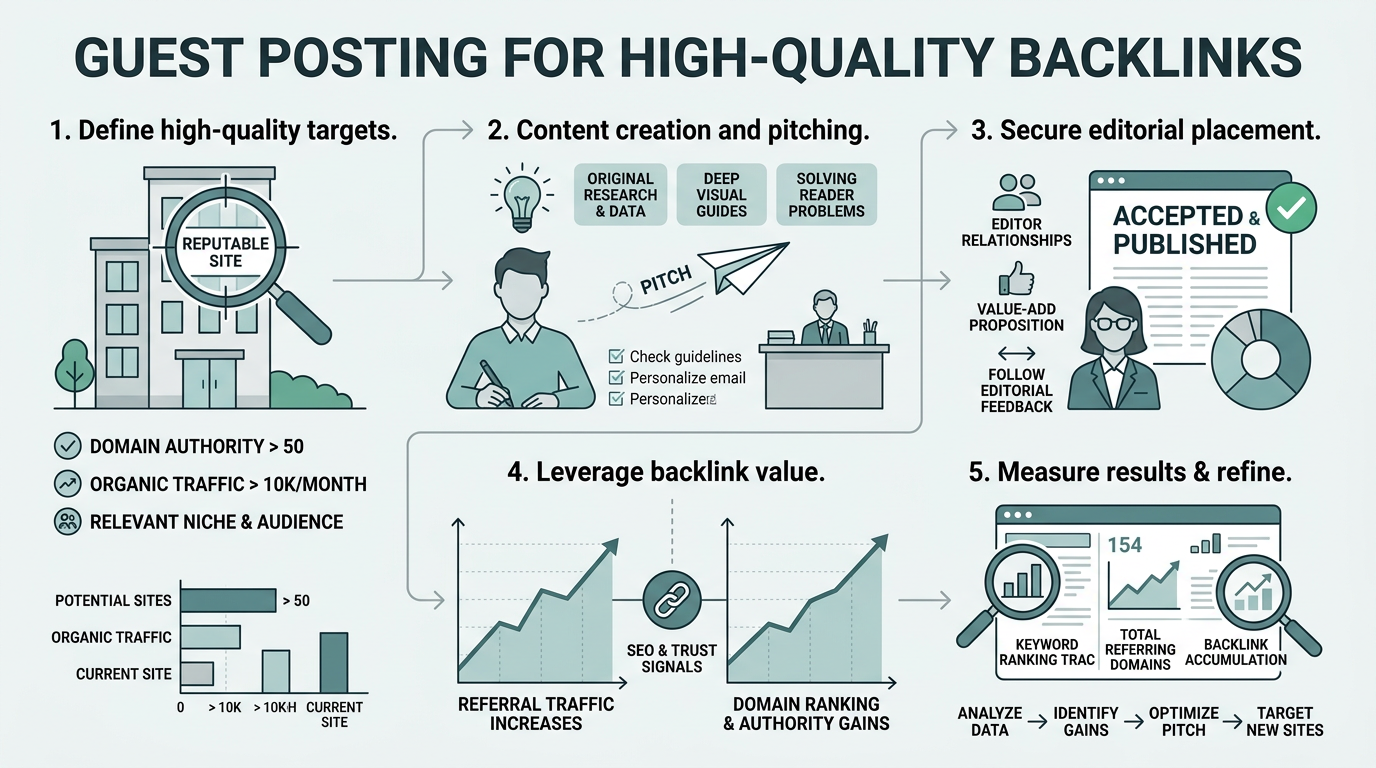
- Strategic Site Vetting: Screen for domain rating >50, organic traffic >10K/month, dofollow links, and genuine editorial credibility before pitching.
- Hyper-Personalized Outreach: Pitch specific topics tied to content gaps on the target site; keep emails concise, data-driven, and audience-focused.
- Substantive Content: Write guest posts of 2,000+ words that provide genuine value; thin filler content no longer earns meaningful links or traffic.
- Relationship-First Approach: Treat each placement as the beginning of an ongoing editorial relationship, not a one-off transaction.
Why High-Quality Backlinks Matter More Now
Backlinks remain one of Google's top three ranking factors, but not all links are created equal. The value of a backlink depends entirely on the authority and relevance of the referring domain. Digital PR and editorial placements now outrank guest posting as the preferred tactic for serious link builders, which raises the bar for what "counts" as a successful guest post.
The cost to acquire a single quality backlink has climbed sharply. In Q1 2026, the average SEO professional pays $508.95 per quality backlink, with 47% spending $500 or more. This means your guest posting strategy can no longer afford to target low-traffic, low-authority sites just to accumulate link volume. Every placement must deliver both topical relevance and measurable domain authority.
The Authority Threshold Problem
One of the biggest challenges in guest posting today is inventory scarcity at scale. According to BuzzStream's 2025 analysis, only 7.6% of openly available guest post opportunities met a baseline quality standard (domain rating above 65, monthly organic traffic exceeding 10,000). The remaining 92.4% fall below those thresholds, making them poor investments for serious backlink building. Even more damning, 85.3% of guest posting sites were classified as low-quality, with domain ratings under 40 and organic traffic under 10,000 per month. This scarcity is exactly why personalized, manual prospectingnot cookie-cutter outreach listshas become the competitive advantage.
Backlink Quality as a Ranking Signal
Google's focus on author expertise, experience, authoritativeness, and trustworthiness (E-E-A-T) means that a backlink from a low-authority or poorly maintained site may carry negative SEO signals. A guest post on a website with thin content, outdated design, or weak topical relevance could actively hurt your rankings if the host site is seen as low-quality. Conversely, a single backlink from a well-maintained, topically relevant site with strong organic traffic and a consistent publishing schedule is worth dozens of links from mediocre sources.
How to Identify High-Quality Guest Posting Opportunities
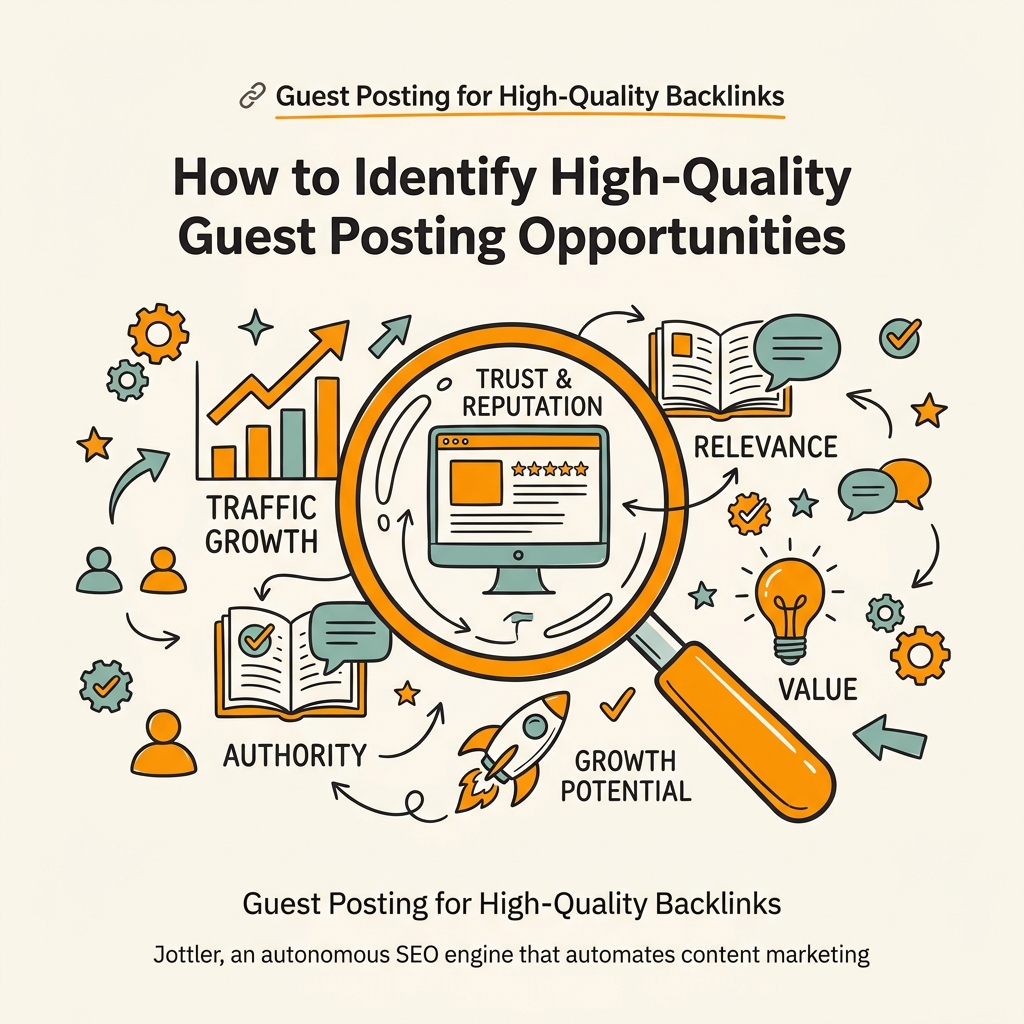
Finding quality guest post targets requires systematic vetting across multiple dimensions. Top-performing link builders now spend 60–70% of their outreach effort on site evaluation rather than on writing or pitching. This investment upfront pays dividends in acceptance rates, referral traffic, and ranking impact.
Core Vetting Criteria for Host Sites
Before you pitch a guest post idea, run the target site through a rigorous checklist:
- Domain Rating: Target sites with DR 50 or above. Sites below DR 40 rarely pass Google's E-E-A-T review for high-value links.
- Organic Traffic: Verify monthly organic traffic of at least 10,000 visitors using third-party tools like Ahrefs or Semrush. Don't trust self-reported numbers.
- Niche Relevance: The site's content must align closely with your industry or topic cluster. A guest post on a loosely related site sends weak topical signals to Google.
- Content Quality: Read the site's top articles. Look for well-researched, original reporting, proper citation, and evidence of editing oversight. Avoid sites with AI-generated filler or shallow how-to content.
- Outbound Link Profile: Analyze where the site links to. If it links primarily to spammy directories or low-quality affiliate sites, it's a red flag for editorial integrity.
- Country Mix: Ensure the host site's traffic is geographically aligned with your target market. A guest post on a site with 90% traffic from a country that doesn't match your audience dilutes the relevance signal.
Finding Overlooked Quality Sites in Your Niche
The biggest mistake link builders make is relying on prebuilt "guest posting opportunities" lists. Those lists are often outdated, low-quality, and available to every competitor who pays. Instead, find overlooked quality sites by:
- Reverse-engineer competitor links: Use Ahrefs or Semrush to identify where your competitors have published guest posts. Visit those sites, vet them against the criteria above, and pitch the same editors with a better angle.
- Search industry-specific keywords: Look for "contribute," "guest post," "write for us," and similar phrases within your niche. This surfaces smaller, higher-quality sites that aren't on every outreach list.
- Follow topical authority sites: Identify the 10–15 authoritative publications in your space and study their guest contributor pages. These sites attract quality writers and have editorial standards.
- Monitor niche communities: Reddit, Slack channels, and industry forums often recommend where editors are actively looking for content. These sources are real-time and typically bypass the spam filters.
Crafting a Compelling Guest Post Pitch
Once you've identified quality targets, your pitch determines your acceptance rate. A highly personalized, data-backed pitch achieves 3–5x higher response rates than generic outreach. The difference comes down to a simple principle: editors care about their audience's benefit, not your backlink goals.
The Anatomy of a Winning Pitch Email
According to Search Engine Land's 2026 guidance, the most effective guest post pitches follow a tight structure. Subject lines should be 9–13 words long and 71+ characters to stand out in crowded inboxes. The email body should be skimmableeditors rarely read long blocks of text. Here's what works:
- Opening: Reference a specific article or recent publication on the target site. Show you've done your homework. Example: "Your recent piece on [topic] hit on X, but didn't cover YI have original data on that."
- The hook: Propose a specific guest post idea that solves a content gap for their audience. Include the keyword they should rank for but don't yet cover. This frames the post as a win for them, not for you.
- Relevance proof: Briefly mention your expertise or previous publications. Keep it to one sentence. Don't oversell.
- Call-to-action: Ask a yes-or-no question. "Does this angle work for your audience?" is stronger than "Would you be interested in a guest post?"
"The most important thing to remember when pitching guest blogs is relevancy. Relevance is the shortcut to building authority in your niche."
BuzzStream, Guest Blogging Strategy Guide, 2026
Follow-Up Sequences and Testing
Many link builders send one pitch and move ona costly mistake. Studies show that reply rates improve significantly with follow-ups, with some responses coming only after the third or fourth touch. A well-designed outreach sequence typically looks like:
- Initial pitch: Personalized, specific topic idea tied to their content gap.
- First follow-up (5–7 days later): Light re-engagement. "Checking indid the idea land?" Keep it brief.
- Second follow-up (7–10 days later): Offer an alternate angle or topic. More flexibility increases the chance they'll bite.
- Final follow-up (10–14 days later): Soften expectations: "No pressure, but let me know if there's a better time to chat."
Track open rates, reply rates, and acceptance rates by segment. A/B test subject lines, angle, and tone so you can identify patterns. For example, if tech publications reply at 18% but finance publications reply at 8%, double down on tech outreach and refine your finance angle.
Creating a Guest Post That Converts Links and Readers
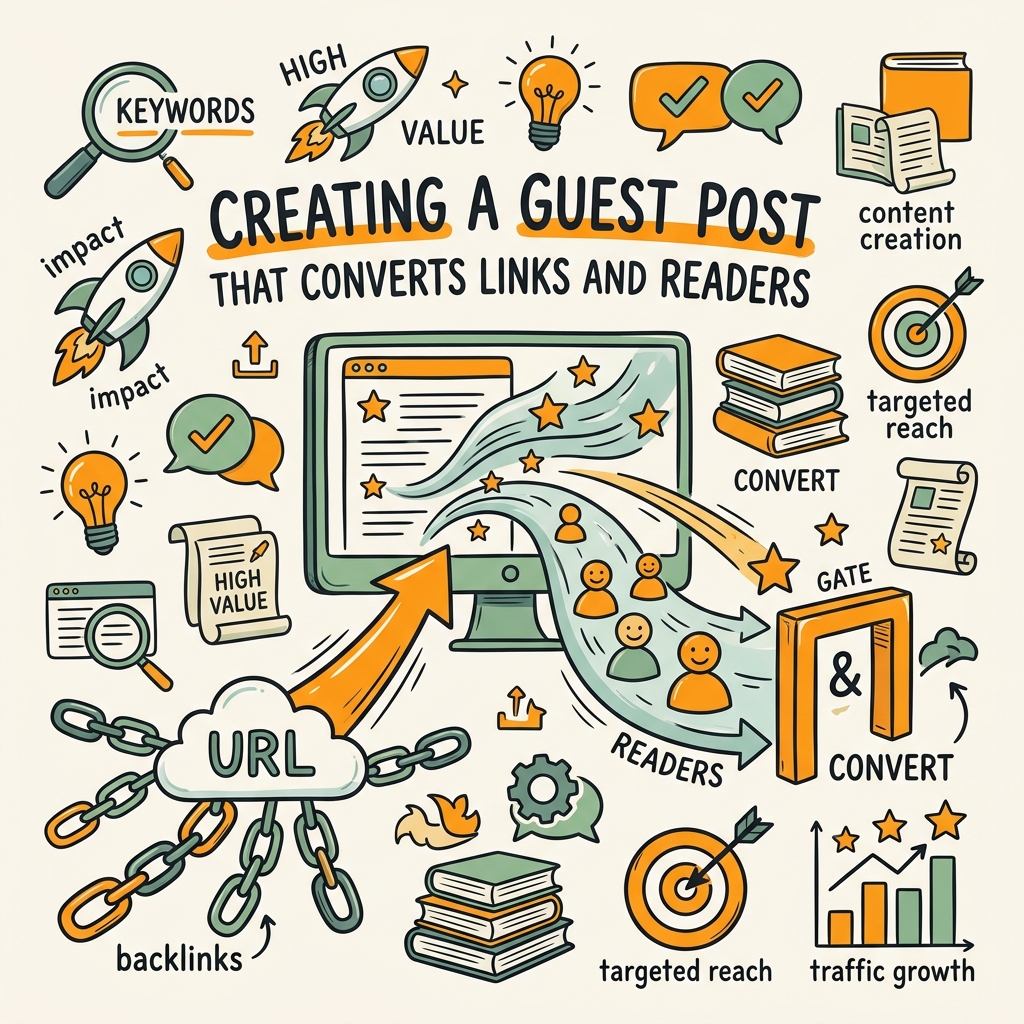
A published guest post is only valuable if it drives backlinks, referral traffic, and brand awareness. Long-form content (2,000+ words) earns 77% more backlinks than short-form articles, so every guest post should be substantive, well-researched, and original.
Structure for Maximum Impact
The best guest posts mirror the host site's editorial style while delivering original value. Use their header structure, tone, and link patterns as a template. But bring your own angle. Include:
- Original data or research: If you can include proprietary data, a survey, or primary research findings, the post becomes more linkable and positions your brand as a thought leader.
- Actionable frameworks: Readers on business publications want templates, checklists, or step-by-step workflows they can implement immediately.
- Industry-specific examples: Use case studies or examples from well-known companies in the host site's niche. Specificity increases engagement.
- Internal linking strategy: The host site will set policies on your author bio and internal links, but propose a natural structure that connects the guest post to relevant resources on your domain.
Leveraging Content Automation for Scale and Quality Control
For teams managing multiple guest post campaigns across several niches, maintaining consistency in research depth and article quality becomes a challenge. Link-building strategies for scaling content production increasingly rely on tools that automate research and initial drafting. Platforms like Jottler can help you rapidly produce well-researched, fact-checked guest post drafts that meet publication standards without sacrificing quality. The platform researches topics from 14+ sources, fact-checks every claim, and structures articles for maximum editorial appealall while your team focuses on outreach, relationship-building, and campaign strategy. This approach allows smaller teams to pitch more targets with higher-quality drafts, improving overall campaign ROI.
Post-Publication Promotion and Relationship Building
The work doesn't end when the post goes live. Promote it across your channelssocial media, email newsletter, Slack communitiesto drive traffic to the host site. This increases the post's visibility and signals to the host editor that you're a valuable partner worth working with again. Engaged guest posts create recurring revenue streams in the form of repeat publication opportunities and stronger editorial relationships.
Building a Scalable Guest Posting Workflow
Successful guest posting isn't one-off pitches; it's a repeatable system. Top-performing link builders aim for 10–20 personalized outreach emails per week and prospect at least 50–100 websites per month to build enough pipeline velocity. For established programs, a cadence of 4–8 quality placements per month is realistic and sustainable.
Workflow Framework: Prospect → Vet → Pitch → Write → Publish → Promote
A structured workflow ensures consistency and removes bottlenecks:
| Stage | Key Activities | Tools & Data Points | Success Metrics |
|---|---|---|---|
| Prospecting | Identify 50–100 potential host sites per month using reverse-competitor analysis, niche searches, and community research | Ahrefs, Semrush, industry databases | Pipeline size; sites per niche |
| Vetting | Run each site through DR, traffic, content quality, and niche relevance checks; eliminate sites below baseline (DR > 50, >10K traffic) | Third-party traffic verification; editorial review | % of prospects cleared to pitch; quality score |
| Outreach | Send 10–20 personalized pitches per week; track open, reply, and acceptance rates | Email sequencing; A/B testing | Reply rate; acceptance rate; cost per placement |
| Content Creation | Research, write, and fact-check 2,000+ word articles tailored to the host site's audience | Primary research; fact-checking tools; editorial templates | Turnaround time; editorial revision cycles |
| Publishing | Coordinate with editor on publication date, author bio, and link placement | Publication calendar; brand guidelines | On-time publication; link placement accuracy |
| Promotion | Share post on social, newsletter, and community channels within 48 hours of publication | Social scheduling; email lists | Referral traffic; social engagement; follow-up placements with same editor |
Measuring ROI and Refining Strategy
Not all placements are created equal. Track the following metrics per placement:
- Domain authority and traffic: Verify that the published site maintains its claimed authority (use Ahrefs monthly checks).
- Referral traffic: Use UTM parameters or Google Analytics to measure how much traffic the guest post drives back to your site.
- Ranking impact: Check whether the guest post links move the needle on your target keywords within 30–90 days.
- Cost per link: Divide your total outreach time and any direct costs by the number of accepted placements to establish cost per link acquired.
This data informs future targeting. If guest posts from tech publications drive 5x more referral traffic and stronger ranking improvements than finance publications, allocate more budget and time to tech outreach.
Common Guest Posting Mistakes and How to Avoid Them
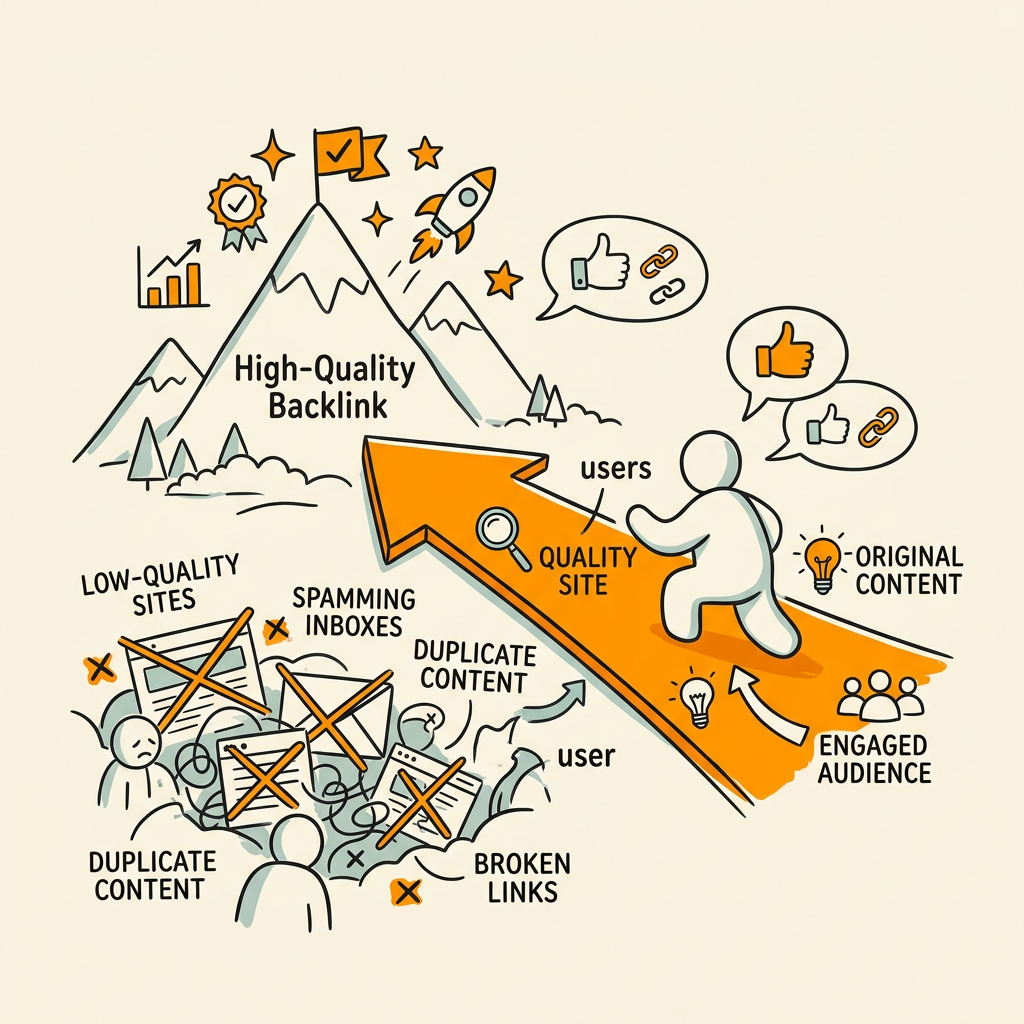
Even experienced link builders make avoidable errors. Here are the costliest mistakes:
- Pitching low-quality sites en masse: Sending 100 pitches to DR < 40 sites wastes time and damages your brand reputation with editors. Vet ruthlessly before pitching.
- Generic pitches: "I'd like to contribute a guest post" gets deleted instantly. Every pitch should reference a specific article and propose a specific topic tied to their audience's gap.
- Skimping on research: A guest post that doesn't match the host site's editorial quality or voice wastes everyone's time and tanks your placement chances with that editor in the future.
- Ignoring follow-ups: Editors are busy. One pitch email is rarely enough. Build a thoughtful 3–4 email sequence and stick with it.
- Treating guest posts as one-off transactions: The highest-ROI strategy is building long-term editorial relationships. Follow up with editors after publication, promote their content, and pitch again within 3–6 months.
The Role of Automation in Guest Posting Outreach
Guest posting is labor-intensiveidentifying quality sites, vetting them, researching topics, writing articles, and managing outreach sequences can easily consume 40+ hours per month. For teams managing link-building campaigns at scale, SEO automation platforms help rapidly produce well-researched, fact-checked guest post drafts that meet publication standards without sacrificing quality. Tools like Jottler can handle topic research, fact-checking, and article structuringall while your team focuses on outreach personalization and relationship-building. This approach allows smaller teams to pitch more targets with higher-quality drafts, improving overall campaign ROI.
Conclusion
Guest posting for high-quality backlinks remains a viable link-building strategybut only when executed with extreme selectivity and editorial rigor. The market has shifted: 92.4% of available guest post opportunities fail to meet quality standards, yet 64.9–81% of link builders continue to use guest posting, likely because most are still targeting the wrong sites.
The path forward is clear: identify and vet ruthlessly, pitch with laser-focused personalization tied to the host site's audience, create substantive 2,000+-word content, and build lasting relationships with editors. Quality placements now cost an average of $508.95 per link, so every pitch must be calculated. Combine strategic outreach with content platforms that automate research and fact-checking to scale without sacrificing quality, and you'll build a guest posting program that compounds over time.
Start your SEO agent to automate the research and content production side of your guest posting campaignsfreeing your team to focus on relationship-building and outreach execution.
FAQs
Is guest posting still effective for backlinks in 2026?
Yes, guest posting still works for high-quality backlinks, but success depends entirely on site selection and editorial relevance. Digital PR has overtaken guest posting as the top-rated tactic among 48.6% of professionals, but 16% still rank guest posting #1, and 64.9–81% of link builders actively use it. The difference between success and failure is whether you're pitching to relevant, high-authority sites (DR > 50, >10K monthly traffic) or mass-pitching to low-quality directories. Quality placements from topically relevant sites with strong traffic still deliver ranking gains and referral traffic.
How many guest posts do I need to rank a new website?
There's no universal answerit depends on competition level, domain age, and the quality of backlinks. However, a sustainable cadence is 4–8 quality placements per month for established programs, with a goal of 10–20 personalized outreach emails weekly to build enough pipeline. For a new domain, you'll likely need 12–24 quality backlinks from topically relevant sites over 3–6 months before you see consistent ranking movement in moderate-to-competitive niches. The quality of each link matters far more than quantity, so focus on landing even 5 placements from sites with 50+ domain rating and 10K+ monthly traffic rather than 50 placements from low-authority sites.
What's the most effective guest post topic strategy?
Pitch topics that solve a content gap for the host site's audiencespecifically, keywords they should rank for but don't yet cover. Long-form content (2,000+ words) earns 77% more backlinks than short-form articles, so propose substantive pieces with original research, frameworks, or case studies. Instead of asking "Can I write a guest post?", propose "Your audience is searching for [keyword your analysis found], but you don't rank for it. I have original data and a framework that would make this your top-performing post." This frames the guest post as a strategic opportunity for their site, not as a link-building request.