Guest Posting Strategy for B2B Backlinks
Guest posting has remained one of the most reliable ways to earn backlinks and drive organic traffic in B2B marketing—but the strategy has fundamentally shifted. 65% of marketers now call guest posting their most effective link-building tactic, yet simultaneously only 3–5% of cold pitches are accepted. The difference? Quality. The days of mass-produced guest posts on random blogs are over. Today's winning B2B guest posting strategy demands topical relevance, relationship-focused outreach, and measurable conversion tracking. Here's how to execute guest posting that actually compounds your organic growth.
Key Takeaways
- 65% of marketers rank guest posting as their most effective link-building strategy (2025–2026 data)
- Guest posts generate 27% more referral traffic than other backlink types, with conversion rates of 2.8–4.1%
- Quality-focused campaigns deliver positive ROI in 4–7 months; relationship-based outreach achieves 25%+ acceptance rates versus 3–5% for cold pitches
- Define Niche Relevance & Site Authority: Target publications in your industry with real organic traffic (5,000+ monthly visitors) rather than chasing domain authority scores alone.
- Build Relationships Before Pitching: Engage with editors and publications consistently; personalized outreach improves acceptance by 47% versus generic cold emails.
- Secure In-Content Links, Not Bio-Only Placements: Links placed naturally within article body drive measurably higher referral traffic and SEO value.
- Measure Referral Conversion & Traffic Attribution: Track UTM parameters and GA4 referral conversions to calculate true ROI—referral traffic converts at 2.8–4.1%, outperforming display ads.
- Build a Contributor Pipeline, Not One-Off Posts: Ongoing relationships with publications generate 3.2x more organic traffic value than standalone guest posts.
Why Guest Posting Still Works for B2B Backlinks in 2026
Guest posting has survived multiple Google algorithm updates because it answers a fundamental question: Is this creator trusted and recognized within their industry? When executed with discipline, a single high-quality guest post can land 2–7 backlinks (your post link plus internal links from the host site), translate into dozens of qualified referral clicks monthly, and compound organic visibility over time.
The core advantage remains unchanged: guest posts generate 27% more referral traffic than other backlink types, and businesses using strategic guest posting report 35% faster organic growth than competitors who don't. For B2B companies, this isn't just traffic—it's qualified leads and brand credibility in front of decision-makers already reading relevant publications.
"A single guest post on a DR 50+ publication in your vertical will outperform ten posts on random DR 20–30 blogs. Niche relevance, not link count, is what moves the needle in 2026."
However, the algorithm has become stricter about link quality. Websites publishing 50+ guest post backlinks rank in the top 10 search results 75% of the time, but only when those backlinks come from topically relevant, editorially strong sources. Generic guest posting networks and low-authority blog farms provide diminishing returns.
The Shift From Volume to Strategic Placement
Five years ago, the goal was simple: get as many guest posts as possible. Today's approach flips that. Niche relevance trumps link count. A single guest post on a DR 50+ publication in your vertical will outperform ten posts on random DR 20–30 blogs. Why? Because Google's ranking systems now value contextual links—links from authoritative, topically aligned sources—far more heavily than raw volume.
The market has polarized around this shift. Industry data shows 65% of marketers swear by guest posting, while another segment reports that only 16% find it effective in 2025. The gap isn't philosophical; it's execution. Teams hitting the 65% success rate are targeting niche publications, building editor relationships, and placing in-content links. Teams in the 16% camp are still pitching content mills and accepting author-bio-only placements.
B2B Decision-Makers Read Industry Publications
Unlike B2C search, B2B organic traffic often clusters around specialized publications, whitepapers, and vertical industry sites. Your buyer—a VP of operations, a procurement director, a CFO—is reading Procurement Magazine, HubSpot's Sales blog, or AI news sites relevant to their role. A guest post landing you on those publications puts your brand directly in front of active decision-makers, not generic searchers.
This audience overlap is why B2B guest posting ROI often looks better than comparable B2C campaigns. Referral traffic from guest posts converts at 2.8–4.1%, higher than display advertising at 0.5–1.2%. For SaaS and software companies especially, a single qualified referral can be worth hundreds of dollars in pipeline value. When done strategically, guest posting becomes a core component of your broader link building strategy for B2B software companies.
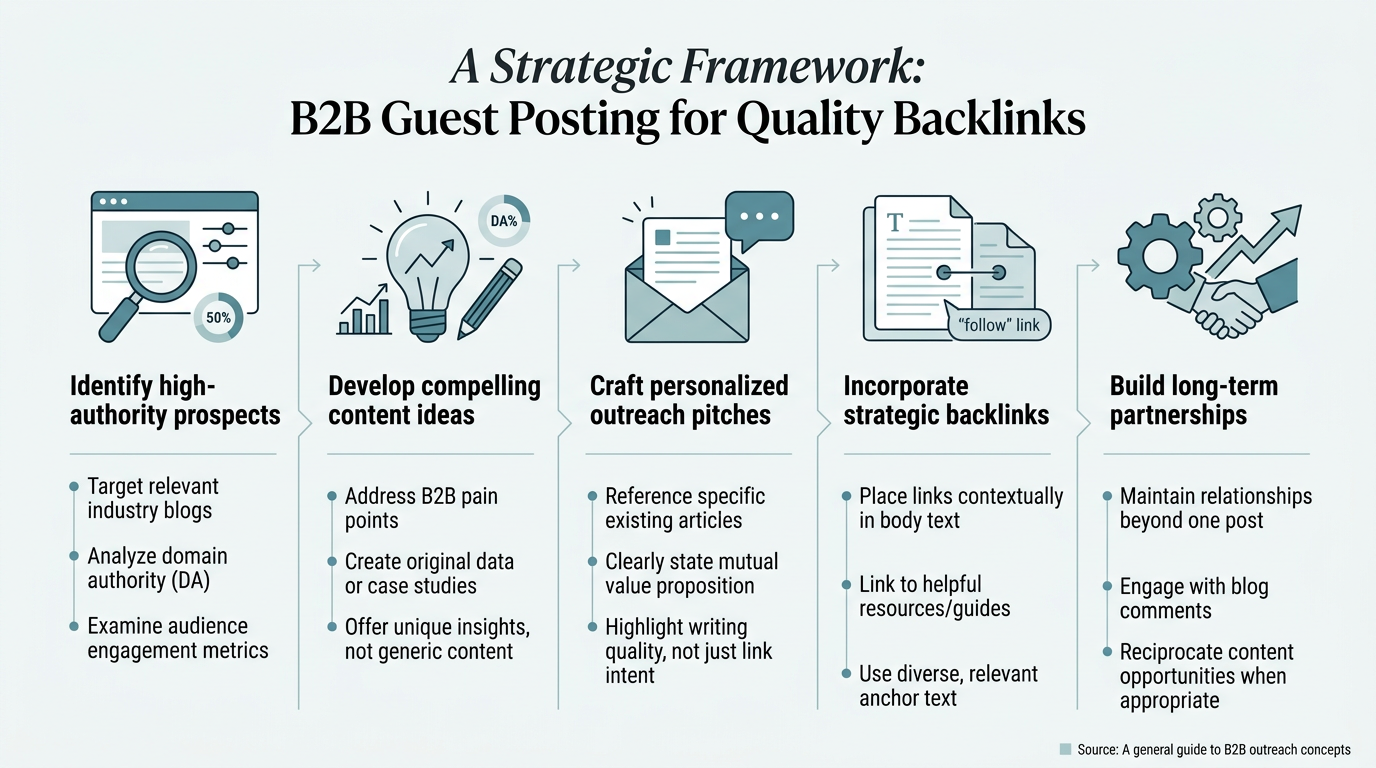
How to Find and Vet High-Authority Guest Posting Targets

The difference between a wasted month and a months-long traffic machine is target selection. Many teams spray pitches to any publication they find on Google. Smart teams build a tiered prospecting list: tier-one niche authorities (DR 50+, 10,000+ monthly traffic), tier-two mid-market publications (DR 35–50, 5,000+ traffic), and tier-three amplifiers for scale. Your effort and pitch quality should match the tier.
| Publication Tier | Domain Authority | Monthly Organic Traffic | Pitch Frequency | Expected Acceptance Rate |
|---|---|---|---|---|
| Tier 1 (Niche Authorities) | DR 50+ | 10,000+ | Monthly | 20–30% |
| Tier 2 (Mid-Market) | DR 35–50 | 5,000–10,000 | Quarterly | 15–25% |
| Tier 3 (Emerging/Amplifiers) | DR 25–35 | 2,000–5,000 | One-off | 10–20% |
Identify Sites Your Competitors Are Already Guest Posting On
Your competitors are doing guest posting. Instead of reinventing the list, study where they're placing posts. Tools like Ahrefs Link Intersect or SEMrush Backlink Analysis let you input a competitor domain and see which sites link to them. Filter for "guest post" or "contributor" anchor text patterns, and you'll immediately surface publications actively accepting external content from your industry.
Once you've identified a candidate site, verify three things: (1) organic traffic via SimilarWeb or Ahrefs (target minimum 5,000 monthly visitors), (2) topical relevance to your niche (does their content align with your buyer's interests?), and (3) link placement policy (do they allow in-content links, or only author bio links?). In-content links are worth 2–3x more SEO value and drive significantly higher referral traffic because readers actually click them.
Evaluate Site Authority by Traffic-to-DR Ratio, Not DR Alone
Domain Authority (DR) is a vanity metric. A site can have a DR 45 with almost no organic traffic, while a niche publication with DR 35 might get 50,000 monthly visitors. For guest posting ROI, traffic matters more than authority. A pragmatic screening criterion is a traffic-to-DR ratio above 100: if a site has 10,000 monthly organic visitors and a DR of 60, that's a 167 ratio—excellent. If it has 1,000 visitors and a DR of 45, that's a 22 ratio—pass.
This filter alone eliminates 70% of low-value targets and focuses your outreach on publications where actual people read and click. Referral traffic is your primary lever for ROI. Backlinks provide secondary SEO benefit, but the traffic is the money.
Check Editorial Standards and Audience Fit
Before you pitch, read three to five recent articles on the target site. Ask yourself: Would my ideal customer read this? Does the editorial voice match my brand? Are the articles substantive (1,500+ words, original research) or thin listicles? High-quality publications have high editorial standards, which means they'll push back on weak drafts and reject poor fits—good for you, because that same rigor means their audience is engaged and serious.
Mismatched pitches waste everybody's time. A B2B HR tech company pitching a post to a design blog might get published, but it'll drive zero conversions. Target publications where your buyer actually hangs out.
Crafting and Pitching Guest Posts That Get Accepted
Acceptance rates hinge on the pitch, not the idea. Personalized, relationship-based outreach achieves 25%+ acceptance rates, versus 3–5% for cold mass pitches. That gap is enormous. The difference isn't just tone; it's strategy. Smart outreach treats the publication's editor as a collaborator, not a gatekeeper.
Build Relationships Before Pitching
The highest-converting approach is to engage with the publication first. Share their articles, comment thoughtfully, reach out with non-pitch messages. If possible, connect with the editor on LinkedIn or via email with a genuine compliment about their recent coverage. Spend two to four weeks building familiarity before pitching anything.
"An editor who knows your name and knows you've been engaging with their content will spend 30 seconds on your pitch instead of 2. They'll be more forgiving of a rough first draft. They'll ask for revisions instead of rejecting outright."
This sounds slow, but it pays. Relationship-based outreach acceptance rates hit 25%+, transforming guest posting from a volume game into a reliable pipeline.
Write a Hyper-Specific, Data-Backed Pitch
Your pitch email should be five sentences. No more. (1) Personalized opener: name one recent article of theirs you liked and why. (2) Thesis: propose a specific angle, ideally with a data hook or counterintuitive claim. (3) Why now: explain why this topic is timely (a new trend, a new product release, an upcoming event). (4) Your credibility: one sentence on why you're the right author (your role, experience, previous publications). (5) CTA: ask if they're interested in a full outline or if you should send a draft.
Example framework: "Hi [Editor], I loved your recent piece on [specific article title] because [specific reason]. I'd like to propose a guest post on [specific angle] because [timely reason]. Given our expertise in [field], I thought it could be valuable for your audience. Would you be interested in seeing a full outline? If so, I can turn it around by [specific date]."
This approach works because it shows you've done homework, respects the editor's time, and makes saying yes simple. Generic pitches get deleted. Specific, relevant pitches get replies.
Include Original Data or Unique Insight, Not Regurgitated Content
Publications get dozens of pitches weekly. Editors reject most because the proposed angle is stale or available elsewhere. Stand out by including novel material: original research data, a unique case study, a contrarian take backed by evidence, or an unpublished framework. This gives the editor permission to publish—they're offering their audience something they can't find elsewhere.
If you're pitching a post on "B2B lead generation tactics," the pitch fails. If you're pitching "Why Our B2B SaaS Company's Guest Posting Generated 200+ MQLs in 90 Days—And Why Most Teams Miss the Revenue Opportunity," the pitch succeeds. Specificity and data differentiate.
Structuring Guest Posts for Maximum Referral Traffic and In-Content Links
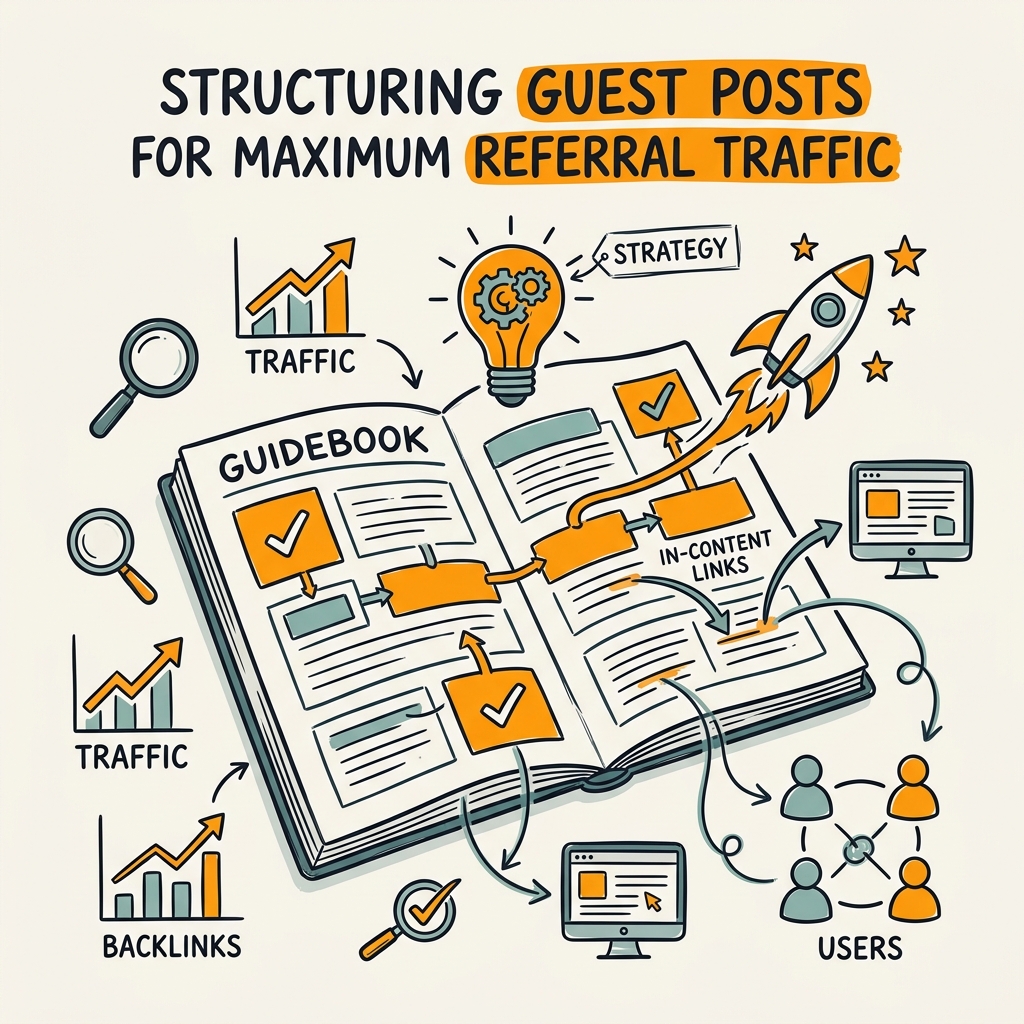
A guest post is not your homepage marketing pitch. It's a standalone article that must serve the host publication's readers first and your brand second. Readers of guest posts convert at 2.8–4.1% when they click through to your site, but only if the post was genuinely valuable and earned their trust.
Front-Load Value, Then Weave Your Brand Naturally
The best guest posts spend 80% of the word count delivering pure value and 20% on your brand. If the post is 2,000 words, 1,600 should be original frameworks, data, case studies, or actionable advice. The final 200 words and the author bio should introduce your company and product, positioned as a natural solution to the problem you've just detailed.
Write as if you're a trusted advisor, not a sales rep. Use the article to build authority, not to close deals. The reader who finds your product valuable after reading an insightful guest post will pursue it themselves. Force a sell, and they'll bounce.
Secure In-Content Links, Not Author-Bio-Only Placements
Many publications limit external links to the author bio. This is a red flag. Links in the author bio get clicked far less frequently than in-content links. If your link appears in the context of a sentence about your solution, readers will click it. If it's buried in a bio at the end alongside a headshot, most won't.
Negotiate for in-content link placement when you pitch. Propose linking from a relevant phrase: "As we've seen at [Your Company], teams using [solution] report…" Then link "Your Company" to your homepage or a specific landing page. In-content links drive 3–5x more referral traffic than bio-only links and carry more SEO value.
Choose Landing Pages Strategically, Not Your Homepage
Your guest post readers are motivated, warm leads. Don't send them to your homepage. Send them to a page that directly addresses the pain point you mentioned in the post. If your post was about "reducing procurement cycle time," send traffic to your procurement-efficiency landing page, not the homepage. If it covered "scaling content marketing without hiring," link to your content automation page.
This micro-targeting of landing pages increases conversion rates by 20–30% versus generic homepage routing. Use UTM parameters (source=guestpost, medium=referral, campaign=[publication_name]) to track which specific guest posts drive conversions. This data is gold for calculating ROI and identifying which publications are worth pitching again.
Measuring Guest Posting ROI and Building a Recurring Pipeline
Guest posting is often treated as a one-off tactic. Smart teams treat it as a systematic channel with repeatable economics. Quality-focused guest posting campaigns deliver positive ROI in 4–7 months, and ongoing contributor relationships generate 3.2x more organic traffic value than standalone posts. The compounding dynamic is what makes guest posting one of the highest-ROI content channels over a 12–24 month horizon.
Track Referral Traffic, Not Just Backlinks
Many teams measure guest posting ROI by counting backlinks and checking ranking positions. This misses the bigger picture. Referral traffic conversion rates of 2.8–4.1% mean that a single guest post driving 100 monthly referral visitors could generate 2–4 qualified leads—or more for B2B products with lower friction. Tracking this requires GA4 setup.
In GA4, create a custom audience for "referral traffic from [publication_name]" and segment by landing page. Add UTM parameters to every guest post link (utm_source=guestpost, utm_medium=referral, utm_campaign=[publication_slug]). This lets you see exactly how many people clicked from the post, how long they stayed, which pages they visited, and whether they converted (signed up, downloaded, scheduled a call).
Compare this to your organic search conversion rate. If organic converts at 1%, but guest post referral converts at 3%, you've found a higher-efficiency channel worth scaling. If it's lower, the publication didn't match your audience well.
Calculate True ROI Including Ranking Lift and Brand Authority Gains
The full ROI equation includes three components: (1) direct referral conversions, (2) SEO ranking lift from the backlink, and (3) brand authority and awareness gains.
A simple ROI formula:
- Referral revenue: (Monthly referral visitors) × (Conversion rate) × (Average customer value)
- SEO benefit: Estimate keyword ranking improvements using your SEO tool's forecasting; multiply improved rankings by estimated monthly traffic gain and your average conversion rate
- Brand lift: Track branded search volume and direct traffic growth in months following the guest post publication; attribute partial uplift to brand exposure
- Total revenue: Sum of all three
- Cost: (Time spent on writing, pitching, and revisions) or ($ spent if outsourcing) + (Any publication fees)
- ROI: ((Total revenue − Cost) / Cost) × 100
Most strategic campaigns report 200–400% ROI within 12 months when all three components are included. Some high performers (typically those with higher customer lifetime values or landing on tier-one publications) report 500–700% ROI.
Build a "Contributor Tier" Strategy to Scale Predictability
Once you've earned acceptance from a publication, don't stop. Become a recurring contributor. Propose a quarterly or monthly guest post cadence. Ongoing contributor relationships generate 3.2x more organic traffic value than one-off posts because you build reader familiarity, you bypass the cold-pitch friction, and the editor prioritizes your content in their schedule.
Create a tiered contributor strategy:
- Tier 1 (1–2 publications): Monthly contributions to your most relevant, highest-traffic niche publications. These are your anchor relationships.
- Tier 2 (3–5 publications): Quarterly guest posts on strong secondary publications.
- Tier 3 (5–10 publications): One-off posts on emerging or mid-market publications for traffic velocity.
This structure ensures consistent backlink flow, recurring referral traffic, and measurable compounding growth. A company executing this could publish 10–15 guest posts annually, generating 20–50+ qualified referral leads and dozens of ranking improvements across the portfolio.
Guest Posting Tools and Workflow Automation

Managing guest posting manually—tracking targets, scheduling pitches, monitoring placement deadlines, and measuring results—can consume 8–10 hours weekly for a growing program. Automation and tools streamline the workflow so your team focuses on writing and relationships, not spreadsheet management.
Prospecting and Target Identification Tools
Start with BuzzStream, which specializes in identifying publications, scraping editor contact info, and tracking outreach. Ahrefs Link Intersect lets you compare your backlink profile to competitors and surface publications they're guest posting on. SEMrush Backlink Analysis provides similar functionality. For niche-specific research, use Muck Rack (for journalists and editors) or LinkedIn advanced search to find editors directly.
Once you've built a target list, use a guest posting database to track outreach status. CMS tools like Airtable or a simple Notion database work fine. Log: publication name, contact, first pitch date, follow-up dates, acceptance status, article title, publication date, link placement, and referral traffic to date.
Streamline Pitch Creation With Templates and Research
Writing a fresh pitch for each publication is slow. Instead, build three to four pitch templates based on your core angles, then customize them for each target. The template should include: (1) a personalized opener referencing a recent article, (2) your thesis, (3) why it's timely, (4) your credibility, and (5) a CTA. Fill in publication-specific details and hit send.
For teams managing large-scale programs, scaling your content production requires the right infrastructure. Tools that help with content marketing automation can reduce the cycle time from pitch to publication, allowing you to execute more guest posts quarterly with less manual overhead. When paired with systematic outreach, automation helps you maintain quality across a growing publication portfolio.
Track and Report on Guest Posting ROI Systematically
Build a monthly reporting dashboard that shows: (1) posts published month-to-date, (2) cumulative referral traffic and conversion rate by publication, (3) backlinks earned, (4) estimated organic value gained (using your SEO tool's data), and (5) total estimated ROI. This keeps the program visible to leadership and helps justify budget for recurring efforts.
Most platforms offer API access or CSV export, so you can pull data weekly. A simple Looker Studio dashboard (free) connected to GA4 and your SEO tool's data sources gives you real-time visibility into program performance.
Common Guest Posting Mistakes and How to Avoid Them
Guest posting is simple in concept, but execution is where most teams stumble. Understanding the most common pitfalls accelerates your success.
Pitching Too Broadly Without Niche Focus
Spraying pitches to 50 publications in a month will generate rejections. Targeting 5 highly relevant publications with personalized, researched pitches will generate acceptances. It's the difference between 3–5% acceptance (cold mass pitches) and 25%+ acceptance (relationship and relevance-focused outreach). Slow down. Research your targets. Build relationships first. Pitch once you know the editor's recent coverage and can speak specifically to their audience.
Accepting Author-Bio-Only Placements
An author bio link will generate 5–20 referral clicks monthly from a high-traffic site. An in-content link on the same site will generate 50–200 clicks. Don't accept bio-only placements unless the publication is so dominant in your space that brand exposure alone justifies it. Even then, propose in-content placement as a counter-offer. Most editors will negotiate if you ask.
Writing Generic Content Instead of Differentiated Angles
If your guest post could have been written by anyone, the readers won't remember your brand and won't click your link. Invest time upfront in a unique angle: original research, unpublished data, a contrarian take, or an operational case study. This forces editors to publish (you've given them exclusive value) and forces readers to pay attention.
Forgetting to Measure Conversions and ROI
Many teams publish a guest post, note the backlink, and move on. They never measure referral traffic or conversions. This blindness makes it impossible to optimize. Some publications will consistently outperform others. Some landing pages will convert better than others. If you measure, you can double down on what works and cut what doesn't. If you don't, you're throwing money at the channel.
Conclusion
Guest posting in 2026 is a high-ROI, long-term compounding channel for B2B companies willing to prioritize quality over volume. The market has shifted decisively toward niche relevance, relationship-based outreach, and measurable conversions. Teams reporting positive ROI in 4–7 months are executing against these standards: targeting topically relevant publications with real organic traffic, building editor relationships before pitching, securing in-content links, and rigorously measuring referral conversions alongside SEO gains.
The compounding effect is powerful. A company executing 12–15 guest posts annually across a tiered publication strategy can expect 35% faster organic growth, 20–50+ qualified monthly referral leads, and dozens of ranking improvements across the keyword portfolio. The upfront effort—research, relationship building, strategic writing—takes 6–8 weeks to feel automatic. After that, the channel becomes predictable and scalable.
Start with five target publications you genuinely respect. Spend two weeks building relationships. Pitch one angle to each. Measure the results obsessively. Then expand. This disciplined approach transforms guest posting from a sporadic tactic into the reliable traffic and authority-building engine it's designed to be. Start your SEO agent to automate the research and content planning behind your guest posting strategy, so you can focus on relationships and execution.
FAQs
How many guest posts should a B2B company publish per month?
Most effective B2B guest posting programs publish 1–3 posts per month, prioritizing publication quality and niche fit over volume. A tiered strategy—one monthly post on a tier-one authority publication, one quarterly post on tier-two sites, and occasional one-off placements on tier-three publications—generates consistent backlinks and referral traffic without overwhelming your content team. Attempting more than one post per week typically sacrifices content quality and relationship depth, which are the actual drivers of ROI. Focus on depth: deeply researched, original-data-backed posts that showcase your expertise earn significantly higher conversion rates than generic articles.
What is the average cost of a guest post in B2B?
Guest posting costs vary by approach. In-house execution (time spent on research, writing, and outreach) typically costs $500–$2,000 per post, depending on your team's hourly rates and content complexity. Outsourced guest post services range from $500–$5,000+ per placement, depending on the publication's authority and the content quality required. Most B2B companies find that targeting mid-tier publications ($77–$500 per post cost) and building recurring relationships delivers the best ROI compared to chasing top-tier publications that command premium placement fees. The ROI becomes positive when a single referral lead from the post is worth $500 or more (typical for B2B SaaS), making even $2,000 posts profitable within 4–6 months if executed strategically.
Which is better for B2B: guest posting or paid ads?
Guest posting is the longer-term, higher-ROI channel; paid ads are faster but less compounding. Paid ads deliver immediate traffic and leads but require continuous spend. Once you pause campaigns, traffic stops. Guest posting has a months-long ramp-up (4–7 months to positive ROI), but then compounds: the post continues generating referral traffic and SEO value for years, and recurring contributor relationships reduce outreach friction on future posts. For B2B companies building sustainable organic growth, the best strategy combines both—use paid ads for short-term pipeline while building guest posting relationships that compound over 12–24 months. Referral traffic from guest posts converts at 2.8–4.1%, higher than most paid channels, making it worth the patience required to build the program systematically.