Guest Posting Tactics That Generate Quality Backlinks
Guest posting has been pronounced dead more than once, yet 64.9% of marketers still use it as a primary link-building strategy in 2026. The real story isn't whether guest posting works. It's that the tactics that worked in 2014 will damage your SEO now. Google's Site Reputation Abuse policy has penalized major publishers (Forbes, CNN, USA Today) for mass guest-posting abuse. Only 4.6% of marketplace opportunities qualify as genuinely high-quality placements. The difference between a backlink that compounds your authority and one that invites algorithmic suspicion comes down to strategy, site selection, and pitch execution.
Key Takeaways
- Guest posts on authority sites (DR 50+) generate 2.4x more ranking impact than low-authority placements (2026, Searchlab)
- Personalized pitches see 47% higher acceptance rates than cold mass outreach (2026, Industry Data)
- Pages with high-quality backlinks from relevant domains are 3.8x more likely to reach top 3 search results (2025, Backlinko study of 11.8M results)
- Define Your Quality Threshold: Authority matters more than volume. Focus on DR 50+ sites with real audiences over generic marketplace listings.
- Craft Hyper-Personalized Pitches: Short, specific, reader-focused outreach with topic ideas doubles acceptance odds versus generic requests.
- Build Strategic Content That Ranks: Guest posts on niche-relevant topics that address audience intent generate both SEO value and referral traffic.
- Monitor Link Retention: 22% of guest post backlinks disappear within 12 monthsaudit placements quarterly and prioritize stable publishers.
- Integrate with Broader Link Strategy: Guest posting works best as one tactic in a diversified link-building mix, not as the core strategy.
What Makes a Quality Guest Post Backlink Different?
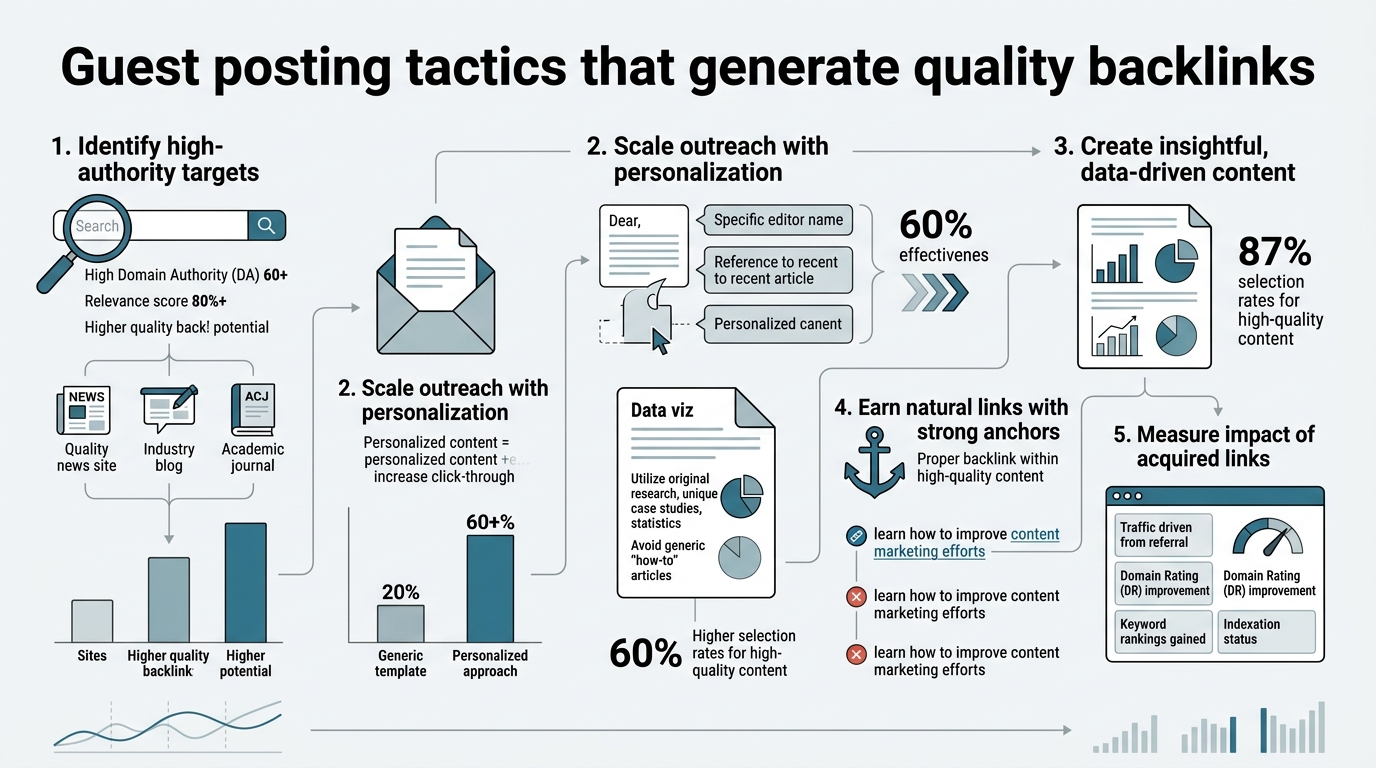
The backlink from a guest post is only as valuable as the publication that hosts it. A placement on a domain with 50+ Authority Rating that drives genuine audience traffic generates ranking credit and brand authority. A placement on a low-quality site or link farm generates risk without reward. According to Link Building HQ's 2026 research, the shift in 2026 is that Google now actively penalizes publishers that use guest posts to manipulate rankings at scale. Your job is to identify publications where a guest post genuinely serves the audience, not where it serves your link-building quota.
Authority and Relevance as the Foundation
A guest post is an editorial endorsement. When you publish on Entrepreneur, HubSpot, or your industry's recognized authority site, you inherit some of that domain's credibility. Research from multiple 2026 analyses confirms the gap: guest posts on high-DR blogs generate 45% more long-term backlinks than placements on low-authority sites. This isn't just about the initial link. It's about the compounding effect. Authority sites get referenced, cited, and linked to again. Your article becomes part of the permanent authority infrastructure in your niche.
Relevance magnifies this effect. A guest post on a tangentially related site with 50M monthly traffic won't outperform a post on a niche-focused blog with 50K monthly traffic if the niche-focused site has a tighter audience match. The reason: Google's ranking systems reward topical authority and contextual link placement. A post about ecommerce SEO on a marketing blog ranks better and passes more value than the same post on a general business site.
The Difference Between Editorial and Sponsored Links
Not all guest post backlinks are created equal legally. Google's spam policies distinguish between editorial links (which pass ranking credit as dofollow) and sponsored links (which must use nofollow or sponsored attributes). A link in a guest post you pitched editorially, were accepted for on merit, and wrote without a financial arrangement is editorial. A link in a paid guest post, a brand collaboration, or a link-for-hire arrangement must be marked nofollow or sponsored.
The confusion costs teams SEO value. If you're paying for guest post placements and not disclosing it with nofollow/sponsored tags, you're violating Google's guidelines. If you're pitching as an authentic expert contributor and the publisher accepts you editorially, your links stay dofollow. The tactic itself is neutral. The ethics and transparency of the arrangement determine its legitimacy.
How to Identify High-Quality Guest Posting Opportunities
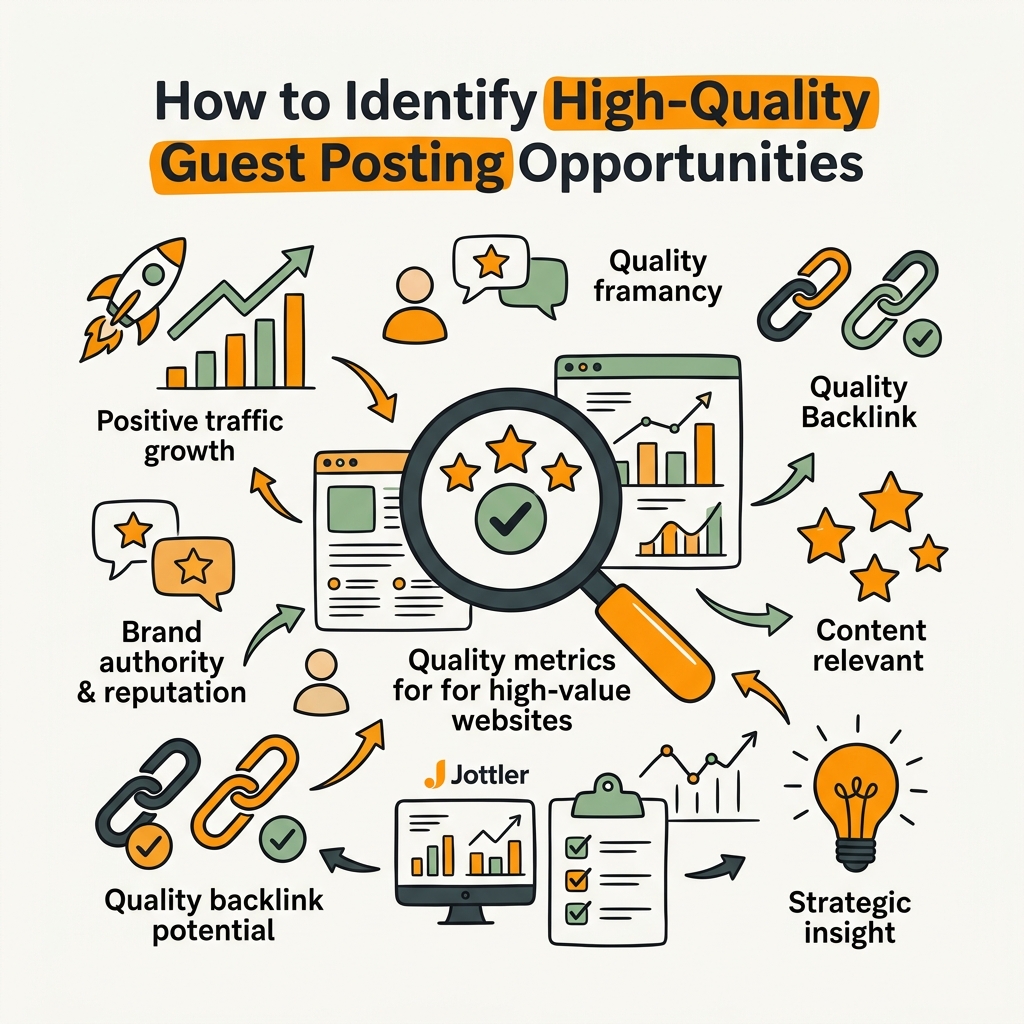
The hardest part of guest posting in 2026 isn't writing the article. It's finding the right host site. Thousands of "guest posting services" offer bulk placements at dirt-cheap prices. None of them are worth the risk. Instead, build a curated list of 10-20 publications where you'd actually want to publish, because your ideal audience reads them.
Screening for Authority and Audience Quality
Start with domain authority, but don't stop there. Use Ahrefs, Semrush, or Moz to check the Authority Rating of target sites. Aim for DR 50+ if possible, but be willing to go lower if the audience match is exceptional. A site with 30 DR but a tightly engaged, niche audience sometimes outperforms a 60 DR generalist site.
Then verify the site actually receives real traffic from your target audience. Check the top pages, read recent articles, look at the comments and engagement. Does the site feel alive, or is it a content farm masquerading as a publication? Cross-reference the site with your own analytics. If your customers read this publication, it's worth pursuing. If you're not sure anyone in your audience has heard of it, skip it. As Backlynk notes, the market has shifted toward quality-first evaluation, not volume-based acceptance.
- Domain Authority 50+: The baseline for a site that passes meaningful ranking value.
- Organic traffic 10K+/month: A signal that the site has real audience reach, not just a DR score.
- Topic alignment: The site covers topics your audience actively searches for in your industry.
- Editorial standards: Recent articles are well-researched, fact-checked, and updated regularly.
- No link-selling history: Avoid sites known for selling guest post placements or churning out low-quality content for bulk placement.
The Marketplace Red Flags
Platforms that aggregate guest posting opportunities"300+ pre-vetted sites accepting guest posts"are rarely worth the risk. Only 4.6% of marketplace opportunities qualify as high-quality (DR 71+ with 50K+ monthly traffic) according to BuzzStream's analysis of 26,000+ sites. The other 95%? Mediocre to harmful for your SEO.
Red flags for low-quality opportunities include: sites that accept any topic, sites with no editorial review process, sites that don't disclose nofollow requirements, sites offering bulk discounts, and sites with zero audience engagement. If an opportunity feels too easy or too cheap, it is. The cost of a bad placementalgorithmic suspicion, wasted effort, reputational associationoutweighs any time savings.
How to Pitch Guest Posts That Actually Get Accepted
Your pitch quality determines your acceptance rate. Generic, mass-blast pitches land in spam folders. Personalized, specific, reader-focused pitches get responses. The data is consistent: personalized pitches see 47% higher acceptance rates than cold outreach, and offering topic ideas doubles acceptance odds versus open-ended requests. Research from PointVisible's survey of 84 editors confirms that personalization and specificity drive acceptance more than any other factor.
Structuring the Pitch for Maximum Impact
Keep your pitch short. Pitches under 150 words are recommended across industry guidance. This forces you to be specific about why your article matters to their readers. Start with a single sentence that references one recent article they published and explains why your idea is the logical follow-up. Then offer 2-3 concrete topic ideas with working titles. Include 1-2 relevant writing samples if you're not already known to the editor. Close with a single, easy question: "Does any of these ideas fit your calendar?"
The structure matters because editors are overloaded. A 500-word pitch with your biography, company background, and generic value proposition signals you don't understand their time constraints. A 100-word pitch that says "I read your post on [specific article]. I'd like to follow up with [specific idea]. Here's a sample of my work. Does this fit?" signals respect and clarity. Editors reward clarity.
- Subject line: "[Publication Name]: 3 Ideas for [Their Audience]", specific and benefit-focused.
- Opening: One sentence referencing a recent post and explaining why you're reaching out now.
- Body: 2-3 topic ideas with working titles, not vague pitches.
- Credibility signal: One sentence about your background or expertise, plus 1-2 writing samples.
- Close: One simple question asking if any idea fits their editorial calendar.
Personalization vs. Scaling
You can't pitch 100 editors the same email and expect strong results. But you can build a template framework that you customize for each target. Research the publication, reference one specific article, suggest ideas that align with their recent coverage gaps, and ask about their topic needs. This takes 10-15 minutes per pitch instead of 2 minutes of mass blasting. The 47% higher acceptance rate justifies the investment. As covered in content marketing automation best practices, selective outreach combined with relationship-building delivers stronger results than volume-based approaches.
Follow up once after 5-7 days if you don't hear back. Send only one follow-up. More than that borders on harassment. If they don't respond to two touches, they're not interested. Move on to the next target.
What to Write in Your Guest Post for Maximum Backlink Value
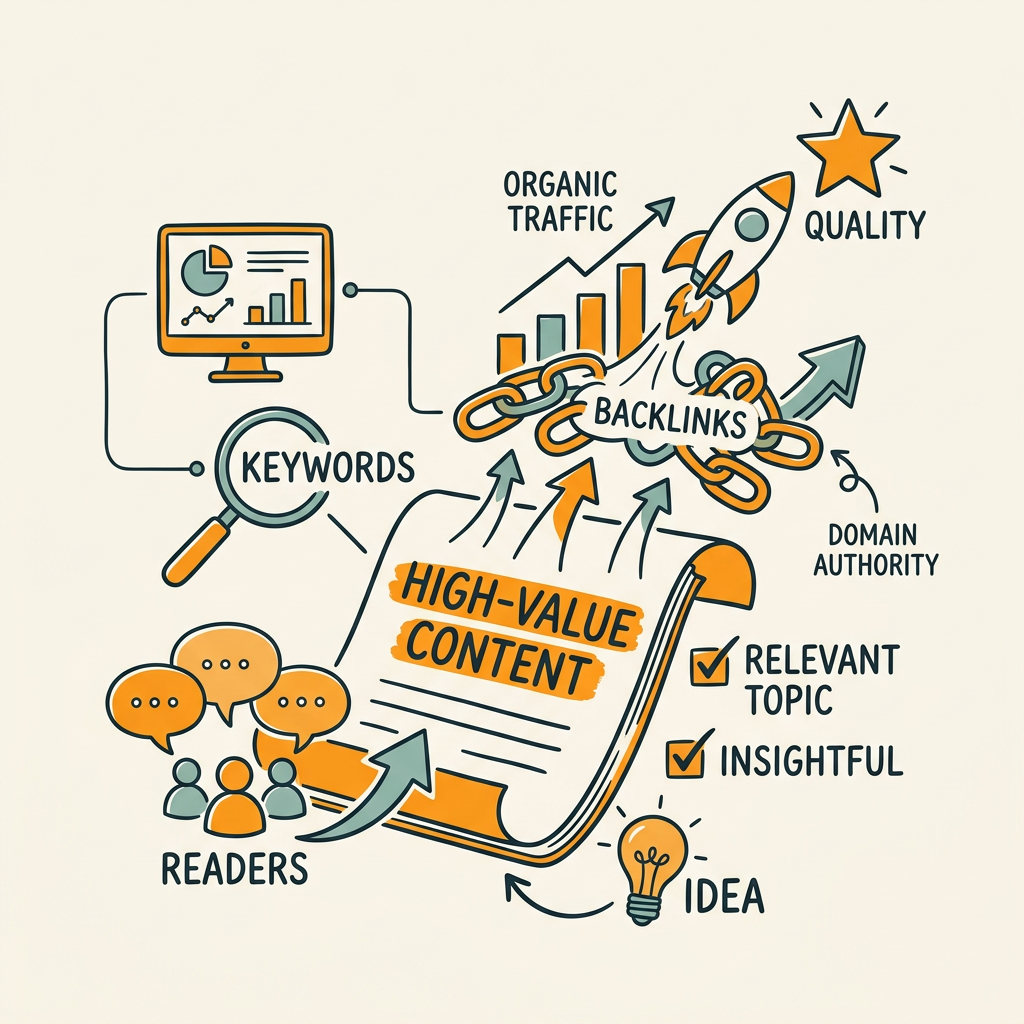
The backlink comes with the byline, but the article itself determines whether the publication keeps the link live, promotes it, and whether readers actually trust it. A weak guest post gets buried or removed. A strong one compounds.
Depth and Original Research as Your Unfair Advantage
Write at least 1,500 words. Most guest posts clock in at 800-1,200 words. The longer posts outperform in search rankings because they tend to be more substantive. Include data. Cite studies. Link to authoritative sources (but not your competitors). If you can, include original research or a case study from your own work. Guest posts that bring genuinely new information outrank those that summarize existing knowledge.
The audience of the publication deserves more than a promotional puff piece. They're there to learn, not to read your company bio. Write as if you're writing for a publication you respect, because you are. The backlink and referral traffic follow from that quality. Tools like AI SEO agents can help automate research and fact-checking across dozens of sources, ensuring your guest post includes the most current data and properly cited claims.
Natural Anchor Text and Internal Linking Strategy
Use your author bio and guest post content to include 1-2 backlinks to your site. Avoid exact-match anchor text like "best SaaS platform" or "content marketing tools." Use natural phrases: "according to our research on [topic]" or "as we documented in our guide to [topic]." The link should serve the reader, not just your SEO. If you're writing about guest posting tactics for an SEO publication, linking to your own detailed guide on link-building strategy makes sense. Forcing a link to your homepage doesn't.
Ask the editor about their linking policy before you submit. Some publications limit outbound links. Some require nofollow on author links. Some only allow links in the author bio. Work within their constraints. A placement with one restricted link beats no placement at all.
How to Track and Retain Your Guest Post Backlinks
The work doesn't end at publication. 22% of guest post backlinks disappear within 12 months. Links decay because articles get taken down, sites redesign and break URLs, publications fail, or editors prune old content. Quarterly audits catch these drops and give you time to reach out to the publisher or find alternative placements.
Audit and Monitoring Workflow
Export your guest post placements into a simple spreadsheet: publication name, URL, publish date, article title, backlink anchor text, and the domain authority of the host site. Every quarter, spot-check a sample of the links. Run them through a link checker or your SEO platform to verify they're still live and pointing to the right URL on your site. If a link is dead, email the publication and ask if the article was archived or removed. Offer to provide an updated version if the article is outdated.
For your highest-impact placements (DR 60+, strong referral traffic), check monthly. For tier-2 placements, quarterly is sufficient. This proactive maintenance keeps your backlink profile clean and gives you justification to reach out to editors againeither to fix the link or to pitch a follow-up guest post.
| Metric | High-Quality Placement | Average Placement | Risky Placement |
|---|---|---|---|
| Domain Authority | DR 60+ | DR 40-50 | DR <30 |
| Monthly Organic Traffic | 100K+ | 10K-50K | <5K |
| Editorial Review Process | Strict editorial standards | Moderate review | No clear review |
| Link Retention at 12mo | 90%+ | 70-80% | <50% |
| Referral Traffic Value | Significant audience overlap | Modest traffic potential | Minimal audience reach |
| Time to Acceptance | 1-3 weeks (competitive) | 2-4 weeks | Immediate (red flag) |
The Case for Consolidation Over Volume
Rather than chasing 20 mediocre placements, invest in 5-10 high-quality placements per quarter. A single DR 70 placement with real audience traffic compounds more value than 20 DR 20 placements that disappear in six months. The energy spent pitching 20 publications can be redirected into writing deeper, more research-backed content that earns editorial acceptance more easily. High-authority editors are more likely to accept expert contributors with proven track records.
"Guest posting is absolutely still worth it in 2026, but only when executed strategically with quality and relevance as the foundation. The real value is not just the backlink, but the combination of ranking credit, referral traffic, and brand authority."
Backlynk, Guest Posting in 2026 Guide
Scaling Guest Posting Without Sacrificing Quality
Once you've proven your process with 3-5 placements, you can scale thoughtfully. The temptation is to hire an outreach agency to blast pitches to hundreds of sites. This approach kills quality and risks penalty. Instead, scale by building deeper relationships with editors and publications that accept your work repeatedly.
Building Recurring Relationships with Target Publications
After your first accepted guest post, follow up with the editor. Thank them for the opportunity, share the performance metrics (traffic, engagement, shares), and ask about future guest posting opportunities. Strong editors appreciate contributors who deliver quality and check in afterward. Some publications have rotating guest contributor programs. Others take recurring expert columns. If you can land a quarterly or bi-annual slot on a DR 60+ publication, you've essentially created a controlled backlink pipeline with no additional prospecting cost after the first pitch.
Track your acceptance rates and engagement metrics by publication. Some editors will accept your pitches 80% of the time because you've earned credibility. Others require more competitive pitches. Focus your ongoing prospecting on the high-acceptance publications and deepen relationships there instead of constantly chasing new targets. This aligns with strategies described in SaaS content marketing playbooks that emphasize relationship depth over channel volume.
How Automation Can Improve Your Process
Prospecting and outreach can be partially automated through tools that identify publishing opportunities and draft personalized initial emails. However, the pitch itself must be manually customized. Tools like SEO automation platforms can streamline the research and fact-checking phases of your guest post writing, ensuring claims are verified against multiple sources and citations are accurate. This reduces the time spent on researchsometimes from weeks to dayswhile increasing the substantiveness of the final article.
"Most teams spend weeks setting up keyword research and fact-checking for a single guest post. When you automate the research phase, you can produce higher-quality content in a fraction of the time, allowing you to pitch more placements without burning out."
David Chen, Content Strategy Lead at a B2B SaaS company
Guest Posting as Part of a Diversified Link-Building Strategy
Guest posting is one tactic, not the strategy. The data shows it clearly: 48.6% of SEO professionals rank Digital PR as the most effective link-building tactic, while only 16% rank guest posting #1 in 2026 surveys. Digital PR (journalism outreach, expert quotes, press coverage) has overtaken guest posting as the primary focus for serious link builders. That doesn't mean guest posting is dead. It means guest posting works best as a complementary tactic. Research from Reporter Outreach's 2026 data reinforces this shift.
Where Guest Posting Fits in Your Link-Building Mix
A diversified link-building approach includes: Digital PR and press coverage (highest tier), resource page placements and industry directory listings (medium tier), relevant guest posting on authority sites (medium-high tier), and possibly affiliate or partnership links (lower tier). Guest posting sits comfortably in the middle because you control the quality of the article (unlike press coverage, which the journalist writes) and you have direct access to the publisher (unlike resource page placements, which require editorial permission).
Allocate 20-30% of your link-building effort to guest posting. Spend the rest on digital PR, relationship-building with journalists, resource page outreach, and co-marketing partnerships. This mix reduces your dependence on any single tactic and lowers your risk if one channel becomes saturated or less effective. For guidance on building this ecosystem, see our article on link-building tools for SaaS teams.
Conclusion
Guest posting in 2026 rewards precision, not volume. Sites that focus on quality authority placements (DR 50+) see 2.4x more ranking impact than those that chase marketplace bulk deals. The backlinks that compound are those on publications with real audiences, real editorial standards, and real authority in your industry. Your job is to identify those publications, pitch with personalization and specificity, write substantive content that serves the audience, and monitor the links to ensure they stay live.
The shift from 2014 to 2026 isn't that guest posting is impossible. It's that guest posting at scale is risky, and guest posting as a standalone strategy is insufficient. Pages with high-quality backlinks from relevant domains are 3.8x more likely to reach the top 3 results, but only if those backlinks come from legitimate, editorially sound placements. Focus on 5-10 high-quality placements per quarter. Measure both the backlink durability and the referral traffic. Integrate guest posting into a broader link-building mix that emphasizes Digital PR and relationship-building.
The easiest way to accelerate this process is to automate the research and fact-checking that makes guest posts substantive. Start your SEO agent and let AI handle the heavy lifting on verification, so you can focus on pitching, writing, and building relationships with the editors who matter.
FAQs
Is guest posting worth it in 2026?
Yes, but only if you focus on quality over volume. Guest posts on authority sites (DR 50+) generate 2.4x more ranking impact than low-authority placements, and sites with high-quality backlinks from relevant domains are 3.8x more likely to rank in the top 3. However, placement on low-quality sites or bulk-marketplace listings carries risk without reward. The 2024-2025 Site Reputation Abuse penalties penalized major publishers (Forbes, CNN, USA Today) for mass guest-posting schemes. The tactic itself is soundthe execution determines the value. Focus on 2-4 high-quality placements per quarter on niche-relevant publications with real audiences instead of chasing dozens of mediocre opportunities.
How long does it take to get a guest post accepted?
High-quality publications typically respond within 1-3 weeks because they're selective and receive fewer pitches. Average publications take 2-4 weeks. Sites that accept guest posts immediately are usually low-quality and should be avoided. The acceptance timeline also depends on your pitch quality and personalization. Personalized pitches with topic ideas see 47% higher acceptance rates than generic mass pitches. If you're pitching publications with editors you have an existing relationship with, acceptance can come within days. The key is: don't rush it. A single placement on a DR 60+ site is worth more than 10 placements on junk sites, even if the quality placement takes longer to close.
What's the best way to find guest posting opportunities?
Start by identifying 10-20 publications your ideal customers actually read. Check their domain authority (aim for 50+), verify they receive consistent organic traffic (10K+/month), read their recent articles to assess editorial quality, and note their author/contributor guidelines. Avoid marketplace platforms ("300+ sites accepting guest posts") because only 4.6% of those opportunities meet high-quality standards. Instead, research publications manually using search operators like "site:[domain] write for us" or by looking at who covers topics relevant to your industry. Build a custom list of targets, then craft personalized pitches to editors at those publications. This manual, targeted approach yields far higher acceptance rates and better backlink value than bulk marketplace submissions.