How to Acquire Quality Backlinks Without Paying for Links
Backlinks remain one of the strongest ranking signals in Google's algorithm, yet 95% of web pages have zero backlinks (SEOmator, 2025). The challenge isn't that backlinks don't matter—they do. The problem is that most teams think earning them requires paying thousands per month or resorting to risky tactics that trigger penalties. That's the wrong assumption.
The real cost of ignoring backlinks is steeper: pages competing in your space average 3.8x more backlinks than yours (SEOmator, 2025). Meanwhile, 64% of SEOs spend $3,000+ per month on paid link programs, and many see zero ROI (Reporter Outreach, 2026). The gap between what works and what most teams are doing is massive.
Here's the good news: you can earn quality backlinks at zero cost by creating content worth linking to, building real relationships with journalists and industry leaders, and systematically turning mentions into citations. This guide walks you through five proven tactics used by companies that don't have million-dollar budgets.
Key Takeaways
- Top-ranking pages have 3.8x more backlinks than competitors (SEOmator, 2025), making organic backlink acquisition a non-negotiable SEO priority.
- Digital PR and HARO outreach are the fastest routes to high-authority links without spending on paid link services.
- Original research and data assets earn compounding backlinks for years and remain the safest strategy under Google's spam policies.
Quick Scan: Five Proven Backlink Tactics
- Create Linkable Assets: Original research and data studies attract natural editorial citations and maintain link value long-term.
- Master Digital PR: Pitching newsworthy findings to journalists delivers DR 50–85+ placements with 250–625% estimated ROI.
- Leverage HARO and Expert Outreach: Responding to journalist queries costs nothing and earns high-DR links with 5–15% placement rates.
- Find and Replace Unlinked Mentions: Converting brand mentions that don't link into actual backlinks is the fastest method to earn citations.
- Automate Content Production: Producing the high-volume, high-quality content needed for backlink campaigns requires systematic content workflows.
Create Linkable Assets That Earn Backlinks Naturally
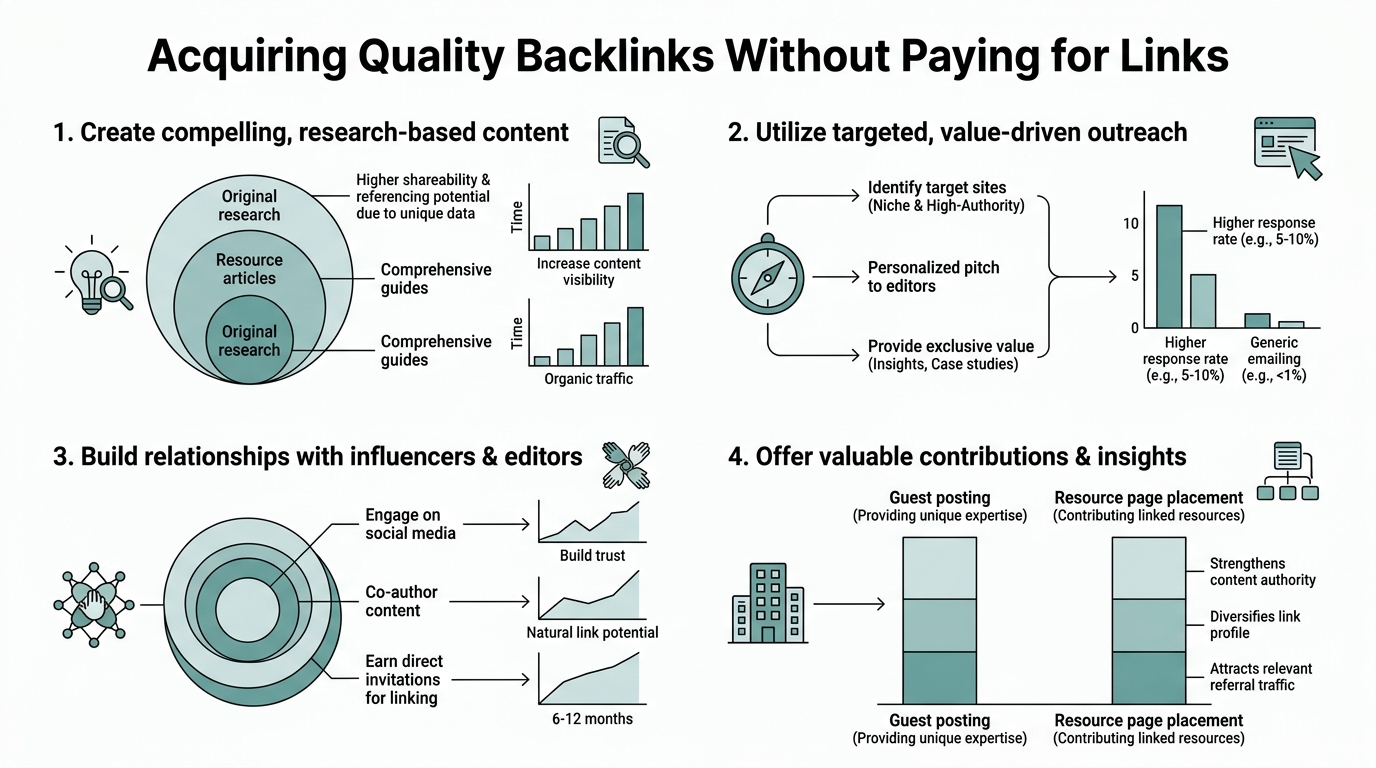
The foundation of earning backlinks without paying is creating content so useful, original, or data-driven that other publishers naturally want to reference it. Long-form content over 3,000 words earns 3.5x more backlinks than shorter pieces (Amraandelma, 2026). The key isn't length alone—it's providing something genuinely new to the industry.
Original Research and Industry Data as Link Magnets
Original research outperforms every other content type for backlink attraction because journalists, competitors, and industry leaders can't cite findings without crediting you. One SaaS company's case study reports earning 22 backlinks, 3 interview requests, and 156% branded search growth from a single original research report (LinkSurge, 2026). That's not a one-time spike—original data becomes a persistent linking asset.
"Original research becomes a persistent linking asset because journalists and industry leaders must credit the source when citing unique findings. This creates a compounding effect where a single study generates backlinks for years, not just weeks."
The mechanics are straightforward: conduct proprietary research, survey your audience or industry, analyze unique data patterns, and publish findings with full transparency. SEOmator's research on backlink trends is itself a linkable asset used across dozens of industry guides. That's not luck—it's intentional positioning.
Your original research doesn't need to be expensive or massive. The strongest candidates are surveys addressing gaps in existing data—questions your audience faces that no published study answers yet. Consider these asset types for maximum link attraction:
- Industry surveys with 500+ respondents addressing unanswered questions
- Proprietary data analyses revealing trends competitors haven't discovered
- Benchmarking reports comparing performance across companies or verticals
- Tools and calculators solving immediate problems for your audience
- Expert roundups featuring 10–20 thought leaders in your space
Expert Roundups and Curated Resource Pages
Expert roundups—pieces featuring quotes and insights from 10–20 thought leaders in your field—naturally generate backlinks from every contributor. Contributors link to the piece from their site, their social profiles, and their email newsletters. This also builds goodwill with industry influencers who then become more willing to cite your work elsewhere.
"Expert roundups work because they create mutual benefit: contributors get visibility, your audience gets diverse perspectives, and you earn links from every participant's network. Each contributor becomes a distribution channel for your linkable asset."
Resource pages follow the same pattern. Curating the 50 best articles on a topic, the top tools in a category, or the most important frameworks creates a destination page that earns links from sites trying to send readers to authoritative compilations. Make the resource page truly useful—annotated descriptions, honest pros/cons, actual rankings—and publishers will reference it.
Master Digital PR to Earn Editorial Backlinks at Scale
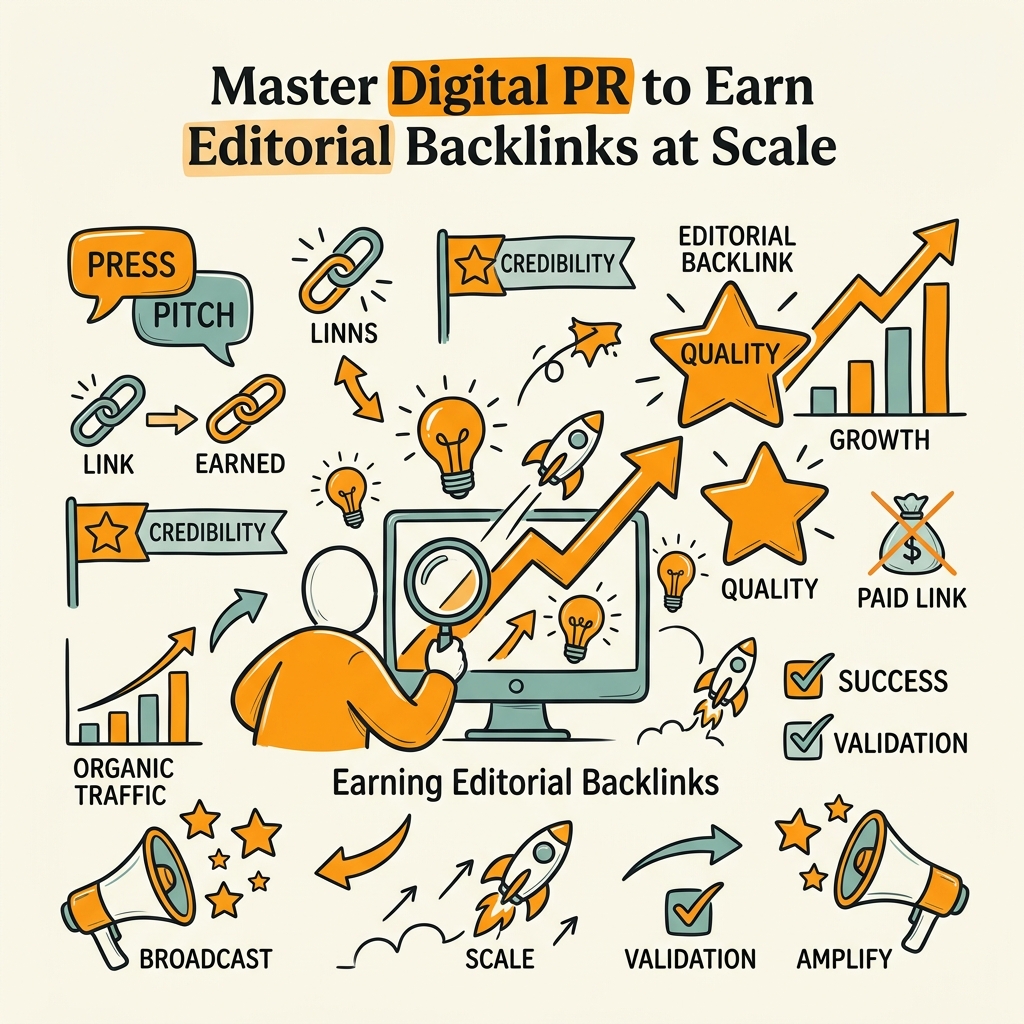
67.3% of marketers use digital PR as their link-building method, with 48.6% citing it as the most effective tactic (SEOmator citing DemandSage, 2025). Digital PR means pitching newsworthy findings, trend analyses, or expert commentary to journalists, bloggers, and media outlets. When executed well, it produces the highest-quality links because editorial outlets naturally include your attribution and context.
The Digital PR Pitch Workflow
Digital PR begins with identifying angles—trends, contradictions, or data points in your research that journalists will find interesting. A software company's analysis of hiring trends, a fintech firm's study on payment behavior shifts, or a marketing agency's guide on what changed in the algorithm are all newsworthy angles if they're specific and timely.
Next, research journalists and outlets covering your space. Tools like HARO (Help A Reporter Out), Cision, and even LinkedIn make finding journalists straightforward. Pitch them concisely—one paragraph explaining why their audience should care, backed by your unique insight. The best pitches lead with the news angle, not your product.
Quality matters more than volume. One placement in a tier-1 publication beats 10 placements in low-authority blogs. Search Engine Land's assessment emphasizes that link quality and relevance matter far more than raw count—a DR 60+ link from a relevant publication is worth more SEO-wise than three DR 30 links from unrelated sites.
Newsworthy Angles That Attract Media Attention
The strongest angles are tied to current events, seasonal trends, or data contradictions. If industry consensus says one thing and your research shows another, that's a story. If you've identified an emerging trend before mainstream media, journalists will want to cover it. If you've analyzed what changed with a major algorithm update or policy shift, your expertise becomes immediately relevant.
Structure your pitches around these proven angle categories:
- Contradictory Data: Your research contradicts conventional wisdom, challenging assumptions the industry has held
- Trend Identification: You've spotted an emerging pattern before mainstream media coverage exists
- Timely Analysis: Your insights directly address current events, new regulations, or recent announcements
- Industry Impact: Your findings affect how companies operate or how their audience makes purchasing decisions
- Expert Access: You have access to data, people, or insider perspectives other journalists cannot easily obtain
When Link Building HQ tracked results, companies combining digital PR with strong internal follow-up achieved 312% ROI over 24 months. The payoff compounds because a single media placement often triggers follow-on coverage and citations from other outlets citing the original coverage.
Leverage HARO and Journalist Outreach for Fast Backlinks
HARO (Help A Reporter Out) is a free database of journalist queries looking for expert sources. Responding with useful, quotable insights earns you backlinks when journalists cite your response in published articles. Placement rates run 5–15% depending on speed and quality, and placements typically come from DR 60–85 domain authority outlets (LinkSurge, 2026).
How to Win HARO Placements
HARO queries arrive three times daily across dozens of industries. The competitive advantage goes to teams responding within the first hour. Speed matters because journalists often accept the first three solid responses.
Your response should be specific, not generic. If a journalist asks, "How are companies using AI in content marketing?" don't respond with a generic overview. Share a specific example—a problem you see teams facing, a mistake they're making, or a tactical insight backed by data. Quote-worthy responses win placements because journalists can drop them directly into articles.
Include your credentials and a link to your site. Journalists verify sources before publishing, so a bio with your title, company, and a working link increases your chances of placement. After placement, your response appears in the published article with your site linked as a source.
To maximize your HARO success, follow this response framework:
- Respond within 60 minutes of query publication for maximum visibility
- Lead with a specific, quoteworthy insight or statistic, not generic advice
- Provide 2–3 sentences max—journalists edit for brevity and readability
- Include your full credentials, title, company, and website URL
- Mention any published research, studies, or books that support your credibility
- Proofread rigorously—errors eliminate your chances of selection
Building Relationships With Journalists and Editors
Beyond HARO, building direct relationships with journalists covering your space creates recurring backlink opportunities. Follow journalists on Twitter, read their articles, comment thoughtfully, and occasionally pitch them directly. When they're writing stories in your wheelhouse, they'll remember you as a reliable source.
Consistency is the key. Responding to five HARO queries per week, pitching journalists monthly, and maintaining a newsletter featuring your insights keeps you visible. Reporter Outreach's data shows that teams treating this as a repeatable system—not one-off efforts—see cumulative backlink growth of 3–5 links per month at zero cost beyond time.
Convert Unlinked Mentions into Actual Backlinks
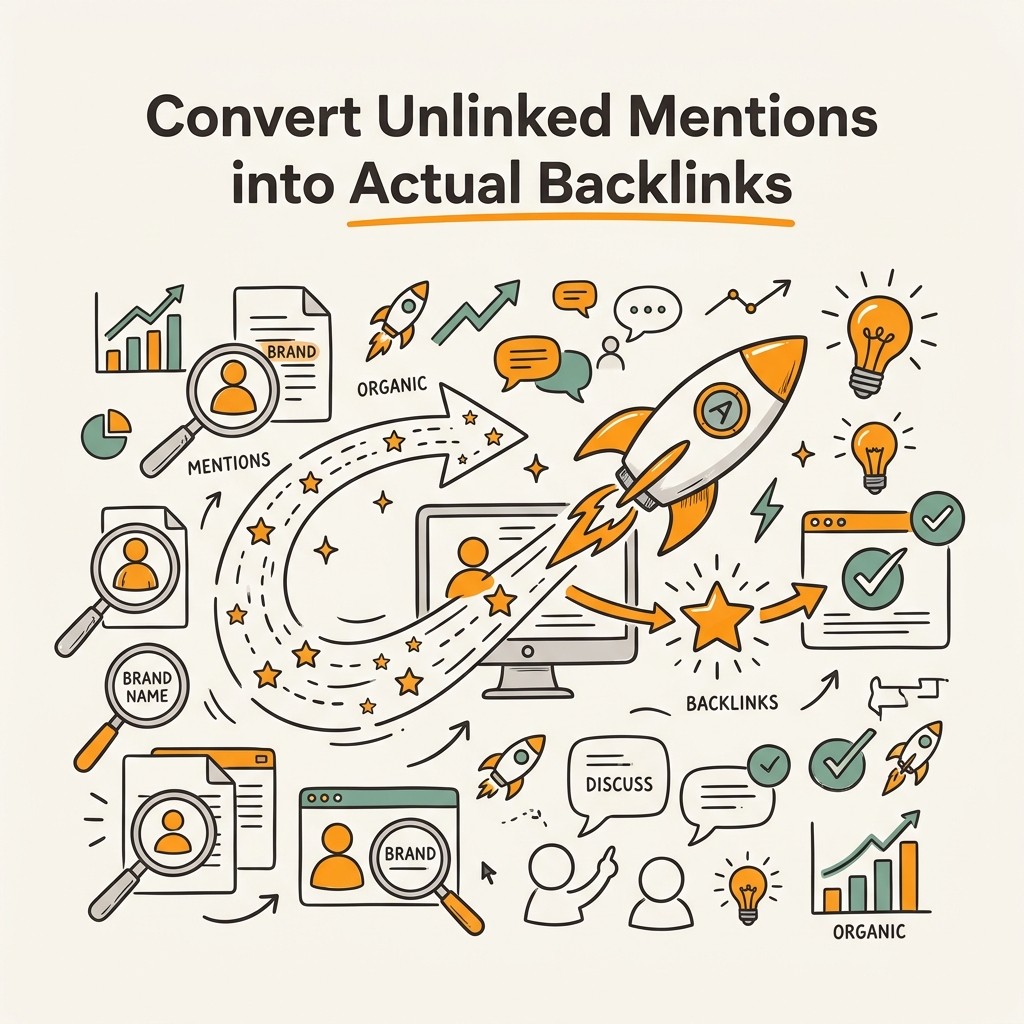
Companies mention your brand, cite your research, or reference your work without linking. These unlinked mentions are the fastest backlinks you can earn because the relationship and credibility already exist—you're just adding the link. A single outreach campaign can typically convert 10–20% of unlinked mentions into actual citations.
Finding Unlinked Brand Mentions
Tools like Google Alerts, Mention, or Semrush's "Brand Monitoring" find sites mentioning your company, products, or founders by name. Filter for high-authority sources where a link would carry real SEO weight. Don't bother with brand mentions from low-authority forums or comment sections.
Look for direct quotes from your founder, references to your published research, or use cases where someone describes your product's effect on their business. These are all contextual situations where a link makes sense and adds value for the linking site's readers.
When evaluating unlinked mentions, prioritize these scenarios for outreach:
- Direct citations of your published research or data without linking to the source
- Quotes from your founder or team members mentioned by name without company link
- Case studies or use cases describing your product's impact without attribution
- Articles referencing your work alongside competitors' work for comparison
- Industry roundups or guides listing your tool or company in text without links
The Outreach Template That Works
Keep outreach friendly and light. Email the author or site owner, note that you appreciate the mention, and point out that adding a link would help readers who want to learn more. Example: "Hi Sarah—I noticed you cited our 2026 backlink research in your article on SEO trends. Readers would probably appreciate a link to the full study if you're open to it."
The best unlinked-mention campaigns convert 15–25% of contacts into links. Even conservatively, if you find 50 mentions, converting just 10 into backlinks is a near-zero-effort win. Build this into a quarterly routine—search for mentions, do a light outreach pass, and watch the backlinks accumulate.
Build an Automated Content System to Sustain Your Backlink Strategy
Earning backlinks at scale requires producing consistent, high-quality content. This is where most teams fail—they lack the resources to publish the original research, expert roundups, and long-form guides needed to fuel a backlink program. Publishing one piece per month means one major link-earning opportunity per month. Publishing one per week compounds the opportunity 4x.
Why Content Volume Matters for Backlink Growth
Sites earning the most backlinks aren't doing anything more sophisticated than their competitors—they're simply publishing more linkable content. Sites investing consistently in content grow organic revenue 2x faster than those relying only on technical SEO (Link Building HQ, 2026). The multiplier effect is real.
The challenge is production friction. Researching topics, conducting interviews, fact-checking findings, writing long-form pieces, formatting, and optimizing for internal linking is a five-day process per article for most in-house teams. That's why most companies publish monthly at best. This is where SEO automation platforms make a critical difference—they eliminate the bottleneck that prevents most teams from achieving the publishing volume required for sustainable backlink growth.
Automation changes the equation. Autonomous SEO engines like Jottler eliminate the production bottleneck by researching topics, writing 3,000+ word articles, fact-checking claims, and publishing directly to your CMS on a daily schedule. A team working with Jottler can publish 5–7 original, research-backed pieces per week instead of one per month. More content means more opportunities for backlinks, and more backlinks compound your organic rankings.
Content Calendar Strategy for Backlink Opportunities
Structure your content calendar to produce a mix of linkable assets: original research quarterly, expert roundups monthly, trending topic commentary weekly, and resource pages on evergreen topics. This diversified approach ensures you're always feeding new fuel to your backlink engine.
Track which content pieces attract backlinks, which angles resonate with journalists, and which topics generate the most expert quotes. Use that data to refine future content. Over time, you'll identify which formats, topics, and publishing cadences drive the most backlinks for your niche. The SaaS content marketing framework emphasizes consistent publication cycles paired with systematic backlink tracking—this combination compounds faster than sporadic high-effort pieces.
| Backlink Strategy | Time Investment (per piece) | Link Quality | Scalability |
|---|---|---|---|
| Original Research Reports | 2–4 weeks | DR 60–85 | Low (quarterly) |
| Digital PR Outreach | 3–5 days | DR 50–80 | Medium (monthly) |
| HARO / Journalist Matching | 1–2 hours | DR 50–75 | High (ongoing) |
| Unlinked Mention Outreach | 4–6 hours | Varies | High (quarterly) |
| Expert Roundups | 1–2 weeks | DR 55–70 | Medium (monthly) |
Avoid These Common Backlink Mistakes
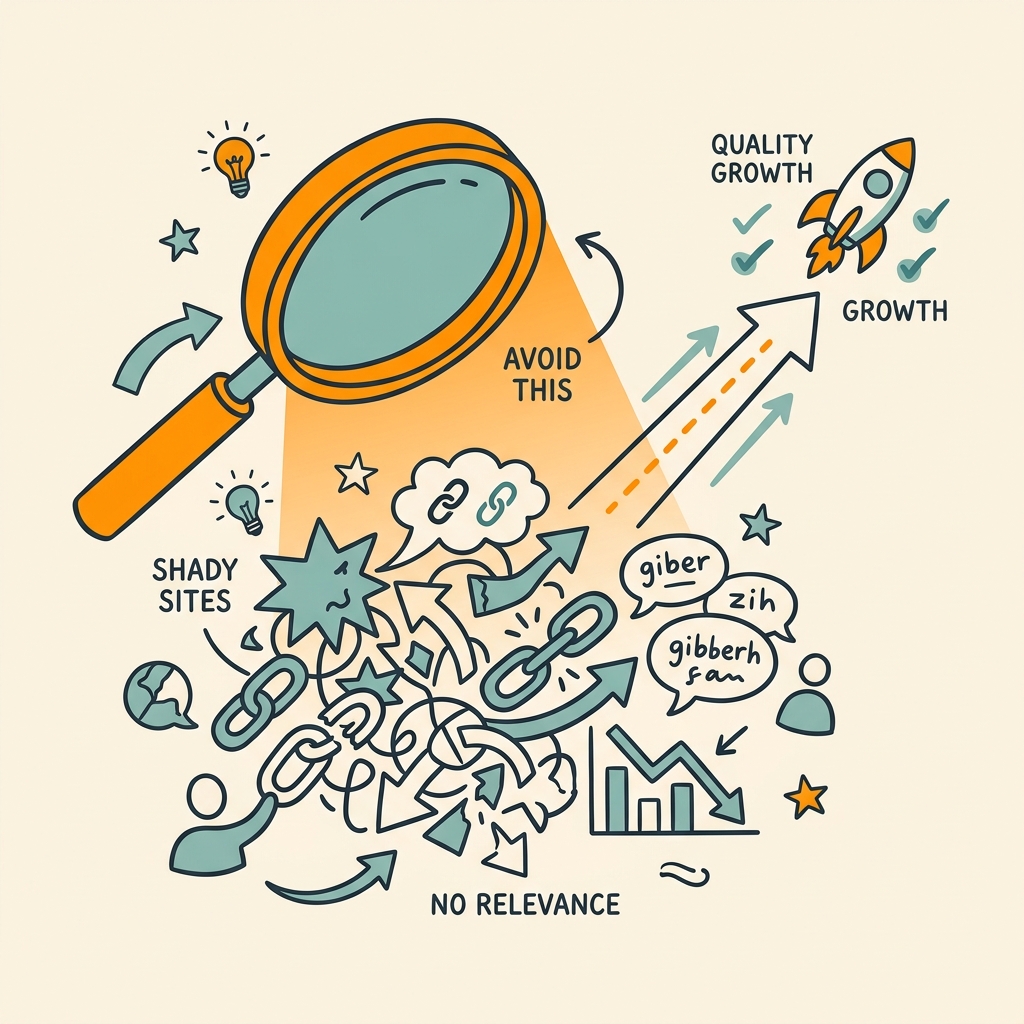
Before scaling your backlink strategy, know what not to do. Google's algorithm has become exceptionally efficient at detecting unnatural link patterns. 86% of SEO professionals now leverage AI tools for backlink automation (SEOmator, 2025), which sounds modern until you realize that automation without quality control usually means buying links in bulk or using PBN networks.
The Purchased Link Trap
Purchased links from link brokers, private blog networks, or article spinning services trigger penalties faster than ever. The cost of a penalty—lost traffic for months while you recover—vastly exceeds the cost of earning links legitimately. Even short-term ranking gains don't justify the risk.
Red flags indicating a risky link-building service include:
- Guarantees of specific rankings or link placements
- Pricing based on bulk link packages rather than actual results
- Links from private blog networks or content mills you don't recognize
- Anchor text targeting exact keywords without contextual relevance
- Link placements appearing within seconds of payment, not after editorial review
- Services that hide the linking domain identity or obfuscate the actual websites
Over-Optimization and Anchor Text Red Flags
Too many backlinks using your exact target keyword as anchor text signals manipulation to Google. Healthy backlink profiles use branded anchor text (your company name), natural variations ("the guide to X," "learn more"), and long-tail keyword phrases that occur naturally in context. Aim for 30–40% keyword-related anchor text, 40–50% branded, and 10–20% generic or URL-based.
Measure Backlink Progress the Right Way
Track backlinks using tools like Ahrefs, Semrush, or Moz. Look for these metrics: unique referring domains (more important than total backlinks), domain authority of linking sites, anchor text distribution, and growth velocity. A site earning five DR 70+ links per month is progressing far better than a site with 50 DR 20 backlinks.
Set a baseline for your current backlink profile. Note how many unique domains link to you, the average domain authority, and your growth rate. Establish a target—typically, 5–10 new DR 50+ backlinks per quarter for competitive niches is a solid goal. Measure yourself against that quarterly and adjust your tactics if you're falling short.
Conclusion
Earning quality backlinks without paying is possible, proven, and increasingly the preferred strategy as Google's spam detection becomes more sophisticated. The barrier isn't the tactics—they're all well-documented and accessible. The barrier is consistency and content volume. Teams that publish high-quality, original content on a reliable schedule earn backlinks compounding over time.
Sites investing in organic backlink strategies grow organic revenue 2x faster (Link Building HQ, 2026), and top-ranking pages average 3.8x more backlinks than lower-ranking competitors (SEOmator, 2025). The advantage goes to teams committed to the long-term compounding effect, not those searching for shortcuts.
Start by creating one piece of original research or expert roundup this quarter. Pitch it to 10 journalists. Respond to HARO queries for 30 days. Find 50 unlinked mentions and reach out. Track the backlinks you earn. Then scale what works. Your competitors are moving fast—if you're still thinking of backlinks as a paid channel, you're falling behind. It's time to start earning them instead.
Ready to scale your backlink strategy? The limiting factor for most teams isn't the tactics—it's producing enough quality content to fuel them. Start your SEO agent and publish the research, roundups, and long-form guides that earn backlinks daily.
FAQs
How long does it take to see backlinks impact rankings?
Most sites notice ranking improvements around 3.1 months after acquiring high-quality backlinks (Link Building HQ, 2026). Google crawls and indexes the referring page, discovers the new link, and factors it into ranking calculations during the next algorithmic update. Some high-authority links show impact faster, while links from new sites may take longer to process. Consistency matters more than speed—teams acquiring 3–5 quality backlinks per month see steady compounding gains, while sporadic link building produces unpredictable results.
What makes a backlink high quality for SEO purposes?
High-quality backlinks share four characteristics: domain authority (the linking site's overall reputation), topical relevance (the linking site's content relates to yours), anchor text context (the link appears within relevant text, not isolated), and referral traffic (the link could realistically send actual visitors). A link from a DR 50 site in your industry is worth far more than 10 links from DR 10 directories. Google values editorial, naturally earned links from authoritative sources far above any other type.
Can I build backlinks without writing content?
Building meaningful backlinks without content is extremely difficult. Backlinks reward sites for creating something worth linking to—original data, useful tools, expert insights, or comprehensive guides. You can earn some links through HARO responses and expert positioning, but sustainable backlink growth requires content assets. The best strategy combines original, high-quality content with strategic outreach—content attracts backlinks passively over time, while outreach accelerates the process. Skipping the content piece means relying entirely on manual outreach, which limits scale.