How to Build a Defensible SaaS SEO Moat
SaaS growth has become measurably harder. Median SaaS growth has compressed to 25% in 2026, with paid acquisition costs rising 14% year-over-year while margins shrink. The same companies that once dominated through paid channels are now struggling. The fix? A defensible SEO moatone built on organic content that compounds month after month, getting cheaper per customer while your competitors fight over increasingly expensive ad inventory. Here's what separates moat-builders from content-mill operators.
Key Takeaways
- Organic search drives 44.6% of all B2B revenue and converts at 51% MQL-to-SQL vs 26% for PPC (Oliver Munro, 2026)
- Topical authority compounds faster than backlinks: sites with 25-30 cluster articles see 40–70% ranking increases within 3-6 months (SearchAtlas, 2026)
- Proprietary data and benchmarks are now your defense against AI-generated generic content and competitor replication
- SEO ROI reaches 702% with ~7 months payback time, making it the compounding engine paid can't match (Oliver Munro, 2026)
- Organic Advantage Moat: SEO-sourced leads convert at 51% from prospect to sales-qualified vs 26% for paid, with ROI hitting 702% and breaking even in ~7 months.
- Topical Authority Strategy: Building 25-30 interlinked cluster articles in one topic generates 40–70% ranking gains in 3-6 months, outpacing domain-authority-first tactics.
- Proprietary Data Defensibility: Original benchmarks, surveys, and customer insights become citation magnets that competitors can't replicate and AI systems must credit.
- Distribution and Compounding: Organic inbound scales exponentially as your content library grows, making it the only durable moat in an AI-disrupted landscape.
- Buyer-Intent Focus: SaaS wins through comparison pages, use-case pages, and niche alternativesnot generic how-to content vulnerable to zero-click AI answers.
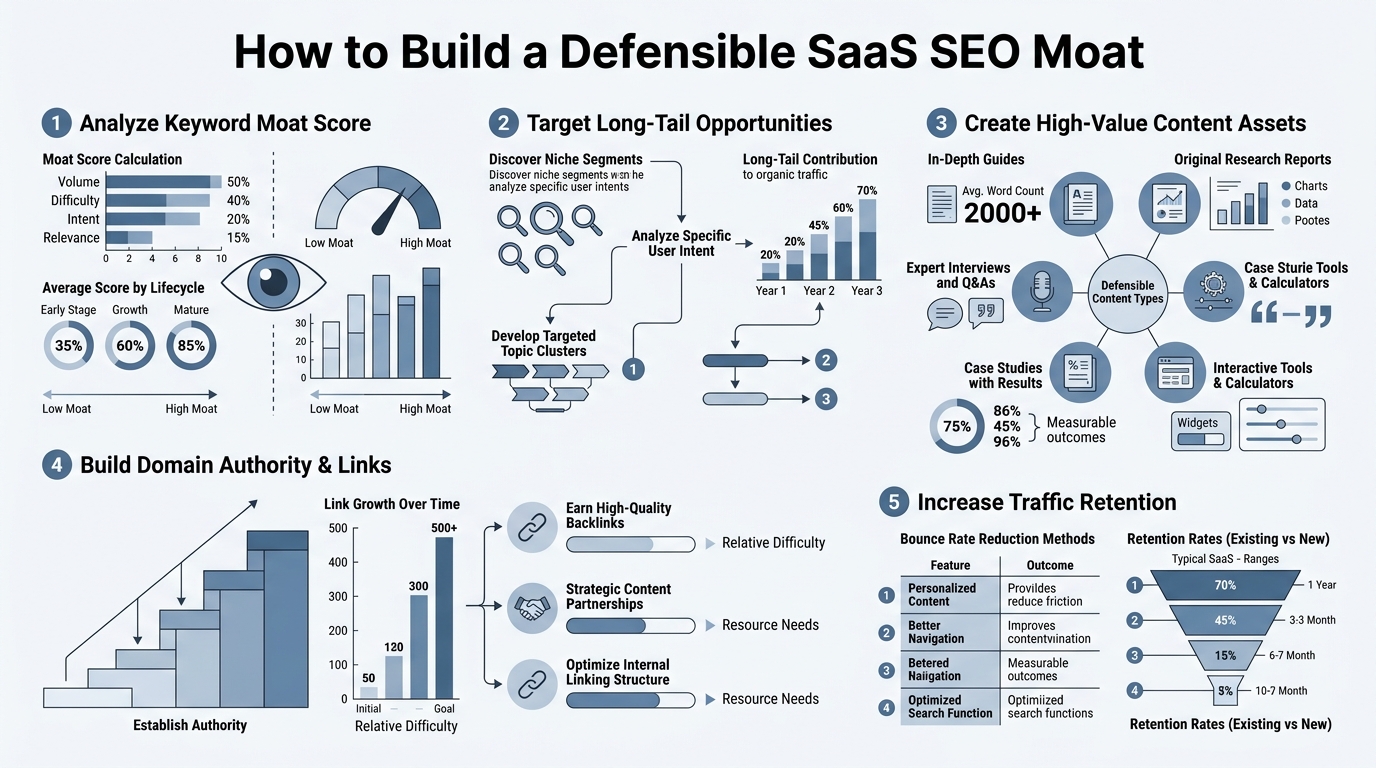
Why Organic Search Is Your Only Durable Moat in a Compressed Market
Paid acquisition is no longer defensible. Median CAC has risen to $2 spent per $1 of ARR acquired, with top-quartile spenders hitting $2.82a 14% jump from 2023. Meanwhile, SEO-sourced leads operate in a completely different math: SEO ROI is 702% with a break-even window of 7 months, compared to paid's compounding cost inflation. The difference? Compounding. Every article you publish compoundsit works 24/7, gets cheaper relative to ARR as volume grows, and becomes harder for competitors to replicate once topical authority takes hold.
The Economics of Organic vs. Paid
Organic isn't just cheaperit's exponentially cheaper over time. In 2026, Oliver Munro's benchmark data shows SEO-sourced leads convert from marketing-qualified to sales-qualified at 51%, versus 26% for PPC. That quality difference compounds. Your content library grows; your traffic multiplies; your CAC per acquisition drops. Paid works in reverse: as markets get crowded, you pay more per lead. As your audience adapts to ads, they click less. Organic is the only motion that gets better as you scale it.
Why Paid Alone Can't Build a Moat
Moats require defensibility. You can't defend a paid channelevery player with budget can buy the same keywords. The moment you stop spending, visibility vanishes. Content is defensible. A well-researched article on a niche topic becomes a ranking asset that compounds. It earns backlinks. It ranks for dozens of related keywords. It drives branded searches as readers recommend you. And critically, once you own topical authority in a space, competitors face a 6-12 month deficit to catch up. That's your moat. To build it, you need a system that publishes consistently, research-backed content that ranks.
"Distribution is the only durable moat left in SaaS. Most companies ignore this truth until paid acquisition becomes economically unviable. By then, it's too late to build organic."
James Currier, Optimist Co-Founder, SaaS Growth Strategy: The 2026 Playbook
Build Topical Authority: The Real SEO Moat Structure

Topical authority is not about chasing rankings for random keywords. It's about owning a subject so completely that Google has no choice but to rank you firstand AI systems have no choice but to cite you. The mechanics are straightforward: choose one core topic, map all subtopics and search intents, publish a tightly interlinked cluster of articles, and add proprietary data that competitors can't replicate. Sites following this pattern see 40–70% ranking increases within 3-6 months. Generic domain-authority tactics take twice as long.
Map Your Topic Cluster Before Writing Anything
The biggest mistake SaaS teams make is writing in silence. You publish 10 blog posts and hope 3 rank. The alternative is to design your topic architecture upfront. Start by choosing one core topic your product owns (e.g., "API security," "no-code automation," "revenue operations"). Map every subtopic: use cases, pain points, comparisons, alternatives, industry definitions, tool reviews, implementation guides. This is your cluster. Now identify gapswhat are competitors not covering? Where's the undefended long-tail space?
This design phase takes 2-3 weeks but prevents 6 months of wasted content. Tools like topical maps help, but a spreadsheet works fine: list your core topic, every major subtopic, 3-5 high-intent keywords per subtopic, and notes on where you'll win (proprietary data, unique angle, founder expertise). The end result is a content roadmap that's impossible to execute half-heartedly. You're building a fortress, not a blog.
Prioritize Depth Over Volume
This is the hardest habit to break for teams coming from content mills. You don't need 50 mediocre posts. You need 8-12 exceptional posts per month that build on each other. Topical authority compounds through depth, not mass. Each article should fully satisfy the search intent. Include original data if possiblecustomer insights, benchmarks, unique research. Use visuals. Include practical examples. Interlink aggressively: this article mentions concept X, so link to your pillar article on X with contextual anchor text.
When SearchAtlas analyzed 400+ SEO campaigns, they found that 25-30 high-quality, interlinked articles within a single topic generate the ranking momentum to dominate a category. That's roughly 3 months of publishing at quality pace. By month 6, you're seeing measurable SERP movement. By month 12, you own the topic. Competitors who are still publishing generic "how-to" content can't catch youthey'd need to publish 3x as much at your quality level to match your topical authority.
| Approach | Domain Authority First | Topical Authority First |
|---|---|---|
| Focus | Backlinks, domain signals, all topics | Content depth, cluster structure, one topic |
| Time to Ranking Gains | 4-8 months | 3-6 months |
| Article Cluster Size | 50+ (broad coverage) | 25-30 (deep focus) |
| Ranking Boost at Maturity | 20-40% increase | 40-70% increase |
| Defensibility vs AI Competition | Low (content easily replicated) | High (proprietary data + structure) |
| Publishing Cadence | Variable, often inconsistent | 2-4 per week, consistent |
Win With Proprietary Data Before Competitors Copy You

Generic content is dying. AI can generate it instantly; competitors can rewrite it; search engines have a thousand versions of it. Your moat isn't being first to explain a concept. Your moat is being the only one with the data to back it up. Original benchmarks, customer surveys, anonymized usage data, and proprietary research are defensible. Once you publish it, every competitor and AI system citing that topic will cite you. That's citability. That's a moat.
Benchmark Data and Original Research
The highest-performing SaaS content in 2026 includes proprietary benchmarks. Publish a survey of 500+ users in your space, analyze the results, and release a report: "The 2026 State of [Your Category]." This generates coverage. Competitors can't replicate itthey don't have your dataset. AI systems will cite it as an authoritative source. Your blog becomes not a content outlet but a research institution. For lean teams, start smaller: an original survey of 100 customers, a competitive pricing analysis with screenshotted current rates, a capability matrix comparing your category. One piece of proprietary data per quarter beats 50 generic articles.
"The companies winning in 2026 aren't those making the most noise. They're those publishing the only data that matters. Proprietary benchmarks are citation magnets. Competitors can't touch them. AI systems must credit them."
Austin Hill, Founder, OnlyCFO
Customer Data and Use-Case Specificity
You have something competitors don't: your customers and their problems. Mine that. Document real customer wins with specific metrics. "Company X increased conversion by 34% by doing Y." "Segment Z uses our tool for A, saving B hours per week." These aren't just case studiesthey're proof that your topical authority is rooted in real product value. They're also defensible. A competitor can read your strategy article and rewrite it. They can't steal your customer data without losing credibility.
Publish Consistently: The Engine Behind the Moat
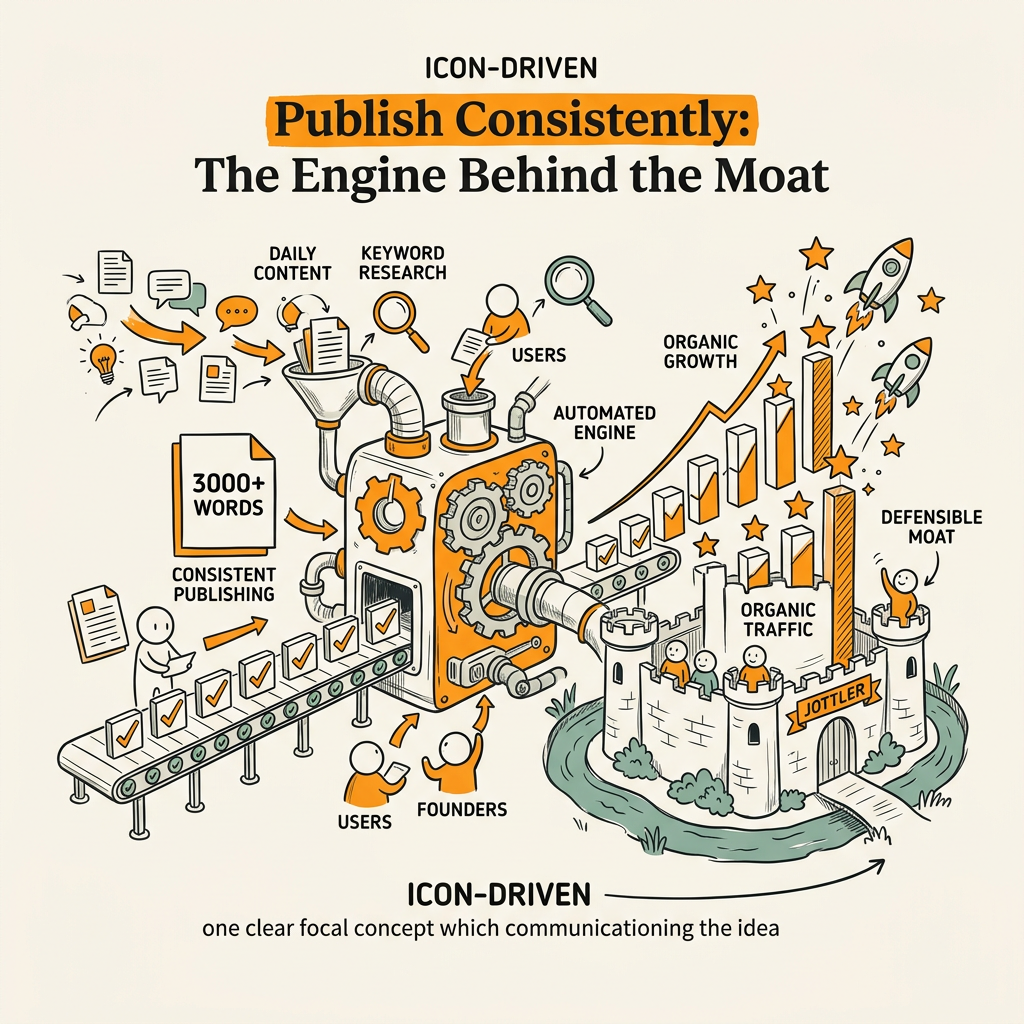
Here's the hard truth: topical authority requires consistency. You can't publish 5 posts in month 1, go silent for 2 months, then publish 10 in month 4. Search engines and topical authority measurement reward signal consistency. You need a publishing cadence you can actually sustain. For most SaaS teams, that's 2-4 articles per week. For lean teams, it's 1-2 per week. The magic is automation.
Automate Research and Writing to Scale Without Burnout
This is where most teams hit a wall. They understand topical authority. They have the data. But they can't staff a content team large enough to publish daily while maintaining quality. That's where autonomous SEO engines change the game. Instead of hiring 2-3 writers plus an editor plus a researcher, you connect your CMS, set your publishing frequency (1-5 articles per day), and the system handles keyword research, deep research from 14+ sources, fact-checking, and publishingall while building smart internal links. One founder using Jottler publishes 21 articles per week without a content team. That's the velocity needed to compound topical authority at scale.
The alternative is hiring. A single SEO content writer costs $5k-$8k per month in salary or agency fees. Two writers means $10k-$16k. A research tool, writing tool, and editing layer adds another $500-$2k. Over a year, that's $120k-$240k in opex for output that still risks being mediocre if the system isn't designed right. An autonomous SEO system handles this for a fraction of that and compounds without human bottlenecks. For founders with limited budget and time, it's the moat accelerant. You can read more about how to approach content automation in our SaaS Content Marketing Framework.
Smart Internal Linking: The Architecture of Your Moat
Every article you publish should link internally to at least 3-4 other articles in your cluster. But not randomly. When you mention a subtopic, link to the article that owns that subtopic with descriptive anchor text: instead of "read more," use "See our guide to API authentication best practices." This serves two functions: (1) it helps readers navigate your expertise, increasing time-on-site and reducing bounce; (2) it signals to search engines that your site has a coherent topical structure. Over time, this interlinking creates a ranking flywheel. A new article launches. It links to older articles. Those older articles get a ranking boost. Some older articles rank higher now, earning more visibility, driving more internal clicks, and indirectly boosting newer articles. That's compounding.
Monitor and Measure Your Moat
You can't manage what you don't measure. Topical authority measurement has evolved beyond just "keyword rankings." The modern metric is topic share: the percentage of available traffic for your topic that you actually capture. If your category has 10,000 monthly searches and you drive 2,000 from it, your topic share is 20%. Increase that to 5,000 searches and you've 2.5xed your dominancenot by competing harder on each keyword, but by expanding your topical authority. Track this quarterly. Set a target: grow from 20% to 35% topic share in 12 months. That's your moat expansion goal.
Key Metrics for Topical Authority
- Topic Share: Your traffic from topic keywords ÷ total available traffic for that topic. Goal: 30%+ by month 12.
- Keyword Ranking Gain: How many keywords moved from unranked or page 2+ to page 1 each quarter. Goal: 20-30 new page-1 keywords per quarter once authority builds.
- Organic Traffic Growth: Compound month-over-month growth from this topic cluster. Early stage (months 1-3): 10-15% MoM. Mid stage (months 4-8): 20-30% MoM. Mature (months 9+): 40%+ MoM as authority compounds.
- Content Cluster Interlinks: Count contextual internal links within your cluster. Target: 3-5 per article. Low linking = weak topical signal to search engines.
- Organic Lead Quality: Conversion rate of organic traffic to MQL, and MQL-to-SQL. Benchmark: 51% for SEO-sourced MQLs (vs 26% for PPC). If you're below 35%, your content is targeting wrong-intent keywords.
Avoid the Moat Killers: Common Mistakes
Building a topical authority moat is not complicated. But it's fragile if you make these mistakes. Recognize them early.
Mistake 1: Publishing Off-Topic Content
Every time you publish something outside your core topic, you dilute topical authority. A company focused on "API security" that publishes 20 security articles and 15 random SaaS business posts sends confused signals to search engines. Your topical authority weakens. The fix: ruthlessly scope your topic. If it doesn't belong in the cluster, don't publish it. Period. This discipline is hardespecially when founders have random ideasbut it's essential.
Mistake 2: Chasing Every Keyword Instead of Owning One Topic
The anti-pattern is the "we'll rank for everything" approach. You publish articles on 30 different topics, rank for none of them. Your competitor publishes 8 articles on one topic and dominates. Topical authority requires focus. Choose one. Own it completely. Then and only then expand to adjacent topics. This is a multi-year play, not a quarter play. For a comprehensive roadmap, explore our AI Content Strategy guide.
Mistake 3: Generic Content Without Proprietary Angles
If your article reads like every other article on the topic, it won't rank. Worse, it won't convert. Add exclusive angles: founder insights, customer data, benchmarks, use cases. The goal is not to be first to explain a concept. The goal is to be the only one with this specific insight. Generic content is replaced by AI. Proprietary content is referenced by it.
Conclusion
A defensible SaaS SEO moat is built on three foundations: topical authority, proprietary data, and consistent publishing. The result compounds year after year. Organic search drives 44.6% of B2B revenue, converts at 51% MQL-to-SQL, and delivers 702% ROI with a 7-month payback. Compare that to paid, where costs rise 14% annually and conversion rates plummet. The math is clear. The only question is execution: can you publish the volume and quality needed to build and maintain a moat?
For most founders, the answer has become: not manually. Publishing 2-4 high-quality articles per week while staying in topical focus, maintaining consistency, and building internal links is the work of 2-3 people. Starting your SEO agent with Jottler eliminates that team hire. The system researches topics, writes to your style, fact-checks, and publishes to your CMS while building smart internal linksall without human oversight. One founder publishes 21 articles per week on product and category topics, building topical authority at scale. That's the velocity of a moat.
Start your SEO agent today and compound your organic advantage for the next 12 months. Your competitor is still writing blog posts manually. You'll own the topic by the time they finish drafting a content calendar.
FAQs
What exactly is a moat in SaaS SEO?
A moat in SaaS SEO is a competitive advantage built through organic content that compounds and becomes harder for competitors to replicate over time. It's not a single ranking or backlink. It's topical authority: owning a subject so thoroughly that search engines must rank you first and your company becomes the default reference for that category. The strongest moats combine depth of content, proprietary research, and smart internal linking in a way competitors can't easily copy. A moat protects you from price competition because you own demand, not just traffic.
How long does it take to build topical authority?
Building measurable topical authority typically takes 3-6 months of consistent, high-quality publishing. Sites publishing 25-30 interlinked cluster articles see 40-70% ranking increases within this window. For most SaaS companies publishing 2-4 articles per week, that's a realistic timeframe. However, months 1-3 feel slowyou'll publish but see minimal ranking movement. Months 4-6 is when the flywheel kicks in and you'll see accelerating results. The key is not abandoning the strategy during month 2 when you see no results. By month 12, if you stay consistent, you'll own your topic.
Can I build a topical authority moat without publishing daily?
Yes, but slower. Publishing 1-2 high-quality articles per week compounds into topical authority over 8-12 months instead of 4-6. The threshold is consistency: whatever frequency you choose (2/week, 3/week, daily), you must sustain it. Monthly publish schedules don't work because search engines reward consistent signals, not sporadic bursts. The real constraint is whether you can maintain quality at your chosen frequency. One deeply researched article per week beats five mediocre articles per week, but daily publishing of high-quality content with proprietary research is the fastest path to dominancewhich is why many founders use autonomous SEO systems to hit that velocity without hiring.