How to Build Lead Scoring Workflows That Convert
The gap between marketing leads and sales-ready prospects costs B2B companies millions annually. Without a structured lead scoring system, sales teams waste 40% of their time chasing unqualified contacts, while high-intent buyers languish in nurture sequences. The real problem isn't lead volumeit's prioritization. Every day you don't score and route leads is a day a competitor responds first. Here's the practical framework teams use to build workflows that move leads to revenue.
Key Takeaways
- Lead scoring increases conversion rates by 30%, and machine-learning models drive 75% higher conversions versus traditional scoring (2026, Landbase)
- Response speed matters: 7x more likely to reach decision-makers when you contact leads within 1 minute versus 2 hours (HubSpot research)
- Closed-loop scoringconnecting scores to actual sales outcomesis now the best-practice requirement to validate and continuously improve your model
- Define Your Scoring Dimensions: Separate firmographic fit (company size, industry, title) from behavioral intent (page visits, form submissions, content engagement) to avoid false positives.
- Build the Workflow Trigger Logic: Route and assign leads automatically based on score thresholds rather than manual review to cut response time from hours to minutes.
- Integrate Your Martech Stack: Connect CRM, marketing automation, and lead enrichment tools so scoring happens in real-time without manual data entry.
- Close the Loop With Sales Feedback: Track which high-scoring leads actually convert to opportunities and wins; disqualified scores reveal where your model misses.
- Automate Scoring Decay and Updates: Reset engagement scores periodically and update firmographic data so stale leads drop priority and fresh prospects rise.
What Is Lead Scoring and Why Does It Matter?
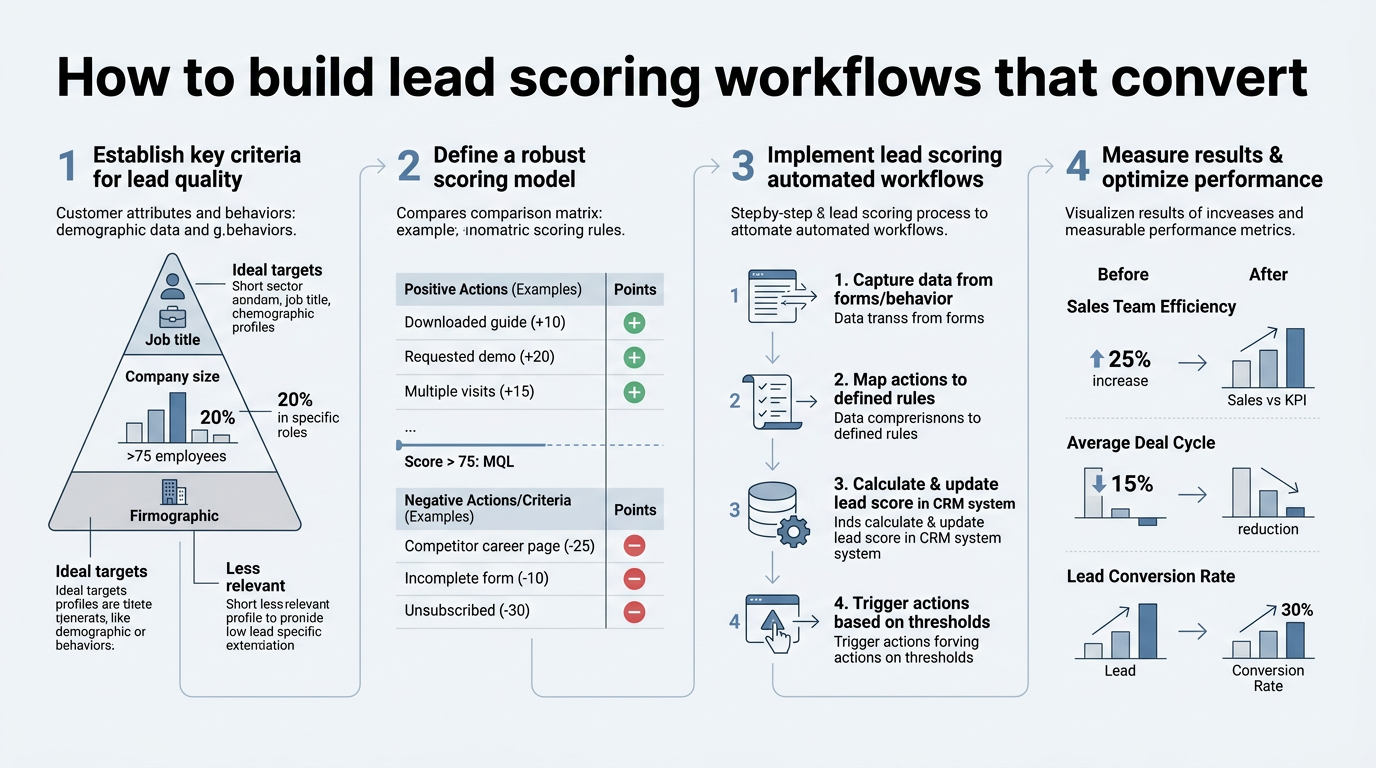
Lead scoring assigns numerical values to prospects based on their likelihood to convert. Teams using lead scoring see a 30% increase in conversion rates compared with those relying on manual qualification. The score reflects two dimensions: fit (how well the prospect matches your ideal customer profile) and engagement (how actively they signal buying intent). This dual framework prevents two common mistakes: scoring high-fit companies with no intent signal, or chasing engaged contacts who will never be customers.
The Two Dimensions of Every Lead Score
Firmographic and behavioral scoring are not competing modelsthey are complementary. Firmographic data tells you whether a prospect is in your addressable market. Company size, industry, job title, and budget are static attributes that rarely change. Behavioral signals tell you whether they are actively evaluating solutions. Page visits, demo requests, email engagement, and content consumption are the early warning signs of buying intent.
A prospect could have perfect firmographic fit (right company, right title, right budget) but zero engagement. Conversely, an engaged contact from a company outside your ICP is unlikely to close. High-performing teams weight both equally, then use the combined score to determine routing priority. This is why the best scoring workflows use a fit + engagement formula rather than a single criterion.
Why Speed-to-Lead Automation Changes the Game
The moment a prospect becomes qualified is the moment to move fastest. Leads contacted within 1 minute are 7x more likely to have a meaningful conversation with a decision-maker than those contacted after 2 hours (HubSpot research). Yet most teams allow qualified leads to sit in a queue for hours or days. Scoring without automated routing is just reporting. The workflowthe automation that detects a score threshold and immediately assigns the leadis where conversion gains happen.
This is why lead scoring only works when paired with trigger-based workflows. A lead hits a score threshold. The CRM instantly routes it to the next available rep. An automated notification pings the rep on Slack. The sales engagement tool queues a first-touch email or call template. That entire sequence should execute in seconds, not manually. Many teams now combine lead scoring with sales automation tools to ensure inbound prospects are qualified and routed before competitors even know they're evaluating.
How to Define Your Ideal Customer Profile Before Scoring
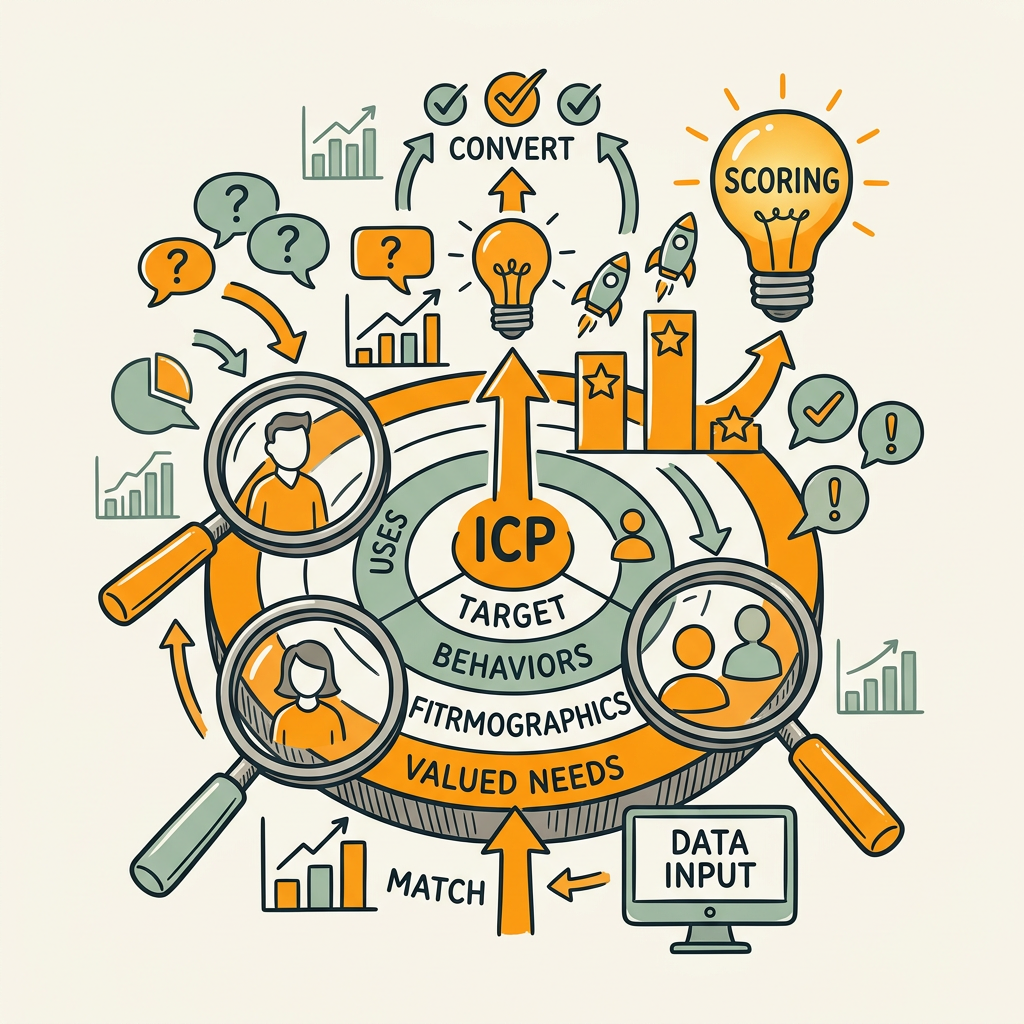
Scoring is only as accurate as the customer profile it's built on. Before assigning a single point, your marketing and sales teams must agree on who you are selling to. Teams with a documented ICP see 40% faster sales cycles because every lead is measured against a shared definition of "right fit." Without this clarity, scoring becomes guesswork. The ICP becomes your north star for all downstream decisions, from content strategy to demand generation to lead evaluation.
Identify Core Firmographic Criteria
Start with static attributes that define your addressable market. These are factors that don't change month-to-month and eliminate entire categories of prospects from consideration. Common firmographic criteria include company size (employee count or revenue), industry vertical, geographic region, and technology stack. For B2B SaaS selling to marketing teams at tech companies, the ICP might be: companies with 20-500 employees in the software or marketing services vertical, based in North America, using WordPress or HubSpot.
The key is specificity. Generic criteria like "mid-market" or "growth-stage" are too vague to score reliably. Quantify size (50-200 employees), name the industries (SaaS, fintech, ecommerce), and specify geographies. This precision ensures your scoring logic applies the same standard to every prospect and reduces the subjectivity that tanks most scoring initiatives.
Layer In Job Title and Decision-Making Unit Requirements
Not every person at a target company is a viable prospect. Decision-making authority matters. If your product requires buy-in from the CEO, a junior marketing coordinator is a poor fit regardless of company size. Map the decision-making unit: who evaluates the solution, who approves the budget, and who uses it day-to-day.
Weight job titles accordingly. A VP of Marketing is more likely to evaluate and approve a marketing automation tool than a social media manager. A CFO has budget authority that a controller may lack. Document the buyer personas explicitlyname them, list the titles and departments they represent, and note which are primary vs. secondary influencers. This becomes the foundation of your engagement scoring rules later and should inform your broader B2B content strategy so you attract the right personas.
How to Build a Fit + Engagement Scoring Model
The best lead scoring models combine firmographic fit with behavioral engagement, then weight the signals based on their predictive power. A prospect scoring high on fit but low on engagement is a nurture candidate. A prospect scoring high on engagement but low on fit is probably a false positive. Machine-learning models that combine these dimensions see 75% higher conversion rates than single-signal approaches.
Assign Points to Firmographic Fit Signals
Start by awarding points for matching your ICP. Create a simple matrix: if the company has 50-200 employees, add 10 points. If the prospect's title is VP of Marketing or above, add 15 points. If they are in your target industry (SaaS, fintech), add 10 points. If they are in a secondary industry, add 5 points. Geographic match might add 5 points.
These are base scoresthey don't move. A prospect who meets all firmographic criteria enters at, say, 40 points. The behavioral scoring then amplifies or dampens that score based on what they do next. The advantage of this approach is it's auditable and easy to explain to your team. Sales can instantly see why someone is flagged as high-fit or low-fit.
Layer Behavioral Engagement Points
Behavioral signals reveal buying intent. A prospect who visits your pricing page and watches a product demo video is further along the buyer journey than someone who merely opened an email. Weight signals by predictive power. Visit to a high-value page (demo request, pricing, contact form) might add 20 points. Email opens add 1 point each. Webinar attendance adds 25 points. Content downloads add 5 points.
The key is using your historical data to calibrate these weights. If prospects who request a demo have a 35% conversion rate but those who only open emails have a 3% rate, the demo signal deserves more points. This is where closed-loop scoring practices prove invaluableyou track which scored leads become customers, then adjust weights based on actual outcomes rather than assumptions.
Set Score Thresholds for Sales Handoff
A score is only useful if it triggers action. Define clear thresholds: a lead scoring 80 or above becomes a Sales Qualified Lead (SQL) and routes to the sales team immediately. A lead scoring 50-79 enters an automated nurture sequence in your marketing automation platform. A lead scoring below 50 stays in a long-term nurture list until engagement signals increase.
These thresholds are not permanent. Test them. Run an A/B test where half your incoming leads follow the 80-point threshold and half follow a 70-point threshold. Track conversion rates in each group. If 70-point leads convert nearly as well but volume is higher, lower the threshold. This data-driven refinement is what separates effective scoring from theater and helps you optimize the ROI of your content marketing by ensuring qualified prospects flow to sales efficiently.
Building the Workflow That Routes Leads Automatically
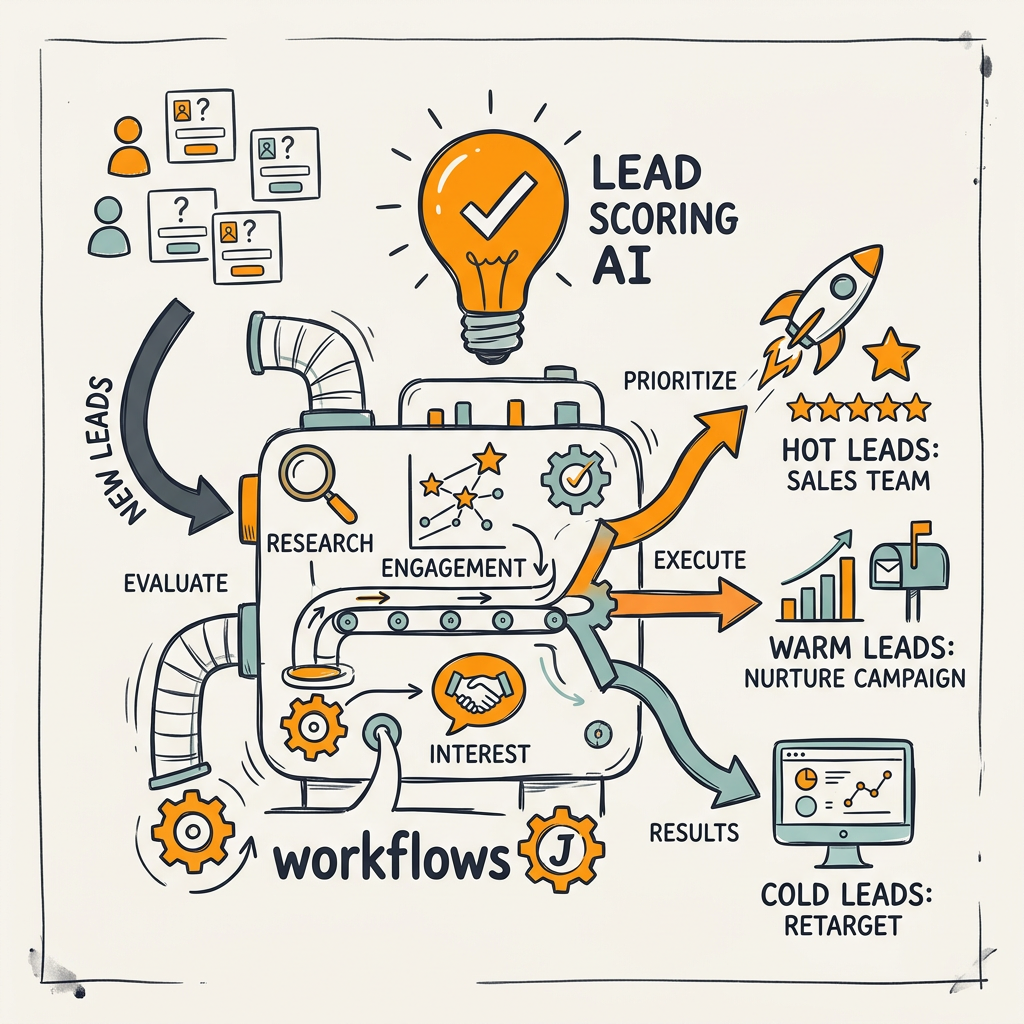
A lead score sitting in a spreadsheet is worthless. The workflowthe set of triggered actions that occurs when a lead crosses a thresholdis where conversion actually happens. Automated lead assignment reduces response time from hours to minutes, directly improving conversion probability. This is where theory meets execution.
Set Up Lead Assignment Rules in Your CRM
Most CRMs (Salesforce, HubSpot, Pipedrive) have workflow automation built in. Create a rule that watches lead score in real-time. When a lead's score reaches 80, automatically assign it to the next available rep in a specific sales team. Route based on territory, industry vertical, or account-based logic if you're running ABM campaigns.
Document the assignment logic clearly so sales understands why they received a particular lead. If a VP of Marketing at a Series B SaaS in the US scores 85 and reaches an enterprise sales rep, that rep knows immediately that this is a high-priority, high-value prospect. The clarity reduces friction and improves rep response time.
Trigger Instant Notifications and First-Touch Sequences
Assignment alone is not enough. The rep needs to know immediately. Create Slack notifications, in-app alerts, or SMS messages that fire when a lead scores above threshold. Pair the alert with pre-built sales templatesan initial email, a call script, or a 15-minute conversation framework so the rep doesn't have to think about what to say next.
Many high-performing teams also configure the marketing automation platform to pause nurture emails for leads who score above threshold. You don't want a prospect receiving both a sales rep's outreach AND a marketing nurture email on the same day. Once a lead routes to sales, marketing steps back unless the sales rep indicates no interest.
Implement Lead Decay to Keep Scores Fresh
Engagement scores degrade over time. A prospect who visited your site two weeks ago is less likely to buy than one who visited today. Implement lead decay rules in your marketing automation platform: reduce engagement points by 5 per week for prospects who have not interacted with you. This ensures aging leads naturally drop in priority unless they re-engage.
Decay also prevents false positives. A prospect who had high engagement three months ago but has gone silent drops below your sales threshold, moving back to nurture. If they re-engagethey open an email, visit a pagetheir score rises again and they route back to sales. This keeps your pipeline focused on active, current prospects.
Integrating Tools and Data to Keep Scoring Real-Time
Lead scoring only works if data flows automatically across your martech stack. Manual data entry kills speed and introduces errors. Teams using integrated CRM + marketing automation + lead enrichment systems see conversion lift within 60 days because scoring happens instantly as new data arrives.
Connect Your CRM and Marketing Automation Platform
Your CRM (source of truth for sales activity) and marketing automation platform (source of truth for engagement) must sync bidirectionally. When a contact engages with marketingopens an email, submits a form, attends a webinarthat data flows into the CRM in real-time. The CRM reads that new engagement, recalculates the score, and routes if threshold is met.
Conversely, when a sales rep indicates a prospect is not a fit (marks them as "nurture later" or "bad fit"), the CRM syncs that flag back to marketing. Marketing stops aggressive nurture and places them in a lighter cadence until sales signals renewed interest. This bidirectional flow prevents sales from being spammed with contacts they've already disqualified. Teams using this integrated lead management approach report cleaner handoffs and faster deal cycles.
Enrich Firmographic Data Automatically
Firmographic scoring requires accurate company data. Your internal records probably have stale or incomplete datajob titles may be wrong, company sizes may be outdated. Use lead enrichment APIs (Apollo, Hunter, RocketReach) to automatically populate and update company size, industry, technology stack, and contact information the moment a new contact arrives.
This data populates your CRM automatically, triggering your firmographic scoring rules immediately. If a contact comes in and the enrichment tool identifies them as working for a $500M company in fintech, and both criteria match your ICP, they get firmographic points instantly. No manual research. No delays.
Use Predictive Scoring for Higher Accuracy
Rules-based scoring (if this, then points) is transparent and easy to understand, but it has a ceiling. Machine-learning scoring models train on your historical conversion data, learning which signals predict closings better than you can explicitly. Predictive lead scoring is increasingly the standard among high-performing teams because it adapts to your actual sales outcomes rather than assumptions.
Many CRM and marketing automation platforms now include built-in AI models. HubSpot offers predictive lead scoring. Salesforce has Einstein Scoring. These models analyze your past conversions and losses, then score new incoming leads on the same patterns. The models improve over time as more deals close or are lostthey learn from outcomes. For teams running SaaS content marketing at scale, pairing predictive scoring with consistent, high-quality content ensures your scoring feeds on high-intent inbound traffic generated through strategic organic growth.
Closing the Loop: Validating Scores Against Sales Outcomes
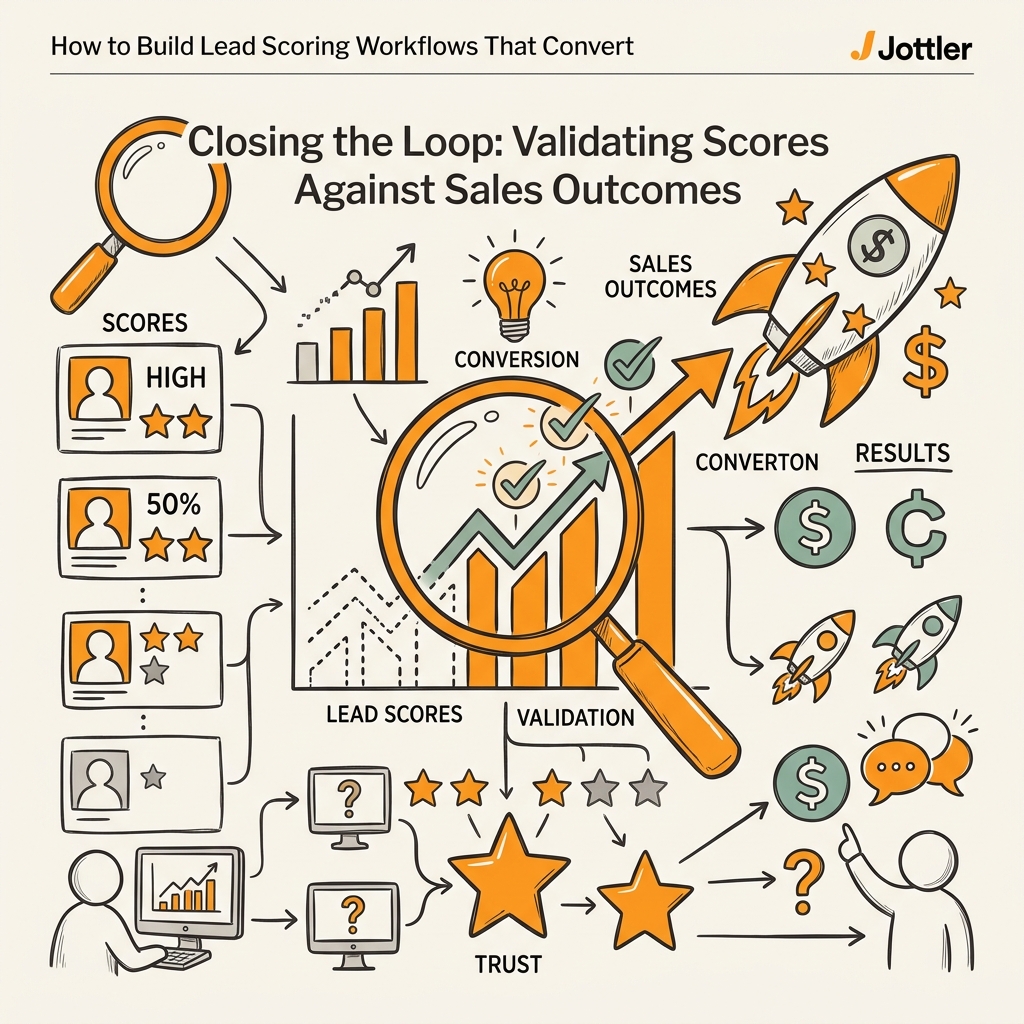
The best lead scoring systems are never static. They improve continuously by comparing predicted outcomes (scores) against actual outcomes (conversions). Teams that track closed-loop scoring see a 30% conversion uplift within the first year because misalignment between scoring and results becomes visible, then fixable.
Create a Feedback Loop Between Sales and Marketing
Sales needs a formal way to flag leads that were scored incorrectly. Build a simple mechanism: a "Scoring Feedback" button in the CRM where a rep can note if a contact was high-fit but truly unqualified, or low-fit but surprisingly engaged. Over time, these flags reveal patterns. Maybe you're overweighting a particular job title. Maybe certain industries rarely convert despite firmographic fit.
Monthly, marketing and sales review this feedback together. Adjust point values or thresholds based on what you learn. If VP-of-Marketing contacts never convert, but Director-of-Marketing contacts do, reweight the scoring rules. This iterative refinement is what separates teams with 3% conversion rates from those with 6%.
Track Score-to-Outcome Metrics
Build a dashboard showing: how many leads scored above 80, how many converted to opportunities, how many closed as won. Calculate conversion rate by score band. Leads scoring 80-89 might convert at 40%. Leads scoring 90-99 might convert at 65%. If all score bands convert equally, your scoring isn't creating meaningful differentiationthe weights need adjustment.
Track average deal size by score band. If high-scoring leads close for $50K and low-scoring leads close for $20K, the high scores are not just leading to more conversions, but bigger deals. That's ROI on the investment in building and maintaining the scoring system.
Recalibrate Scoring Weights Quarterly
As your product evolves, your market shifts, and your sales team learns, your scoring model will drift. Set a quarterly review cadence where marketing and sales recalibrate. Did a new competitor emerge that changed buyer priorities? Are engagement signals changing? Is one engagement signal (webinar attendance) now less predictive than before?
Use this quarterly meeting to test hypothesis: "If we double the weight on demo requests and halve the weight on email opens, we should see better lead quality." Run a one-week test on new leads, measure results, and decide whether to make it permanent. This culture of measurement and iteration is what makes lead scoring compound over time.
Common Mistakes That Wreck Lead Scoring Systems
Most broken lead scoring systems fail for the same reasons. Knowing these pitfalls helps you avoid them from day one.
Scoring Without a Defined ICP
This is the most common failure. Teams jump into scoring mechanics before agreeing on who they sell to. Without a clear ICP, scoring is arbitraryeveryone has a different definition of "qualified." Sales refuses to work leads they think are bad fit. Marketing questions the point values. The system loses credibility within weeks.
Fix: Before you assign a single point, get marketing and sales in a room and document your ICP explicitly. Company size range. Industries. Job titles. Decision-making authority. Use this as your north star for all scoring decisions.
Relying Purely on Behavioral Signals
Page visits and form submissions feel like engagement, but they can mislead. A researcher at a non-target company might visit your site three times and download a guide, appearing "engaged" on paper while having zero budget authority or buying intent. Firms that score only on behavior waste reps' time on unqualified prospects.
Fix: Always combine behavioral signals with firmographic fit. A contact must meet minimum firmographic criteria to route to sales regardless of engagement level. Engagement raises the priority, but fit is the gate.
Threshold Creep Without Testing
Teams often lower score thresholds to generate more sales activity"Let's send 100 more leads to sales this month." But lower thresholds mean lower-quality leads. Sales then rejects more leads. Scoring loses credibility. Eventually the system is abandoned.
Fix: Never change thresholds without an A/B test. Run both thresholds for a week. Measure conversion rates. Make decisions based on data, not on volume targets.
| Lead Scoring Dimension | Firmographic (Fit) | Behavioral (Engagement) | Predictive (ML-Based) |
|---|---|---|---|
| What It Measures | Company size, industry, title, budget fit | Page visits, demo requests, email opens, content downloads | Historical conversion patterns; learns from outcomes |
| Transparency | Highly transparent; rules-based | Transparent; easy to audit | Lower transparency; requires trust in model |
| Scalability | Works for low and high-volume motions | Better for inbound-heavy, digital-first sales | Requires historical conversion data; improves with scale |
| Conversion Lift vs. No Scoring | ~20-25% improvement | ~25-30% improvement | ~75% improvement vs. traditional rules-based |
| Time to Implementation | 1-2 weeks | 2-3 weeks | 4-8 weeks (model training required) |
| Best For | High-ticket, complex sales; clear ICPs | PLG, SaaS, inbound-driven growth | High-volume sales orgs with 2+ years of conversion data |
Conclusion
Lead scoring workflows convert when they combine accurate customer profiling, dual-signal scoring (fit + engagement), and automated routing that moves leads to sales in minutes not hours. Teams using structured lead scoring see 30% higher conversion rates and machine-learning models achieve 75% higher conversions versus manual approaches. The real gain comes from closing the loopvalidating scores against sales outcomes quarterly, adjusting weights, and letting the system improve.
Start with a simple firmographic + behavioral model. Get marketing and sales aligned on thresholds. Connect your CRM and marketing automation platform so scoring happens in real-time. Track outcomes. Adjust quarterly. This systematic approach compounds: month one you save a few hours. Month three your conversion rate visibly improves. Month six you've built a machine that generates qualified pipeline automatically.
The teams that build lead scoring workflows earlywhile most competitors still sort leads manuallygain months of lead-quality advantage. Your sales team will thank you, and your conversion metrics will show it. Start your SEO agent to build the organic content that attracts the high-fit, high-intent prospects your lead scoring system is designed to convert.
FAQs
What's the difference between lead scoring and lead qualification?
Lead scoring is the process of assigning numerical values to prospects based on fit and engagement. Lead qualification is the sales decision to pursue or reject a prospect. Scoring is data-driven and objective; qualification is a sales judgment call that should be informed by (but not dictated by) the score. A prospect might score 75below your sales thresholdbut a rep might still choose to pursue them if they see strategic fit. The score provides the signal; the rep makes the final call.
How often should I update my lead scoring model?
Review your model quarterly. Pull closed-loop data: which score bands converted best, which converts worst, which produce the largest deals. Adjust point values if you see clear patterns (e.g., webinar attendees consistently convert, email-only contacts rarely do). Test threshold changes for one week before rolling them out. This balance between stability and iteration prevents constant churn while ensuring the model stays accurate as your market and product evolve.
Can I use lead scoring in a low-volume, high-ticket sales motion?
Yes. In fact, high-ticket B2B sales benefit even more from structured lead scoring because each lead represents significant value, and misalignment between marketing and sales is costly. A $500K ACV deal requires extreme care in hand-off. A formal lead scoring modeleven if simpler than high-volume SaaS modelsensures sales focuses on the highest-probability opportunities first. Use firmographic and intent signals (inbound inquiry, executive engagement, competitive win) rather than volume-based behaviors like page visits.