How to Identify High-Intent SaaS Keywords That Convert
Most SaaS teams chase search volume. A keyword with 40,000 monthly searches looks like a win until you realize none of those visitors are buying. That's the volume trap—a costly mistake that turns traffic into noise. The fix is learning to identify high-intent keywords instead, which consistently convert 3.5x to 4.5x better than general keywords, and deliver 62% of your new monthly recurring revenue (MRR) despite lower search volume. Here's how to shift from vanity metrics to pipeline-generating keywords.
Key Takeaways
- High-intent keywords convert at 5.2%–8.7% compared to 1.1%–2.3% for general keywords (First Page Sage, 2025)
- Intent-based content architecture (separate pages for pricing, demo, comparison) boosts conversion by 30–50%
- Focus on value density (CPC × Intent Score ÷ Difficulty) rather than volume—this reveals the keywords that actually generate revenue
- Intent Classification: Categorize keywords into TOFU, MOFU, BOFU, and retention stages—then prioritize bottom-funnel keywords for immediate revenue impact.
- SERP Validation: Confirm intent by analyzing the search results themselves; >60% product pages signal commercial viability.
- Value Density Scoring: Calculate (CPC × Intent) ÷ Difficulty to identify keywords that maximize ROI, not just traffic.
- Content Architecture Alignment: Build separate pages for each intent variation (pricing, demo, comparison, integration) so users land on the exact content they're seeking.
- Keyword Research Automation: Use tools like Jottler to identify, prioritize, and create targeted content around high-intent keywords at scale without manual bottlenecks.
What High-Intent Keywords Actually Mean in SaaS
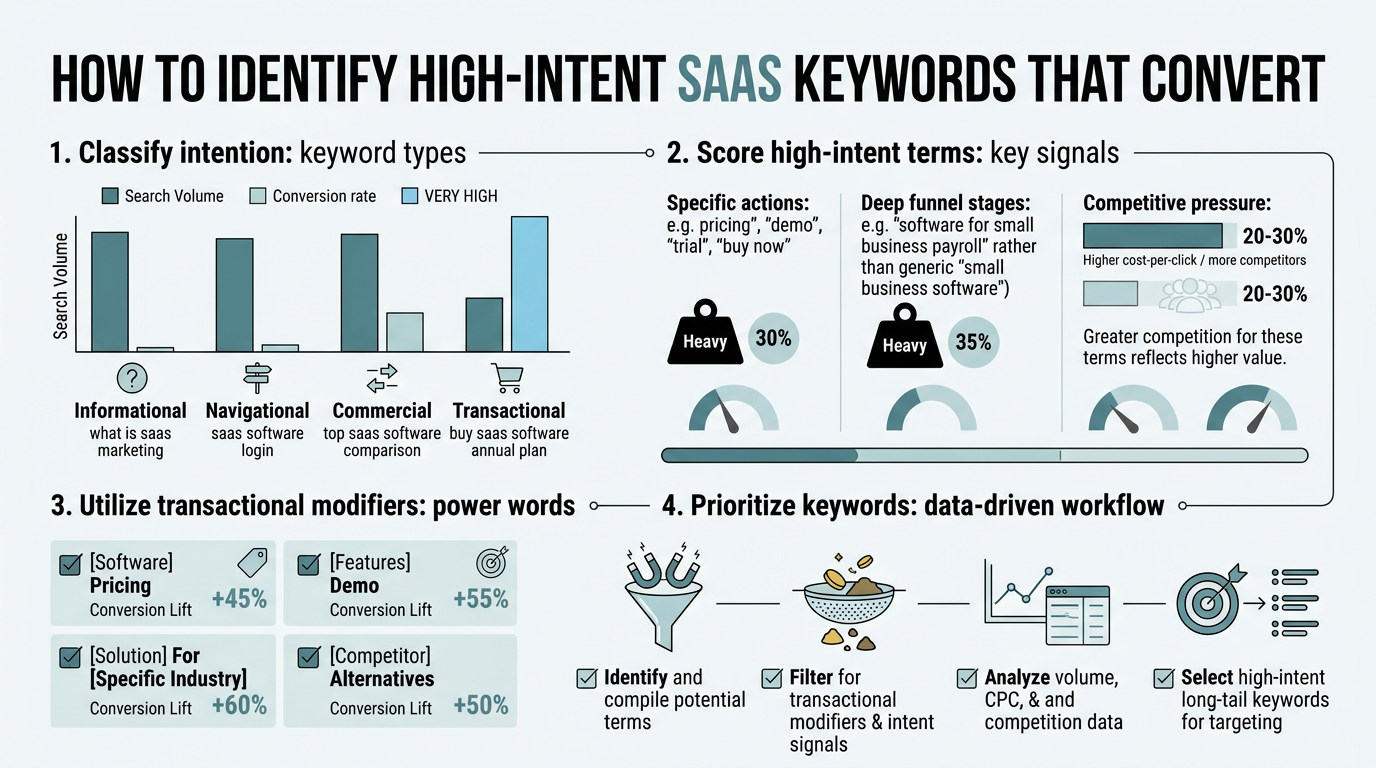
High-intent keywords reflect searchers who have already moved past awareness and into active evaluation. They've identified a problem, recognized they need a solution, and are now comparing specific options. The difference in conversion power is dramatic: high-intent keywords drive 62% of new MRR in SaaS companies, even though they represent a fraction of total search volume. This inverse relationship between volume and conversion is the core insight that separates winning content strategies from budget-wasting ones.
The Volume Trap and Why It Costs SaaS Teams Thousands
Ranking for "marketing software" might seem valuable—thousands of monthly searches, predictable organic traffic. But those thousands of searchers range from business students writing essays to journalists researching industry trends to founders exploring categories they'll never buy. Only a microscopic percentage are decision-ready buyers. By contrast, "best AI marketing platform for B2B SaaS replacing SEMrush" has a fraction of the volume but attracts only active, qualified evaluators. The searcher has already:
- Defined their specific problem and context
- Identified the category of solution they need
- Named competitors they're replacing
- Reached the stage of comparing options
That specificity is a proxy for intent, and it translates directly into conversion rates: high-intent keywords convert at 5.2%–8.7% versus 1.1%–2.3% for general keywords. In practical terms, one high-intent visitor is worth 4–8 generic visitors. Optimizing for volume builds a traffic report. Optimizing for intent builds a revenue engine.
"High-intent keywords convert 3.5x to 4.5x better than general keywords and drive 62% of new MRR despite representing only a fraction of total search volume. This inverse relationship between volume and conversion power is what separates winning SaaS strategies from budget-wasting ones."
Why SaaS Keyword Intent Differs from Consumer Categories
SaaS keyword intent is uniquely powerful because the product sale is the outcome the searcher is actively working toward. When someone searches "best CRM for small sales teams," they're not gathering information for a school project—they're shopping. The commercial stakes are high enough that multiple decision-makers may be involved, the evaluation process is rigorous, and the buyer will absolutely follow through if your product fits their specific use case. This concentration of purchase-ready intent in a relatively small keyword set makes SaaS keyword research fundamentally different from, say, content marketing for consumer goods, where awareness and consideration phases dominate.
The Four Intent Categories in SaaS Keywords
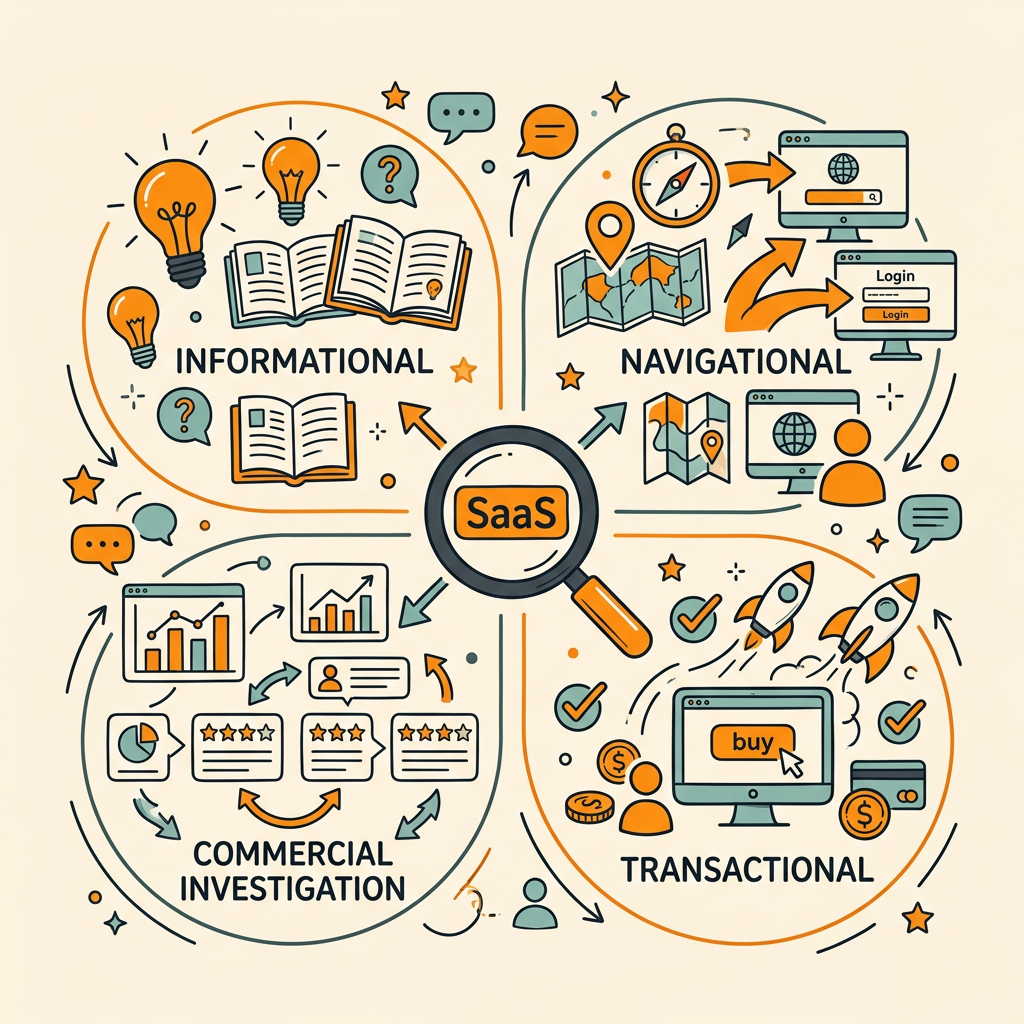
Not all high-intent keywords are created equal. SaaS keywords cluster into four distinct intent categories, each targeting a different stage of the buyer journey and requiring different content approaches. Identifying where a keyword sits in this taxonomy is critical for building content that actually converts. A pricing page optimized for a demo-intent keyword will underperform. A feature comparison built for problem-aware keywords will feel like overkill. The goal is to align your content architecture with the specific stage each keyword represents.
Category 1: Problem-Aware Keywords
Problem-aware keywords are searched by buyers who have identified a specific painful problem and are looking for frameworks, explanations, or solutions. They know what is wrong. They do not yet know what to do about it. Examples include "why is our content not ranking on Google," "how to track brand mentions in ChatGPT," and "marketing team spending too much time switching tools." These keywords have low to moderate volume but signal the beginning of a buying journey. The searcher has crossed the threshold from passive dissatisfaction to active investigation. Content that specifically addresses their stated problem—without genericizing the answer to appeal to everyone—captures them at the moment their evaluation process begins. This is where you establish expertise and build trust as a potential solution provider.
Category 2: Solution-Aware Keywords
Solution-aware keywords target buyers who know a category of solution exists and are now evaluating fit. They've moved past "what is the problem?" to "what's the right approach?" Keywords like "AI marketing platform for small SaaS teams" and "all-in-one SEO and content tool for B2B" tell you the searcher understands the category and has some criteria in mind. They're comparing options and weighing trade-offs. Content for these keywords should focus on feature explanations, use-case-specific guidance, and how your approach differs from the competition. This is the middle-of-funnel stage where intent-based content architecture showing separate pages for specific use cases boosts conversion by 30–50%.
"When you build separate, focused pages for each intent variation—pricing, demo, comparison, integration—users land on content that matches their exact stage in the buying process. This alignment increases conversion rates by 30–50% compared to one-size-fits-all guides."
Category 3: Solution Comparison Keywords
Comparison keywords represent the stage where a buyer is actively evaluating competing solutions. "Best project management tool for remote teams," "HubSpot vs Salesforce," and "CRM pricing comparison" all reflect bottom-of-funnel intent. The searcher has narrowed their options and is making a final decision. Your content here must directly address comparison criteria, feature-by-feature breakdowns, and pricing transparency. This is where demos are booked and trials are started. Keywords in this category have the highest conversion rates—the searcher is literally ready to buy; your job is to make it easy for them to choose your product.
Category 4: Retention and Support Keywords
Post-purchase keywords like "CRM software training," "integration documentation," and "how to set up advanced workflows" target users who have already become customers. These keywords don't drive new revenue but they're critical for reducing churn, accelerating time-to-value, and creating upsell opportunities. A customer stuck on a technical problem is a retention risk. One who finds a clear, authoritative solution to that problem becomes an advocate.
How to Score and Prioritize High-Intent Keywords
Identifying intent is step one. Prioritizing which keywords will generate the most revenue per effort is step two, and it requires a different metric than traditional keyword research tools use. Most platforms optimize for search volume. You need to optimize for conversion value. The framework that works is called value density: (CPC × Intent Score) ÷ Difficulty Proxy. This calculation favors keywords that are commercially valuable (high CPC), capture purchase-ready audiences (high intent), and are realistic to rank for (low to moderate difficulty).
The Value Density Calculation and Why It Works
Value density weights three factors that actually predict revenue: cost-per-click (CPC) signals the commercial stakes of the keyword. Advertisers only bid high on keywords they know convert, so high CPC is a proxy for buyer intent. Intent Score reflects where the keyword sits in the TOFU-MOFU-BOFU framework: bottom-funnel keywords score higher. Difficulty Proxy accounts for the effort required to rank; keywords with extreme difficulty may be too expensive to pursue. A high-CPC, high-intent, low-difficulty keyword is the sweet spot. For example, "CRM software pricing" might have $40 CPC, BOFU intent (score 9/10), and KD of 25. Compare that to "what is CRM software" with $5 CPC, TOFU intent (2/10), and KD of 40. The first keyword has a value density of (40 × 9) ÷ 25 = 14.4. The second has (5 × 2) ÷ 40 = 0.25. You'd generate 57x more revenue-per-effort ranking for the first keyword, yet most volume-focused strategies would prioritize the second because it has higher search volume. Value density flips this logic and points you toward what actually converts.
Using CPC as a Proxy for Commercial Intent
CPC (cost-per-click) in paid search reflects what advertisers are willing to pay for a click on that keyword. If advertisers are bidding $50 per click, they've done the math and know that clicks convert to revenue at a rate that justifies that spend. Keywords with high CPC ($15–$50+) typically have 2–3x higher conversion rates than low-CPC keywords. Check CPC using your keyword research tool, and flag all keywords where CPC is above your average. These are where the commercial momentum lives.
Validating Intent Through SERP Composition
Before targeting a keyword, look at the search results themselves. Do you see mostly educational content, or product pages? If >60% of the top 10 results are product pages, pricing pages, or comparison pages, the keyword has strong commercial intent. If the SERP is dominated by blog posts and explainer content, the keyword is earlier-stage and will require different content. Also check: Are there paid ads above the organic results? Presence of paid ads signals that businesses are willing to pay for clicks, which means they've validated conversion value. Are "People Also Ask" questions buying-stage focused or educational? "How much does X cost?" and "What's the best X for Y?" signal commercial interest. "What is X?" and "How does X work?" signal awareness-stage interest. This rapid SERP audit takes 90 seconds and prevents you from pursuing low-intent keywords that would waste months of content effort.
Building a High-Intent Keyword Research Workflow
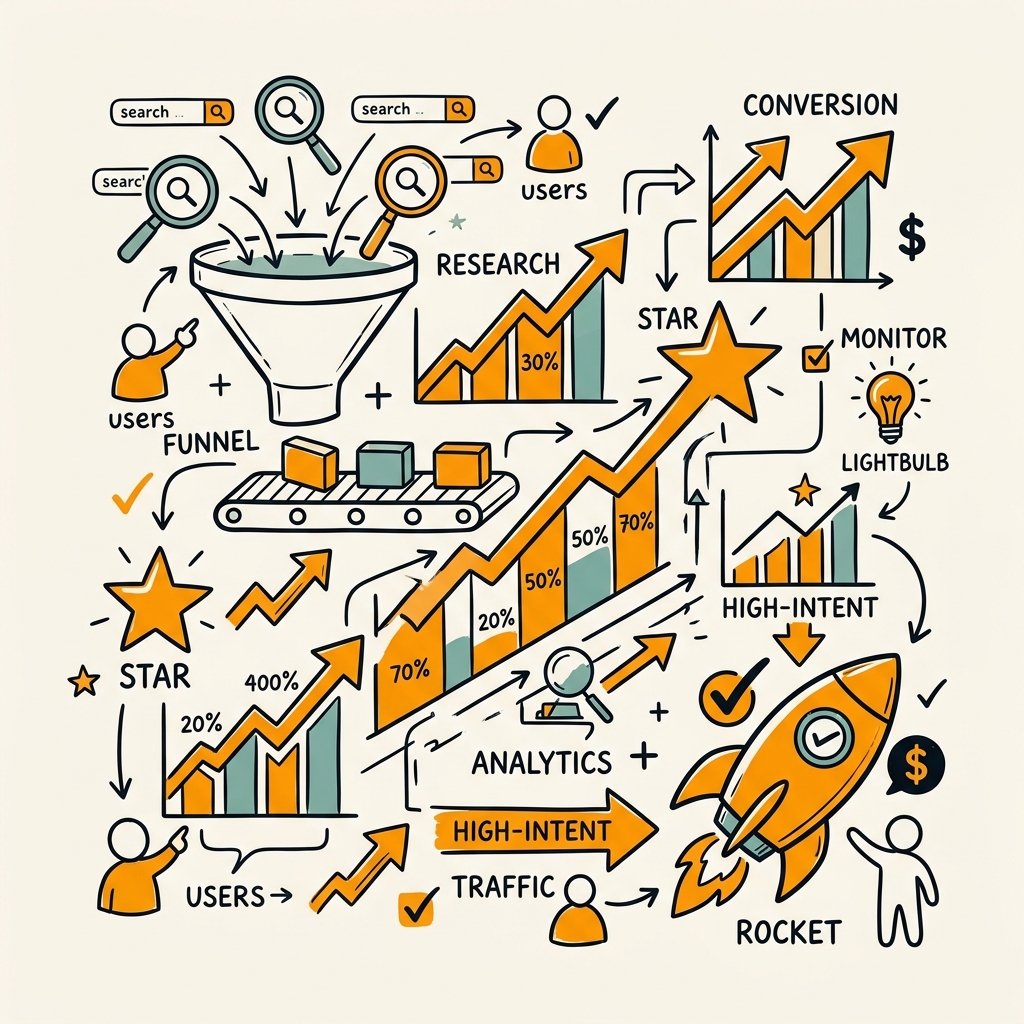
Identifying intent manually—keyword by keyword, SERP by SERP—doesn't scale. For a SaaS company building a sustainable content strategy, you need a systematic workflow that surfaces high-intent keywords, validates them, and connects them to content ideas, all without consuming your entire marketing team's time. The workflow breaks into four stages: seed expansion, intent filtering, prioritization, and content mapping.
Step 1: Expand From Known Converters
Start with keywords you know convert. If "CRM demo" or "CRM pricing" have historically driven pipeline, that's your north star. Use your keyword research tool to find related keywords, variations, and long-tail expansions of those converters. The goal is not to find brand-new keyword categories but to expand the cluster of high-intent keywords you know work. Long-tail keywords (3+ words) are especially valuable here: "best CRM for small sales teams" is more specific—and more high-intent—than "best CRM." You want specificity because specificity equals intent.
Step 2: Apply Intent Filters Ruthlessly
Once you have a candidate list, filter for intent signals: (1) BOFU stage keywords (pricing, demo, comparison, ROI); (2) keywords with high CPC indicating commercial value; (3) keywords with >60% product pages in the SERP indicating buyer-ready audience. This filtering eliminates low-intent outliers and focuses your list on keywords that are statistically likely to convert.
Step 3: Rank by Value Density
Sort your filtered list by value density score: (CPC × Intent) ÷ Difficulty. Target the top 20% first. These keywords deliver the highest revenue-per-effort. They may not have the highest volume, but they will generate the most pipeline growth per hour spent on content production.
Step 4: Map Keywords to Content and Content Architecture
For each high-intent keyword, decide what content is required. A pricing keyword needs a dedicated pricing page or pricing-focused resource. A comparison keyword needs a comparison guide or table. A demo keyword needs a demo request guide or product walkthrough. A specific use-case keyword needs use-case-specific content. This mapping ensures your content architecture is built around buyer intent, not generic blog posts about your category. Tools like Jottler automate this entire workflow—surfacing high-intent keywords, validating them via SERP analysis, scoring them by value density, and generating targeted content that matches the keyword's specific intent stage.
Content Architecture: The Missing Piece in Most SaaS Strategies
Many SaaS teams identify high-intent keywords but then make a critical mistake: they build one-size-fits-all content that tries to appeal to all intent stages at once. A single "CRM Software: Complete Guide" attempts to explain what CRM is, compare options, show pricing, and justify ROI. It ranks for some high-intent keywords, but it underperforms because it's not optimized for any specific intent. Users searching "CRM pricing" want to see pricing. They don't want to read 500 words about CRM philosophy. Users searching "CRM comparison" want to see feature tables. They're not interested in a beginner's explanation of what CRM means. The solution is intent-based content architecture: separate, focused pages for each intent variation, each optimized for the specific stage and question the searcher has.
The Case for Dedicated Intent-Focused Pages
Instead of one comprehensive guide, build multiple focused assets: (1) Problem explanation page targeting "how to improve sales team efficiency"—educational, frameworks, best practices; (2) Solution overview page targeting "what is CRM software for sales teams"—categories, use cases, implementation overview; (3) Comparison page targeting "best CRM for [specific use case]"—feature tables, pricing comparison, trade-offs; (4) Pricing page targeting "CRM pricing" or "CRM cost comparison"—transparent pricing, ROI calculator, package breakdown; (5) Demo/trial page targeting "CRM software demo" or "CRM free trial"—clear CTA, security assurances, implementation timeline; (6) Specific integration guides targeting "CRM + marketing automation integration"—technical setup, workflow examples, benefits. Each page is shorter, more focused, and answers the exact question the searcher typed. This approach increases conversion rates by 30–50% compared to generic comprehensive guides because the user's intent and your content are perfectly aligned.
Using Data and Social Proof to Deepen Conversion
Once you've built intent-focused content, add specificity that turns browsers into buyers. Include measurable results: "Customers using [your product] see a 35% reduction in sales cycle length" is more powerful than "CRM software improves sales efficiency." Add implementation stories showing real companies solving the exact problem the keyword targets. Include structured data (pricing, feature lists, implementation timelines) that helps search engines and AI systems understand what you're offering. Add direct CTAs that match the intent stage: problem-aware content might CTA to a template; comparison content might CTA to a free trial; pricing content might CTA to a demo request.
High-Intent Keyword Research Tools and Automation
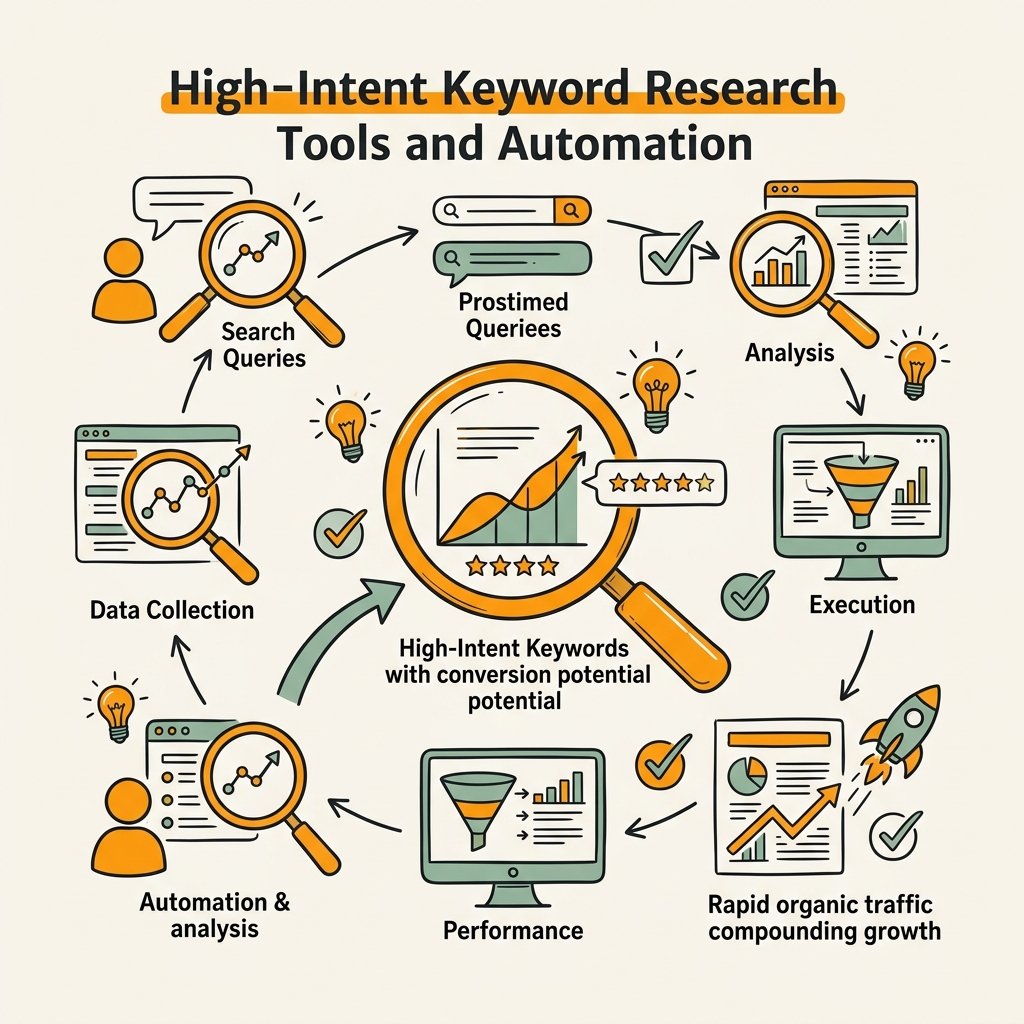
Manual keyword research at scale becomes a bottleneck. Expanding keyword clusters, validating intent, scoring by value density, and mapping to content architecture takes hundreds of hours per quarter. The solution is automation. Modern keyword research tools can surface high-intent keywords, validate SERP composition, calculate difficulty, extract CPC data, and even generate content briefs—all without manual intervention. For busy SaaS teams, this is the difference between a keyword research process that scales and one that stalls.
Automation Within Your Keyword Research and Content Stack
Purpose-built SEO platforms can automate keyword research by analyzing SERP composition, calculating value density, and identifying content gaps in minutes instead of weeks. They surface long-tail variations automatically, flag intent signals (CPC, SERP composition, paid ads presence), and recommend which keywords to target first based on your specific business model. The best platforms also integrate with your content creation workflow, so once keywords are identified and prioritized, content briefs are automatically generated—including outline, search intent analysis, and target word count. This eliminates the gap between keyword research and content production that stalls most SaaS strategies. Jottler goes further: it not only identifies high-intent keywords but generates the actual content around those keywords, handles internal linking, and publishes directly to your site. This means your team can focus on strategy and messaging while the automation handles keyword identification, content creation, fact-checking, and publication—turning high-intent keywords into published, ranking content automatically every day.
"The bottleneck for most SaaS teams isn't understanding keyword intent—it's executing at scale. Tools that automate keyword research, validation, prioritization, and content generation turn a multi-week process into days, allowing your team to focus on strategy while automation handles the execution."
Avoiding Common Tool Pitfalls
Not all keyword research tools surface intent equally. Some focus exclusively on volume and difficulty, leaving intent to guesswork. Others provide intent classifications but don't weight them by commercial value (CPC). The best tools combine volume, difficulty, CPC, and SERP analysis in a single calculation that points toward keywords that will actually generate revenue. When evaluating a keyword research tool, check: (1) Does it provide CPC data? (2) Does it analyze SERP composition (product pages vs. educational pages)? (3) Does it classify intent (TOFU/MOFU/BOFU/retention)? (4) Can it integrate with your content production workflow? (5) Does it flag long-tail variations automatically? The ideal tool reduces keyword research from weeks to days, validates intent programmatically, and feeds directly into content creation.
| Metric | High-Intent Keywords | General/Category Keywords |
|---|---|---|
| Conversion Rate | 5.2%–8.7% | 1.1%–2.3% |
| Average CPC | $15–$50+ | $5–$15 |
| Typical Search Volume | 500–3,000 | 5,000–50,000+ |
| Keyword Difficulty (KD) | 20–35 | 40–70+ |
| MRR Attribution | 62% | 18% |
| Paid Ads Present (SERP) | >70% | <30% |
Avoiding the High-Intent Keyword Mistakes SaaS Teams Make
Understanding intent and building intent-aligned content is the right strategy. But execution often falters. The most common mistakes destroy the value of otherwise smart keyword research. Knowing what to avoid is as important as knowing what to do.
Mistake 1: Confusing Traffic Volume With Revenue Potential
A keyword with 50,000 monthly searches feels valuable. A keyword with 500 monthly searches feels risky. The truth: the smaller keyword might generate 10x more revenue if it has higher intent. The instinct to chase volume is human—it feels safer and looks better in reports. But in SaaS, lower-volume, high-intent keywords drive 62% of new MRR while high-volume, low-intent keywords drive mostly vanity traffic. The fix: stop measuring success by traffic volume. Measure by conversion rate and revenue per visitor. A 2% conversion rate on 500 monthly visitors (10 conversions) beats a 0.1% conversion rate on 50,000 visitors (50 conversions) if your average deal value is $10k+ per customer. Train your team—and your stakeholders—to think in terms of pipeline impact, not traffic headlines.
Mistake 2: Building Generic Content for High-Intent Keywords
You identify "best CRM for remote sales teams" as a high-intent keyword. You rank for it. But your content is a generic "Top 10 CRM Tools" list with a paragraph about remote work. The visitor bounces because your content doesn't answer their specific question. High-intent keywords demand specific, focused content. "Best CRM for remote sales teams" requires content that addresses remote-specific workflows, collaboration features, and integration with tools remote teams actually use. Generic content wastes the intent signal. The fix: align content depth and specificity to keyword intent. High-intent keywords earn dedicated, focused pages, not sections of a broader guide.
Mistake 3: Publishing Without Validating Keyword Intent First
You write content for a keyword that looks commercial but turns out to be primarily educational or awareness-stage. Months later, you realize the content ranks but converts poorly. You've burned time and resources on the wrong keyword. The fix: validate intent before you write. Spend 5 minutes analyzing the SERP before you commit to a 3,000-word article. Check: Are >60% of results product pages or educational? Are there paid ads? What do "People Also Ask" questions focus on? This quick SERP audit prevents you from pursuing keywords that look high-intent but actually aren't.
Mistake 4: Prioritizing Too Many Keywords
You identify 200 high-intent keywords and try to tackle all of them at once. Your team burns out, content quality drops, and your strategy becomes scattered instead of focused. The fix: pick the top 20% by value density. Build content around those first. Once you're ranking and converting on 20 high-intent keywords, expand. Depth beats breadth in keyword strategy. Ranking for 20 keywords that convert is more valuable than ranking for 200 that don't.
Conclusion
The SaaS teams winning at organic growth have shifted from chasing traffic volume to targeting high-intent keywords that convert. High-intent keywords consistently deliver 3.5x to 4.5x higher conversion rates than general keywords and drive 62% of new MRR, despite representing a fraction of total search volume. The framework is straightforward: classify keywords into intent categories (TOFU-MOFU-BOFU-retention), validate intent through SERP analysis, score by value density (CPC × Intent ÷ Difficulty) rather than volume, and build intent-focused content architecture with separate pages for each buyer stage. The bottleneck for most teams isn't understanding intent—it's executing at scale. Manually researching, validating, and writing content for hundreds of high-intent keywords takes months. Tools that automate this workflow—identifying keywords, validating intent, prioritizing by revenue potential, and generating targeted content—turn weeks into days. Jottler handles all of this: it identifies high-intent keywords aligned to your business model, validates them via SERP analysis, and generates focused content that actually converts. Start by picking your top 20 high-intent keywords by value density. Build dedicated content for each. Measure conversion rate and MRR attribution, not just traffic. This shift from volume to intent is the single highest-leverage change you can make in your content strategy.
Start your SEO agent with Jottler to automate high-intent keyword research and content creation at scale.
FAQs
What's the difference between high-intent and low-intent keywords for SaaS?
High-intent keywords are searched by buyers actively evaluating solutions and ready to make a decision. Low-intent keywords are searched by people in early awareness or research phases. "CRM software pricing" is high-intent because the searcher is comparing options. "What is CRM software" is low-intent because they're still learning. High-intent keywords convert 3.5x to 4.5x better than low-intent keywords in SaaS, making them far more valuable despite lower search volume. The specificity of high-intent keywords (more words, narrower scope) correlates directly with buyer readiness.
How do I identify buyer intent from a keyword alone?
Look for these signals: Does the keyword include commercial modifiers like "pricing," "demo," "free trial," "best for," "versus," "replace," or "cost"? Does it specify a use case or industry, like "for small teams" or "for remote sales"? Does it include a problem statement, like "how to improve" or "stop wasting"? Higher specificity and commercial language signal higher intent. You can also use the SERP itself: analyze the top 10 results to see if they're product pages (high intent) or educational content (low intent). Paid ads present = high commercial value. All of these signals together reveal the true intent beneath the keyword.
Should I focus only on high-intent keywords and ignore awareness-stage keywords entirely?
No. A balanced strategy includes all intent stages, but your content production budget should be allocated based on revenue impact. Prioritize bottom-funnel keywords (pricing, demo, comparison) first because they convert immediately. Once you're dominating that space, expand into middle-funnel (solution-aware) keywords that build authority. Awareness-stage keywords (TOFU) are valuable for brand awareness and thought leadership, but they drive less direct revenue. Tools like Jottler automate content production around all intent stages simultaneously, so you can build authority across the entire funnel without burning out your team on keyword research and writing.