How to Optimize AI Content for Click-Through Rates
AI-generated content is proliferating across search results, but organic click-through rates have collapsed 61% for queries with AI Overviews according to Seer Interactive's 2025 data. The problem is compounded: 68% of marketers now rely on AI for first drafts, yet 85% of that content requires human editing before publishing. Most AI-generated pages fail the one critical test that matters—they don't convert clicks into traffic. The fix requires a fundamentally different approach: optimizing not for Google's algorithm, but for human intent and AI citation patterns that actually drive qualified visits.
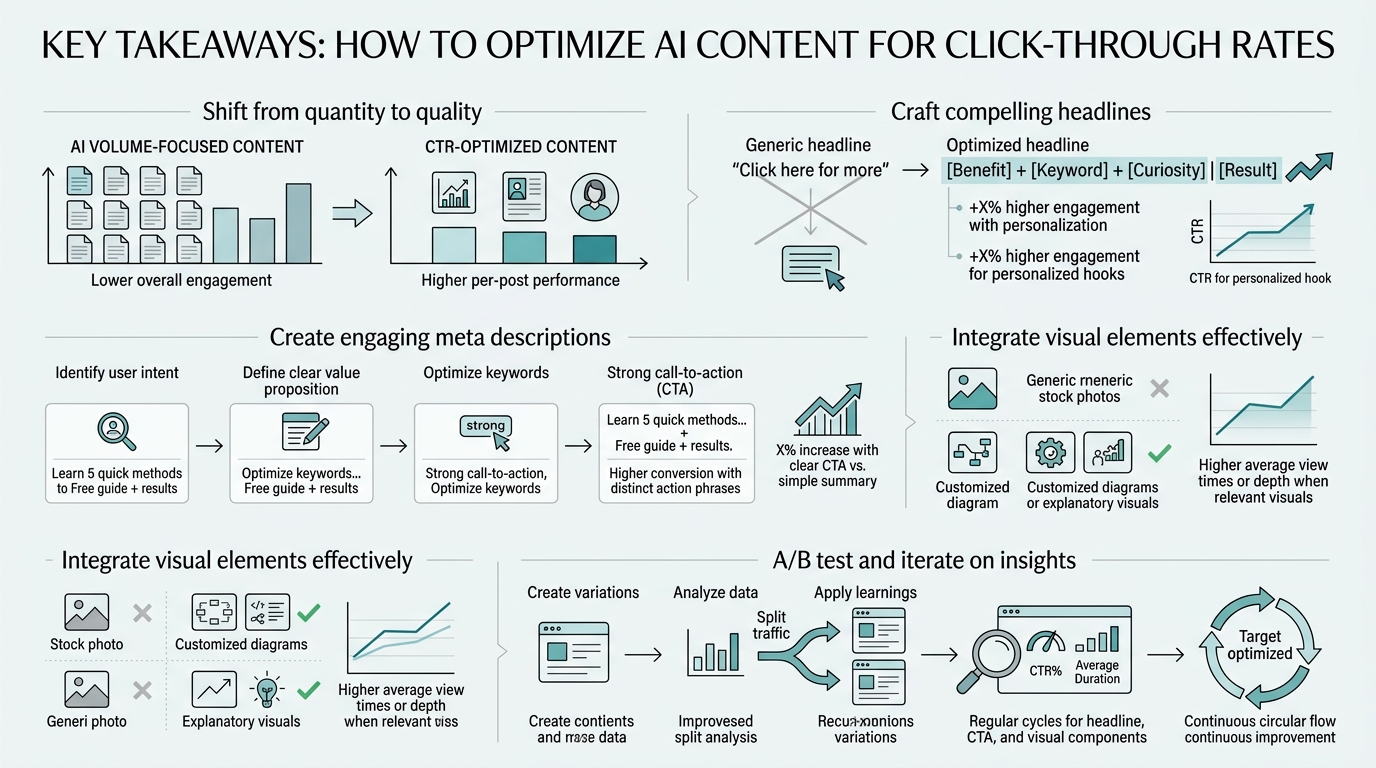
Key Takeaways
- AI Overviews reduce organic CTR by 61% on average, making traditional SERP visibility insufficient (Seer Interactive, 2025)
- Pages cited in AI Overviews receive 120% more clicks per impression than non-cited pages, shifting optimization from ranking to citation visibility
- Winning AI-era content combines clear intent matching, structured answers, and original data that AI systems excerpt and attribute
- Optimize Title Tags and Meta Descriptions for Human Intent: Place the primary keyword early and use benefit-driven language to stand out in AI-mediated SERPs where generic titles get rewritten or ignored.
- Structure Content for AI Extraction: Use short, quotable definitions, comparison tables, numbered steps, and original research that AI Overviews can surface and cite back to your site.
- Build Topical Authority with Citation-Ready Content: Create cluster content around core topics so your domain becomes the go-to source AI systems reference, driving higher-quality referral traffic.
- Target Search Behavior Shifts Away from Zero-Click: Focus on commercial and research-mode intent where users click through multiple sources, not one-line definitions AI answers directly.
- Maximize Content Automation for Speed and Scale: Use AI-powered content systems to produce high-volume, structured output faster than manual writing, then optimize at scale rather than one article at a time.
Why AI Overviews Changed the CTR Game
The click-through rate crisis is real and immediate. Google's AI Overviews have become the default experience for millions of search queries, fundamentally rewiring how users interact with results. When an AI Overview appears, organic CTR plummets from 1.76% to 0.61%, according to Seer Interactive's analysis of AI Overview impact on CTR, a 65% reduction in clicks per impression. But the metric that matters most now isn't ranking position—it's citation visibility.
"Pages cited within AI Overviews receive 120% more clicks per impression than pages that rank normally without citation. This is the new optimization lever."
A counterintuitive finding has emerged: pages cited within AI Overviews receive 120% more clicks per impression than pages that rank normally without citation. This is the new optimization lever. Your content needs to be excerptable, citable, and valuable enough that AI systems choose to attribute traffic back to you.
The shift from "rank higher" to "get cited" requires rethinking content structure entirely. AI systems don't scan your entire article looking for ranking keywords. They extract short, specific answers, definitions, data points, and sourced claims. If your AI-generated content can't be broken into pieces AI can use, it won't be cited—and without citation, it won't get clicks.
The AI Overview Extraction Mechanism
AI Overviews pull content from multiple sources, synthesizing answers in real-time. They prioritize pages that answer the question directly, early, and with structural clarity. A page buried in 500-word paragraphs won't rank as citable. Pages that open with clear definitions, include comparison tables, and provide original data are far more likely to be excerpted.
This means your H1, first paragraph, and opening section must answer the query immediately. 85% of AI-generated content requires human editing, and that editing usually means adding structure: breaking long paragraphs into lists, pulling out key data, and adding subheadings that make content scannable. Tools like Jottler's AI content generator for SEO automate this structural optimization by generating AI content with built-in formatting for extraction and citation.
Citation as a Traffic Driver
When you're cited in an AI Overview, you don't lose the click—you gain it in a different form. AI referral traffic converts at 11.4% compared to 5.3% for traditional organic search, according to research on AI search referrals vs traditional organic clicks. Visitors who click through from an AI Overview come pre-qualified: they've already read an excerpt of your answer. They're visiting your site to get the full context or additional detail, not to discover what the topic is.
This is why competing on rank alone is futile in 2026. Competing on citability—being the source AI systems trust and extract from—is how you recapture lost traffic and actually grow qualified visits.
How to Write Title Tags and Meta Descriptions That Stand Out in AI Search
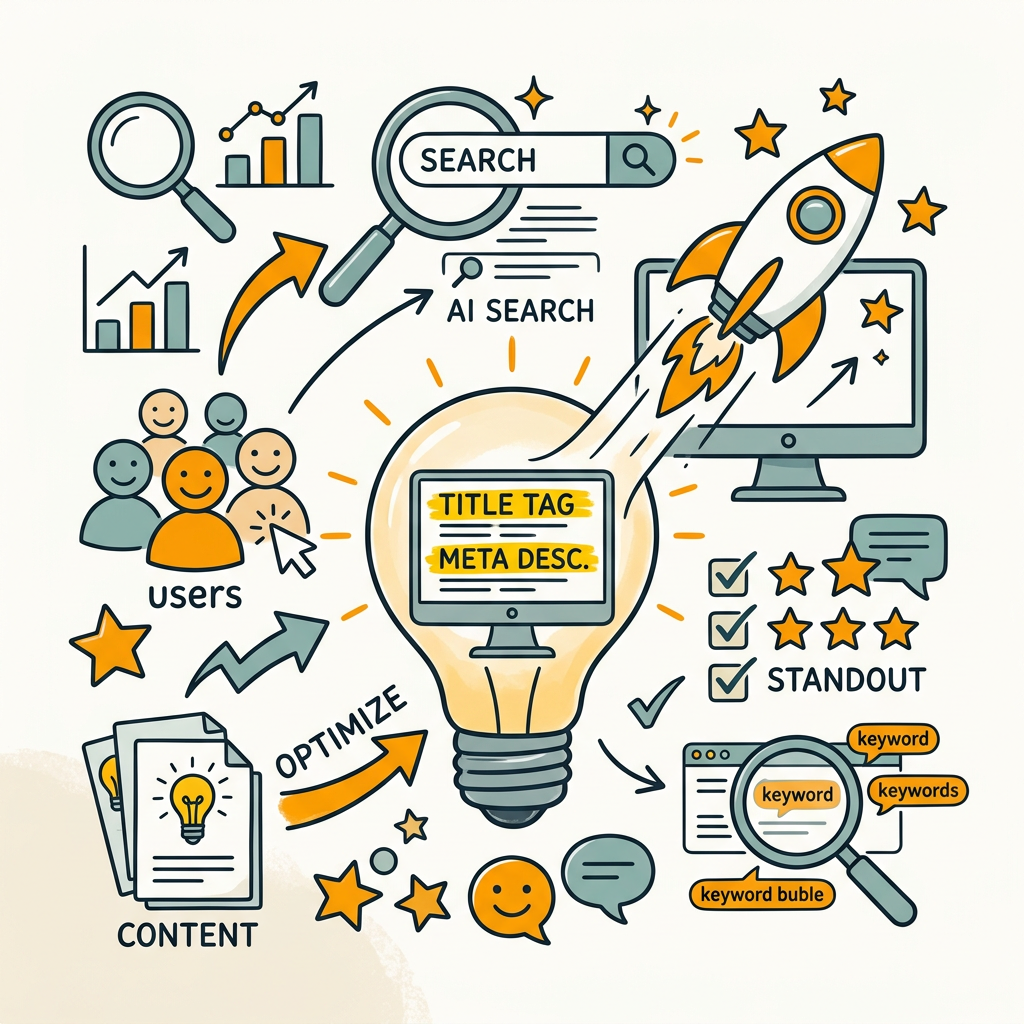
Title tags and meta descriptions are no longer just about ranking. They're your first-impression real estate in a SERP crowded with AI Overviews, featured snippets, and ads. In many cases, Google rewrites your meta description entirely, using its own snippet instead. But when it does use your description, the copy matters enormously for click decisions.
"A specific title like 'How to Optimize AI Content for Click-Through Rates' immediately answers the query and makes the value clear to human readers and AI extraction systems alike."
The best-performing titles in AI-heavy SERPs share a pattern: they're specific, benefit-driven, and keyword-forward without being stuffed. A generic title like "AI Content Optimization Guide" gets buried. A specific title like "How to Optimize AI Content for Click-Through Rates" immediately answers the query and makes the value clear to human readers and AI extraction systems alike.
Title Tag Strategy for Intent Matching
Your title tag is the primary SERP element deciding whether someone clicks. In AI-mediated search, it's also the first thing AI systems see when evaluating whether your page is relevant to include. A weak title loses on both fronts.
Follow these rules for 2026 title tag optimization:
- Place the primary keyword first. "How to Optimize AI Content for CTR" outperforms "Optimizing AI Content: CTR Techniques."
- Add a modifier that signals depth or currency. "2026," "guide," "complete," or "step-by-step" tell searchers and AI systems this is comprehensive, not a stub.
- Keep it under 60 characters to avoid truncation on mobile and desktop.
- Make each title unique. Title duplication confuses Google and AI systems about which page to prioritize.
- Write for humans first, SEO second. A title that makes sense to a person reading the SERP will make sense to AI systems evaluating relevance.
Google frequently rewrites titles that are too long, keyword-stuffed, or misaligned to the query. If you see Google rewriting your titles in Search Console, the reason is usually one of these three. Fix the root cause—the title itself—rather than waiting for Google to do it.
Meta Description Copy That Converts
Meta descriptions are not a ranking factor, but they are a click factor. Research from Straightnorth shows that well-written meta descriptions reduce CTR variance significantly—pages with compelling descriptions outclick pages with vague ones, even at the same ranking position.
Your meta description should function like ad copy. It answers one implicit question: "Why should I click this instead of the others?" Include:
- A specific benefit or outcome: "Reduce click losses by 50% without losing rank—here's how AI content and traditional SEO align."
- A reason to click: "Includes step-by-step checklist and 2026 data."
- Brevity: 150–160 characters so it doesn't truncate.
Note that Google may still rewrite or ignore your description if it finds a better snippet in the page content itself. But providing a strong description improves your odds and gives Google a starting point aligned to your intent.
Structure Your AI Content for Extraction and Citation
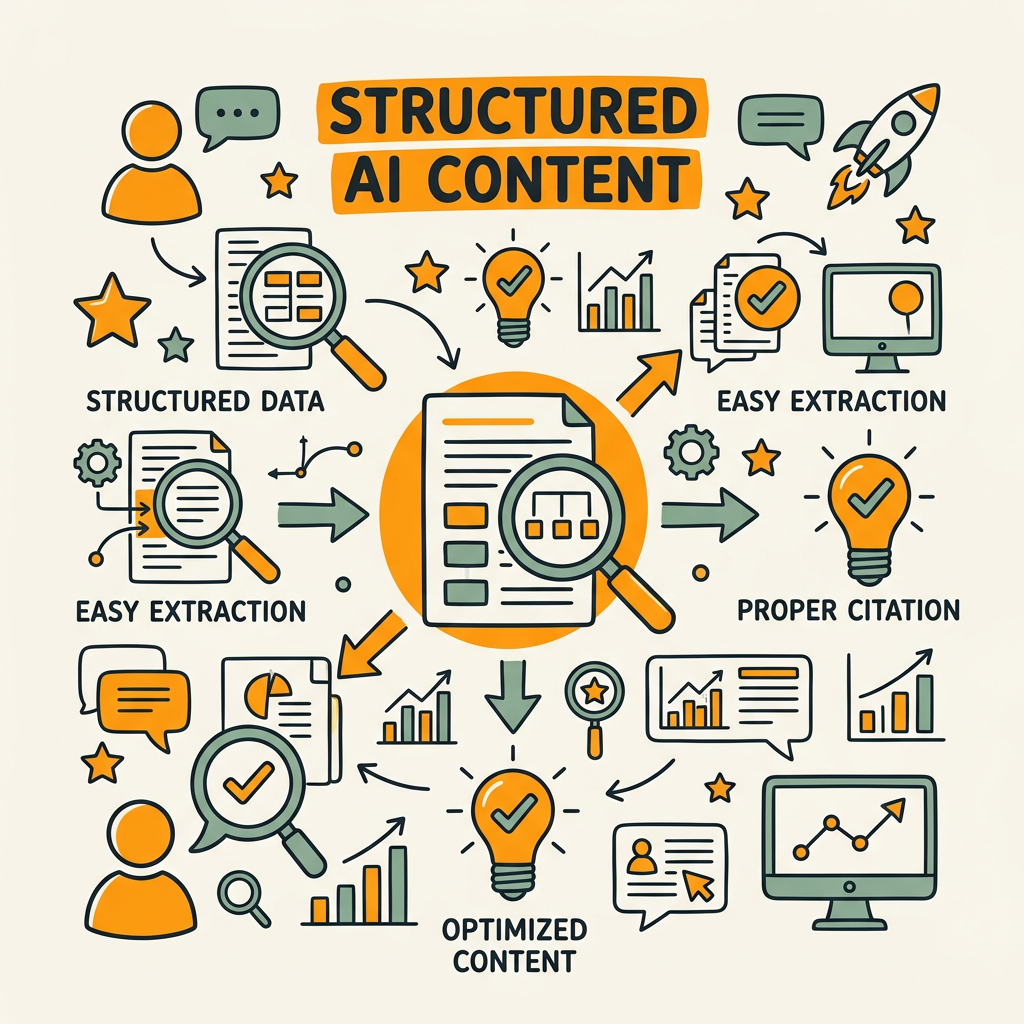
The shift to AI-first optimization requires rethinking content architecture. Most AI-generated articles are long, flowing prose that reads well but isn't built for extraction. Search engines and AI systems alike privilege structured, scannable content.
When you're optimizing AI content for CTR, you're really optimizing for two audiences at once: humans reading the full page, and AI systems scanning for excerpt-worthy content. The structure that serves both is straightforward, repeatable, and heavily formatted with headings, lists, and tables.
Opening Answers Before Explanation
AI systems extract from the beginning of pages first. If you open with a 3-sentence introduction before stating the answer, AI will excerpt the introduction instead of the answer. This is a critical mistake.
The format that works: open with the answer in the first sentence, then explain. For example, instead of "There are many ways to optimize AI content for CTR. Let's explore them," write "To optimize AI content for CTR, place keywords early in titles, structure content in lists and tables, and target citation visibility over ranking position." The answer comes first. The explanation follows.
This is why AI content strategy platforms emphasize answer-first formatting in long-form articles. AI agents are trained to lead with the answer, supporting it with data and explanation. Pages built this way are more citable and rank better for featured snippets and AI Overviews.
Using Lists and Tables for AI Extraction
AI Overviews pull structured data far more readily than unstructured prose. A comparison table with 5 rows and 3 columns is instantly understandable to AI systems and humans alike. A 200-word paragraph describing the same comparison requires interpretation.
Build content with the assumption that every important claim will be extracted separately:
- Use numbered lists for sequential information. "Step 1," "Step 2," "Step 3" are extracted cleanly and cited as procedural knowledge.
- Use bullet lists for non-sequential sets. "Benefits of X," "Features of Y," "Limitations of Z" are parsed as attribute lists.
- Use comparison tables for trade-offs. Feature matrices, before/after tables, and benchmark comparisons are cited directly in AI Overviews.
- Use blockquotes for expert attribution. A quote from a named expert is more likely to be cited than your own synthesis of the same idea.
This structural approach has a dual benefit: it improves SEO because Google and AI systems prioritize structured data, and it improves UX because readers scan and understand content faster.
Including Original Data and Research
AI systems favor pages with original statistics, proprietary research, or first-party data. If every claim in your article is paraphrased from other sources, AI will cite the original sources instead of you. If you include original research—even simple benchmarks from your customer base—AI systems treat you as a primary source and cite you directly.
This is why adding original data is one of the highest-leverage CTR optimizations:
- Run a survey of your audience and publish the results with attribution.
- Analyze your own customer metrics and share anonymized findings.
- Interview subject matter experts and pull direct quotes.
- Create a comparison table of tools or platforms, testing them yourself.
Every original research point you add increases the likelihood you'll be cited and increases the authority AI systems assign to your content.
Target the Right Search Intent to Avoid Zero-Click Queries
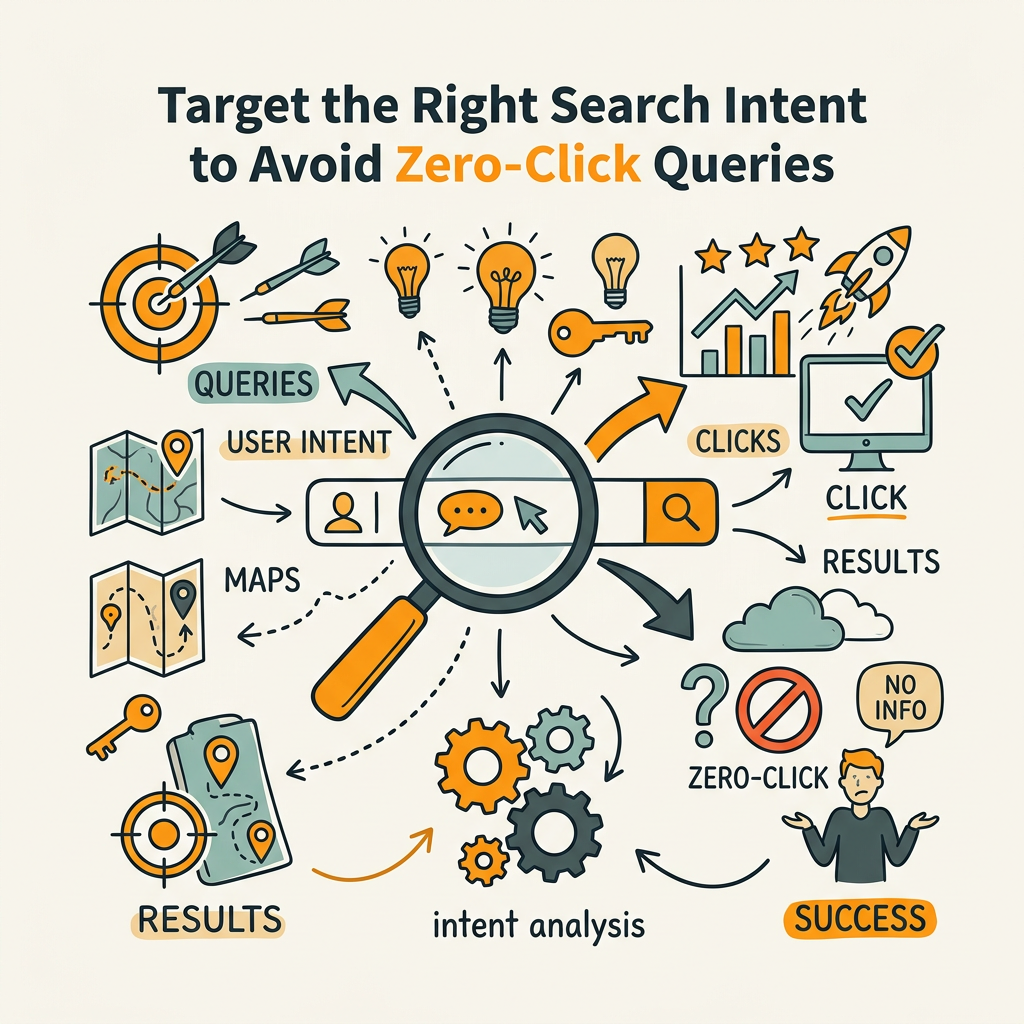
Not all search queries are created equal in the AI era. Some queries are nearly impossible to convert into clicks because AI answers them completely. Others are still highly clickable because users want multiple perspectives, comparisons, or deeper context.
The biggest mistake teams make is treating all content the same. If you're writing 50 AI-generated articles per month, you need to be strategic about which queries you target.
Query Types That Still Drive Clicks
Certain query patterns remain high-intent and high-click despite AI Overviews. These are your priority targets:
- Commercial intent: "Best X for Y," "X vs Y," "How to choose X" — users are evaluating products and want multiple reviews and perspectives. Click rates remain high.
- Research mode: "How to implement X" with multi-step processes — users want step-by-step guidance and examples, not a one-line summary. These still drive significant clicks.
- Comparison queries: "X vs Y vs Z" — users want to see detailed trade-offs and use cases. AI Overviews can't adequately cover three-way comparisons, so users click through.
- How-to with implementation detail: "How to set up X" or "How to use X" — the AI answer gets the basics right, but users click to see screenshots, examples, or advanced techniques.
These query types still convert well because the user's intent is to make a decision or solve a specific problem, not to get a quick answer. Invest your content volume here.
Query Types That Have Gone Zero-Click
Conversely, informational queries where the user wants a fast answer have largely gone zero-click. These are less valuable targets because CTR has collapsed:
- Definition queries: "What is X," "Definition of X" — AI Overviews provide the definition in full. Click rates are near zero.
- Fact-based queries: "Who is X," "When did X happen," "How long does X take" — AI gives the fact. No click needed.
- Quick-reference queries: "Best time to post on social media," "Average salary for X job" — AI answers are comprehensive and sufficient.
Unless you have unique data or perspective on these topics, don't target them. Compete on the queries where clicks still matter.
Building Search Behavior Diversity
One of the underrated CTR optimization tactics is reducing dependence on SERP clicks altogether. While you're optimizing for AI citations and standing out in SERPs, simultaneously build traffic from owned channels:
- Email list building: Capture visitors and send regular content digests. Email traffic isn't affected by AI Overviews.
- Social distribution: Post content on LinkedIn, Twitter, Reddit, and relevant communities. Social traffic is independent of search.
- Brand search volume: Build recognizable, branded content series that people search for by name.
- Partnership and syndication: Get content republished on partner sites and industry publications. Syndicated reach is additive to organic.
This diversification isn't a replacement for SERP optimization—it's a complement. The teams winning in 2026 are those who optimize for search AND build alternative traffic channels.
Automate AI Content Production for Competitive Frequency
One of the hardest truths in AI-era content marketing is this: you can't compete on quality alone anymore. You also have to compete on frequency and scale. A manually written article that ranks well but takes 2 weeks to produce loses to competitors publishing 3 articles per week, each structured properly and optimized for extraction.
"Manual writing workflows can't match the speed needed to build topical authority and citation presence at scale. Content automation is essential for competitive frequency."
This is where content automation becomes essential. Manual writing workflows can't match the speed needed to build topical authority and citation presence at scale.
How AI-Powered Content Automation Improves CTR at Scale
The most efficient teams use AI content systems to handle the research, writing, and structural optimization, then apply human editing to fact-check, add original insights, and publish. This hybrid approach compounds faster than either manual writing or unoptimized AI generation alone.
A good AI content system does more than write. It:
- Researches topics from 14+ sources in minutes, extracting data and statistics for citations.
- Structures content automatically with answer-first formatting, lists, tables, and headings designed for extraction.
- Fact-checks claims against source material, ensuring every statistic is attributed and accurate.
- Handles internal linking intelligently, connecting new content to existing authority pages to build topical clusters.
- Publishes directly to your CMS so content goes live without manual uploads or formatting.
Tools like Jottler automate all five steps with an autonomous SEO agent, publishing 3,000+ words daily across keyword research, writing, fact-checking, and internal linking. The time saved isn't spent on writing—it's spent on strategy: choosing which queries to target, editing for brand voice, and measuring which content drives the most qualified traffic.
Fact-Checking and Quality Control in Automated Content
The biggest objection to AI content automation is quality and accuracy. 85% of AI-generated content requires human editing, and most of that editing is about removing hallucinations, verifying statistics, and confirming sourcing. A system that generates content without fact-checking will hurt your domain authority and CTR over time.
The solution is to integrate fact-checking into the generation process. When an AI system cites a statistic, it should verify the claim against the source before publishing. When it pulls a quote, it should confirm the quote is real. This overhead is worth it because inaccurate content kills CTR faster than any other failure mode.
| Optimization Tactic | CTR Impact | Implementation Effort | Timeline |
|---|---|---|---|
| Optimize title tags and meta descriptions | 15–30% CTR improvement on high-impression pages | Low (manual rewrites) | 1–2 weeks |
| Restructure content for AI extraction | 25–40% improvement in citation likelihood | Medium (adding lists, tables, original data) | 2–4 weeks |
| Target high-intent queries instead of zero-click queries | 50–75% baseline CTR improvement | Medium (keyword strategy) | Ongoing |
| Build topical authority with content clusters | 120%+ click increase from citation visibility | High (requires 20+ articles) | 6–12 weeks with automation |
| Automate content production and optimization | Compounds over time with scale | High upfront (system setup), Low ongoing | Week 1, scales thereafter |
Content automation tools that include verification in their pipeline eliminate the manual fact-checking overhead and ensure published content is both accurate and citable.
Build Topical Authority to Increase Citation Visibility
The page-level optimization tactics above (title tags, structure, original data) matter. But the highest-leverage CTR optimization is topical authority. When your domain is known as THE source on a topic, AI systems cite you preferentially. Citation preference directly translates to click share.
Topical authority is built through content clusters: a pillar article that covers the broad topic, surrounded by cluster content that addresses specific subtopics, all internally linked. This cluster architecture signals to AI systems that your domain is comprehensive and trustworthy on the topic.
Defining Your Topic Cluster
Start by identifying your core topic. For a marketing automation company, the core topic might be "email marketing." The cluster around it includes:
- Pillar: "Complete Guide to Email Marketing 2026"
- Cluster: "How to Segment Your Email List"
- Cluster: "A/B Testing Best Practices for Email Campaigns"
- Cluster: "Email Personalization: Step-by-Step"
- Cluster: "Email Deliverability and Compliance"
Each cluster article targets a specific search query with high intent. The pillar article provides broad overview and links to all cluster articles. Cluster articles link back to the pillar and to related cluster articles. This internal linking structure is what builds topical authority.
Speed as a Competitive Advantage
Building topical authority used to take months because writing a 30-article cluster manually requires a 6-month content calendar. Now, with AI content automation, you can build a 30-article cluster in 3 weeks. Speed matters because:
- First to publish wins on emerging topics. If you publish first on "AI content optimization for CTR," you build topical authority before competitors catch the trend.
- Frequency compounds citation advantage. AI systems favor domains that comprehensively cover topics. 50 articles on a topic attracts more citations than 5 articles.
- Internal linking scales. A larger cluster creates more internal linking opportunities, which distributes authority across your domain and improves crawl efficiency.
The teams using SEO automation tools to build topical authority in clusters are seeing citation rates increase and zero-click risk decrease. Your competitors building one article per week can't keep pace.
Conclusion
Optimizing AI content for click-through rates requires abandoning the assumption that ranking position equals traffic. AI Overviews have fundamentally changed the equation: citation visibility now matters more than rank position, and pages cited in AI Overviews drive 120% more clicks per impression than pages that rank normally. The optimization strategy that works in 2026 combines structural clarity, original research, strategic query selection, and aggressive content frequency to build topical authority and citation presence.
The path forward is clear: optimize title tags for intent matching, structure content for extraction, target high-intent queries that still drive clicks, and automate content production to compete on frequency. Teams that execute this playbook will recapture traffic lost to AI Overviews and build sustainable, citation-driven growth. Start automating your content strategy today to begin publishing structured, optimized articles at scale. Visit Jottler to start your SEO agent and begin building topical authority with AI-powered automation.
FAQs
How do I optimize AI content for AI Overviews?
Optimize for AI Overviews by structuring content with clear answers at the beginning, using comparison tables, numbered lists, and original data that AI systems can extract and cite. Answer-first formatting, where the main claim comes before supporting explanation, increases citability by making it easier for AI to understand and excerpt your content. Include original research, expert quotes, and specific statistics with sources—AI systems treat original sources as more valuable and cite them more frequently. The goal isn't to rank higher; it's to become the source AI systems extract from.
What's the difference between ranking and getting cited in AI search?
Ranking means appearing on the first page of Google results. Getting cited means your content is excerpted and attributed in an AI Overview. Cited pages receive 120% more clicks per impression than pages that rank normally, even at position #1, because visitors clicking through from a citation are pre-qualified: they've already read your excerpt and want more detail. This is why citation visibility has become the primary CTR lever. You can rank #1 and still get zero clicks if you're not cited. You can rank #5 and drive strong traffic if you're cited prominently.
How often should I publish AI content to build topical authority?
The teams winning on topical authority are publishing at a frequency that was impossible 2 years ago. Publishing 3-5 articles per week in a narrow topic cluster builds topical authority in 6-12 weeks instead of 12+ months. This is only achievable with AI-powered automation because manual writing can't produce that volume without sacrificing quality. Automated systems handle keyword research, writing, fact-checking, and publishing, freeing your team to focus on strategy and editing. The frequency that matters is consistency and relevance, not speed alone—all content must target genuine, high-intent queries within your cluster.