How to Select the Best AI SEO Tool
The market for AI SEO tools has exploded. 70% of businesses report higher ROI from AI in SEO, yet most teams still waste weeks researching, comparing, and testing platforms that don't match their actual workflow. The stakes are real: a poor tool choice means wasted budget, missed optimization opportunities, and falling behind competitors who've already automated their content pipelines. The fix isn't to test everything—it's to know exactly what to evaluate before you even log in.
Key Takeaways
- AI-referred traffic converts at 15.9% on ChatGPT and 10.5% on Perplexity, versus 1.76% for traditional Google organic (Seer Interactive, 2025)
- Match your tool to your bottleneck—not your budget. Different tools excel at keyword research, content optimization, or AI search tracking.
- The best AI SEO tools combine deep research, autonomous writing, fact-checking, and direct publishing to eliminate manual workflows.
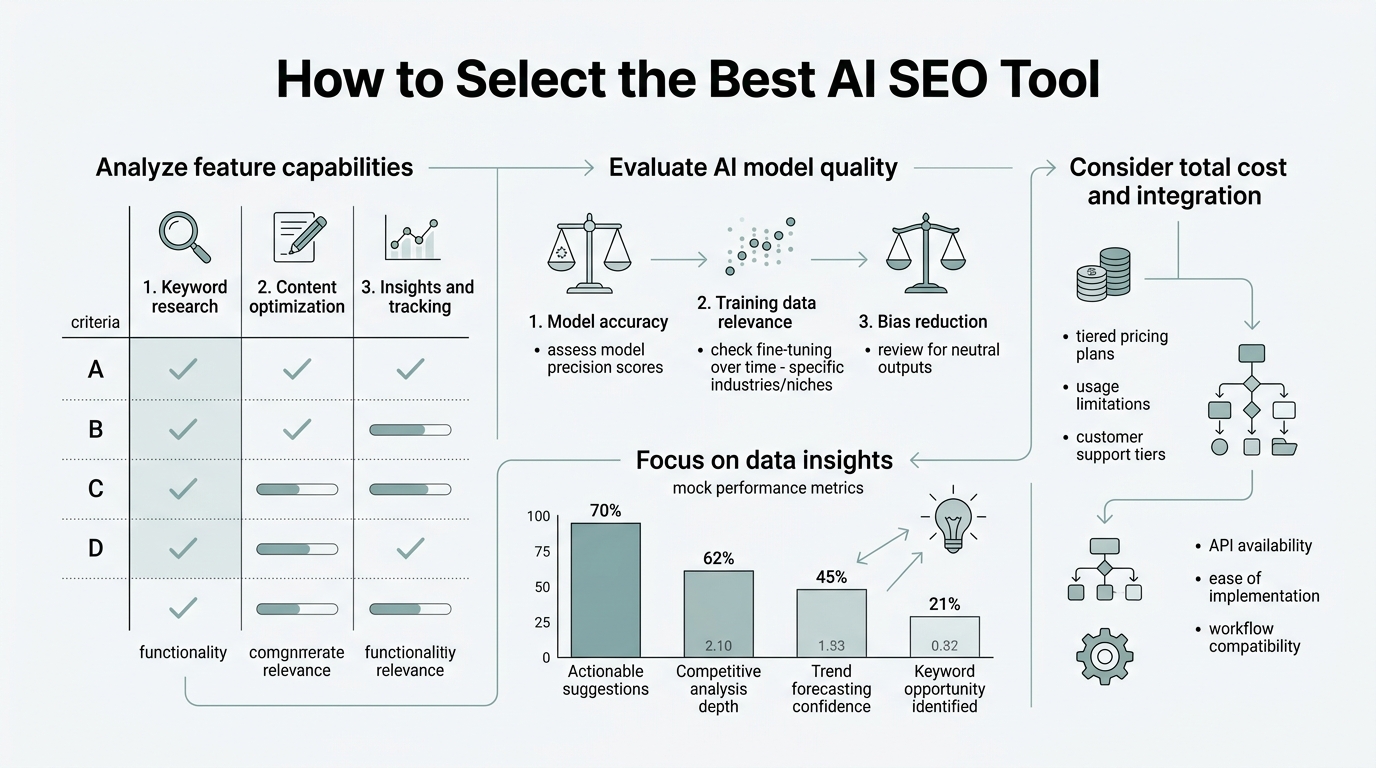
- Define Your Core Bottleneck First: Identify whether you're constrained by keyword research, content creation speed, on-page optimization, or AI search tracking.
- Evaluate Research Depth and Accuracy: The tool should pull from 10+ authoritative sources, verify facts, and cite properly without hallucinating.
- Assess Automation Coverage: True automation means research, writing, publishing, and internal linking—not just one stage.
- Compare Integration and Publishing Workflows: Native CMS support (WordPress, HubSpot, etc.) saves hours of manual transfers and formatting.
- Benchmark Against AI Search Metrics: Prioritize tools that track visibility in ChatGPT, Perplexity, Google AI Overviews, and Gemini.
How Does Your Current Content Workflow Actually Break Down?
Before evaluating any AI SEO tool, you need to audit where your team spends the most time. Most marketing teams spend 40-50 hours per week on research, drafting, editing, and publishing—but not all bottlenecks are the same. The tool that solves keyword research won't necessarily help if your real problem is publishing speed or internal linking at scale.
Where Your Team Is Stuck Right Now
Teams typically face one of three constraints. First: research takes forever. Keyword research, competitor analysis, topic clustering, and fact-checking consume weeks before a single draft begins. Second: writing quality is inconsistent. AI generators produce generic content fast, but most rank poorly because they miss semantic depth, entity relationships, and actual search intent. Third: publishing is manual and fragmented. Even if you have a draft, you're manually formatting, internal linking, scheduling, and moving files between tools—a workflow that breaks at scale.
"Most teams waste weeks testing platforms that don't match their actual workflow. The real ROI comes from matching your tool to your specific bottleneck—whether that's research speed, content quality, or publishing automation."
Honest self-assessment here saves you money. If your team can research in-house but can't write fast enough, a keyword-research tool won't help. If you can write but struggle with on-page optimization, a content optimizer (like Surfer or Clearscope) makes sense. If you lack time for everything, you need an autonomous SEO agent that handles research-to-publishing end-to-end.
The Hidden Cost of Manual Processes
Manual workflows compound inefficiency. One expert on AI search noted that 28.3% of the pages ChatGPT cites have zero organic visibility—meaning teams are missing opportunities to reach AI platforms. When you manually publish without tracking AI search metrics, you're blind to where your content actually appears. Tools that integrate keyword research, writing, fact-checking, and publishing reduce the surface area for error and ensure every step builds toward AI-powered SEO visibility.
What Core Features Should Your AI SEO Tool Include?
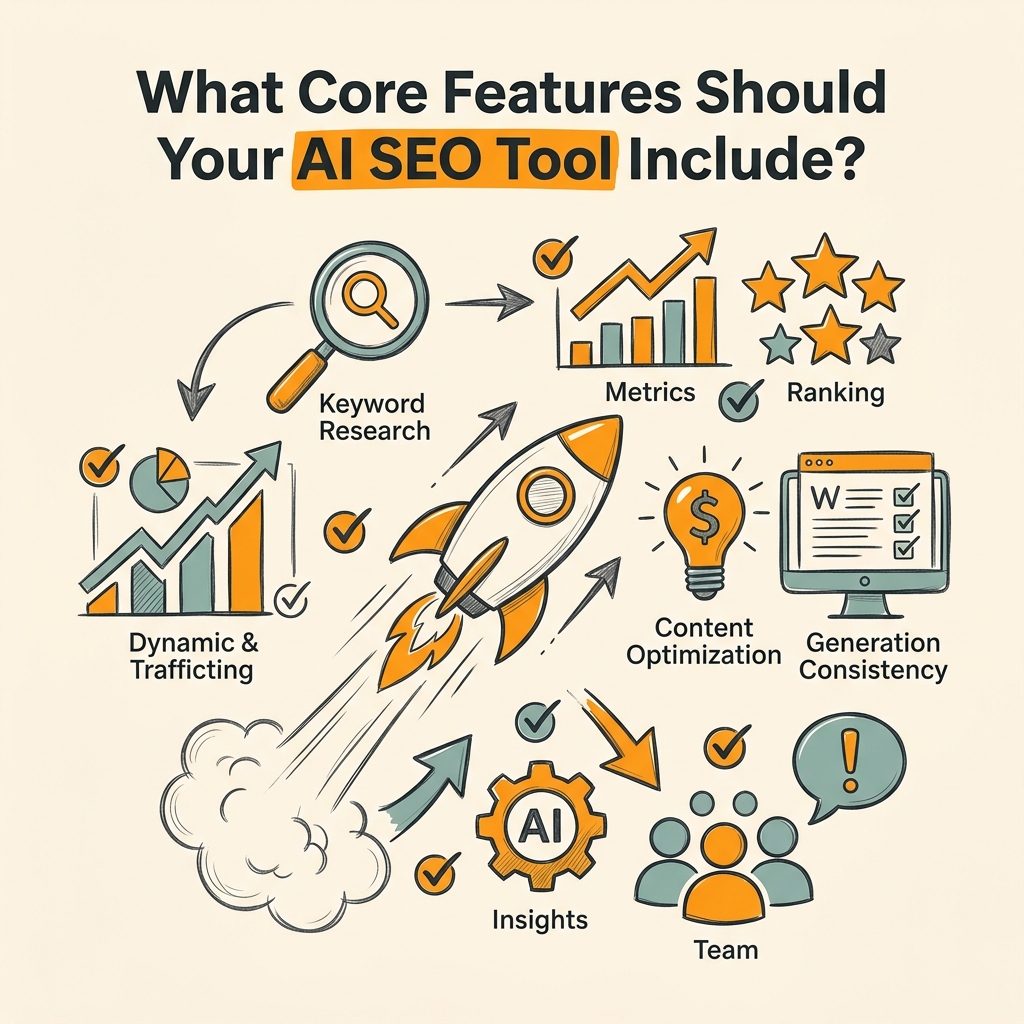
Not all AI SEO tools are equal. The best ones combine research depth, autonomous writing, fact-checking, and native publishing. Understanding these core features helps you avoid tools that look impressive but lack critical functionality for scaling content production.
Research Depth and Multi-Source Integration
The best AI SEO tools pull from 10+ authoritative sources per article, not just one database or training set. This means real competitor analysis, real search trends, real expert quotes—not hallucinated data. Look for tools that display their sources transparently and allow you to verify citations. Tools like Semrush integrate deep keyword and competitor data; autonomous platforms like Jottler combine 14+ real sources per article with fact-checking and entity verification to eliminate false claims.
This matters because search engines (and AI systems) now reward factual accuracy heavily. Content with verifiable citations ranks higher and gets cited more often by ChatGPT, Perplexity, and Google AI. A tool that just generates plausible-sounding text without grounding it in real data will fail to reach either audience.
Content Quality and Semantic Relevance
AI content quality depends on understanding semantic relationships, not just keyword density. Content optimizers like Surfer SEO excel at on-page semantic alignment, matching entity relationships and word vectors that search engines recognize. However, a pure optimization tool doesn't write the content—you do. Conversely, generative tools like ChatGPT write fast but miss crucial semantic structure, context, and depth.
"The best AI SEO tools either combine research, writing, and optimization in one pass, or integrate seamlessly with post-draft optimization platforms. Generic LLM outputs will rank poorly because they lack the semantic depth and entity relationships that modern search engines reward."
The best AI SEO tools either combine both (write + optimize in one pass) or integrate with optimization platforms post-draft. Tools with real SEO expertise—not just LLM outputs—produce AI SEO content that ranks because it's researched, semantically aligned, and built for both human readers and search algorithms simultaneously.
Fact-Checking and Citation Integrity
Hallucinations destroy trust and rankings. A tool without fact-checking will confidently cite fake statistics, misquote experts, or invent case studies. Look for platforms that verify every statistic, cross-reference quotes, and flag weak claims before publishing. This is non-negotiable for B2B content, regulatory compliance, and any niche where accuracy affects reputation.
Jottler, for example, runs three layers of fact-checking: source verification (confirming URLs resolve and quotes match originals), statistical validation (checking year, methodology, and reasonableness), and expert cross-reference (ensuring attributed claims align with the person's public statements). Most AI writing tools skip this entirely, which is why best AI content writer tools in the SEO space prioritize verification over raw speed.
How Should AI SEO Tools Handle Publishing and Internal Linking?
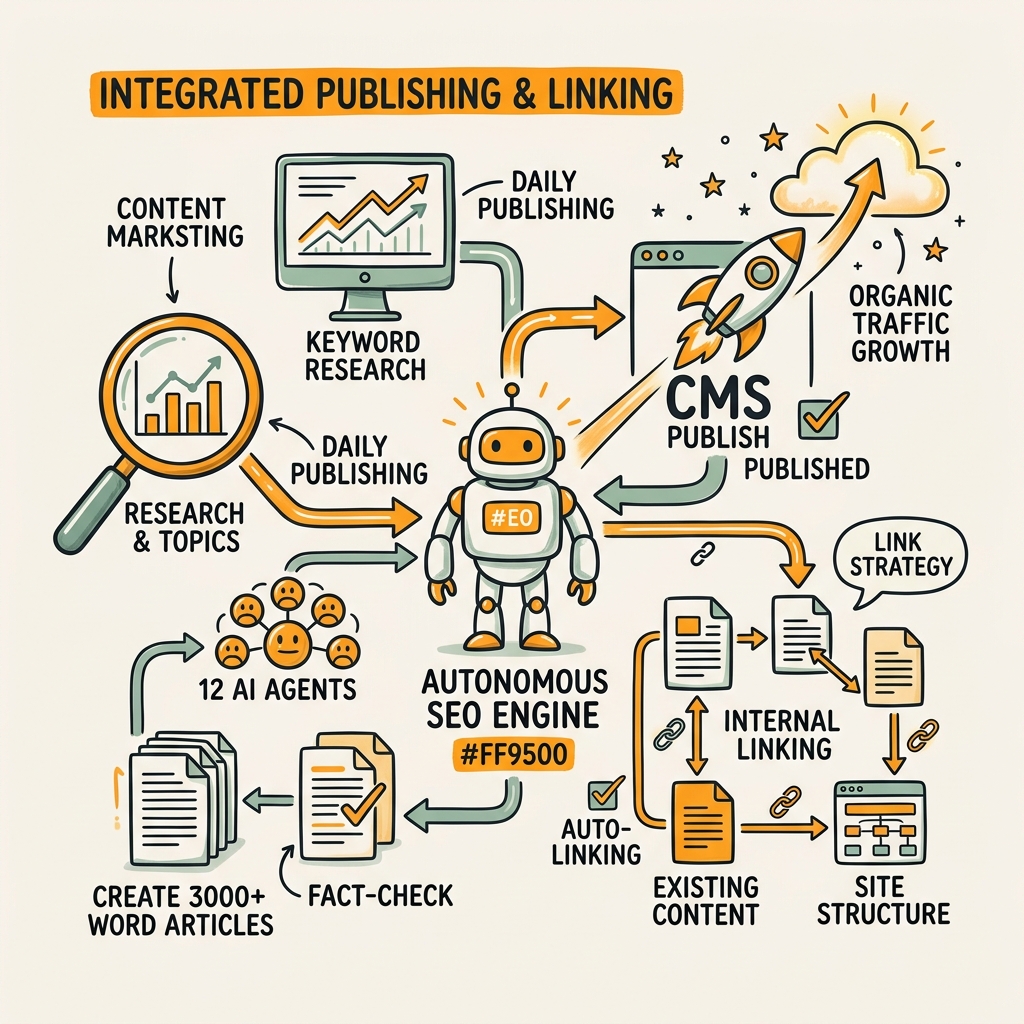
Publishing workflow can make or break an AI SEO tool's ROI. Teams lose 30-40% of productivity gains to manual CMS integration and formatting. The best tools publish directly to your CMS, build internal link networks automatically, and track what's live—all without human intervention.
Native CMS Integration and Direct Publishing
Evaluate whether the tool supports your actual CMS. WordPress, HubSpot, Webflow, Ghost, or custom platforms all need different integrations. If a tool only supports WordPress and you run HubSpot, you're back to manual copy-paste. Native integrations should include:
- Direct Publishing: Write → schedule → publish without leaving the tool
- Metadata Management: Auto-populate SEO titles, meta descriptions, slug structures
- Image Handling: Embed, optimize, and credit images without manual uploads
- Scheduling and Versioning: Publish on a cadence; preserve revision history
Jottler connects natively to WordPress, HubSpot, and Webflow with one-click publishing. The AI agents research, write, and push directly to your site without manual intervention—essential for teams publishing 3+ articles weekly. This is core to what makes content marketing automation actually work at scale.
Automatic Internal Linking and Topical Authority
Internal linking is one of the highest-leverage SEO tactics, yet teams rarely do it consistently because it requires manual work. The best AI SEO tools build internal link networks automatically, matching new content to existing assets and creating semantic clusters that establish topical authority faster.
When evaluating tools, ask: Does it map existing content to new articles? Does it suggest contextual anchor text? Does it enforce linking strategy (max links per article, preferred anchor patterns)? Tools that automate internal linking at scale—combining keyword clusters with link graphs—compound organic growth far faster than tools that just generate standalone articles. This is why topical authority SEO has become essential for modern content strategies.
What AI Search Platforms Should Your Tool Track?
Traditional Google ranking no longer tells the whole story. ChatGPT receives 5 billion monthly visits, Perplexity and Claude are growing rapidly, and Google AI Overviews reach 2 billion monthly users. Your AI SEO tool should track visibility across all major platforms, not just organic search. According to Slate's AI SEO statistics, adoption of AI tools for visibility tracking has accelerated dramatically across marketing teams.
Multi-Platform AI Search Visibility
The best tools monitor where your content appears in:
- ChatGPT: 43.2% of Google #1 pages are cited by ChatGPT—3.5x higher citation rate than lower-ranking pages (Ahrefs, 2025)
- Perplexity: High-intent, research-focused audience; 10.5% conversion rate (Seer Interactive, 2025)
- Google AI Overviews: Reaches 2 billion monthly users; prioritizes authoritative, well-sourced content
- Gemini, Claude, and Others: Emerging platforms worth tracking as they grow
Tools like Rankability and Profound specialize in multi-platform AI search tracking, showing exactly which pages get cited and how often. MEGA AI's comprehensive tool comparison shows that Semrush also integrated AI tracking into its suite. If your tool can't report on AI visibility, you're flying blind to the fastest-growing traffic source. This is why AI SEO optimization tools now must address both traditional and AI search visibility.
Conversion Quality Over Volume
AI traffic is lower volume but higher intent. AI-referred visitors convert at 15.9% for ChatGPT versus 1.76% for traditional organic—a 9x difference (Seer Interactive, 2025). This means even 1% of your traffic from AI platforms can drive meaningful revenue. Prioritize tools that help you optimize for high-intent AI visitors, not just rank for keywords.
How Should You Compare Tools in Practice?
The real test of any AI SEO tool is whether it saves time while improving quality. Here's how to evaluate fairly.
Test With Your Actual Workflow
Most tools offer free trials or freemium tiers. Rather than explore features, run a real project: pick an important keyword, use the tool to research it, write an article, publish it, and track results over 60 days. Measure:
- Hours saved vs. manual process
- Article quality (does it rank? get cited by AI?)
- Publishing friction (how many manual steps?)
- Research accuracy (are the sources real and cited properly?)
This is the only way to know if a tool truly fits your team and supports your SEO strategy to scale organic traffic.
Build Your Comparison Scorecard
| Feature | Research Depth | Content Quality | Publishing Speed | AI Search Tracking | Best For |
|---|---|---|---|---|---|
| Jottler | 14+ sources, fact-checked | Long-form SEO content daily | Direct CMS publish (1-5 articles/day) | Emerging focus | Autonomous end-to-end content at scale |
| Semrush | Excellent (own database) | Good (AI-assisted) | Manual (export) | ChatGPT, Perplexity, Gemini | Enterprise all-in-one |
| Surfer SEO | Good (on-page only) | Excellent (optimization scoring) | Manual (guidelines export) | No built-in tracking | Content optimization and semantic alignment |
| Rankability | Excellent (NLP-based) | Very good (entity-focused) | In-app editor | ChatGPT, Perplexity, Gemini (new) | AI search visibility optimization |
| Clearscope | Very good (competitive) | Excellent (optimization) | Manual (guidelines) | No tracking | Enterprise content strategy |
| Frase | Adequate (surface-level) | Fair (templated) | Manual export | No tracking | Budget-conscious solo creators |
Each tool excels in different areas. Jottler stands out for complete automation—from research through publishing—without sacrificing depth. Teams that need fast, factual, SEO-optimized content publishing daily choose Jottler because it removes the manual steps that slow down competitors.
Consider Your Growth Stage and Team Size
Solo freelancers have different needs than in-house marketing teams at Series B startups. Small teams should prioritize automation and low setup friction (Jottler, Frase). Growing teams can afford more specialized tools (Surfer + Semrush combo). Enterprise should invest in suites (Semrush, BrightEdge) that integrate across research, optimization, tracking, and analytics in one platform.
What Hidden Costs Should You Watch For?
Tool pricing rarely reflects true cost. Seat licenses, API limits, publishing restrictions, and integration fees add up quickly. Evaluate total cost of ownership, not just per-month price.
Pricing Transparency and Hidden Limits
Watch for tools that charge separately for core features: research add-ons, additional publishing seats, API overages, or integration fees. Jottler's pricing is transparent—plans start at $29/mo and include unlimited articles, research from 14+ sources, fact-checking, and direct publishing. No per-seat fees, no API limits. Compare this to tools that nickel-and-dime for publishing, additional team members, or advanced optimization features.
Setup and Onboarding Friction
A $99/month tool that requires 20 hours to set up or integrate is more expensive than a $49/month tool that's live in 30 minutes. Evaluate:
- How quickly can you publish your first article?
- Does the tool require technical setup (API keys, webhooks) or is it point-and-click?
- Is customer support responsive to integration issues?
The best tools disappear into your workflow. You shouldn't think about the tool; you should focus on content strategy.
Conclusion
Selecting the best AI SEO tool means matching your actual bottleneck to the right platform. Teams using integrated AI SEO systems report 70% higher ROI, and those publishing to AI search platforms see 15.9% conversion rates versus 1.76% for traditional organic. The difference isn't the tool—it's having a tool that eliminates manual steps and compounds your content output.
Start by auditing your workflow. Where does research take longest? Where do edits and publishing slow you down? Then evaluate tools that solve that specific pain point with transparency, accuracy, and native publishing support. If you need autonomous content production at scale with deep research and fact-checking built in, Jottler handles research-to-publishing without manual intervention. Otherwise, combine specialized tools (Surfer for optimization, Semrush for research, Rankability for AI tracking) into a stack that matches your team's capabilities.
Start your SEO agent with Jottler and see how autonomous content research and publishing compounds organic traffic in your first month.
FAQs
What is the fastest way to publish AI-written SEO content?
The fastest way is to use an AI SEO tool with native CMS integration that publishes directly to your site without export, formatting, or manual linking. Tools that combine research, writing, and publishing in one step—eliminating copy-paste and manual workflows—save 10-15 hours per week for teams publishing multiple articles. If you're currently exporting drafts from one tool and importing to another, you're adding days to your timeline. Direct publishing, native fact-checking, and automatic internal linking are the three features that compress publication time most dramatically.
How do I know if my AI SEO tool is actually improving organic traffic?
Measure three metrics over 90 days: search impressions from Google Search Console, visibility in AI platforms (ChatGPT, Perplexity, Google AI Overviews), and conversion rates from each source. AI traffic converts at 9x the rate of traditional organic but represents lower volume—so if you're tracking only Google traffic, you'll miss the real impact. Set up tracking in both GSC and AI search tools (Rankability, Profound, or Semrush's AI module). If impressions are flat but AI citations are rising, your tool is working—you just need to optimize your funnel. If both are flat after 90 days, the tool isn't delivering.
Should I use one all-in-one AI SEO tool or combine multiple specialist tools?
It depends on your team size and tolerance for integration complexity. Solo creators and small teams should choose one comprehensive platform that handles research, writing, optimization, and publishing end-to-end—fewer integrations mean less friction and faster output. Growing teams (5+ people) can afford a specialist stack: use Semrush for research and analytics, Surfer for optimization, and Rankability for AI tracking. Enterprise teams benefit from integrated suites like Semrush or BrightEdge. The rule: if switching between tools takes more than 2 clicks, consolidate. If you can do it in one tool, do that first before adding specialists.