HubSpot vs Klaviyo vs Mailchimp: Which Platform Wins
Choosing between email marketing and CRM platforms is one of the most critical decisions a growing company can make. Mailchimp holds 44.3% of detected email marketing platform share, yet Klaviyo and HubSpot are rapidly gaining ground among high-growth teams. The stakes are significant: a poor platform choice leads to wasted setup time, integration headaches, and missed revenue opportunities. The three platforms dominate for different reasons, and picking the wrong one can cost months of productivity. Here's how to decide which platform truly wins for your business.
Key Takeaways
- HubSpot is the broadest all-in-one CRM/marketing suite best for B2B teams needing cross-department workflows (2026)
- Klaviyo dominates ecommerce with behavior-based automation, reaching 50,000+ brands who switched from competitors
- Mailchimp leads by volume (44.3% market share) but costs significantly less at scale—critical when comparing 100,000+ contact lists
- HubSpot: Full CRM with all-in-one automation and sales pipeline management, best for complex B2B operations requiring integrated workflows.
- Klaviyo: Ecommerce-first lifecycle marketing with event-driven segmentation and unlimited behavioral automation, ideal for Shopify and high-growth DTC brands.
- Mailchimp: Most affordable generalist email platform with strong template design and multichannel capabilities, perfect for bootstrapped teams and beginners.
How Does Pricing Compare Across the Three Platforms?
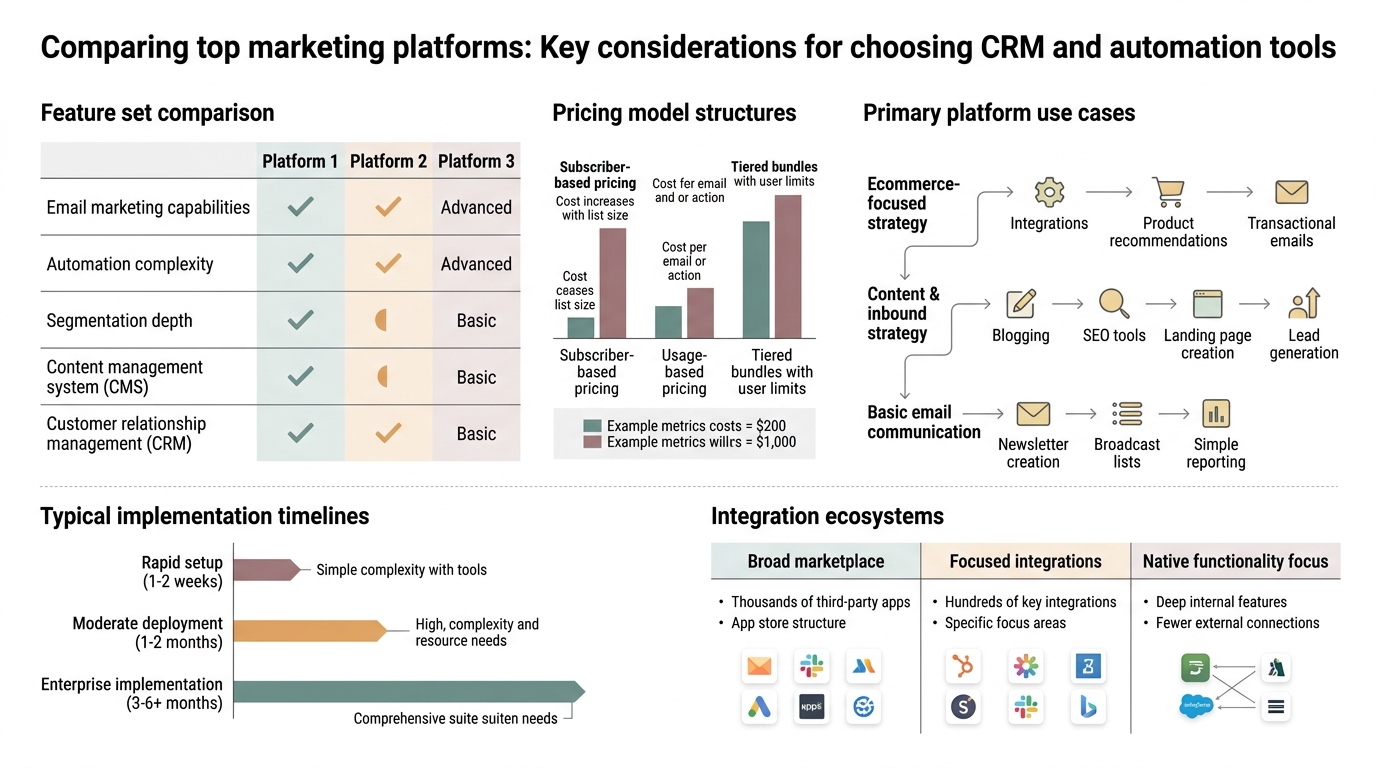
Pricing is where these three platforms diverge most dramatically. At 100,000 contacts, Klaviyo costs roughly $1,380–$1,440 per month, while Mailchimp costs $700–$800 (2026, Automation Atlas). Yet this comparison oversimplifies reality because contact-based pricing scales differently across each platform, and plan features vary significantly.
Entry-Level Costs and Free Tiers
Mailchimp offers the most generous free tier, supporting up to 500 contacts with basic email campaigns. This makes it the obvious choice for bootstrapped founders testing email for the first time. HubSpot's free CRM tier is also robust but excludes marketing automation features you'll need to run segmented campaigns—you must upgrade to Professional tier at around $890 per month to unlock omnichannel automation.
"For founders choosing between platforms, the free tier often determines the winner in the first 90 days. Mailchimp's 500-contact free plan removes the barrier to entry entirely, while HubSpot's free CRM forces an early upgrade decision." — Platform Comparison Atlas, 2026
Klaviyo's free plan is a middle ground: you get access to most features including flows and segmentation, but free users only receive support for the first 60 days. This is a meaningful constraint if you're still learning the platform.
Scaling Costs at Higher Contact Volumes
The real differentiation appears at scale. A pricing comparison across contact tiers reveals the steepness of each platform's curve:
| Contact Count | Klaviyo | Mailchimp | HubSpot (est.) |
|---|---|---|---|
| 500 contacts | ~$20/month | ~$13/month | $0 (Free CRM) |
| 5,000 contacts | ~$100/month | ~$75/month | $890/month (Pro) |
| 15,000 contacts | ~$350/month | ~$200/month | $890/month (Pro) |
| 50,000 contacts | ~$720/month | ~$350/month | $1,500+/month (Enterprise) |
| 100,000 contacts | ~$1,380/month | ~$700/month | Custom pricing |
If list size drives your decision, Mailchimp remains the least expensive at every tier above 5,000 contacts. However, Mailchimp's lower cost comes with trade-offs in feature depth, especially for behavioral automation and ecommerce-specific flows.
What Are the Core Feature Differences Between These Platforms?
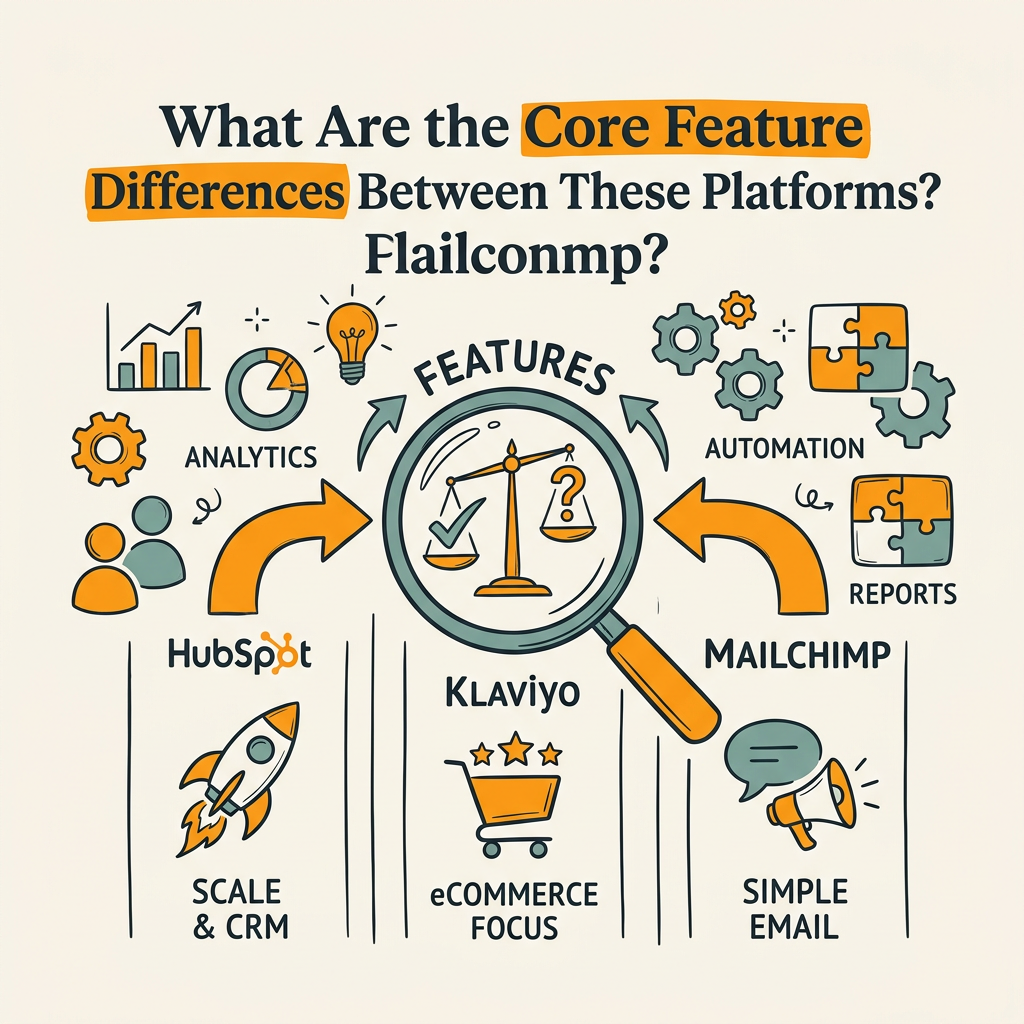
Beyond pricing, each platform was built for a specific use case. Mailchimp handles general-purpose email and basic marketing, Klaviyo specializes in ecommerce lifecycle automation, and HubSpot offers the deepest CRM and sales integration. Understanding what each was optimized for explains why companies often end up needing more than one platform.
CRM and Sales Pipeline Management
HubSpot is the clear winner in CRM capabilities. It includes detailed contact profiles, company-based targeting, deal pipelines, and sales forecasting—all of which are foundational to B2B sales operations. You can track deal stage, set follow-up reminders, and attribute revenue back to specific campaigns. Klaviyo and Mailchimp lack deal pipelines entirely, making them unsuitable for teams running a sales-driven GTM motion.
"The moment a B2B company hires its first sales rep, Mailchimp becomes a liability. Without deal pipelines and revenue attribution, your sales team will abandon the platform within 30 days." — B2B GTM Operations, 2026
For B2B SaaS and professional services companies, HubSpot's CRM depth justifies the higher cost. For ecommerce and DTC brands, this feature is rarely worth paying for separately.
Ecommerce-First Automation
Klaviyo dominates in event-driven, behavior-based segmentation. The platform retains event-level data indefinitely, meaning you can segment based on browse history, cart abandonment, product views, and post-purchase behavior months after the action occurred. Mailchimp and HubSpot support cart recovery and basic ecommerce flows, but neither offers the same granular behavioral memory.
This explains why over 50,000 brands have switched to Klaviyo from Mailchimp or Salesforce, with reported 48x ROI after consolidation (2026, Klaviyo). For DTC brands, Klaviyo's behavioral automation translates directly to revenue.
Multichannel Capabilities
All three platforms now support email and SMS. HubSpot extends furthest with integrations to 1,600+ apps and deeper social media, ads, and content management tools embedded in the platform. Mailchimp offers email, SMS, social advertising, and landing pages. Klaviyo focuses narrowly on email and SMS but executes both with ecommerce-specific features.
If you need a unified inbox, landing page builder, and ad platform under one roof, HubSpot's breadth is unmatched. If you want simplicity and ecommerce precision, Klaviyo's focus wins.
Which Platform Wins for Different Business Models?

The "best" platform depends entirely on your business model, team size, and revenue stage. No single winner exists across all use cases. This is why detailed feature comparisons across use cases are essential before deciding.
For B2B SaaS and Professional Services
HubSpot wins decisively for B2B teams. The integrated CRM, sales pipeline, and deal tracking are non-negotiable for managing a sales-led motion. Email automation is secondary to pipeline management. HubSpot's cost is justified by eliminating the need to integrate separate CRM and email platforms.
The tradeoff: HubSpot's pricing is aggressive, starting at $890/month for meaningful automation capabilities. But for B2B companies with sales cycles and deal stages, the alternative—managing Salesforce + Klaviyo + separate email tools—creates more complexity.
For Ecommerce and DTC Brands
Klaviyo is the clear winner for ecommerce. Event-driven segmentation, shop-specific integrations (especially Shopify), and revenue-focused reporting are built into the product. Every ecommerce-specific automation template (browse abandonment, cart recovery, post-purchase, winback) is optimized in Klaviyo in ways that Mailchimp and HubSpot simply can't match.
The cost premium ($1,300+/month at scale) is recoverable through higher conversion rates and customer lifetime value optimization. Klaviyo's own data shows this is why brands switch.
For Small Businesses, Freelancers, and Bootstrapped Startups
Mailchimp remains the best entry point. The free tier supports 500 contacts, pricing scales more gradually, and the learning curve is gentler. Mailchimp's email template designs are also considered more visually appealing than HubSpot's out-of-the-box templates.
The constraint: if you grow beyond 10,000 contacts or need complex automation, Mailchimp's automation depth becomes limiting. Plan to either stay with Mailchimp indefinitely or migrate to Klaviyo (if ecommerce) or HubSpot (if B2B sales operations) within 12–24 months.
How Do Implementation and Learning Curves Compare?
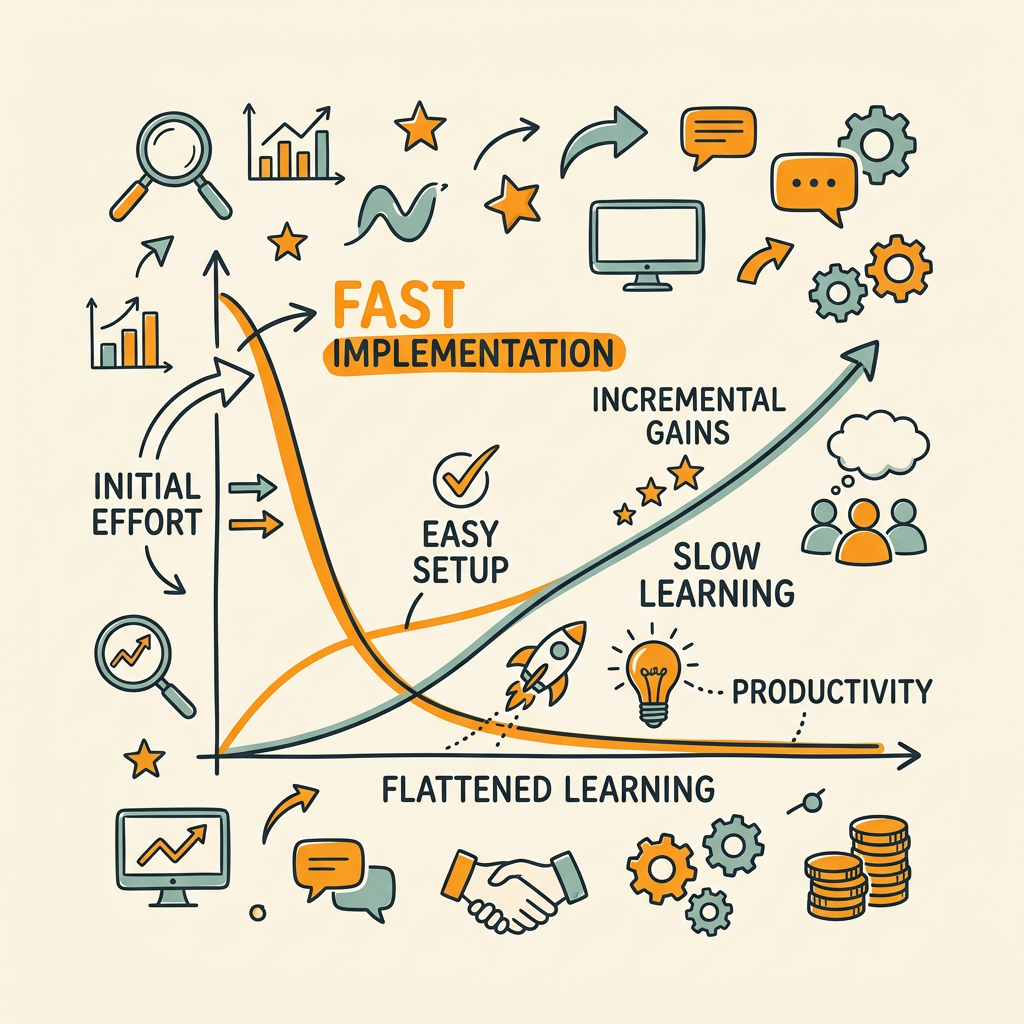
Time to productivity matters for busy founders. Mailchimp is fastest to learn and execute, with straightforward campaign creation and basic segmentation taking minutes. HubSpot has a steeper learning curve due to broader functionality, but HubSpot's interface is modern and clean, making navigation intuitive once you understand the organizational structure.
Setup Friction and Integration Complexity
All three platforms integrate with major ecommerce and CRM tools via Zapier and direct connectors. However, Klaviyo has the deepest native integrations for Shopify, WooCommerce, and BigCommerce. HubSpot requires more custom setup if you're connecting complex sales operations and lead scoring workflows. Mailchimp is the simplest to set up but offers fewer native integrations for advanced use cases.
"Implementation speed matters when your marketing calendar is already behind. Mailchimp launches campaigns in hours; HubSpot requires weeks of CRM configuration before your first automated workflow runs." — Implementation Benchmarks, 2026
For teams that want their email platform operational within days, Mailchimp and Klaviyo both move faster than HubSpot. HubSpot's setup typically requires a 2–4 week implementation to get CRM, automation, and reporting fully connected.
Support and Documentation Quality
HubSpot offers 24/7 chat support on paid plans, extensive Academy courses, and premium onboarding. Klaviyo has strong community resources and email support but fewer official training programs. Mailchimp offers email and chat support, though response times vary by plan tier.
If your team needs hands-on onboarding and training, HubSpot's investment in support education is an advantage worth the higher cost. For self-directed teams, all three have sufficient documentation.
Market Adoption and Competitive Positioning
Mailchimp dominates by volume with 44.3% of detected email marketing platform share, followed by Klaviyo at 17.2% (2026, Wmtips). Yet market share doesn't indicate best-fit—it reflects Mailchimp's historical dominance and low barrier to entry. Among ecommerce brands and high-growth companies, Klaviyo's adoption is accelerating faster.
Why Brands Switch Between Platforms
The primary reasons companies migrate away from these platforms reveal their limitations:
- From Mailchimp to Klaviyo: Ecommerce brands outgrow Mailchimp's automation and segment depth as lists exceed 15,000 contacts. Klaviyo's behavior-based logic and revenue reporting are compelling enough to justify migration costs.
- From Mailchimp to HubSpot: B2B companies adding sales teams need CRM and pipeline management Mailchimp can't provide. The integration burden drives consolidation.
- From Klaviyo to HubSpot: Companies managing both sales and ecommerce might consolidate onto HubSpot to reduce platform count, accepting ecommerce automation trade-offs for operational simplicity.
Few companies stay on one platform forever. Growth typically drives the need to either specialize deeper (Klaviyo) or broaden (HubSpot).
Building Your Content Strategy While Scaling Your Email Operation
Choosing an email platform is just the first decision. Once you've selected HubSpot, Klaviyo, or Mailchimp, your next challenge is creating the content that actually engages subscribers. Most teams underestimate the effort required to maintain consistent, high-quality email content alongside organic growth initiatives.
A scalable content strategy compounds your platform investment. Whether you're building a blog to feed your email list or creating segmented content for different buyer personas, the work is never-ending without automation.
This is where autonomous content systems become critical. Jottler automates the entire research-to-publish pipeline for SEO content, meaning you can feed your email platform with a consistent stream of high-converting content without hiring a full content team. The platform researches keywords, writes 3,000+ word articles, fact-checks claims, and publishes directly to your CMS—all while building internal link networks that compound organic traffic.
For busy founders running HubSpot, Klaviyo, or Mailchimp, the real competitive advantage isn't the email platform itself—it's the content machine feeding it. Every email campaign is only as effective as the landing pages and resources you link to. Jottler handles the content production so you can focus on segmentation, automation, and revenue.
Conclusion
HubSpot wins for B2B SaaS teams needing deep CRM integration. Klaviyo wins for ecommerce brands optimizing customer lifetime value through behavioral automation. Mailchimp wins for cost-conscious, early-stage founders who need email and basic marketing without enterprise overhead.
The decision framework is straightforward: if you have a sales team, choose HubSpot. If you sell online, choose Klaviyo. If you're bootstrapped or testing, choose Mailchimp. Your choice will drive $600–$1,500 monthly in platform costs and months of implementation work, so get it right the first time.
Beyond platform selection, your competitive edge depends on content quality and consistency. Building a sustainable email program requires a constant stream of valuable content—blog posts, segmented resources, and conversion-focused landing pages. Rather than hiring a full content team to maintain this, start your SEO agent today at https://jottler.co/auth/signup to automate content production and compound your email marketing ROI.
FAQs
Is Klaviyo better than HubSpot?
Not universally. Klaviyo is better for ecommerce brands because it specializes in event-driven segmentation, cart recovery, and revenue-focused reporting. HubSpot is better for B2B teams because it includes CRM, deal pipelines, and sales workflow management that Klaviyo lacks. The "better" platform depends on your business model. B2B SaaS teams will find HubSpot's broader capabilities more valuable; DTC and ecommerce brands will find Klaviyo's precision automation delivers higher ROI.
Which is cheaper at scale: Mailchimp or Klaviyo?
Mailchimp is significantly cheaper at 100,000+ contacts. Mailchimp costs around $700–$800 per month for 100,000 contacts, while Klaviyo costs $1,380–$1,440. The gap widens as your list grows. However, Klaviyo's superior automation and ecommerce-specific features often generate enough additional revenue to offset the cost premium for online brands. Mailchimp is the clear winner if budget is your only constraint.
Can I migrate from Mailchimp to HubSpot or Klaviyo without losing data?
Yes, but migrations require planning. All three platforms support CSV exports and contact list imports. Your historical email data, segment definitions, and campaign performance won't transfer automatically—you'll need to export from Mailchimp and manually recreate workflows in your new platform. This typically takes 1–4 weeks depending on workflow complexity. Many companies hire implementation consultants to manage the transition, which adds cost but reduces downtime.