Implementing Marketing Automation Without Losing Human Touch
71% of customers expect personalized experiences, yet 76% become frustrated when automation feels impersonal. This paradox defines modern marketing: businesses need scale, but customers demand connection. The fear is real. Launch a marketing automation platform and many teams watch engagement drop as sequences become robotic, one-size-fits-all, and visibly machine-generated. The solution isn't less automation—it's smarter automation paired with deliberate human intervention at moments that matter most. Here's what actually works: using AI to handle volume and routine interactions while keeping humans in the loop for trust-building, emotional, and high-stakes customer moments.
Key Takeaways
- 77% of marketers use automation tools to create personalized content, but customers increasingly crave authenticity over perfection. (2026, Amraandelma)
- Automation users report $5.44 return for every $1 spent, but ROI depends on segmentation depth and human oversight, not volume alone.
- Companies that route complex or emotional interactions to humans while automating routine tasks achieve 63% higher customer lifetime value.
- Segment interactions by complexity: Automate routine FAQs and confirmations; handle objections and upsells with humans or AI-assisted humans.
- Make personalization real, not fake: Use behavioral data and preferences to tailor content, but disclose AI use and maintain authentic brand voice.
- Build escalation paths: Allow customers to quickly reach a human when automation falls short—speed of handoff builds trust.
- Measure beyond efficiency: Track customer satisfaction, NPS, and forgiveness after failure—not just cost savings and speed.
- Choose the right automation platform: Platforms with natural language processing, dynamic content rules, and CRM integration enable personalization without losing control.
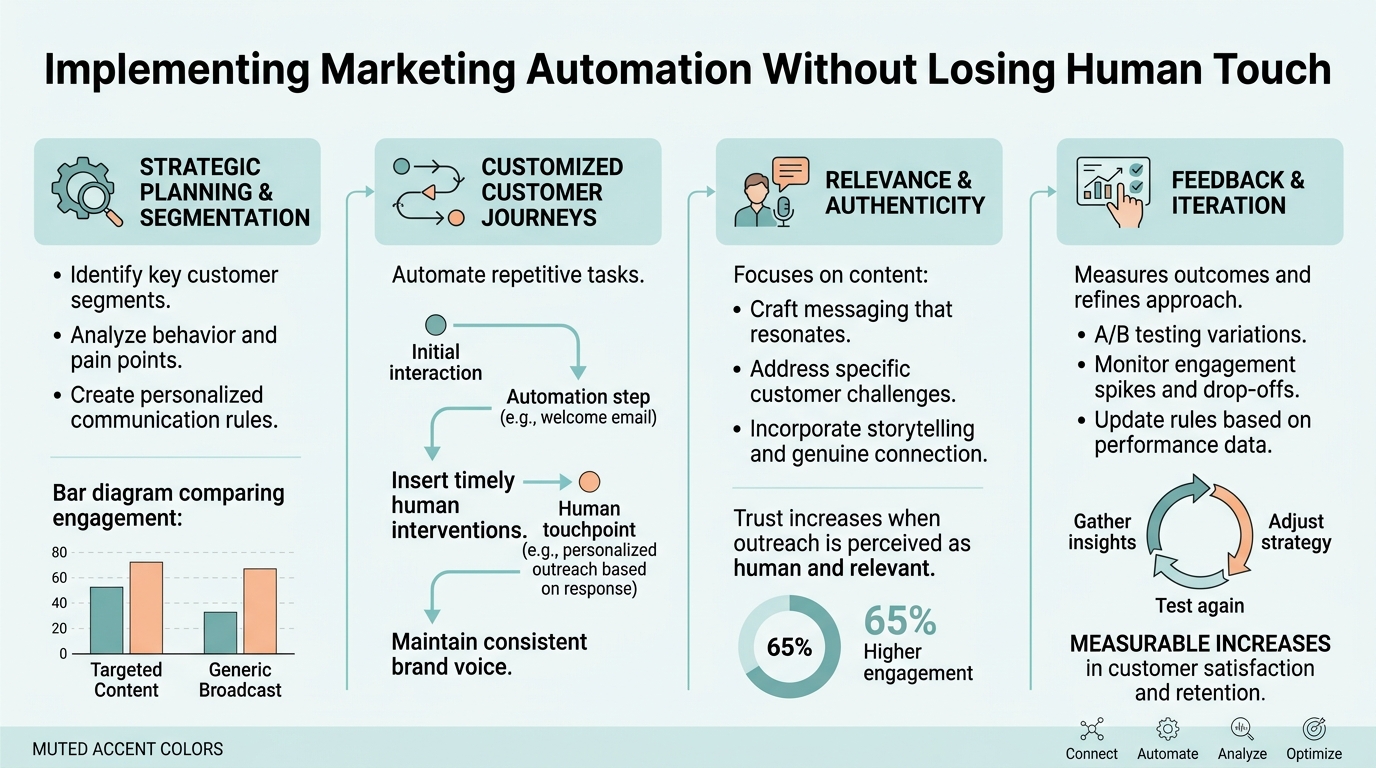
How Marketing Automation Creates (and Kills) Customer Relationships
Automation scales your reach, but scale without strategy destroys relationships. 68% of marketing leaders increased automation budgets in 2025, yet many teams report lower engagement after implementation. The culprit? They automate everything—including moments when customers expect a human touch. The fix is straightforward: use automation to free your team to be more human, not less. Automation handles the noise. Your team handles the signal.
"Automation isn't about replacing humans—it's about freeing them to do what machines can't: build trust, show empathy, and make strategic decisions. The teams winning right now use automation to handle volume so their people can focus on relationships."
— Marketing Operations Leader, B2B SaaS
Why Customers Resent Robotic Marketing
Personalization has become table stakes. 61% of consumers are more likely to buy from companies offering personalized experiences. But here's the catch: 80% of consumers can spot inauthentic, generic messaging instantly—and they resent it. When a customer receives the fifth identical email in a week, they don't feel special. They feel automated. The problem compounds when teams treat personalization as a checkbox (use their name, mention past purchase) rather than a genuine effort to solve their problem. Personalization without authenticity reads as manipulation.
Customers also expect escalation rights. 65% of customers prefer to interact with human support agents when an issue is complex, sensitive, or urgent. A chatbot that loops back with canned responses breaks trust. But a bot that immediately routes complex issues to a human while handling simple FAQs? That feels smart, not lazy. Research on customer experience and AI shows that this tiered approach significantly improves satisfaction metrics.
The ROI Paradox: Efficiency Doesn't Equal Revenue
Automation software vendors emphasize cost savings: automation saves 6+ hours per week per marketer and improves campaign execution speed by 30–50%. Real wins. But here's what gets lost: 77% of marketers use automation tools to create personalized content, yet only 41% of organizations have fully automated their customer journeys. The gap matters. Partial automation, where teams still intervene on high-value accounts or at critical moments, outperforms full-auto systems.
Why? Because high-value customers don't want to be treated like volume. A prospect worth $100K over their lifetime deserves a phone call from your VP of Sales, not an automated drip campaign. Companies using AI-driven personalization saw 63% higher customer lifetime value partly because they used automation to handle tier-one interactions and freed humans to focus on relationships that actually moved revenue. According to Salesforce's 2026 marketing statistics, businesses achieving this balance report 23.4% conversion rates versus 9.1% for companies with no automation strategy.
"The biggest mistake we made was treating automation as a replacement for relationships. Once we flipped that—using automation to handle routine work so our team could focus on high-touch accounts—our churn dropped 28% and expansion revenue doubled."
— VP of Customer Success, Mid-Market B2B
The Architecture: Segmenting Automation by Interaction Tier
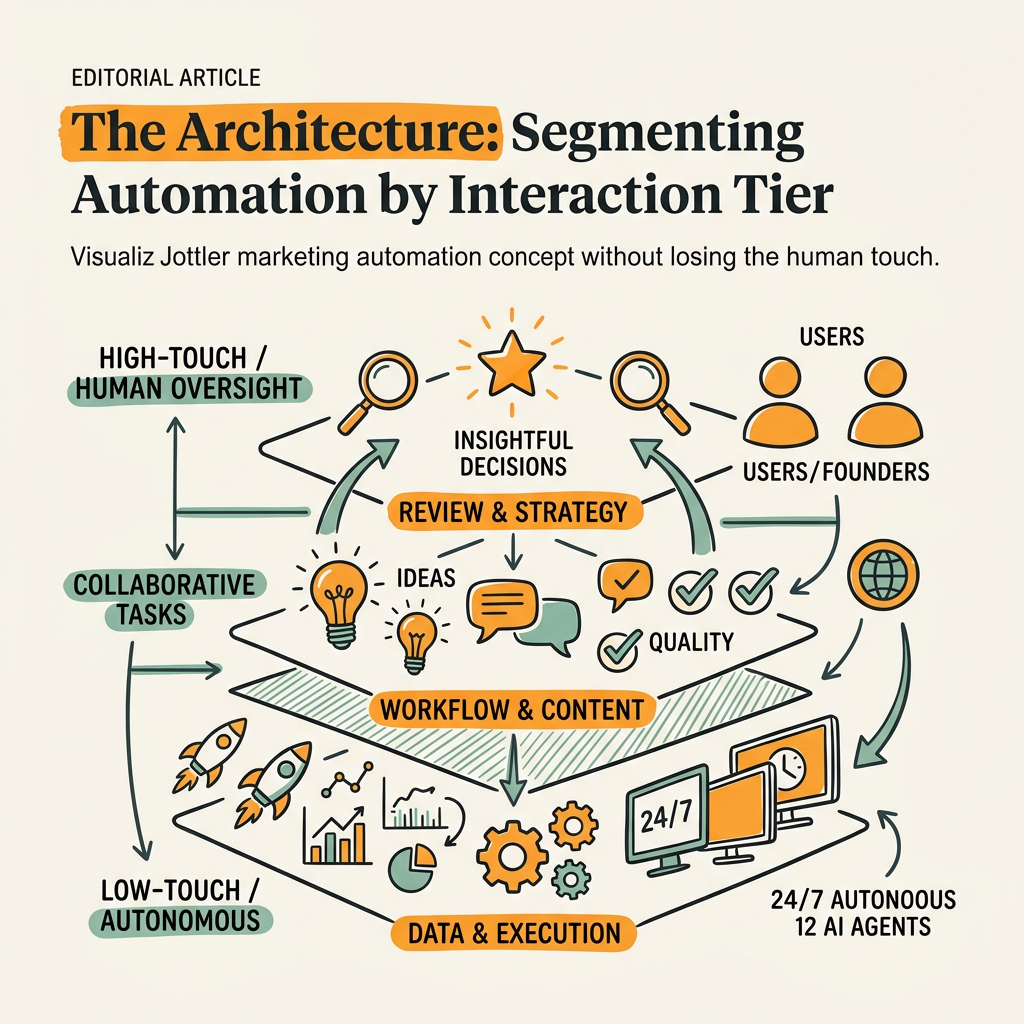
The best performing teams use a three-tier model. Automation is not a binary choice. Think of it as an escalation ladder where the tier changes based on complexity, value, and emotional stakes. The secret is that your automation system needs to be smart enough to route correctly—and your team needs to design the rules. Most platforms allow this. Most teams don't set it up.
Tier 1: AI-First for Routine Volume
Automate everything that doesn't require judgment. Welcome emails, order confirmations, abandoned cart reminders, FAQ responses, re-engagement campaigns, and behavioral nudges belong here. Your automation platform should handle these with zero human oversight per message. The ROI is highest here: one person's time can service thousands of routine interactions. Let the system run.
Rules to lock in: Set clear triggers (user behavior, time-based, event-based). Test for tone and consistency before launching. Monitor for weird outputs—AI can produce strange results with edge-case data. Use templates, but inject small personalization details (name, past category interest, local timezone for send time) to avoid the "Dear Valued Customer" feel.
Tier 2: AI-Assisted Humans for Moderate Complexity
Here's where most teams go wrong: they apply full automation to interactions that benefit from human context. Inquiry responses, product recommendations for uncertain customers, discount negotiation, objection handling—these need a human in the loop, but AI can accelerate them. Your CRM or automation platform should suggest responses, pull in relevant data, and alert the right person. The human reviews, tweaks, and sends. This hybrid model combines automation's speed with human judgment.
Setup: Create CRM views or dashboards that surface "awaiting human response" cases. Set response time SLAs. Use AI to draft responses; humans edit and personalize. Measure: are responses being sent within 2–4 hours? Do follow-up rates meet benchmarks? Is customer satisfaction improving? This tier is where you'll see the biggest conversion and retention gains because it's fast and human.
Tier 3: Human-First for High-Emotion or High-Value Interactions
Some interactions should never be fully automated. Complaints, churn risk signals, negotiations, refund requests, and outreach to your largest accounts belong to your team. Automation can flag these and alert a human—don't let the system auto-respond. A customer unhappy enough to complain deserves a real person. A prospect considering your product over a competitor needs to talk to someone who actually knows the product. 73% of customers appreciate AI-driven efficiency, yet 64% still crave authentic human interaction during critical touchpoints. Honor that preference.
Setup: Create escalation triggers in your CRM or automation platform. Map "high-emotion" keywords (angry, disappointed, cancel, refund, competitor) to human team members. For high-value accounts, bypass automation entirely—route directly to account managers. Measure: response time (target: within 4 hours), resolution rate (first contact), and customer satisfaction. This tier drives loyalty.
Practical Tactics for Keeping Marketing Automation Feeling Human
Architecture matters, but execution matters more. Here are the techniques that prevent automation from feeling cold.
Use Behavioral Data, Not Just Demographic Data
Most teams segment by company size, industry, or job title. That's the floor. Actual personalization uses behavioral signals: pages visited, content consumed, time spent, search queries, past purchases, and support interactions. Behavioral segmentation lets you send the right message to the right person at the right time. The message changes based on what they actually care about, not who you think they are.
Example: Two prospects in the same company size. One visits pricing pages repeatedly (price-sensitive). One reads your case studies (validation-seeking). Send them different follow-ups. The first gets a discount or payment-plan angle. The second gets customer stories and proof points. Same automation platform, but the output feels tailored because it is.
Tools to enable this: Your CRM should track all behavioral events. Most major platforms (HubSpot, Salesforce, Pipedrive) integrate with website analytics or event tracking. Set up behavioral tags automatically when customers cross thresholds. Then build automation rules that trigger based on tags. Content marketing automation that respects behavioral signals produces higher engagement because it's less about flooding the inbox and more about timing and relevance.
Inject Brand Voice and Humor—Don't Sanitize Your Copy
Automated content often sounds sterile because marketers fear offending anyone, so they write for no one. The result is forgettable. The fix: maintain your brand voice in automated sequences. If your brand is playful, your automation can be playful. If it's formal and expert, stay formal. If it's straightforward and no-nonsense, be direct. Customers recognize authentic voice and trust it more than perfectly generic copy.
Authenticity is emerging as a real competitive advantage in 2026. Consumers increasingly value genuine, imperfect, and deeply human experiences over overly polished interactions. This doesn't mean your automation should be unprofessional. It means it should be recognizably yours—with personality, specificity, and occasional vulnerability. An apology for a shipping delay that acknowledges the inconvenience feels human. One that says "We sincerely regret any inconvenience" feels corporate.
Build a "Human Override" into Your Automation
Even with good segmentation, edge cases happen. A customer sends an email that doesn't match your automation triggers. A person who should get Tier 1 treatment says something that requires Tier 3 attention. Your system needs escape valves. Build in a rule: if a customer replies to an automated email, their next message skips automation and goes to a human. Simple. Effective. And critical for trust—customers feel heard because they actually are heard.
Another approach: monitor for sentiment. Modern CRM systems can detect negative sentiment in replies. When detected, flag for a human. Or set a threshold: if a customer has contacted you 3+ times in a week, the next interaction gets a human. These overrides prevent customers from falling through cracks in your system.
Choosing Automation Tools That Support, Not Replace, Human Connection
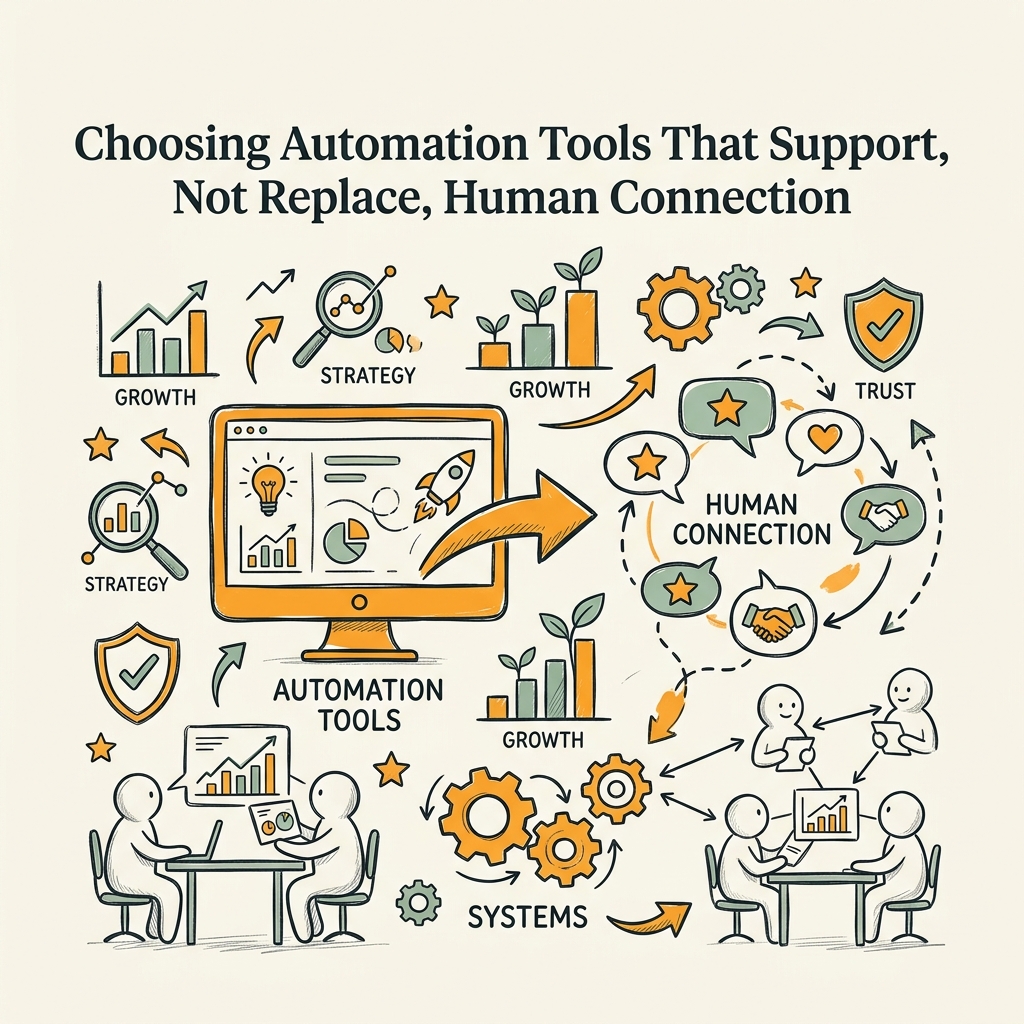
Not all automation platforms are equal. Some force you into full-auto flows. Others give you levers for human oversight. SEO automation tools differ wildly in this respect. When evaluating an automation platform, ask: Does it support partial automation? Can I set up dynamic content rules based on behavior? Does it integrate deeply with my CRM? Can I easily route interactions to humans? Does it support A/B testing for personalization?
Essential Features for Human-Centric Automation
- Behavioral segmentation: Track and segment customers based on what they do, not just who they are. Build rules that change messaging based on real-time behavior.
- Dynamic content: Content blocks that change based on segment, behavior, or custom fields. Different versions of the same email for different audiences—all in one campaign.
- Deep CRM integration: Automation and CRM should talk freely. Lead scoring, interaction history, and context should flow both directions. No manual updating.
- Escalation workflows: Built-in logic to route complex cases to humans automatically. One-click handoff from automation to your team.
- Natural language processing: Some platforms can detect intent and sentiment in customer replies and route accordingly. Use it.
- A/B testing for personalization: Test which messaging, tone, or angle resonates with each segment. Let data guide your personalization rules.
Jottler stands out here because it combines daily AI-driven research and writing with the ability to preserve your authentic voice. Rather than forcing you to choose between scale and quality, it lets you scale high-touch, personalized content without sacrificing the human judgment that builds trust. For busy founders and marketing teams, this means you get more frequent, more relevant content—and your team stays involved in strategy and customer interaction rather than wrestling with content calendars.
When to Invest in Enterprise vs. Startup Tools
Your stage matters. Early-stage teams (under 10 people) should pick a platform that's simple enough to configure without a specialist. HubSpot's free tier covers basic automation. Klaviyo dominates for ecommerce. ActiveCampaign works well for B2B with decent behavioral features. Later-stage teams (20–100+ people) benefit from platforms with more customization: Salesforce, Marketo, or Iterable if your needs are sophisticated. But honest caveat: fancier platforms don't automatically produce better relationships. 41% of marketing teams have significantly automated customer journeys—meaning 59% haven't. Most teams fail not because their tools are weak, but because they haven't designed thoughtful interaction tiers or segmentation strategies. Tools enable execution. Strategy enables results.
| Feature | Critical for Human Touch? | Jottler Advantage |
|---|---|---|
| Behavioral segmentation | Yes | Daily research and content creation preserve team's ability to focus on strategy; AI handles volume |
| Dynamic content rendering | Yes | Integrates with your CMS/automation platform; content auto-tags for personalization without manual effort |
| CRM integration depth | Yes | Publishes directly to CMS and feeds content into your email/marketing automation workflows |
| Human escalation workflows | Yes | Frees your team from content creation overhead to handle high-touch customer interactions |
| Natural language processing | Recommended | AI fact-checks and verifies content quality, reducing human QA burden |
| Brand voice preservation | Critical | You control tone, messaging, and strategy; AI executes at scale while maintaining authenticity |
Measuring Success: Move Beyond Efficiency Metrics
Most teams measure automation by cost savings and speed. Hours saved per week. Faster response times. These matter, but they miss the point. Automation users report 77% higher conversion rates through lead nurturing, but only when automation is paired with smart segmentation and human oversight. Pure efficiency doesn't drive revenue. Relevance does.
Metrics That Actually Predict Revenue Growth
Track these alongside your efficiency numbers:
- Customer satisfaction (CSAT) by interaction tier: Tier 3 (human-first) should score highest. If it doesn't, something's wrong with your human team or their tools. Measure separately.
- Net Promoter Score (NPS) by automation intensity: Customers who've only interacted with Tier 1 automation should have lower NPS than those who've had human touchpoints. If not, your automation is working too well—and you're missing relationship-building opportunities.
- Customer effort score (CES) for resolution: Did the customer get what they needed without friction? Track this per interaction type. Automation should reduce effort. If it increases it, your escalation logic is broken.
- Churn rate by customer segment: High-value accounts should have lower churn if you're investing Tier 3 resources. If they're churning despite human attention, automation isn't your problem—relationship strategy is.
- Repeat purchase rate or expansion revenue: Customers who've had positive interactions with your team (not just automation) should have higher LTV. Measure this explicitly.
Setting Up a Feedback Loop
Automation and relationships are feedback systems. Your team should review every high-impact interaction: lost deals, churned customers, and your biggest fans. Ask: Did automation help or hurt? Where should we have escalated sooner? Where did a human intervention lock in the deal? Use these insights to refine your automation rules, not to blame the system or the people. Consistent content marketing frameworks rest on feedback loops like this—not just one-way broadcast.
Common Mistakes That Kill the Human Touch (And How to Avoid Them)
Most teams stumble on the same pitfalls. Recognize them.
Mistake 1: Automating Everything
Full automation feels efficient until your churn spikes and your team wonders why. Some interactions need humans. Don't automate your way out of customer relationships. Your segmentation strategy should explicitly reserve high-value and high-emotion interactions for people, not bots. If you don't have humans available, hire or reallocate—don't let automation substitute for care.
Mistake 2: Forgetting That Personalization Requires Maintenance
Behavioral data decays. Customer preferences change. Segments that worked last quarter might not work this quarter. Your automation isn't "set and forget." Audit it quarterly. Are your segmentation rules still predictive? Do your message variants still resonate? Are response rates dropping? If yes, refresh your strategy. Personalization is a living system.
Mistake 3: Not Training Your Team on the Platform
Your automation platform is only as good as your team's ability to use it. Many teams set up basic drip campaigns and call it done. They leave money on the table because they never learned dynamic content, behavioral triggers, or A/B testing. Invest in training. Read the platform's best practices guides. Join user communities. The ROI is usually 3–5x what you'd get from a faster tool with no training.
Mistake 4: Hiding Behind Automation
Some teams use automation as cover for poor products or services. Automation can't fix a broken onboarding or product. If customers are churning, automation didn't cause it—something else did. Address the root cause before blaming automation. Use automation as a tool to optimize what's working, not to patch what's broken.
Conclusion
Marketing automation isn't a choice between scale and relationships anymore. It's a choice between doing both poorly or doing both well. Organizations using AI-powered personalization achieve 63% higher customer lifetime value, but only because they automate volume and route complexity to humans. The teams that win use automation to free their people to be more human—to spend time on strategy, relationships, and moments that actually matter. Automation can save you 30–50% in execution time. Use that time to call a customer who's on the fence. Review a lost deal. Craft a personalized outreach to your biggest prospects. Attend to relationships instead of drowning in busy work. That's the real win.
Start by auditing your current automation. Where are you automating things that should have human eyes? Where are you wasting human time on stuff machines could handle? Build your three-tier interaction model. Configure your platform to support it. Train your team. Then measure by relationships and revenue, not just efficiency. You'll find that when automation amplifies human judgment instead of replacing it, everything improves—speed, relevance, trust, and growth. Start your SEO agent to see how automated content creation can free your team to focus on high-touch customer interactions while scaling your content footprint.
FAQs
How do you balance marketing automation with personalization?
Balance comes from segmenting your customers by interaction complexity and value. Use automation to handle routine, low-complexity interactions—welcome emails, order confirmations, abandoned cart reminders—where scale matters and personalization needs are simple. For moderate complexity interactions like objection handling or product guidance, use AI to draft responses but have humans review and customize them. For high-value or emotionally sensitive interactions, bypass automation entirely and have your team take the lead. This three-tier model lets you scale efficiently without sacrificing the authenticity that builds trust. The key is using behavioral data to segment intelligently. When customers see you've tailored your approach to their actual behavior and preferences, automation feels personal, not generic.
What automation tasks should you never automate?
Never fully automate responses to complaints, churn signals, or requests from high-value accounts. These interactions carry emotional weight or revenue significance that demands human judgment and genuine empathy. A customer frustrated enough to complain deserves a real person who can understand context and offer solutions, not a canned response. Similarly, objection handling during complex sales processes should involve a human (though AI can prepare context and suggested talking points). Support escalations, refund requests, and relationship-building outreach for your largest accounts belong exclusively to your team. When customers feel they're being treated like a ticket number rather than a priority, they leave. Automation excels at volume; reserve human effort for moments where relationships get made or broken.
How do you measure the success of marketing automation on customer relationships?
Track customer satisfaction, NPS, and customer lifetime value separately by interaction tier. Customers who've had human touchpoints should score higher on relationship metrics than those who've only interacted with automated sequences. Also measure customer effort score—is automation reducing friction, or creating it? Monitor churn rate by segment, especially for high-value accounts; if you're automating away from your biggest customers, that's a problem. Finally, audit the interactions that drive revenue: lost deals, expansions, and customer wins. Ask your team: where did automation help, and where should we have escalated faster? Use these insights to refine your automation rules quarterly. If your efficiency metrics are up but your relationship metrics are down, automation is harming your business, not helping it. Recalibrate toward humans and customer outcomes.