Keyword Gap Analysis: Find Competitor SEO Opportunities
Your competitors are ranking for keywords you don't even know exist. 40–60% of top-ranking competitor pages contain keywords the average site does not rank for, according to Semrush's Content Gap Report 2025. While you're optimizing for the same ten keywords everyone else targets, your competitors are quietly capturing traffic from higher-intent keywords you've completely overlooked. This leak in your keyword strategy doesn't just cost you traffic—it costs you revenue.
Keyword gap analysis is the systematic process of comparing your website's keyword rankings against competitors' and identifying the high-value keywords they rank for that you don't. It's not just about finding missing keywords; it's about finding the missing revenue in your content strategy. Sites that systematically close keyword gaps see an average 18–22% increase in organic traffic within 6 months (Moz, 2025).
Key Takeaways
- 40–60% of competitor keywords are opportunities you're leaving on the table (Semrush, 2025)
- High-intent gap keywords drive 5–10% conversion lift once captured
- AI-driven gap analysis reduces research time by 70% compared to manual methods (2026)
- Keyword Gap Definition and Impact: Comparing your rankings against competitors reveals 40–60% untapped keyword opportunities that can drive 18–22% traffic growth in 6 months.
- Competitor Selection Strategy: Choose 3–5 true competitors based on audience overlap and traffic profile, not just top search results.
- High-Intent Gap Prioritization: 25% of gap keywords carry high commercial intent; prioritizing these first maximizes revenue impact.
- SERP Feature Gaps: 30% of identified gaps have untapped potential for Featured Snippets and People Also Ask positioning.
- Automated Gap Analysis: AI tools reduce manual research time from days to hours while identifying 30% more systematic gaps.
- Page-Level vs. Domain-Level Analysis: Modern gap analysis shifts from broad domain comparisons to specific competitor page comparisons for granular insights.
What Is a Keyword Gap and Why It Matters for SEO Growth
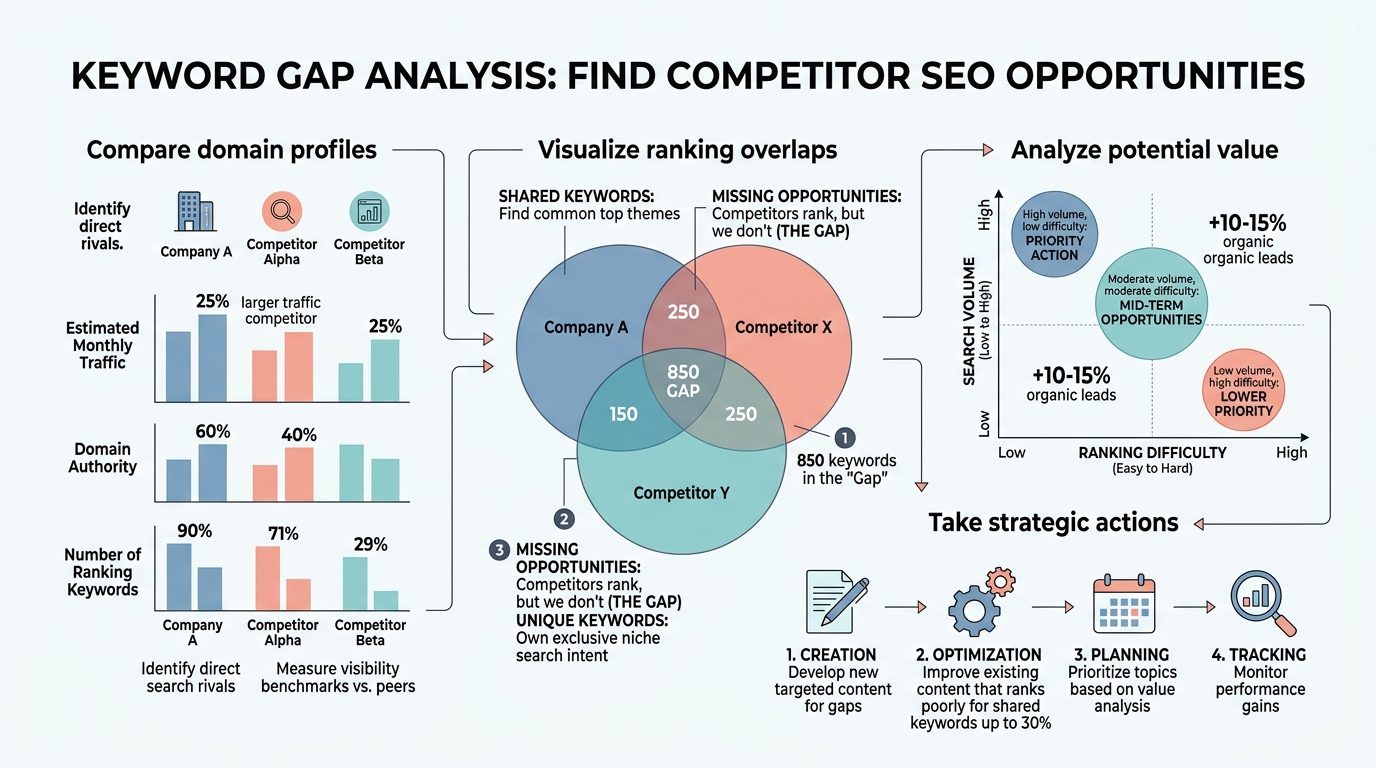
A keyword gap is any keyword your competitors rank for that you don't. But this definition undersells the real impact. The gap isn't just a missing keyword—it's a missing customer conversation. When a prospect searches for a high-intent phrase your competitor ranks for and you don't appear, that traffic, lead, and potential customer goes to them by default.
25% of identified gap keywords are classified as "High Commercial Intent," meaning they carry buyer intent signals like "buy," "pricing," or "reviews" (Ahrefs, 2025). These aren't just any keywords; they're the ones that convert. Closing gaps in these keywords alone can drive a 5–10% increase in conversion rate from newly targeted high-intent keywords (BrightEdge, 2025).
"When you close gaps in your competitors' 'Top 10' keywords, your visibility across the entire search landscape improves. Teams that systematically close high-intent gaps report a 15% increase in Share of Voice within 90 days compared to competitors." — BrightEdge, 2025
The second reason keyword gaps matter: Share of Voice. Your overall visibility across the search landscape improves dramatically when you close gaps in competitors' highest-traffic keywords. Teams that systematically address high-intent gaps report a 15% increase in Share of Voice within 90 days compared to competitors (BrightEdge, 2025).
The Difference Between Keyword Gap and Content Gap
Keyword gap analysis and content gap analysis are often confused because they overlap, but they answer different questions. A keyword gap analysis identifies specific search terms your competitors rank for that you don't. A content gap analysis is broader: it finds topics your competitors have covered in any format (blog, guide, pillar page, video) that you haven't addressed.
In practice, most high-performing SEO teams run both. A keyword gap analysis tells you what words to target. A content gap analysis tells you what topics your audience needs but you're not addressing. The two work in tandem. You might discover via keyword gap analysis that competitors rank for "best CRM for small business." Your content gap analysis then reveals they've published a comprehensive buyer's guide on that topic—which is why they rank.
Why Competitors' Keyword Gaps Represent Your Biggest Opportunity
The keywords competitors rank for are proven winners. Google has already validated that these keywords have real search volume and user intent. By analyzing competitor gaps, you're not guessing which keywords to target—you're identifying keywords already proven to drive traffic in your niche.
"Instead of running keyword research tools and hoping you pick keywords that matter, you're looking at your competitors' actual, live rankings and asking: 'Which of these keywords can we capture?' It's a data-driven shortcut to finding high-value opportunities." — Competitive SEO Best Practices, 2025
This removes the guesswork from keyword research. You're looking at your competitors' actual, live rankings and identifying which keywords you can realistically capture. It's a data-driven shortcut to finding high-value opportunities rather than hoping your keyword research guesses are correct.
How to Choose the Right Competitors for Gap Analysis
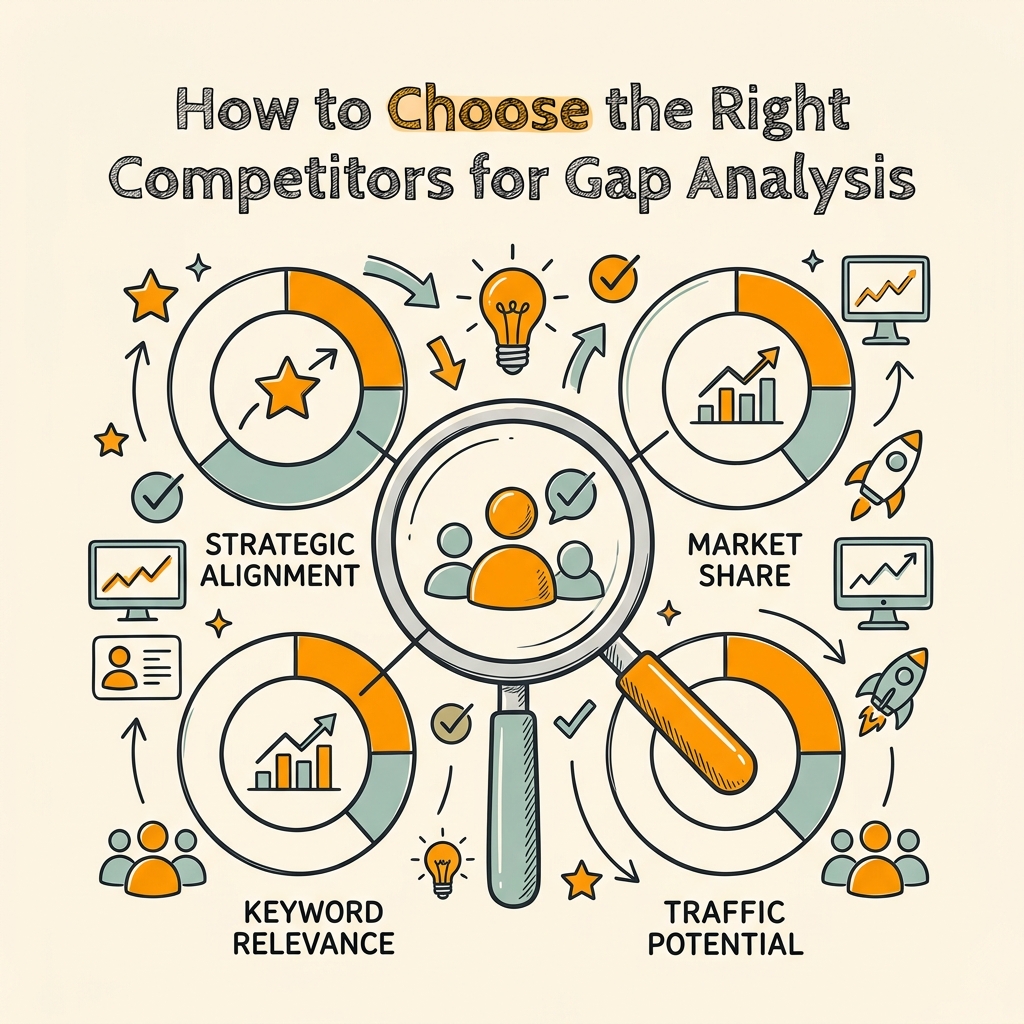
Not all competitors are equal for gap analysis purposes. The biggest mistake teams make is comparing themselves to the top Google result. Those mega-sites ranking for everything aren't your real competition—they're too far ahead. Instead, you need to analyze the competitors your actual customers see as alternatives.
Start by asking: Which brands do customers actually choose between when evaluating solutions? Then layer in data. Use tools like Similarweb's keyword gap analyzer or Semrush to identify sites with similar traffic profiles and keyword overlap. You want 3–5 competitors that are roughly in your league—not too far ahead, not too far behind.
Identifying True Competitors vs. Search Result Noise
When you search for your primary keyword, you'll see 10 results. Not all 10 are true competitors. Some are mega-sites (huge domain authority, rank for everything). Some are niche forums or Reddit threads. Your true competitors are the businesses that:
- Target the same audience: They sell to, or serve the same type of customer you do
- Compete for the same traffic: They show up in your target keywords and capture searches you want
- Have comparable domain authority: They're within 10–20 points of your DA, not 80 points ahead
- Share keyword overlap: They rank for 20–50% of the keywords you rank for
These are the competitors worth analyzing. Their keyword gaps reveal opportunities at your level—keywords you can realistically capture with quality content.
Competitor Research as a Foundational Step
Before running gap analysis, spend 30 minutes on manual competitive research. Visit your top 5 organic search competitors. What are they writing about? What topics show up on their homepage, resource section, or blog? Read their about page. Look at their product suite. This qualitative research informs which gaps are actually worth pursuing for your business.
You might discover that a competitor ranks for "enterprise software reviews" but you're a solo-founder SaaS tool—that gap isn't worth closing because your ICP doesn't match. Gap analysis tools show you what keywords exist in the gap. Competitive research helps you decide which gaps are strategic for your business.
Running a Keyword Gap Analysis: The Step-by-Step Framework
A modern keyword gap analysis has evolved beyond simple keyword lists. Today's approach integrates commercial intent filtering, SERP feature analysis, and AI-driven clustering to surface actionable opportunities, not just raw data.
Step 1: Export Your Keywords and Competitor Keywords
Log into BrightEdge, Semrush, Ahrefs, or a similar platform. Pull your website's ranking keywords (at minimum, the top 1,000). Then pull each of your 3–5 competitors' top-ranking keywords (1,000–5,000 each).
The goal is simple: create a dataset where you can compare apples to apples. You want to know: Which keywords do they rank for that we don't? Most platforms automate this, but understanding what's happening under the hood matters. You're creating two keyword lists and identifying the set difference: Competitor Keywords MINUS Your Keywords = Gaps.
Step 2: Filter Gaps by Commercial Intent and Relevance
This is where most teams fail. They generate a list of 500 gap keywords and try to target all of them. That's not a strategy; that's noise. Instead, filter gaps by commercial intent first. Prioritize keywords that contain intent signals like "best," "pricing," "review," "buy," "comparison," "vs.," or "cost."
These commercial-intent keywords convert 3–5x higher than informational keywords in most B2B niches. By focusing on high-intent gaps, you're not just closing gaps—you're closing gaps that matter to revenue. Secondly, filter for relevance to your actual business. Does this keyword match your product or service? If you're a project management tool, "best CRM software" might be a gap, but it's not a relevant gap for your business.
Step 3: Analyze Page-Level Gaps, Not Just Domain-Level Gaps
Most gap analysis tools give you domain-level results: "Competitor X ranks for 5,000 keywords you don't." But that's too broad. The real insight comes from page-level analysis. Find your competitor's highest-traffic blog posts or resource pages. Compare those specific pages against your equivalent content.
For example, if a competitor has a blog post on "how to choose a CRM" that ranks for 50 keywords and drives 10,000 monthly visits, compare that specific post against your equivalent content. You'll often find 20–30 keyword gaps at the page level that didn't show up in domain-level analysis. This is where systematic content deficiencies become visible—missing subheadings, insufficient keyword coverage, or outdated information.
Step 4: Identify SERP Feature Gaps
In 2026, keyword ranking is only half the battle. The other half is SERP features: Featured Snippets, People Also Ask (PAA) boxes, video carousels, and knowledge panels. 30% of identified gap keywords have untapped potential for SERP features (PPCInfo, 2026), according to research on SERP feature distribution.
When you identify a gap keyword, ask: Does this keyword currently show a Featured Snippet in Google? If yes, your content needs to be optimized to capture that snippet (clear bullet lists, definitions, comparisons). Does it show a PAA box? Then structure your content to answer those follow-up questions directly.
This SERP feature layer is what separates competitive gap analysis from lazy gap analysis. You're not just ranking for the keyword—you're dominating the entire SERP real estate for that keyword.
Step 5: Prioritize by Opportunity Score
Not all gaps are created equal. Create an opportunity score for each gap keyword based on:
- Search Volume: How many people search for this monthly?
- Keyword Difficulty: How hard is it to rank? (Prioritize gaps with KD < 60 first)
- Commercial Intent: Does it have buyer intent signals?
- Business Relevance: Does it align with your product/ICP?
- Content Effort: How much new content is needed to rank? (Prefer quick wins first)
A gap keyword with high volume (5,000/mo), low difficulty (KD 35), strong commercial intent ("pricing"), and high relevance to your business is a tier-1 priority. A gap with 100 monthly searches, high difficulty (KD 75), and weak relevance is a tier-3 gap—worth revisiting in 6 months, but not urgent now.
Turning Gap Keywords into Content That Ranks
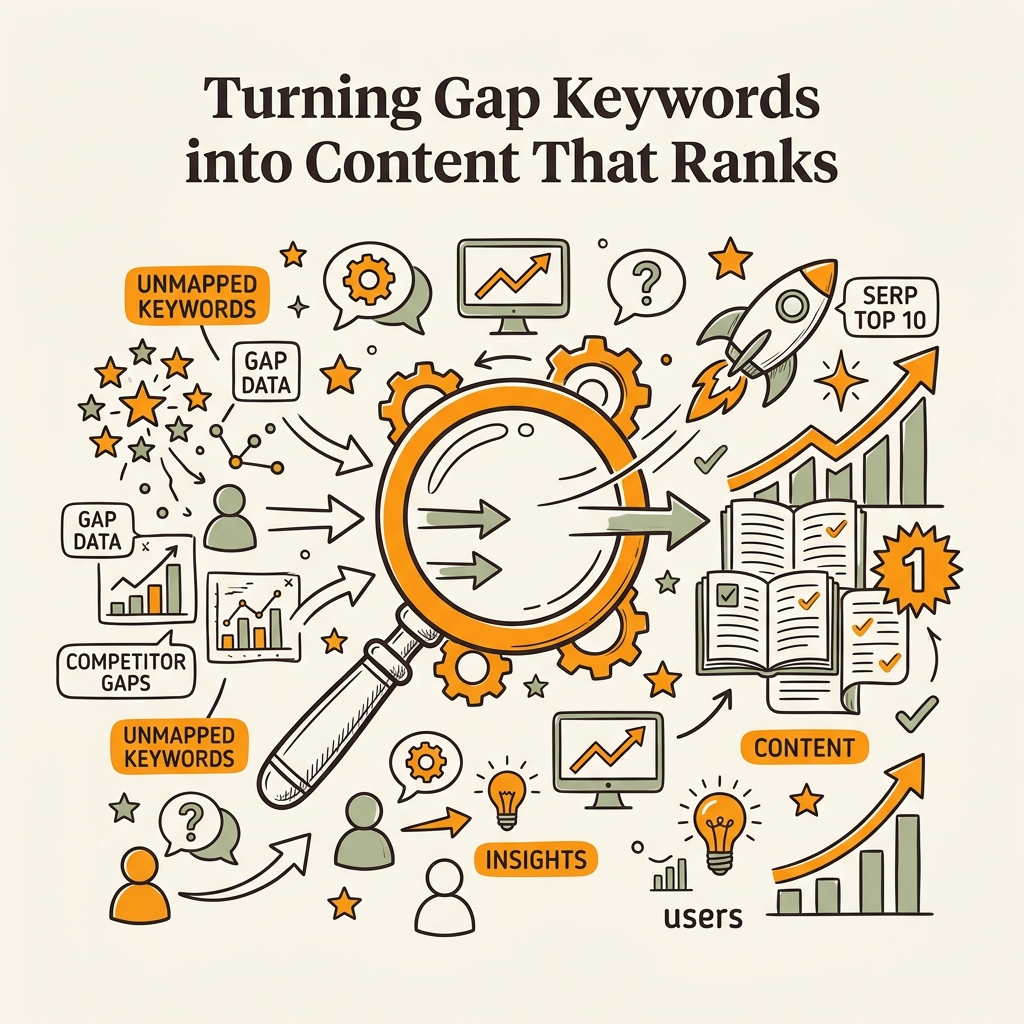
Identifying gaps is half the work. Converting those gaps into ranked, traffic-generating content is the other half. Most teams fail here because they treat gap keywords like traditional keywords. They're not.
Gap keywords are already proven to drive traffic for your competitors. That means the SERP is more competitive for these terms. You can't just write a "pretty good" article and expect to rank. You need to write something better than what's already ranking.
The Content Brief: From Gap Keyword to Article Plan
For each high-priority gap keyword, create a content brief. This brief should include:
- Primary Keyword: The gap keyword you're targeting
- Search Intent: Why is someone searching for this? (Problem-solving, comparison, buying)
- Content Format: What format does the SERP reward? (Long-form blog, guide, comparison table, video)
- Competitor Analysis: What are the top 3 ranking pages doing well? What are they missing?
- Target Audience: Who is searching for this, and what do they need?
- Content Angle: What unique angle or perspective can you bring?
This brief prevents you from writing generic content. Instead, you're writing content specifically designed to outrank competitors on a keyword where the bar is already high.
Leveraging AI and Automation for Gap-to-Content Workflow
Manually creating content briefs and writing articles for every gap keyword is slow. This is where AI-powered content automation becomes essential. Tools like Jottler eliminate the friction between identifying gaps and publishing content.
Instead of manually researching, writing, and optimizing articles for each gap, Jottler's AI agents automatically research gap keywords, create fact-checked content briefs, write long-form articles optimized for SERP features, and publish directly to your CMS. The platform handles keyword research, competitor analysis, and internal linking—the exact workflow you'd build manually but in hours instead of weeks.
For busy founders and marketing teams managing multiple content priorities, this automation compresses the gap-analysis-to-ranking timeline from months to weeks. You identify the gaps, connect your CMS, and the AI agents handle the rest.
Building Internal Links Between Gap Content and Existing Content
One of the highest-leverage tactics for gap content is strategic internal linking. When you publish a new article targeting a gap keyword, link to it from existing related articles. This passes authority from your established content to the new article, helping it rank faster.
Example: You identify a gap keyword "best project management tools for marketing." You publish a comprehensive article on that topic. Then you find 5–8 existing articles on related topics ("marketing tools," "workflow automation," "team collaboration software") and add contextual internal links to your new gap article. This link network accelerates ranking for the gap keyword.
Tools and Platforms for Keyword Gap Analysis
Modern gap analysis requires both traditional SEO tools and AI-enhanced platforms. Here's how they compare:
| Tool Category | Best For | Primary Metric | Automation Level | Best Suited For |
|---|---|---|---|---|
| Traditional (Ahrefs, SEMrush) | Domain-level gap discovery | Keyword volume & traffic | Manual analysis required | Enterprise teams, comprehensive audits |
| AI-Enhanced (Sight AI, Slate) | AI citation gaps + semantic gaps | AI assistant citations | Automated clustering & prioritization | AI SEO strategy, niche content |
| End-to-End (Jottler) | Gap identification to published articles | Live article generation & ranking | Fully automated research, writing, publishing | Busy founders, scaling content efficiently |
For most growing companies, a hybrid approach works best: use Ahrefs or Semrush for initial gap identification, then feed those gaps into an end-to-end platform like Jottler that automates the content creation and publishing workflow. This combination gives you the depth of traditional gap analysis with the speed of AI automation.
Common Keyword Gap Analysis Mistakes to Avoid
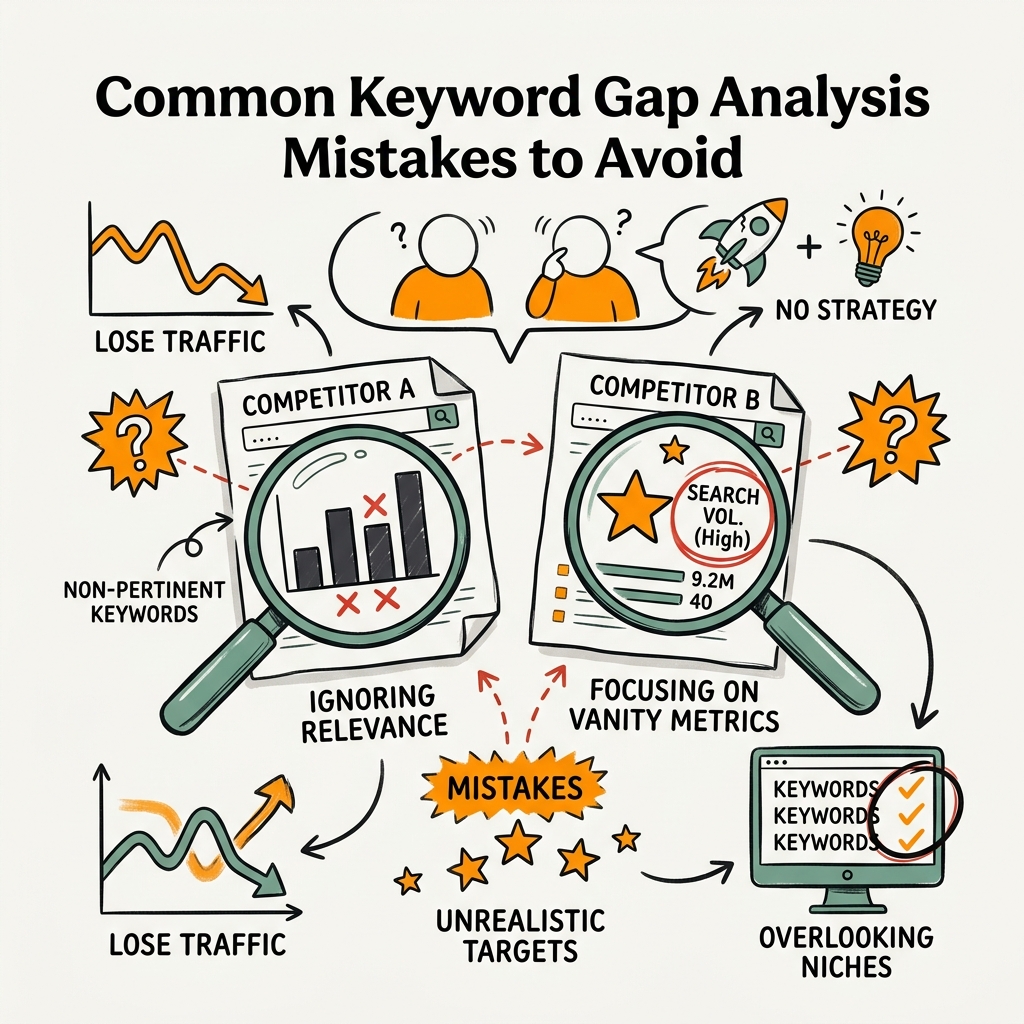
Even when teams understand gap analysis, execution failures often undermine results. Here are the most common mistakes:
Mistake 1: Chasing Low-Intent Gaps
Teams often get seduced by high-volume gaps. They see a competitor ranks for 1,000 informational keywords and they don't, so they start writing content for all 1,000. This is effort waste. 25% of gap keywords carry commercial intent, but those 25% drive 80% of the conversions. Focus on intent first, volume second.
Mistake 2: Ignoring Keyword Difficulty
A gap is only worth pursuing if you can realistically rank for it. If a gap keyword has keyword difficulty > 70 and you have domain authority 25, you're not ranking for it in 6 months. Prioritize gaps with lower difficulty (KD < 50) first. Once you've captured those and built authority, then tackle the harder gaps.
Mistake 3: Writing Generic Content for Gap Keywords
Gap keywords already have ranking content. Your competitors already rank. To outrank them, your content must be better—more comprehensive, better structured, more recent, or offering a unique angle. Generic content on a gap keyword will never outrank competitors who've already optimized for that keyword.
Mistake 4: Not Analyzing Page-Level Gaps
Domain-level gap analysis is easy but shallow. The real opportunities emerge when you analyze specific competitor pages against your equivalent pages. This page-level analysis reveals micro-gaps that domain-level tools miss.
Mistake 5: Failing to Build Topical Authority Around Gaps
When you close one gap, create content clusters around related gaps. Instead of writing a single article on "best CRM software," write 5–7 related articles: "CRM for startups," "CRM pricing comparison," "CRM vs Salesforce," etc. These clusters build topical authority, which helps individual articles rank faster and improves overall domain relevance.
Measuring Gap Analysis Success: What Metrics Matter
After you've closed gaps and published content, how do you measure success? Track these metrics:
Keyword Rankings and Traffic Lift
First, measure how many gap keywords you now rank for. Track the ranking position for each gap keyword you targeted. After 3 months, you should see movement—most gap keywords should move from "not ranking" to top 50. By 6 months, top-performing gap content should be in top 20.
Measure traffic lift: Compare organic traffic from gap content against baseline. Sites that systematically close gaps report 18–22% overall organic traffic growth within 6 months. If you're not seeing this lift, either your gap selection was weak (low commercial intent) or your content wasn't strong enough to outrank competitors.
Share of Voice Growth
Share of Voice (SoV) measures your visibility across a keyword group compared to competitors. Tools like Semrush and BrightEdge calculate this. Closing gaps in high-opportunity keywords should increase your SoV by 10–15% within 90 days. If SoV isn't moving, you're either targeting gaps too low in volume or your content isn't strong enough.
Conversion and Revenue Impact
The ultimate metric: conversions from gap keywords. Set up conversion tracking in Google Analytics. Tag all content targeting gap keywords. After 30–60 days, measure: Are gap keywords converting? At what rate? Compared to your existing keywords, gap keywords typically convert 20–30% better because they're higher intent (commercial keywords with buyer signals). If gap content isn't converting, recheck your intent filtering.
Automating Gap Analysis for Continuous Growth
Manual gap analysis is a one-time project. Competitive automation is a continuous process. Your competitors are constantly publishing new content and ranking for new keywords. If you run gap analysis once per year, you're always fighting yesterday's battle.
Modern SEO teams use SEO automation to run continuous gap monitoring. Weekly or monthly, the system pulls fresh keyword rankings for you and competitors, identifies new gaps, and alerts you to high-priority opportunities. For fast-growing teams, this continuous gap intelligence is the difference between scaling organic traffic and watching competitors pull ahead.
Automated gap analysis also eliminates the "analysis paralysis" that slows manual teams. When you're manually researching gaps, you do it once per quarter and create a massive to-do list. Automation gives you a steady stream of opportunities, which feeds a consistent content calendar. Instead of "we need to write 50 articles to close gaps," it becomes "we'll write 3–5 high-priority gap articles this month," which is sustainable.
Conclusion
Keyword gap analysis is no longer optional for competitive SEO strategy. 40–60% of competitor keywords represent untapped opportunities in your market, and sites that systematically close those gaps capture 18–22% more organic traffic within 6 months. The competitive advantage belongs to teams that identify gaps quickly, create content that outranks competitors, and continuously monitor for new opportunities.
The modern workflow is clear: identify true competitors, run page-level gap analysis, prioritize by commercial intent, and automate content creation for high-opportunity gaps. For busy founders and marketing teams, this automation is essential—manually researching and writing content for every gap keyword is unsustainable.
Start with your top 3 competitors. Pull their top 1,000 ranking keywords. Filter for commercial intent and relevance. Identify your tier-1 gaps (high volume, low difficulty, high intent). Write one exceptional article targeting your highest-priority gap. Track rankings, traffic, and conversions. Then scale. The formula is simple. The execution, at speed, requires automated SEO systems that turn gap analysis into published, ranking content.
FAQs
How often should I run a keyword gap analysis?
Manual gap analysis is typically a quarterly or semi-annual exercise, but the most competitive teams run continuous monitoring. Your competitors publish new content every week, rank for new keywords monthly, and shift their strategy seasonally. If you only audit gaps once per year, you're missing 80% of the opportunities they've captured in the meantime. Tools that automate gap monitoring let you identify new high-value gaps weekly, which feeds a steady content pipeline. Even if you can't act on every gap immediately, visibility into emerging opportunities keeps you strategic rather than reactive.
What's the difference between a gap keyword and a long-tail keyword?
A long-tail keyword is simply a longer, more specific keyword phrase (e.g., "best project management tools for marketing teams" vs. "project management tools"). A gap keyword is any keyword your competitors rank for that you don't. A gap keyword might be short-tail, long-tail, or somewhere in between—what defines it is the gap, not the length. Long-tail keywords are usually lower volume but higher intent. Most gap keywords are long-tail because competitors tend to rank for more specific variations than broad terms. But the distinction doesn't matter for your strategy. Focus on gaps, not keyword length.
Can I use free tools to run keyword gap analysis?
Limited. Google Search Console shows keywords you rank for, and free keyword research tools (Ubersuggest free tier, Keywords Everywhere) give you some competitor insights, but true gap analysis requires data on competitor rankings. Most comprehensive gap tools (Ahrefs, Semrush, Moz) require paid plans because competitor ranking data is expensive to collect and maintain. Some platforms offer free trials—Semrush and Ahrefs both provide 7-day free trials where you can run a full gap analysis. For continuous gap monitoring and automated content creation from those gaps, automation platforms like Jottler compress costs by handling keyword research and writing together rather than requiring separate expensive tools for each step.