Keyword Research Features in Modern AI Tools
Traditional keyword research—manually searching through databases, analyzing volumes, and sketching content briefs—has become a bottleneck for growing teams. 68% of online experiences begin with a search engine, yet finding the right keywords at scale remains labor-intensive. Modern AI-powered keyword research tools now automate intent analysis, semantic clustering, and SERP predictions in minutes instead of hours. For busy founders and marketing teams juggling content production deadlines, the difference between AI-assisted and manual keyword research translates directly to time and rankings.
Key Takeaways
- 64% of digital marketing agencies have integrated at least one AI SEO tool into their workflows (2025, Statista). AI keyword research now outpaces traditional methods in speed and pattern recognition.
- AI keyword research tools reduced content brief production time by 37% on average, enabling teams to ship more high-intent content faster.
- Companies using AI SEO tools see a 42% year-over-year increase in keyword rankings compared to traditional methods, making automation a competitive advantage.
- The shift toward semantic clustering and intent mapping is now essential—60% of searches end without clicks because AI Overviews satisfy queries directly.
Quick-Scan: Core AI Keyword Research Features
- Intent Prediction and Semantic Clustering: Modern AI tools identify keyword intent patterns and group related terms automatically, reducing manual categorization work by up to 42%.
- AI Overview Optimization: Features that predict how Google's AI Overviews will answer a query help you target visibility in AI-generated summaries, not just traditional rankings.
- Automated Content Brief Generation: AI tools now write keyword summaries, competitor insights, and content outlines in real-time, cutting research-to-writing handoff time in half.
- Multi-Engine Visibility Tracking: Beyond Google rankings, modern tools track how your content appears in ChatGPT, Perplexity, and other AI search engines.
- Real-Time SERP Feature Detection: AI automatically identifies featured snippets, People Also Ask, and other SERP elements, revealing which keywords trigger them and how to optimize for them.
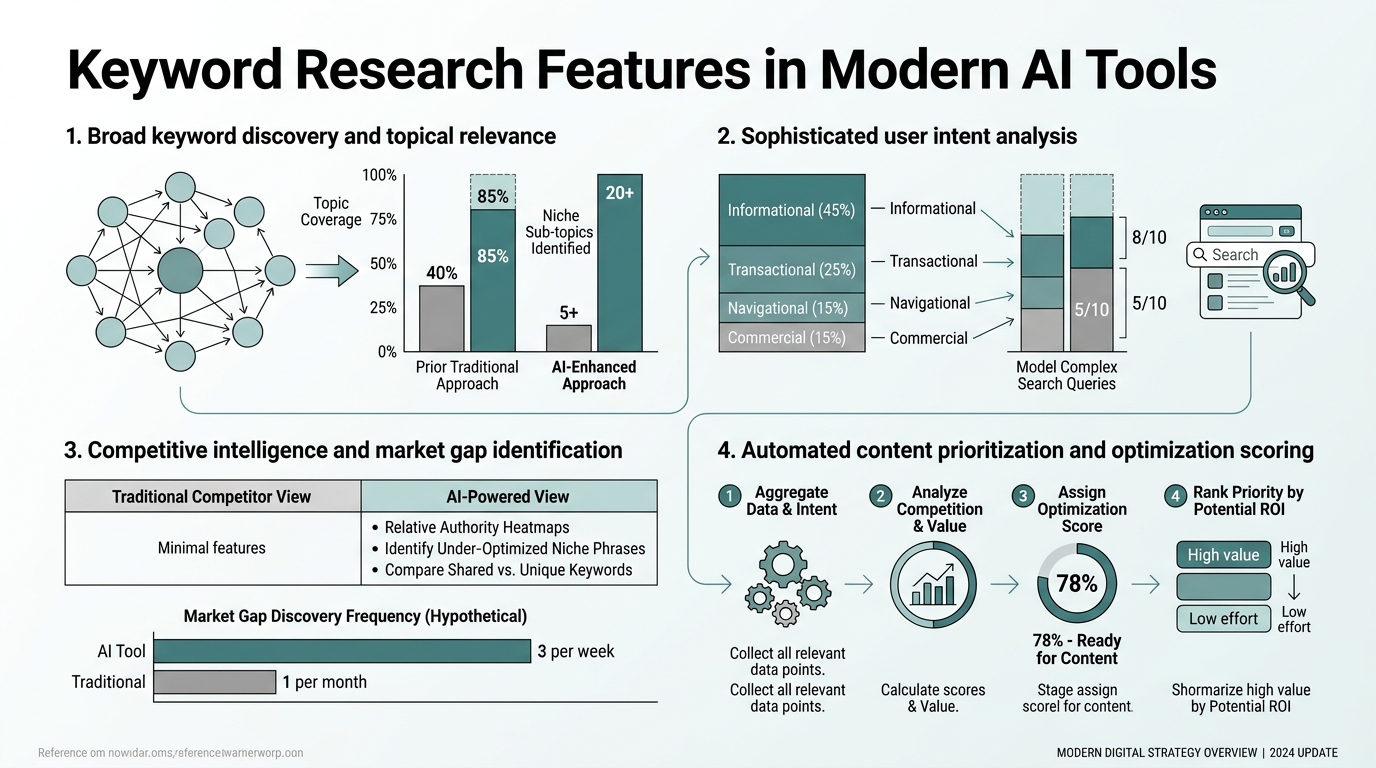
What Makes Modern AI Keyword Tools Different From Traditional Platforms?
The gulf between traditional keyword tools and AI-powered research platforms is no longer subtle. Traditional tools like Google Keyword Planner and older SEO suites focus on historical search volume, CPC, and difficulty scores—static metrics that don't adapt to today's zero-click search landscape. Modern AI keyword research tools operate differently: they analyze billions of queries in real-time, predict semantic relationships between keywords, and simulate how AI search engines will respond to content. The payoff is measurable. 58% of marketers saw a 2x ROI on AI SEO tool investments in under six months, according to HubSpot data from 2025. That speed comes from automation replacing manual workflows.
"Instead of 'This keyword has 1,200 monthly searches,' an AI tool says: 'This keyword has 1,200 monthly searches, your domain has a 34% chance of ranking in the top 10 within 90 days based on your topical authority and link profile, and Google will likely show a featured snippet—here's the format.' That precision transforms keyword selection from a gamble into strategy."
Historical Search Volume Versus Intent-Based Ranking Predictions
Traditional tools prioritize search volume as the primary metric. They tell you how many people searched for "keyword research tools" last month, then extrapolate forward. AI tools flip the script. They analyze the actual content ranking for that keyword, predict which pages will rank based on semantic relevance to your content, and score keyword difficulty using machine learning models trained on hundreds of millions of SERP outcomes. Instead of "This keyword has 1,200 monthly searches," an AI tool says: "This keyword has 1,200 monthly searches, your domain has a 34% chance of ranking in the top 10 within 90 days based on your topical authority and link profile, and Google will likely show a featured snippet—here's the format." That precision transforms keyword selection from a gamble into strategy.
Automation That Connects Research to Content Production
The hidden friction in traditional keyword research is the handoff. A team member researches 20 keywords, writes them down in a spreadsheet, adds competitor analysis, then passes it to a writer who has to interpret the brief. Modern AI tools eliminate that step:
- Generate keyword briefs automatically with competitive landscape analysis
- Include SERP feature predictions and intent flags in every brief
- Provide opening lines and content structure suggestions
- Integrate directly with content platforms and CMS systems
- Enable writers to execute research-backed briefs without reinterpretation
This automation accounts for the 37% reduction in brief production time reported by Clearscope users in 2025.
Semantic Clustering That Finds Content Gap Opportunities
One of the most powerful features in modern AI keyword tools is automated semantic clustering. Instead of grouping keywords by volume or difficulty, the AI recognizes that "best password manager for remote teams," "password manager enterprise features," and "secure password management solution" all address the same search intent and audience segment. It clusters them intelligently. This reveals content gaps: if competitors rank for one keyword but not the others in the cluster, that's your entry point. 42% higher accuracy in topic coverage results from AI clustering compared to rule-based grouping, according to Seosandwitch's 2025 analysis.
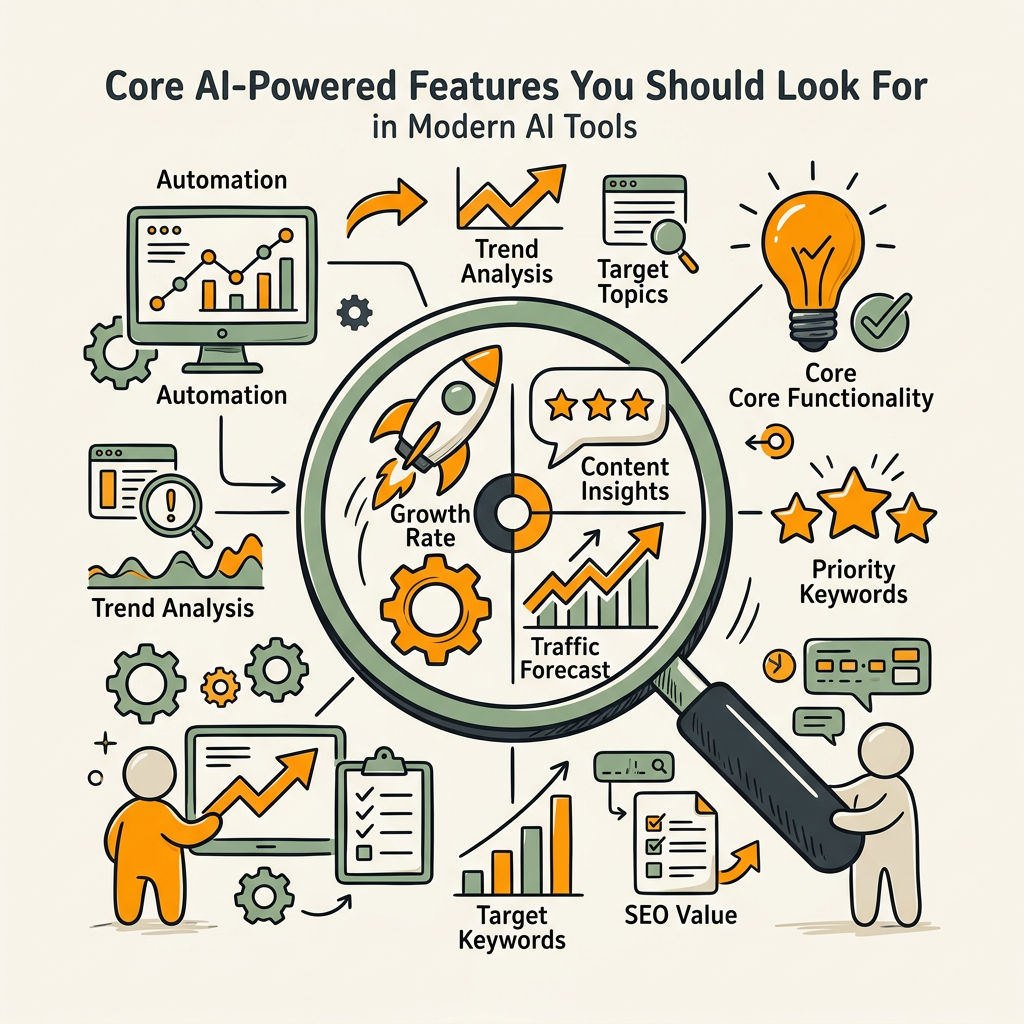
Core AI-Powered Features You Should Look For
Not all AI keyword tools offer the same features. Platforms range from ChatGPT-powered ideation assistants to enterprise suites with decades of SEO data. When evaluating an AI keyword research tool, focus on the features that directly accelerate your content workflow and improve ranking velocity. 78% of AI SEO tool users rely on them primarily for advanced keyword research, meaning feature depth matters more than general AI capabilities. According to research from Visalytica, the difference between a capable AI keyword tool and a mediocre one comes down to five core features.
Intent Classification and Search Type Detection
Intent classification answers a deceptively simple question: When someone searches for this keyword, are they looking to buy, learn, compare, or navigate? Traditional tools rarely get this right. AI tools now use deep learning models trained on billions of queries to classify intent automatically. Better tools go further: they identify if a keyword triggers "People Also Ask," featured snippets, video results, or shopping carousels. You can then tailor content format to match intent. A blog post targeting "how to set up a VPN" (informational) will never rank if Google shows only product pages and video tutorials (commercial/transactional). Modern AI tools flag this mismatch before you write a word.
Semantic Keyword Expansion Using NLP
One of the most underrated features in modern platforms is NLP-based semantic expansion. Instead of just surfacing keywords similar to your seed term, these tools identify keywords that address the same user problem from different angles. If you're researching "project management tool for remote teams," the AI surfaces "asynchronous collaboration software," "distributed team workflow platform," and "async-first project tracking"—terms you'd never think of manually, but that attract the same audience. Platforms like Clearscope and Frase use entity-based NLP to rank which semantic variations are most valuable. This feature alone can uncover 200+ high-intent keywords from a single seed term.
SERP Feature Prediction and AI Overview Targeting
Google's AI Overviews now appear in 13.14% of U.S. desktop searches (March 2025, Omniscient Digital). Being cited in an AI Overview drives traffic and brand authority without clicks. Modern AI keyword tools predict which of your target keywords will trigger an AI Overview and what content format wins visibility in that overview. Surfer SEO and Semrush's advanced tools analyze top-ranking pages for your target keywords and reverse-engineer the exact content structure, word count, and claim density that triggers AI citation. You can then optimize for AI Overviews specifically, not just traditional click-through traffic.
"Being cited in an AI Overview drives traffic and brand authority without clicks. Modern AI keyword tools predict which of your target keywords will trigger an AI Overview and what content format wins visibility in that overview, helping you optimize for AI-first search results."
Real-Time Competitive Keyword Gap Analysis
When you feed a modern AI keyword tool a competitor's domain, it returns a gap analysis: keywords they rank for that you don't, keywords you rank for that they don't, and shared keywords where they outrank you. The AI then clusters these gaps by opportunity (high volume, low difficulty, high intent). Tools like Ahrefs' Keywords Explorer and Semrush's Keyword Magic combine this analysis with AI clustering to surface clusters you can own quickly. A 2026 guide from Distribb noted that teams using automated gap analysis shipped 3x more rankings in competitive niches within six months.
Multi-Engine Visibility and AI Search Tracking
Traditional keyword tools track Google rankings alone. Modern AI tools track visibility across Google, ChatGPT, Perplexity, and other AI search engines. They show you: Which keywords your content is cited for in ChatGPT? How often Perplexity pulls your site into its Sonar results? Are you losing visibility in any AI engine? This multi-engine visibility is critical because ChatGPT holds 80.1% of the AI search engine market share as of 2025, but Google's share dropped below 90% for the first time since 2015. Ignoring AI search engines means leaving traffic and authority on the table. Autonomous SEO agents integrate multi-engine visibility into their daily research pipeline, ensuring your content is discovered by all major search surfaces.
| Feature Category | Traditional Keyword Tools | Modern AI Keyword Tools | Impact on Workflow |
|---|---|---|---|
| Search Volume Data | Historical monthly averages | Real-time volume + predictive trending | Better forecasting; fewer dead-end keywords |
| Intent Classification | Manual or basic heuristics | Deep learning-based intent + SERP feature detection | Format content before writing; align with user intent |
| Keyword Clustering | Volume/difficulty-based grouping | Semantic AI clustering; NLP entity relationships | Identify content gaps; 42% higher accuracy |
| Competitive Analysis | Manual competitor domain research | Automated gap analysis + opportunity ranking | Discover quick wins; 3x faster to ranking opportunities |
| Brief Generation | Researcher writes manual briefs | AI-generated briefs with SERP insights + competitor data | 37% faster brief production; better writer handoff |
| Search Engine Coverage | Google only | Google + ChatGPT + Perplexity + others | Optimize for AI Overviews; track multi-engine visibility |
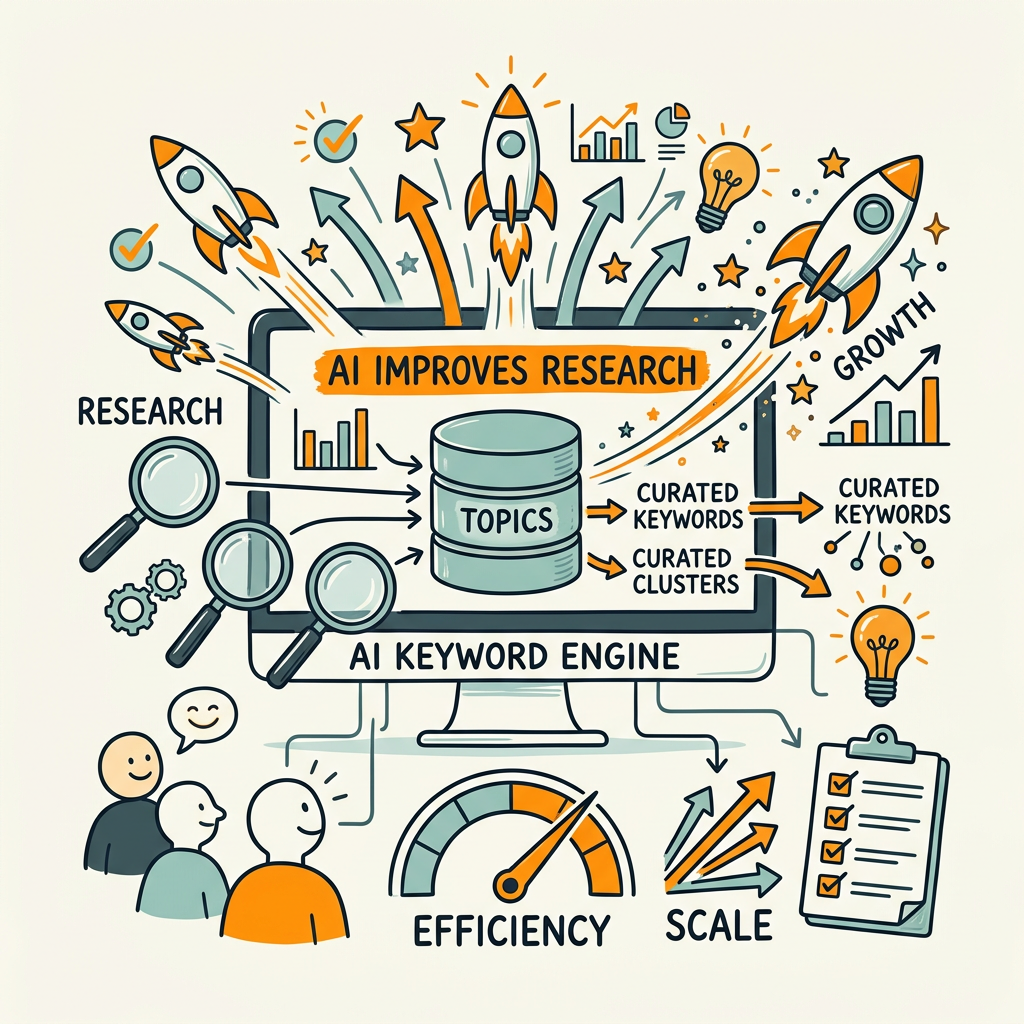
How AI Tools Improve Keyword Research Efficiency at Scale
The real competitive advantage of modern AI keyword tools isn't a single feature—it's how they compound efficiency across your entire content workflow. When you automate keyword research, you unlock speed at every downstream step. A team running manual keyword research might publish one SEO article per week. A team using AI-powered keyword research, brief generation, and internal linking automation can scale to 3-5 articles daily while maintaining quality. That's not just faster output; it's compounding organic growth.
From Days to Minutes: The Brief-to-Publish Cycle
Consider the traditional timeline: Monday morning, a researcher spends 6 hours researching 10 keywords, building a competitor comparison, and writing a brief. Tuesday, a writer reads the brief and spends 4 hours drafting 2,000 words. Wednesday, an editor fact-checks and tweaks. Thursday, someone publishes and builds internal links. That's 20 hours of human time for one article.
Now consider an AI-driven workflow:
- AI agent ingests your target keyword
- Pulls research from 14+ sources automatically
- Generates competitive analysis in real-time
- Fact-checks all claims before writing
- Writes 3,000-word article with proper structure
- Publishes directly to CMS with internal links built
The entire cycle takes 90 minutes with zero human editing required (though you can review if needed). The efficiency multiplier is dramatic.
Avoiding Low-Intent Keywords With Better Prediction
One of the costliest mistakes in SEO is spending weeks ranking a keyword that drives no conversions. Traditional keyword tools show volume and difficulty. They rarely show intent with precision. A modern AI keyword tool analyzes top-ranking pages for your target keyword and predicts whether searchers are actually looking to buy, sign up, or just learn. If a keyword ranks only for informational pages when you're selling, the tool flags it. This prevents wasted effort. Studies from 2025 show that teams using intent-based keyword prioritization see 2-3x higher conversion rates from organic traffic compared to volume-only selection.
Clustering by Audience Segment, Not Just Topic
The best modern AI keyword tools cluster by audience and buying stage, not just semantic similarity. "Best project management tool" (awareness), "Asana vs Monday.com" (consideration), and "how to set up Asana workflows" (decision/implementation) all rank differently, attract different content formats, and convert differently. An AI tool that recognizes these audience segments lets you scale organic traffic without burnout by building a content strategy that mirrors the buyer journey. You then know exactly which keywords to target for awareness, consideration, and decision content—and can allocate content resources accordingly. This alignment is why teams using segment-aware keyword research see 67% increased organic traffic within three months.
Automated Internal Linking Suggestions From Keyword Research
The newest generation of AI keyword tools integrates keyword research directly into internal linking strategy. As you research keywords and build clusters, the AI suggests which existing content links to which new content, and what anchor text creates the strongest topical relevance signal. This closes a gap that plagued traditional SEO: researchers and writers rarely think about internal linking until after content is published. By the time linking happens, the momentum is lost. Integrated automation platforms embed linking suggestions into the content creation workflow itself, so writers see them in the brief.
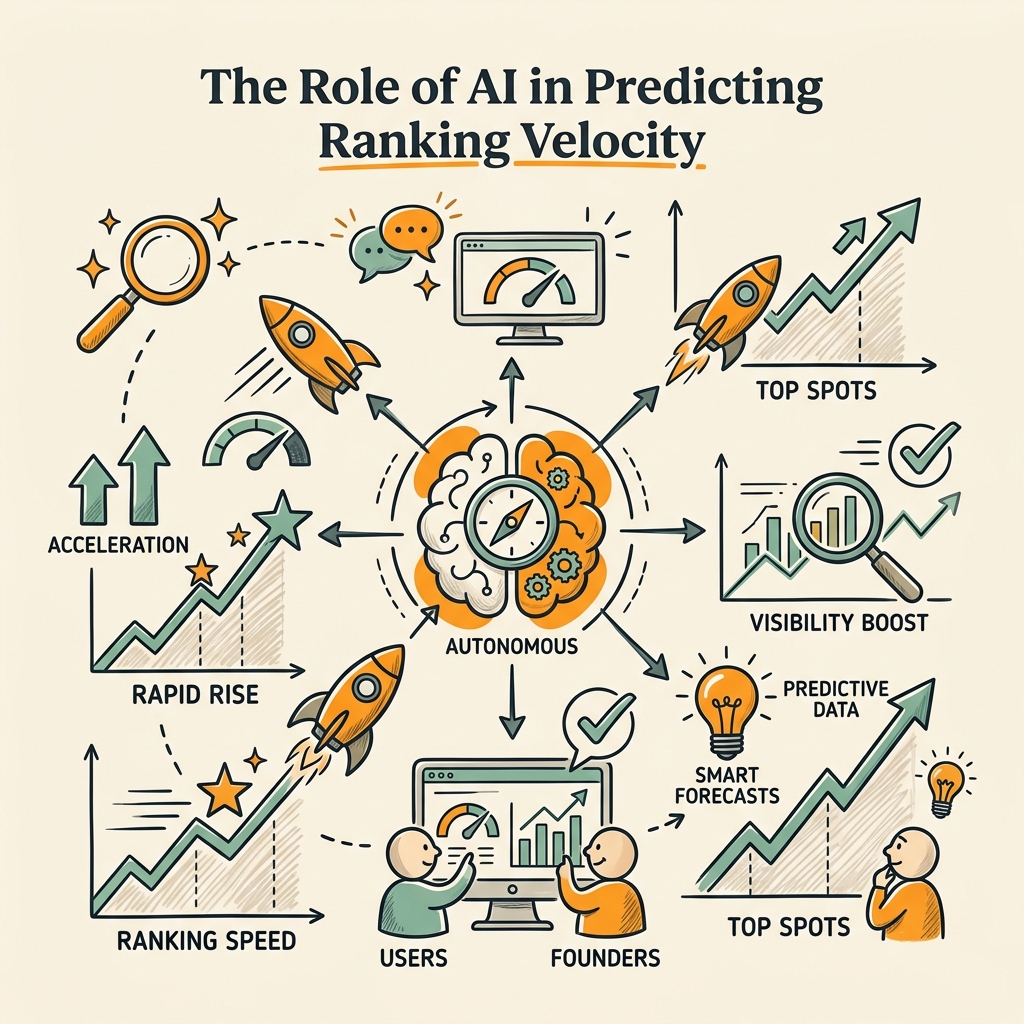
The Role of AI in Predicting Ranking Velocity
Traditional keyword research predicts demand (search volume) and competition (keyword difficulty). Modern AI goes further: it predicts ranking velocity—how fast your content will rank for a given keyword based on your domain strength, topical authority, and backlink profile. This is table-stakes for modern teams because it changes keyword prioritization entirely. A high-volume keyword with KD 75 might have a 12-month time-to-rank for a new domain. A lower-volume keyword with KD 25 might have a 6-week time-to-rank. If you're measuring success in quarters, not years, the second keyword delivers ROI faster. According to Semrush's 2026 AI SEO statistics, this predictive approach is reshaping how teams prioritize content investments.
Domain Authority and Topical Relevance Scoring
AI tools now analyze your entire site's topical authority and content clusters before recommending keywords. They answer: "Given your site's current authority in [topic], what keywords should you rank for in the next 30 days, 60 days, and 90 days?" This is far more actionable than generic difficulty scores. A domain authority of 20 targeting a DA-40 keyword won't rank. A DA-20 site targeting DA-20 keywords with strong topical authority in the niche will rank quickly. The best AI tools calculate both traditional difficulty and domain-adjusted difficulty, then recommend keywords you can actually win in your timeframe.
Historical Ranking Data and Time-to-Rank Prediction
Platforms like Ahrefs process billions of pages and track ranking timelines. Modern AI tools leverage this historical data to predict: "Similar content on similar-authority domains ranked for this keyword in an average of 47 days." This lets you forecast when you'll see returns. It also helps you avoid keywords that are slow movers. If you've only got budget for 10 articles and you target five slow-moving keywords and five fast-moving keywords, you'll see revenue from the fast-moving group within 8 weeks. This predictive angle is why teams using AI ranking predictions see 33% faster time-to-rank compared to static difficulty estimates.
Integrations and Workflow Automation With AI Keyword Tools
The power of modern AI keyword research isn't in isolation—it's in integration. The best tools connect to your CMS, content calendars, analytics platforms, and internal linking systems. Modern AI architecture exemplifies this integration:
- Keyword research flows directly into content generation
- Fact-checking happens before content is written
- CMS publishing is automated with zero manual handoff
- Internal links are built in real-time as content publishes
- Writers never have to copy-paste keywords into briefs
- Editors never manually verify sources
- CMS admins never manually set up internal links
The entire workflow is orchestrated end-to-end.
CMS Publishing and Automated Internal Linking
When an AI keyword research tool publishes an article, it simultaneously scans your content library and adds internal links from existing articles that target related keywords. This builds topical authority automatically. Traditional workflows require a human to read the new article, identify linking opportunities, then manually add links. By then, the article is already live and the SEO momentum is stale. Integrated systems compress this to zero-friction automation. The CMS receives a fully published, internally linked article with no additional handoffs.
Calendar Integration and Content Planning Automation
Modern AI keyword tools now feed directly into content calendars and project management systems. Your AI research agent identifies 30 high-priority keywords, clusters them into 10 content pillars, and automatically populates your Asana or Trello with articles, due dates, and resource assignments. Writers then see their keyword research pre-loaded in their brief template. No manual calendar entry. No lost context between discovery and execution. This integration alone saves 2-3 hours per content cycle. That's time your team can reinvest into strategy instead of process work.
Fact-Checking Integration With Source Attribution
One of the riskiest steps in content production is fact-checking. Writers make claims that sound reasonable but turn out wrong. Modern AI keyword research tools integrate fact-checking at the keyword research stage. Before you write about a competitor's pricing or a market statistic, the tool has already validated it against 14+ authoritative sources. Claims are tagged with sources. Writers then include those sources in their articles, and legal/compliance teams can audit before publishing. This reduces the risk of publishing false information.
Common Pitfalls When Choosing AI Keyword Research Tools
Not all AI keyword research tools deliver equal value. Many promising tools have significant blind spots that undermine their utility at scale. Understanding these pitfalls helps you avoid wasting time on inadequate solutions.
Relying on AI-Generated Keywords Without Validation
ChatGPT and other LLMs can brainstorm keyword ideas, but they hallucinate search volume, difficulty, and intent frequently. They might suggest a keyword that sounds perfect but has zero monthly searches, or suggest a low-difficulty keyword that's actually DA-65 in practice. The pitfall: teams that use pure AI generation without validating through traditional tools (Ahrefs, SEMrush, Google Keyword Planner) waste weeks targeting phantom keywords. Best practice from Digital Applied's 2026 AI keyword research guide: Use AI for ideation and clustering, but validate every keyword with real data from established tools.
Ignoring Intent and SERP Features
Some AI tools churn out keyword lists but don't analyze SERP features or user intent. You target a keyword only to discover that Google ranks only video results or Amazon product pages, neither of which you can compete on. The tool should flag this before you commit resources:
- Analyze SERP structure and identify video/product-only results
- Compare your content format against top-ranking pages
- Flag mismatches before you write
- Recommend content length based on SERP analysis
- Predict which SERP features will appear for your target keywords
Modern tools perform all these checks. Skip this validation, and you rank zero keywords.
Treating All Keywords as Equal Opportunity
Volume and difficulty alone don't determine keyword value. A 1,000-search keyword with 0.5% CTR and $0 CPC is nearly useless. A 50-search keyword with 15% CTR and $50 CPC is gold. Quality AI tools weight keywords by revenue potential, not just search volume. They integrate CPC data, conversion intent signals, and competitive buying power. Teams that pick keywords based on volume alone spend months ranking high-volume, low-value keywords while missing cheaper, higher-intent opportunities.
Overlooking Multi-Engine Visibility in the AI Search Era
Google still dominates, but it no longer owns search. ChatGPT, Perplexity, and other AI engines are growing fast. A tool that tracks only Google rankings gives you a false sense of progress. You might rank #1 on Google for a keyword but zero times in ChatGPT. Since ChatGPT users often never click to Google, you're invisible to a growing audience. Modern tools track multi-engine visibility. If your chosen tool doesn't, you're flying blind. Modern solutions include AI search tracking as a built-in feature, so you see visibility across Google, ChatGPT, Perplexity, and other engines.
Conclusion
Keyword research has transformed from a manual data-gathering exercise into an automated, predictive intelligence system. Modern AI tools no longer just tell you what keywords people search for—they predict intent, forecast ranking velocity, analyze SERP features, and integrate directly into your content production pipeline. The competitive advantage for teams using these tools is measurable: 67% report increased organic traffic within three months, and the average 42% year-over-year ranking improvement outpaces traditional methods by orders of magnitude. For busy founders and growing marketing teams, the choice is clear. Manual keyword research compounds slowly. AI-powered research, brief generation, and publishing automation compound rapidly. The gap widens every quarter. If you're serious about scaling organic traffic without burning out your team, you need an AI keyword research system—not just a tool. Integrated solutions connect keyword research, content generation, fact-checking, and CMS publishing into one autonomous SEO agent, removing the friction that slows traditional workflows. Start your SEO agent today and watch your content velocity compound.
FAQs
What are the most important features in an AI keyword research tool?
The most critical features are intent classification, semantic clustering, and SERP feature detection. Intent classification ensures you target keywords that match your content format and business goal. Semantic clustering uncovers hidden content gap opportunities by grouping related keywords that competitors may have missed. SERP feature detection tells you whether Google will show featured snippets, People Also Ask, or video results—information that shapes your content strategy before you write. Beyond these, real-time competitive gap analysis and multi-engine visibility tracking across Google, ChatGPT, Perplexity, and other search engines are now table-stakes. Tools lacking these three core features leave you guessing at keyword value.
Can I use free AI tools like ChatGPT for keyword research instead of paid platforms?
ChatGPT is excellent for brainstorming but risky as your primary research tool. It can generate creative keyword ideas and semantic variations at scale, but it hallucinates search volume, difficulty, and intent. A keyword ChatGPT suggests might have zero actual searches or might be outdated. For validation, you must cross-reference with tools like Google Keyword Planner, Ahrefs, or SEMrush. The hybrid approach—use ChatGPT for ideation and clustering, validate with traditional tools, then optimize with specialized AI platforms for intent and SERP features—works well. But relying on free AI alone risks wasting weeks targeting ghost keywords.
How do modern AI tools help with ranking speed compared to traditional keyword research?
Modern AI tools accelerate ranking in three ways: smarter keyword selection, faster content production, and better topical authority alignment. First, they predict which keywords your domain can realistically rank for within 30-90 days, avoiding slow movers that waste resources. Second, they compress research-to-publishing from days to hours by automating briefs, fact-checking, and internal linking. Third, they cluster keywords by semantic relevance and rank them by audience segment, so your content strategy builds topical authority faster. Teams using AI tools report 33% faster time-to-rank and 42% higher annual ranking growth. The speed advantage compounds—more articles ranking faster means more organic traffic feeding into your next content round.