Link Building Strategy for B2B SaaS: A Founder's Playbook
B2B SaaS founders often assume that great product and strong content are enough to drive organic growth. The reality is different. 78.1% of SEO professionals report positive ROI from link building, yet most SaaS companies leave links on the table by treating them as a byproduct rather than a strategic lever. Link building for software companies isn't about accumulating quantityit's about earning the right editorial mentions from sites your buyers actually trust. This playbook shows founders how to build a systematic link strategy that compounds over time, drives qualified referral traffic, and signals authority to both search engines and AI systems evaluating your brand for recommendations.
Key Takeaways
- 78.1% of SEO professionals report positive ROI from link building, making it one of the highest-leverage SEO tactics (2026, Link Building HQ)
- Digital PR with original data is the highest-quality link source; guest posting remains viable but only when targeting niche-relevant sites your buyers read
- Topical relevance and editorial fit matter far more than domain authority alonea DR 40 blog in your niche outperforms a DR 70 generic site
- Digital PR with Original Data: Publish proprietary research and pitch findings to journalists; generates the highest-quality editorial links with real referral traffic.
- Partnership and Integration Links: Leverage your ecosystem of vendors, customers, and integrations to earn contextual links from relevant authority sites.
- Strategic Guest Posting: Target only sites your target buyers read; position yourself as a thought leader, not a distributor of rewritten content.
- Resource Page and Broken-Link Outreach: Find outdated resources pointing to competitors; offer your content as a more current replacement.
- Automation-First Measurement: Track links by domain relevance, referral traffic, and assisted conversionsnot just domain rating or raw link count.
Why B2B SaaS Link Building Is Fundamentally Different
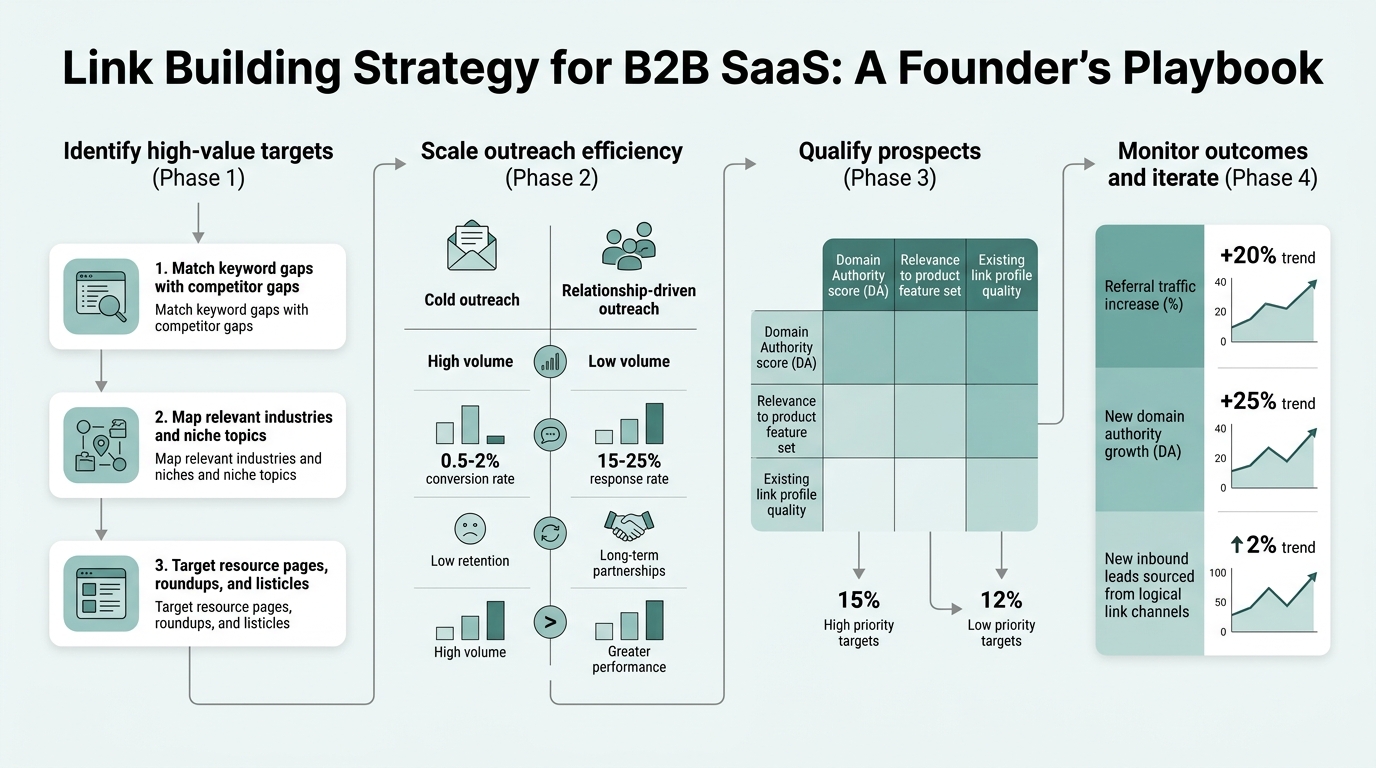
Link building for software companies follows different rules than other industries. 93.8% of link builders prioritize quality and topical relevance over high-volume acquisition, yet most SaaS founders still think in terms of "more links." The distinction matters because your buyers search differently and editorial sites write about software categories differently than they write about, say, fitness or finance.
Most links to SaaS companies point to blog content, not product pages. Nobody writes a roundup of project management tools and links to a pricing page. They link to articles that solve a problem or compare solutions. This means your content strategy and link strategy are inseparable. You can't earn links to content you haven't published. According to Link Building HQ's 2026 research, editorial relevance has become the primary ranking factor for link value, surpassing domain authority metrics.
There's also the authority gap. If you're a young SaaS startup under domain rating 30, many link opportunities won't take you seriously yeteditors prefer linking to established voices. Getting early links feels like needing experience to get a job, but needing a job to get experience. The solution is strategic targeting rather than spray-and-pray outreach. Tools like autonomous SEO agents can help identify high-opportunity targets faster, but the strategy remains human-driven.
How to Define "Good" Links for Your SaaS Company
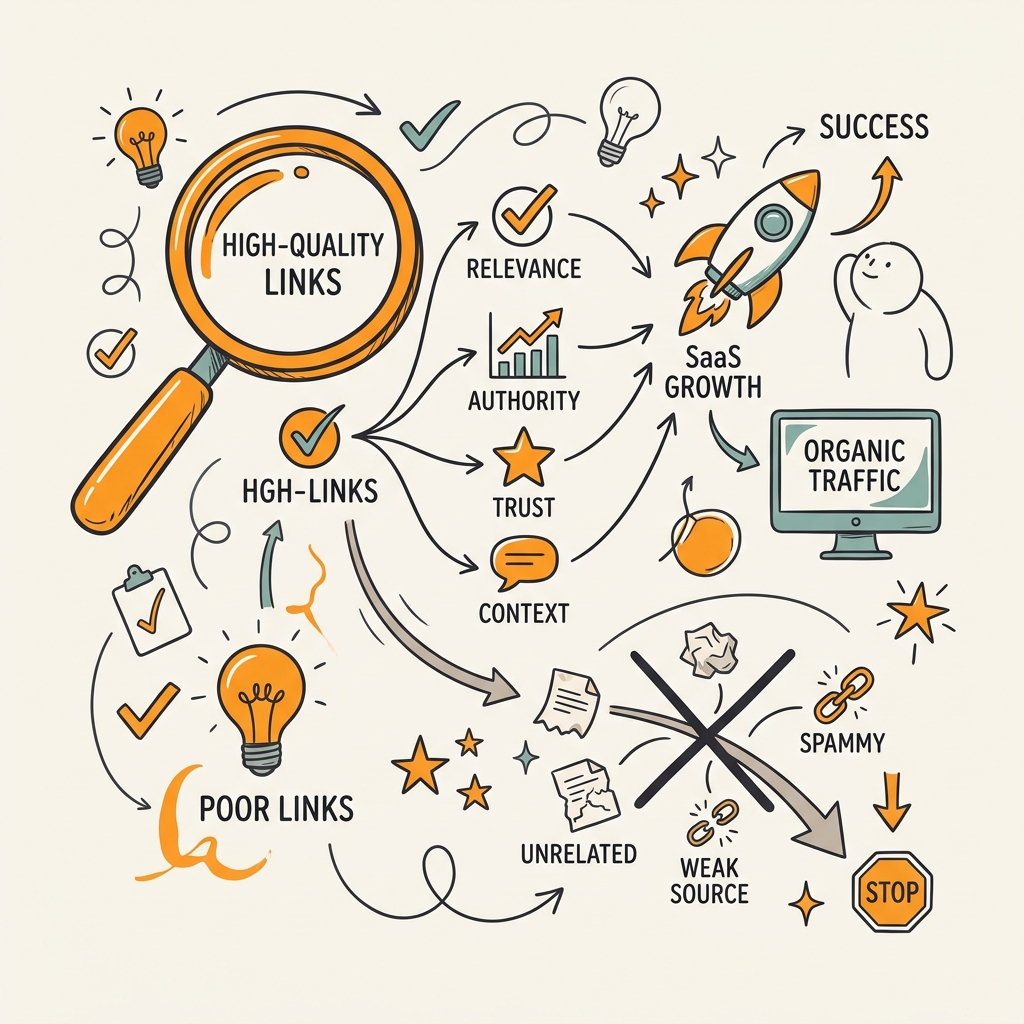
Before you build an outreach list, clarify what you're actually looking for. Many founders optimize only for domain authority (DA) or domain rating (DR), treating those metrics as proxies for link value. That's a trap. A DR 40 blog written for SaaS founders is often worth more than a DR 70 lifestyle site. The question isn't "Is this site powerful?" It's "Would our buyers read this? Would our buyers trust it?"
Topical Relevance as the First Filter
A link from a relevant niche site drives better outcomes because the audience is already in-market for what you sell. If you're a LinkedIn automation tool, a link from a blog about lead generation or outbound sales strategy fits naturally. A mention on a general business news site might have higher authority, but it feels contextually out of place. Google rewards natural editorial flow, and so do AI systems evaluating which tools to recommend.
When you evaluate link opportunities, apply this filter first: Would our target customer read this site and learn something useful from its audience? If yes, then look at authority. If no, skip the site regardless of DR score.
Referral Traffic and Audience Overlap
Some links drive zero referral traffic but still move rankingsthat's the direct SEO signal at work. But the best links do both: improve rankings and send qualified visitors. Prioritize sites that have existing traffic from your buyer personas. Check Google Analytics of competing sites (or your own if you've had links before) to see which referral sources convert best.
Tools that analyze competitor backlinks can show you traffic estimates, though those are rough. The principle is sound: a link from a high-traffic niche site where your buyers spend time compounds harder than a link from a dead authority domain.
Editorial Context and Natural Placement
The link should feel earned, not paid. If the anchor text reads naturally and the paragraph would make sense to a reader who doesn't know your company, Google treats it better. Links that are obviously inserted for SEO purposeslike a random mention in a list or a bolded product name with no supporting contextcarry less weight and risk being classified as manipulative.
When you pitch or create content for link placement, ask yourself: "If I removed my company name, would this paragraph still make sense?" If the answer is no, rewrite it.
The Five Most Effective Link-Building Tactics for SaaS in 2026
Not all link-building tactics deliver the same ROI for software companies. Research from 2025-2026 shows clear leaders in terms of link quality, scalability, and referral traffic. Below are the five tactics that work best for founders with limited time but serious growth targets.
Tactic 1: Digital PR with Proprietary Data
Digital PR is ranked as the most effective link-building tactic by 48.6% of professionals, and it's the best ROI play for SaaS founders because it generates multiple link types at once: editorial mentions, journalist citations, HARO placements, and natural resource page links. You're not asking for linksyou're publishing newsworthy research that journalists want to cite.
The workflow is simple: Create proprietary research (survey results, benchmark report, or analysis of your product data), then pitch the findings to journalists and industry analysts. A well-designed study with 300–500+ respondents is statistically robust enough that journalists feel confident citing it without independent verification. According to Powered by Search's B2B SaaS SEO research, companies using data-driven content strategies see 12.2x marketing spend in SEO ROI.
For example, a fintech SaaS company might survey 400 small business owners about their payment preferences, then pitch stories like "Small Business Payment Trends: 2026 Report" to publications serving SMBs and entrepreneurs. Each story creates a link. Each link comes from an editorial context (someone writing about the topic, not a directory), which means higher quality and better topical relevance.
Digital PR typically takes 4-8 weeks from research publication to the first inbound links. You'll need a small budget for survey distribution or a large audience to recruit respondents. But the compounding is real: one major report can generate 10-30 editorial links over time, and those links keep earning referral traffic for months.
Tactic 2: Partnership and Integration Links
SaaS companies live in ecosystems. You integrate with other tools, you have customers who are also customers of competitors, you partner with agencies and consultants. These relationships are link opportunities waiting to be activated. Partnership-based link building is ranked as the second most scalable tactic for software companies because it converts existing business relationships into SEO value.
Start by mapping your ecosystem:
- Integration partners: Tools you connect with via API; they often have "integrations" pages or "partners" pages that list you.
- Customer advocates: Companies using your product often write case studies or testimonials; ask them to link when they mention you.
- Competitor comparison audiences: Sites comparing software in your category; you can pitch to be added to their comparisons.
- Vendor lists: Agencies and consultancies often maintain resource pages of recommended tools; reach out to claim your spot.
- Certification or partner programs: If you have certified partners or resellers, their sites become natural link sources.
This tactic doesn't require external outreach budgets or agencies. You're leveraging relationships you already have. A quick email to partners saying "We'd love to be included on your integrations page" often works. The links usually have strong topical relevance (integration pages are by definition in-context) and drive decent referral traffic from prospects evaluating your category.
Tactic 3: Strategic Guest Posting on Niche Publications
Guest posting still works in 2026, but only if you're strategic. 70% of SEO experts rely on guest posting as a backlink tactic, but many waste time on irrelevant sites. The trap is pitching to every vaguely related publication. The strategy is picking 5-10 publications your target buyer actually reads and building relationships with editors.
For a B2B SaaS company, relevant guest posts usually land on:
- Industry-specific publications (e.g., Customer.io blog if you sell to email marketers)
- Thought leadership platforms (e.g., LinkedIn, Medium, industry-specific Medium equivalents)
- SaaS founder media (e.g., Indie Hackers, Product Hunt blog, Startup publications)
- Professional communities and forums (e.g., subreddits, Slack communities, Discord servers with publishing arms)
- Category-specific blogs and roundups
When you pitch, be specific. Instead of "I'd like to contribute an article," pitch an actual angle: "I've noticed you cover [topic]. I've built [specific thing] for [your customers]. I can write about [specific insight] that would be useful to your readers." Reference something from their recent articles. Show you've read their work.
Keep the article original. If you're rewriting your own blog posts into slightly different versions for each site, editors will reject it or readers will bounce. Your guest post should offer insight that lives nowhere else on your site. The link is a bonus; the real win is the credibility and referral traffic from being positioned as an expert to a new audience.
Tactic 4: Broken-Link Building and Resource Page Outreach
This tactic is unglamorous but systematic. Find web pages that link to outdated content, broken links, or low-quality resources in your space. Then pitch your content as a replacement. It works because you're solving a webmaster's problem, not asking for a favor.
The process: Use a tool to find sites that link to competitor content or outdated resources. Check if any of those links are broken or if the linked content is old. Then reach out with something like: "I noticed you link to [outdated article]. We've published something more recent on [topic]: [your link]. Thought your readers might find it useful."
Continuous follow-up improves link acquisition by an estimated 42% compared to single outreach attempts. Most webmasters don't respond to a single email. A follow-up after 5-7 days, and sometimes a third email after another week, significantly increases acceptance rates.
This tactic scales because you can systematize the outreach. You're not relying on relationships or waiting for a journalist to cover your research. You're identifying problems and offering solutions. The links tend to be solidresource pages are explicitly designed to link to quality contentbut they're smaller in volume than digital PR.
Tactic 5: Testimonials and Ecosystem Mentions
If your SaaS product serves other SaaS companies, many of your customers are themselves vendors. They use your software and should mention it when sharing their story. A detailed testimonial with a link to your site is a link you didn't have to pitch for; your customer provided it naturally.
Encourage customers to share their wins publicly. When a customer publishes a blog post, guest article, or case study mentioning your tool, ask them to add a link to your case studies page or product page. Make it easy by providing the exact link and anchor text.
Similarly, feature your vendors, partners, and integrations on your own site. These mentions often get reciprocated. A "Tools We Use" or "Recommended Partners" page on your site encourages those vendors to link back to you from their own marketing materials.
Building Your Link-Building System as a Founder
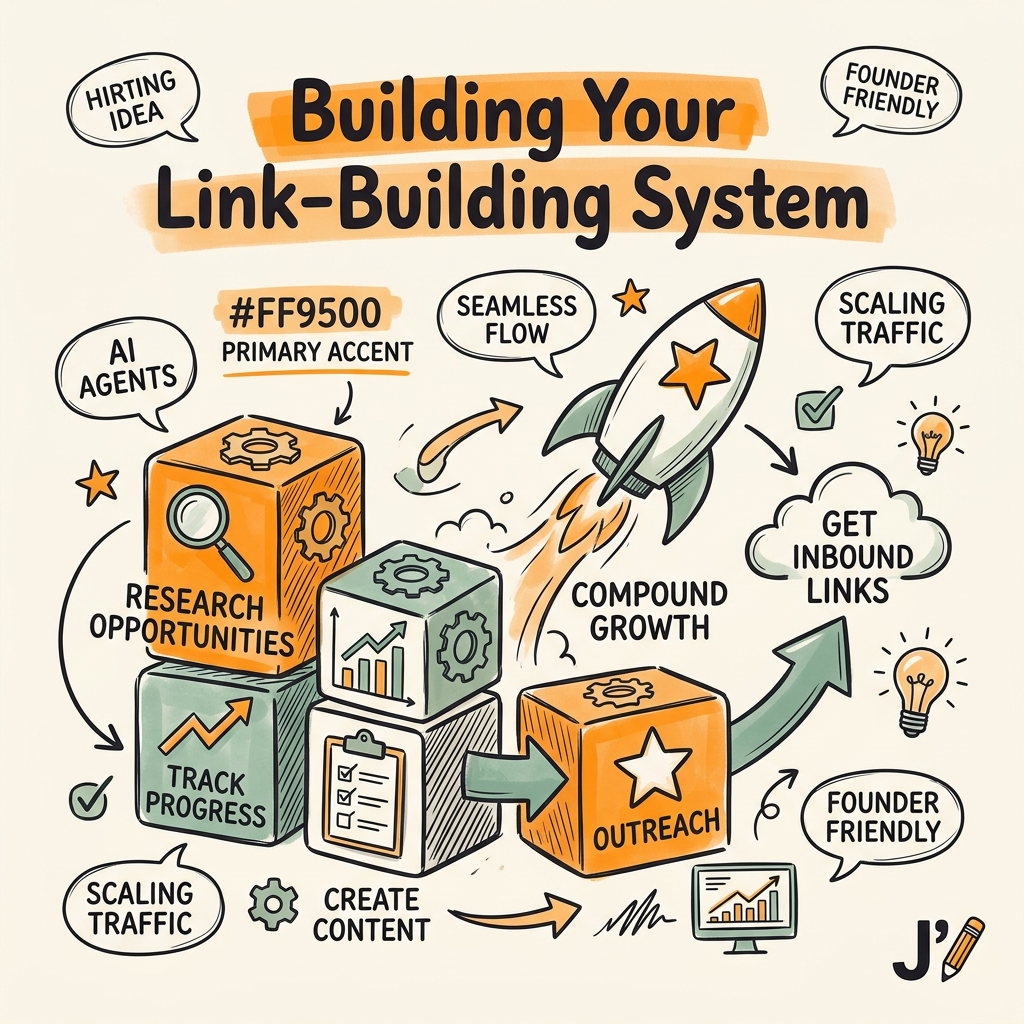
The biggest difference between founders who compound link growth and those who don't is systematization. Ad-hoc link building produces ad-hoc results. Systematic link building, even if it's just one or two hours a week, compounds into real authority.
Step 1: Establish Your Link-Building Target and Metrics
Start with a realistic target. Most SaaS startups should aim for 5-10 new quality links per month. That sounds conservative, but at that pace you'll build 60-120 quality links in a yearwhich is genuinely rare for young SaaS companies and will move rankings significantly.
Your success metrics should include:
- Link count and topical relevance: Track total links and note how many come from topically relevant sites vs. generic directories.
- Referral traffic: Monitor how many visitors each link sends. Some links have high SEO value but zero traffic; others drive steady visitors.
- Assisted conversions: In Google Analytics, track how many users who eventually converted were referred from a linked site.
- Keyword movement: Watch if pages you're building links to move up in rankings for target keywords.
Don't measure success by domain authority alone. A link from a lower-authority niche site that sends 20 qualified referral visitors is often more valuable than a link from a high-authority site that sends none.
Step 2: Create Your Link-Worthy Content Calendar
You can't earn links to content you haven't published. Plan your content around link-earning potential. Instead of publishing one general blog post per month, publish one highly linkable asset per quarter. That asset might be:
- Proprietary research or survey results
- A detailed comparison (e.g., "Tool A vs. Tool B vs. Tool C")
- Original data or benchmarks
- A comprehensive guide that becomes the definitive resource on a topic
- A calculator or interactive tool
- A templated toolkit (e.g., "SaaS Sales Checklist")
Publish linkable assets first, then build your outreach around them. This is why many SaaS teams automate their content productionthe more published content you have, the more link opportunities you create.
Step 3: Build Your Outreach List and Tracking System
Dedicate 2-3 hours a month to building a list of link targets. Focus on:
- Direct competitors: Find sites linking to competitors and note the context. Could you earn the same link?
- Niche publications: Subscribe to 3-5 industry blogs and note which cover topics you publish about.
- Partner and integration sites: List every integration partner, vendor, and customer and find their linking pages.
- Relevant HARO pitches: Monitor HARO (Help A Reporter Out) queries related to your category and respond quickly with expert insights.
Use a simple spreadsheet or tool to track prospects with columns for: site name, URL, contact email, context (what they cover, why they're relevant), pitch topic, outreach date, follow-up date, status (no response, declined, link earned).
Step 4: Systematize Your Outreach Email Template
Most outreach fails because the email is too long, too generic, or too obviously a template. Effective outreach emails stay under 150 words, include one specific reference to their site, and make one clear ask.
Use a template like this:
- Subject: [Specific reference to their work] + Question
- Body: (1) Personal reference to something they recently published (2) Your insight or asset that's relevant (3) One link option (4) Simple CTA ("Worth a share?" or "Any interest?")
- Signature: Your name, title, company
Send the initial email, wait 5-7 days, then send one follow-up. If no response after the follow-up, move on. You're filtering for people who are receptive, not convincing skeptics.
Step 5: Measure Results and Adjust
After 2-3 months of consistent outreach, analyze what's working. Which types of sites are most responsive? Which topics get the most interest? Which outreach angles convert best? Double down on what works, and drop tactics with sub-1% response rates.
Most founders overestimate how much time link building takes and underestimate how long it takes to see results. Plan for 4-8 weeks between outreach and seeing a link live. If you're in month 2 and seeing no links, don't panicthe pipeline is building. If you're in month 3 and still seeing nothing, adjust your targeting or tactics.
Avoiding the Biggest Link-Building Mistakes for SaaS
Founders often sabotage their own link-building efforts by following outdated advice or misunderstanding how Google evaluates links in 2026. Here are the most common mistakes and how to avoid them.
Mistake 1: Optimizing for Domain Authority Instead of Relevance
Young SaaS founders often chase high-DA links and ignore relevance. You'd never pay for a banner ad on a site your customers don't read. Don't trade links on sites your customers won't either. A DR 35 blog written by and for SaaS founders is usually worth more than a DR 60 financial websiteeven if both are "relevant" in a broad sense.
Evaluate link targets like you'd evaluate marketing partnerships. Would you sponsor this site? Would your target buyer trust its recommendation?
Mistake 2: Spray-and-Pray Outreach
Sending generic pitches to hundreds of sites wastes time. You'll get a 0.5% response rate and a lot of rejections. Instead, build a focused list of 20-30 truly relevant targets and pitch them well. A 10% response rate on 30 targets yields 3 conversations, any of which could turn into a link.
Quality over quantity applies to link outreach too.
Mistake 3: Forgetting to Follow Up
Most people don't respond to a single email. If you send one pitch and get no response, you've lost the opportunity. A follow-up after 5-7 days increases response rates dramatically. This is low-frictionit's just a reminderbut most founders skip it.
Mistake 4: Not Measuring Properly
If you're tracking links by domain rating alone, you're missing the actual value. A link that sends 100 referral visitors per month is worth more than a link that sends zero, even if the second link has higher DA. Set up Google Analytics tracking for your referring domains so you know which links drive traffic. Then track how many of those visitors convert or move down your sales funnel.
Mistake 5: Expecting Links to Appear Without Content
Some founders want to build links before they've published content worth linking to. You can't shortcut this. You need to create something actually useful first. That might be a comparison, research, a guide, or a tool. But empty outreach won't work if there's nothing to link to.
How to Scale Link Building Beyond DIY
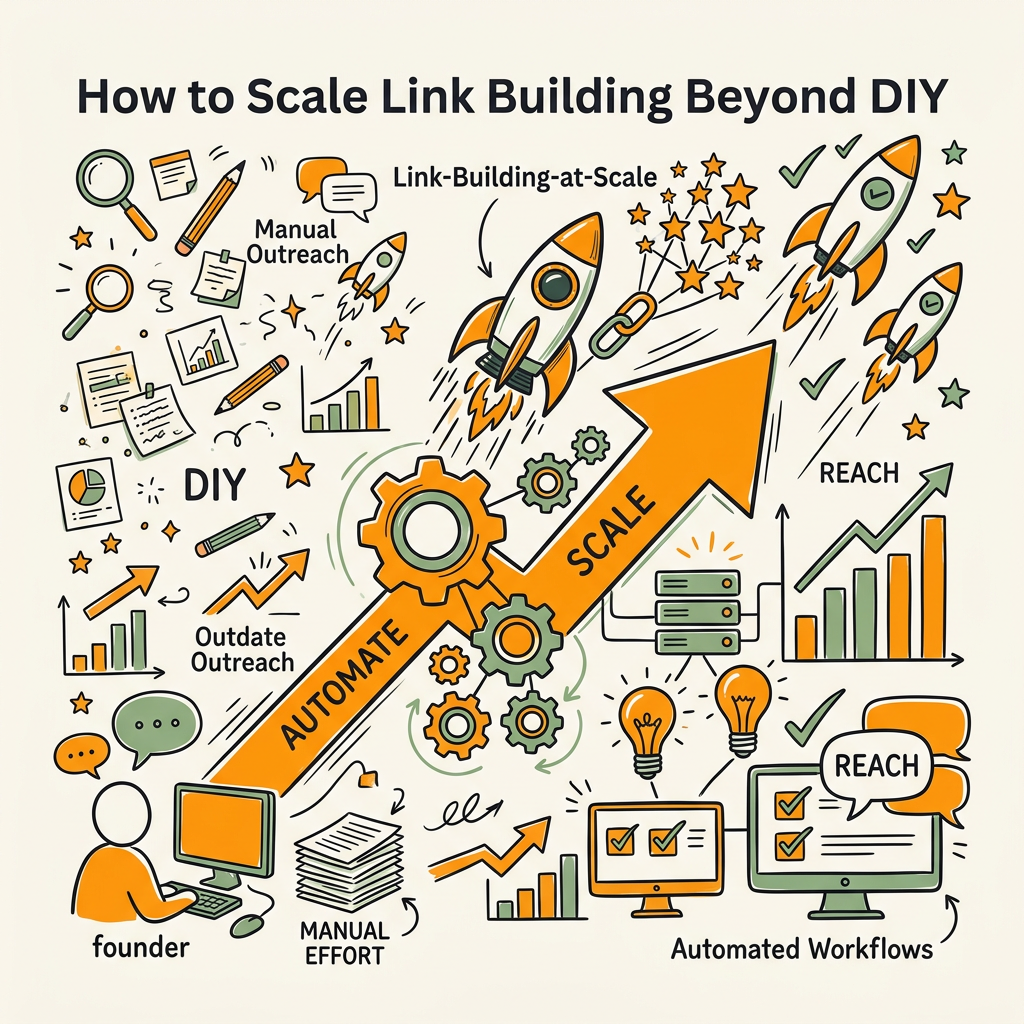
As your SaaS company grows and you're publishing more content, DIY link building eventually becomes a bottleneck. At that point, you have three options: hire an in-house SEO person, outsource to a link-building agency, or automate the content creation part and stay hands-on with outreach.
In-House vs. Outsourced: When to Make the Switch
56% of SEO professionals outsource at least part of link building, while 44% keep it fully in-house. The split suggests a hybrid model works best: one person owns the strategy and outreach, but you outsource tactical work like list building, research, or initial email prospecting.
Hire in-house when your company has:
- Consistent publishing volume (at least 1 piece of quality content per week)
- A clear SEO budget allocated for link building ($5k+ per month)
- Multiple content areas and link opportunities that overlap
Outsource when you:
- Don't have time for systematic outreach
- Need access to agency relationships (journalists, editors, industry contacts)
- Want to compress a 6-month timeline into 2-3 months
The best in-house teams have been supported by content automation. If you're publishing 3-5 articles per week instead of 1, you suddenly have 3-5x the link opportunities. Content automation strategies allow small teams to punch above their weight on volume without sacrificing quality, which means more content to build links to.
| Link-Building Tactic | Typical Link Quality | Referral Traffic Potential | Scalability | Best For |
|---|---|---|---|---|
| Digital PR with original data | Very High | High | Medium | Category leaders, thought leadership |
| Partnership and integration links | High | High | Medium | Ecosystem-based SaaS products |
| Strategic guest posting | Medium-High | Medium | Medium-High | Thought leadership, category visibility |
| Broken-link and resource outreach | Medium | Low-Medium | Medium | Evergreen guides and documentation |
| Testimonials and partner mentions | Medium-High | Medium | Medium | SaaS with active vendor ecosystem |
Measuring Link-Building ROI: Beyond Domain Rating
The most common measurement mistake is treating all links as equal. A link is not a link. One editorial link from a niche authority site driving referral traffic is worth more than five directory links with zero traffic.
The Metrics That Actually Matter
Track these KPIs instead of just counting links:
- Referral traffic by domain: In Google Analytics, segment traffic by referring domain. Which links send the most visitors?
- Click-through rate by link source: Some links convert at 5% CTR, others at 0.1%. Knowing this tells you which link types your buyers care about.
- Assisted conversions by referring domain: Google Analytics shows which sessions converted. Which referring domains contributed to those conversions, even if the conversion came from another channel?
- Keyword ranking movement for link-target pages: Did the page you built links to move up in rankings? For which keywords?
- Domain relevance score: Build a simple score: +2 points for high topical relevance, +1 point for medium relevance. Track average score over time. Improving relevance is as important as increasing volume.
Benchmarking Your Progress
A realistic annual goal for a young SaaS company is 60-120 quality links. For a mid-market SaaS company actively pursuing link building, 200-300+ links annually is achievable. These numbers assume consistent effort, good content, and strategic targetingnot perfect execution.
In your first month, expect 0-2 links (pipeline building). Months 2-3, expect 2-5 links as outreach begins landing. Months 4-12, expect 5-10 per month as your reputation and content library grow. The growth compounds in year 2 as you have more content to link to and more established relationships.
Building Links as a Competitive Advantage for Your SaaS
Link building feels slow. You could spend a week on outreach and see zero immediate results. But that's exactly why most SaaS companies don't do it seriously. The ones that do gain a compounding advantage. After 12 months of consistent effort, you'll have 60-100 quality links. After 24 months, 150-300. After 36 months, 300-600.
Each link improves your domain authority, sends referral traffic, and signals to Google and AI systems that your brand is trusted. It's the difference between being invisible and being a recognized authority in your category. The best time to start was yesterday. The second best time is today.
Conclusion
Link building for B2B SaaS is not a hack or a shortcut. It's a systematic process of publishing content worth sharing, identifying the right places to share it, and building relationships with the people who control those platforms. When executed properly, link building can deliver ROI as high as 702% for SaaS companies, making it one of the highest-leverage uses of your marketing time and budget.
Start small: pick one tactic that fits your company's stage (digital PR if you have time and data, guest posting if you have relationships, partnership links if you have an ecosystem). Execute it consistently for 90 days. Measure what works. Double down on the winners. This approach beats trying to do all five tactics at once and executing none well.
The founders who win in SEO are the ones who treat link building not as a one-time effort but as a permanent part of their content and marketing machine. Build links systematically, and they'll compound into real competitive advantage.
FAQs
What is the fastest way to build links for a new SaaS company?
The fastest path is usually partnership and integration links combined with strategic guest posting. Partnership links leverage existing relationships, so you're not cold-pitching. Strategic guest posting on niche publications you already read takes 2-3 weeks per article. If you have data or original research, digital PR can compress your timeline to 4-8 weeks for your first editorial links. Avoid broken-link building and directory submissions early onthey're slow and low-value. Focus on editorial placements first when your domain authority is still building.
How many links does a SaaS company actually need to rank?
There's no magic number, but studies suggest that pages with 10-15 quality backlinks rank competitively in most SaaS categories. However, link quality and topical relevance matter far more than raw count. A page with 5 links from highly relevant, high-authority sites will often outrank a page with 50 low-quality directory links. Focus on building 5-10 genuinely good links to your key pages instead of chasing 100 mediocre ones. Link diversity (links from different domains, different content types, different anchor texts) is also importantmultiple links from the same domain have diminishing returns.
Should we hire a link-building agency or do it in-house?
A hybrid approach usually works best. Do outreach and relationship-building in-house because you understand your company's positioning best. Outsource list building, research, and initial prospecting to an agency or freelancer to save time. Most successful SaaS companies have one person (founder or early marketer) owning link strategy while outsourcing execution. The in-house person focuses on high-touch outreach to top prospects and maintaining relationships with key journalists and editors. An agency or contractor handles volume work. This splits your $5k-10k monthly budget between both, improving both quality and speed.