Local SEO for Multi-City SaaS Companies
Most SaaS founders assume local SEO only matters to brick-and-mortar businesses. That's a costly blind spot. 50% of all Google searches now include local intent, and 1.5 billion "near me" searches happen monthly across the globe. For SaaS companies with multiple office locations, regional sales teams, or service areas spanning multiple cities, local SEO represents a massive untapped opportunity to capture high-intent leads actively searching for solutions in their market. The challenge is that multi-location local SEO is fundamentally different from traditional SEO — each location must be treated as a distinct entity, with separate signals, local citations, and location-specific content. Here's how to build a scalable local SEO strategy that compounds organic traffic across all your target markets.
Key Takeaways
- 50% of all Google searches now include local intent (2026, Sterling Sky), and businesses with consistent location data see 84% more inbound calls.
- AI Overviews now appear in 43% of local searches, making Google Business Profile optimization critical for visibility in AI-generated summaries.
- Multi-location SaaS companies that optimize each location as a separate entity see 2.7x more local organic traffic than first-year adopters.
- NAP (Name, Address, Phone) consistency across 70+ directories yields 84% more calls and 1.4–2.0x engagement lift.
- Zero-click searches now dominate local results — optimize for Google Business Profile and AI Overviews, not just traditional organic rankings.
Quick-Scan Checklist
- Google Business Profile Mastery: Complete GBP optimization for each location increases visibility in local pack and AI Overviews by 2.4x.
- Location-Specific Content Strategy: Create unique landing pages and blog content for each target city to capture local search intent and support sales teams.
- NAP Consistency Across Directories: Implement data governance to maintain 100% name, address, and phone consistency across 70+ business directories.
- Review Management at Scale: Build a response workflow to increase local rankings and build social proof across all locations simultaneously.
- Local Citation Building: Systematically build authoritative citations in industry-specific and geographic directories to establish location-level entity authority.
Why Local SEO Matters for SaaS Companies Scaling Across Multiple Cities
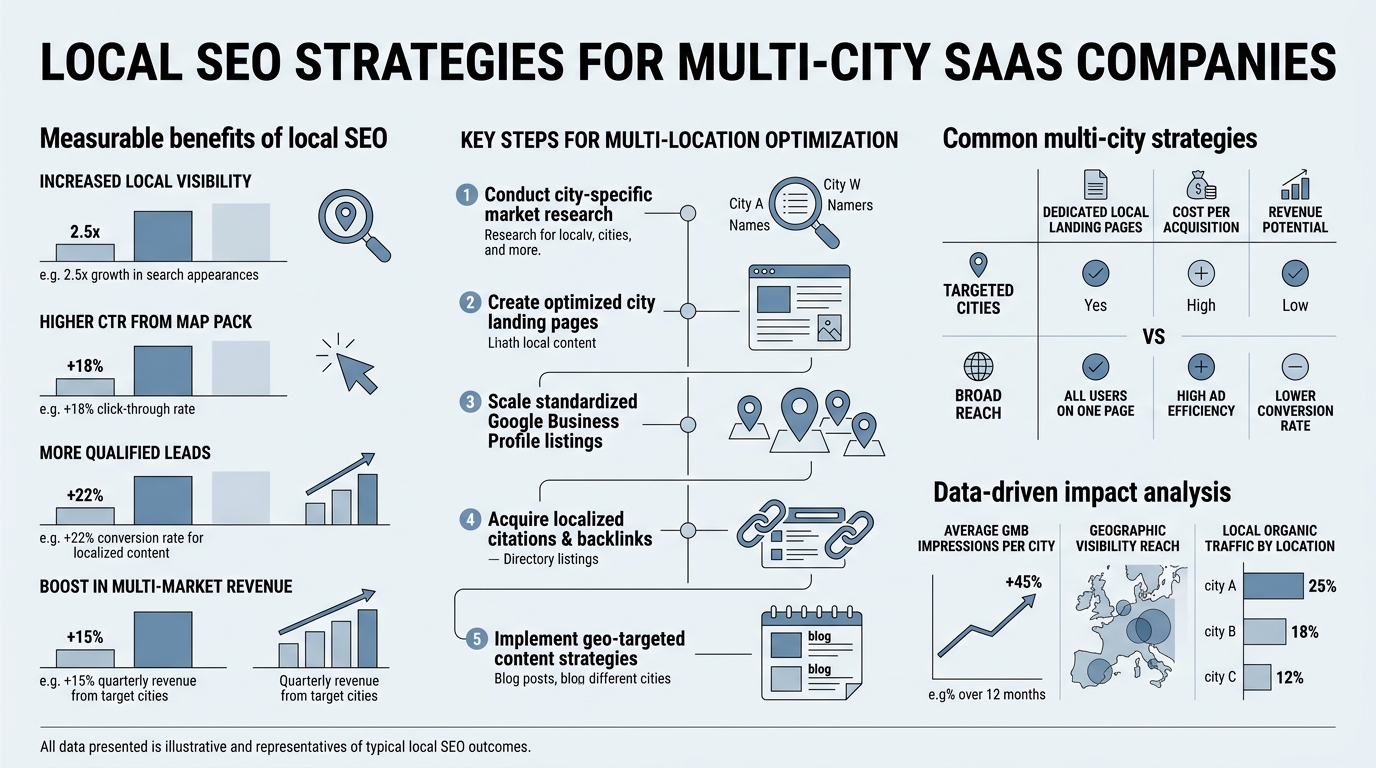
Local SEO isn't just for plumbers and pizza shops anymore. For SaaS companies with physical offices, regional teams, or service territories spanning multiple cities, local search is a major driver of qualified inbound leads. According to Sterling Sky's 2026 local SEO report, 28% of local searches result in a purchase within 24 hours, and 72% of consumers who search locally visit a location within 5 miles. When prospects in Denver search "project management software Denver" or "CRM for Denver businesses," they're showing high purchase intent — they want a solution that understands their local market.
"28% of local searches result in a purchase within 24 hours. When prospects in Denver search for 'project management software Denver,' they're showing high purchase intent—they want a solution that understands their local market." — Sterling Sky, 2026
The key difference between local SEO and traditional SEO is that you're not optimizing a single website — you're optimizing separate entities. Each physical location, regional office, or service area needs its own set of local signals: a Google Business Profile, local citations across directories, location-specific reviews, and unique content tailored to that market. Most SaaS companies skip this because they assume one global website covers all markets. That leaves thousands of high-intent local searches unranked.
The Multi-Location Entity Advantage
Google and other search engines now classify individual locations (entities) separately from websites. This means a SaaS company with 15 regional offices can rank in 15 separate local packs simultaneously — one for each city. A competitor with a single national website cannot. When properly optimized, each location becomes a separate ranking asset in Google Maps, Google Search, and increasingly, in AI Overviews. This multiplier effect is the core reason multi-location SaaS companies that execute local SEO systematically capture significantly more market share in their service areas than competitors who don't.
Local Signals Build Trust and Regional Authority
B2B buyers, especially for SaaS solutions, value regional presence and local understanding. A prospect in Austin is more likely to trust a vendor with a visible Austin office, local case studies, and team members who understand the Austin market. Local SEO helps you showcase that authority through local pack rankings, customer reviews from that specific market, and location-specific content that speaks to regional needs. This authority translates to higher conversion rates — 3.8x higher conversion rates for local vs. non-local organic traffic.
"B2B buyers trust vendors with visible local presence and regional understanding. This local authority translates to 3.8x higher conversion rates for local vs. non-local organic traffic."
How to Build a Scalable Google Business Profile Strategy Across Multiple Locations
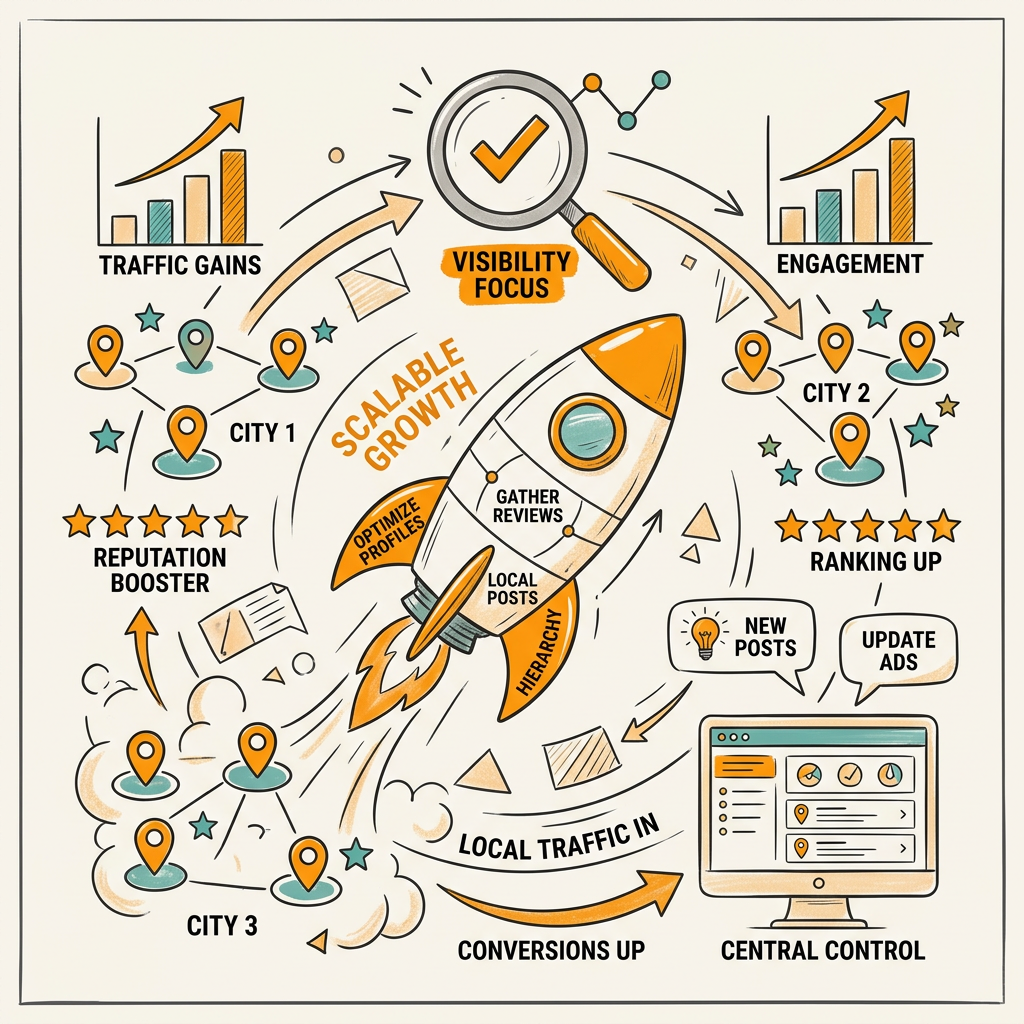
Google Business Profile (GBP) is the foundation of local SEO. It controls how your business appears in Google Maps, the Local Pack, and increasingly, in AI Overviews. 67% of AI Overviews for local queries now reference GBP data directly, which means an incomplete or poorly optimized GBP profile costs you visibility not just in traditional local search, but also in AI-generated results. Here's how to build a system that scales GBP optimization across all your locations.
Creating Verified Profiles for Each Physical Location
Start by creating a separate Google Business Profile for each distinct physical location. This is not optional — a single national GBP will not rank in local packs for multiple cities. For each location, ensure you have accurate NAP (Name, Address, Phone) information that matches your official business records. The address must be a real, verifiable physical location. If you operate from a shared coworking space or virtual address, Google may not approve a profile. Once created, verify each profile through Google's verification process (postcard, phone, or email, depending on availability in that region).
The process sounds simple, but scale introduces complexity. A 15-location SaaS company needs 15 verified profiles, each with current hours, phone numbers, and service area information. Assign ownership and maintenance responsibilities clearly — ideally, the local team or regional manager owns their location's profile. This prevents information decay and ensures updates happen quickly when details change.
Optimizing GBP for AI Overviews and AI-Driven Discovery
AI Overviews now appear in 43% of local searches, a significant shift from traditional organic rankings. These AI-generated summaries pull data directly from GBP profiles, meaning your profile content directly shapes how AI systems present your business. Optimize your GBP description to include location-specific keywords naturally. For example, instead of a generic description, use something like: "Project management software trusted by 500+ Denver companies. Built for remote teams. Starts at $29/month. Schedule a demo with our Denver-based team." This GBP description becomes raw material for AI summaries, and when done well, positions your business prominently in AI results.
Upload photos and videos monthly. AI systems favor fresh, recent visual content in their summaries. Show your local office, team members, customer installations, or community involvement in that specific city. This makes your profile more attractive to both AI systems and human searchers.
Building Service Area Definitions
If your SaaS company has regional teams that serve a broader geographic area (e.g., a Denver office that serves Colorado and Wyoming), define your service area clearly in the GBP profile. Google allows you to specify the cities and regions you serve, which helps local search understand your geographic scope. For multi-location SaaS companies, each location should have its own service area — the Denver office serves Colorado, the Atlanta office serves Georgia and the Carolinas, etc. This prevents ranking conflicts and ensures each location owns its geographic territory in search results.
How to Create Location-Specific Content That Captures Local Search Intent
Location-specific content is where local SEO moves from management task (GBP optimization) into strategic content strategy. Creating content for each city isn't about writing generic pages with city names swapped in — it's about developing genuine regional insights, local case studies, and location-tailored messaging that resonates with prospects in that market. Businesses that invest 3+ consecutive years in local SEO generate 2.7x more local organic traffic than first-year adopters, and the difference is content depth and consistency over time.
Building Location Landing Pages That Convert
Create a dedicated landing page for each major city or region you serve. This page should be distinct from your main product homepage — it's a gateway specifically designed for local searchers. Include location-specific elements:
- Local customer logos and case studies from that city
- Team members visibly based in that region
- Local compliance or regulatory requirements your solution handles
- Local pricing or service options if they differ by geography
- Testimonials from customers in that specific market
Optimize these landing pages for local keywords: "project management software Denver," "CRM for Denver teams," "best project management tool Colorado," etc. Use these keywords naturally in the H1, first paragraph, and throughout the page. Keep the page focused — this is not a second version of your main product page, it's a conversion page designed to capture local search intent and hand qualified leads to your local team.
Publishing Location-Focused Blog Content to Build Local Authority
Beyond landing pages, publish blog content that addresses local market dynamics, industry trends in that region, and local use cases specific to your SaaS. For a project management tool targeting multiple cities, blog posts might cover:
- "How Denver Tech Companies Use Async Project Management"
- "Managing Remote Teams Across Mountain and Pacific Time Zones"
- "SaaS Compliance Requirements for Denver Financial Services"
- "Best Practices for Atlanta-Based Distributed Teams"
- "Real Estate Tech Trends in the Austin Market"
This content serves two purposes: it ranks for local long-tail keywords, and it demonstrates that your company understands the specific needs and challenges of that market.
The mistake most multi-location SaaS companies make is publishing one national blog and calling it "local." That doesn't work. You need dedicated location-specific content that genuinely addresses that market's unique situation. Jottler automates research and writing at scale, enabling you to publish location-specific content daily across all your target cities without manual overhead. The AI agents research local trends, write articles tailored to each region, and publish directly to your site, building topical authority across multiple markets simultaneously. With an autonomous SEO agent, you can compound local content authority without burning out your team.
How to Maintain NAP Consistency Across Directories at Scale
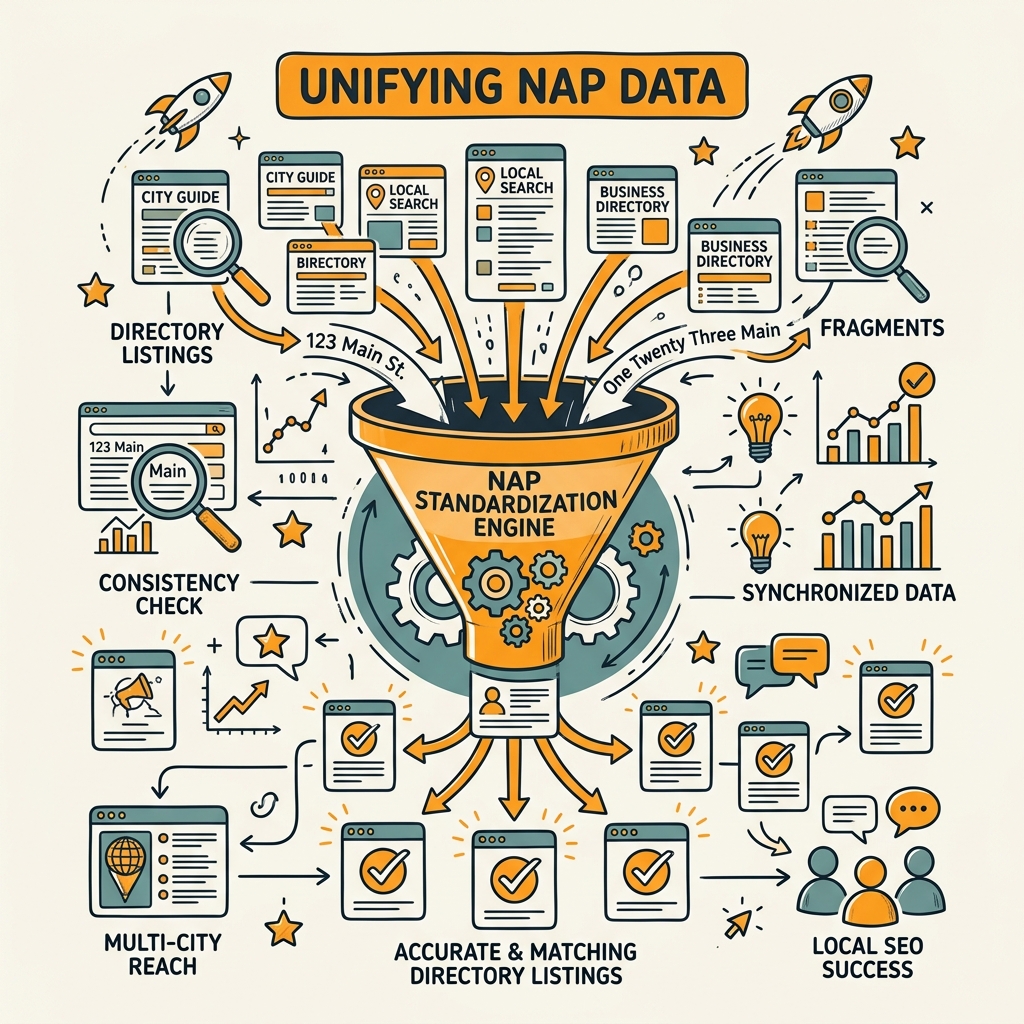
NAP consistency — keeping your Name, Address, and Phone number identical across all business directories and citations — is unglamorous but critical. According to Key-g's local SEO analysis, 100% NAP consistency across 70+ directories yields 84% more calls. When your address appears as "Denver, CO" in one directory and "Denver Colorado" in another, when your phone is (303) 555-0100 in some places and 303.555.0100 in others, search engines interpret these as different entities. This fragments your local authority and confuses search results.
Implementing a Citation Data Governance System
For a 5-location company, manually updating NAP across directories becomes a part-time job. For a 20-location company, it's impossible. Build a data governance system by following these steps:
- Maintain a master record of NAP for each location in a spreadsheet or database
- Update citations systematically whenever information changes
- Use citation management tools to monitor and push updates across 70+ directories automatically
- Prioritize major directories: Google Business Profile, Apple Maps, Bing Places, Facebook, LinkedIn
- Include industry-specific directories and local business associations
Assign one person (or team) to own citation management across all locations. Schedule monthly audits to catch inconsistencies. When address or phone changes happen, update the master record first, then propagate across all directories within 48 hours. This prevents the slow drift that undermines local authority over time. Tools and systems help scale citation management without manual overhead.
Monitoring for Data Decay and Errors
Citations decay. Third-party sites update information incorrectly, outdated directory entries persist, and former employees post wrong contact details online. Implement monthly monitoring through these actions:
- Track your NAP across key directories using dedicated monitoring tools
- Flag and monitor discrepancies automatically
- Request corrections when addresses or phone numbers diverge
- Audit inactive or outdated directories quarterly
- Monitor social media profiles and review sites for old contact information
This ongoing maintenance feels tedious, but consistency compounds — over 2-3 years, perfect NAP consistency across all directories becomes a significant local authority asset that competitors without systematic data governance will never achieve.
How to Build a Review and Reputation Management Workflow Across Multiple Locations
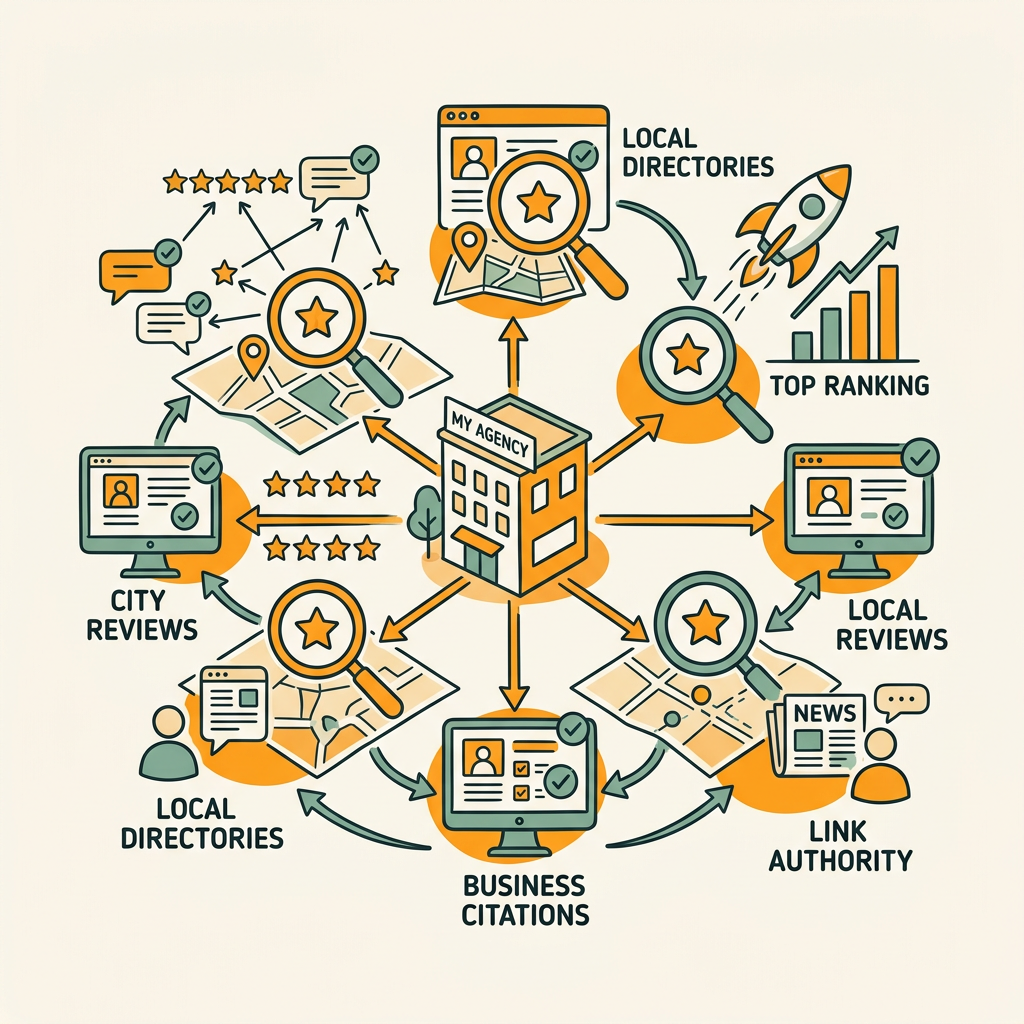
Reviews are a ranking factor in local SEO, but they're also a trust factor for prospects. A location with 20 reviews and 4.8 stars ranks higher than the same location with 5 reviews and 4.5 stars. For multi-location companies, reviews also provide social proof for each regional office. A prospect in Denver sees that your Denver team has strong reviews and assumes the service quality is local. This trust premium increases conversion rates. But generating and managing reviews at scale requires a system.
Creating a Review Generation System by Location
Don't ask for reviews generically. Create a workflow where, after a successful customer interaction or completed project with a customer in Denver, your Denver team sends a targeted request for a Google review, specifically mentioning the Denver location. Use location-tagged review request emails, SMS messages, or in-app prompts that remind customers which team helped them and direct them to review that specific location on Google. This precision increases review volume and authenticity.
Incentivize review generation using these proven methods:
- Offer small discounts on future purchases
- Entry into a monthly drawing for prizes
- Exclusive webinar or training access
- Early access to new product features
- Donation to their preferred charity on their behalf
Make it easy — provide a direct link to the Google Business Profile review page and clear instructions. Most customers will not hunt for your GBP to leave a review, but they'll happily review if you make it frictionless.
Responding to Reviews Within 24 Hours to Boost Local Ranking Signals
Response speed and quality matter. Locations with fast, thoughtful responses to all reviews see higher ranking lift than locations that respond sporadically. Build a workflow where:
- All team members flag negative or neutral reviews to a central response team
- The team responds to negative reviews within 24 hours
- Negative review responses offer to resolve the issue and move conversation offline
- Positive review responses include genuine gratitude and location-specific details
- Each response demonstrates authenticity, not templated language
Assign review response ownership by location. The Denver team owns Denver reviews, the Atlanta team owns Atlanta reviews. Local team members will respond more authentically and can offer location-specific solutions more credibly than a centralized corporate response team.
How to Build Local Citations and Link Authority for Each Location
Citations are mentions of your business (Name, Address, Phone, Website) across the web. Every mention builds a small signal of local authority. A SaaS company mentioned in a Denver startup directory, a Colorado Chamber of Commerce list, a "Best Software Companies in Colorado" roundup, and a handful of local industry awards or certifications accumulates local citation authority. Google uses citation count, quality, and consistency as local ranking factors.
Identifying High-Value Local Citation Opportunities
Don't submit to every directory. Focus on high-quality, relevant sources using this framework:
- Industry-specific directories relevant to your SaaS product
- Local business associations and chambers of commerce
- Local "best of" lists and award submissions
- Regional publications and business journals
- Startup and technology-focused directories
- Professional associations in your industry vertical
A project management software targeting Denver should be listed in Colorado tech directories, Denver tech community lists, Colorado business journals, and industry directories specific to project management. These citations are far more valuable than being listed in a generic business directory.
Create a prioritized list of 20-30 citation sources per location (shared sources like industry directories apply to multiple locations, while local sources are unique to each city). Have the local team submit to local sources — they often require a local email, phone, or approval process that's smoother when a local team member handles it. Centralize industry submissions for efficiency.
Building Links From Local Sources
Citations sometimes include links (a backlink from a directory is a citation that also links to your site). This is better than a non-linked citation. When submitting to directories, prioritize those that offer links. Additionally, engage with local media, community events, and local partnerships that might earn you links. A blog post featuring your Denver team speaking at a local conference, or a local news article about your expansion into Denver, is a high-value local link that boosts your Denver office's authority.
Building a Multi-Location Local SEO Tech Stack That Scales
Managing local SEO manually across multiple locations is unsustainable. A single-location business can manually optimize GBP, submit to directories, and respond to reviews. A 20-location company cannot. You need tools and automation.
| Category | Purpose | Best Fit for Multi-Location SaaS |
|---|---|---|
| GBP Management | Optimize profiles, upload photos, respond to reviews across all locations | Tools like Uberall or Locally handle multiple GBP profiles at scale, but Jottler integrates local content strategy into your broader organic growth system |
| Citation Management | Track and update NAP across 50+ directories, catch data discrepancies | Semrush Local, Whitespark, or Moz Local; choose based on directory coverage in your regions |
| Review Management | Generate reviews, respond to reviews, track reputation across locations | Podium, Birdeye, or GatherUp; integrate with your local team's communication channels |
| Content Creation at Scale | Research, write, and publish location-specific content without burnout | Jottler automates research, writing, fact-checking, and publishing of location-specific articles daily, handling the entire local content workflow so your team focuses on strategy |
| Local Rank Tracking | Monitor local rankings across multiple cities and keywords | BrightLocal, SE Ranking, or Semrush Local; pick based on reporting flexibility and location count |
The real bottleneck for most multi-location SaaS teams is content at scale. You can outsource GBP optimization and citation management, but creating location-specific blog posts, landing page content, and supporting sales materials for 10-20 cities requires serious writing resources. This is where automated content marketing compounds your advantage. AI content generation tools like Jottler remove the content bottleneck entirely — the system researches local topics automatically, writes 3,000+ word articles tailored to each city, fact-checks the content, and publishes directly to your site. Over 6-12 months, this compounds into a moat of local content authority that manual writing teams simply cannot match.
Conclusion
Local SEO for multi-city SaaS companies is no longer optional. With 50% of all Google searches now including local intent and 43% of local searches triggering AI Overviews, the markets you serve are explicitly searching for location-specific solutions. The companies winning this space are treating each location as a distinct entity — with its own GBP profile, local citations, reviews, content, and sales support. This requires more work than single-location SEO, but the payoff is multiplied: a properly executed multi-location local SEO strategy compounds organic traffic across all your service areas simultaneously, creating a search authority advantage that competitors still working under old SEO assumptions will never close.
Start with GBP mastery: ensure every location has a complete, verified profile optimized for AI Overviews. Layer in NAP consistency across directories — this foundation prevents your local authority from fragmenting. Build location-specific content systematically, either by hiring local writers or by automating the research and writing process so content production scales with your expansion. Implement review and citation workflows that run without constant manual intervention. Over 2-3 years, this system turns local search into a major source of qualified inbound leads for each of your markets. Start your SEO agent and let AI handle the research and content production so your team can focus on strategy and conversion.
FAQs
Can a single website rank for local searches in multiple cities?
Not effectively. While a single website can technically rank for searches like "project management software Denver," the rankings will be weak compared to a company with a dedicated location page and location-specific signals. Google prioritizes locations with separate Google Business Profile verification, local reviews, local citations, and locally-relevant content. A single national website lacks these signals for each city. The best approach is a single primary website with dedicated landing pages and content hubs for each location, plus a separate Google Business Profile for each physical office or service territory. This hybrid approach gives you the SEO benefits of location specificity while maintaining a cohesive brand and customer experience.
How often should I update my Google Business Profile information?
Update critical information (hours, phone, address) immediately when changes occur. For discretionary updates like photos, posts, and service area descriptions, aim for monthly refreshes. AI systems now favor fresh, recent GBP data in their summaries, meaning outdated profiles rank lower in AI Overviews. Set a monthly calendar reminder for each location to upload new photos (office, team, customer installations), write a post, and review the profile description. This cadence keeps your profile current enough to benefit from AI visibility while remaining manageable across multiple locations. The maintenance pays dividends — locations with monthly updates see higher engagement and visibility than static profiles.
What's the fastest way to generate more local reviews for my SaaS locations?
The fastest path is a hybrid approach: first, contact your best existing customers directly with a personal request and a direct link to your Google Business Profile review page. This usually generates 20-40% response rate. Second, implement an automated review request workflow that triggers after successful customer milestones (project completion, demo completion, first month anniversary, etc.). Third, incentivize reviews with non-monetary rewards like exclusive content, early feature access, or entry into a monthly prize drawing. Most SaaS companies see review velocity increase 3-5x when they combine personal requests from the sales or success team with automated workflows. Focus on quality over quantity — five authentic local reviews that highlight real customer outcomes outrank 20 generic, obviously incentivized reviews.