Marketing Automation Platforms: Feature Comparison
The marketing automation software market is experiencing explosive growth. 78% of mid-market B2B organizations now use marketing automation, and 95% of enterprise marketing teams run at least one platform. Yet selecting the right solution remains difficult. Each platform specializes in different use cases, pricing models, and workflows. Rather than chase features you don't need, the goal is to match your team's maturity, workflow complexity, and budget to the right fit. Here's how to evaluate marketing automation platforms by actual feature depth, not marketing hype.
Key Takeaways
- 78% of mid-market B2B organizations use marketing automation (2026, HubSpot State of Marketing).
- HubSpot leads in integrated CRM + marketing usability; ActiveCampaign dominates mid-market automation depth; Marketo remains the enterprise specialist for complex B2B orchestration.
- Automated workflows generate 320% more revenue than non-automated campaigns, justifying platform investment for teams at scale.
- CRM Integration: Centralized customer data eliminates sync complexity and enables smarter automation rules.
- Workflow Automation Depth: Branching logic, conditional paths, and multi-touch orchestration separate serious platforms from broadcast-only tools.
- Lead Scoring and Qualification: Predictive scoring and behavioral triggers accelerate handoff to sales.
- Multi-Channel Orchestration: Email, SMS, in-app, and push notifications work together instead of siloed.
- AI-Assisted Features: Predictive sending, content generation, and sentiment analysis are now table stakes across all major platforms.
What Features Matter Most in Marketing Automation Platforms?
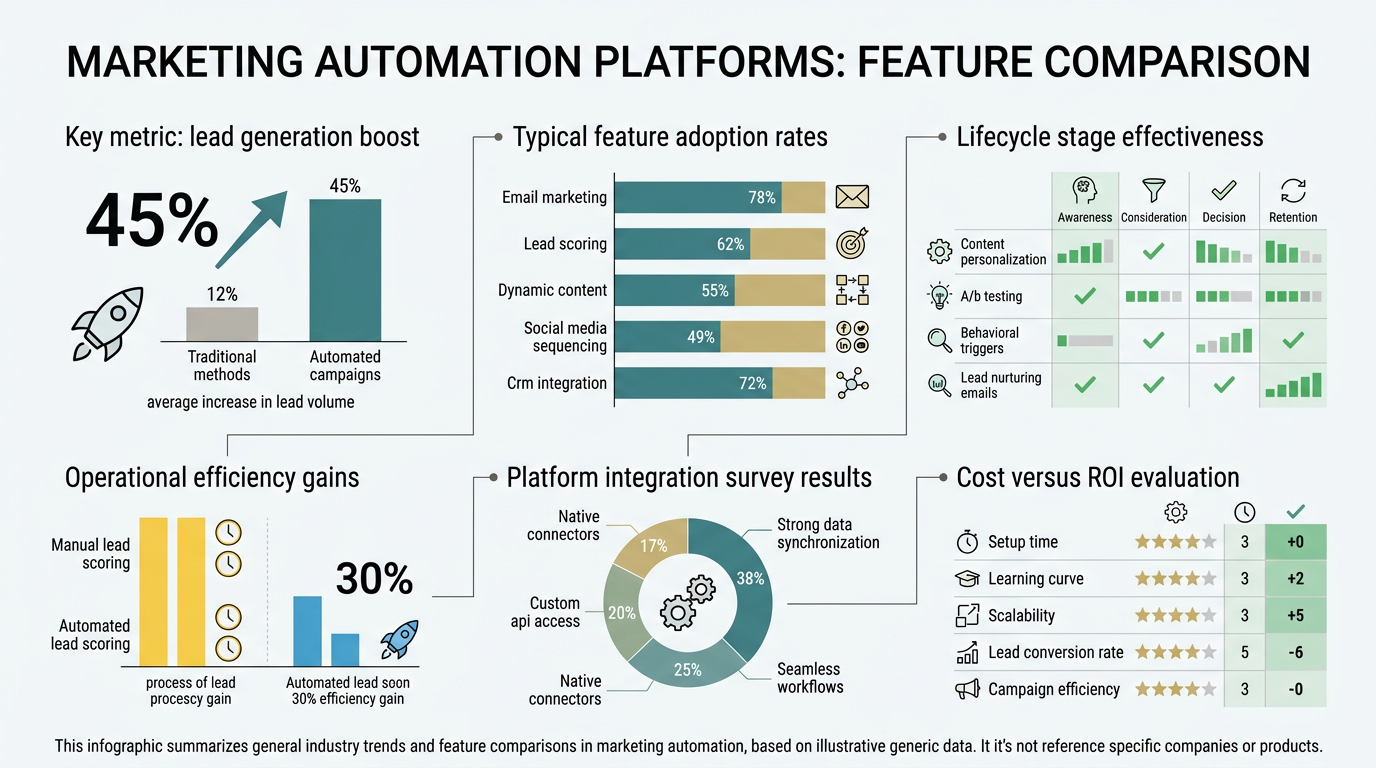
Marketing automation platforms differ less on core email sending and more on integration architecture, workflow depth, and AI maturity. Teams evaluating platforms often conflate feature count with actual value. A platform with 200 integrations means nothing if your specific CRM, data warehouse, and revenue tool aren't among them. Similarly, advanced workflow builders appeal to marketing operations teams with the bandwidth to use them, but overwhelm small teams running basic nurture flows. According to recent marketing automation statistics, the most important features to evaluate are the ones your team will actually deploy, not the features with the longest feature list.
CRM Integration and Native Architecture
The first decision point is whether you want a native all-in-one CRM + marketing platform or a specialized automation tool that syncs with an external CRM. This choice cascades into every downstream workflow decision. HubSpot's built-in CRM powers marketing, sales, and service automation from a single database, reducing sync friction and enabling cross-team visibility without API complexity. Teams that select HubSpot are essentially choosing a unified data model where contacts, companies, and deal stages live in one place. Marketo and ActiveCampaign, by contrast, are purpose-built marketing automation engines that sync with Salesforce, HubSpot, Pipedrive, or any REST API-enabled CRM. The tradeoff is architectural: unified platforms are simpler for small teams, while specialist tools offer deeper automation workflows once your team has the ops capacity to manage them.
Workflow Builder Power and Conditional Logic
A platform's workflow builder reflects its core philosophy. HubSpot's workflow interface is drag-and-drop visual, optimized for marketers who aren't engineers. It handles basic nurture, lead scoring, and sales handoff elegantly. ActiveCampaign's builder goes further: split paths, dynamic content blocks, goal tracking, and nested conditionals allow you to build multi-touch journeys where different segments receive radically different experiences based on behavior. Marketo's workflow engine is the most sophisticated of the three but also the steepest learning curve; it's designed for marketing operations professionals who write complex B2B demand generation programs involving 20+ touch points, account-based marketing (ABM) orchestration, and revenue attribution. For growing companies with 1–5 marketing team members, HubSpot's simplicity wins. For mid-market teams with 5–15 marketers and a marketing operations hire, ActiveCampaign becomes the natural fit. For enterprise teams with dedicated ops staff and complex sales cycles, Marketo's sophistication becomes necessary rather than overkill.
Lead Scoring and Sales Handoff Rules
Lead scoring directly impacts sales efficiency. Automated workflows generate 320% more revenue than non-automated campaigns, and much of that lift comes from timely, relevance-based handoff to sales. HubSpot offers simple behavioral and demographic scoring; ActiveCampaign adds predictive lead scoring powered by machine learning, which identifies which leads are most likely to close based on historical data; Marketo's scoring model is fully customizable and designed to support account-based marketing where scoring happens at both the lead and account level. For teams using sales methodologies like BANT or MEDDIC, the ability to score on explicit criteria like budget and authority is critical. ActiveCampaign's implementation of this is faster out of the box than Marketo, but Marketo's customization is deeper if your sales team has specific scoring rules.
How Do Enterprise and Mid-Market Platforms Compare?
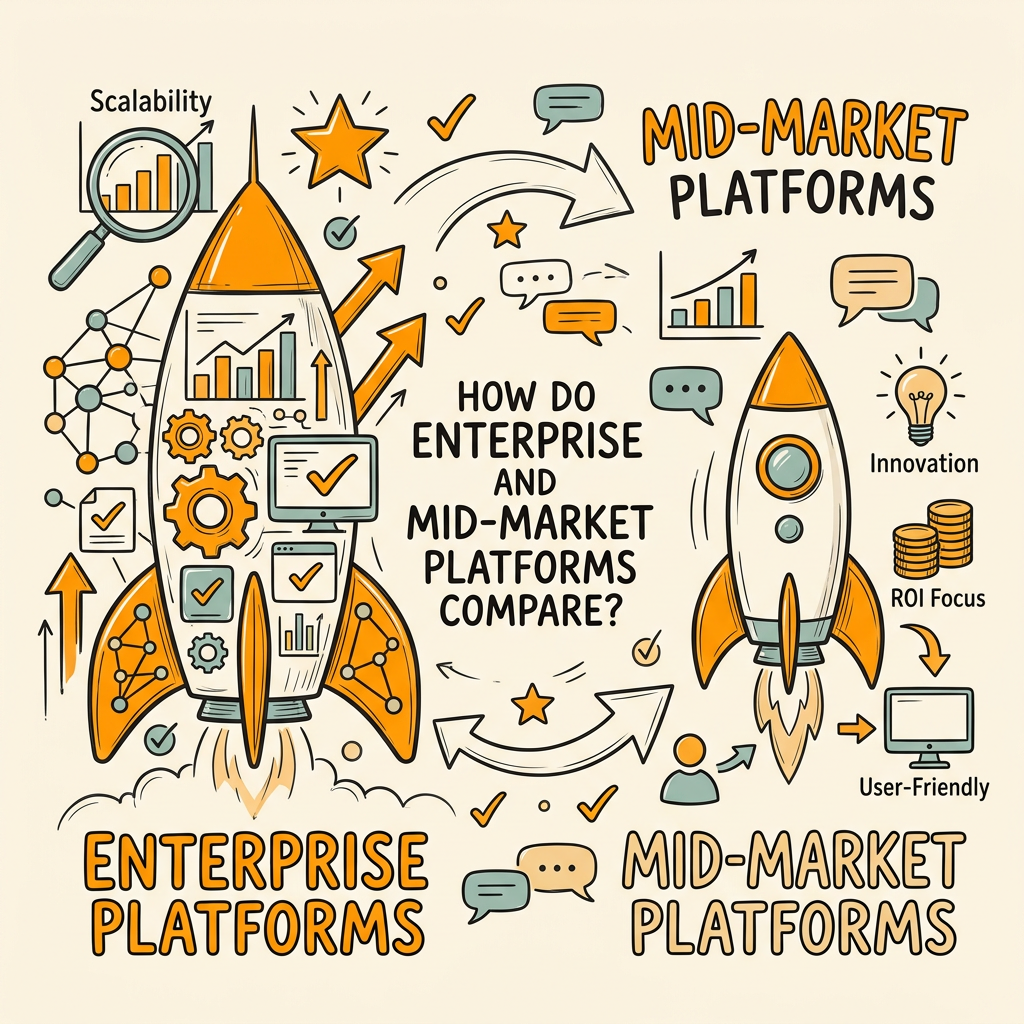
Enterprise and mid-market platforms serve different team structures and sales cycles. Enterprise platforms like Marketo are built for organizations with 500+ employees, dedicated marketing operations teams, complex sales cycles lasting 6+ months, and a need for account-based marketing and multi-touch attribution. Mid-market platforms like ActiveCampaign and HubSpot are optimized for companies with 10–200 employees, 3–15 person marketing teams, sales cycles of 1–3 months, and a balance between ease of use and workflow sophistication. The real distinction isn't the feature listit's the operational model. Enterprise platforms assume a team of experts will configure them carefully; mid-market platforms assume a lean team will need self-service onboarding and templates.
HubSpot: The All-in-One Integrated CRM + Marketing Solution
HubSpot's strength lies in unified CRM architecture and usability. A single database powering marketing, sales, and service automation eliminates the Salesforce sync complexity that plagues marketing teams. HubSpot Enterprise, updated in 2026, now supports up to 15 million contacts, 1,000 custom fields, and 10,000 formsdepth that rivals Marketo for most growing teams. The platform excels at revenue attribution, clear dashboards, and faster implementation. A typical deployment takes 2–4 weeks versus 8–16 weeks for Marketo. The tradeoff: workflow branching is simpler than ActiveCampaign, and the platform has traditionally lagged Marketo on ABM and complex orchestration. However, 2026 updates to HubSpot's custom objects and AI-assisted content generation (Breeze suite) have closed much of that gap. For founders and marketing teams at scaling companies who understand the importance of organic traffic and need to compound content marketing efforts, HubSpot integrates content production with lead nurture workflowsyou can publish blog posts, automatically nurture readers who convert to leads, and score them for sales. That end-to-end visibility is harder to achieve in specialized platforms.
ActiveCampaign: The Mid-Market Automation Powerhouse
ActiveCampaign is the default mid-market choice when automation sophistication is the priority. Its workflow builder supports split paths, nested conditionals, dynamic content, goal tracking, and predictive sendingfeatures that would otherwise require Marketo at 3–4x the cost. ActiveCampaign pricing starts around $15/month for 1,000 contacts on the Starter plan, scaling to $145+/month for Enterprise, making it the value leader for teams that want powerful automation without enterprise pricing. The platform excels with behavioral triggers, segmentation depth, and email-centric journeys. It's also built for users who don't want to learn enterprise software; the interface is approachable, and onboarding is faster than HubSpot Enterprise or Marketo. The limitation: CRM depth is lighter than HubSpot's native CRM, so deal tracking and sales forecasting require tighter Salesforce or Pipedrive integration. For teams running direct-response email campaigns, e-commerce automation, or B2B lifecycle nurture without account-based marketing complexity, ActiveCampaign delivers the best automation value.
Marketo Engage: The Enterprise B2B Specialist
Marketo is the most technically sophisticated platform for complex B2B demand generation and account-based marketing. It's built for organizations where a lead interacts with marketing 20+ times before sales engagement, and where attribution across email, ads, webinars, and content must be precise. Marketo excels at progressive profiling, complex lead lifecycle management, ABM orchestration, and revenue attribution. The cost is high: enterprise contracts often start at $60,000+ annually and scale with complexity. Implementation typically requires 3–4 months and a dedicated marketing operations professional. Marketo is the right choice for enterprise teams with Salesforce deeply embedded, complex sales processes, and the ops maturity to maintain sophisticated workflows. It is the wrong choice for teams just starting marketing automation or with simple nurture requirements. The barrier to adoption is intentionalMarketo is built for power users, not self-service.
What Feature Comparisons Reveal About Platform Fit?
A feature comparison matrix isolates the exact capabilities that differentiate platforms. The most valuable matrix compares workflow automation, lead scoring, CRM integration, multi-channel support, AI features, and implementation timelinenot raw feature count. Looking at comprehensive platform comparisons for 2026, the differences become clear when evaluated against actual team needs rather than abstract feature checklists.
| Feature Category | HubSpot Enterprise | ActiveCampaign | Marketo Engage |
|---|---|---|---|
| Best For | All-in-one CRM + marketing; usability first | Mid-market automation depth; email-first workflows | Enterprise B2B; complex ABM and attribution |
| Workflow Branching | Strong (visual builder; nested conditions supported) | Very strong (split paths, goals, dynamic content) | Deepest (multi-touch, account-level orchestration) |
| Native CRM | Yes (best in class) | Lightweight CRM included | Typically paired with Salesforce |
| Lead Scoring | Behavioral + demographic scoring | Predictive ML scoring | Fully customizable; account + lead level |
| ABM (Account-Based Marketing) | Emerging in 2026 | Limited | Strongest (dedicated ABM engine) |
| Multi-Channel (Email, SMS, Push, In-App) | Email + SMS native; push via integration | Email + SMS native; integrations for others | Email-first; others via integration |
| AI Features | Predictive scoring; Breeze content agents; send-time optimization | Predictive sending; sentiment analysis | Predictive scoring; lead routing suggestions |
| Attribution and Reporting | Clear, accessible; multi-touch revenue attribution | Good for email; limited full-funnel visibility | Most powerful for complex attribution models |
| Implementation Timeline | 2–4 weeks (simple) to 8–12 weeks (enterprise) | 1–2 weeks (simple) to 4–6 weeks (complex) | 8–16 weeks; requires ops expertise |
| Starting Price (2026) | ~$20/seat/month (Professional); $120+/month (Enterprise) | $15/month (1,000 contacts, Starter); $145+/month (Enterprise) | Quote-based; typically $60K+ annually |
When Workflow Depth Becomes Critical
Workflow depth matters when your nurture strategy involves conditional branching. A simple example: if a contact opens your welcome email, they receive a product demo. If they don't open, they receive educational content. That's basic branching, supported by all three platforms. A more complex example: if a contact visits your pricing page, downloads a comparison guide, and abandons a demo booking, they receive a discount offer. But if they book the demo, they skip directly to onboarding. That multi-step conditional logic with dynamic paths is where ActiveCampaign and Marketo begin to differentiate. HubSpot's workflow builder handles this, but with more manual rule creation. For teams running 5–10 active nurture workflows, the difference is negligible. For teams running 24–100+ active workflows (mid-market to enterprise scale), workflow sophistication becomes the limiting factor in campaign velocity.
CRM Architecture: The Hidden Constraint
CRM architecture is the hidden constraint that often outweighs feature richness. If your sales team is built on Salesforce, you have three choices: adopt HubSpot's CRM and migrate your Salesforce data (expensive, disruptive); use Marketo with a Salesforce sync (native, but two systems to maintain); or use ActiveCampaign with a Salesforce sync (simpler than Marketo, but lighter CRM capabilities). Each choice trades off simplicity, data freshness, and cost. Teams that choose HubSpot are betting that a single CRM benefits the whole organization enough to justify the migration. Teams that choose Marketo are betting that Salesforce's depth justifies maintaining two systems. Teams that choose ActiveCampaign are betting that email automation efficiency matters more than CRM sophistication. There's no wrong choiceonly tradeoffs.
How Does Pricing Compare Across Platforms?
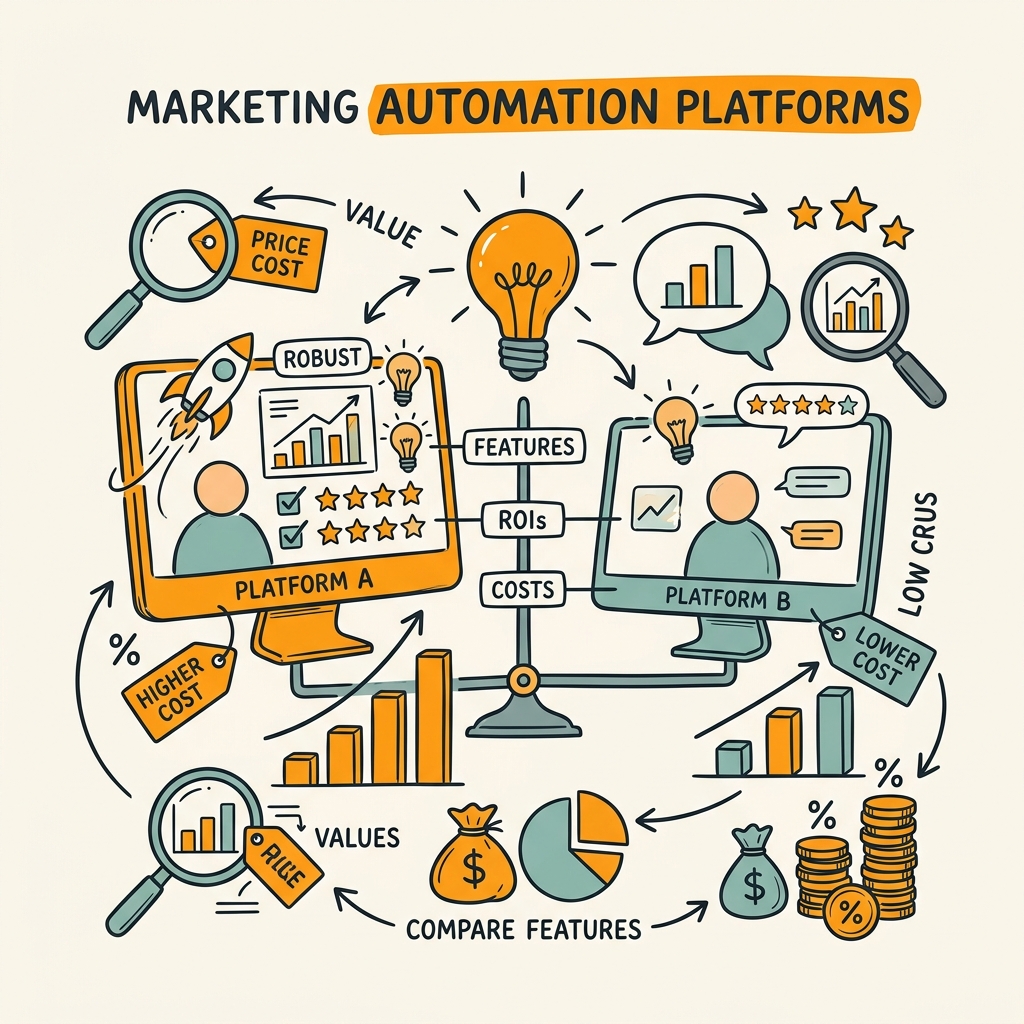
Pricing is often the hidden factor in platform selection. A platform with lower per-contact costs can become expensive as you scale, or a platform with flat-rate pricing can be cheaper than expected. Understanding the pricing modelper contact, per user, per feature, or fixed enterprise contractis essential before selecting a platform.
Per-Contact and Per-User Pricing Models
ActiveCampaign and HubSpot use per-contact or tiered pricing, which scales with your email list size. ActiveCampaign Starter is $15/month for up to 1,000 contacts, and scales to $145+/month as you grow. HubSpot Professional tier starts around $20/seat/month for users plus contact-based scaling. Marketo uses enterprise-only, contract-based pricing, typically starting at $60,000+ annually. For a team with 10,000 contacts, ActiveCampaign's mid-tier plan (~$79/month) is significantly cheaper than HubSpot Professional scaled to the same list size (~$200+/month depending on seat count). However, as you add HubSpot users for sales and service, the total cost shifts. Marketo's enterprise pricing assumes you have a dedicated marketing ops team and can leverage the platform's depth to justify the cost through complex workflows and ABM programs. The lesson: compare total cost of ownership, including seats, integrations, and implementation, not just monthly platform cost.
Hidden Costs: Implementation, Integration, and Training
Platform cost is 30% of total cost of ownership for enterprise platforms. Implementation, integrations, API usage, training, and opportunity cost of slow deployment often exceed the software cost. HubSpot's rapid implementation (2–4 weeks) versus Marketo's lengthy deployment (8–16 weeks) translates to weeks of lost productivity and delayed campaign launches. For a team of 5 marketers billing at $100/hour loaded cost, an 8-week delay is $20,000 in opportunity cost alone. Similarly, ActiveCampaign's native SMS and email automation may eliminate the need for a separate email provider and SMS tool, reducing total-tool-count costs. Conversely, if your team uses a specialized CDP (customer data platform) or requires advanced reporting integrations, Marketo's flexibility may eliminate the need for a separate data infrastructure tool. The real calculation is total platform ecosystem cost, not per-platform cost.
What's Driving Marketing Automation Adoption in 2026?
Marketing automation adoption is accelerating due to three converging trends: AI integration, multi-channel orchestration, and content marketing compounding. 79% of marketers now automate their customer journey, with 10% fully automated, 25% mostly automated, and 44% partly automated. This distribution reveals that true full-stack automation is still rare. The platforms that close the gap between manual workflows and fully autonomous marketing are winning.
AI-Powered Automation and Predictive Features
AI is now table stakes across all major platforms. HubSpot's Breeze suite includes AI-generated subject lines, preview text, and email body copy. ActiveCampaign uses predictive sending to optimize send times for individual contacts. Marketo offers predictive lead scoring and lead routing suggestions. The value isn't the existence of these features, but how usable they are. A platform with AI that generates mediocre content that hurts engagement is worse than a platform without AI. A platform with predictive scoring that integrates seamlessly into lead lifecycle workflows is valuable. A platform with predictive scoring that requires exporting data and re-importing results is a toy. The 2026 differentiation is moving from "do we have AI?" to "how well does the AI integrate with our existing workflows?"
Multi-Channel Orchestration Beyond Email
Email remains the core channel for marketing automation, but 34% of companies now run two or more automation platforms to cover SMS, push, in-app, and chat. Platforms that natively support email, SMS, and push reduce tool fragmentation. HubSpot and ActiveCampaign both support email and SMS natively. Marketo is email-first but supports SMS via integrations. The platforms that win in 2026 are those that treat every channel as part of a unified customer journey. A contact who opens your email should automatically receive SMS follow-ups if they're SMS-enabled. A contact who engages with push should move through email segments differently based on device engagement. This cross-channel orchestration requires deep integration, not just native support for multiple channels.
Content and Automation Integration
Growing companies face a specific challenge: scaling content production while maintaining quality and SEO value. 78% of mid-market B2B organizations use marketing automation, but most don't connect content production with lead nurture automation. That's where the conversation shifts. Tools that combine autonomous content generation with SEO research and publishing address this gap. For founders and marketing teams that understand the compounding value of organic traffic, automating the full content lifecycle creates a unified growth engine. HubSpot includes content hub features but doesn't automate the research and writing phase. Tools designed purely for automation don't touch content production. The platforms that integrate content research, production, and nurture automation are beginning to win in the 2026 market because they address the full growth engine, not just lead nurturing.
How Should You Evaluate and Select the Right Platform?
Platform selection should follow a structured decision framework, not a feature checklist. Begin by defining your actual use case, your team's capacity, and your CRM strategy. Then evaluate platforms against those constraints, not the other way around.
Step 1: Define Your Core Use Case and Maturity Level
Start with one honest question: are you doing simple nurture or complex orchestration? If your answer is "we send welcome emails, weekly newsletters, and re-engagement campaigns," ActiveCampaign is likely sufficient and cheaper than HubSpot or Marketo. If your answer is "we run 24+ active workflows, need lead scoring, and do account-based marketing," HubSpot or Marketo becomes necessary. If your answer is "we need complex ABM, revenue attribution, and a dedicated ops team will maintain the platform," Marketo is the only choice. This single decision eliminates 70% of the platforms you don't need.
Step 2: Lock Down Your CRM Strategy First
Before evaluating marketing automation, decide: do you want one unified CRM or are you comfortable maintaining Salesforce as the system of record? If unified CRM is the goal, HubSpot is your platform. If Salesforce is locked in, Marketo has the tightest integration. If you're Salesforce-optional, ActiveCampaign offers flexibility. This decision determines your total cost and implementation timeline more than any feature comparison. Integrating content automation with marketing automation becomes possible when your CRM architecture is clear and aligned to your team's tools.
Step 3: Map Your Workflow Complexity and Active Workflow Count
Count the number of active workflows your team will run in year one and year two. Simple nurture is 3–5 workflows. Mid-market programs run 10–24 workflows. Enterprise programs run 100+ workflows. This number directly correlates to workflow builder sophistication. A 5-workflow team is happiest on HubSpot. A 24-workflow team needs ActiveCampaign. A 100-workflow team needs Marketo.
Step 4: Pilot With a Free Trial or Freemium Tier
Request a demo and free trial on the top 2–3 candidates. Spend 30 minutes building a real workflow in each platformnot a theoretical workflow, but the nurture sequence you'll actually use in month one. Platform selection is 30% feature richness and 70% how naturally the workflow builder fits your brain. Some teams think visually and love drag-and-drop builders. Other teams think logically and prefer text-based rule configuration. Your comfort with the UI often matters more than raw capability.
Conclusion
Selecting the right marketing automation platform is a decision about team structure, CRM architecture, and workflow complexity, not feature count. HubSpot is the integrated all-in-one choice for unified CRM and marketing, with clear revenue attribution and faster implementation than specialist platforms. ActiveCampaign is the mid-market default for automation depth without enterprise complexity or cost. Marketo is the enterprise specialist for complex B2B demand generation and account-based marketing. For growing companies that understand the importance of organic traffic, automating content production alongside marketing automation creates a compounding growth engine. The right platform is the one that matches your team's maturity, your CRM strategy, and your workflow complexity. Once you've answered those three questions, feature selection becomes straightforward. Start your SEO agent to begin automating the content that feeds your marketing automation platform.
FAQs
Which marketing automation platform is best for small teams?
For teams under 10 people with simple nurture workflows and tight budgets, ActiveCampaign is the best choice. It starts at $15/month for 1,000 contacts, offers powerful automation workflows (split paths, conditional logic, goal tracking), and requires minimal implementation time. HubSpot is also viable if you want a unified CRM and don't mind starting at a higher per-seat cost. Marketo is overkill for small teamsits enterprise complexity and pricing make it unsuitable until you have a dedicated marketing operations hire and complex lead lifecycle requirements.
What's the difference between HubSpot and Salesforce-compatible platforms like Marketo?
HubSpot is an all-in-one system with a built-in CRM that replaces Salesforce for marketing and sales teams. This means one database, tighter integration, and faster implementation, but it requires migrating away from Salesforce if you're already invested. Marketo is a specialized marketing automation platform designed to pair with Salesforce as your CRM. It offers deeper automation workflows and better ABM capabilities, but you maintain two systems, sync data between them, and need more ops expertise to configure. Choose HubSpot if you want simplicity and unified data. Choose Marketo if you're Salesforce-committed and need complex automation orchestration.
How much should a marketing automation platform cost?
There's no single answerit depends on your team size, contact volume, and feature depth. ActiveCampaign starts at $15/month and scales to $145+/month. HubSpot starts around $20/seat/month and can reach $500+/month for multiple users on enterprise plans. Marketo requires an enterprise contract typically starting at $60,000+ annually. The cheapest platform often isn't the best valueconsider total cost of ownership, including implementation time, training, and integrations. A $500/month platform that deploys in 2 weeks and generates $50,000 in incremental pipeline value is cheaper than a $100/month platform that takes 12 weeks to launch.