Nurturing Leads with Marketing Automation Content Sequences
Only 25% of inbound leads are sales-ready at first contact. The other 75% require strategic nurturingyet most teams default to sporadic outreach or no follow-up at all. This explains why 79% of non-nurtured leads never convert, even though 63% of leads not ready to buy eventually purchase if systematically nurtured. The solution isn't more email blasts. It's a predictable, content-driven nurturing framework powered by marketing automation that guides prospects toward readiness using behavioral triggers, progressive education, and personalization at scale.
Key Takeaways
- Marketing automation for lead nurturing delivers a median ROI of $5.44 per $1 invested (Forrester, 2026)
- AI-driven nurturing sequences achieve 94% conversion improvement and 108% more lead volume than manual campaigns (HubSpot, 2026)
- Nurtured leads close 47% larger deals and convert at 50% higher rates at 33% lower cost (Forrester, 2026)
- Why Lead Nurturing Matters at Scale: 63% of non-ready leads convert with systematic automation, delivering 50% more sales-ready leads at 33% lower cost than cold outreach.
- Building Behavioral Content Sequences: Move from static email drips to branching workflows that adapt based on engagement, clicks, and demographic intent signals.
- Segmentation and Personalization Strategy: Behavioral segmentation drives relevance; 80% of buyers expect personalized experiences, and sequences must progress logically through awareness, consideration, and decision stages.
- Multi-Channel Orchestration: Coordinating email with social, video, and conversational AI across multiple touchpoints yields 287% higher purchase rates than single-channel sequences.
- Automation Workflow Architecture: Pre-built templates, trigger-based sending, and real-time intent scoring cut implementation time and accelerate ROI19% of programs show measurable returns in just 30 days.
Why Lead Nurturing Automation Drives Revenue
Lead nurturing automation closes the gap between prospect interest and purchase readiness. When a prospect downloads a resource or visits your pricing page, they've signaled interestbut they're not ready to buy yet. The traditional sales team approach of immediate outreach fails because the prospect is still educating themselves. Instead, automated nurturing sequences deliver the right content at the right time, progressing the prospect through awareness, consideration, and decision stages without requiring manual follow-up.
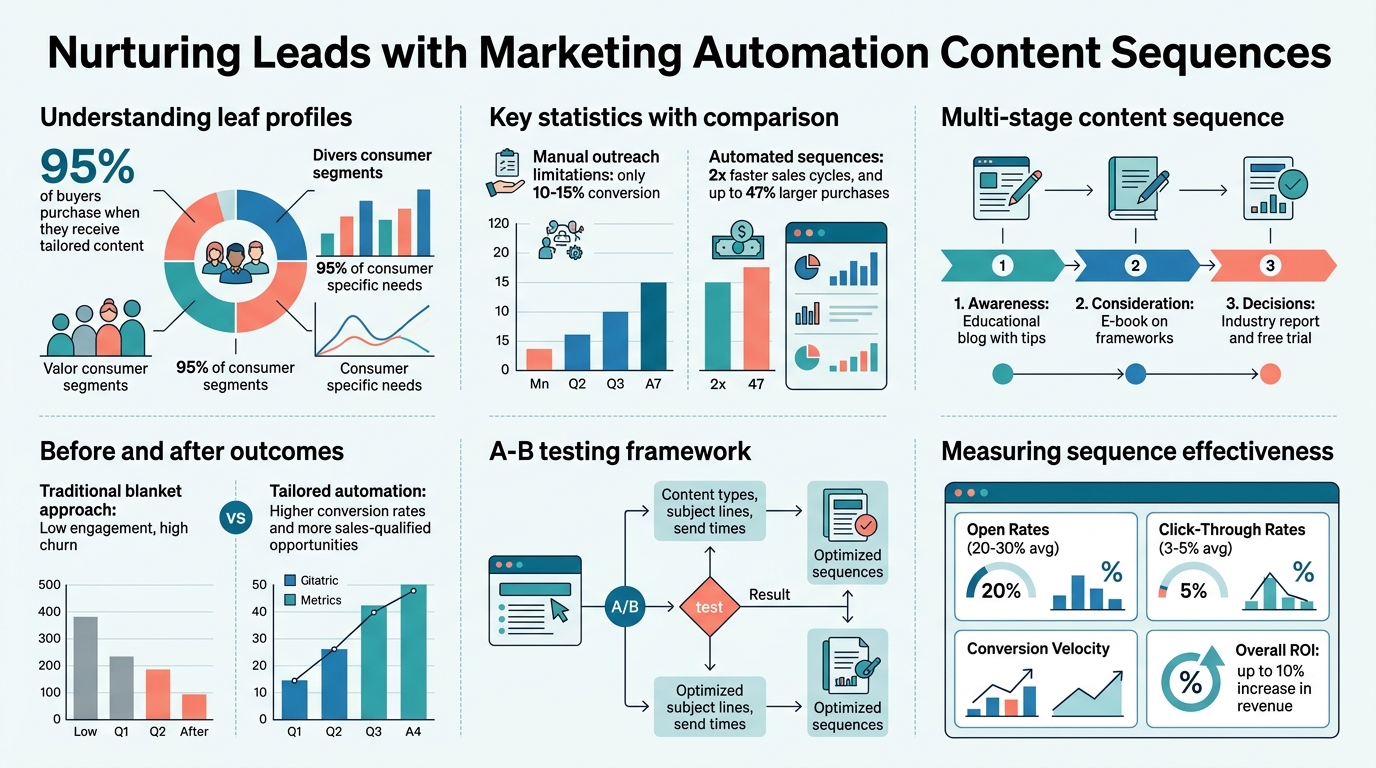
Here's what this looks like in numbers: companies using marketing automation for lead nurturing report 451% more qualified leads, with nurtured prospects closing 47% larger deals. The top quartile of automation programs achieve $8.71 ROI for every $1 invested over three years. More immediately, 19% of organizations report measurable positive ROI within 30 daysprimarily those using pre-built templates and pre-integrated CRM data.
The mechanics are straightforward: automation removes the friction of manual outreach, scales personalization, and ensures no prospect falls through the cracks due to human scheduling constraints.
The Gap Between Lead Capture and Sales Readiness
The first problem automation solves is timing. A prospect who fills out a gated content form isn't ready to hear a sales pitch. They're in the awareness or early consideration phase. Sending them a demo request or pricing page immediately damages the relationship. Yet manually tracking where each of 500+ leads sits in the buying journey is impractical.
Automated sequences bridge this gap by delivering educational content, case studies, and comparative resources on a predictable cadence. A B2B SaaS company, for example, might structure a nurturing sequence this way:
- Day 1 (Awareness): Welcome email + industry benchmark report
- Day 4 (Consideration): How-to guide addressing a top pain point
- Day 8 (Consideration): Case study showing results
- Day 12 (Decision): Pricing and comparison resource
- Day 16 (Decision): Soft demo or free trial offer
Each step assumes the prospect has digested the prior content. This progressive structure works: automated sequences generate 320% more revenue than non-automated batch campaigns.
Behavioral Triggers vs. Calendar-Based Sends
The second advantage of automation is behavioral intelligence. Not all prospects move through the journey at the same pace. Some spend 3 days researching; others spend 3 weeks. Calendar-based sequences (send email on Day 4 regardless of engagement) waste that investment by sending the same message to completely different audience segments.
Behavioral triggers flip this: send the next email when the prospect engages with the current oneclicking a link, downloading a resource, or visiting your pricing page. Triggered emails deliver 47.1% open rates vs. 21.3% for batch sends, and 8% click-through rates vs. 3% for generic campaigns. The dynamic approach respects the prospect's pace while accelerating those who are actively evaluating.
How to Design Behavioral Content Sequences
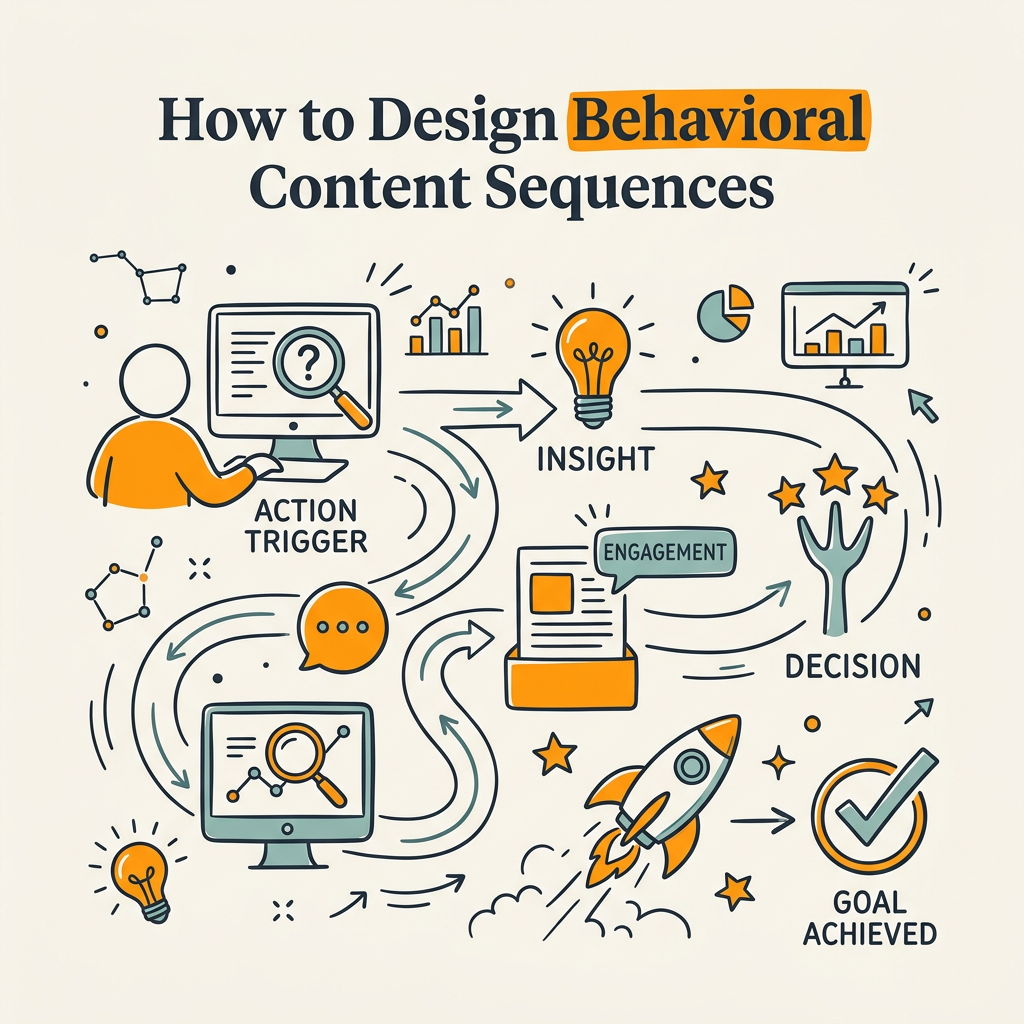
A high-performing nurturing sequence is built on three pillars: logical content progression, behavioral branching, and one clear call-to-action per email. The difference between a sequence that converts and one that underperforms often comes down to structure. Most teams either send generic content to everyone (low relevance) or attempt hand-crafted personalization for every lead (not scalable). The solution is a templated framework with dynamic branching. When structured correctly, content marketing automation at scale ensures consistency and relevance across all prospect interactions.
Mapping Content to Buyer Journey Stages
Your content library should reflect the buyer's mindset at each stage. Awareness-stage prospects haven't yet identified their problem. Consideration-stage prospects know the problem and are evaluating solutions. Decision-stage prospects are comparing vendors. Sending a pricing page to an awareness-stage prospect is like closing the sale before opening the conversation.
Structure your sequence by buying stage, not chronology:
- Awareness: Problem-focused content (e.g., "5 Signs Your Process Is Broken," industry reports, webinars)
- Consideration: Solution-focused content (e.g., "How Teams Like Yours Solve X," how-to guides, best practices, case studies)
- Decision: Vendor-focused content (e.g., pricing, ROI calculators, product comparisons, free trials, testimonials)
Email copy must stay under 300 words and focus on one topic with one CTA. This isn't a limitationit's the best practice. Longer emails have lower engagement; multiple CTAs confuse the reader on what action to take next. Prospect your sequence internally: if it feels redundant or sells too hard, trim it.
Building Branching Logic for Engagement-Based Paths
Static drip campaigns send the same sequence to all subscribers. Branching workflows adapt based on engagement. If a prospect clicks on an awareness-stage email, they're signaling interestskip to consideration content. If they ignore it, send a secondary awareness email before progressing. This isn't manualthe marketing automation platform executes the logic automatically.
A typical branching structure looks like this:
- Trigger: Prospect downloads a gated guide
- Send Awareness Email 1
- Decision Point: Did they click the link in Email 1?
- YES: Send Consideration Email (they're engaged)
- NO: Wait 2 days, send Awareness Email 2 (alternative angle on the same problem)
- Second Decision Point: Did they engage with Email 2?
- YES: Send Consideration Email
- NO: Send a single follow-up + move to re-engagement cadence
This approach personalizes without requiring manual intervention. Each prospect follows their own path based on real behavior, not assumptions. The result is higher engagement, better conversion, and clearer lead quality signals for sales.
Setting Cadence and Frequency Benchmarks
How often should you send? The answer depends on your audience and content value, but industry benchmarks are clear: for warm leads, a cadence of every 1–2 weeks maintains engagement without overwhelming the prospect. B2B SaaS companies typically structure 8-email sequences over 30 days; B2B services aim for 13 emails over 21 days. The key is consistency, not volume.
If your content is genuinely valuablecase studies, data-backed guides, expert interviewsa weekly send performs well. If it's promotional or thinly veiled pitches, reduce frequency to bi-weekly. More importantly, respect unsubscribes and engagement signals. If a prospect hasn't opened an email in 3 sends, move them to a re-engagement track before continuing the main sequence.
Segmentation and Personalization at Scale
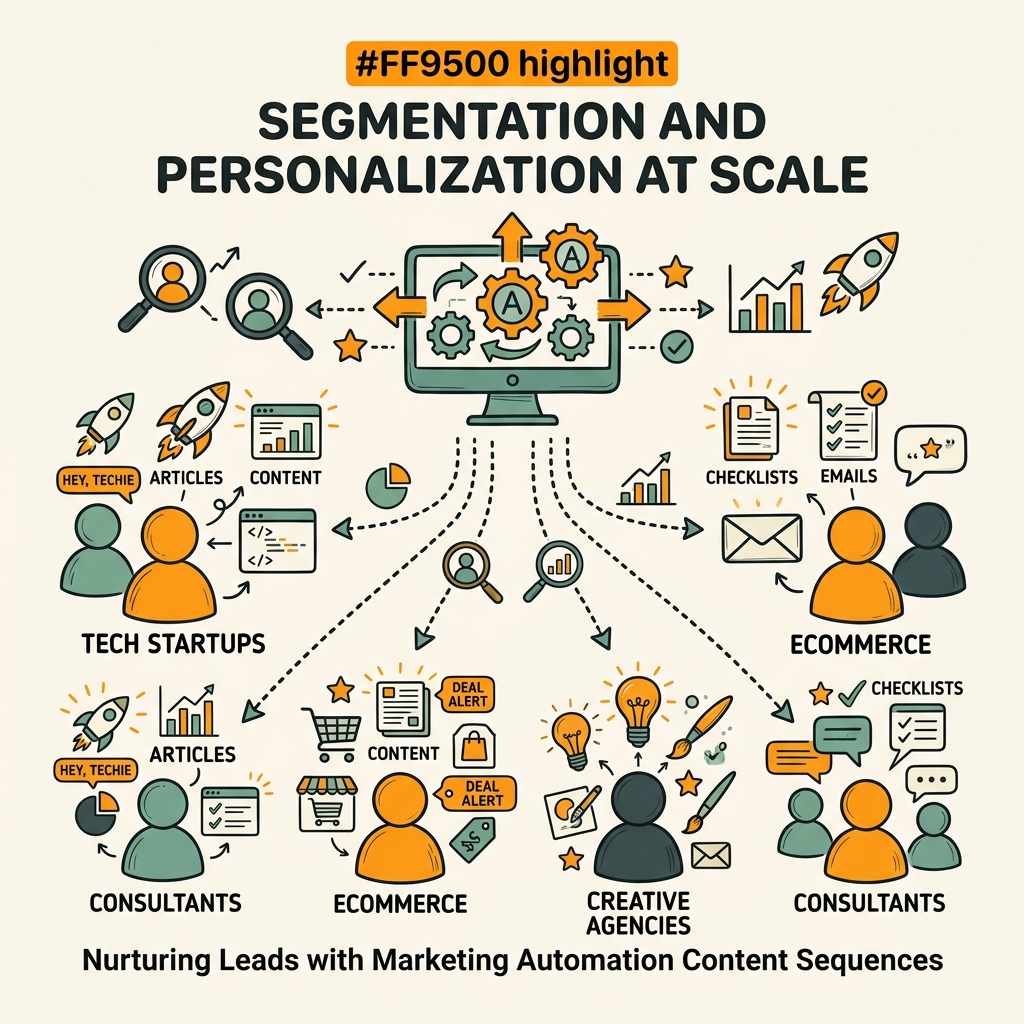
The gap between a mediocre nurturing sequence (20% open rate) and a strong one (50%+) is segmentation. 90% of marketers believe personalization is essential to business success, and 80% of buyers are more likely to purchase from brands offering personalized experiences. Yet most teams implement only basic demographic segmentation (company size, industry, role). True personalization goes deeper: it's behavioral, intent-based, and progressive.
Moving Beyond Demographics to Behavioral Signals
Demographic segmentation is the starting point: you might segment by company size (SMB vs. enterprise) or industry (healthcare vs. SaaS). But behavioral segmentation is where conversion happens. Track these signals:
- Engagement Patterns: Email opens, link clicks, content downloads, website session duration
- Content Consumption: Which topics does the prospect engage with? (pricing, use cases, integrations, etc.)
- Intent Signals: Visit frequency, pages reviewed, time spent on pricing or comparison pages
- Stage Progression: Did they move from one buying stage to the next, or stall?
AI-driven intent scoring increases targeting accuracy by 40–50%, directly improving conversion rates. The intelligence here is automatic: modern marketing automation platforms assign intent scores to each lead based on these behaviors, allowing you to prioritize hot leads for sales outreach while maintaining nurture cadence for cooler prospects. AI-driven content strategy frameworks help ensure each personalized touchpoint is genuinely relevant to the prospect's demonstrated interests.
Progressive Profiling and Dynamic Personalization
Instead of demanding a 15-field form upfront (which kills conversion), use progressive profiling: ask one or two questions per email touchpoint. Over 3–4 emails, you'll gather role, department, specific use case, and timeline without friction. Then use that data to personalize future emailsnot just with first names, but with role-specific pain points, company-relevant case studies, and use-case-specific resources.
For example, if a prospect identifies as a "head of marketing at a SaaS company interested in demand generation," the next email could reference a case study of another SaaS company's lead gen results, a how-to guide specific to demand gen workflows, and a CTA offering a free demand gen audit. Generic emails to the same list get 2% click rates; role-specific emails get 5–8%.
Creating Audience Segments for Different Buyer Personas
Your company likely has 2–4 distinct buyer personas: maybe an executive (focused on ROI), a practitioner (focused on ease of use), and a technical buyer (focused on integration and security). A single nurturing sequence won't resonate with all three. Instead, create parallel sequences tailored to each persona's concerns and goals.
- Executive Persona: Focus on business outcomes, competitive advantage, time-to-value
- Practitioner Persona: Focus on process improvements, best practices, feature education
- Technical Persona: Focus on architecture, security, API docs, integrations
Segment your audience by self-identified role during the signup or progressive profiling process. Route each segment to its respective sequence. The conversion uplift is significant because the messaging aligns with what each buyer actually cares about.
Orchestrating Multi-Channel Sequences Beyond Email
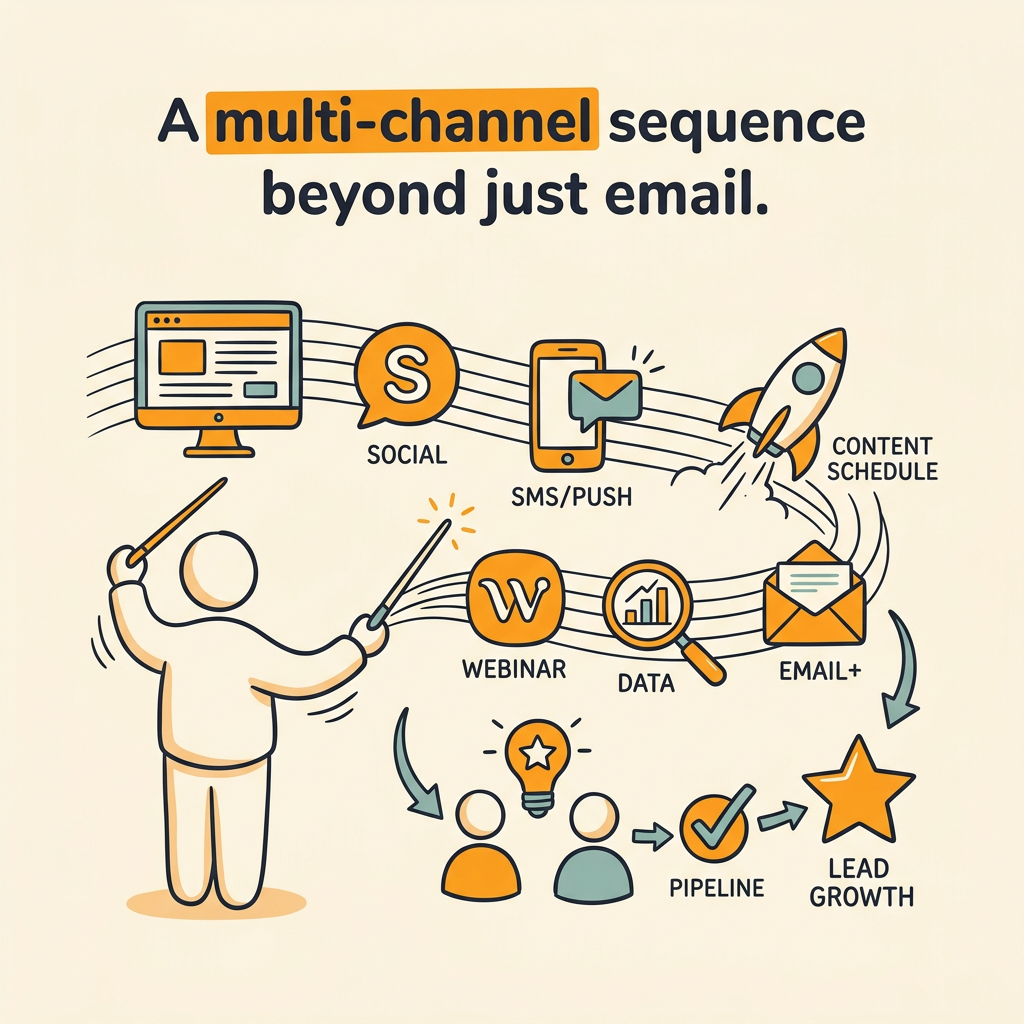
Email is the engine of automation, but it's not the only channel. Prospects consume content across email, social media, website experiences, and messaging platforms. Multi-channel automation yields 287% higher purchase rates than single-channel sequences. The best nurturing frameworks coordinate across channels, ensuring consistent messaging and touchpoints without overwhelming the prospect.
Integrating SMS, Social, and Conversational Touchpoints
Email remains the highest-ROI channel, but adding complementary touchpoints increases velocity. Consider this multi-channel approach:
- Email (Primary): Educational content, case studies, resources, offers
- SMS (Tactical): Time-sensitive notifications (webinar in 2 hours, limited-time offer), re-engagement pings
- Social (Awareness): Retargeting with case studies, testimonials, content amplification
- Conversational AI (Engagement): Live chat, chatbots answering FAQs, proactive outreach if a prospect stalls
The key is orchestrationnot overload. If a prospect engages with your email, you might follow up with a social ad showcasing a related case study, or a chatbot prompting them to book a demo. If they ignore the email, hold off on SMS. Respect the prospect's engagement level; automation should enhance the journey, not spam it.
Leveraging Website Experiences for Real-Time Engagement
Your website is a nurturing asset. When a prospect visits and hasn't yet converted, show them contextual CTAs: if they're on your pricing page, offer a comparison guide; if they're on a feature page, offer a how-to video. If they're a known lead returning to the site, customize the experience to their stage and interests. This real-time personalization bridges the gap between email and direct engagement, accelerating readiness without feeling pushy.
Implementing Automation with Templates and Triggers
Building a nurturing sequence from scratch is painful. Most teams waste weeks copywriting, designing, and setting up logic. The fastest path to ROI is using pre-built templates and trigger frameworks that have been battle-tested with thousands of leads. This is where modern automation platforms shinethey let you customize proven sequences rather than invent from zero.
Choosing the Right Automation Platform
Not all marketing automation platforms are created equal. Look for capabilities that matter:
- Pre-built Sequence Templates: Start with proven frameworks (welcome series, webinar follow-up, abandoned cart, re-engagement) rather than blank slates
- Behavioral Trigger Logic: Build branching workflows based on clicks, opens, form submissions, and website behavior
- CRM Integration: Sync lead behavior with sales tools (HubSpot, Salesforce) so sales knows exactly where each prospect is
- AI-Powered Segmentation: Automatic lead scoring based on engagement and intent, not manual rules
- Multi-Channel Orchestration: Send email, SMS, and social ads from a single platform
Tools like HubSpot, Marketo, and Klaviyo all support these, but with different tradeoffs. Platforms built for automation with built-in content generation capabilities create a compounding advantage: you can nurture leads consistently only if you have enough quality content to draw from. If you're short on content, building a nurturing sequence is pointless without a supply chain to feed it.
Setting Up Trigger-Based Automation at Launch
The fastest wins come from trigger-based campaigns. These are event-driven workflows that activate when a specific condition occurs. Examples:
- Download Trigger: Prospect downloads a guide → welcome email + 4-email awareness sequence
- Webinar Trigger: Prospect registers → reminder 24 hours before + attendee follow-up sequence
- Stalled Lead Trigger: No email opens in 14 days → re-engagement email or move to hold campaign
- High-Intent Trigger: Prospect visits pricing page 3+ times → alert sales team + send decision-stage content
- Form Submission Trigger: Prospect completes a needs assessment → role-specific sequence
Each trigger fires a sequence automatically, scaling personalization without manual work. Set these up at launch to begin building your lead intelligence immediately.
Measuring Sequence Performance and Optimization
Automation generates data. Use it. Track these metrics per sequence:
- Email Metrics: Open rate, click-through rate (CTR), unsubscribe rate
- Conversion Metrics: Form submission rate, booked demo rate, CTA conversion rate
- Lead Quality: How many leads move to SQL (sales-qualified lead) status?
- Revenue Metrics: Deals closed from this sequence, average deal size, sales cycle length
- Engagement Velocity: Time from first email to qualified lead (faster is better)
Benchmark these against industry standards (most platforms show you average performance across their customer base). If your open rates lag by 5+ points, test subject lines. If CTR is weak, test copy or CTA button color. If conversion stalls, the content may not match the promise of your lead magnetrevisit the alignment. A proven SaaS content marketing framework will accelerate both content creation and nurturing optimization.
| Metric | Benchmark (2026) | Best-in-Class Performance | Action If Below Benchmark |
|---|---|---|---|
| Email Open Rate | 20–30% | 40%+ | Refine subject line; test send time |
| Click-Through Rate (CTR) | 2–5% | 8%+ | Simplify copy; strengthen CTA |
| Conversion (Lead → SQL) | 5–15% | 20%+ | Review content relevance; add re-engagement |
| Unsubscribe Rate | <0.5% | <0.2% | Reduce frequency; test content quality |
| Sales Cycle Reduction | –15% | –25%+ | Accelerate trigger-based sends; add decision-stage content |
Real-World Sequence Examples Across Industries
The principles above apply universally, but execution varies by industry. Here's how three different companies might structure their lead nurturing sequences, adapted to their sales cycles and buyer needs.
SaaS Product Company: 8-Email Sequence Over 30 Days
SaaS buying cycles are typically 30–90 days. Early nurturing should focus on education and use case alignment, not product features.
- Day 1: Welcome email + link to top-3-use-cases resource
- Day 4: How-to guide (one key feature deep-dive)
- Day 8: Case study (similar company, similar use case, quantified results)
- Day 12: Webinar or demo request (soft ask)
- Day 16: Comparison guide (your tool vs. alternatives)
- Day 20: Pricing + ROI calculator
- Day 24: Free trial or freemium signup (low-friction conversion)
- Day 28: Success story + customer testimonial video
Then hand off to sales if SQL; move to re-engagement if no conversion.
B2B Services: 13-Email Sequence Over 21 Days
Services sales rely on trust and expertise. Nurturing should position your team as thought leaders.
- Day 1: Welcome + link to industry benchmark report
- Day 2: Insider tips (3 quick wins they can implement today)
- Day 4: Long-form guide (the definitive resource on their pain point)
- Day 6: Client case study (detailed results + methodology)
- Day 8: Expert interview or webinar (you as the authority)
- Day 10: Second case study (different industry, same core problem)
- Day 12: Comparison: DIY vs. outsourced (why they should hire you)
- Day 14: Consultation offer + qualification questions
- Day 16–21: Nurture 4–6 more touches on objections (price, timelines, complexity)
Enterprise B2B: Account-Based Nurturing for Multiple Stakeholders
Enterprise deals involve multiple buyers. Your sequence should address different roles and orchestrate across them.
- Executive Track: ROI case studies, competitive positioning, board-level impact
- Operations Track: Process diagrams, integration roadmaps, implementation timelines
- Technical Track: Architecture docs, security certifications, API reference
- Procurement Track: Pricing, contract terms, customer references
Each track runs in parallel for the 4–6 months of the typical enterprise sales cycle, with coordinated touchpoints to keep the conversation moving forward across all stakeholders.
Conclusion
Nurturing leads with marketing automation content sequences is no longer optional for growth-focused companies. The data is clear: nurtured leads convert 50% more often, close larger deals (47% larger on average), and do so at 33% lower cost. Automation enables this by removing the friction of manual follow-up, scaling personalization, and adapting content to each prospect's engagement level and buying stage.
The path forward is straightforward: map your content to the buyer journey, build behavioral workflows that branch based on engagement, segment by persona and intent, and measure ruthlessly. 19% of organizations now see measurable ROI in just 30 daysthe fastest wins come from pre-built templates, pre-integrated CRM data, and trigger-based automation.
If you're currently managing lead follow-up manually or rely on static batch-and-blast campaigns, the opportunity is massive. Even small refinements in cadence, content relevance, and trigger logic compound over time into meaningful revenue growth. Start with one high-value sequence, measure it, optimize it, then replicate the framework across additional buyer segments. Start your SEO agent today and let automation handle both your content supply and nurturing workflows.
FAQs
What is the best cadence for lead nurturing emails?
For warm leads, the industry standard is every 1–2 weeks. More frequent sends (multiple emails per week) risk fatigue and unsubscribes unless the content is exceptionally valuable. SaaS companies typically structure 8 emails over 30 days; B2B services use 13 emails over 21 days. The key is consistency and relevance: if your content is genuinely valuable (case studies, data-backed guides, expert interviews), weekly sends work. If it's thinly veiled pitches, reduce to bi-weekly. Always monitor unsubscribe and engagement ratesif you see a spike in unsubscribes, your cadence or content relevance needs adjustment.
How do you segment leads for targeted nurturing sequences?
Start with behavioral signals, not just demographics. Track engagement patterns (email opens, link clicks, content downloads), content consumption (which topics resonate), intent signals (pricing page visits, comparison page time spent), and stage progression (are they moving from awareness to consideration). AI-driven intent scoring boosts targeting accuracy by 40–50%, automatically assigning priority scores based on these behaviors. Use progressive profiling (asking 1–2 questions per email) to gather role and use-case data without killing early conversion. Then create parallel sequences for each buyer persona (executive, practitioner, technical buyer), ensuring each segment receives messaging aligned to their actual priorities.
What metrics indicate a successful lead nurturing sequence?
Track four metric categories. First, engagement: aim for 20–30% email open rates and 2–5% click-through rates. Second, conversion: measure how many leads move from early-stage (MQL) to sales-qualified (SQL) and how many become customers. Third, revenue impact: monitor average deal size, sales cycle length, and total revenue attributable to the sequence. Fourth, quality: ensure sales is actually following upnurturing metrics mean little if sales ignores the leads. Compare your metrics against industry benchmarks for your space; most automation platforms show peer data. If metrics lag, test subject lines, simplify copy, strengthen CTAs, or review content-to-promise alignment.