On-Page SEO Checklist for Better Rankings
On-page SEO is the foundation of every ranking. 73% of websites have at least one critical on-page SEO issue that prevents them from competing for traffic, yet most of these problems can be fixed in weeks, not months. The challenge isn't knowing what to optimize—it's executing consistently across pages while managing content production at scale.
Key Takeaways
- 73% of websites have critical on-page SEO problems (RankNibbler, 2026), yet on-page fixes can move pages from position 11–30 to page one in 2–4 weeks.
- Pages with properly optimized titles and meta descriptions achieve 45% higher click-through rates than those without keyword placement (Backlinko, 2025).
- Sites missing structured data schema rank 2–4 positions lower; only 17% of sites have core schema implemented (RankNibbler, 2026).
- Optimize title tags and meta descriptions: Title tags stay a ranking signal; invest in 50–60 character titles with front-loaded keywords for maximum CTR and performance.
- Structure headings and content hierarchy: Use H1 for primary keyword, H2/H3 for subtopics, and section openers that directly answer the heading's question.
- Implement schema markup: Article, Organization, and BreadcrumbList schema lift rankings by 2–4 positions and improve AI Overview citation chances.
- Master keyword placement and LSI: Place primary keywords naturally in titles, first 100 words, and headings; use semantic variants throughout content.
- Create internal link networks: Strategic internal linking distributes authority and signals topical depth to search engines.
How Should You Structure Your On-Page Elements for Maximum Impact?
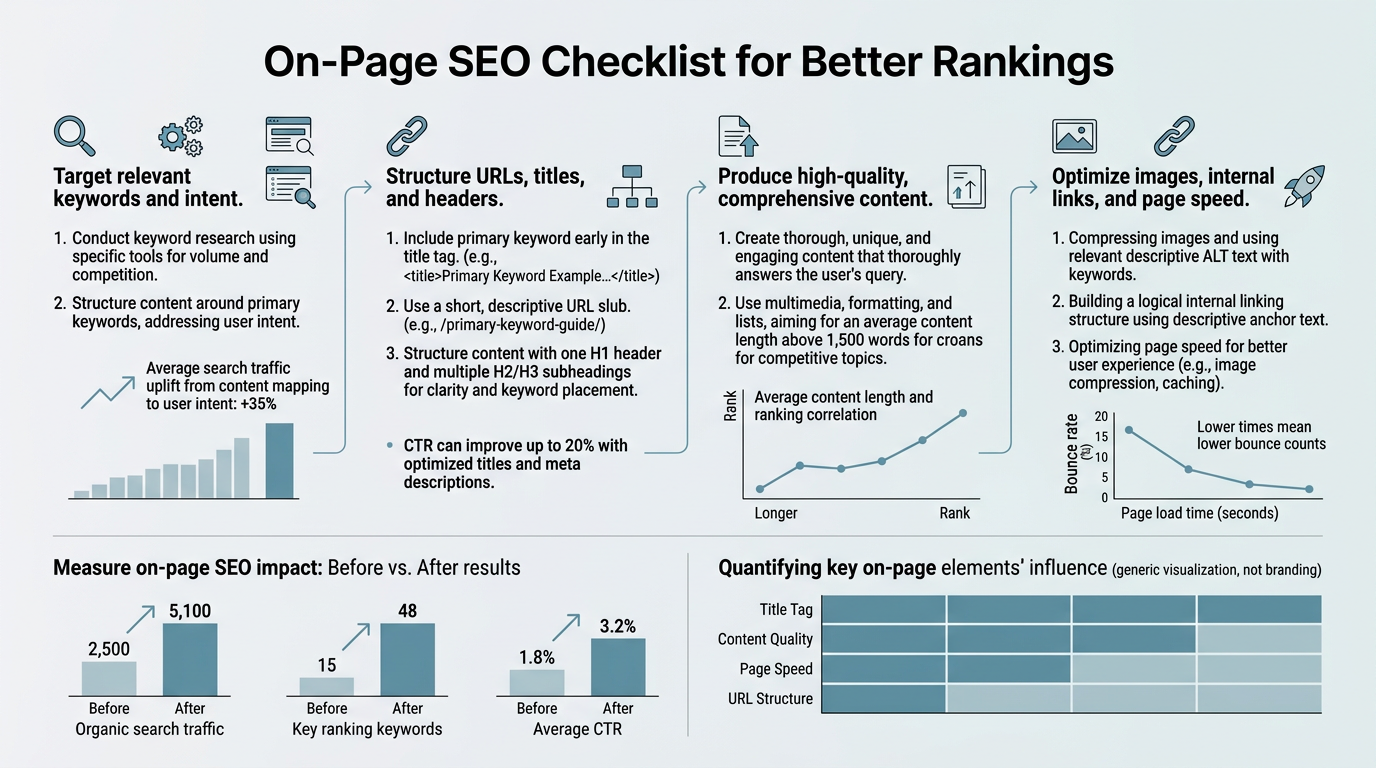
On-page structure determines whether search engines understand your content's purpose and whether users actually click through to read it. Pages ranked in positions 11–30 can reach page one in just 2–4 weeks with optimized titles, meta descriptions, and heading hierarchies—these are the fastest wins in SEO. The fight for rankings isn't won by guessing; it's won by precise execution on elements you control completely. According to Backlinko's ranking factors research, title tags and content clarity remain core signals that Google prioritizes.
"Title tags remain a confirmed ranking signal in 2026, though Google now rewrites 76% of titles to prioritize relevance and brand clarity. The original HTML title tag still matters for ranking computation—Google processes it even when displaying a rewritten version to users."
Optimize Your Title Tag for Both Ranking and CTR
Title tags remain a confirmed ranking signal in 2026, though Google now rewrites 76% of titles to prioritize relevance and brand clarity. The original HTML title tag still matters for ranking computation—Google processes it even when displaying a rewritten version to users. Your task is crafting a title that works both for algorithms and clicks.
Aim for 50–60 characters—this range maximizes CTR and avoids pixel-based truncation (Google uses 580–600px width as the cutoff, not character count). Front-load your primary keyword so it appears before any natural modifiers. A title like "On-Page SEO Checklist: 15 Optimization Steps That Rank" works better than "15 Optimization Steps for On-Page SEO That Rank" because the keyword comes first.
Best practices for title tag optimization include:
- Place primary keywords in the first 3–4 words for maximum impact
- Use modifiers like year, "best," "guide," or "how-to" when they match content intent
- Avoid keyword stuffing and maintain natural readability
- Test title variations for CTR and ranking performance
- Keep descriptive power proportional to your target audience's search behavior
Write Meta Descriptions That Drive Clicks
Meta descriptions don't directly rank pages, but they influence click-through rate—a key ranking factor. 47% of websites are missing meta descriptions entirely, representing a massive opportunity for quick wins. A strong description can earn more clicks than a result ranked one or two positions higher. According to Seranking's 2026 SEO statistics, the gap between optimized and missing meta descriptions directly impacts organic traffic volume.
Keep descriptions between 140–160 characters so Google displays them in full on desktop. Write for users first: include the primary keyword naturally, highlight your unique angle or benefit, and use action language. "Learn the 10-point on-page SEO checklist that moves pages to page one in weeks—updated for 2026 algorithms" outperforms "This article covers on-page SEO."
"Meta descriptions don't directly rank pages, but they influence click-through rate—a key ranking factor. A strong description can earn more clicks than a result ranked one or two positions higher."
Structure Headings to Signal Content Hierarchy
Headings tell search engines the content's topical structure and help users scan for answers. Use exactly one H1 per page for your primary keyword or its close semantic variant. Map secondary keywords and subtopics to H2 and H3 tags in logical order.
Heading structure principles:
- Use exactly one H1 tag per page for primary keyword or semantic variant
- Organize H2 and H3 tags in logical, hierarchical order
- Make each heading descriptive and question-focused when possible
- Include secondary keywords in H2/H3 for topical depth
- Ensure headings signal what the section contains—no vague labels
Each heading should signal what the section contains—no vague labels. "How Should You Structure Your On-Page Elements?" outperforms "Structure" because it answers an implied question. AI systems and users both scan for answer-first content.
What Role Does Keyword Placement and LSI Keywords Play in Modern On-Page SEO?
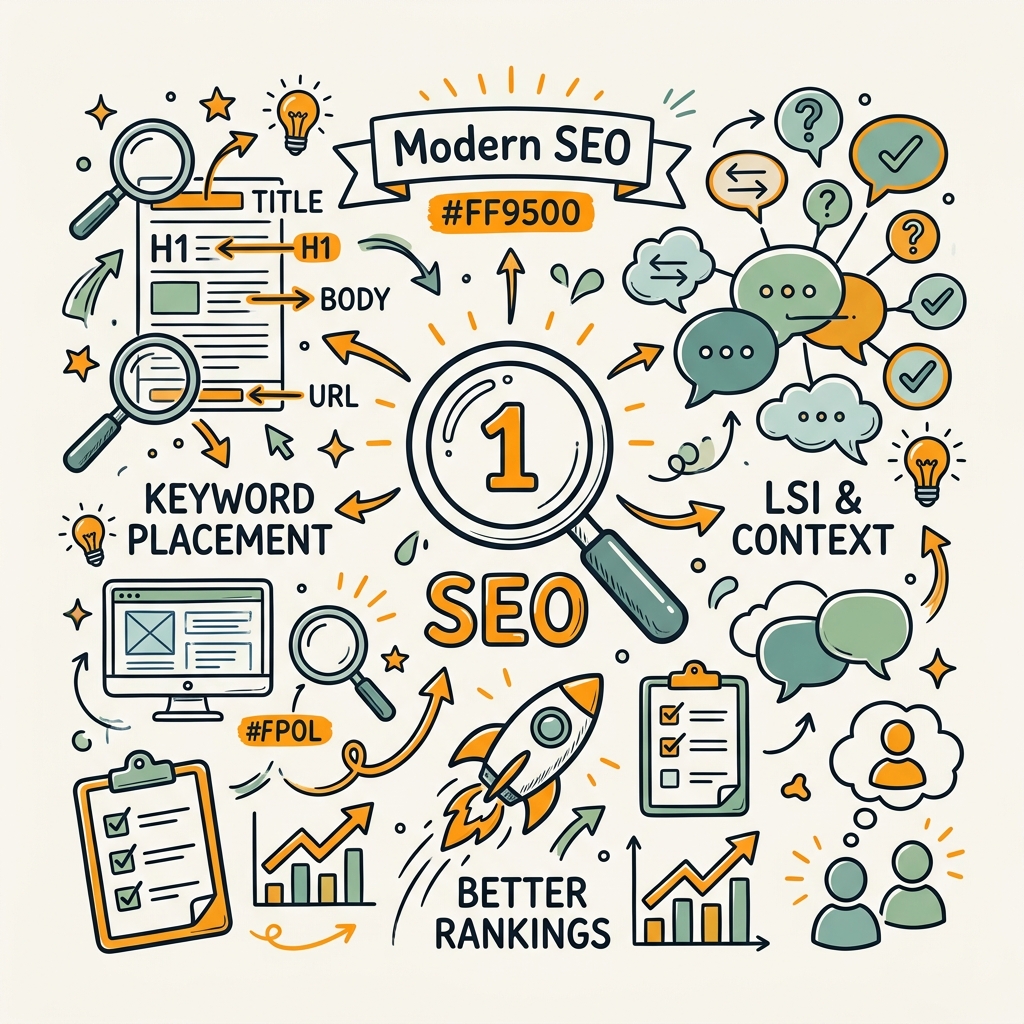
Keyword strategy has evolved from simple repetition to contextual relevance. Place your primary keyword in the title, the first 100 words, and naturally throughout the body. Search engines no longer reward artificial keyword density; they reward semantic depth—using related concepts that demonstrate expertise. Modern on-page optimization prioritizes addressing related subtopics and answering follow-up questions naturally, rather than simple keyword repetition.
Front-Load Keywords in Critical Zones
The first 100 words of your content carry disproportionate weight for ranking signals. Include your primary keyword naturally in the opening paragraph, ideally within the first 1–2 sentences. This early placement signals to Google what the page is about and improves topical relevance scoring.
Strategic keyword placement zones include:
- First 100 words of body content (highest priority)
- Title tag (front-loaded position)
- H1 and H2 headings naturally
- Meta description with natural integration
- Image alt text where contextually relevant
Repeat your primary keyword 3–7 times throughout the page, distributed across body paragraphs, headings, and the closing section. Avoid forced repetition—context matters far more than frequency. If you force the keyword unnaturally, readability suffers and rankings drop.
Integrate LSI Keywords and Semantic Variants
Latent Semantic Indexing (LSI) keywords are concepts and phrases semantically related to your primary keyword. For "on-page SEO checklist," LSI variants include "title tag optimization," "meta descriptions," "heading structure," "keyword placement," and "schema markup." Using these naturally signals that you understand the topic comprehensively.
LSI keyword integration strategies:
- Research semantic variants using Google autocomplete and People Also Ask
- Place LSI keywords in H2/H3 headings and subheadings
- Integrate variants in image alt text and meta descriptions
- Use LSI terms in opening paragraphs of new sections
- Ensure semantic variants flow naturally—never force usage
When you use semantic variants, Google understands you're not just targeting a single keyword—you're addressing the entire topic cluster. This approach improves your chances of ranking for related searches and AI-generated answers.
Why Is Structured Data Schema Essential for Competitive Rankings?
Only 17% of websites have core schema markup implemented, yet sites missing schema rank 2–4 positions lower than competitors at equal authority levels. Schema tells search engines and AI systems what your content represents—article, product, review, organization, or local business. Without it, you're forcing Google to guess. As documented in RankNibbler's 2026 SEO report, schema implementation is no longer optional for competitive keywords.
"Only 17% of websites have core schema markup implemented, yet sites missing schema rank 2–4 positions lower than competitors at equal authority levels. Schema implementation is no longer optional for competitive keywords."
Implement Core Schema Types for Your Content
Start with Article schema for blog posts—it signals publish date, author, and content type, improving your chance of appearing in AI Overviews and news carousels. Add Organization schema sitewide to establish brand identity and local presence. For e-commerce or service pages, implement Product or LocalBusiness schema with pricing, ratings, and location data.
Essential schema implementation steps:
- Use JSON-LD format (most reliable for Google processing)
- Add Article schema for blog posts with publish/update dates
- Implement Organization schema sitewide for brand identity
- Use Product or LocalBusiness schema for commerce/service pages
- Add BreadcrumbList schema to improve site architecture indexing
- Validate schema using Google's Rich Results Test before publishing
Use JSON-LD format (not RDFa or Microdata) because Google processes it most reliably. Implement BreadcrumbList schema for multi-level navigation—it doesn't directly rank you, but it improves how Google indexes your site architecture and improves CTR for position #1 results.
Add Speakable Schema for AI Overview Optimization
Speakable schema marks portions of your content as "answer-ready" for AI systems. Less than 3% of websites have adopted Speakable schema, making it the highest-leverage implementation available. Mark your section openers—the sentences that directly answer heading questions—as speakable content.
This signals to Google's AI that specific passages are high-confidence answers that can be cited directly. Pages with Speakable schema see dramatically higher AI Overview citation rates because Google can extract quotable sections without paraphrasing.
How Do You Build Internal Links for On-Page Topical Authority?
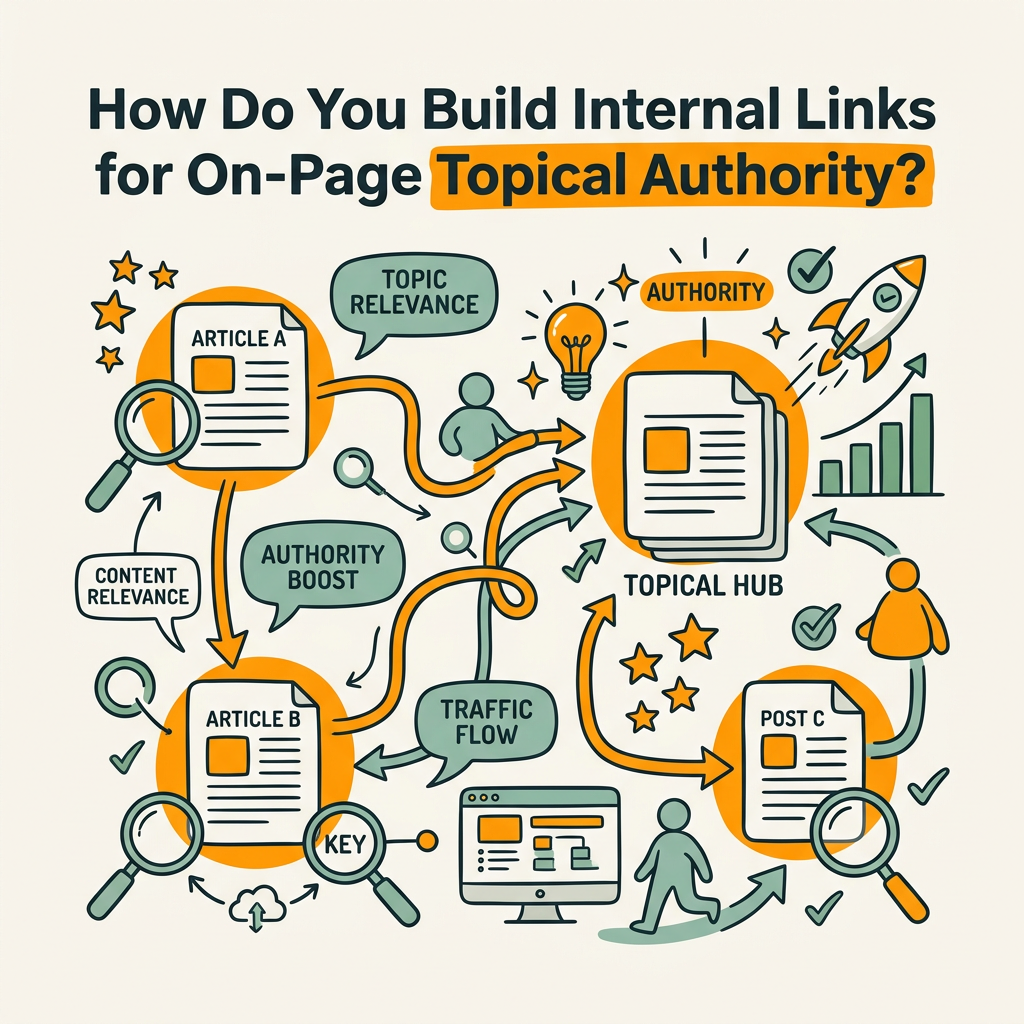
Internal linking doesn't just pass PageRank—it signals to Google which pages cover related subtopics and builds topical authority clusters. Tools like SEO automation platforms now automatically build internal link networks as content scales, ensuring every piece of content connects to related articles without manual effort. Additionally, understanding your programmatic SEO strategy helps automate content creation and linking at scale.
Link Contextually to Related Subtopics
When you mention a concept that deserves deeper explanation, link to a dedicated page on that topic. If you mention "meta descriptions," link to your meta description guide. This contextual linking helps users find more relevant content and signals to Google that your site comprehensively covers these subtopics.
Best practices for contextual linking include:
- Link when a concept deserves deeper explanation or expansion
- Use descriptive anchor text that includes keywords naturally
- Link to the most relevant, comprehensive page on that topic
- Avoid linking to multiple pages for the same concept
- Ensure anchor text provides context without being promotional
Use descriptive anchor text that includes keywords when natural. "Learn more about on-page SEO ranking factors" is better than "read this" because the anchor text reinforces topical relevance.
Create Hub-and-Spoke Link Networks
Establish pillar pages that cover broad topics (e.g., "Complete On-Page SEO Guide"), then link from detailed cluster pages (e.g., "Title Tag Optimization," "Meta Description Best Practices") back to the pillar. The pillar links to all clusters. This structure signals topic mastery to Google and helps pages rank for related keyword variations.
What Technical and Content Factors Accelerate On-Page SEO Results?
On-page optimization alone won't rank pages, but combined with technical health and content depth, results appear quickly. Pages ranked 11–30 move to page one in 2–4 weeks with on-page improvements. Pages with zero domain authority typically need 3–6 months of content and authority building. The variable isn't effort—it's your starting point.
Solve Core Web Vitals to Prevent Ranking Penalties
56% of pages fail at least one Core Web Vital in 2026, yet optimizing these metrics can increase mobile revenue by up to 42%. Core Web Vitals—Largest Contentful Paint (LCP), Cumulative Layout Shift (CLS), and First Input Delay (FID)—are ranking factors that Google weights increasingly heavily for mobile-first indexing.
Core Web Vitals optimization checklist:
- Enable browser caching to reduce server response times
- Minify CSS and JavaScript files for faster rendering
- Lazy load offscreen images to improve LCP
- Use a content delivery network (CDN) for global performance
- Remove render-blocking resources and third-party scripts
- Optimize font loading to prevent layout shift
- Test performance using PageSpeed Insights and CrUX Dashboard
Fix these issues first: enable browser caching, minify CSS and JavaScript, lazy load offscreen images, and use a content delivery network (CDN). These changes often improve LCP by 1–2 seconds and are foundational for any modern SEO strategy.
Implement Content Freshness and Update Signals
Add visible publish and "last updated" dates to your articles. Google now prioritizes content freshness as a topical authority signal—pages refreshed every 30–90 days rank better than static content from years past. You don't need to rewrite everything; small updates like changing statistics, adding recent examples, or updating images signal freshness without massive effort.
Use AI content generation tools to refresh content at scale. This frees you from manually updating hundreds of articles while keeping your site's topical depth signals current. Learn more about building a sustainable content marketing framework that maintains freshness continuously.
How Should You Optimize for AI Overviews and Agentic Search?
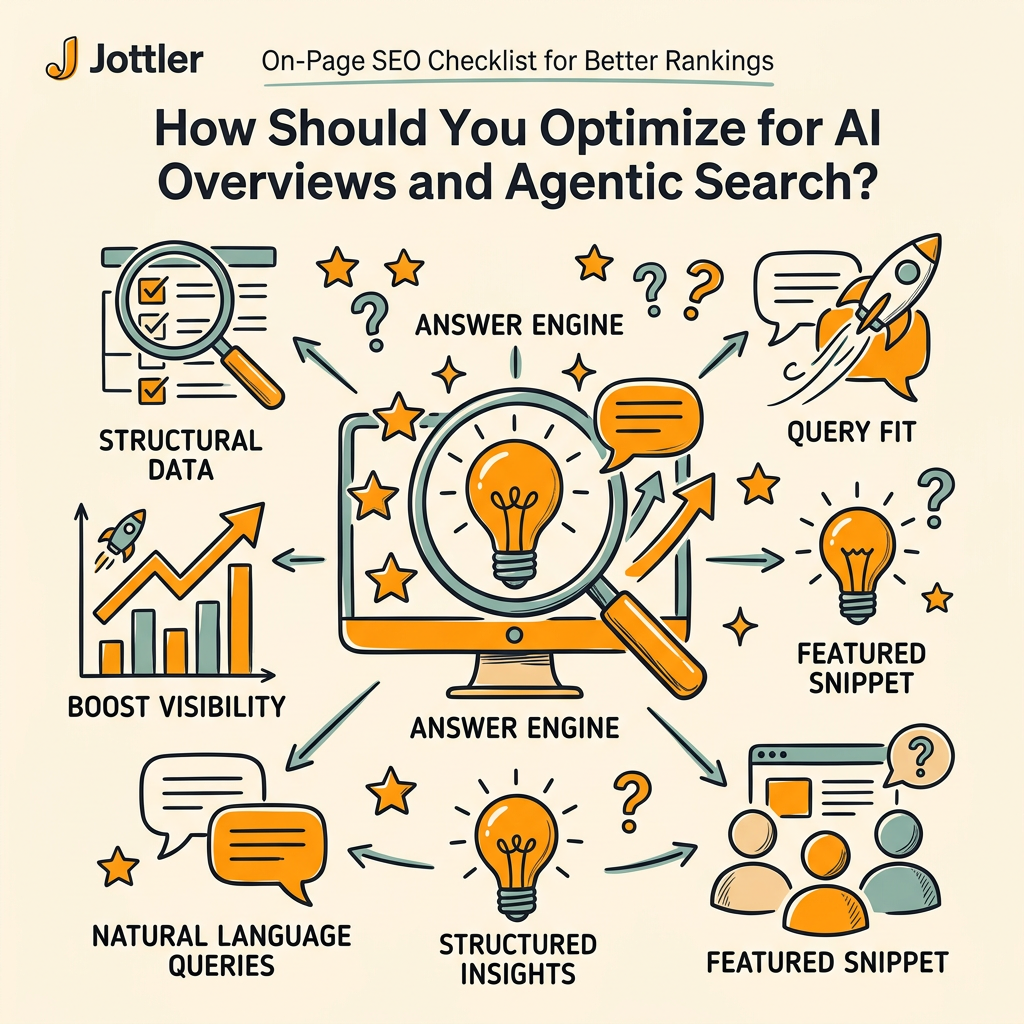
Traditional on-page SEO and AI Overview optimization overlap significantly, but AI systems prioritize structured, extractable content. Title tags and meta descriptions still matter, but now you must also format content so AI can pull direct answers without paraphrasing.
Create Answer-First Content Blocks
Start every section with a 40–60 word paragraph that directly answers the heading's implied question in the first sentence. AI engines extract these opening statements for AI Overviews and citations. If your answer is buried in paragraph three, it won't get cited.
Answer-first content formatting strategies:
- Open each section with a direct answer to the heading question
- Keep opening answer 40–60 words maximum
- Use tables and checklists for AI-extractable content
- Format numbered lists for complex processes
- Make bullet points scan-friendly and self-contained
Format answers with tables, checklists, and short lists that AI can lift directly into generated responses. An AI system is more likely to cite a numbered checklist than prose. This formatting serves both human scanners and AI extraction systems.
Optimize for Question-Based Search Intents
People and AI both search using questions: "How do I optimize title tags?" "What is on-page SEO?" "Why does schema matter?" Write H2 titles as questions whenever possible. Questions get cited more frequently by AI systems and rank higher in People Also Ask sections.
Use your "people also ask" research to identify follow-up questions your content should answer. Build FAQ sections that address these questions explicitly. This signals comprehensiveness to both humans and AI while capturing long-tail traffic.
What's the Best Tool-Assisted Approach to On-Page SEO at Scale?
Manual on-page optimization works for 1–2 articles per week. At 3+ articles per week, manual keyword research, title optimization, and schema implementation become bottlenecks. This is where autonomous SEO agents prove their value for busy founders. Discover how SEO automation saves hours across your content pipeline.
Automate Keyword Research and Title Generation
Tools that automate keyword research and title optimization can generate dozens of optimized titles and meta descriptions in minutes. Rather than manually researching keywords for each article, these systems identify search volume, difficulty, and user intent automatically. They also suggest title variations and test which performs best for CTR.
Automation benefits for keyword and title optimization:
- Generate dozens of optimized titles in minutes
- Identify search volume and keyword difficulty automatically
- Create meta descriptions matching content intent
- Test title variations for CTR performance
- Eliminate manual keyword research bottlenecks
Jottler handles this at the article generation stage—researching keywords, generating titles optimized for CTR, and writing meta descriptions that match your content before publishing. This eliminates the gap between content creation and on-page optimization.
Implement Schema and Internal Links Automatically
Manually adding schema markup and internal links to hundreds of articles is impossible. Solutions that inject schema automatically, identify linking opportunities across your site, and build hub-and-spoke topical clusters scale on-page SEO efforts without requiring additional team members.
The result: your entire site improves systematically. As you publish more content, your topical authority compounds. Every new article automatically links to related pieces, creating the hub-and-spoke structure that Google rewards with higher rankings.
| On-Page Task | Manual Approach | Automated Approach (Jottler) |
|---|---|---|
| Keyword research per article | 15–30 minutes per article | Automatic; included in content generation |
| Title tag optimization | 5–10 minutes per article; requires A/B testing | AI-generated titles optimized for CTR; instant |
| Meta description writing | 5 minutes per article | Auto-generated from content; 140–160 char optimized |
| Schema markup implementation | 10–20 minutes per article; error-prone | Automatic JSON-LD schema injection; 100% accurate |
| Internal linking (hub-and-spoke) | 20+ minutes per article; manual link research | Automatic; identifies and links related articles as they publish |
| Total time per article (on-page only) | 55–75 minutes | 0 minutes (automatic during publishing) |
If you publish 3 articles per week manually, that's 4–6 hours per week spent on on-page optimization alone—time that doesn't improve content quality. Automation moves that effort to your first publish, freeing your team to focus on strategy and audience understanding.
Conclusion
On-page SEO remains the highest-leverage, fastest-returning investment in your organic growth. 73% of websites have critical on-page problems waiting to be fixed, and pages ranked 11–30 can reach page one in 2–4 weeks with proper optimization. Title tags, meta descriptions, heading structure, keyword placement, and schema markup are non-negotiable elements that directly impact both rankings and click-through rates.
The challenge isn't understanding what to optimize—it's executing consistently as your content library grows. Manual on-page optimization doesn't scale. Start your SEO agent to automate keyword research, title optimization, schema implementation, and internal linking across all your content. Let your system handle the repetitive work while you focus on building topical authority that compounds month after month.
FAQs
What is the most important on-page SEO element?
Title tags and H1 headings are the highest-leverage on-page elements. Title tags influence both ranking computation and click-through rate, while H1 signals your page's primary topic to search engines. However, no single element drives rankings alone—a strong title paired with poor content won't rank. The most important approach is systematic: optimize titles, headings, keyword placement, and schema together, treating them as a unified system rather than separate tasks.
How long does it take to see rankings improve after on-page optimization?
Pages already ranked 11–30 can reach page one in 2–4 weeks with on-page fixes. Entirely new pages typically take 3–6 months to show meaningful ranking movement, depending on domain authority and keyword competition. The variable is your starting point: established sites with existing traffic move faster than new domains. Start with your existing ranked pages—they're your fastest wins and will show measurable results within a month.
Do I need to hire someone to manage on-page SEO, or can tools handle it?
Tools can automate 80–90% of on-page SEO tasks: keyword research, title generation, meta descriptions, schema implementation, and internal linking. You don't need additional team members for on-page work if you use automation. The human effort you do need goes to strategy—choosing topics, understanding your audience, and building topical clusters—not repetitive optimization tasks. For most growing companies, automation eliminates the hiring bottleneck entirely.