Optimizing AI-Generated Blog Posts for Search Engines
AI-generated content now powers 74.2% of newly created web pages, yet most founders and marketers still treat it as a shortcut rather than a starting point. The real challenge isn't writing with AI—it's optimizing what AI writes so it actually ranks, gets cited by AI Overviews, and drives traffic instead of disappearing into the algorithmic void. 86.5% of pages in Google's top 20 already contain some AI content, proving the technology itself isn't the differentiator. Raw, unedited AI content underperforms by 5.4x compared to human-reviewed alternatives, which means the gap between success and failure comes down to post-publication optimization discipline.
Key Takeaways
- AI content ranks equally to human-written content when properly edited and fact-checked; correlation between AI usage and ranking position is 0.011 (effectively zero). (2026, Ahrefs/Semrush)
- Human oversight, original expertise, and E-E-A-T signals matter far more than whether content was AI-generated.
- Structured formatting, answer-first design, and source citations increase AI Overview citation rates by up to 47%.
- Edit and fact-check ruthlessly: One study found raw AI content got 5.4x fewer visitors than professionally edited alternatives—the difference is human oversight, not the tool.
- Write for AI Overviews, not just Google SERPs: Pages with clear FAQ sections and answer-first structure achieve 47% higher citation rates in AI-generated answers.
- Build topical authority, not scattered posts: Google's 2026 updates reward sites with consistent depth in a niche, not broad coverage of unrelated topics.
- Add original expertise and first-party data: Generic AI content gets buried; content backed by your own research, examples, or proprietary insights survives.
- Use structured formatting and schema markup: Content with clear headings, lists, tables, and schema markup achieves 33–41% higher AI citation rates.
Does Google Penalize AI-Generated Content?
No. The most important finding in 2026 SEO is this: Google doesn't have a binary "AI detector" that automatically downgrades your content. Instead, the algorithm evaluates helpfulness, originality, and user intent regardless of whether AI was involved in the creation process. When research teams analyzed ranking data across thousands of domains, they found that 57% of pages in Google's top 10 contained AI-generated content, versus 58% for fully human-written pages. The gap is statistical noise, confirming that AI content and SEO success correlate with quality, not origin.
"The algorithm detects patterns of low-effort, low-originality, or mass-produced content regardless of how it was written. A human-written generic summary that copies five competitors ranks no better than unedited AI output."
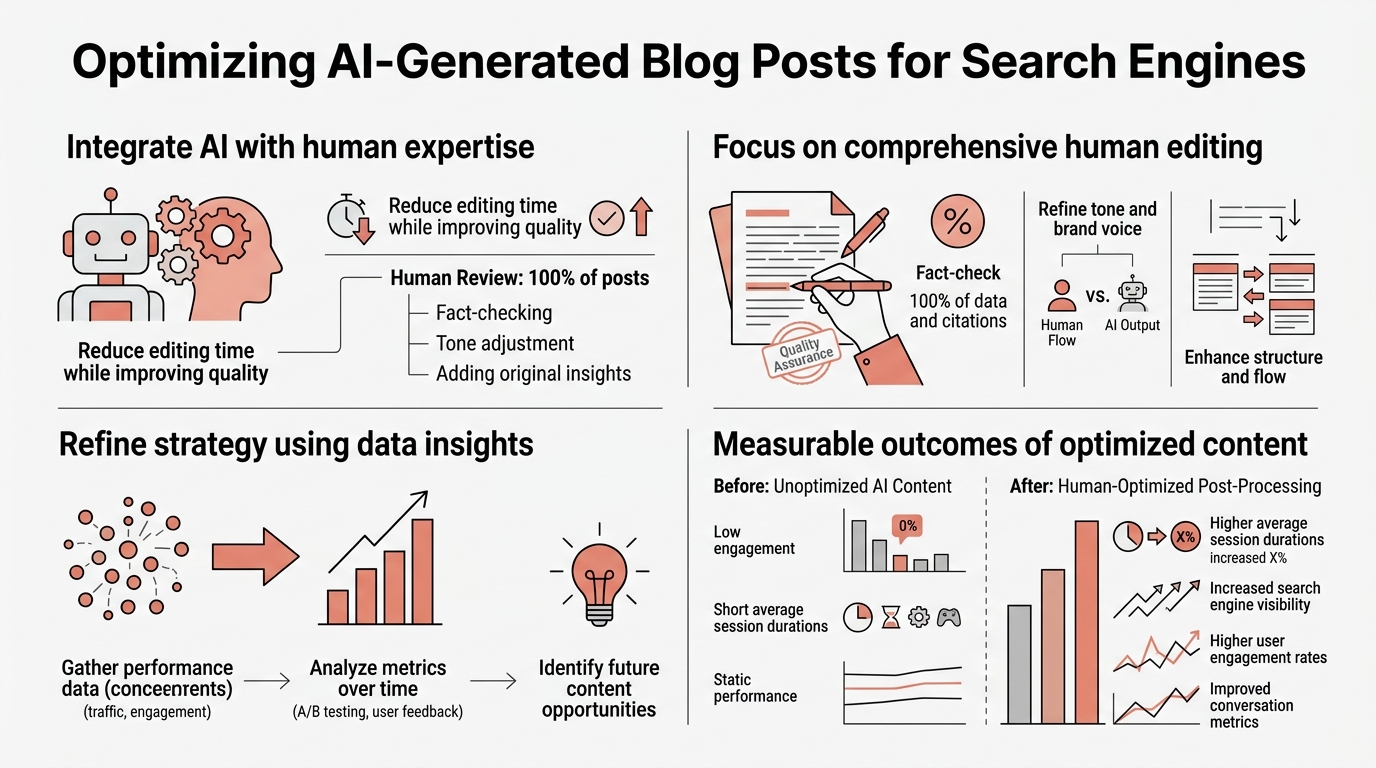
What Google does penalize is neglect. The algorithm detects patterns of low-effort, low-originality, or mass-produced content regardless of how it was written. A human-written generic summary that copies five competitors ranks no better than unedited AI output. Conversely, AI-assisted content that's been edited for accuracy, fact-checked, and infused with original expertise performs on par with human-only work. This shift fundamentally changes how you should approach AI content when building an AI content strategy that compounds organic growth.
The Real Ranking Signal: Post-Publication Edit Quality
The biggest mistake founders make is hitting "publish" on raw AI output. One benchmark experiment showed that completely unedited AI content averaged only 52 visitors per month, while professionally edited content in the same niche pulled 283 visitors—a 5.4x difference. That gap isn't about search rankings alone; it's about quality signals that compound across every ranking factor.
"Spend as much time editing as you do generating. Remove generic phrases, tighten rambling sections, add a statistic from your own data where possible, and strip out repetitive explanations."
Here's what the data tells us: spend as much time editing as you do generating. Remove generic phrases, tighten rambling sections, add a statistic from your own data where possible, and strip out repetitive explanations. Using content automation tools designed for SEO can accelerate the drafting process, but the automation is in the workflow, not in skipping editorial review. The best platforms still expect founders to verify claims and inject their voice into the final piece.
Distinguishing AI Content from Low-Quality Content
Google's March 2026 core update made clear that the algorithm now distinguishes between "AI-assisted content" and "low-quality content produced at scale without meaningful oversight." The key difference is originality and human judgment. If your post rehashes the top-five ranking competitors without adding new analysis, insight, or data—whether AI-written or human-written—it will underperform. But if you use AI to accelerate research and drafting, then layer in original examples, case studies, or proprietary findings, you're working within Google's intended workflow.
A practical signal: pages with clear author credentials and subject-matter expertise achieved 34% higher AI citation rates in a 2026 study. Include a brief author bio that connects you to the topic. If you're writing about SaaS marketing, mention your background. If you're discussing SEO automation, reference your direct experience building systems. AI didn't write that credibility—you did.
How to Structure AI Content for Search and AI Overview Visibility
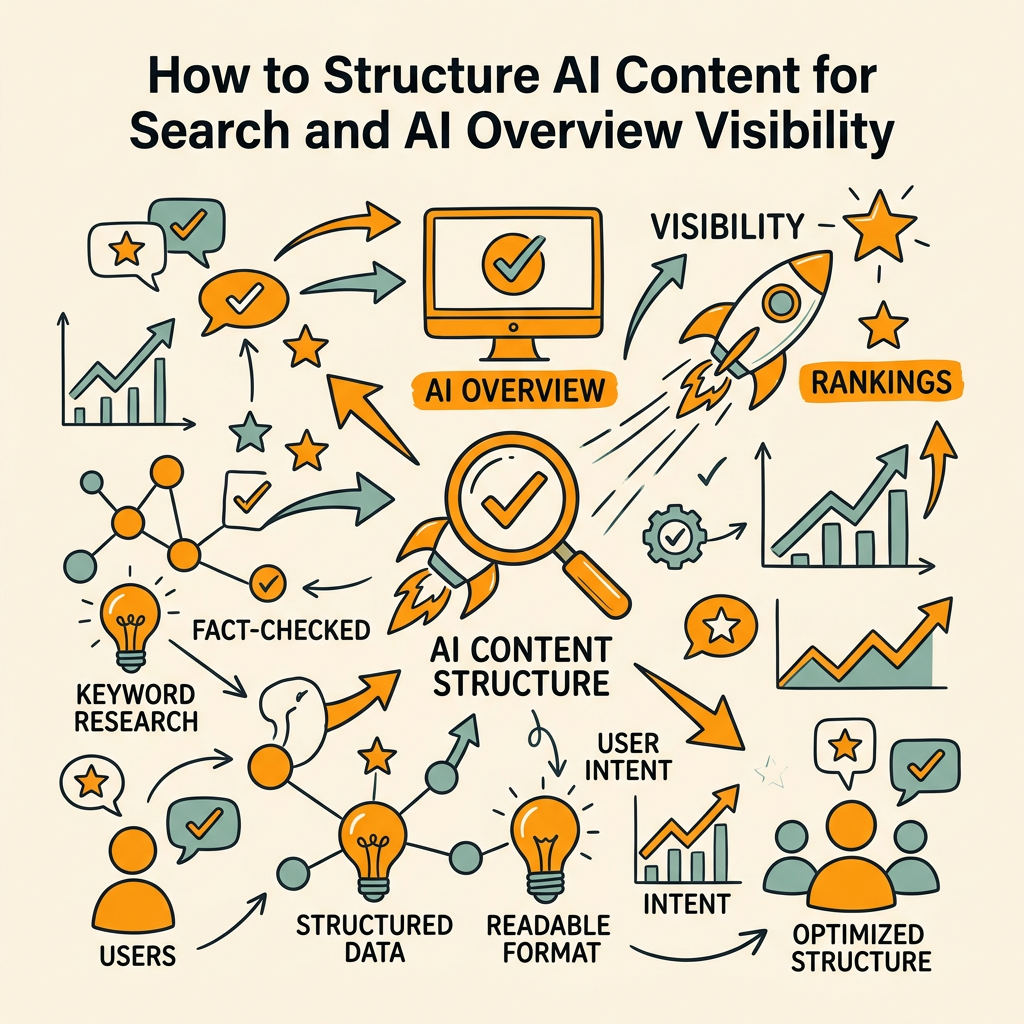
The biggest shift in 2026 SEO is that you're now writing for two audiences simultaneously: human readers and AI models pulling excerpts for Overviews, ChatGPT, Claude, and other generative engines. This changes your formatting strategy dramatically. Answer-first structure, which was optional before, is now essential. Content answering questions directly in the first paragraph achieved 47% higher AI citation rates, according to research tracking AI search visibility. When you understand this dual-audience requirement, you also understand why AI article generators built specifically for ranking prioritize structural formatting from the start.
Answer-First Design: Lead with the Direct Response
Start every section—especially under H2 and H3 headings—with a single, clear sentence that directly answers the question posed by the heading. Don't bury the answer in paragraph three. AI systems extract section openers as standalone facts, and search engines reward pages where the answer is obvious on first read.
Example: Instead of "There are many ways to optimize AI content. Let's explore the landscape. First, it's important to understand that Google has long prioritized quality..."—write: "AI content ranks as well as human-written content when properly edited and fact-checked, with zero correlation between AI usage percentage and ranking position." Then expand. The first sentence is your citation. AI systems will quote it verbatim.
Structured Formatting and Schema Markup
Pages combining text, images, tables, charts, and embedded media achieved 28% higher AI visibility in 2026 visibility studies. Beyond visual variety, structured data makes an enormous difference. Content using schema markup for articles, FAQs, or how-tos saw 41% higher AI citation rates. Use:
- H2 and H3 headings: Organize your content hierarchically so the structure is machine-readable, not just human-scannable.
- Unordered lists and ordered lists: Break complex ideas into 3-7 item lists. AI systems extract lists as structured data.
- Tables: Compare options, frameworks, or benchmarks in HTML tables. One study found articles with structured data achieved 33% higher click-through rates.
- FAQ blocks: If you have 3+ questions your audience asks repeatedly, use an FAQ section with clear question-and-answer pairs. AI systems cite FAQs directly.
- Blockquotes for expert statements: When citing industry experts or research, use blockquote tags. They improve both readability and AI extraction.
| Content Optimization Tactic | AI Citation Impact | Implementation Effort |
|---|---|---|
| Answer-first design (direct answer in first 1-2 sentences) | +47% AI citation rate | Low |
| Structured data markup (schema for FAQ, article, how-to) | +41% AI citation rate | Medium |
| Source citations with visible links (10+ authoritative sources) | +40% generative engine visibility | Medium |
| Author credentials and subject-matter expertise signals | +34% AI citation rate | Low |
| Fact-checking and editorial oversight | +34% AI citation rate + 5.4x visitor increase | High |
| Tables and structured data formatting | +33% click-through rate | Low-Medium |
Using Linked Evidence to Boost Credibility and AI Citations
Pages that cite sources with visible links achieve higher trust signals both with Google and with generative AI systems. When you make a claim—especially a data-backed one—include a link to the source. Research on AI SEO statistics shows pages with comprehensive source citations achieved 23% higher Generative Engine Optimization scores. This is particularly important because AI Overviews now consistently show "sources" below their answers, and your page is far more likely to be cited if you cite others.
Link to: authoritative industry reports, academic studies, government data, named tool reviews, and competitor analyses. Use descriptive anchor text that gives readers (and AI systems) context about what they'll find at the link. Internal linking matters too—link to your own related posts to build topical clusters that signal depth to both search engines and LLM context windows. This is where autonomous SEO agents excel, automatically connecting new content to existing topical clusters without manual effort.
Building Topical Authority and Avoiding Thin Content Traps
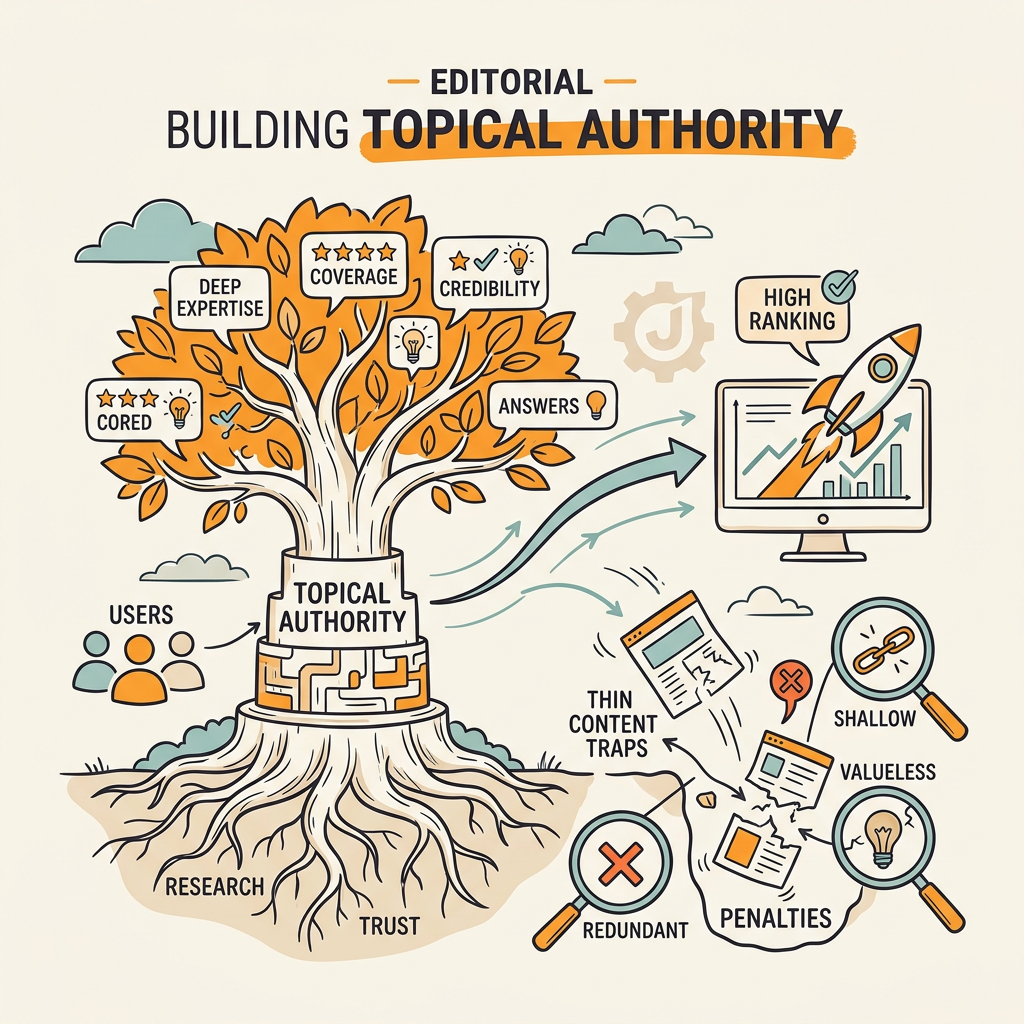
One of the fastest ways to make AI-generated content fail is to scatter posts randomly across unrelated topics. Founders often think breadth = more organic traffic. It doesn't. Google's March 2026 update explicitly de-ranked sites with broad, shallow coverage in favor of sites demonstrating consistent expertise in defined niches. AI makes it easy to generate 100 posts; that's actually the worst strategy.
Creating Content Clusters Around Core Topics
Instead of writing standalone posts, organize AI-generated content into clusters. Pick a core topic—for example, "SEO automation for bootstrapped SaaS"—and write an extensive pillar article covering the full breadth, then create 5-10 detailed sub-articles addressing specific angles: "How to set up internal linking automation," "AI tools for keyword research," "Measuring SEO ROI on a bootstrap budget," etc. Link them together with descriptive anchor text. This structure signals to Google that you own a topic, not that you dabble.
Platforms designed for semantic SEO handle this automatically by building internal link networks as they publish. Each new article is analyzed for topical relevance and connected to existing content, creating a web of authority rather than isolated posts. For manual workflows, you need to plan clusters before generating content, not after. The difference between random AI posting and strategic content publication is exactly this: one compounds authority, the other dilutes it.
Depth Over Frequency: Longer-Form Content Wins in 2026
The era of 500-word blog posts optimizing for keyword density is over. AI systems and Google's algorithm both reward comprehensive, long-form content that covers a topic exhaustively. A 2026 benchmark found that articles exceeding 2,000 words, when written with original insight, outranked shorter alternatives by a measurable margin. Quality AI-generated content tends to be verbose, which is actually an advantage if you edit it into coherent longer-form pieces rather than chopping it into snippets.
The sweet spot: 1,800–3,500 words for competitive topics. This gives you space to define terms, provide examples, share data, acknowledge counterarguments, and build authority. Longer content also naturally creates more internal linking opportunities and gives AI systems more material to extract for citations. When you pair comprehensive content with the right SEO tools for AI content optimization, you're maximizing both discovery and relevance signals.
Fact-Checking and Originality: The Non-Negotiable Step
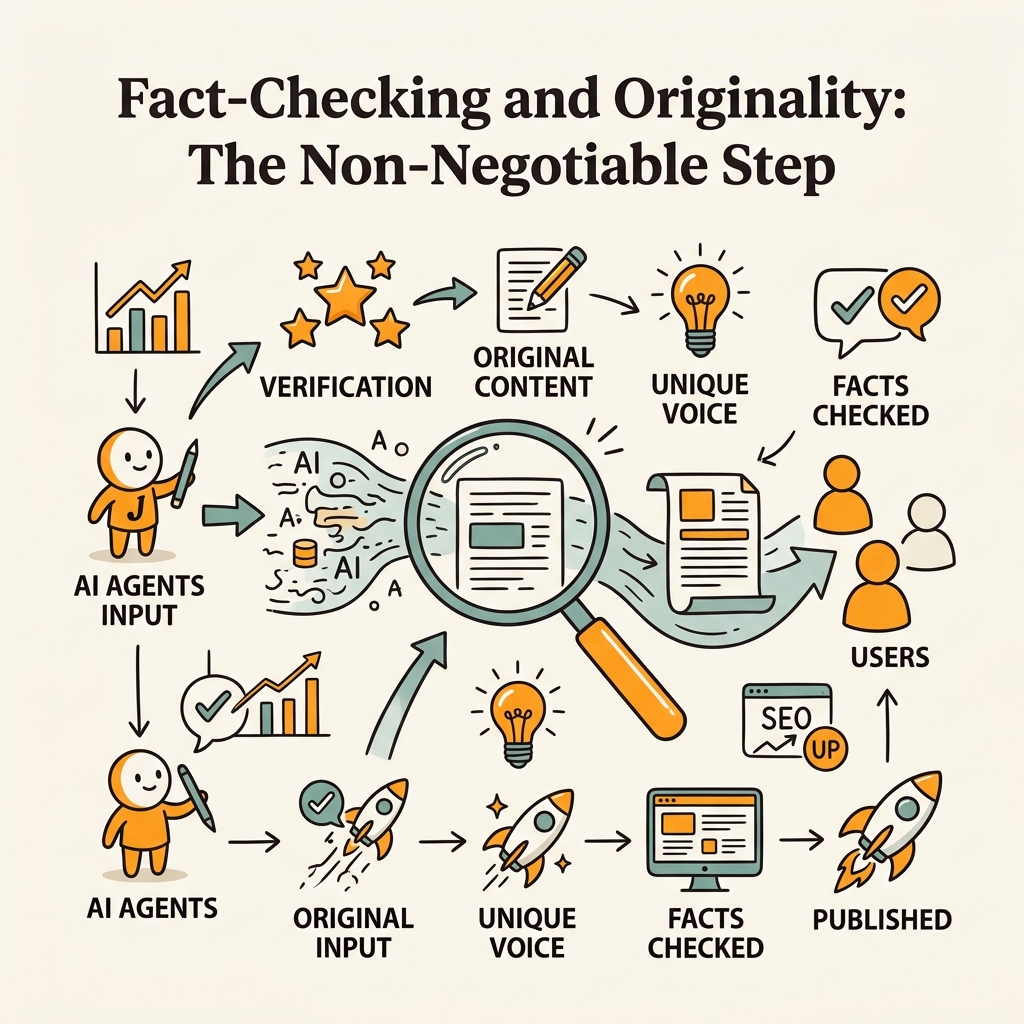
Publishing AI-generated content without fact-checking is the fastest way to tank your domain authority. AI models hallucinate statistics, conflate sources, and confidently state incorrect information. A 2026 analysis found that pages explicitly showing human editorial oversight and fact-checking achieved 34% higher AI citation rates and ranked more consistently. This is your insurance policy against both algorithmic penalties and reader distrust.
Building a Fact-Checking Workflow
For every statistic, claim, or reference in AI-generated content, verify it before publishing. Create a simple workflow:
- Flag every numeric claim: Use find-and-replace to highlight any percentage, dollar amount, or year mentioned in the draft.
- Cross-reference with original sources: Find the study or report the AI cited (or should have cited) and confirm the number is accurate.
- Update attribution: AI often cites vaguely ("studies show") or doesn't cite at all. Add explicit source attribution with links where possible.
- Add original data: Include at least one statistic or example from your own research, testing, or customer data. This is what separates commodity content from authority content.
- Have a human read it: Before publishing, have someone familiar with the topic but not the writing process read the draft cold. They'll catch inconsistencies, vague claims, and missing explanations that you've become blind to.
Injecting Original Voice and Proprietary Insight
The difference between AI content that ranks and AI content that doesn't is the presence of original voice and proprietary insight. If you're publishing in a category where you have direct experience—your own metrics, case studies, or proprietary methodology—include it. Don't just restate what other bloggers have said.
For example, if you're writing about SEO tools, include a screenshot of your own setup, a comparison of how you use two tools differently than other reviewers suggest, or data from your own testing showing which feature drove the highest ROI. This transforms the post from "another review" into "a founder's unfiltered guide." AI can't generate this; only you can. And it's exactly what makes content rise above the commodity baseline.
Optimizing for AI Overviews and Generative Engine Optimization (GEO)
In 2026, Google's AI Overviews appear on 18.76% of US search results and are accessed by approximately 2 billion monthly users. Being cited in an AI Overview doesn't guarantee clicks, but being excluded from one is a significant traffic loss. Your optimization strategy needs to address this parallel ranking system as part of your broader SEO strategy.
Formatting for AI Overview Extraction
AI Overviews prioritize pages that clearly structure answers in extractable formats. This means:
- Direct answers at the top: Put the answer to your target question in the first 1-2 sentences of the section covering it.
- Bullet lists: Complex ideas broken into 3-7 bullets are cited more frequently than paragraph-form explanations.
- Comparison tables: If you're comparing options, a clean HTML table is 3x more likely to be excerpted by AI systems than prose comparison.
- FAQ sections: Dedicated FAQ blocks signal to AI systems that this content is answer-oriented and worth citing.
- Short, quotable sentences: Vary sentence length, but aim for 15-20 word average. Short, pithy sentences are copy-pasted verbatim by AI systems far more than long, complex ones.
Citation Count and Topical Coherence
Pages that cite multiple authoritative sources within the same topic rank more favorably in AI Overviews. One benchmark found that pages with 10+ source citations achieved 40% higher visibility in generative engine responses. This doesn't mean randomly linking to everything; it means linking to sources directly relevant to your claims. Use link text that signals authority: "According to research on AI and search behavior" rather than "link" or "click here."
Additionally, pages that stay coherently on-topic throughout rank better. If you're writing about "AI content optimization," don't jump to "best social media tools" halfway through. AI systems evaluate topical consistency across the entire piece. Narrow your focus, go deep, and cite the best sources in your narrow lane.
Avoiding AI Overview Pitfalls
One challenge in 2026 is that AI Overviews suppress organic clickthrough rates. Studies show that when an AI Overview appears, organic CTR drops from 1.76% to 0.61%—a 65% decline. This creates a paradox: you want to be cited, but being cited doesn't always drive the most traffic. The solution is dual optimization: structure your content for AI citations, but also write in a way that encourages clicks even when an Overview is present. This means adding original analysis, case studies, or proprietary data after the direct answer—content the AI can cite, then readers click through to see your full context.
Conclusion
Optimizing AI-generated blog posts for search engines isn't about hiding the fact that you used AI; it's about treating AI as a drafting tool and investing the time to turn that draft into authority content. The data is clear: raw AI content underperforms by 5.4x compared to edited alternatives, yet AI-assisted content edited for accuracy and original insight ranks equally to human-only content. The gap between success and failure comes down to post-publication work—fact-checking, adding original voice, and formatting for both human readers and AI systems.
Focus on three fundamentals: (1) edit and fact-check ruthlessly, injecting original expertise where possible; (2) structure every page for AI extraction using answer-first design, lists, tables, and FAQs; (3) build topical authority through interconnected content clusters rather than scattered one-off posts. Start automating your SEO content workflow today with Jottler's autonomous SEO engine and reclaim the hours you spend on manual research, writing, and publishing. The winning strategy in 2026 isn't "avoid AI"—it's "use AI to write 10x faster, then invest the time you saved into deeper editing, fact-checking, and original content."
FAQs
Does Google penalize AI-generated blog posts in 2026?
No. Google doesn't have a binary penalty for AI-generated content. The algorithm evaluates helpfulness, originality, and user intent regardless of how content was created. In 2026, 86.5% of pages in Google's top 20 contain some AI content, proving the technology itself isn't a ranking factor. What does trigger penalties is low-effort, generic, or mass-produced content—whether written by AI or a human. The real differentiator is post-publication quality: edited, fact-checked content with original expertise ranks on par with human-only alternatives.
How do I optimize AI-written content for AI Overviews?
Structure your content with answer-first design: put the direct answer to your target question in the first 1-2 sentences of each section. Use bullet lists, comparison tables, and FAQ blocks instead of dense paragraphs—these formats are extracted far more frequently by AI systems. One study found pages with clear FAQ sections achieved 47% higher AI citation rates. Additionally, cite authoritative sources with visible links; pages with 10+ relevant citations showed 40% higher visibility in generative engine responses. Shorter, quotable sentences are cited verbatim more often than longer ones.
What's the most important step to make AI blog posts rank higher?
Fact-checking and editing. Raw, unedited AI content gets 5.4x fewer visitors than professionally reviewed alternatives. Before publishing, verify every statistic, tighten rambling explanations, and inject at least one piece of original data or insight—whether it's your own metrics, a case study, or a proprietary finding. This single step transforms commodity content into authority content and signals to both Google and AI systems that a human verified the claims and added expert judgment.