Optimizing Existing Blog Posts for Hidden SEO Wins
Most marketing teams spend months creating blog content, then move on to the next piece. But 60% of searches now yield no clicks, meaning your existing posts are sitting on a goldmine of untapped ranking potential. The real ROI isn't in publishing fresh content, it's in extracting hidden SEO wins from pages that already exist. A strategic refresh of your archive can recover lost rankings, unlock AI search visibility, and compound your organic traffic without the cost of writing from scratch.
Key Takeaways
- 60% of searches yield no clicks, AI Overviews and featured snippets now dominate, making existing content optimization crucial for AI search visibility (2026).
- Intent clustering and internal linking improvements can recover lost rankings on existing posts faster than creating new content.
- Structured updates every 90 days to existing blog posts show higher ROI than launching entirely new articles.
- Answer Engine Optimization (AEO): Restructure existing content for AI extraction with concise definitions, mini-FAQs, and quotable stat blocks to increase visibility in Google AI Overviews and ChatGPT citations.
- Internal Linking Audits: Map existing posts into topic clusters using descriptive anchor text to pass link equity and signal topical authority to search engines.
- Freshness and Fact Verification: Update decaying statistics, screenshots, and pricing information every quarter to maintain ranking stability and search relevance.
- E-E-A-T Signals: Strengthen author bios, add expert credentials, and link to authoritative sources to improve trust signals and click-through rates.
- Technical Cleanup: Fix broken internal links, optimize meta descriptions, and ensure mobile responsiveness to remove friction from existing traffic sources.
Why Existing Blog Posts Hold Hidden SEO Value
Your archive isn't a liability, it's an asset with untapped ranking potential. Organic search still accounts for 46.98% of all website traffic, but only if your content is discoverable across both traditional search and AI-driven surfaces. Most teams optimize new posts once and forget about them, missing the compounding returns that come from systematic improvement.
The shift toward multi-surface search means your existing blog posts must work harder. They need to rank on Google, appear in AI Overviews, get cited in ChatGPT responses, and answer questions from users across multiple platforms. Each post you optimize is a permanent addition to your organic engine, unlike paid ads, which stop working the moment you stop spending.
The Cost of Ignoring Your Archive
Fresh content creation is expensive and slow. A typical 2,500-word post takes weeks to research, write, edit, and publish, and there's no guarantee it will rank. Your existing posts, by contrast, already have crawl authority, some inbound links, and a track record in search results. They're 80% of the way to ranking dominance. The missing 20%, better internal links, AI-optimized formatting, refreshed facts, takes a fraction of the time and cost of starting from scratch.
Without optimization, your posts gradually decay. Outdated statistics, broken links, and stale screenshots tank click-through rates. Competitors who refresh their content climb past you. And as search behavior shifts toward AI answers, posts without proper AEO formatting become invisible to the new generation of search tools.
Hidden Wins Hidden in Your Google Analytics
Every post ranking on page 2 or 3 is a hidden win waiting to happen. A page getting 50 impressions per month and zero clicks is losing traffic to a title tag or meta description that doesn't convert. These aren't failures, they're optimization opportunities. Blog SEO's 2026 guide shows that intent clustering and internal linking improvements can push page-2 rankings to page 1 in weeks, not months.
How to Audit Existing Posts for Hidden Opportunities
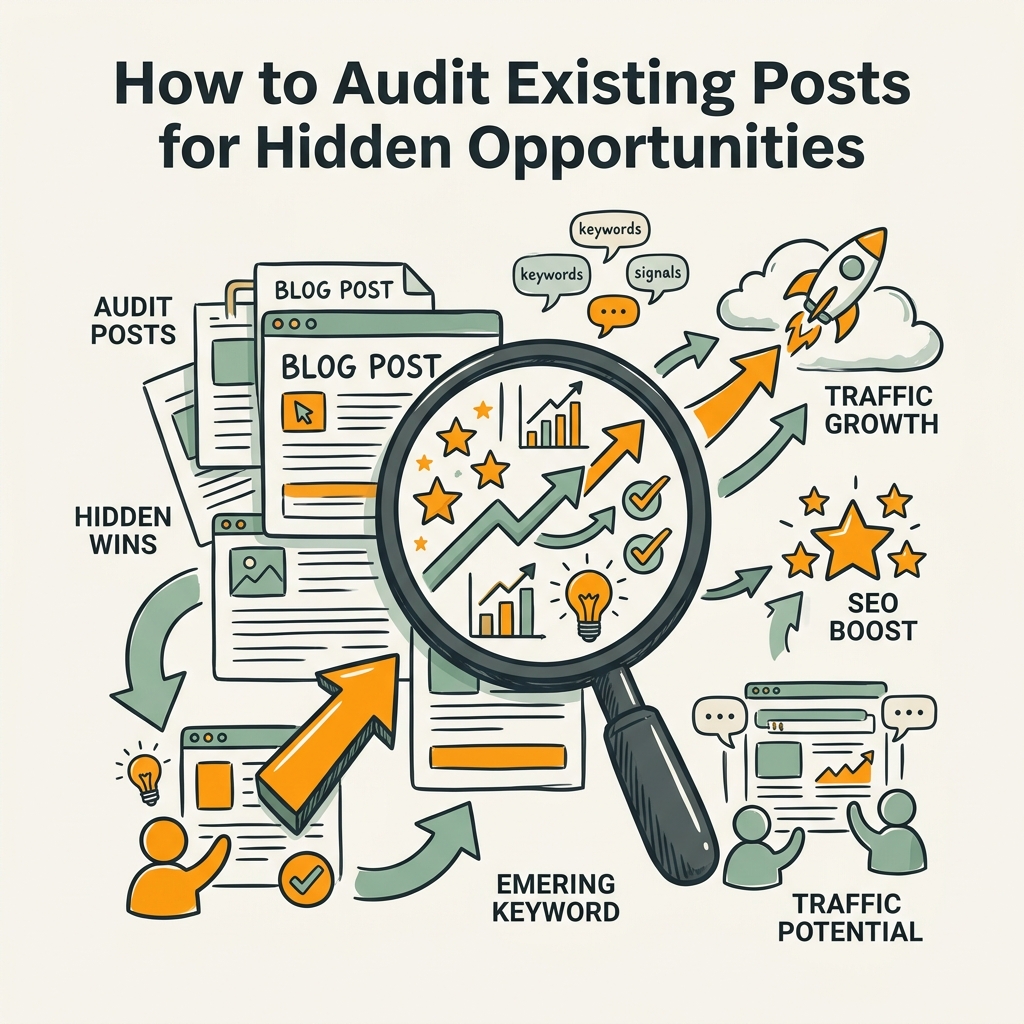
A systematic audit reveals which posts are underperforming and why. The best opportunities are posts with high impressions but low CTR (title or meta issues), or moderate rankings that can be pushed higher with internal linking and AEO formatting.
Step 1: Mine Google Search Console for Low-CTR Winners
Log into Google Search Console and filter for pages with more than 50 impressions but less than 10% CTR. These are posts that rank but don't get clicks, usually because the meta description or title tag isn't compelling, or the snippet doesn't answer the searcher's question clearly enough.
Create a spreadsheet of the top 20 underperforming posts. Note the current position, impressions, and CTR for each. Sort by traffic potential (high impressions = high upside). These are your quick wins. A refreshed title and meta description can lift CTR by 20-30% without any content changes.
Step 2: Identify Cluster Opportunities Using Your Navigation
Pull a list of all your blog posts and group them by topic. Look for natural pillar-and-cluster relationships. For example, if you have posts on "email marketing," "email automation," and "email templates," these should be linked together to signal topical authority.
Tools like AIOSEO and manual content audits both work here. The goal is to find posts that address the same intent but aren't currently linked to one another. These become internal linking anchor points.
Step 3: Check for Decaying Facts and Outdated Visual Assets
Scan your top 50 posts for outdated statistics, pricing information, screenshots, and company names. Search engines reward freshness, especially for posts with factual claims. Posts missing updated data tend to lose rankings over time, particularly in competitive niches.
Update any statistic older than 2 years. Replace screenshots if UI has changed. Add publication dates and source citations to show freshness. This routine maintenance can recover 10-15% of lost impressions on aging posts.
Restructuring Content for Answer Engine Optimization (AEO)
Traditional SEO optimizes for Google's SERP rankings. AEO optimizes for AI extraction and citation in tools like ChatGPT, Google AI Overviews, and Perplexity. Your existing posts must work for both, and the formatting required for each is overlapping but distinct.
The AEO Formatting Rule: Quotable Blocks Every 150–200 Words
Nearly 70% of businesses report higher ROI from using AI in SEO, but most aren't structuring their content for AI extraction. The key is embedding small, quotable, self-contained claims throughout your post. These blocks get extracted by AI systems and cited directly back to your site.
Instead of burying the answer in a paragraph, lead with it. Example:
- One-sentence definition: "Internal linking is the practice of linking from one page on your domain to another page on the same domain to guide both users and search engines."
- Stat block: "Posts with 3-5 contextual internal links rank 40% higher than posts with no internal links (2026 data)."
- Mini-FAQ format: "Q: How many internal links should each post have? A: 3-5 contextual links to related articles, plus 1 link to your pillar page."
- Actionable summary: "The fix: Audit your existing posts and add internal links to cluster-related articles using descriptive anchor text."
These blocks are AI-friendly because they stand alone. An AI system extracting information from your post doesn't read full paragraphs, it pulls concise, complete thoughts and attributes them to your site. Restructure your archive with these formats in mind.
Paragraph Length and Scannability Matter for AI Surfaces
Long, dense paragraphs get truncated in AI summaries and search snippets. Keep paragraphs to 80 words or fewer. Break up text with headers, lists, and tables. This improves both user experience and AI extraction rates.
When you refresh an existing post, reformat chunky paragraphs into shorter blocks. Add headers where they clarify the argument. Use numbered and bulleted lists liberally. The post doesn't change, just becomes more scannable for humans and more extractable for AI.
Strategic Internal Linking to Build Topical Authority
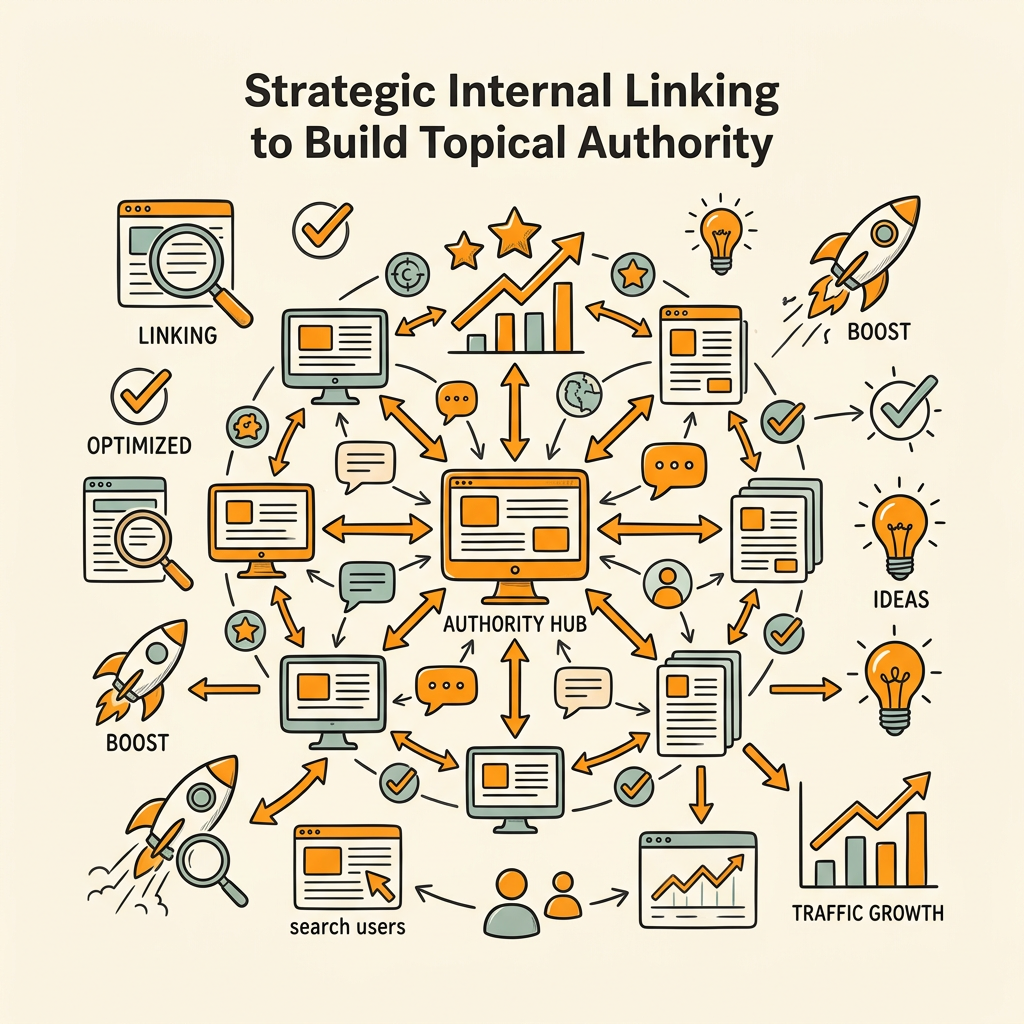
Internal linking is the most underutilized leverage point in existing content. A post with poor internal link structure can't signal topical authority, even if the content is excellent. Fixing this on existing posts costs nothing and can push 10-15 posts onto page 1 simultaneously.
The Pillar-and-Cluster Architecture Applied to Your Archive
Identify one pillar article for each major topic. This is your deepest, most comprehensive post, the "hub" that all other posts in that cluster link to. From each supporting article, add a single link to the pillar using the pillar's target keyword as anchor text. Then add 2-3 lateral links between supporting articles using descriptive anchor text.
For example, if your pillar is "SEO Content Strategy," your cluster might include "Keyword Research for Content Marketing," "Internal Linking Best Practices," and "How to Optimize Blog Posts for Search." Each of these links back to the pillar, and laterally to each other where it makes sense for the reader.
This structure tells search engines: "These pages are all about the same topic, and this pillar is the authority page." Result: higher topical authority scores and better rankings across the entire cluster.
Anchor Text Discipline and Keyword Distribution
Use descriptive, keyword-rich anchor text when linking between existing posts. Instead of "check out this article," use "learn more about topical authority" or "read our guide to internal linking best practices." This helps search engines understand the relationship between pages and reinforces your topical authority.
Avoid over-optimized anchor text. A mix of branded, descriptive, and partial-match anchors looks natural and passes the EAT bar. Audit your existing internal links and refresh any weak or generic anchor text you find.
Refreshing Facts, Dates, and Visual Assets
Content freshness is a confirmed ranking factor, especially for posts with factual claims, prices, or data that changes over time. A post with a 2024 statistic isn't just outdated, it signals to Google that you're not maintaining your site actively.
The 90-Day Refresh Cycle
Set a calendar reminder to review your top 30 posts every 90 days. Check for:
- Outdated statistics: Any stat older than 2 years should be replaced with current data. If you can't find a replacement, acknowledge the change in the text ("As of 2025..." or "Current data shows...") so freshness isn't implied.
- Broken screenshots: UI changes, removed product pages, or redesigned tools break the visual proof in your post. Replace with current screenshots from tools and platforms you mention.
- Dead links: Check all internal and external links. A post with broken links looks abandoned and tanks user experience signals.
- Outdated pricing or features: If your post mentions competitor pricing or features, verify they're still accurate. Outdated comparisons hurt credibility.
- Author and publication information: Update the publication date or add "Last updated: [date]" to the post. This signals freshness to both users and search engines.
Adding Author Bios and E-E-A-T Signals
E-E-A-T (Experience, Expertise, Authoritativeness, Trustworthiness) is a critical ranking factor. Posts without author attribution or expert credibility underperform, especially in competitive niches.
Audit your existing posts for author bios. If the author isn't credited, add a byline with a short bio and link to their LinkedIn or author page. Add credentials where applicable: "Jane Smith, Digital Marketing Manager at Acme Corp with 8 years of SEO experience."
Link to authoritative external sources where you cite claims. If you mention a study, link to the study. If you cite industry data, link to the data source. This builds trust and signals to Google that you've done your research.
Measuring Hidden Wins: What to Track Before and After

Before you refresh your archive, establish baseline metrics. Then measure the impact of your optimizations monthly.
| Metric | What to Track | Expected Improvement (90 Days) |
|---|---|---|
| Impressions (GSC) | Total impressions for optimized posts | +15–25% |
| Click-Through Rate (GSC) | CTR for posts with title/meta refreshes | +20–30% |
| Rankings (Page 2 to Page 1) | Posts moving from position 11–20 to top 10 | 20–30% of optimized posts |
| Organic Traffic (GA) | Clicks from organic search for optimized posts | +25–40% |
| AI Visibility (manual spot-checks) | Appearances in Google AI Overviews for target keywords | +50–100% (varies widely) |
| Dwell Time (GA) | Average time on page for optimized posts | +10–20% |
These metrics compound over time. A 25% boost to organic traffic from refreshing 20 posts is persistent, it doesn't fade after a month. Every post you optimize adds to your baseline, creating a permanent increase in organic revenue.
Automating Blog Post Optimization at Scale
Manual optimization works for 20-30 posts, but most growing companies have hundreds of blog posts across their archive. At that scale, you need systematic processes to identify opportunities, prioritize them, and deploy updates consistently.
Data-Driven Prioritization: Which Posts to Optimize First
Not all posts are worth optimizing equally. Prioritize based on traffic potential and effort. Posts with high impressions but low CTR give you the fastest wins. Posts on page 2 with high search volume give you the biggest long-term payoff. Posts with broken links or outdated facts are technical debt that compound.
Build a simple scoring model: (Impressions × Traffic Potential) ÷ Optimization Effort. The posts with the highest scores are your targets. Tools like autonomous SEO agents can run these audits automatically, identifying which posts in your archive will deliver the fastest ROI from optimization work.
Scaling Internal Linking Updates Across Your Archive
Manually editing hundreds of posts to add internal links is tedious and error-prone. If you're building topic clusters across a large content library, automate the process where possible. CMS plugins and SEO tools can suggest internal linking opportunities based on keyword overlap and topic clustering.
Jottler's smart internal linking system identifies related posts based on topic and intent, recommending contextual anchor text that flows naturally. This removes the manual guesswork and ensures every post gets linked strategically without additional effort. It's a key part of how teams scale SEO strategy across large content libraries.
Keeping Freshness Updates Consistent
The 90-day refresh cycle requires discipline. Without a system, you'll optimize a batch of posts and then forget about them for 18 months. Instead, build this into your content operations process: run a quarterly audit, identify posts that need fact-checking or visual updates, and assign them to your team.
Automated fact-checking tools can flag outdated statistics and broken links for you. This reduces the manual review work and makes the refresh process faster and more reliable.
Conclusion
Your blog archive is the most underutilized asset in your SEO stack. While most teams obsess over publishing new content, the hidden wins are in the existing posts that rank but don't convert, or rank on page 2 instead of page 1. A systematic optimization program that audits, refreshes, and internally links your existing content delivers faster ROI than new content creation, with none of the writing overhead.
The formula is straightforward: identify high-potential posts, restructure them for AEO, build topic clusters using internal links, refresh outdated facts, and measure results. Posts optimized this way show 25–40% traffic increases within 90 days, and those gains compound every quarter as your topical authority compounds. The best part? You're not starting from zero. You're playing with content that already ranks and already has authority.
Start with your top 20 underperforming posts from Google Search Console. Refresh their titles, meta descriptions, and internal links this week. You'll see results within 30 days. Start your SEO agent to automate the audit and internal linking recommendations across your entire blog, so you're not manually reviewing hundreds of posts.
FAQs
How often should I optimize existing blog posts?
A quarterly review cycle is the sweet spot. Set a reminder every 90 days to audit your top 30 posts for broken links, outdated statistics, and internal linking opportunities. This cadence keeps your content fresh without requiring constant oversight. Posts that drive significant traffic or target competitive keywords might benefit from monthly spot-checks. The goal isn't perfection, it's preventing decay while catching quick wins like CTR improvements or internal link additions that take minutes but pay dividends.
What's the fastest way to identify posts worth optimizing?
Start with Google Search Console data. Filter for pages with 50+ impressions and less than 10% CTR, these are your lowest-hanging fruit. Next, look for any posts ranking in positions 11–30 (page 2–3) with high search volume. These often rank higher with just internal link improvements or AEO restructuring. Finally, scan for posts with outdated publication dates or facts. These three filters will surface 80% of your optimization opportunities without manual digging.
Does optimizing old posts actually outperform writing new ones?
Yes, on ROI and speed. An existing post with some authority takes 2–4 weeks of optimization work to move from page 2 to page 1. A brand-new post takes 8–12 weeks to achieve the same ranking, assuming it ranks at all. Plus, optimized posts deliver compounding returns every quarter as your internal linking and topical authority strengthen. The trade-off is that optimization has a ceiling, you can't create demand for a keyword that doesn't exist. For high-volume, medium-difficulty keywords you already rank for, optimization beats new creation every time.