Problem-Solution Content: The Framework SaaS Teams Need
The challenge is simple but brutal: 79% of SaaS purchase decisions now require consuming at least five pieces of vendor content before a buyer engages sales. Yet most teams are publishing generic product overviews instead of solving the actual problems their audience faces. The cost? Stalled pipelines, low-intent traffic, and wasted marketing budget on content that ranks but doesn't convert. The fix is problem-solution content — a structured framework that identifies a specific pain point, demonstrates expertise in solving it, and naturally guides the buyer toward your product as the logical outcome.
Key Takeaways
- 79% of B2B buyers consume 5+ content pieces before sales conversations, shifting the burden to educational, problem-solution content (2026, Demand Gen Report)
- Case studies and narrative problem-solution content convert at 8.4% — the highest rate of any B2B format
- Long-form technical guides focused on solving problems generate 3.4x more qualified pipeline than product-led landing pages
- Problem Identification: Pin down the exact pain point your audience faces with specific data and emotional resonance.
- Solution Architecture: Walk through the framework or methodology for solving the problem independently of your product.
- Product-as-Accelerant: Position your tool as the vehicle that makes the solution repeatable and scalable.
- Narrative Structure: Use a story arc — challenge, escalation, resolution — rather than traditional list formats.
- Content Automation: Publish 3+ problem-solution pieces weekly to reach the 5-piece threshold most buyers need.
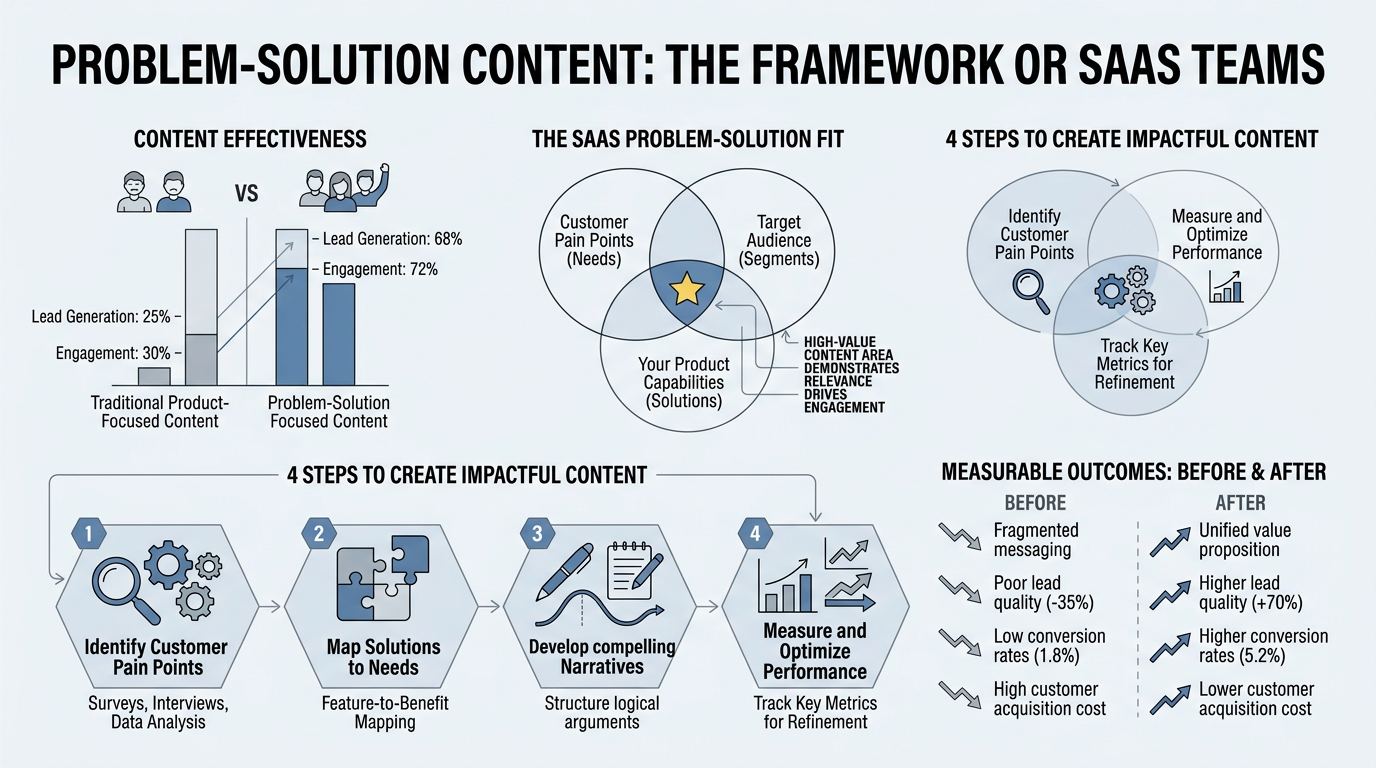
Why Problem-Solution Content Dominates B2B SaaS in 2026
The shift from product-centric to problem-centric content happened slowly at first, then all at once. Today, case studies and problem-solution narratives convert at 8.4% — four times higher than standard blog posts. The reason? Buyers don't want to know about your product. They want confirmation that their problem is solvable and that someone understands it deeply.
"Buyers now have access to dozens of competitors. They're not asking 'What does this tool do?' anymore. They're asking 'Which tool best solves my specific problem?' Problem-solution content answers that question before your sales team ever has to."
The data backs this up. Long-form technical guides and research reports that address specific pain points generate 3.4x more qualified pipeline than product-led landing pages. And comparison content — the ultimate problem-solution format — converts 2–5x higher than standalone blog posts because it reaches buyers already evaluating solutions.
What's changed? Buyers now have access to dozens of competitors. They're not asking "What does this tool do?" anymore. They're asking "Which tool best solves my specific problem?" Problem-solution content answers that question before your sales team ever has to. Research shows that SaaS content marketing compounds over time, with older posts continuing to rank while new content attracts fresh audiences.
The Conversion Mechanics Behind Problem-Solution Content
Standard blog posts targeting informational keywords convert at 0.5–2.0%. High-intent problem-solution content (comparisons, pricing pages) converts at 5–10%. Case studies and narrative problem-solution pieces? 8.4%. The difference isn't magic—it's audience intent. A person searching "how to reduce customer churn" is already aware they have a problem and is actively shopping for a solution. Your job is to demonstrate expertise and provide a clear path forward.
"A technical guide published today will rank for years, attract high-intent readers, and build topical authority that amplifies all future content. Product-focused content? It's mostly forgotten within weeks."
Problem-solution content also solves the awareness-to-consideration gap. 83% of SaaS marketing budgets are flatlined at 7.7% of company revenue, yet decision-makers expect that to grow. The answer isn't more budget—it's smarter content that compounds. A technical guide published today will rank for years, attract high-intent readers, and build topical authority that amplifies all future content. Product-focused content? It's mostly forgotten within weeks.
How Problem-Solution Content Shortens the Sales Cycle
B2B buyers consume an average of 13 pieces of content before making a purchase decision. Problem-solution content accelerates that. When a prospect reads a case study showing how a company reduced churn by 35%, encounters a comparison guide ranking your product against competitors, and then discovers an interactive ROI calculator specific to their problem, they move through the funnel faster. They're no longer "learning about the problem"—they're evaluating solutions. Your team's job shifts from education to closing.
The Four Tiers of Problem-Solution Content: What to Build
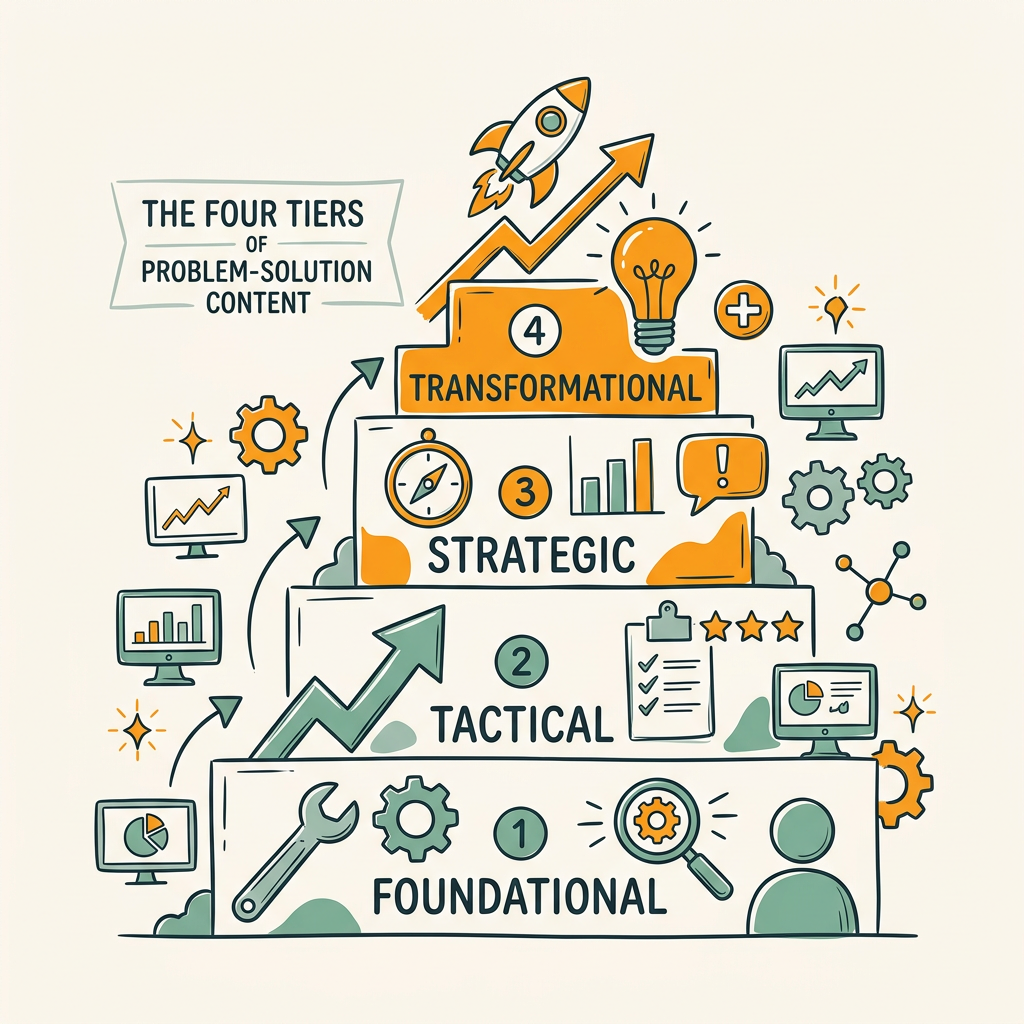
Not all problem-solution content is equal. Effective programs layer four tiers of content, each reinforcing the others. The most successful SaaS teams structure their content marketing strategy with multiple content tiers, moving readers up the funnel from awareness to decision.
Tier 1: Problem-Aware Educational Content (Foundations)
This is where 40% of your content budget should live. These are articles, guides, and tutorials that identify a problem without mentioning your product. "5 Ways to Reduce Customer Churn," "Why Your Support Costs Are Rising," "The Hidden Cost of Manual Data Entry"—these titles speak to readers who know they have a problem but haven't started shopping yet. Educational problem-solution content at the top of the funnel captures high volume because it has low search competition and strong search intent.
Publish 2–4 of these per week. Target long-tail keywords with 100–500 monthly searches. Focus on solving the problem completely—don't leave readers wondering how to actually fix it. When readers finish your article, they should feel like they have a framework for solving the problem on their own. Only then will they consider whether they want to automate it with a tool.
Tier 2: Comparison and Alternative Content (Evaluation)
This is 30% of your content budget. Once readers understand their problem, they start evaluating solutions. Comparison content — "Tool A vs. Tool B," "Best Solutions for X," "Why [Competitor] Isn't Right for Your [Situation]" — captures the commercial intent that converts. Comparison pages convert 2–5x higher than standard blog posts because they're read by active evaluators, not learners.
The framework here is straightforward: identify genuine trade-offs, acknowledge competitor strengths, but position your product as the better fit for the target audience. Don't lie. If a competitor is cheaper, say so. Then explain why they're charging less and what you get for the premium. Include at least one interactive element—a comparison table with real features, a calculator showing total cost of ownership, or a scorecard the reader can customize to their needs.
Tier 3: Case Studies and Narrative Problem-Solution Stories (Validation)
This is 20% of your content budget, and the highest-converting format. A case study isn't "Company X Used Our Product and Got Results." It's a narrative arc: "Company X Had This Specific Problem, Here's Why Solving It Mattered, Here's What They Tried, Here's Where It Failed, Here's How They Solved It with Our Product, Here's the Outcome and What They Learned." The specificity matters. Use real numbers. Case studies convert at 8.4%—the highest rate of any B2B content format.
Include a breakdown of the methodology, a month-by-month timeline of results, and an interview excerpt from the customer. Video case studies (60–90 seconds of the customer speaking) outperform text-only by 30%. Make the problem emotional, not just financial. A CFO cares about ROI, but the ops team cares about not working weekends.
Tier 4: Interactive Tools and Original Data (Community and Authority)
This is 10% of your budget but generates 40% of backlinks and word-of-mouth. A free calculator ("Calculate Your Annual Support Cost"), an interactive roadmap tool, or an original benchmark report that shares anonymized data from 100+ companies—these assets are shared, cited, and ranked for years. Tools capture email addresses. Reports attract PR and citations. Both compound.
The problem-solution angle: Your calculator shows the reader exactly how much their problem is costing them. Your benchmark report puts their pain in context: "You're spending 3x the industry average on X." That creates urgency and validates that their problem is worth solving.
How to Structure Problem-Solution Content for Maximum Conversion
The framework is more important than the format. Follow this pattern for every piece, whether it's a blog post or a 5,000-word guide. Narrative-driven problem-solution content achieves 2x higher engagement rates compared to traditional informational articles because it mirrors how humans naturally process and retain information.
The Problem-Solution Arc: Five Elements
Traditional how-to guides lead with steps. Problem-solution content leads with narrative. Start with the problem, deepen the stakes, build tension, reveal the solution, and show the resolution. This structure works because it mirrors how buyers actually think.
- Identify the Core Problem (Headline + First 100 Words): Name the pain point explicitly. "Your support team is overwhelmed" beats "Support optimization strategies." Use a stat if you have one. "Companies lose $150,000 annually to inefficient support processes."
- Introduce Consequences (Next 200–300 Words): Show the reader what happens if they don't solve it. Churn increases. Burnout spreads. Competitors eat market share. Make the problem emotional and financial. This is where a relatable character helps: "Sarah is a support manager at a 50-person SaaS company. Her team handles 2,000 tickets monthly."
- Reveal the Root Cause (Middle Section, 300–500 Words): Don't jump to solutions. First, explain why the problem exists. Bad hiring decisions? Outdated tools? Lack of visibility into ticket volume? Once the reader understands the cause, the solution becomes obvious.
- Present the Solution Framework (Next 500–800 Words): Walk through the methodology for solving the problem. This is framework-level thinking, not product marketing. "The three pillars of support optimization are: (1) Visibility into ticket types, (2) Prioritization rules, (3) Feedback loops." Explain each without mentioning your product once.
- Show the Outcome and Next Steps (Final 200–300 Words): Bring back the relatable character. "After implementing these three strategies, Sarah's team reduced ticket response time by 40% and support costs dropped by 25%." Then, naturally, "Tools like Jottler automate these workflows, compressing a 3-month implementation into a single day."
Visual and Formatting Best Practices
Long paragraphs disappear when AI extracts content. Scannable structure wins. Use short sentences, bold key metrics, and break heavy sections into lists. When optimizing content for AI-driven content ranking and visibility, structure becomes even more critical.
- Bullet points for lists of criteria, features, or tips — keep each under 2 sentences
- Numbered lists for sequential steps or ranked items
- Tables for comparisons — problem-solution content should include at least one table comparing "before" and "after," or comparing approaches
- Interactive elements — polls, quizzes, or a sidebar CTA that offers a free assessment based on the problem
- Blockquotes and statistics — every section should open with a stat that validates the problem
Publishing Volume and Content Velocity: The Compounding Engine

Problem-solution content only works at scale. SaaS companies ($2M–$20M ARR) that automate their content pipeline publish 3x more content without adding headcount. To hit the five-piece threshold most buyers need, you need velocity.
The Content Velocity Math
If your goal is to reach every buyer with five pieces of content before they engage sales, calculate how many potential buyers you're pursuing monthly. If you aim to attract 500 qualified leads monthly, you need 2,500 content impressions minimum. That's roughly 10–15 pieces of original content weekly, distributed across owned channels (blog, email) and earned channels (organic search, Reddit, communities).
Most teams can't staff for that. The solution is content automation. Autonomous SEO agents like Jottler research, write, and publish 3,000+ word articles daily using 12 AI agents that handle keyword research, fact-checking, internal linking, and CMS publishing. This eliminates the bottleneck most teams face when scaling problem-solution content, allowing founders and marketing teams to focus on strategy while the system compounds.
Content Sequencing Across Channels
Don't publish the same article everywhere. Tailor problem-solution content to the channel:
- Blog: Full-length, 3,000+ word pieces targeting medium-difficulty keywords. Optimized for Google and AI search engines.
- Email: Short-form problem-solution threads. "Here's the problem..." (paragraph). "Here's why it happens..." (paragraph). "Here's the fix..." (paragraph + link to full article).
- Reddit and Communities: Value-first posts answering the problem directly without promoting your product. Authentic engagement builds trust. Link to your guide only when it adds genuine value.
- LinkedIn: Narrative case studies. "I was leading a 50-person team when X happened. Here's how we solved it." Link to the full case study on your blog.
- Video: Problem-solution stories in 60–90 seconds. Show the problem, hint at the solution, link to the written guide where the full methodology lives.
Measuring Problem-Solution Content Performance: ROI That Matters
Vanity metrics (page views, shares) don't matter. Track what actually drives revenue. Problem-solution content's ROI flows through three channels: pipeline generation, trial-to-paid conversion, and churn reduction.
Pipeline Attribution and Conversion Metrics
Set up conversion tracking so you can measure which content pieces drive leads. A prospect who reads your "how to reduce churn" guide and then fills out a demo request is attributed to that piece. That's pipeline. Over time, you'll see which problem statements drive the most qualified leads.
Benchmark: Standard blog posts convert at 0.5–2.0%. Problem-solution content targeting commercial intent should hit 5–10%. If you're below that, your problem statement isn't resonating, or your CTA isn't clear. Research from 312 B2B companies shows case studies and narrative formats drive measurable lead generation and revenue attribution.
- Leads Generated: Tracked via form submissions, demo requests, email signups
- Lead Quality (MQL to SQL conversion): Are these high-intent prospects or just curious readers?
- Opportunity Size: What's the average deal value of prospects sourced by problem-solution content vs. other channels?
- Sales Cycle Length: Does problem-solution content shorten time-to-close? It should.
Content ROI Calculation
Here's the formula: (Revenue Generated from Content − Content Production Cost) / Content Production Cost × 100 = Content ROI.
If you publish one 3,000-word guide weekly and it costs $500 (writer + editor + tools), you're spending $2,000 monthly on content. If that guide generates 20 leads monthly and 2 convert to customers at $5,000 each, you've generated $10,000 in revenue from $500 of content. That's 20x ROI in the first month. Add month two and month three? That same piece is still generating leads and converting. The ROI compounds.
Common Mistakes to Avoid in Problem-Solution Content
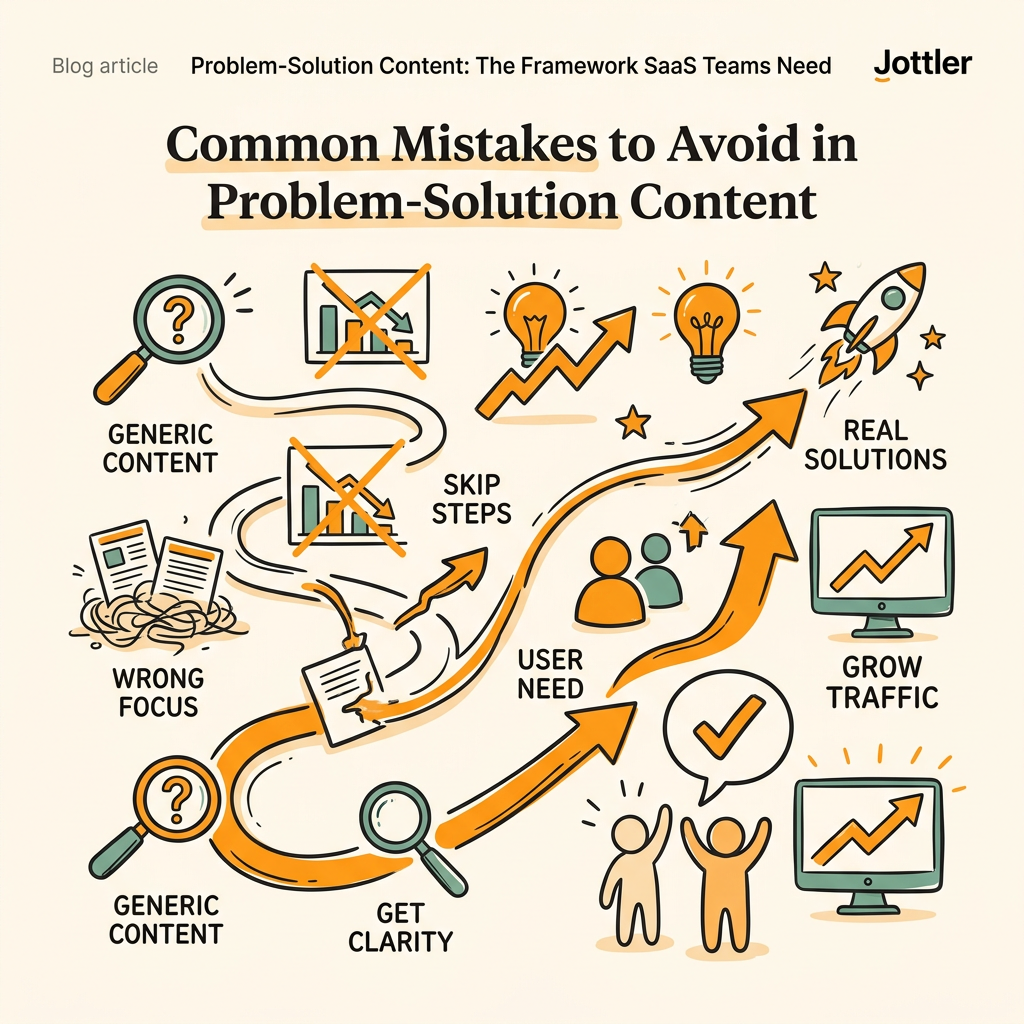
Most teams get problem-solution content wrong by making one of three mistakes: solving the problem too quickly, pushing the product too early, or not addressing the true root cause. Understanding how to avoid these pitfalls through structured content automation and planning can dramatically improve your outcomes.
Mistake 1: Jumping to the Solution Too Fast
A reader lands on your article because they have a problem. You have roughly 30 seconds to prove you understand it. If your first section pivots to "here's our product," you've lost them. Spend the first 30% of the content validating the problem, showing its scope, and building trust that you understand the stakes. Only then introduce the solution framework.
Mistake 2: Presenting Your Product as the Only Solution
The best problem-solution content walks readers through solving the problem themselves first. "Here's how to reduce churn with these three strategies." Only after you've proven the methodology do you introduce the tool. "You can implement these manually, or tools like Jottler automate the process in 24 hours instead of three months." The reader now sees your product as an accelerant, not the only option. They're also more likely to buy because they understand what they're paying for.
Mistake 3: Ignoring the Emotional Layer
Financial pain is real, but emotional pain drives urgency. "Your support team is drowning," "Churn is killing your growth," "You're losing top talent to burnout"—these resonate because they're true and because they tap into how the reader actually feels. Balance data with narrative. Use relatable characters. Show what happens when the problem isn't solved.
Scaling Problem-Solution Content Without Burning Out Your Team
The paradox: to compete in SaaS marketing in 2026, you need to publish 10–15 pieces weekly. Most marketing teams are 2–3 people. The solution isn't hiring more writers—it's automating the production pipeline.
The Automation Approach
A content automation system like Jottler handles the repetitive work: keyword research, competitive analysis, fact-checking, internal linking, and publishing. The AI agents research problems your audience is searching for, identify gaps in competitor content, and write problem-solution articles optimized for both Google and AI search engines. What used to take a team of 4 writers working 4 weeks now takes 1 person managing the system daily.
The founder or marketing lead focuses on: (1) defining the problems worth solving, (2) reviewing and refining strategic content, (3) creating content sequencing for different channels. The system handles the production line. This is how busy founders compound traffic without burnout.
Content Batching and Workflow Optimization
If you're not using automation, batch your work. Instead of writing one article per week, block a day to outline 10 articles. Another day to draft them all. Another day for editing and optimization. This context-switching reduction cuts production time by 40–50% and improves consistency.
- Monday–Tuesday: Research and outline 8–10 problem-solution articles
- Wednesday–Thursday: Draft all articles in parallel, reference the same sources
- Friday: Edit, optimize, fact-check, publish, and schedule social distribution
Problem-Solution Content Across the Buyer's Journey: Mapping for Maximum Impact
Not all problem-solution content is created equal. The same problem resonates differently depending on where the buyer is in their journey.
Top-of-Funnel: Problem Awareness and Education
At this stage, the buyer is searching for answers. "How to reduce customer churn," "Why is my support team overwhelmed?" These readers don't know you exist. They're not ready for a demo. Your job is to provide the best answer on the internet, establish authority, and make them aware that solutions exist.
Content style: Educational, no product mention, data-heavy, actionable. Publication velocity: 4–6 articles weekly targeting these keywords. These pieces should have the lowest search difficulty but strong search volume. You're going for reach, not immediate conversion.
Mid-Funnel: Solution Exploration and Comparison
Once the buyer understands their problem, they start researching solutions. "Best tools for reducing support costs," "Zendesk vs. Intercom vs. Jottler," "How to evaluate a support platform." At this stage, they're comparing options and reading case studies to understand what's possible.
Content style: Comparative, honest, specific metrics, case study narratives. Publication velocity: 2–3 articles weekly. These pieces have higher search difficulty but higher conversion. They attract fewer readers but more qualified prospects.
Bottom-of-Funnel: Decision and Validation
The buyer is in final evaluation. "Jottler pricing and plans," "How Jottler works for 100-person teams," "Jottler implementation timeline." At this stage, objection handling and social proof matter most. Testimonials, detailed feature comparisons, and transparent pricing documentation all serve as problem-solution content: "Here's the problem you might have with implementation, here's how we solve it."
Content style: Specific, trust-building, objection-addressing, transparent. Publication velocity: 1–2 articles weekly. These pieces have high search difficulty and low volume but convert at 10%+.
| Funnel Stage | Problem Focus | Content Type | Expected Conversion Rate | Weekly Volume |
|---|---|---|---|---|
| Awareness (ToFu) | Problem education | How-to guides, tutorials, listicles | 0.5–2.0% | 4–6 articles |
| Consideration (MoFu) | Solution exploration | Comparisons, case studies, benchmarks | 5–10% | 2–3 articles |
| Decision (BoFu) | Implementation & objections | Pricing, feature breakdowns, FAQs | 10–20% | 1–2 articles |
Conclusion
Problem-solution content is no longer optional for SaaS teams. With 79% of buyers consuming five or more pieces before engaging sales, the teams that win are those publishing educational, problem-centric content at scale. The framework is straightforward: identify problems, educate on solutions, position your product as the accelerant, and publish with enough velocity to reach your entire addressable market.
The challenge isn't the framework—it's the execution. Most teams lack the bandwidth to publish 10–15 high-quality pieces weekly while maintaining SEO rigor and fact-checking. That's where automation changes the game. Tools that handle research, writing, fact-checking, and publishing allow small teams to compete with large content operations. Companies using content automation publish 3x more content without increasing headcount, directly translating to compounded organic traffic and shorter sales cycles.
Start with one problem-solution framework today. Map the buyer journey. Publish at least two pieces weekly across awareness, consideration, and decision stages. Track conversion rates by piece. Iterate based on what converts. Within 90 days, you'll see problem-solution content generating 3.4x more qualified pipeline than your product-focused efforts ever did. Ready to automate this process? Start your SEO agent with Jottler at https://jottler.co/auth/signup.
FAQs
What's the difference between problem-solution content and regular blog posts?
Regular blog posts often focus on general information or list-style content ("10 Ways to Improve Retention"). Problem-solution content takes a narrative arc: identifying a specific pain point, explaining why it matters, walking through a framework for solving it, and naturally positioning your product as the accelerant. Problem-solution content converts at 5–10% while standard blog posts convert at 0.5–2%. The difference is audience intent—problem-solution content speaks to readers who recognize they have a problem and want to fix it, not just learn about it.
How often should we publish problem-solution content?
To reach the five-piece threshold most B2B buyers need before engaging sales, you should publish 10–15 pieces weekly across awareness, consideration, and decision stages. This sounds aggressive, but it's achievable with content automation. Without automation, aim for 4–6 pieces weekly split across different content types. The key is consistency. Publishing three pieces every Monday then nothing for weeks is less effective than one piece every other day. SaaS companies automating their content pipeline publish 3x more content without adding staff, creating a compounding effect where older pieces continue generating traffic while new pieces attract fresh audiences.
How do we measure if problem-solution content is working?
Track three metrics: (1) Pipeline generated, (2) Lead quality (conversion from MQL to SQL), and (3) Deal size and sales cycle length. A piece of problem-solution content should generate leads within 30 days if it targets the right problem statement. Over time, watch for patterns—do comparisons convert higher than how-tos? Do case studies bring in larger deals? Case studies convert at 8.4%, the highest rate of any B2B content format. Use these patterns to double down on high-performing problem statements and shift budget away from content that attracts curious readers but not buyers.