Product-Led Growth and SEO: Aligning Content With Free Trials
Product-led growth has become the dominant go-to-market strategy for SaaS companies, yet most PLG teams ignore the biggest advantage: organic search traffic. When a free trial is your primary conversion lever, every piece of SEO content must do double duty: rank high for commercial intent and funnel visitors straight into signup. Opt-out free trials convert at 48.8% versus 18.2% for opt-in trials, but that advantage disappears if your SEO content doesn't actively guide trial-ready prospects to the conversion funnel. The problem is structural: your blog posts, comparison pages, and use-case guides sit disconnected from your free trial flow, leaving high-intent organic traffic stranded in informational content instead of moving to signup. 83% of marketers cite content marketing as the most effective demand generation method, yet most PLG teams never align their SEO strategy to their trial conversion model. Here's how to bridge that gap.
Key Takeaways
- Product-qualified leads convert at 25% on average, reaching 39% for higher-ACV products — making intent-based SEO content critical (Segment8, 2025)
- Commercial-intent keywords (pricing, free trial, alternatives) deliver higher trial signup rates than informational content when paired with clear CTAs
- Free trial pages must appear both above the fold and at multiple points throughout SEO content to capture both quick deciders and readers seeking proof
- Map SEO Keywords to Trial Intent: Prioritize transactional keywords like "free trial," pricing, reviews, and comparisons—they drive trial-ready prospects, not just awareness.
- Structure Content as a Conversion Funnel: Start with high-intent pages (pricing, use cases, alternatives), then layer top-funnel content to drive traffic to them.
- Embed Proof Elements in Every Page: Testimonials, screenshots, and social proof reduce signup hesitation and improve trial-to-paid conversion rates.
- Eliminate Signup Friction: No credit card requirements, short forms, and instant access increase trial starts from organic traffic.
- Automate Your Content Flywheel: Daily, keyword-optimized articles create compounding organic traffic without manual SEO effort.
Why SEO Content Fails for Product-Led Growth
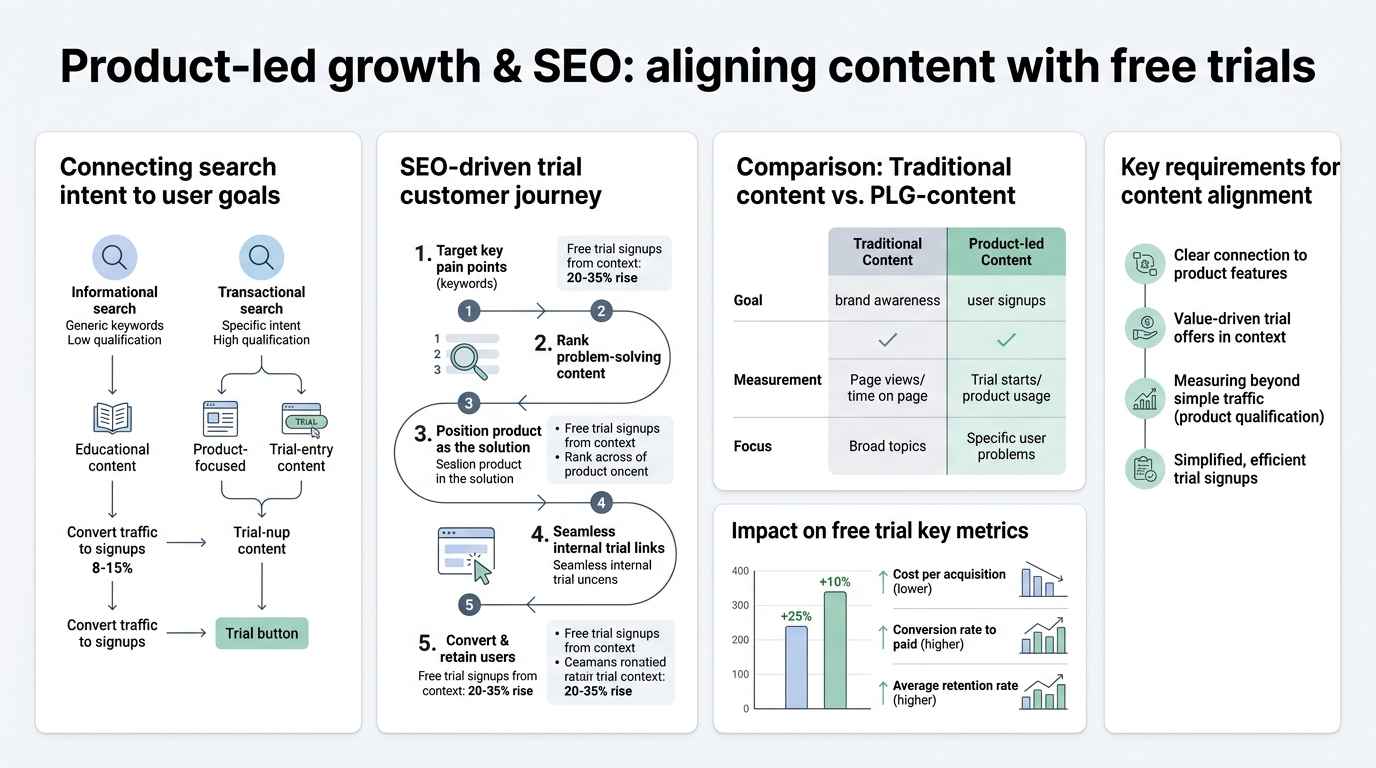
Most SaaS marketing teams publish content without connecting it to the product trial funnel. 60% of PLG initiatives fail within 18 months, and the primary culprit is misalignment between acquisition channels and conversion models. A blog post ranking #3 for "CRM software comparison" is worthless if it doesn't guide readers into a free trial—it's just traffic. In product-led growth, the product is the sales tool, so content must be the acquisition tool and the conversion accelerator. Traditional demand gen content treats SEO as a top-funnel awareness play; PLG teams need content that does three things simultaneously: rank, educate, and convert.
"In product-led growth, content must do three things simultaneously: rank for your keywords, educate your audience, and actively convert readers into trial signups. Content that ranks but doesn't convert is just expensive awareness."
The Intent-to-Trial Gap
Search intent and trial readiness are not the same thing. Most SaaS SEO strategies prioritize transactional keywords like pricing and free trial over broad informational terms because high-intent searchers are genuinely ready to start a trial. The issue: most content teams write for ranking, not for conversion. They optimize for keyword density and backlinks but forget to place a clear trial CTA above the fold. A prospect searching "project management software free trial" is seconds away from action—yet they encounter a 3,000-word article with the CTA buried in paragraph 12. Intent is wasted.
Disconnected Content Portfolios
PLG teams typically maintain separate assets: blog content (informational), product pages (descriptive), and landing pages (conversion-focused). These live in silos. A blog post on "agile project management best practices" is genuinely useful, but if it doesn't link internally to your free trial page or mention your product as the example tool, it's a missed conversion opportunity. Visitor must find your free trial independently—a friction point. The solution is architectural: every blog post, comparison page, and use-case guide must feed directly into the trial funnel through strategic internal linking and product mention. This is where a content framework that ties every piece to your business outcomes becomes essential—teams that build this win.
Slow Organic Growth Momentum
Content marketing takes 6–9 months to generate meaningful organic traffic, and most PLG companies don't have that runway. They need fast wins. The fastest path is to optimize existing pages that already rank #4–15 for commercial keywords; these are typically the quickest route to top-3 rankings. Yet most teams publish new content instead. Additionally, publishing 1–2 blog posts per month isn't enough to compound organic growth; you need a system that publishes consistently (8–12 posts monthly) while maintaining quality and SEO standards. Manual content workflows make this impossible. This is why PLG-focused SEO teams are shifting toward automated content workflows that publish daily, optimized articles while preserving the manual human review for strategy and linking.
How to Map Keywords to Your Free Trial Funnel
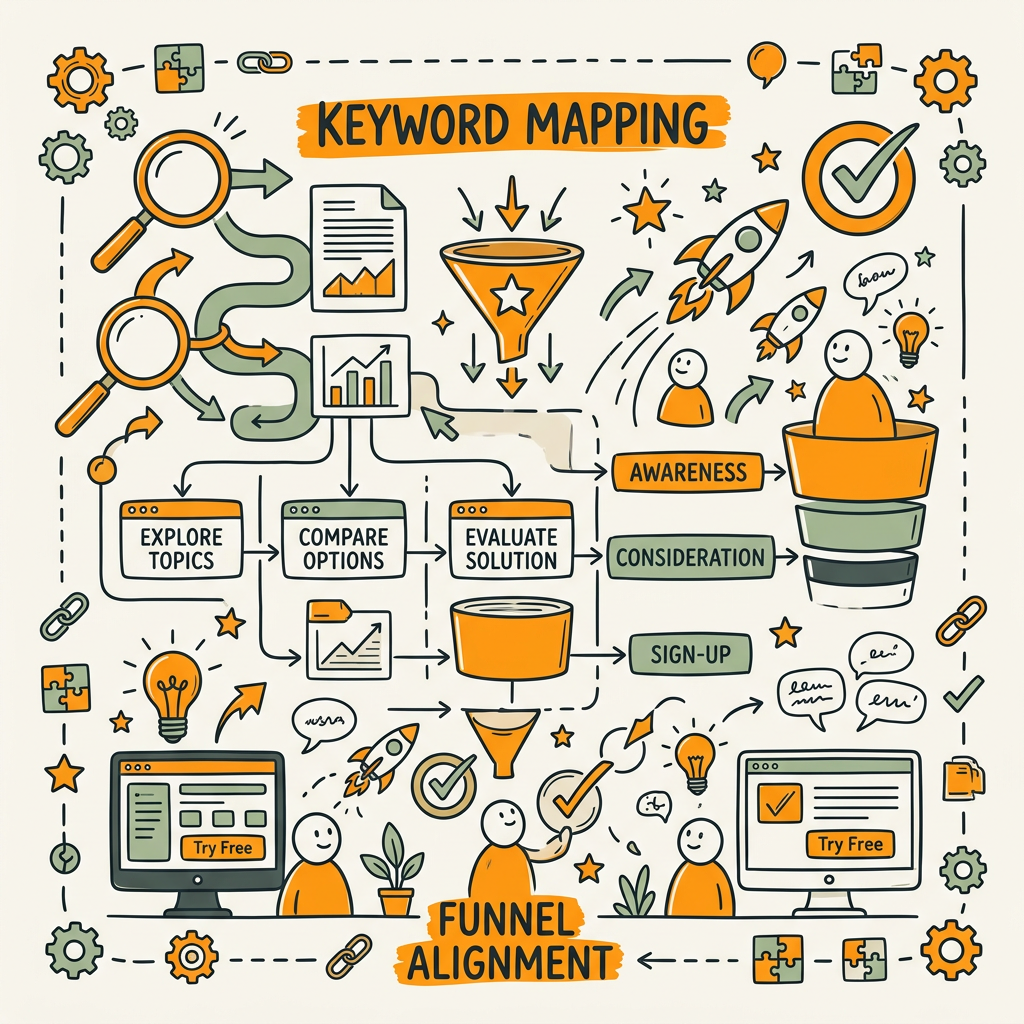
Keyword strategy is where most PLG teams stumble. They chase high-volume terms without considering conversion intent. Product-qualified leads (PQLs) convert at 25% on average, reaching 39% for higher-ACV products (GTM 8020, 2025), so your keyword map must separate PQL-ready searches from awareness-stage searches. The framework is simple: identify which keywords map to each stage of your trial funnel, then build content around that structure rather than chasing rankings.
"Product-qualified leads converting at 39% for high-ACV products proves that intent matters more than volume. One targeted keyword attracting a PQL outperforms ten broad keywords attracting awareness-stage searchers."
Bottom-Funnel Keywords: Direct Trial Intent
Bottom-funnel keywords are the revenue drivers. These are searches where the prospect is 48–72 hours away from signup. Examples: "[your product] free trial," "free trial for [use case]," "[product] pricing," "[product] reviews," "[competitor] alternative," "best [category] for [specific need]." These keywords have lower volume than "project management software," but they convert. Build dedicated pages for each of these keywords:
- Free trial page: Simple, frictionless entry. No credit card, instant access, clear onboarding path.
- Pricing page: Transparent feature breakdown, comparison table, social proof, trial CTA.
- Comparison pages: "[Your product] vs. [competitor]" — highlight why you're the better fit for this specific use case.
- Use-case pages: "[Your product] for [industry/role]" — show use-case-specific features and benefits.
- Review/alternative pages: Structured to rank for comparison searches while positioning your product favorably.
Publish these pages first. They are the conversion endpoints of your organic traffic. Once these rank in the top 5 for their respective keywords, you have a strong trial acquisition engine.
Mid-Funnel Keywords: Educational + CTA
Mid-funnel keywords are 2–4 weeks away from trial. Examples: "how to [use case]," "best practices for [problem]," "[tool] tutorial," "benefits of [feature]." These keywords have higher volume than bottom-funnel terms and attract genuinely interested people. The content strategy here is educational-first, conversion-second. Write a comprehensive guide that answers the question fully, then layer in product mentions and internal links to your trial page. A guide on "how to build project management dashboards" can organically mention your product's dashboard builder as an example, then link to the trial page. Readers won't feel sold; they'll feel guided.
Top-Funnel Keywords: Awareness + Internal Linking
Top-funnel keywords are 8–12 weeks away from trial. Examples: "what is [feature]," "benefits of [problem-solving approach]," "[topic] guide," "[industry] trends." These pages serve awareness, but they're equally important for organic growth momentum. They generate volume, build topical authority, and create internal link opportunities. Strategy: write comprehensive, expert-level content on these topics, then interlink to your mid-funnel and bottom-funnel content. A guide on "project management trends in 2026" mentions specific solutions (like your product's AI-powered task automation) and links to both a mid-funnel tutorial and a bottom-funnel comparison page. Visitors can follow a natural journey from awareness to conversion.
How to Build Trial-Converting Content
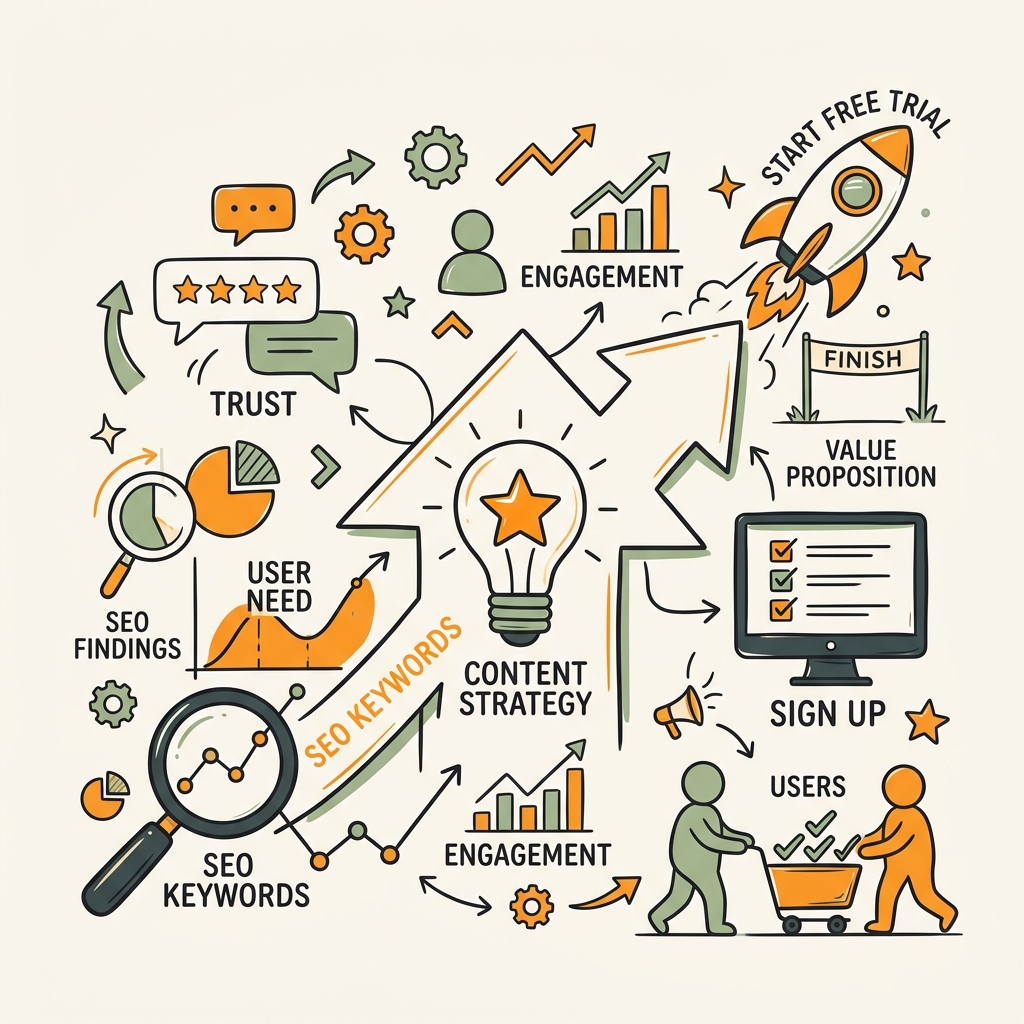
Publishing keyword-aligned content isn't enough. Your content must actively persuade prospects to start a trial. This isn't salesy—it's structural. You're removing objections before they block signup. The biggest objection to free trials is uncertainty: "Will this product actually work for me?" Your content answers that question before the prospect reaches the trial page.
Lead With Value, Not Features
The first 100 words of your content must answer the searcher's core question, then immediately show why your product is the obvious choice. Example: If someone searches "how to reduce customer churn," don't start with "Customer churn is a major issue." Start with "Churn happens because you lack real-time visibility into customer health. Here's the framework we use at [company], and the tools that made it work." This is value-first framing. Then, within the next 2–3 paragraphs, mention your product as the automation layer: "We built [your product] to automate this exact workflow—you get churn alerts in real-time without manual check-ins." This doesn't feel like an ad; it feels like an expert sharing their workflow.
Embed Proof Elements Throughout
Product-led SEO pages that include screenshots, customer testimonials, and usage examples convert trial signups at significantly higher rates. Prospects landing on your SEO content from Google want proof that your product works. Add it liberally:
- Customer quotes: "We cut onboarding time by 60% with [your product]." Attribute to name, title, company.
- Before/after metrics: Specific numbers. "30 hours/month saved." "40% reduction in churn."
- Screenshots of the actual product: Show the feature in action, not just the concept.
- Case study snippets: 1–2 sentences on a real customer result, link to the full case study.
Proof elements reduce signup hesitation. When a prospect sees your product working, they're more likely to start a trial.
Place Trial CTAs Strategically
Never bury your CTA. Place it:
- Above the fold on every page — the first "start free trial" button should appear within the first 300px.
- At the end of key sections — after you've explained a major benefit or included proof, invite them to try.
- In the conclusion — summarize the key takeaway, then close with "Ready to [benefit]? Start a free trial."
- Sticky header/footer — a persistent CTA that stays visible as readers scroll.
Remove friction from the CTA itself. "Start Free Trial" beats "Get Started." "No credit card required" beats silence on the topic. "7 days of full access" is better than "Start trial" because it sets expectations.
The Content Publishing and Scaling Problem
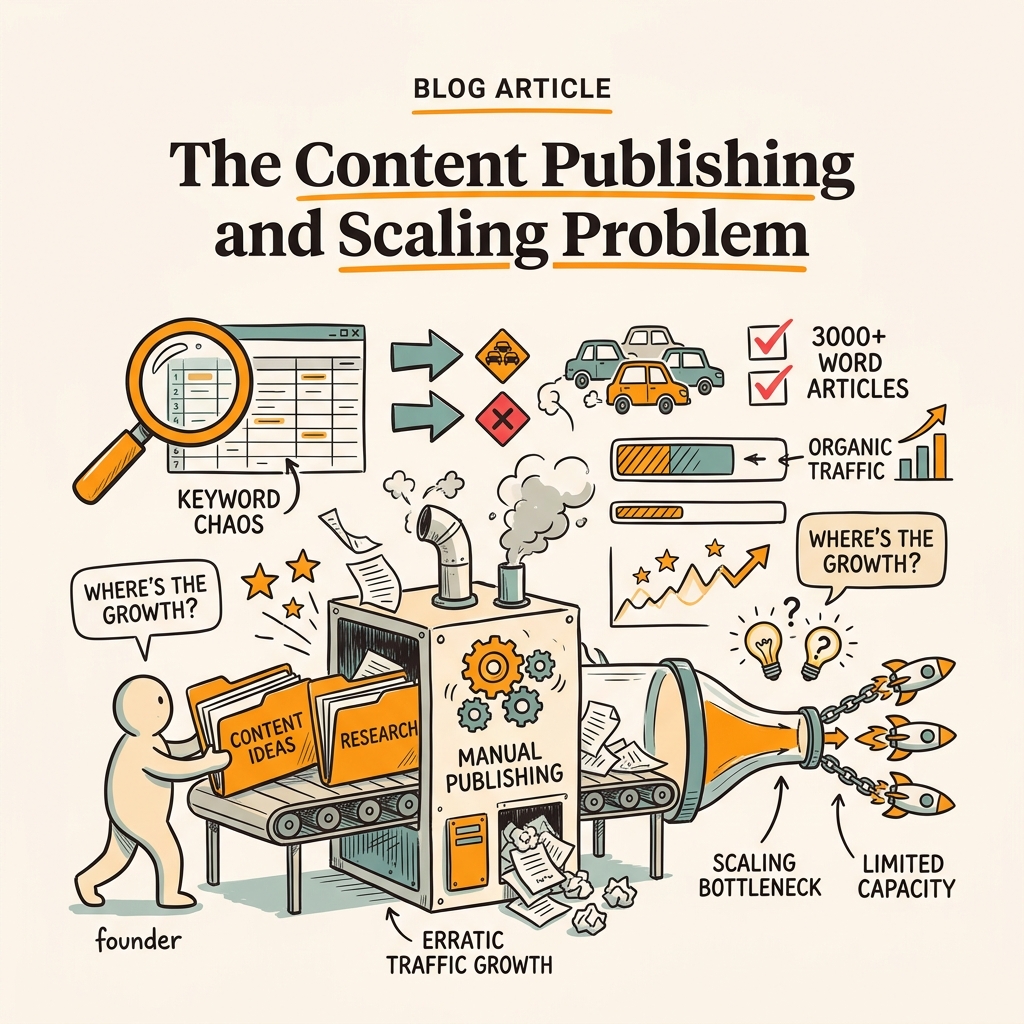
Structuring trial-aligned content is one thing; publishing enough of it is another. Marketers publishing 8–12 posts per month see 3x more organic growth than those publishing 1–2 posts monthly (HubSpot, 2026). Yet most SaaS marketing teams can't scale past 2–3 posts/month because keyword research, writing, SEO optimization, fact-checking, and CMS publishing all require manual work. The math breaks: one comprehensive SEO article takes 6–8 hours to research, write, and optimize. At 3 posts/month, that's 18–24 hours. Scale to 8–12 posts/month and you're asking 50+ hours weekly from a team of 2–3 people. Something has to give—usually quality, consistency, or accuracy.
Why Manual Content Workflows Break at Scale
Keyword research alone is expensive. You need to identify commercial-intent keywords, check ranking difficulty, analyze competitor content, and map everything to your funnel. That's 4–6 hours per keyword cluster. Then writing. Optimizing for SEO while writing naturally is hard; most writers either ignore SEO or write keyword-dense gibberish. Then internal linking—you need to know your entire content library to link intelligently, which requires manual tracking. Then fact-checking—every stat must be verified. Then publishing and CMS configuration. By the time a single article goes live, a week has passed and only 1–2 articles per month are feasible.
Automation as a Scaling Lever
The winning teams in 2026 use automation for the mechanical parts of content production—keyword research, content generation, fact-checking, and publishing—while reserving human judgment for strategy, internal linking, and competitive positioning. Autonomous SEO agents capable of publishing 3,000+ word articles daily are reshaping how PLG teams approach organic growth. You define the topics and keywords, set the publishing frequency (1–5 articles daily), and the system handles research from 14+ sources, writing, fact-checking, internal linking, and direct CMS publishing. This frees your team to focus on what machines can't do: analyzing which content drives trial signups, optimizing the funnel, and building competitive advantages. With a system like this in place, even small marketing teams compound organic traffic 10x faster than teams stuck in manual workflows.
Building a Product-Led Content Flywheel
The ultimate competitive advantage is not a single great piece of content—it's a systematic flywheel that generates consistent, trial-converting content without manual overhead. The structure is: identify keyword clusters tied to your trial funnel, publish high-quality content on those clusters at scale, measure trial signups by content source, and double down on what works.
Keyword Clustering by Funnel Stage
Group keywords by the three-funnel model:
| Funnel Stage | Keywords | Content Type | Primary Goal |
|---|---|---|---|
| Bottom-Funnel | Free trial, pricing, [competitor] alternative, [product] review | Trial page, pricing page, comparison page | Conversion to trial |
| Mid-Funnel | How to [use case], [feature] tutorial, best practices | Educational guides, use-case pages | Product education + internal link |
| Top-Funnel | [Topic] guide, [topic] trends, [problem] solutions | Thought leadership, industry insights | Traffic, topical authority, awareness |
For each cluster, publish content weekly or biweekly. Aim for 40% bottom-funnel content (direct trial focus), 40% mid-funnel (educational + product mention), and 20% top-funnel (authority building). This ratio maximizes both traffic volume and conversion rate.
Measuring Trial Signups by Content Source
Not all content creates equal trial value. You need to know which blog posts, comparison pages, and guides actually drive signups. Set up UTM parameters on every CTA: ?utm_source=blog&utm_medium=article&utm_campaign=[keyword_cluster]. Then track in your analytics: which articles drive the most trial starts? Which convert the highest percentage of readers to trials? Which have the lowest bounce rate? Use this data to double down. If your "CRM for startups" guide drives 20 trials/month, publish 3 more guides in adjacent startup-software categories. If your pricing page ranks #2 for "[product] pricing" but only converts 8% of visitors, test copywriting changes and proof elements.
Compounding Traffic Through Internal Linking
Internal links are both an SEO signal and a conversion funnel. Every top-funnel article should link to 2–3 mid-funnel guides, which should link to 1–2 bottom-funnel conversion pages. Example link structure: A blog post on "industry trends 2026" links to a guide on how to adopt emerging strategies, which links to a comparison page "[our product] vs. [competitor for this use case]" which links to the free trial page. Readers follow a logical journey from interest to conversion. Search engines see a content network with clear topical authority. Both outcomes compound organic growth.
Conclusion
Product-led growth isn't about giving away your product for free; it's about giving away access to your product's value and letting the product convince users to pay. SEO content is the fastest way to reach trial-ready prospects at scale. Credit-card-required free trials convert at 49–60%, yet that conversion rate is worthless if your content doesn't guide high-intent searchers into the trial funnel. The winning strategy is simple: map commercial-intent keywords to your trial funnel, publish educational content that proves your product works, and automate the publishing workflow so you can scale from 2–3 articles per month to 8–12. Start by auditing your current content library—identify which pages rank #4–15 for commercial keywords and optimize them first. Then, build a keyword cluster roadmap that covers your entire funnel. Finally, implement a publishing system that lets you ship consistent, trial-optimized content without burning out your team. The teams that master this in 2026 will capture 10x more organic trial signups than competitors still trapped in manual workflows. Start your SEO agent and begin building your content flywheel today.
FAQs
Should I use opt-in or credit-card-required free trials for SEO?
Credit-card-required (opt-out) trials convert at 48.8% versus 18.2% for no-credit-card trials, making them significantly more powerful when aligned with high-intent organic traffic. For SEO specifically, you want the highest-intent audience possible, so opt-out trials paired with transactional keyword content will generate more conversions per visitor. The trade-off is friction—fewer people will start a trial. Solve this by optimizing your SEO content to pre-convince readers before they see the trial page. If your article proves your product works, the credit-card requirement becomes a non-issue. Use opt-in trials only if your addressable market is small or if your product requires extensive setup.
How much does it cost to scale trial-focused content production?
Manual content production costs roughly $2,000–4,000 per article when you account for keyword research (4 hours), writing (6–8 hours), SEO optimization (2 hours), fact-checking (2 hours), and publishing (1 hour) at a fully-loaded marketing team rate. To publish 10 articles monthly, that's $20,000–40,000. Agencies typically charge $150–300 per hour, pushing the total higher. Automated content platforms start at $29/month and handle the entire research-to-publishing workflow, reducing per-article costs to under $10 while freeing your team to focus on strategy. For startups and small SaaS companies, this makes consistent, high-volume content production actually feasible.
What's the fastest way to drive trial signups from existing content?
Optimize pages that already rank #4–15 for commercial keywords. These pages are often the fastest path to top-3 rankings, meaning immediate trial traffic with minimal effort. First, add a trial CTA above the fold if it's missing. Second, add proof elements (testimonials, screenshots, before/after metrics). Third, update internal links to point readers toward your trial page. Fourth, refresh any outdated statistics or claims. Most teams see 20–40% increases in trial signups from existing pages within 2 weeks. After winning your #4–15 pages, move to new content creation and keyword expansion to compound growth.