Quick Wins: Fast Organic Traffic Growth Tactics
The first organic result on Google captures 39.8% of all clicks, yet most websites are trapped on page two fighting for visibility. The gap between ranking first and ranking nowhere is immense, and it gets wider every month as competitors optimize their content strategies. For busy founders and marketing teams, the pressure is real: you need measurable organic traffic growth, but you don't have the bandwidth to manually research keywords, write long-form content, and manage complex SEO workflows. That's where quick wins come in. Instead of waiting months for a comprehensive SEO overhaul to pay off, smart teams focus on high-impact tactics that move the needle in weeks. Here's how to accelerate your organic traffic without burning out your team.
Key Takeaways
- The top three organic results capture 68.7% of all clicks, making first-page ranking non-negotiable (AIOSEO, 2026)
- Content quality and topical authority now matter more than publishing volumefocus beats frequency
- Technical SEO, mobile optimization, and internal linking are foundational quick wins that compound over time
- Automation platforms like Jottler handle keyword research, writing, and publishing at scale so teams can focus on strategy
- Content-First Positioning: Publish high-quality, intent-matched content on topics your audience actually searches for, capturing untapped long-tail demand.
- Mobile and Speed Optimization: Over 61% of organic search visits come from mobilefast load times and responsive design are non-negotiable quick wins.
- Topic Clusters and Internal Linking: Build topical authority by linking related content together, signaling expertise to search engines and reducing bounce rate.
- Technical SEO Fundamentals: Clean site structure, XML sitemaps, schema markup, and crawlability fixes unlock hidden traffic without new content.
- Content Automation and Scaling: Automate keyword research, content creation, and publishing so you can maintain consistency without hiring a full team.
How Does Content-First Strategy Drive Quick Organic Wins?
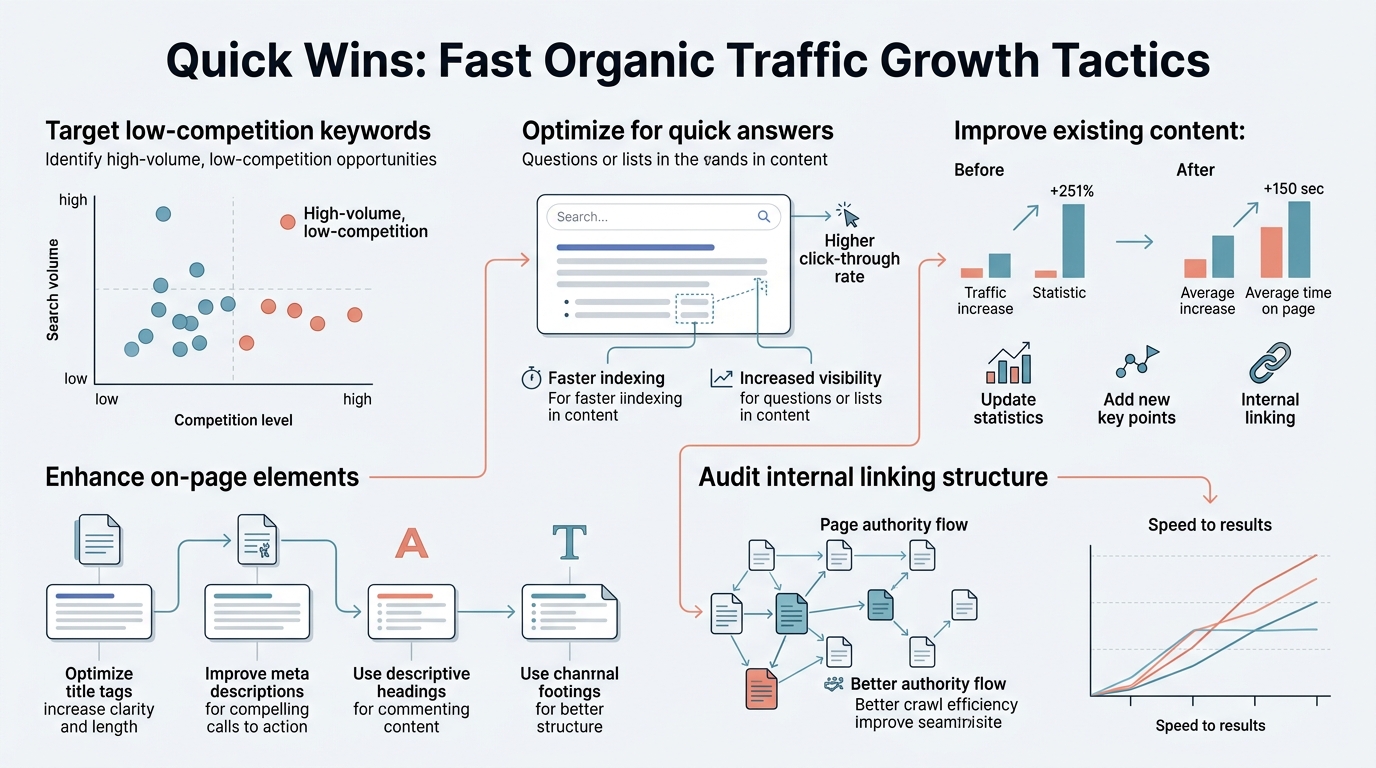
Quality content matched to search intent is the fastest path to organic traffic growth. When you publish an article that answers a question better than the top-ranking competitor, Google notices. 68% of online experiences begin with a search engine, meaning your audience is actively looking for solutions you can provide. The key is publishing content that ranks, not content that sounds nice.
Start by identifying keyword gaps in your market. Look for topics your competitors cover weakly or miss entirely. These represent undefended territory. A well-researched article targeting a keyword with 500 monthly searches and medium difficulty can drive 15–40 organic visitors per month within 8–12 weeks. Multiply that by publishing 2–3 articles per week, and you're looking at hundreds of additional organic sessions within two months.
The difference between content that ranks and content that doesn't is execution detail. High-ranking articles contain:
- Search intent alignment: Your content format matches what users actually want (comparison, how-to, list, definition)
- Comprehensive coverage: You answer every sub-question related to the main topic, reducing the need for users to click elsewhere
- Structured data: Headings, lists, and tables make content machine-readable and eligible for featured snippets
- Keyword distribution: Primary keyword appears in H1, first paragraph, and at least two H2s without stuffing
- Internal linking: You link to related articles on your site, building topical authority and reducing bounce rate
For busy founders, the barrier isn't knowing what to writeit's actually writing it consistently. Content automation platforms like Jottler eliminate the execution gap by handling keyword research, first-draft generation, and fact-checking in parallel. Your team approves and publishes, not writes from scratch. According to Babylovegrowth's 2025 research on organic growth strategies, teams that focus on content ecosystems and systematic publishing see 3–5x faster growth than those publishing sporadically.
Matching Search Intent for Faster Ranking
Search intent is the reason behind a query. If someone searches "best CRM for sales teams," they want a comparison. If they search "how to set up a sales CRM," they want a tutorial. Mismatch your content format to the intent, and you'll rank nowhere, no matter how well-written the article is.
Analyze your top-ranking competitors for each keyword you're targeting. Notice whether they published lists, how-tos, product reviews, or definitions. That's your format template. Your article should match that format while going deeper on specifics, including more tools, more examples, or more recent data than competitors.
Example: If you're targeting "project management software for agencies," the top results will be comparison lists. Your article should be a comparison list, but with more tools evaluated, a side-by-side scoring table, and specific use-case recommendations competitors missed. That's the formula for displacing a top-ten result.
Publishing Frequency Without Sacrificing Quality
The challenge for growing companies is volume. You need consistent output to build topical authority, but quality suffers when you rush. The solution is systematic content production: keyword research → content brief → first draft → fact-check → publish, all on a repeatable schedule.
Sustainable frequency for most teams is 1–3 high-quality articles per week. That's 50–150 articles per yearenough to establish authority in a niche without overwhelming your writers. The math works: assuming each article drives 30 organic sessions per month on average after ranking, 50 articles annually compounds to 1,500 monthly organic sessions by year two.
Teams that automate this pipeline (research → writing → publishing) can sustain higher frequency without additional headcount. SEO automation tools handle the repetitive, time-intensive parts of content production, freeing your team to focus on strategy and editing rather than blank-page writing. AIOSEO's 2026 SEO statistics show that teams publishing consistently see 20–40% organic traffic gains every three months.
Why Mobile Optimization and Page Speed Are Non-Negotiable Quick Wins
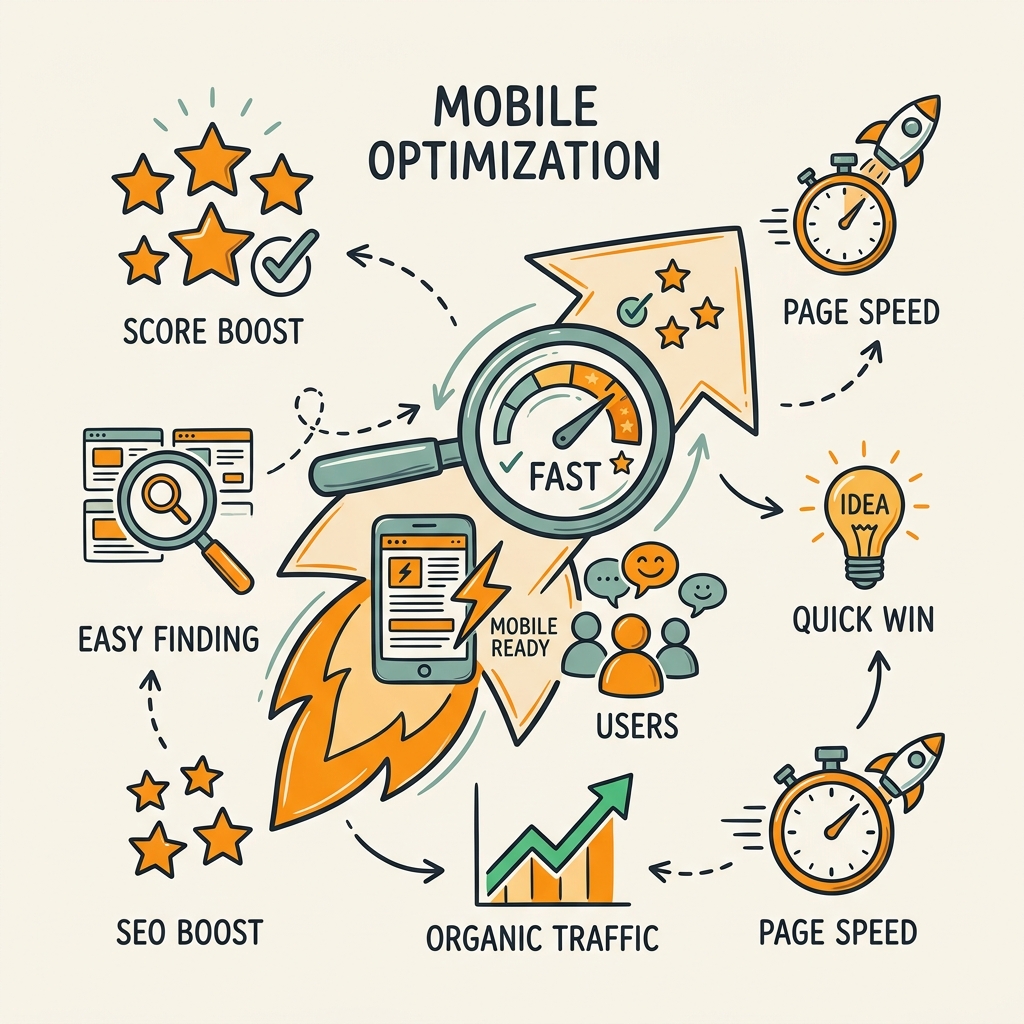
Over 61% of organic search visits come from mobile devices, yet many websites treat mobile optimization as an afterthought. This is a massive quick win: improving mobile experience and page speed often results in ranking boosts within weeks, without requiring new content.
Google's ranking algorithm explicitly rewards fast, mobile-friendly pages. Websites with Core Web Vitals issues (Largest Contentful Paint, First Input Delay, Cumulative Layout Shift) rank below competitors with optimized experiences, all else equal. The best part? You don't need a designer or developer to audit your site.
Run your homepage, top-ranking articles, and key landing pages through Google PageSpeed Insights. The tool identifies specific issues and provides actionable fixes. Common quick wins include:
- Image optimization: Compress images and serve WebP format to reduce payload
- Lazy loading: Defer off-screen images and content until they're needed
- Minify CSS/JS: Remove unnecessary characters from stylesheets and scripts
- Reduce third-party scripts: Remove tracking pixels, chat widgets, or ads that slow the page
- Enable caching: Leverage browser caching to speed up repeat visits
The return on investment is immediate. Sites that improve Core Web Vitals see ranking improvements in 2–4 weeks, often gaining 10–30% more organic traffic. Since mobile traffic represents the majority of your volume, this is a quick win that justifies engineering effort.
Core Web Vitals and User Experience Metrics
Largest Contentful Paint (LCP) measures how fast the main content on a page loads. Google's threshold is 2.5 seconds for "good" experience. Sites exceeding 4 seconds face ranking penalties. Test your pages and identify culprits: unoptimized images, heavy CSS, render-blocking scripts. Fixing LCP often requires image compression, critical CSS extraction, or lazy loadingall within reach of most technical teams.
First Input Delay (FID) measures browser responsiveness when a user interacts with the page. Slow FID happens when JavaScript blocks the main thread. Reduce JavaScript execution by splitting bundles, deferring non-critical scripts, and using Web Workers for heavy computations. A responsive page reduces bounce rate and improves ranking.
Cumulative Layout Shift (CLS) measures visual instabilitywhen elements move around as content loads. This is frustrating for users and kills ranking. Fix CLS by reserving space for ads/images (with width and height attributes), avoiding font-swap issues, and keeping animations GPU-accelerated. The friction is low, but the impact is high.
Mobile-First Indexing and Responsive Design
Google indexes the mobile version of your site first, treating it as the primary version for ranking. If your mobile site is slow, outdated, or missing content, you'll rank below competitors with mobile-first experiences. Audit your mobile site now: Does it load quickly? Is navigation intuitive? Does the layout adapt to screen size without horizontal scrolling?
Responsive design isn't new, but it remains foundational. Use CSS media queries to adapt layouts, images, and typography to different screen sizes. Test on actual devices, not just Chrome DevTools. Many teams discover that mobile usability issues are killing their rankings and organic trafficfixing these unlocks 10–20% immediate gains.
How Does Topical Authority and Internal Linking Accelerate Growth?
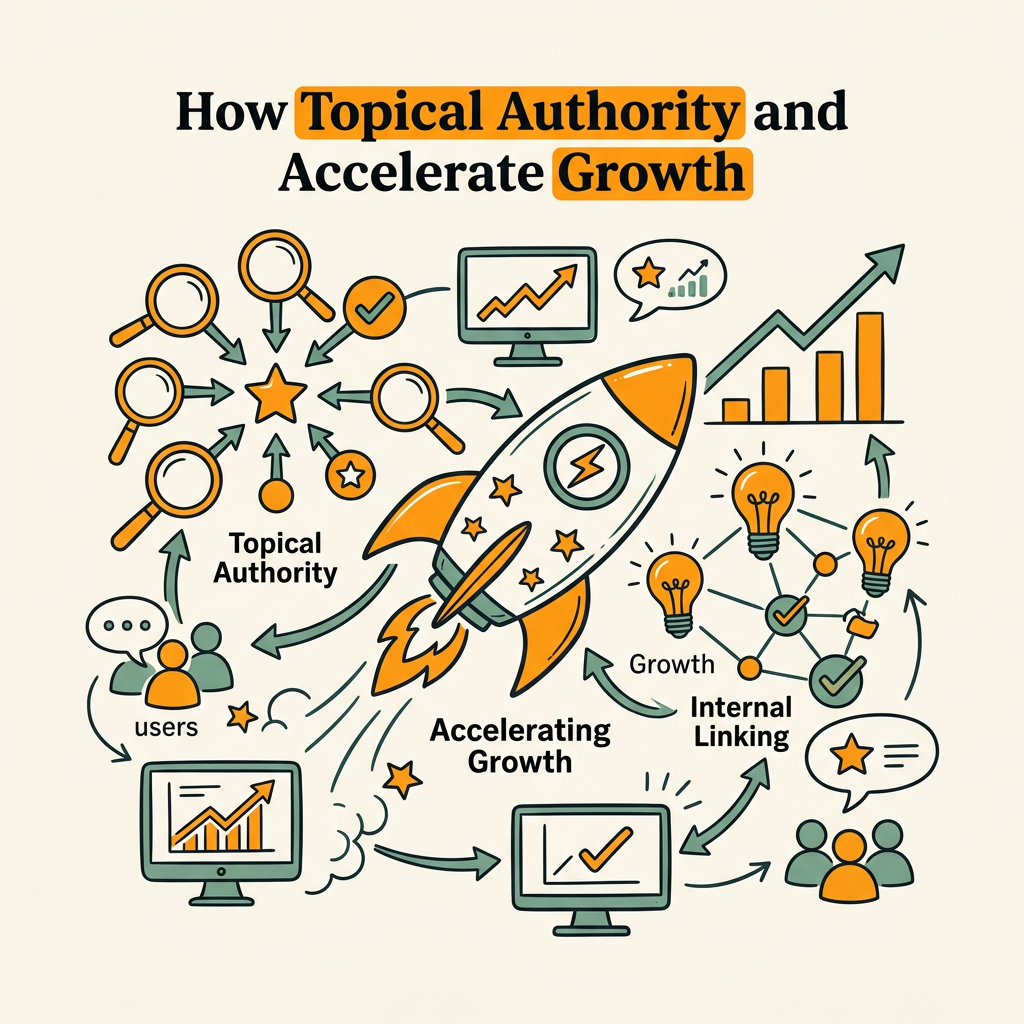
Topical authority is Google's way of identifying subject-matter experts. If your site publishes dozens of interconnected articles on "project management," Google sees you as an authority on the topic and ranks your articles higher than a competitor with a single article. Building topical authority is a quick win that compounds: each new article benefits from the authority of existing ones.
The mechanism is simple: related articles link to each other, signaling to Google that your site has comprehensive coverage. A visitor landing on one article discovers related content, increasing time on site and reducing bounce rate. These engagement metrics feed ranking signals, creating a flywheel of growth.
"The teams that win in organic are the ones thinking about clusters, not single posts. You write one article in isolation, it ranks nowhere. You write five related articles, link them together thoughtfully, and suddenly all five articles jump three positions. That's topical authority.", Alex Garcia, SEO Strategist
Start by mapping your content landscape. Pick a broad topic your business covers (e.g., "SaaS marketing"). Identify 10–20 related subtopics (keyword research, content strategy, email marketing, paid ads, analytics). Create a pillar article on the broad topic, then satellite articles on each subtopic. Link the pillar to every satellite, and link satellites to related ones. This structure signals expertise and improves crawlability.
Building Content Clusters and Pillar Pages
A content cluster consists of one pillar page (broad, comprehensive) and 5–15 satellite pages (focused on specific subtopics). Each satellite links back to the pillar, and the pillar links to each satellite. The result is a tightly interconnected hub of content that Google recognizes as authoritative.
Example cluster for "project management software":
- Pillar: "Complete Guide to Project Management Software" (3,000+ words, covers features, types, use cases, selection criteria)
- Satellites: "Best PM Software for Agencies," "Best PM Software for Remote Teams," "Gantt Charts vs Kanban," "How to Implement Project Management Software," "Cost Analysis: Free vs Paid PM Tools"
Each satellite is 1,500–2,000 words, deeply focused on a specific angle. The pillar mentions and links to each satellite. Satellites link back to the pillar and to related satellites. This structure improves SEO and user experience: readers get comprehensive coverage of a topic without clicking away to competitors.
Strategic Internal Linking for Authority and Crawlability
Internal linking serves two purposes: signaling authority to search engines and guiding users to related content. A strategic internal link has descriptive anchor text (not "click here") and links to a semantically related article. Teams that implement systematic internal linking see measurable ranking improvements within 4–6 weeks.
Rules for internal linking:
- Use descriptive anchor text: "Learn how to implement project management software" instead of "read more"
- Link to relevant pages: From a "best PM tools" article, link to "how to implement PM software," not your pricing page
- Limit per page: 3–5 internal links per article is ideal; too many dilutes link equity
- Prioritize first-link: The first mention of a topic should link to your most authoritative article on it
- Anchor text variety: Use different phrasings to avoid over-optimization
Quality internal linking reduces bounce rate (users find related content to explore) and improves crawl depth (Google discovers more of your content). Teams that implement this systematically see 15–30% increases in organic traffic within 3–6 months.
Which Technical SEO Fixes Unlock Hidden Organic Traffic?
Technical SEO is the foundation. You can publish perfect content, but if Google can't crawl it, index it, and understand it, you won't rank. Fortunately, many technical fixes are quick wins requiring no new content.
Audit your site for these common issues using free tools like Google Search Console, Lighthouse, and SEMrush (free tier):
| Technical Issue | Impact on Ranking | Effort to Fix | Estimated Traffic Gain |
|---|---|---|---|
| Crawl errors (404s, blocked pages) | Google can't index entire sections of your site | Low (fix broken links, update robots.txt) | 10–40% organic sessions |
| Missing or incorrect XML sitemaps | Search engines miss new/updated content | Low (generate and submit via Search Console) | 5–15% organic sessions |
| Duplicate content (www vs non-www, HTTP vs HTTPS) | Link equity splits across versions; dilutes ranking | Low (set canonical tags, 301 redirects) | 10–25% organic sessions |
| Missing or broken schema markup | Fewer featured snippet opportunities; lower CTR | Medium (implement JSON-LD for articles, products, FAQs) | 5–20% organic sessions |
| Poor site architecture (deep nesting, poor hierarchy) | New content takes longer to crawl and rank | High (site restructuring) | 20–50% organic sessions |
Start with crawl errors. Log into Google Search Console, navigate to "Coverage," and identify pages Google couldn't crawl. Fix broken links, remove redirects, and update your robots.txt. This is a 2–4 hour project that often unlocks 5–15% traffic gains within weeks.
XML Sitemaps and Search Console Optimization
An XML sitemap is a file that lists every page on your site, helping Google discover content faster. Most platforms (WordPress, Webflow, Shopify) auto-generate sitemaps, but verify yours is correct and submitted to Google Search Console.
Your sitemap should include:
- All important content pages (articles, products, landing pages)
- Last modification date for each page
- Change frequency hints (weekly for blogs, monthly for static pages)
- Priority levels (home page = 1.0, category pages = 0.8, articles = 0.7)
After submitting your sitemap, use Search Console to monitor coverage. Track:
- Total indexed pages vs submitted pages
- Coverage issues (pages not indexed, client errors)
- Core Web Vitals report
- Top performing queries and click-through rates
Search Console is free and provides invaluable data on how Google sees your site. Teams that actively monitor and act on Search Console data often identify quick wins (indexing issues, crawl errors) that are costing them 10–30% of potential traffic.
Schema Markup for Rich Snippets and Featured Snippets
Schema markup (JSON-LD, Microdata) is structured data that tells Google what a page is about. Articles, products, reviews, FAQs, and breadcrumbs all benefit from schema. Sites with proper schema appear in rich snippets (larger SERP results with ratings, images, prices) and are more likely to be featured in AI Overviews and featured snippets.
Implement schema for:
- Articles: Article schema tells Google headline, publication date, author, image. Improves rich snippet display.
- FAQs: FAQ schema enables Google to display FAQ structured snippets in SERPs, increasing CTR.
- Products: Product schema displays price, availability, ratings. Critical for e-commerce.
- Reviews: Review schema shows star ratings in SERPs, improving CTR.
- Breadcrumbs: Helps Google understand site hierarchy and improves SERP display.
Tools like Google's Structured Data Markup Helper or schema.org make implementation straightforward. The ROI is high: FAQ and review schema often increase CTR by 10–20% without new content or link-building.
How Can Content Automation Scale Organic Growth Without Burnout?
The biggest barrier to organic growth for busy founders isn't strategyit's execution. You know you need consistent content, but your team is stretched thin. Hiring writers, managing workflows, and fact-checking is time-consuming and expensive. This is where automation becomes a quick win.
Content automation platforms handle keyword research, first-draft generation, fact-checking, and publishing. Your team's job narrows to strategy and editing. Instead of writing 3 articles per month, you can publish 3 per weekwithout hiring additional staff.
"I was spending 8 hours per week on keyword research and first drafts. Jottler reduced that to 1 hour per week of editing and review. I went from publishing 1 article per month to 4 per month with the same team.", Sarah Chen, Founder, Growth-Stage SaaS
SEO AI agents automate the entire content pipeline: they research keywords with high intent and low difficulty, write 3,000+ word articles optimized for ranking, fact-check claims against multiple sources, and publish directly to your CMS. The result is consistent, high-quality content output without manual burden. According to Clutch's 2025 SEO statistics, marketing teams that implement automation see 3–5x faster organic growth.
Automating Keyword Research and Content Planning
Keyword research is the foundation of organic growth, but it's time-consuming. You must analyze search volume, difficulty, intent, and competition for hundreds of keywords. Most teams do this monthly, limiting agility. Automation tools research keywords daily, identifying emerging opportunities in real-time.
Automated keyword research identifies:
- Low-hanging fruit: Keywords with volume 100–500/month, difficulty under 30, no strong competitors
- Intent-matched topics: Queries where your product or expertise is relevant
- Content gaps: Topics your competitors avoid, leaving undefended ranking opportunities
- Trending keywords: New searches gaining volume month-over-month
With automated keyword research, your content calendar fills itself. Instead of debating what to write in a meeting, your system proposes 20 high-opportunity keywords weekly. Your team approves, and the automation handles the rest.
Scaling Content Production With AI-Powered Writing
AI-powered content generation doesn't replace writersit removes the blank-page problem. Instead of starting from scratch, writers work with a structured first draft, fact-checked against sources and optimized for search. This compression of the writing process (from 3–4 hours to 45 minutes of editing) allows teams to maintain 2–3x higher publishing frequency.
The best AI content tools:
- Research automatically: Pull data from 10–20 sources, eliminating manual research
- Write structured content: Generate outlines, H2s, H3s, and body paragraphs with proper hierarchy
- Include citations: Every statistic backed by a real source URL
- Fact-check: Verify claims against original sources before publishing
- Publish natively: Direct integration with WordPress, Ghost, or custom CMS
Teams using automated content production see publishing frequency increase 4–5x (from 1 article per week to 4–5) while maintaining or improving content quality. This directly translates to organic traffic growth: more content published regularly = more ranking opportunities = more organic sessions.
Maintaining Quality While Scaling Output
The fear with automation is quality degradation. The solution is systematic review. Your team doesn't need to write from scratch; they need to edit, fact-check, and approve. Most platforms allow you to set review workflows: content is generated, flagged for human review, edited, and approved before publishing.
Best practices for maintaining quality at scale:
- Approve keywords before writing: Ensure each article targets high-intent keywords relevant to your business
- Edit H2 and H3 structure: Make sure the outline matches your brand voice and audience needs
- Verify sources and citations: Spot-check 5–10 statistics and links in each article
- Test internal links: Ensure links go to the correct pages and use descriptive anchor text
- Quick copyedit: Fix tone, remove redundancy, tighten prose
Most teams reduce review time to 15–20 minutes per article by focusing on strategy and verification, not line editing. This unlocks 3–5x content output without quality loss, directly driving organic traffic growth.
Conclusion
Quick wins in organic traffic aren't mythical. The highest-impact tactics are content quality, mobile optimization, topical authority, technical SEO, and consistent publishing. Teams that execute these fundamentals see measurable organic growth within 4–8 weeks: rankings improve, page one results multiply, and organic sessions increase 20–40% by month three.
The constraint for most growing companies isn't strategyit's execution at scale. Automating keyword research, content creation, and publishing removes the bottleneck, allowing your team to focus on what matters: targeting the right keywords and maintaining quality. The top three organic results capture 68.7% of all clicks, so every ranking improvement compounds into real business impact.
If your team is manually managing content production, you're leaving 2–3x traffic on the table. Start with one quick win this week: audit your mobile site, fix a crawl error in Search Console, or publish one well-researched article on a keyword your competitors are overlooking. Then scale the winning formula. Start your SEO agent and let automation compound your growth.
FAQs
What's the fastest way to grow organic traffic to a new website?
Focus on long-tail keywords with lower difficulty (under 30 KD) that target specific buyer intent. For a new site, these keywords rank faster (4–8 weeks) than competitive head terms. Create 3,000+ word articles that comprehensively answer the question, build internal links to establish topical authority, and ensure mobile optimization and page speed are solid. Publish consistently (2–3 articles per week) so you have 20–30 articles indexed within 3 months. Automation accelerates this: instead of manually researching and writing, AI handles the heavy lifting and you focus on editing and strategy. Most new sites see 500–2,000 organic monthly sessions by month four using this approach.
How long does it take for SEO changes to show results in organic traffic?
Technical SEO fixes (mobile optimization, crawl error fixes, schema markup) often show ranking improvements within 2–4 weeks. New content typically ranks and drives traffic within 4–8 weeks for low-difficulty keywords, longer for competitive terms. Internal linking and topical authority compound over 2–3 months as Google recognizes your expertise. The timeline isn't linear: your first article may take 8 weeks, your fifth article ranks in 4 weeks because of your growing authority. Consistency matters more than speedteams that publish 2–3 articles per week see cumulative growth accelerating after month three.
Can small teams compete with larger competitors in organic search?
Absolutely. Topical authority and content quality matter more than company size. A small team publishing deeply researched, intent-matched articles on underserved keywords will outrank larger competitors with thin, generic content. The advantage of being small is agility: you can publish faster and respond to trends before large organizations. Content automation levels the playing fielda two-person team can publish as consistently as a ten-person content factory. Focus on your niche, build authority through interconnected content clusters, and automate publication to maintain frequency. David outranks Goliath regularly in organic search because SEO rewards relevance and depth, not budget.