Quick Wins: Organic Traffic Growth Without Link Building
Link building has long been treated as the gateway drug for organic growth. But the truth? Organic search accounts for 53% of all website traffic, and the majority of that growth isn't coming from outdated outreach campaigns. Modern organic traffic growth lives in the fundamentals: on-page optimization, content depth, technical excellence, and internal linking strategy. The good news: you can drive meaningful traffic increases without a single guest post or skyscraper link. Here's how to capture quick wins in your organic channel right now.
Key Takeaways
- Organic search drives 53% of all website traffic, far outpacing paid search at 15% (2026, AIOSEO)
- The #1 organic result captures 27.6% CTR; ranking up one position increases clicks by 32.3% on average
- Content over 3,000 words wins 3x more traffic and 3.5x more backlinks naturally
- Internal linking with descriptive anchor text signals topical authority and aids crawl depth
- Technical SEO Foundation: HTTPS, optimized URLs, and schema markup fix crawlability issues that silently kill your ranking potential.
- On-Page Content Optimization: Strategic keyword placement, semantic clusters, and AI-optimized heading structure attract both search engines and zero-click summaries.
- Content Depth and Format: Long-form articles with topic authority and visual assets compound traffic without requiring outreach.
- Internal Linking Architecture: 3–5 contextual links per article build topical clusters that outrank isolated posts.
- Mobile and Speed Optimization: 63% of organic traffic originates from mobile; Core Web Vitals directly impact rankings and conversions.
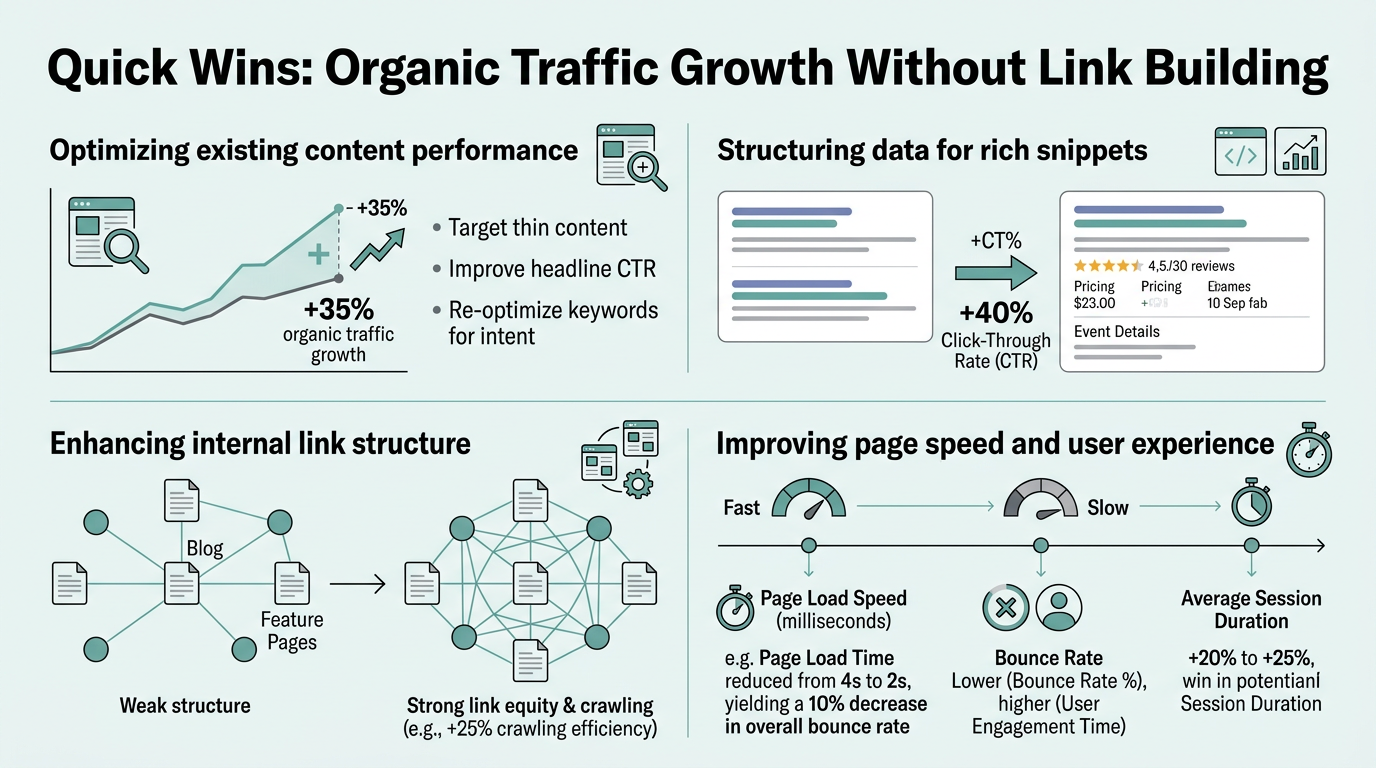
How Can You Fix Technical SEO Issues That Kill Organic Rankings?
Technical SEO is the invisible foundation. Broken crawlability, missing security protocols, and poor URL structure silently suppress traffic. Over 40% of websites have unresolved technical SEO issues that prevent Google from indexing critical content. Start here before optimizing anything else.
Security and HTTPS Implementation
HTTPS isn't optional anymore. Google treats it as a ranking signal, and users avoid sites showing security warnings. If your site isn't HTTPS, you're losing clicks at the door. Every visitor who sees a browser warning will bounce. Implement an SSL/TLS certificate immediately. Most modern hosting providers include this at no cost. The payoff? HTTPS sites see measurable CTR improvements and rank favorably in security-conscious verticals like finance and health.
URL Structure and Crawlability Optimization
URLs are real estate. A clean URL structure tells Google what your content is about before it reads a single word. Use descriptive, keyword-inclusive URLs. Avoid date-stamped structures unless your content is inherently time-sensitive. Example: /how-to-increase-organic-traffic/ beats /blog/2024/12/15/article-123/. Ensure every page has a logical path from the homepage. Use breadcrumb navigation to reduce crawl depth and help both users and search engines understand your site architecture.
Schema Markup for AI and Rich Results
Structured data has shifted from a "nice to have" to critical infrastructure. With 60% of searches now ending in zero-click AI summaries, schema markup helps AI models extract and understand content context. Implement JSON-LD schema for your content type: articles, FAQs, how-tos, product reviews. This directly improves your visibility in AI Overviews. Additionally, schema markup triggers rich result features (star ratings, featured snippets) that increase CTR by up to 42.9%.
What On-Page Content Optimization Actually Drives Ranking Gains?
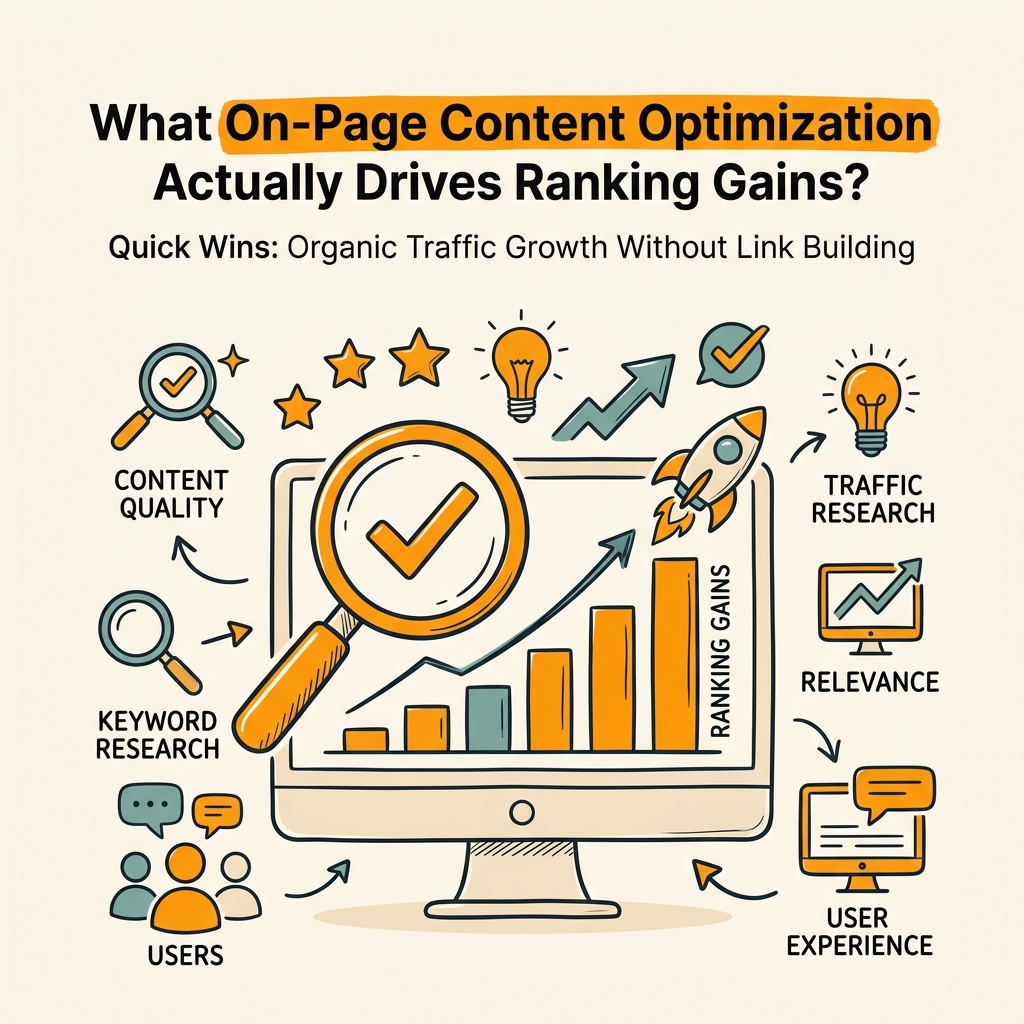
On-page SEO now goes beyond keyword placement. Search engines and AI models both reward content that answers questions directly, structures information clearly, and demonstrates topical authority. Pages with 3–5 relevant internal links rank higher than isolated posts, signaling that you've built knowledge depth around your topic. Let's break down each lever.
Keyword Placement and Semantic Variation
Place your primary keyword in the first 100 words. Include it naturally in your H1 tag, and weave semantic variations throughout the body. But stop forcing exact-match repetition; it reads unnatural and risks penalties. Instead, use LSI keywordsrelated terms that search engines recognize as contextually relevant. Example: if your primary keyword is "organic traffic growth," naturally incorporate variations like "growing organic search traffic," "driving organic visitors," and "organic search strategy." This semantic approach ranks better for the primary keyword while capturing long-tail variations organically.
Heading Structure for AI Extraction
Your heading hierarchy now serves two audiences: human readers and AI summarizers. AI models extract answers from content under H2 and H3 tags, so place your most important claims directly under headings. Use one H1 per page. Break your content into focused H2 sections, each addressing a single concept. Sub-divide with H3s that get granular. This structure makes your content "scannable" for AI systems, improving visibility in zero-click summaries and chat-based interfaces.
Direct Answers and Lead Paragraphs
Open each section with a 40-60 word paragraph that answers the section's implied question. AI engines extract these opening paragraphs as standalone answers. If your critical claim is buried in paragraph 3, it won't be cited. Example: instead of "Let's explore internal linking," write "Internal links signal topical relevance to search engines. Sites using 3–5 internal links per article rank higher than those publishing isolated posts, as internal links map knowledge relationships across your content."
How Does Content Depth Drive Long-Term Organic Growth?
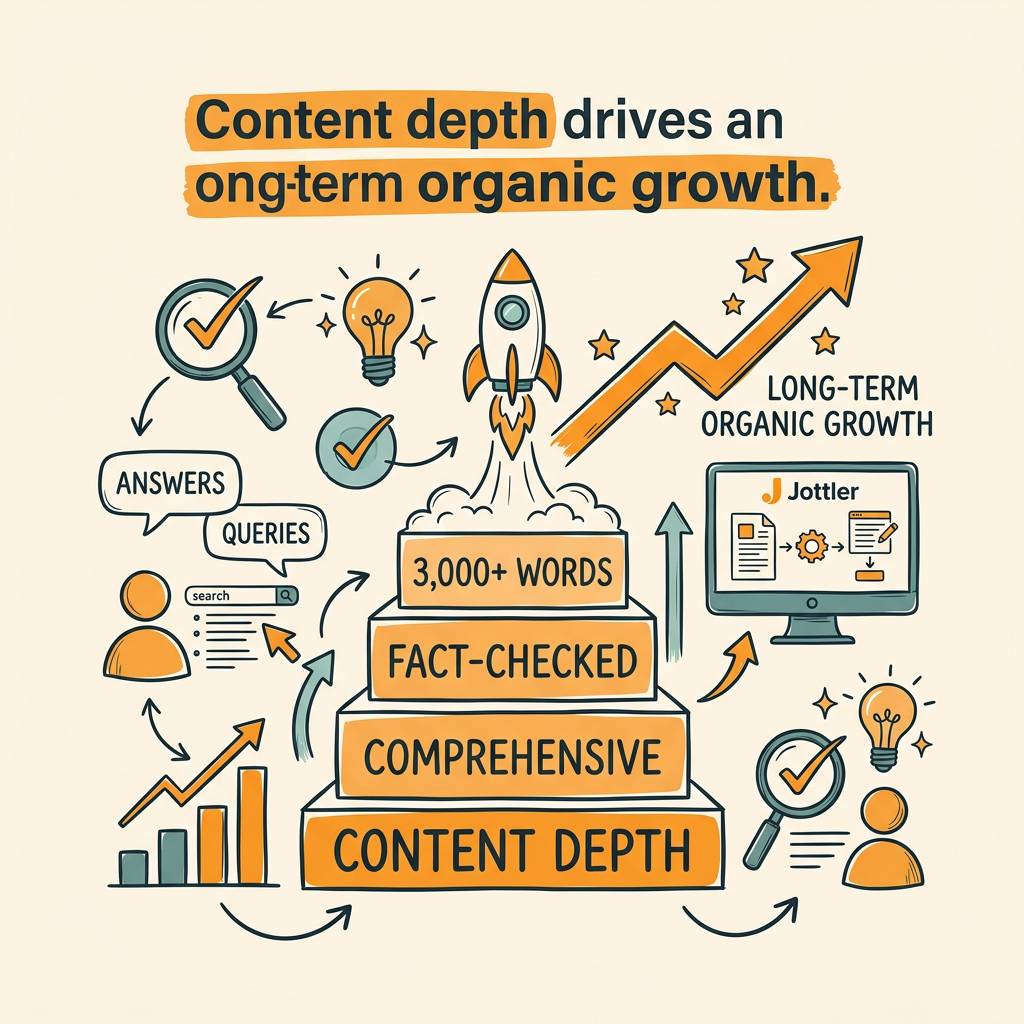
Content exceeding 3,000 words wins 3x more traffic and 3.5x more backlinks naturally than shorter posts. But length alone is worthless. Depth means covering your topic comprehensively, addressing user pain points, and building authority signals that Google recognizes. This approach requires a shift from "one post per topic" to "topic clusters."
Topic Cluster Strategy and Internal Linking
Instead of publishing random blog posts, organize your content into semantic clusters. Create one pillar page that comprehensively covers your main topic (3,000+ words). Then create 4–6 supporting subtopic pages, each exploring a specific angle or question. Link them all together with descriptive anchor text. This architecture signals to Google that you've built genuine expertise around a topic. Each internal link using phrases like "learn how to implement internal linking strategy" or "discover on-page SEO best practices" reinforces relevance and distributes authority throughout your cluster. Teams using automated content systems with topic cluster architecture see exponential traffic growth compared to fragmented approaches.
Adding Expert Authority and Original Data
Depth isn't just word count; it's evidence. Cite recent studies, include expert quotes, and add original insights. If you're citing a statistic, verify it's from 2025 or 2026. Outdated data signals thin research. According to Ahrefs data, the #1 organic result captures an average CTR of 27.6%, significantly outperforming all other positions. Consider creating original research, surveys, or case studies that no competitor has. This original angle drives both direct traffic (people searching for your specific data) and backlinks (competitors wanting to cite your findings). You don't need a massive budgeteven small original surveys or audits add credibility that AI and humans recognize as authoritative.
Visual Content and Media Optimization
Articles with images rank higher and get shared more. But optimize them properly. Convert all images to WebP format and compress themthis single action increases mobile conversion rates by 15%. Add descriptive alt text for every image (it helps accessibility and image search). Use infographics, tables, and charts to break up text and provide quick summaries. Each visual asset should serve a purpose: explaining a concept, showing data, or providing a checklist. Lazy-load images below the fold to improve page speed, a critical ranking factor.
What Quick Technical Wins Improve Rankings Without Content Changes?
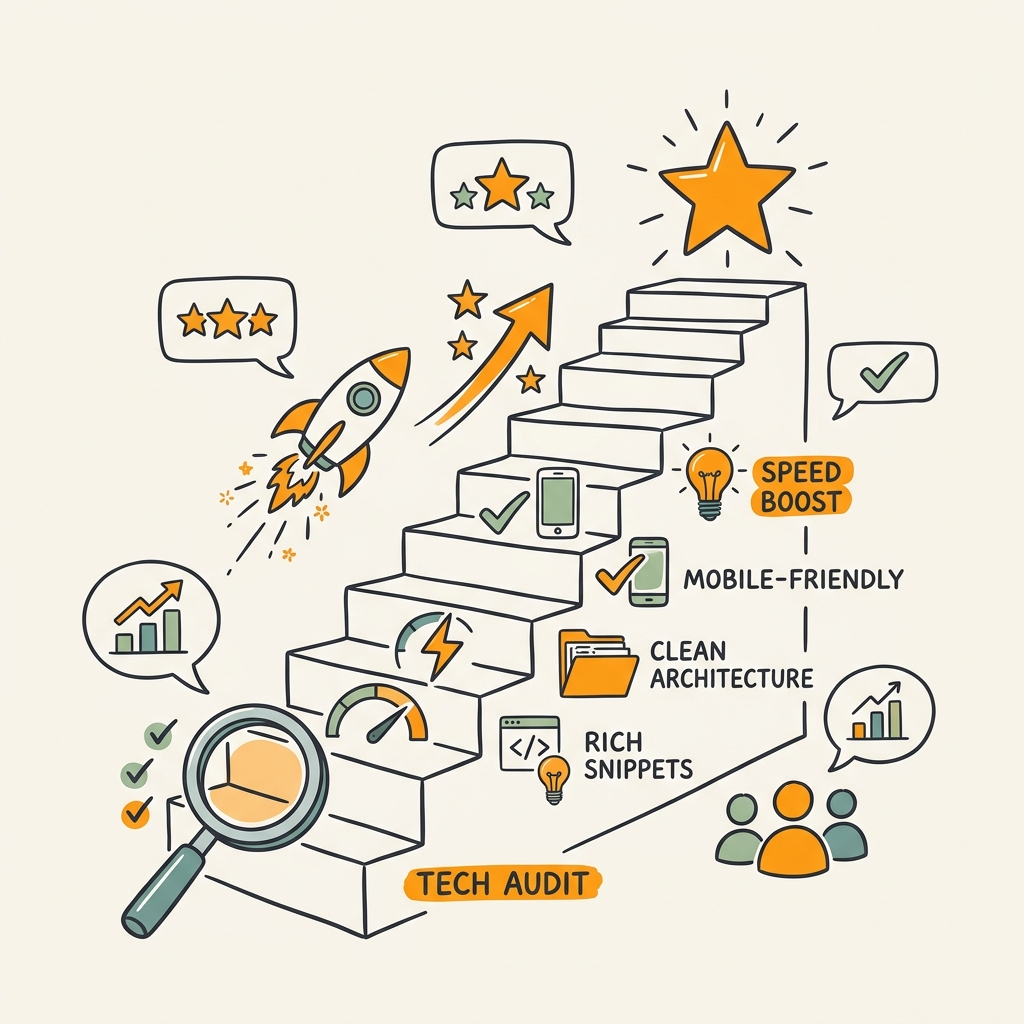
You don't always need new content. Sometimes fixing existing pages or optimizing metadata delivers fast traffic increases. These are low-effort, high-impact actions that compound over time.
Meta Titles and Descriptions for CTR Lift
Your meta title and description are billboard advertisements for your page. Keep titles under 60 characters. Include your primary keyword front-loaded. Make it compelling. Meta descriptions should be 150–155 characters, benefit-focused, and include a call to action when relevant. Moving a single position in search results increases relative CTR by an average of 32.3%. Optimizing meta titles and descriptions won't move you up, but they'll increase clicks from your current position immediately. Review your top 20 pages and rewrite weak descriptions with concrete benefits instead of generic summaries.
Mobile Optimization and Core Web Vitals
Mobile devices drive 63% of all organic traffic. If your site isn't mobile-first, you're blocking the majority of your potential audience. Ensure text is readable without zooming. Use responsive design so content reflows properly on all screen sizes. Server response time should be under 200ms. Largest Contentful Paint (LCP) should be under 2.5 seconds. Cumulative Layout Shift (CLS) should be minimal. These Core Web Vitals are ranking factors. Tools like Google PageSpeed Insights and Lighthouse audit these metrics instantly. Fix critical issues first. Consider enabling GZIP compression, minifying CSS/JavaScript, and using a content delivery network (CDN) for global performance.
Indexation and Crawl Efficiency
Check Google Search Console to see which pages are and aren't being indexed. Look for crawl errors, blocked resources, and indexation issues. If you have 100 pages but Google is only indexing 60, you're losing 40% of your potential traffic. Fix broken internal links. Remove noindex tags from pages you want to rank. Ensure your robots.txt file isn't blocking important pages. Create an XML sitemap and submit it to Google Search Console. These aren't glamorous fixes, but they're foundational. Many sites lose more traffic to indexation problems than any on-page issue.
How Does Internal Linking Architecture Build Topical Authority?
Internal links are the most underutilized ranking lever. They cost nothing, require no outreach, and compound over time. Pages with 3–5 internal links to relevant content rank higher than those with fewer links, as internal links signal topical relevance and help Google crawl deeper into your site structure. This is where busy founders see immediate wins.
Building Contextual Link Clusters
Internal links should always be contextual and descriptive. Avoid generic anchor text like "read more" or "click here." Instead, use specific phrases: "learn the importance of on-page SEO," "discover advanced keyword research tactics," "explore how to create topic clusters." These descriptive anchors tell Google exactly what the linked page is about. When you link from a page on "organic traffic growth" to a related page on "content strategy," use anchor text like "comprehensive content strategy for scaling organic traffic." This approach teaches Google the relationship between your topics and builds internal link networks that outrank fragmented content.
Strategic Anchor Text Variation
Don't link with the same anchor text repeatedly; vary your language naturally. Linking to your homepage 50 times with "organic traffic growth" looks artificial. Instead, use a mix: brand name, topic name, specific phrases, and partial keyword variations. This natural variation maintains trust with search engines while still building topical associations.
Linking from Authority Pages to New Content
Your highest-authority pages (usually your oldest, most-linked articles) distribute ranking power. When you publish new content, prioritize linking to it from these authority pages. This "crawl budget funneling" accelerates ranking for new content. You're not just helping users find related articles; you're strategically distributing your site's authority where it matters most.
What Role Does Consistency and Publishing Frequency Play?
Organic growth is compounding. One article doesn't move the needle. But 20 well-optimized, internally linked articles begin to signal expertise. Publishing frequency matters, but consistency matters more. Sites that publish consistently with topical depth see 200%+ organic growth within 12 months compared to sporadic publishing. The challenge for busy founders is that manual content creation is slow. You can't write a high-quality, 3,000-word article every day while running a business. This is where automation becomes critical. Autonomous SEO agents like Jottler handle the full content pipelineresearch, writing, fact-checking, and publishingenabling founders to publish daily without burning out. The system researches trending keywords, writes SEO-optimized articles with proper internal linking, fact-checks every claim, and publishes directly to your CMS. This removes the bottleneck that prevents most founders from scaling organic traffic. Content systems that combine topic clustering with daily publication schedules create a compounding effect where each new article reinforces topical authority.
Conclusion
Organic traffic growth without link building isn't a myth. It's the default for companies that master the fundamentals: technical SEO, content depth, semantic optimization, and internal linking. You don't need thousands of backlinks. You need 53% of your traffic coming from organic search, and achieving that requires consistent, high-quality content that ranks. The #1 position captures 27.6% CTR; a single ranking position increase lifts clicks by 32.3%. Every section optimized, every internal link added, every article published with topical authority compounds. Start with technical fixes (HTTPS, crawlability, schema). Then build topic clusters with 3,000+ word pillars. Link internally with descriptive anchor text. Publish consistently. The traffic will follow. Start your SEO agent today and let automation handle the content production while you focus on strategy.
FAQs
Can you really grow organic traffic without link building?
Yes. While backlinks remain a ranking factor, on-page optimization, content depth, and technical SEO drive the majority of organic traffic growth for most websites. Studies show that sites ranking in the top 3 for their target keywords often achieve those positions through superior content, internal linking strategy, and user experience rather than sheer backlink volume. Newer domains with minimal backlinks can rank if they publish deep, authoritative content and optimize every on-page element. Focus on the fundamentals firstmost sites leave 50%+ of their organic traffic on the table by ignoring these basics.
How many internal links should each article have?
Aim for 3–5 contextual internal links per article. Each link should be to genuinely related content that benefits the reader. Avoid over-linking; more links don't mean better rankings. Quality matters far more than quantity. Each link should use descriptive anchor text that tells Google exactly what the linked page covers. For a 3,000-word article, 3–5 links feels natural and distributes authority effectively. This approach builds internal link networks across your topic cluster without looking manipulative.
What's the fastest way to see organic traffic gains?
Optimize existing high-traffic pages first. Audit your top 20 pages in Google Analytics. Look for pages with high impressions but low CTR. Rewrite meta titles and descriptions to improve click-through rates. Check that these pages are properly indexed and have no technical issues. Fix mobile usability problems. Add internal links from these authority pages to newer content you want to rank. These quick wins deliver traffic increases within weeks. Then layer in new content with proper on-page optimization and topic clustering for long-term compounding growth.