SaaS Positioning Keywords: Win Market Share
Most SaaS founders spend months perfecting their product only to lose market share to competitors who capture it through smarter keyword strategy. Case studies and thought-leadership content rank as the top performers for B2B SaaS sales conversion, yet 71% of SaaS teams waste budget chasing generic head terms they can't rank for. The real win isn't finding the most searched keyword—it's owning the specific phrase that signals a buyer is ready to switch. Positioning your SaaS through high-intent keywords maps your product directly into the hands of buyers actively researching solutions like yours.
Key Takeaways
- Focus on commercial-intent keywords (alternatives, pricing, comparisons) over generic head terms—they capture ready-to-buy prospects.
- Build keyword strategy around buyer journey stages, not volume alone—category terms, use-case keywords, and competitor comparisons combined win market share.
- Positioning is searchable: map your differentiation to keywords your ICP actually types, then create proof-driven content (case studies, data, integrations).
- AI search visibility is now standard—structure content with clear headings and direct answers so AI systems cite you alongside traditional search rankings.
- High-Intent Keyword Selection: Target commercial-intent phrases where prospects signal readiness to buy, not just traffic volume.
- Buyer-Journey Mapping: Align keyword strategy across awareness, consideration, and decision stages for holistic market capture.
- Competitive Keyword Strategy: Own alternatives, vs., pricing, and review pages to steal consideration-stage share from established competitors.
- Positioning Statement Framework: Create a searchable positioning statement that answers what, for whom, why different, outcome, and timing.
- Proof-Led Content Strategy: Reinforce positioning with case studies, integrations, and original data so content ranks and converts.
- AI Search Optimization: Structure content for both traditional search and AI extraction by using heading hierarchy and direct answers upfront.
How to Build a High-Intent Keyword Strategy for SaaS Positioning
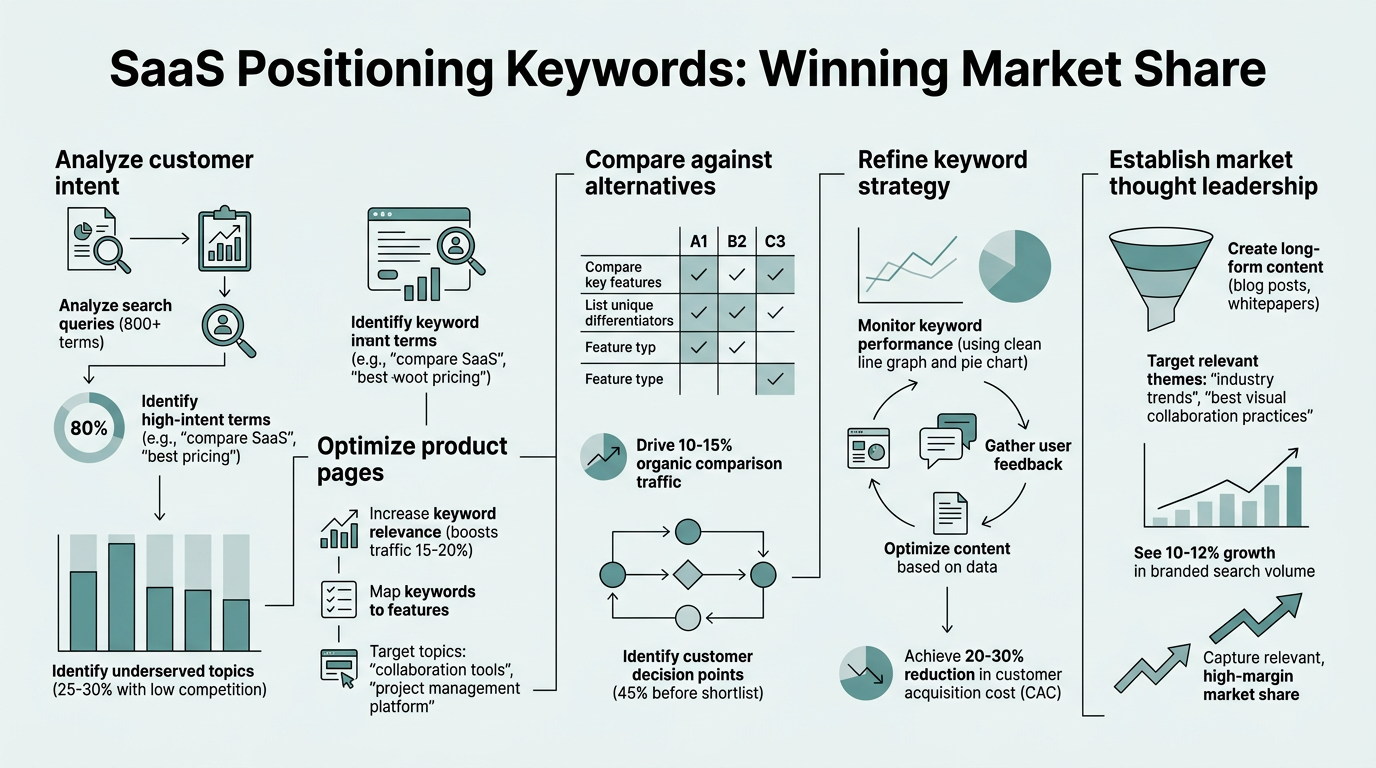
High-intent keywords are the difference between capturing tire-kickers and closing deals. Keywords signaling "ready to buy" intent—alternatives, pricing, reviews, and comparisons—outperform generic terms by 3–5x in conversion rate. Your positioning lives in these keywords. Instead of competing for "project management software," you win with "project management for remote teams" or "alternative to Asana for nonprofits." The specificity is your moat.
"The fastest way to win market share is to own keywords where competitors already rank—especially in the 4–20 position range. These are 'quick wins.' Buyers have already heard of the incumbent and are actively looking for something different."
Define Your Keyword Categories Across the Buyer Journey
Build a keyword taxonomy that mirrors how buyers actually research and decide. Commercial-intent keywords (alternatives, vs., pricing, reviews, best-of) capture the bottom-of-funnel demand where SaaS deals close. Create keyword buckets for each stage:
- Awareness stage: Category terms ("workflow automation," "team collaboration tools") and pain-based keywords ("how to reduce manual work").
- Consideration stage: Comparison keywords ("alternative to Jira," "Notion vs. Monday.com," "best project management for design teams").
- Decision stage: Pricing and proof keywords ("pricing comparison," "customer reviews," integration queries, and success metrics).
Tools like Whitehat SEO emphasize that keyword research now spans both Google and AI search systems—meaning your visibility strategy must account for how Perplexity and ChatGPT extract and cite your content. Positioning is searchable when keywords map directly to your unique value. By focusing on SaaS content marketing built around positioning, you ensure every piece serves your broader market-share strategy.
Target Competitor Keywords and Market Gaps
The fastest way to win market share is to own keywords where competitors already rank—especially in the 4–20 position range. These are "quick wins." Search for "alternative to [competitor]," "[competitor] vs [your product]," and "[competitor] pricing." These queries are warm. Buyers have already heard of the incumbent and are actively looking for something different. Create dedicated pages comparing your solution to named competitors, highlighting your distinct value.
When building competitor-focused content, be specific and honest. Acknowledge the competitor's strengths briefly, then lead with where your product wins for your target buyer. Factors.ai's positioning framework asks: What do you do? For whom? Why are you different? What outcome do you deliver? Why does it matter right now? Let these answers shape your keyword choices.
How SaaS Companies Use Positioning Keywords to Capture Market Share

Positioning isn't a brand exercise—it's a keyword and content strategy. When SaaS teams align their keyword strategy with a clear positioning statement, organic traffic often increases 40–60% within 6 months because content becomes laser-focused on buyer intent. Winning market share means moving buyers from awareness (generic searches) to decision (specific, competitor-aware searches).
"When your positioning is searchable—meaning it maps directly to the keywords your ideal customers type—your content targets the right intent from day one. You waste less effort on irrelevant traffic and see higher conversion rates."
Map Positioning to Searchable Keywords
A strong positioning statement answers five questions. Each answer should map to a keyword cluster:
- What we do: "Workflow automation for non-technical teams" → Keywords: "easy workflow automation," "no-code workflow automation"
- For whom: "Mid-market financial services" → Keywords: "workflow automation for finance teams," "finance workflow automation"
- Why different: "No implementation required, runs in 5 minutes" → Keywords: "quick workflow setup," "fastest workflow automation setup"
- Outcome: "Save 20 hours per month per team member" → Keywords: "workflow automation ROI," "time savings from workflow automation"
- Urgency: "Compliance deadlines drive adoption" → Keywords: "workflow automation compliance," "SOC 2 workflow automation"
Each keyword cluster becomes a pillar page or content series. According to Position Digital, case studies and proprietary research are the highest-converting content formats for B2B SaaS demand generation. Pair your positioning keywords with proof: customer ROI data, case studies by industry, implementation guides, and integration documentation. This combination signals authority to both search engines and AI systems.
Build Pillar-and-Cluster Content Around Positioning Keywords
Structure your content strategy around topical authority. Create a pillar page that broadly covers your main positioning keyword (e.g., "Workflow Automation for Finance"). Then create supporting cluster pages that dive into use cases, industries, and comparisons. Link them together to reinforce relevance for both search algorithms and AI-extraction models.
A pillar-cluster structure serves two masters: search engines reward the coherence and topical depth, and AI systems find it easier to extract and cite your content when it's organized hierarchically. Use descriptive headings, answer the query early in each section, and include original data or case studies to differentiate your content from competitors. When you're building this at scale, tools that automate content creation and internal linking—like AI-powered SEO content generators—help ensure consistency and speed.
Content Strategy to Reinforce Positioning Keywords
Content type matters enormously in SaaS positioning. Competitors often create generic "how-to" content that ranks nowhere because it doesn't address a specific positioning angle. Your content should prove your positioning, not just explain it.
Create High-Converting Page Types for Each Positioning Keyword
Different keyword intents demand different content structures. Tailor your content to match the query type:
| Keyword Type | Example Keyword | Best Content Format | Positioning Angle |
|---|---|---|---|
| Category / Awareness | "Workflow automation benefits" | Educational guide with use cases | Define the category; position your approach as the modern way |
| Problem + Solution | "Manual approval process causing delays" | Solution-focused case study | Show specific ROI; benchmark against status quo |
| Alternatives / Competitor | "Alternative to Zapier" | Comparison table + tradeoff analysis | Acknowledge competitor strengths; highlight your differentiation |
| Pricing / ROI | "Workflow automation cost savings" | Pricing page + ROI calculator + case studies | Prove economic value; show how your model works for their budget |
| Industry-Specific | "Workflow automation for financial services" | Industry guide + compliance-focused case study | Show you understand their world; prove you've solved for their constraints |
Each page type reinforces your positioning. Awareness content frames the category in your terms. Decision-stage content proves you deliver on your promises. Together, they create a cohesive narrative that wins market share. The discipline of aligning content type to keyword intent ensures nothing is wasted.
Use Proprietary Data and Case Studies as Positioning Proof
Positioning claims without proof are marketing noise. Support your positioning keywords with original research. If you claim "fastest implementation," show average time-to-value. If you claim "best for finance," publish case studies from named finance customers with specific metrics. If you position on compliance, share a detailed guide on how your product handles regulated workflows.
Case studies are the strongest content format for SaaS demand because they prove positioning with real outcomes. Structure them around your keywords: a case study titled "How [Company] Reduced Invoice Processing Time by 75% with Workflow Automation" directly targets the keyword "workflow automation for accounting." The specificity signals to both search engines and buyers that you understand their problem.
How to Optimize Your Content for AI Search and Traditional SEO
SaaS positioning in 2026 requires visibility in both traditional search and AI answer engines. AI search systems like Perplexity and ChatGPT now influence how prospects research SaaS solutions, and your content must be structured to be extracted and cited. The good news: optimizing for AI and traditional SEO uses the same playbook—clear structure, direct answers, and proof.
Structure Content for AI Extraction and Citation
AI systems extract answers from clearly structured content. Answer the query in the first 60 words of each section. Use descriptive heading hierarchy (h2, h3, h4) so AI can understand your content structure. Include original statistics, data, and insights that AI systems want to cite—generic advice gets filtered out.
This approach mirrors how SeoProfy's 2026 SaaS statistics are organized: specific data points, sourced claims, and actionable insights. When your content is easy to extract, it gets cited more often—in AI overviews, in ChatGPT summaries, and in traditional search results. This visibility compounds your market share wins.
Link Positioning Keywords Together Across Your Site
Internal linking reinforces your positioning. Link from your awareness-stage content to decision-stage content, and vice versa. If you write about "workflow automation benefits," link to your "alternative to Zapier" comparison page. This creates a web of positioning keywords that Google (and AI systems) recognize as comprehensive topical authority. Discover how SaaS SEO strategy scales without burnout when internal linking is automated rather than manual.
When building a content engine to support positioning keywords, consistency matters. Tools that handle both research and internal linking ensure your positioning is reinforced across every piece of content published. Manual linking across dozens of articles is error-prone and time-consuming. Automated systems compound the effect of your positioning strategy by ensuring every new article is linked to relevant existing content, building topical authority faster.
Common Positioning Keyword Mistakes and How to Avoid Them
SaaS teams often sabotage their positioning keyword strategy without realizing it. Avoiding these mistakes can save months of wasted effort.
Chasing Volume Over Intent
The most common mistake is building keyword strategy entirely around search volume. "Project management software" gets 50,000 searches per month and looks attractive—until you realize it costs $500+ per click in ads and ranks for companies with 100+ person teams working on positioning for 18+ months. Your smaller team won't move the needle targeting it.
Instead, target long-tail, high-intent keywords where search volume is lower (1,000–5,000 searches per month) but conversion intent is higher. "Project management for nonprofit teams" has 800 monthly searches and less competition. Prospects using that search are 10–15x more likely to evaluate a solution like yours and upgrade.
Ignoring Your Actual Positioning When Choosing Keywords
It's tempting to target keywords that sound good even if they don't align with your positioning. A project management tool that positions on simplicity might chase the keyword "enterprise project management software" because the volume is high. Wrong move. That keyword attracts prospects looking for complexity and feature richness—the opposite of your positioning. The mismatch leads to high bounce rates, low conversions, and wasted content effort.
Choose keywords that match your positioning. If you position on "simplicity and speed," chase keywords that signal the same value: "fastest project setup," "easiest project management," "project management without the learning curve."
Not Testing and Iterating Your Positioning Keywords
Positioning isn't set-it-and-forget-it. Monitor which keywords drive the highest-quality traffic, which convert best, and which are gaining or losing search volume. Revisit your keyword strategy quarterly. As your product evolves and the market changes, positioning often needs refinement. If you discover that "workflow automation for agencies" converts better than your original "workflow automation for enterprises," shift resources accordingly.
Conclusion
SaaS positioning keywords are the bridge between your differentiation and your market. When you align keyword strategy with a clear positioning statement—answering what you do, for whom, why you're different, what outcome you deliver, and why it matters now—you create a searchable advantage that competitors can't easily replicate. Teams that focus on commercial-intent keywords and proof-driven content see 40–60% organic traffic growth within 6 months. The key is specificity: abandon generic head terms, target buyer-journey stages, own competitor comparison pages, and reinforce your positioning with case studies and original data. Build your keyword strategy around the actual searches your ideal customers type, structure content for both traditional search and AI extraction, and let your positioning compound as your content hub grows. Start by auditing your current keyword strategy against your positioning statement. Where are you losing opportunities? Where can you own a specific keyword better than competitors? Those gaps are your market share wins waiting to happen. Ready to scale your SaaS positioning through consistent, high-quality content? Start your SEO agent today and let AI handle the research, writing, and linking while you focus on strategy.
FAQs
What are the best keywords to target for SaaS companies?
The best SaaS keywords target commercial intent and buyer journey stage rather than raw search volume. Focus on long-tail, problem-plus-solution keywords like "project management for remote teams" or "invoice automation for agencies" that signal a prospect is researching solutions. Include alternatives ("alternative to Asana"), comparison ("Notion vs. Monday.com"), pricing, and review keywords in your strategy because these capture buyers closest to purchase. Avoid generic head terms like "project management software" unless you have the resources and authority to compete for them—they attract broad, low-intent traffic. Prioritize keywords where you can credibly position as differentiated; specificity is your competitive advantage.
How do I create a positioning statement that works for keyword strategy?
A searchable positioning statement answers five core questions, each mapping to keyword clusters. Start with: (1) What do you do? (2) For whom? (3) Why are you different? (4) What outcome do you deliver? (5) Why does it matter right now? For example: "Workflow automation (what) for mid-market finance teams (for whom) that requires zero implementation and runs in minutes (why different) so they can save 15+ hours per month (outcome) and meet compliance deadlines faster (why now)." Each answer becomes a keyword cluster. "Zero-implementation workflow automation," "5-minute workflow setup," "workflow automation for finance compliance"—these become your content topics. The discipline of writing a positioning statement forces you to think like a searcher, ensuring your keyword strategy is rooted in real buyer needs and language.
Does positioning help with organic traffic growth in SaaS?
Yes, substantially. Clear positioning is the foundation of effective keyword strategy, and keyword strategy drives organic growth. When your positioning is searchable—meaning it maps directly to the keywords your ideal customers type—your content targets the right intent from day one. You waste less effort on irrelevant traffic and see higher conversion rates. Teams with clear, searchable positioning typically see significant organic traffic growth within 6 months because every piece of content reinforces a cohesive narrative rather than scattered messaging. The compounding effect happens when multiple pages support the same positioning theme: awareness content introduces the category, comparison pages win consideration-stage searchers, and case studies seal decision-stage buyers. Positioning creates coherence. Coherence builds topical authority. Authority drives rankings and market share.